Overview
Superposition is a fundamental principle in Physics that describes how two or more waves interact when they occupy the same space at the same time. When waves meet, they combine according to the principle of superposition: the resulting displacement at any point is simply the algebraic sum of the individual displacements from each wave. This seemingly simple concept underlies a vast array of physical phenomena, from the formation of standing waves on a guitar string to the complex interference patterns observed in light and sound experiments.
For the MCAT, understanding Superposition Physics is essential because it forms the theoretical foundation for numerous testable phenomena within the Waves and Sound unit. The exam frequently presents scenarios involving wave interference, beat frequencies, standing waves, and resonance—all of which depend directly on superposition principles. Questions may appear as discrete items testing conceptual understanding or embedded within passages describing acoustic phenomena, musical instruments, or optical interference experiments. The MCAT expects students not only to recognize when superposition is occurring but also to predict the outcomes of wave interactions and interpret graphical representations of combined waveforms.
The principle of superposition connects intimately with other core physics concepts tested on the MCAT. It serves as the bridge between basic wave properties (amplitude, frequency, wavelength) and more complex phenomena like constructive and destructive interference. Understanding superposition enables students to grasp standing wave formation, resonance in closed and open tubes, beat frequency generation, and even provides conceptual groundwork for understanding quantum mechanical wave functions. Mastery of Superposition MCAT content ensures students can confidently approach any question involving multiple waves or oscillations interacting simultaneously.
Learning Objectives
- [ ] Define Superposition using accurate Physics terminology
- [ ] Explain why Superposition matters for the MCAT
- [ ] Apply Superposition to exam-style questions
- [ ] Identify common mistakes related to Superposition
- [ ] Connect Superposition to related Physics concepts
- [ ] Calculate the resultant amplitude when two or more waves combine at a specific point in space and time
- [ ] Distinguish between constructive and destructive interference patterns and predict their locations
- [ ] Analyze standing wave patterns and determine node and antinode positions using superposition principles
Prerequisites
- Wave properties (amplitude, frequency, wavelength, period): Understanding these fundamental characteristics is essential because superposition involves adding wave displacements, which directly affects amplitude while preserving frequency.
- Wave equation and wave speed: The relationship v = fλ is necessary to determine phase relationships between waves, which determines whether interference is constructive or destructive.
- Trigonometric functions (sine and cosine): Waves are mathematically represented using sinusoidal functions, and superposition requires adding these functions algebraically.
- Vector addition and algebraic summation: Superposition is fundamentally an addition process, requiring comfort with combining positive and negative values.
- Phase and phase difference: Understanding what phase means and how phase differences arise is critical for predicting interference patterns.
Why This Topic Matters
Clinical and Real-World Significance: Superposition principles underlie numerous medical technologies and diagnostic tools. Ultrasound imaging relies on interference patterns created when sound waves reflect from tissue boundaries and superpose with incident waves. Noise-canceling headphones use destructive interference—a direct application of superposition—to reduce ambient sound. In cardiology, heart sounds represent the superposition of multiple vibrations from valve closures and blood flow. Understanding how waves combine helps medical professionals interpret complex acoustic signals and optimize imaging techniques.
Exam Statistics: Superposition appears in approximately 2-4 questions per MCAT administration, either as discrete questions or embedded within passages. The topic most commonly appears in the Chemical and Physical Foundations of Biological Systems section, though it occasionally surfaces in passages describing sensory physiology (hearing) in the Biological and Biochemical Foundations section. Questions typically test conceptual understanding rather than complex calculations, focusing on interference patterns, standing waves, and beat frequencies.
Common Exam Presentations: The MCAT presents superposition through several recurring scenarios: (1) passages describing musical instruments or acoustic resonance chambers, requiring students to identify standing wave patterns; (2) questions showing graphical representations of two waves and asking students to sketch or identify the resultant wave; (3) problems involving beat frequencies when two similar frequencies combine; (4) experimental passages describing interference experiments with sound or light; (5) questions about noise reduction or signal enhancement technologies. Recognizing these contexts allows students to quickly activate their superposition knowledge during the exam.
Core Concepts
The Principle of Superposition
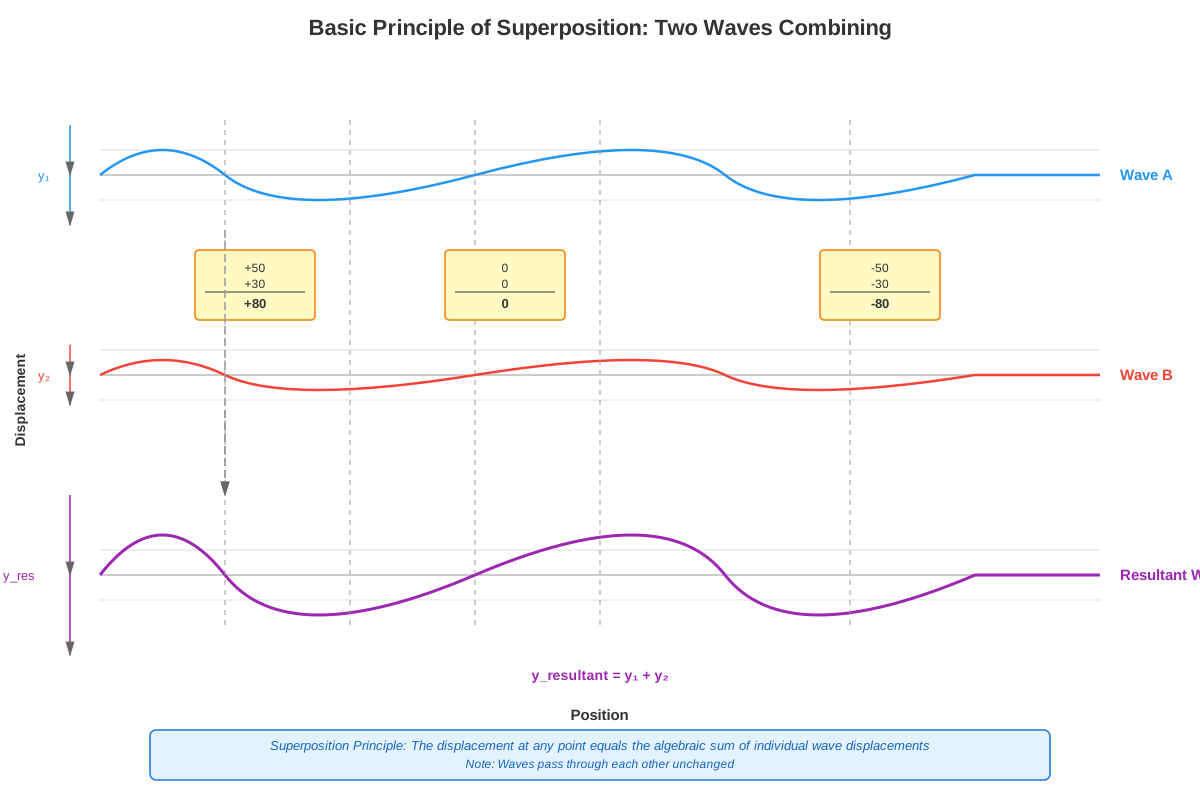
The principle of superposition states that when two or more waves overlap in space, the resultant displacement at any point equals the algebraic sum of the individual displacements from each wave at that point. Mathematically, if wave 1 produces displacement y₁ and wave 2 produces displacement y₂ at the same location and time, the total displacement y_total is:
y_total = y₁ + y₂This principle applies to all types of waves—mechanical waves (sound, water, seismic), electromagnetic waves (light, radio), and even quantum mechanical wave functions. The superposition principle holds true only for linear systems, where the medium's response is proportional to the disturbance. For the MCAT, students can assume linearity unless explicitly told otherwise.
The algebraic nature of superposition is crucial: displacements can be positive or negative relative to equilibrium. When a wave crest (positive displacement) meets another crest, they add to create a larger positive displacement. When a crest meets a trough (negative displacement), they partially or completely cancel. This simple addition rule generates all interference phenomena.
Constructive Interference
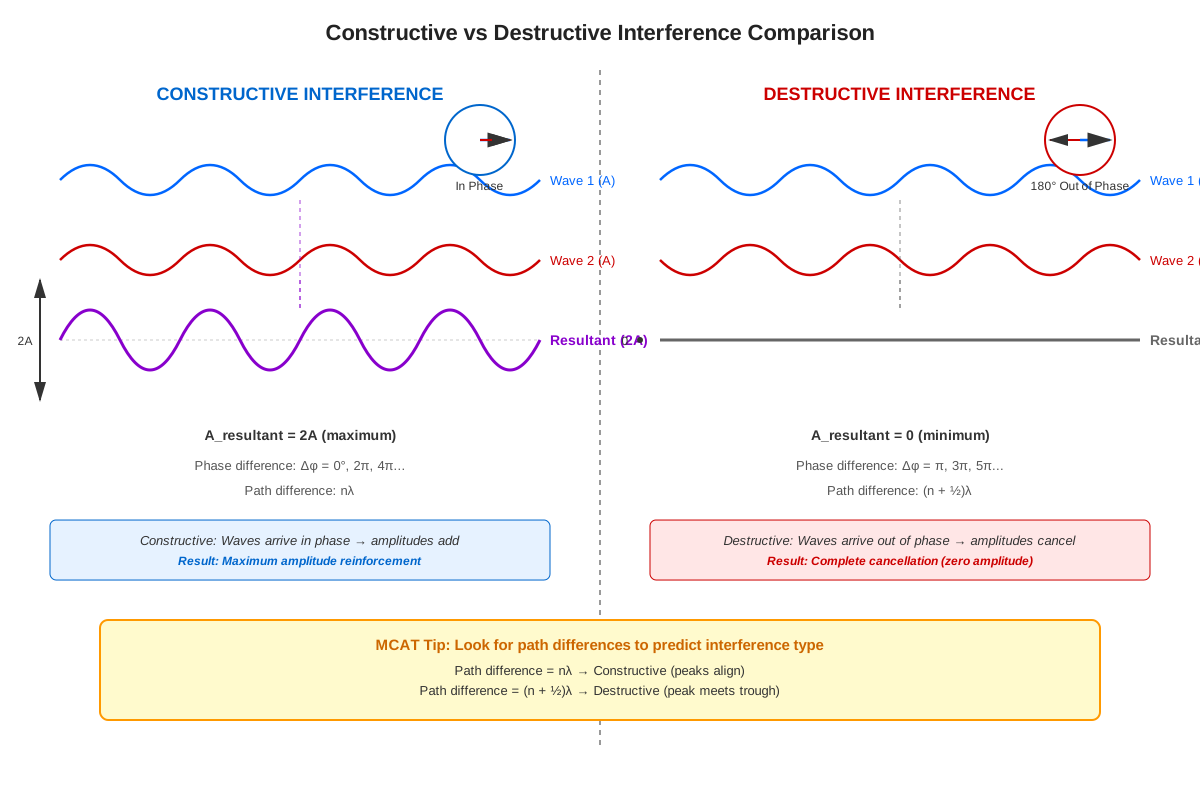
Constructive interference occurs when waves combine to produce a resultant wave with amplitude greater than either individual wave. This happens when waves meet in phase—meaning their crests align with crests and troughs align with troughs. The condition for constructive interference is that the path difference between the two waves equals an integer multiple of the wavelength:
Path difference = nλ (where n = 0, 1, 2, 3, ...)Equivalently, the phase difference must be an integer multiple of 2π radians (or 360°):
Phase difference = 2πn (where n = 0, 1, 2, 3, ...)When two identical waves (same amplitude A and frequency) interfere constructively, the resultant amplitude is 2A. The intensity, which is proportional to amplitude squared, becomes four times greater (I ∝ A²). This amplification effect is why constructive interference creates bright fringes in light interference patterns and loud regions in sound interference patterns.
Destructive Interference
Destructive interference occurs when waves combine to produce a resultant wave with amplitude smaller than at least one individual wave. Complete destructive interference—where waves perfectly cancel—happens when waves meet exactly out of phase (180° or π radians apart). The condition for destructive interference is:
Path difference = (n + 1/2)λ (where n = 0, 1, 2, 3, ...)Or in terms of phase:
Phase difference = (2n + 1)π (where n = 0, 1, 2, 3, ...)When two identical waves interfere destructively, they completely cancel, producing zero displacement. This creates dark fringes in light interference patterns and quiet regions (nodes) in sound interference patterns. Partial destructive interference occurs when waves are neither perfectly in phase nor perfectly out of phase, resulting in intermediate amplitudes.
Standing Waves
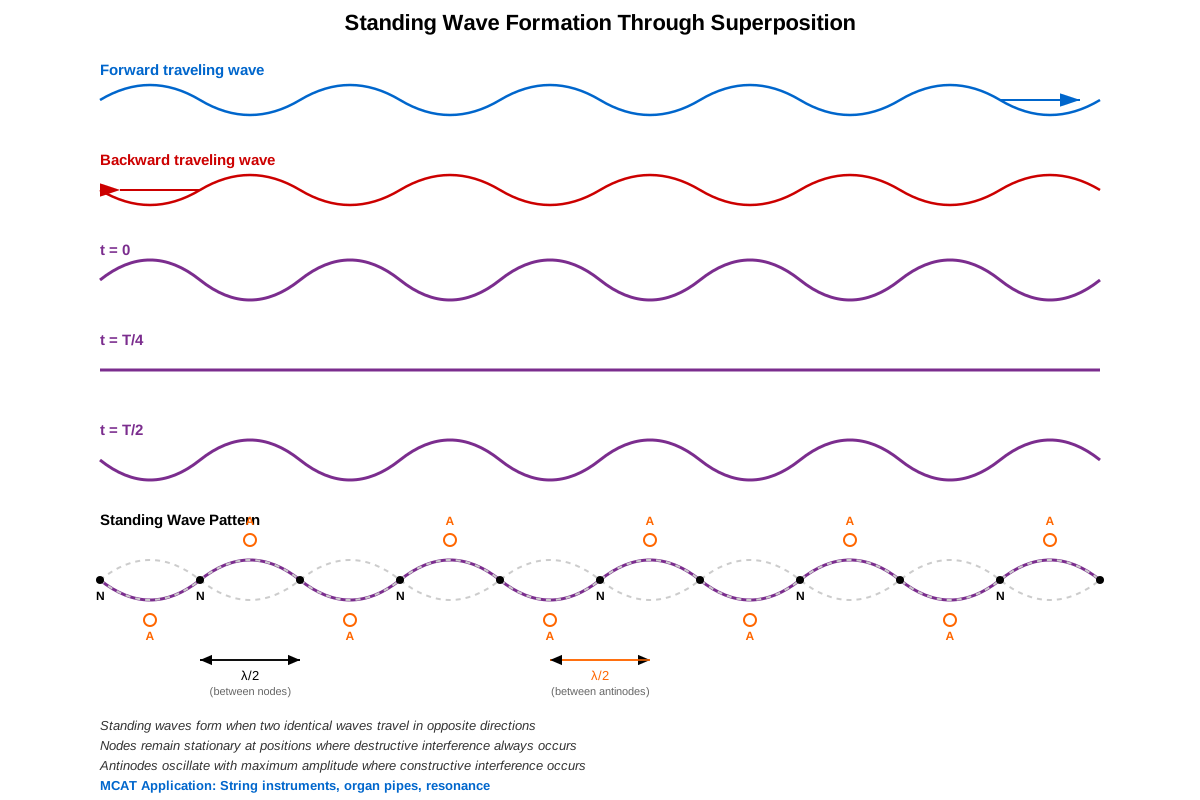
Standing waves represent a special case of superposition where two waves of equal frequency and amplitude travel in opposite directions through the same medium. Unlike traveling waves that transport energy, standing waves appear stationary, with fixed points of zero displacement (nodes) and maximum displacement (antinodes).
Standing waves form when a wave reflects back on itself, such as on a string fixed at both ends or in an air column. The incident and reflected waves superpose continuously, creating a stable pattern. The distance between adjacent nodes (or adjacent antinodes) is λ/2, where λ is the wavelength.
For a string of length L fixed at both ends, standing waves form only at specific resonant frequencies where the string length equals an integer multiple of half-wavelengths:
L = n(λ/2) (where n = 1, 2, 3, ...)This constraint means only certain frequencies can produce standing waves—these are the harmonics or normal modes of the system. The fundamental frequency (first harmonic, n=1) has the longest wavelength (λ = 2L) and lowest frequency. Higher harmonics have proportionally higher frequencies.
Beat Frequency
When two waves of slightly different frequencies (f₁ and f₂) superpose, they create a phenomenon called beats—a periodic variation in amplitude that listeners perceive as a pulsing or throbbing sound. The beat frequency equals the absolute difference between the two frequencies:
f_beat = |f₁ - f₂|Beats occur because the two waves alternately drift in and out of phase. When momentarily in phase, constructive interference creates loud moments; when out of phase, destructive interference creates quiet moments. Musicians use beats to tune instruments: when two strings produce audible beats, they're slightly out of tune; when beats disappear, the strings match frequency.
The MCAT may present beat frequency problems asking students to identify the frequency of an unknown source when beats are heard with a known reference frequency. If a 440 Hz tuning fork produces 3 beats per second with an unknown source, that source must be either 437 Hz or 443 Hz.
Interference Patterns in Space
When two coherent sources (sources with constant phase relationship) emit waves, they create spatial interference patterns with alternating regions of constructive and destructive interference. The classic example is two speakers emitting sound of the same frequency. At points where the path difference from the two sources equals nλ, constructive interference creates loud regions. Where the path difference equals (n + 1/2)λ, destructive interference creates quiet regions.
The geometry of these patterns depends on the wavelength and source separation. Longer wavelengths create more widely spaced interference fringes. This principle applies to sound waves, water waves, and light waves (though light requires special conditions to observe interference due to its short wavelength and the need for coherent sources).
| Interference Type | Phase Relationship | Path Difference | Amplitude Result | Intensity Result |
|---|---|---|---|---|
| Constructive | In phase (0°, 360°) | nλ | Maximum (2A for identical waves) | Maximum (4I for identical waves) |
| Destructive | Out of phase (180°) | (n + 1/2)λ | Minimum (0 for identical waves) | Minimum (0 for identical waves) |
| Intermediate | Partial phase difference | Between above values | Between minimum and maximum | Between minimum and maximum |
Concept Relationships
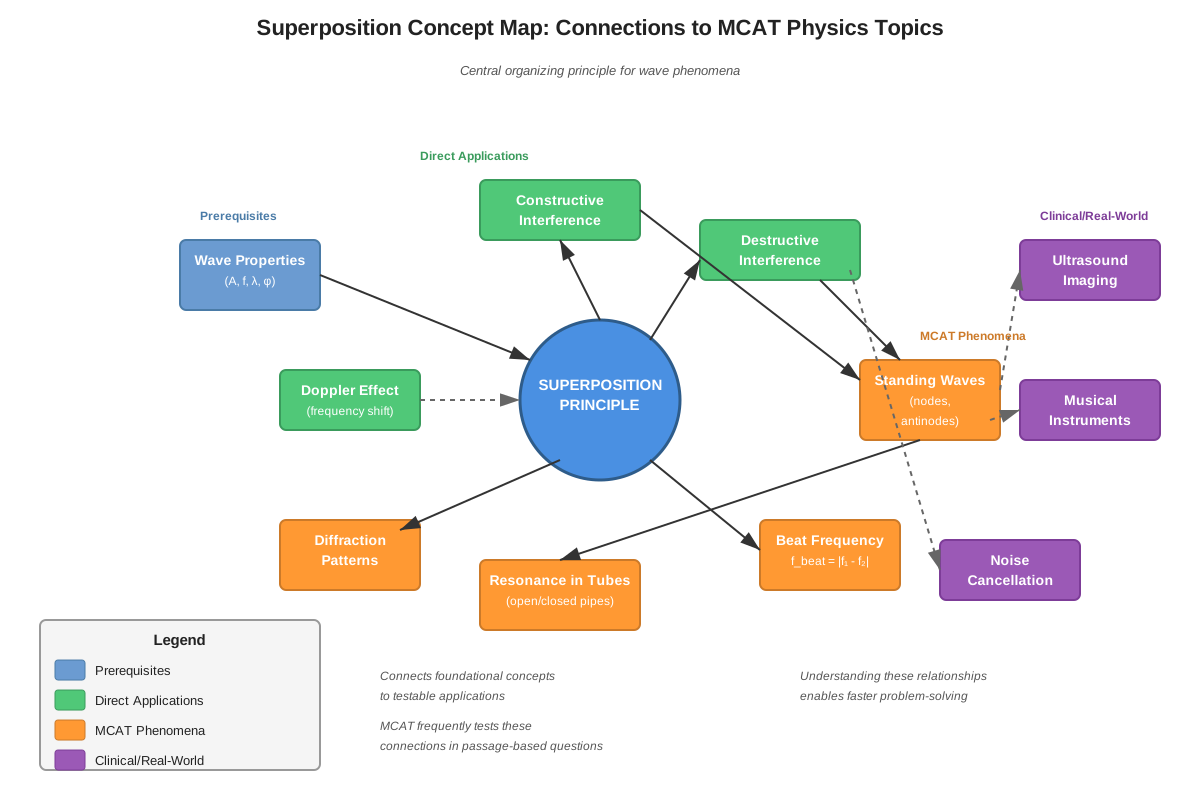
The principle of superposition serves as the foundational concept from which all other interference phenomena derive. Superposition → enables → Constructive and Destructive Interference, which are simply special cases of wave addition where waves are perfectly in phase or perfectly out of phase, respectively.
Constructive and Destructive Interference → combine to create → Standing Waves. Standing waves represent the continuous superposition of incident and reflected waves, with nodes forming at locations of permanent destructive interference and antinodes at locations of permanent constructive interference.
Standing Waves → determine → Resonance and Harmonics. The boundary conditions of a system (fixed ends, open ends, closed ends) constrain which standing wave patterns can form, establishing the resonant frequencies. This connects superposition to the broader topic of resonance in mechanical systems.
Superposition of slightly different frequencies → produces → Beat Frequency. This represents a temporal interference pattern rather than a spatial one, where the interference alternates between constructive and destructive over time rather than over space.
All these concepts connect back to prerequisite knowledge of basic wave properties. The wavelength determines the spacing of interference patterns; frequency determines beat frequencies and resonant modes; amplitude determines the intensity of constructive interference; phase determines whether interference is constructive or destructive.
Looking forward, superposition concepts enable understanding of more advanced topics: Doppler effect (which can create beat frequencies when sources move), diffraction (which involves superposition of wavelets), and even quantum mechanics (where probability amplitudes superpose). The mathematical and conceptual framework developed here applies across multiple physics domains.
High-Yield Facts
⭐ The principle of superposition states that the total displacement equals the algebraic sum of individual wave displacements at any point in space and time.
⭐ Constructive interference occurs when the path difference equals nλ (n = 0, 1, 2, ...), producing maximum amplitude.
⭐ Destructive interference occurs when the path difference equals (n + 1/2)λ, producing minimum amplitude or complete cancellation.
⭐ Beat frequency equals the absolute difference between two interfering frequencies: f_beat = |f₁ - f₂|.
⭐ Standing waves have nodes (zero displacement) separated by λ/2 and antinodes (maximum displacement) also separated by λ/2.
- For a string fixed at both ends, the resonant wavelengths satisfy L = n(λ/2), where n is a positive integer.
- When two identical waves interfere constructively, the resultant amplitude doubles (2A) and intensity quadruples (4I).
- Complete destructive interference requires waves of equal amplitude and opposite phase (180° difference).
- The distance between adjacent nodes or adjacent antinodes in a standing wave is always half a wavelength.
- Superposition applies to all wave types: mechanical, electromagnetic, and quantum mechanical waves.
- In phase means crests align with crests (phase difference = 0°, 360°, 720°, etc.).
- Out of phase means crests align with troughs (phase difference = 180°, 540°, etc.).
- The fundamental frequency (first harmonic) has the longest wavelength that fits the boundary conditions.
- Higher harmonics have frequencies that are integer multiples of the fundamental frequency.
- Interference patterns require coherent sources (constant phase relationship between sources).
Quick check — test yourself on Superposition so far.
Try Flashcards →Common Misconceptions
Misconception: Superposition only applies to waves traveling in the same direction.
Correction: Superposition applies whenever waves occupy the same space, regardless of their direction of travel. Standing waves specifically result from superposition of waves traveling in opposite directions.
Misconception: Destructive interference destroys wave energy.
Correction: Energy is conserved during interference. In destructive interference, energy is redistributed to other locations where constructive interference occurs. The total energy remains constant; it's just relocated in space.
Misconception: Waves must have the same frequency to superpose.
Correction: Any waves can superpose regardless of their frequencies. However, stable interference patterns (like standing waves) require identical or very similar frequencies. Different frequencies produce time-varying interference patterns, such as beats.
Misconception: The amplitude of constructive interference always equals the sum of individual amplitudes.
Correction: The amplitude equals the sum only when waves are perfectly in phase. For partial constructive interference (phase difference between 0° and 180°), the resultant amplitude is less than the arithmetic sum but greater than the difference of the amplitudes.
Misconception: Nodes in standing waves are locations where waves don't exist.
Correction: Nodes are locations where waves continuously interfere destructively. Both the incident and reflected waves are present at nodes, but they always have opposite displacements that cancel. The waves exist there; they just produce zero net displacement.
Misconception: Beat frequency can be higher than either of the two interfering frequencies.
Correction: Beat frequency always equals the difference between the two frequencies, so it must be smaller than the higher frequency. If you hear 5 beats per second from 440 Hz and 445 Hz sources, the beat frequency is 5 Hz, not 885 Hz.
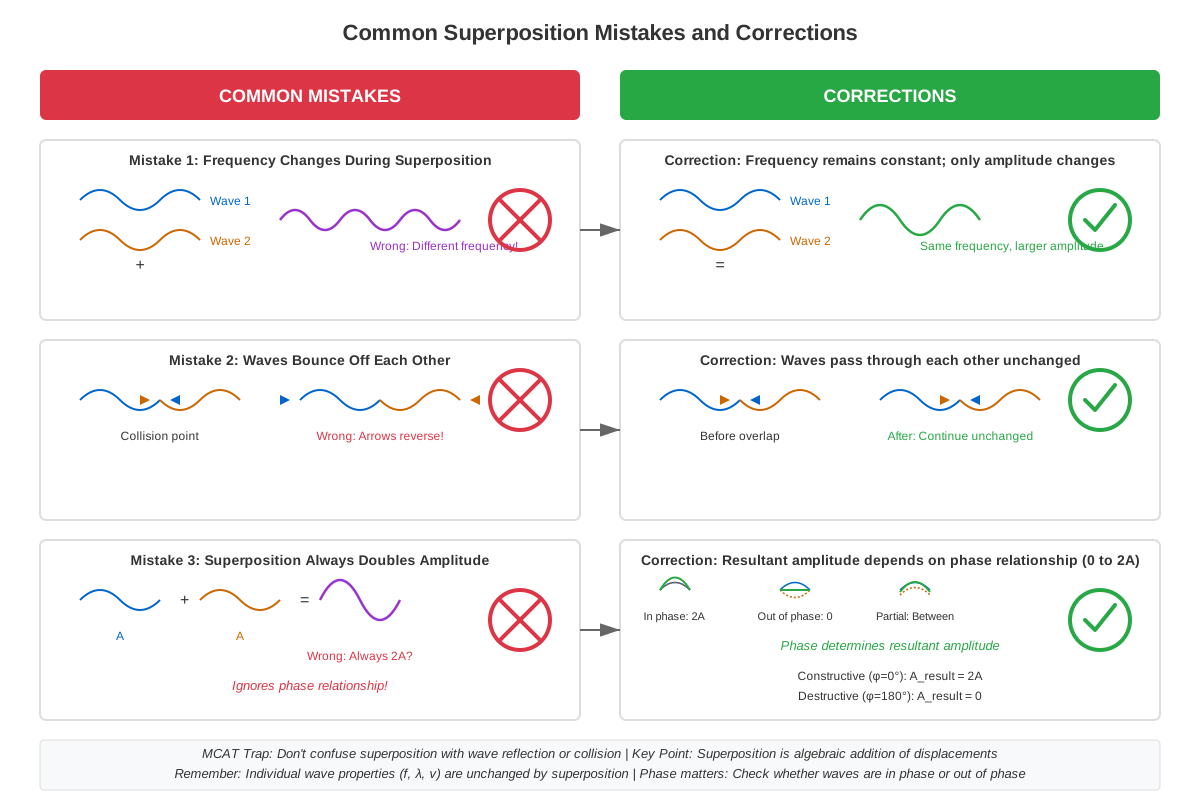
Misconception: Superposition changes the individual waves.
Correction: Superposition is a linear addition process that creates a resultant wave, but the individual waves pass through each other unchanged. After overlapping, each wave continues with its original amplitude, frequency, and wavelength.
Misconception: Standing waves transport energy like traveling waves.
Correction: Standing waves do not transport energy along the medium. Energy oscillates between kinetic and potential forms at fixed locations. This is why they're called "standing"—the pattern doesn't move.
Worked Examples
Example 1: Identifying Resultant Wave from Superposition
Problem: Two waves traveling along the same string are described by the equations y₁ = 0.05 sin(2πx - 10πt) and y₂ = 0.05 sin(2πx - 10πt + π), where distances are in meters and time in seconds. What is the resultant wave?
Solution:
Step 1: Identify the wave parameters. Both waves have the same amplitude (A = 0.05 m), the same wave number (k = 2π rad/m), and the same angular frequency (ω = 10π rad/s). The second wave has an additional phase term of π radians.
Step 2: Recognize the phase relationship. A phase difference of π radians equals 180°, meaning these waves are exactly out of phase. When one wave has a crest, the other has a trough of equal magnitude.
Step 3: Apply superposition. The resultant displacement is:
y_total = y₁ + y₂
y_total = 0.05 sin(2πx - 10πt) + 0.05 sin(2πx - 10πt + π)
Step 4: Use the trigonometric identity sin(θ + π) = -sin(θ):
y_total = 0.05 sin(2πx - 10πt) + 0.05[-sin(2πx - 10πt)]
y_total = 0.05 sin(2πx - 10πt) - 0.05 sin(2πx - 10πt)
y_total = 0Answer: The resultant wave has zero displacement at all points and all times. This is complete destructive interference. The two waves perfectly cancel each other.
Connection to Learning Objectives: This example demonstrates applying superposition to calculate resultant waves and identifying destructive interference—a common MCAT question type that tests both mathematical and conceptual understanding.
Example 2: Beat Frequency in a Clinical Context
Problem: A physician uses a 512 Hz tuning fork to test a patient's hearing. When the tuning fork is struck simultaneously with a malfunctioning audiometer that produces a pure tone, the physician hears 4 beats per second. After adjusting the audiometer to increase its frequency slightly, the beat frequency increases to 6 beats per second. What was the original frequency of the audiometer?
Solution:
Step 1: Understand what beat frequency tells us. The beat frequency equals |f₁ - f₂|. With 4 beats per second, the audiometer frequency is either 512 - 4 = 508 Hz or 512 + 4 = 516 Hz.
Step 2: Use the additional information. When the audiometer frequency increases, the beat frequency increases to 6 Hz. We need to determine which original frequency (508 or 516 Hz) would produce this result.
Step 3: Test the first possibility. If the original frequency was 508 Hz and it increased, the new frequency might be 509 Hz, 510 Hz, etc. The beat frequency would be |512 - 509| = 3 Hz, |512 - 510| = 2 Hz, etc. These are decreasing, not increasing to 6 Hz. This possibility is incorrect.
Step 4: Test the second possibility. If the original frequency was 516 Hz and it increased to 518 Hz, the beat frequency would be |512 - 518| = 6 Hz. This matches the observation.
Answer: The original audiometer frequency was 516 Hz.
Connection to Learning Objectives: This problem requires applying superposition principles (beat frequency) to a clinically relevant scenario, demonstrating how the MCAT contextualizes physics concepts. It also illustrates the importance of using all given information to eliminate possibilities—a key exam strategy.
Example 3: Standing Wave Harmonics
Problem: A string of length 0.60 m is fixed at both ends and vibrates in its third harmonic at a frequency of 450 Hz. What is the wave speed on the string, and what is the fundamental frequency?
Solution:
Step 1: Understand the third harmonic. For a string fixed at both ends, the nth harmonic has n half-wavelengths fitting in the length: L = n(λ/2). For the third harmonic (n = 3):
0.60 m = 3(λ/2)
0.60 m = 1.5λ
λ = 0.40 m
Step 2: Calculate wave speed using v = fλ:
v = (450 Hz)(0.40 m) = 180 m/sStep 3: Determine the fundamental frequency. The fundamental frequency (n = 1) has the longest wavelength:
L = (1)(λ₁/2)
0.60 m = λ₁/2
λ₁ = 1.20 m
Step 4: Calculate the fundamental frequency:
f₁ = v/λ₁ = 180 m/s / 1.20 m = 150 HzAlternatively, recognize that harmonics are integer multiples of the fundamental: f₃ = 3f₁, so f₁ = 450 Hz / 3 = 150 Hz.
Answer: The wave speed is 180 m/s, and the fundamental frequency is 150 Hz.
Connection to Learning Objectives: This example connects superposition (standing waves result from superposition of incident and reflected waves) to resonance and harmonics, demonstrating how these concepts build on each other. It also shows two solution methods, reinforcing conceptual flexibility valued on the MCAT.
Exam Strategy
Approaching MCAT Questions on Superposition:
- Identify the interference type first: Determine whether the question involves constructive interference, destructive interference, standing waves, or beats. Each has specific mathematical relationships and conceptual frameworks.
- Look for phase information: Questions often provide phase differences directly or indirectly through path differences. Convert between these using the relationship: phase difference (in radians) = (2π/λ) × path difference.
- Draw diagrams for spatial problems: When dealing with interference patterns or standing waves, sketch the wave positions. Visual representation often makes the solution obvious and prevents sign errors in algebraic addition.
- Check for boundary conditions: Standing wave problems always involve boundaries (fixed ends, open ends, closed ends). Identify these first, as they determine which harmonics are possible.
Trigger Words and Phrases:
- "Waves overlap," "waves meet," "waves combine" → Apply superposition principle
- "In phase," "crests align" → Constructive interference (path difference = nλ)
- "Out of phase," "crest meets trough" → Destructive interference (path difference = (n+1/2)λ)
- "Pulsing sound," "throbbing," "periodic loudness variation" → Beat frequency
- "Fixed at both ends," "closed at both ends," "open at both ends" → Standing waves with specific boundary conditions
- "Resonant frequency," "harmonic," "fundamental" → Standing wave frequencies
- "Node," "point of no displacement" → Destructive interference location in standing wave
- "Antinode," "maximum displacement" → Constructive interference location in standing wave
Process of Elimination Tips:
- If a question asks about energy in interference, eliminate any answer suggesting energy is destroyed or created. Energy is always conserved and redistributed.
- For beat frequency questions, eliminate answers greater than either source frequency or negative values.
- For standing wave problems, eliminate wavelengths that don't satisfy boundary conditions (e.g., if both ends are fixed, eliminate wavelengths where λ ≠ 2L/n).
- If asked about the resultant amplitude of constructive interference, eliminate answers less than the larger individual amplitude.
Time Allocation:
Superposition questions typically require 60-90 seconds. Spend 15-20 seconds identifying the specific type of interference or wave interaction, 30-45 seconds on calculations or conceptual reasoning, and 15-20 seconds checking your answer against the physical situation. If a question requires extensive calculation, consider flagging it and returning after completing faster questions.
Memory Techniques
Mnemonic for Interference Conditions:
"Nice Lambdas Create Harmony" (NLCH)
- Nice = N (integer) for constructive interference
- Lambdas = λ (wavelength)
- Create = Constructive (path difference = nλ)
- Harmony = Half-integer for destructive (path difference = (n+1/2)λ)
Visualization for Standing Waves:
Picture a jump rope held by two people. When they shake it at just the right frequency, the rope forms a stable pattern with points that don't move (nodes) and points that move maximally (antinodes). The rope length must fit an integer number of "humps" (half-wavelengths). This physical image helps recall that L = n(λ/2) for fixed-end boundary conditions.
Acronym for Beat Frequency:
"DAB" = Difference of Absolute frequencies produces Beats
Remember: f_beat = |f₁ - f₂|
Memory Aid for Phase and Path:
"2π per λ": A full wavelength corresponds to a full cycle (2π radians). Therefore, phase difference = (2π/λ) × path difference. This relationship converts between spatial separation (path difference) and temporal/phase relationships.
Conceptual Anchor for Superposition:
Think of superposition as "transparent waves"—they pass through each other without permanent change, like two ripples crossing on a pond. At the moment they overlap, their heights add algebraically, but afterward, each continues unchanged. This mental model prevents the misconception that waves destroy or permanently alter each other.
Summary
Superposition is the fundamental principle governing how waves interact when they occupy the same space simultaneously. The resultant displacement at any point equals the algebraic sum of individual wave displacements, a simple rule that generates all interference phenomena. Constructive interference occurs when waves meet in phase (path difference = nλ), producing enhanced amplitude, while destructive interference occurs when waves meet out of phase (path difference = (n+1/2)λ), producing reduced or zero amplitude. Standing waves represent continuous superposition of counter-propagating waves, creating stable patterns with nodes (zero displacement) and antinodes (maximum displacement) separated by half-wavelengths. Beat frequency, the pulsing effect heard when two similar frequencies combine, equals the absolute difference between those frequencies. For the MCAT, students must recognize superposition in various contexts—musical instruments, acoustic phenomena, interference experiments—and apply both conceptual understanding and mathematical relationships to predict outcomes. Mastery requires connecting superposition to wave properties, resonance, and boundary conditions while avoiding common misconceptions about energy conservation and wave behavior during interference.
Key Takeaways
- Superposition is algebraic addition: The total displacement equals the sum of individual wave displacements at each point in space and time.
- Phase determines interference type: In-phase waves (path difference = nλ) interfere constructively; out-of-phase waves (path difference = (n+1/2)λ) interfere destructively.
- Standing waves require boundary conditions: Only specific wavelengths (λ = 2L/n for fixed ends) produce standing wave patterns, establishing resonant frequencies.
- Beat frequency reveals frequency differences: When two similar frequencies combine, the beat frequency equals |f₁ - f₂|, creating periodic amplitude variations.
- Energy is conserved in interference: Destructive interference redistributes energy to constructive interference locations; total energy remains constant.
- Nodes and antinodes are separated by λ/2: This spacing relationship is crucial for analyzing standing wave patterns and predicting interference locations.
- Superposition applies universally: The principle works for all wave types—mechanical, electromagnetic, and quantum—making it a foundational concept across physics domains.
Related Topics
Resonance in Tubes and Pipes: Building on standing wave concepts, this topic explores how air columns in open and closed tubes support specific resonant frequencies, with different boundary conditions producing different harmonic series. Mastering superposition enables understanding why closed tubes support only odd harmonics.
Doppler Effect: When wave sources or observers move, frequency shifts occur. Combined with superposition, this explains why moving sources can create beat frequencies and how relative motion affects interference patterns.
Diffraction and Interference of Light: Superposition principles extend to electromagnetic waves, explaining double-slit interference patterns, diffraction gratings, and thin-film interference—topics that may appear in MCAT passages about optical instruments or wave-particle duality.
Sound Intensity and Decibels: Understanding how constructive interference increases amplitude connects to calculating intensity changes, since intensity is proportional to amplitude squared. This relationship appears in questions about acoustic environments and hearing.
Wave-Particle Duality: In quantum mechanics, probability amplitudes superpose according to the same mathematical principles, providing conceptual foundation for understanding electron diffraction and quantum interference experiments occasionally referenced in MCAT passages.
Practice CTA
Now that you've mastered the principles of superposition, it's time to solidify your understanding through active practice. Attempt the practice questions and flashcards designed specifically for this topic—they'll challenge you to apply these concepts in MCAT-style scenarios and help identify any remaining gaps in your knowledge. Remember, physics mastery comes not just from reading but from repeatedly working through problems until the patterns become second nature. Each practice question you complete strengthens the neural pathways that will serve you on test day. You've built the foundation; now construct the expertise through deliberate practice!
Sign up free to keep reading
Create a free AnvayaPrep account to finish this MCAT guide on Superposition — plus flashcards and practice questions.