Overview
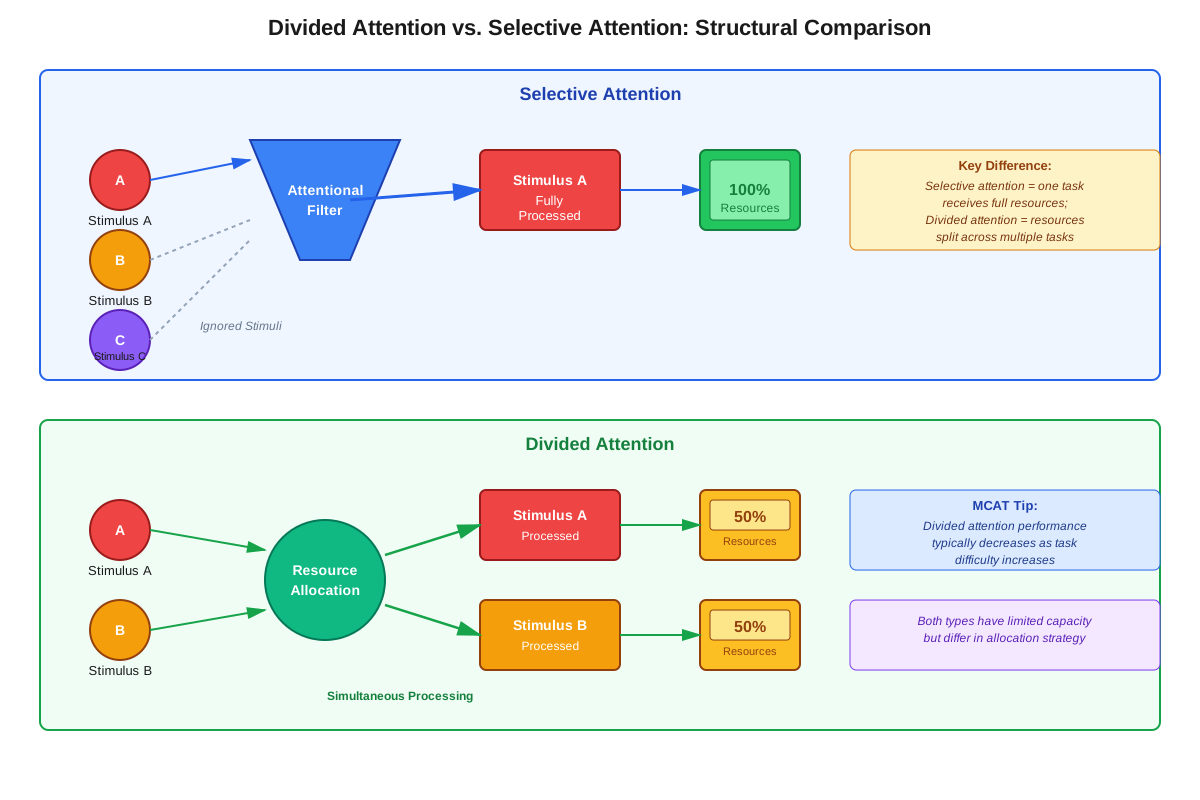
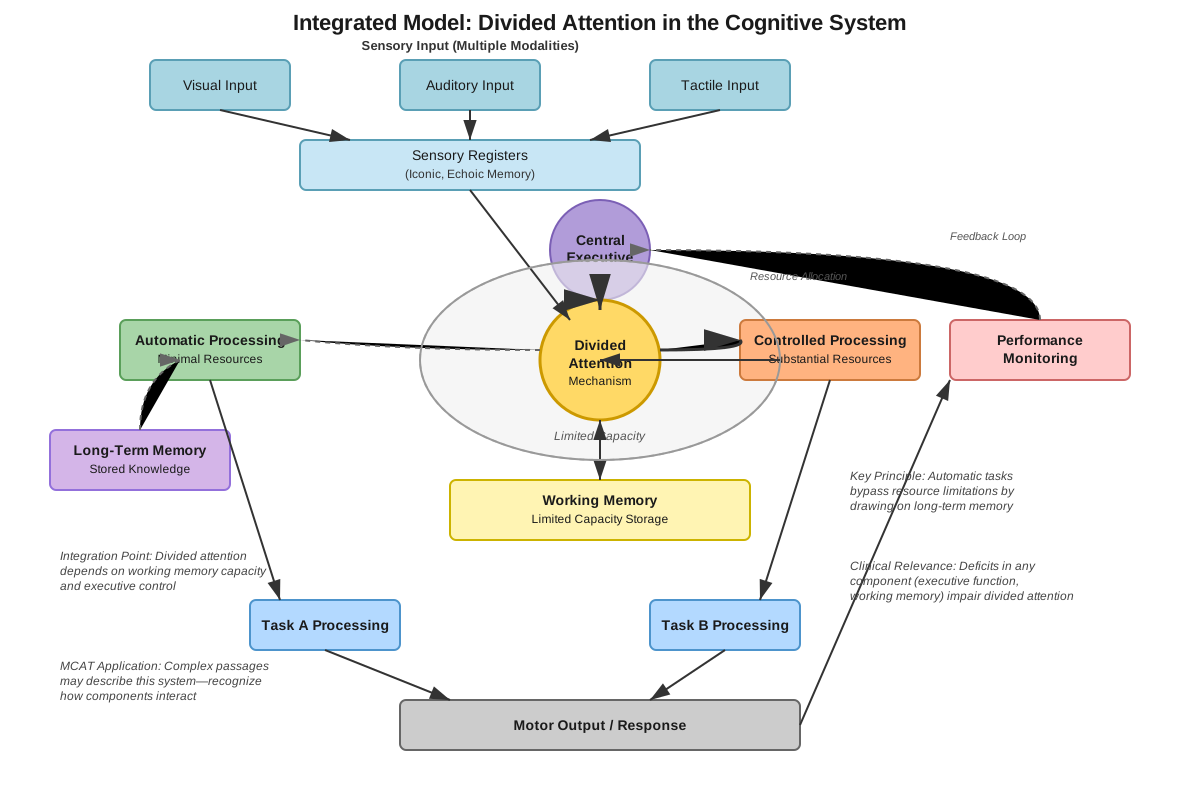
Divided attention is a fundamental cognitive process that refers to the ability to simultaneously process multiple sources of information, perform more than one task at a time, or attend to multiple stimuli concurrently. This concept sits at the intersection of Cognition and Consciousness and represents a critical component of how humans navigate complex environments that demand multitasking. Unlike selective attention, which involves focusing on one stimulus while ignoring others, divided attention requires the cognitive system to allocate processing resources across multiple channels simultaneously.
For the MCAT, understanding divided attention Psychology is essential because it frequently appears in passages describing experimental paradigms, real-world scenarios involving multitasking, and questions about cognitive limitations and performance. The MCAT tests not only the definition of divided attention but also the ability to apply this concept to novel situations, interpret research findings, and understand its relationship to other cognitive processes such as working memory, automatic processing, and attentional capacity. Questions may present scenarios involving driving while talking, studying with background noise, or clinical situations where healthcare providers must monitor multiple patients simultaneously.
Within the broader framework of Psychology, divided attention connects to theories of attention, information processing models, cognitive load theory, and the distinction between automatic and controlled processing. It provides insight into human cognitive limitations, the role of practice in skill acquisition, and how the brain manages competing demands for limited processing resources. Mastering this topic enables students to understand not only attention mechanisms but also performance decrements under cognitive load, individual differences in multitasking ability, and the neural substrates underlying attentional control.
Learning Objectives
- [ ] Define divided attention using accurate Psychology terminology
- [ ] Explain why divided attention matters for the MCAT
- [ ] Apply divided attention to exam-style questions
- [ ] Identify common mistakes related to divided attention
- [ ] Connect divided attention to related Psychology concepts
- [ ] Distinguish between divided attention and selective attention in experimental and real-world contexts
- [ ] Analyze factors that influence divided attention performance, including task difficulty, practice, and automaticity
- [ ] Evaluate research paradigms used to study divided attention and interpret experimental results
Prerequisites
- Selective attention: Understanding focused attention provides the contrast necessary to appreciate divided attention's unique characteristics and challenges
- Working memory: Divided attention tasks often tax working memory capacity, making knowledge of this system essential for understanding performance limitations
- Information processing models: Familiarity with how information flows through cognitive systems helps explain bottlenecks in divided attention
- Automatic vs. controlled processing: This distinction is fundamental to understanding when divided attention succeeds or fails
- Cognitive resources and capacity: Basic understanding of limited processing resources explains why divided attention is challenging
Why This Topic Matters
Clinical and Real-World Significance
Divided attention has profound implications for everyday functioning and clinical practice. Healthcare providers must constantly divide attention between monitoring vital signs, communicating with patients, documenting information, and making clinical decisions. Deficits in divided attention are characteristic of numerous neurological and psychiatric conditions, including attention-deficit/hyperactivity disorder (ADHD), traumatic brain injury, stroke, and dementia. Rehabilitation programs often target divided attention skills to improve functional independence. In the real world, divided attention failures contribute to accidents, particularly in driving scenarios where individuals attempt to use phones, adjust controls, and monitor traffic simultaneously.
Exam Statistics and Question Types
Divided attention appears in approximately 3-5% of MCAT Psychology/Sociology section questions, typically integrated into passages about cognitive psychology research or applied scenarios. Questions most commonly appear in three formats: (1) experimental design questions asking students to identify which paradigm tests divided attention versus other attentional processes, (2) application questions presenting real-world scenarios and asking students to predict performance outcomes, and (3) interpretation questions requiring analysis of data from dual-task experiments. The topic frequently appears alongside questions about working memory, cognitive load, and automaticity.
Common Exam Passage Contexts
MCAT passages featuring divided attention often describe:
- Dual-task paradigms where participants perform two tasks simultaneously while researchers measure performance decrements
- Driving simulation studies examining the effects of cell phone use or other distractions
- Age-related changes in cognitive function, particularly comparing younger and older adults' multitasking abilities
- Clinical assessments of attention in patient populations
- Neuroimaging studies showing brain activation patterns during single versus dual-task conditions
- Training studies demonstrating how practice affects divided attention performance
Core Concepts
Definition and Fundamental Characteristics
Divided attention is the cognitive ability to process two or more sources of information or perform multiple tasks concurrently by distributing attentional resources across competing demands. This process requires the cognitive system to allocate limited processing capacity among multiple channels, resulting in performance that typically falls below what would be achieved if full attention were devoted to a single task. The key characteristic distinguishing divided attention from other attentional processes is the simultaneous nature of processing—the individual attempts to maintain awareness of and respond to multiple stimuli or task demands at the same time rather than rapidly switching between them.
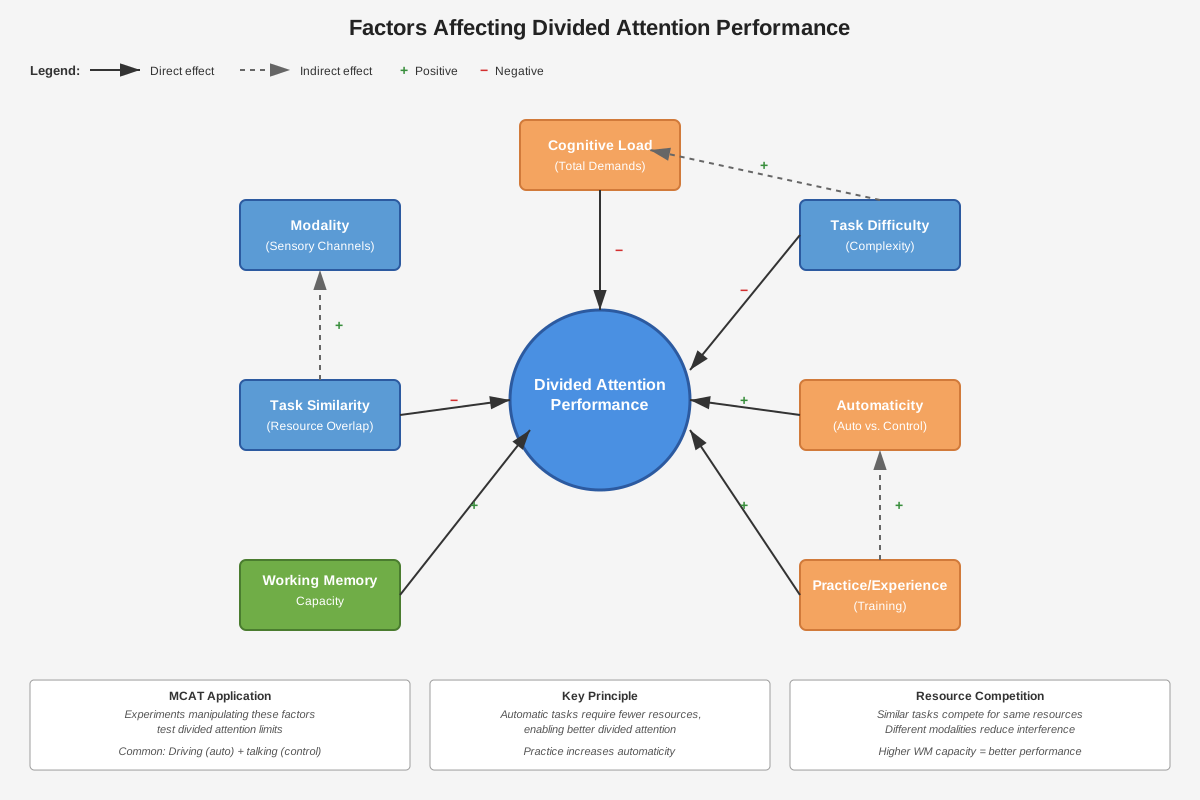
The capacity for divided attention is not unlimited. Performance on divided attention tasks depends on several factors: the difficulty of each individual task, the similarity between tasks, the degree of practice with each task, and whether tasks require the same sensory modalities or response systems. When tasks are simple, well-practiced, or use different processing resources, divided attention is more successful. Conversely, when tasks are complex, novel, or compete for the same resources, performance suffers significantly.
Theoretical Framework: Resource Theory
Resource theory, primarily developed by Daniel Kahneman, provides the dominant framework for understanding divided attention. According to this model, humans possess a limited pool of cognitive resources or processing capacity that can be flexibly allocated across tasks. When performing a single task, all resources can be devoted to that activity. However, when attempting to divide attention between two tasks, resources must be split, potentially leaving insufficient capacity for optimal performance on either task.
The theory distinguishes between undifferentiated capacity models, which propose a single pool of resources for all cognitive activities, and multiple resource models, which suggest separate pools for different types of processing (e.g., verbal vs. spatial, visual vs. auditory). Multiple resource theory, developed by Christopher Wickens, better explains why some task combinations interfere with each other more than others. For example, two visual tasks typically interfere more with each other than a visual task paired with an auditory task because they compete for the same specialized resource pool.
Automatic vs. Controlled Processing
The distinction between automatic processing and controlled processing is crucial for understanding divided attention success and failure. Automatic processes are fast, require minimal attentional resources, occur without conscious awareness, and develop through extensive practice. Examples include reading for skilled readers, walking for healthy adults, or shifting gears for experienced drivers. Controlled processes are slow, require substantial attentional resources, involve conscious awareness, and are used for novel or complex tasks.
Divided attention is most successful when at least one task can be performed automatically. When both tasks require controlled processing, performance typically deteriorates significantly because both tasks compete for limited controlled processing resources. This explains why experienced drivers can converse while driving on familiar roads (driving has become largely automatic) but struggle to maintain conversation when navigating complex intersections or unfamiliar areas (requiring controlled processing).
| Processing Type | Speed | Resource Demand | Consciousness | Development | Divided Attention Impact |
|---|---|---|---|---|---|
| Automatic | Fast | Minimal | Unconscious | Extensive practice | Enables successful division |
| Controlled | Slow | Substantial | Conscious | Minimal practice | Causes interference |
Dual-Task Paradigm
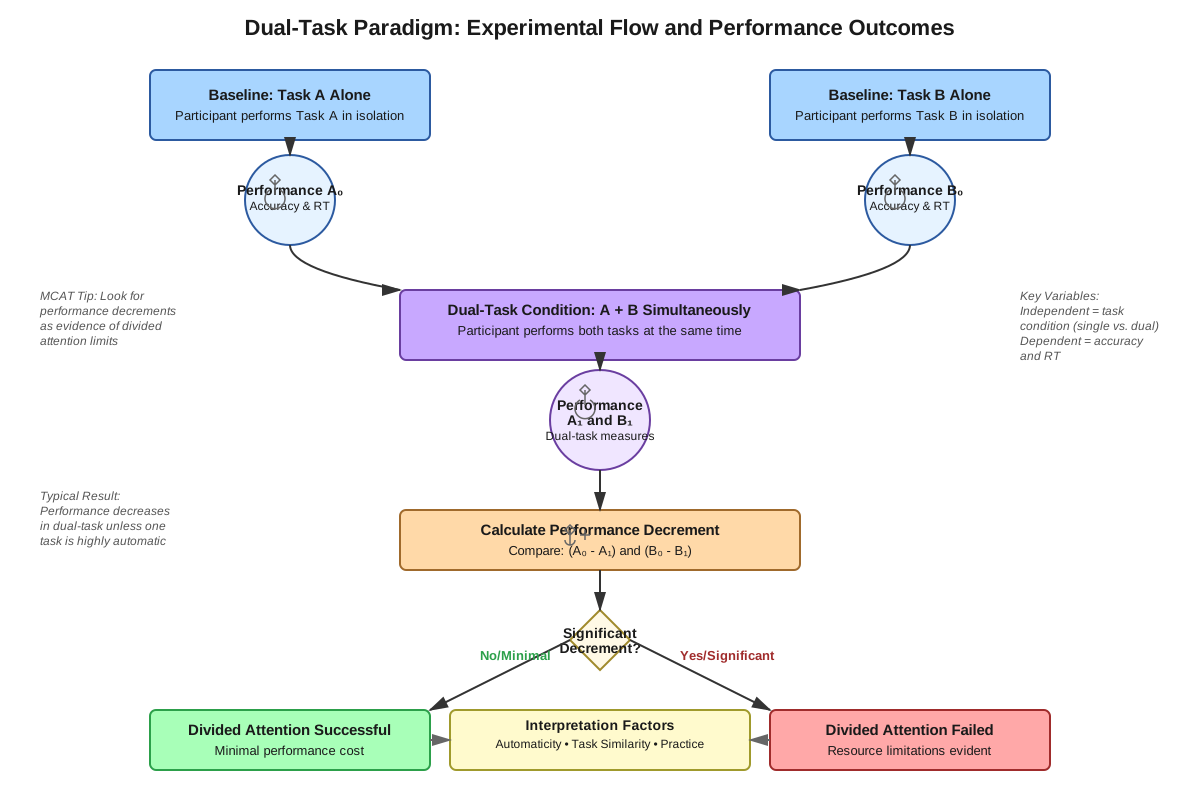
The dual-task paradigm is the primary experimental method for studying divided attention. In this approach, participants perform two tasks simultaneously, and researchers compare performance to baseline conditions where each task is performed alone. The dual-task cost or dual-task decrement refers to the performance decline observed when tasks are performed together compared to separately. This cost is quantified by measuring accuracy, reaction time, or both.
A typical dual-task experiment might involve:
- Baseline phase: Participants perform Task A alone, then Task B alone, establishing single-task performance levels
- Dual-task phase: Participants perform both tasks simultaneously
- Analysis: Researchers calculate the performance decrement: (Single-task performance - Dual-task performance) / Single-task performance
The magnitude of dual-task costs reveals information about task difficulty, resource overlap, and the degree of automaticity achieved. Minimal dual-task costs suggest tasks use different resources or that one task is highly automatic. Large dual-task costs indicate substantial resource competition or that both tasks require controlled processing.
Factors Affecting Divided Attention Performance
Several factors systematically influence divided attention success:
Task Difficulty: As individual task difficulty increases, more resources are required, leaving fewer available for concurrent tasks. Complex mathematical reasoning cannot be effectively combined with reading comprehension, but simple arithmetic might be combined with listening to music.
Task Similarity: Tasks that are similar in their processing demands interfere more with each other than dissimilar tasks. Two language tasks (reading while listening to speech) interfere more than a language task paired with a spatial task (reading while navigating). This reflects competition for specialized processing resources.
Practice and Skill Level: Extended practice reduces resource demands, potentially allowing a task to become automatic. Novice drivers cannot easily converse while driving, but experienced drivers manage both tasks successfully on familiar routes. Practice essentially frees up resources for other activities.
Sensory Modality: Tasks using different sensory inputs (visual + auditory) typically interfere less than tasks using the same modality (visual + visual). This supports multiple resource theory's claim that separate resource pools exist for different modalities.
Response Modality: Similarly, tasks requiring different response types (vocal + manual) interfere less than tasks requiring the same response type (manual + manual), as they don't compete for the same output systems.
Individual Differences
Divided attention ability varies across individuals and populations. Working memory capacity strongly predicts divided attention performance—individuals with greater working memory capacity show smaller dual-task costs. Age significantly affects divided attention, with older adults typically showing larger performance decrements in dual-task situations compared to younger adults, reflecting age-related declines in processing speed and cognitive flexibility.
Clinical populations often show specific divided attention deficits. Individuals with ADHD demonstrate particular difficulty with divided attention tasks, showing larger dual-task costs than neurotypical individuals. Patients with traumatic brain injury, stroke affecting frontal or parietal regions, or neurodegenerative diseases frequently exhibit impaired divided attention that affects daily functioning.
Neural Substrates
Neuroimaging studies reveal that divided attention recruits a distributed network of brain regions. The prefrontal cortex, particularly the dorsolateral prefrontal cortex, plays a critical role in allocating attentional resources and coordinating multiple tasks. The parietal cortex, especially the intraparietal sulcus, is involved in spatial attention and resource allocation. The anterior cingulate cortex monitors for conflicts between competing tasks and signals when additional control is needed.
During dual-task performance, brain activation patterns show both increased activity in control regions (reflecting greater demand for coordination) and sometimes decreased activity in task-specific regions (reflecting reduced resources available for each individual task). The efficiency of communication between brain regions, mediated by white matter tracts, influences divided attention success.
Concept Relationships
Divided attention exists within a hierarchical framework of attentional processes. At the broadest level, attention encompasses all mechanisms for selecting and processing information from the environment. Within this domain, selective attention (focusing on one stimulus while ignoring others) contrasts with divided attention (processing multiple stimuli simultaneously). Both selective and divided attention draw upon limited cognitive resources, making them subject to capacity constraints.
The relationship flows as follows: Limited cognitive capacity → necessitates attention mechanisms → which include both selective attention (choosing what to process) and divided attention (distributing resources across multiple targets) → success depends on automatic vs. controlled processing → which develops through practice and skill acquisition → mediated by working memory capacity → supported by neural networks in prefrontal and parietal cortex.
Divided attention connects forward to concepts of cognitive load (the total demand placed on working memory), multitasking (rapidly switching between tasks, often confused with true divided attention), and attention switching (the process of reallocating resources from one task to another). It also relates to vigilance (sustained attention over time), as maintaining divided attention for extended periods is particularly demanding.
Understanding divided attention enhances comprehension of executive functions, as dividing attention requires cognitive control processes including planning, monitoring, and flexible resource allocation. The concept also illuminates learning and memory, since divided attention during encoding typically impairs later memory retrieval—a phenomenon with important implications for study strategies.
Quick check — test yourself on Divided attention so far.
Try Flashcards →High-Yield Facts
⭐ Divided attention refers to simultaneously processing multiple information sources or performing multiple tasks concurrently, requiring distribution of limited cognitive resources
⭐ Dual-task costs (performance decrements when performing two tasks simultaneously versus separately) provide the primary measure of divided attention limitations
⭐ Divided attention is most successful when at least one task is automatic (requiring minimal resources) rather than controlled (requiring substantial resources)
⭐ Tasks using different sensory modalities (visual + auditory) or response modalities (vocal + manual) interfere less than tasks using the same modalities, supporting multiple resource theory
⭐ Working memory capacity strongly predicts divided attention performance, with higher capacity associated with smaller dual-task costs
- Older adults typically show larger dual-task costs than younger adults, reflecting age-related declines in processing speed and cognitive flexibility
- Practice reduces resource demands and can transform controlled processes into automatic ones, improving divided attention performance
- The prefrontal cortex, particularly dorsolateral regions, plays a critical role in allocating attentional resources during divided attention tasks
- Task similarity increases interference—two language tasks interfere more than a language task paired with a spatial task
- Divided attention during learning impairs subsequent memory retrieval, making multitasking during studying ineffective
- Clinical populations including individuals with ADHD, traumatic brain injury, and dementia often show specific divided attention deficits
- The anterior cingulate cortex monitors for conflicts between competing tasks during divided attention
Common Misconceptions
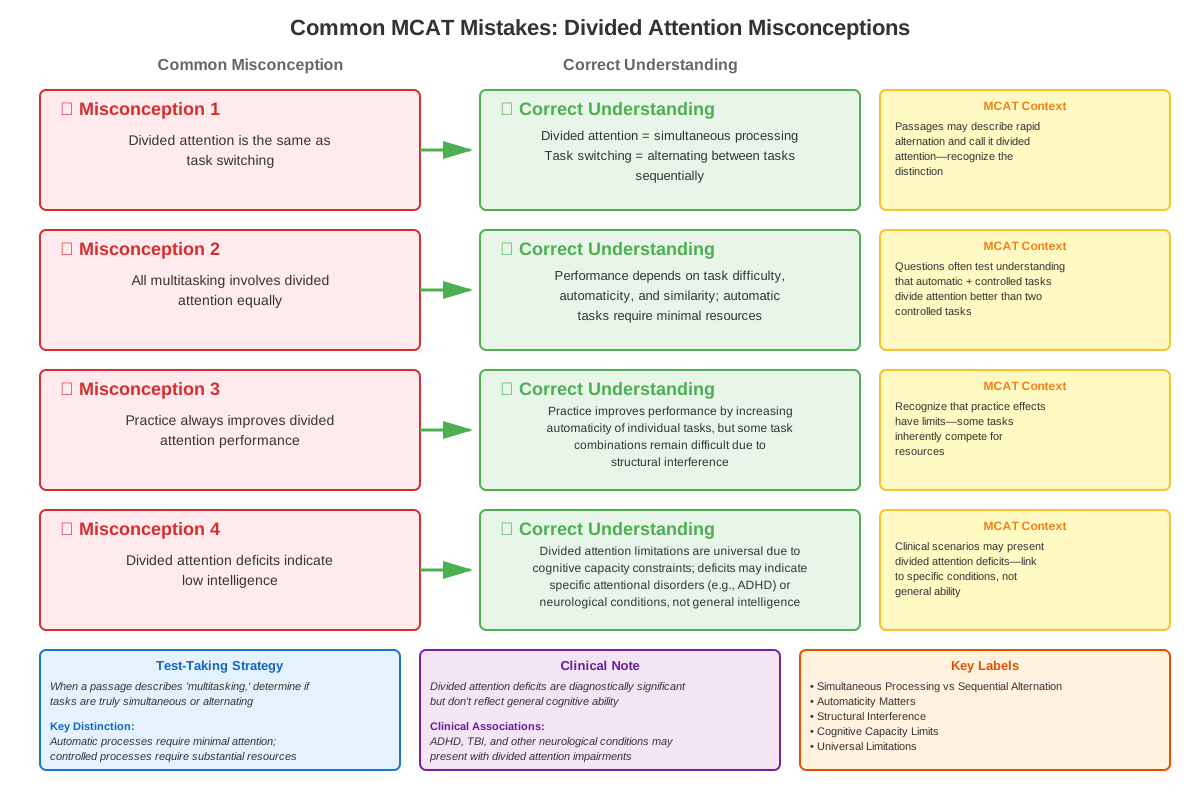
Misconception: Divided attention and multitasking are the same thing
Correction: True divided attention involves simultaneously processing multiple streams of information, while most "multitasking" actually involves rapid switching between tasks (alternating attention). Genuine divided attention is only possible when tasks don't exceed available cognitive resources, typically when at least one task is automatic.
Misconception: Some people are "good multitaskers" who can divide attention without performance costs
Correction: While individual differences exist in divided attention capacity (largely due to working memory differences), everyone experiences dual-task costs when performing demanding tasks simultaneously. People who believe they multitask effectively often don't recognize their performance decrements or are performing tasks that have become automatic through practice.
Misconception: Practice improves divided attention by increasing overall cognitive capacity
Correction: Practice doesn't expand the total pool of cognitive resources; rather, it reduces the resources required for individual tasks by making them more automatic. This frees up resources for other activities, creating the appearance of improved divided attention when actually task demands have decreased.
Misconception: Divided attention always involves conscious awareness of both tasks
Correction: When one task becomes automatic through extensive practice, it can be performed with minimal conscious awareness while attention is consciously directed toward the other task. For example, experienced drivers may have little conscious awareness of routine driving actions while consciously attending to conversation.
Misconception: If two tasks use different senses (e.g., listening and looking), they don't interfere with each other
Correction: While tasks using different sensory modalities interfere less than those using the same modality, they still compete for central cognitive resources, particularly if both require controlled processing, decision-making, or response selection. Some interference occurs even with different modalities.
Misconception: Divided attention deficits are always due to attention problems specifically
Correction: Poor divided attention performance can result from various factors including limited working memory capacity, slow processing speed, difficulty with task switching, or problems with executive functions. The deficit may reflect broader cognitive limitations rather than attention problems per se.
Worked Examples
Example 1: Interpreting a Dual-Task Experiment
Scenario: Researchers conduct an experiment where participants perform two tasks: (A) monitoring a visual display for target letters, and (B) listening to spoken words and pressing a button when they hear an animal name. Results show:
- Task A alone: 95% accuracy
- Task B alone: 92% accuracy
- Tasks A + B together: Task A = 93% accuracy, Task B = 70% accuracy
Question: What do these results suggest about the nature of these tasks and the resources they require?
Analysis:
Step 1: Calculate dual-task costs
- Task A cost: (95% - 93%) / 95% = 2.1% decrement
- Task B cost: (92% - 70%) / 92% = 23.9% decrement
Step 2: Interpret the asymmetric costs
The dramatically larger dual-task cost for Task B (auditory monitoring) compared to Task A (visual monitoring) suggests several possibilities:
- Task B requires more controlled processing resources than Task A
- Task B may be inherently more difficult or less practiced
- There may be a central bottleneck in response selection, as both tasks require button presses (Task B explicitly, and likely Task A as well for indicating targets)
Step 3: Consider resource allocation
The relatively preserved performance on Task A suggests participants may have prioritized the visual task, allocating more resources to it at the expense of the auditory task. Alternatively, the visual task may have become more automatic through practice during the experiment.
Step 4: Apply theoretical framework
These results support resource theory—both tasks compete for limited cognitive resources. The asymmetric interference pattern is consistent with multiple resource theory if we assume the auditory-verbal processing required for Task B demands more central executive resources than the visual processing for Task A.
Conclusion: The results demonstrate classic divided attention limitations with asymmetric dual-task costs, suggesting that the auditory monitoring task requires more controlled processing resources and/or that participants prioritized visual task performance.
Example 2: Real-World Application
Scenario: A medical student is studying for the MCAT while listening to a podcast about medical ethics. She believes this is efficient use of time. After studying, she takes a practice test and finds she remembers very little of the material she reviewed, and when asked about the podcast content, she can only recall general themes but no specific arguments.
Question: Use divided attention principles to explain why this study strategy was ineffective and what would be more effective.
Analysis:
Step 1: Identify the tasks and their processing demands
- Task 1: Studying MCAT material requires controlled processing—reading complex content, encoding new information, making connections to prior knowledge
- Task 2: Comprehending podcast content requires controlled processing—following arguments, understanding relationships between ideas, encoding information
Step 2: Apply divided attention principles
Both tasks require substantial controlled processing resources and use overlapping cognitive systems (language comprehension, working memory, encoding into long-term memory). According to resource theory, the limited pool of cognitive resources must be divided between these competing demands, leaving insufficient capacity for either task to be performed optimally.
Step 3: Explain the poor outcomes
The poor retention of both MCAT material and podcast content reflects the dual-task cost. When attention is divided during encoding, information is processed less deeply, resulting in weaker memory traces. This is consistent with research showing that divided attention during learning significantly impairs subsequent retrieval.
Step 4: Predict what would work better
More effective strategies would include:
- Sequential processing: Study MCAT material with full attention, then listen to the podcast with full attention
- Pairing with automatic tasks: Study MCAT material while background instrumental music plays (music processing can be relatively automatic and doesn't compete for language processing resources)
- Strategic breaks: Use the podcast as a break between study sessions, allowing full attention to each activity
Step 5: Connect to broader principles
This example illustrates why multitasking during studying is generally ineffective—academic learning requires controlled processing that cannot be successfully combined with other demanding cognitive tasks. The student's belief that she was being efficient reflects the common misconception that people can effectively multitask with complex cognitive activities.
Conclusion: The study strategy failed because both tasks required controlled processing and competed for limited cognitive resources, resulting in poor encoding and retention of both types of information. Effective studying requires full attentional resources devoted to the learning material.
Exam Strategy
Approaching MCAT Questions on Divided Attention
When encountering divided attention questions on the MCAT, follow this systematic approach:
- Identify the attentional demand: Determine whether the question describes selective attention (focusing on one thing), divided attention (processing multiple things simultaneously), or alternating attention (switching between tasks)
- Assess task characteristics: Evaluate whether tasks are automatic or controlled, similar or dissimilar, and whether they use the same or different sensory/response modalities
- Predict performance outcomes: Based on task characteristics, predict whether divided attention will be successful (minimal dual-task costs) or impaired (substantial dual-task costs)
- Look for experimental controls: In research-based passages, identify whether the study includes appropriate single-task baseline conditions for comparison
Trigger Words and Phrases
Watch for these key phrases that signal divided attention concepts:
- "Simultaneously," "at the same time," "while also"—indicate divided attention rather than sequential processing
- "Dual-task," "concurrent tasks"—explicitly reference divided attention paradigms
- "Performance decrement," "interference," "cost"—suggest dual-task costs
- "Automatic," "well-practiced," "skilled"—indicate tasks that can be successfully combined
- "Novel," "complex," "demanding"—suggest tasks that will interfere when combined
- "Resource allocation," "capacity limitations"—reference theoretical frameworks
- "Multitasking"—may refer to divided attention or task switching; read carefully to distinguish
Process of Elimination Tips
When evaluating answer choices:
Eliminate options that:
- Confuse divided attention with selective attention (focusing on one stimulus while ignoring others)
- Suggest unlimited capacity for divided attention
- Claim that practice increases total cognitive capacity (rather than reducing task demands)
- Ignore the role of automaticity in successful divided attention
- Propose that all task combinations interfere equally
Favor options that:
- Acknowledge resource limitations and dual-task costs
- Distinguish between automatic and controlled processing
- Recognize that task similarity increases interference
- Account for individual differences in working memory capacity
- Apply multiple resource theory when tasks use different modalities
Time Allocation Advice
Divided attention questions typically appear as discrete questions (15-20% of cases) or as part of research passages (80-85% of cases). For discrete questions, allocate 60-90 seconds—these usually test straightforward definitional knowledge or simple application. For passage-based questions, allocate 90-120 seconds, as you'll need to integrate information from the passage with divided attention principles. If a question requires calculating dual-task costs or comparing multiple conditions, allocate the full 120 seconds to avoid calculation errors.
Memory Techniques
Mnemonics
DIVIDE for factors affecting divided attention performance:
- Difficulty of tasks (harder tasks = more interference)
- Individual differences (working memory capacity matters)
- Variety of modalities (different modalities = less interference)
- Interference from similarity (similar tasks compete more)
- Degree of practice (practice reduces demands)
- Executive control (frontal lobe coordination required)
AUTOMATIC for characteristics of automatic processing that enable divided attention:
- Awareness not required
- Unconscious operation
- Time efficient (fast)
- Occurs with practice
- Minimal resources needed
- Allows attention division
- Task becomes effortless
- Interference reduced
- Control not necessary
Visualization Strategy
Visualize cognitive resources as a pitcher of water that must be poured into multiple glasses (tasks). When you have two small glasses (easy tasks), the pitcher can fill both adequately. When you have two large glasses (difficult tasks), the pitcher doesn't contain enough water to fill both—some glasses remain partially empty, representing performance decrements. Practice makes glasses smaller (reduces task demands), allowing the same amount of water to fill multiple glasses successfully.
Conceptual Anchors
Driving analogy: Remember that experienced drivers can converse while driving familiar routes (one task automatic) but struggle to talk while navigating complex intersections (both tasks controlled). This real-world example anchors the automatic vs. controlled processing distinction.
Study scenario: Recall that studying while watching TV leads to poor retention of both—a personally relevant example of divided attention failure that reinforces why both tasks requiring controlled processing cannot be effectively combined.
Summary
Divided attention represents the cognitive system's ability to simultaneously process multiple information sources or perform concurrent tasks by distributing limited attentional resources across competing demands. Success in divided attention depends critically on task characteristics—particularly whether tasks require automatic or controlled processing—and the degree to which tasks compete for the same specialized resources. The dual-task paradigm provides the primary experimental method for studying divided attention, with dual-task costs (performance decrements in concurrent versus single-task conditions) revealing the limitations of attentional capacity. Multiple resource theory explains why some task combinations interfere more than others, with tasks using different sensory or response modalities showing less interference than those using the same modalities. Practice reduces resource demands by making tasks more automatic, effectively improving divided attention performance not by expanding capacity but by reducing individual task demands. Individual differences in working memory capacity predict divided attention success, and age-related declines in cognitive flexibility contribute to larger dual-task costs in older adults. For the MCAT, understanding divided attention enables interpretation of cognitive research, prediction of performance in multitasking scenarios, and recognition of the neural and cognitive mechanisms underlying attentional limitations.
Key Takeaways
- Divided attention involves simultaneously processing multiple information streams, requiring distribution of limited cognitive resources across concurrent tasks
- Dual-task costs (performance decrements when tasks are combined) demonstrate attentional capacity limitations and provide the primary measure of divided attention
- Successful divided attention requires at least one task to be automatic (minimal resource demands) rather than controlled (substantial resource demands)
- Multiple resource theory explains that tasks using different modalities (visual vs. auditory) or response systems interfere less than tasks using the same systems
- Practice improves divided attention not by expanding capacity but by reducing task demands through automaticity
- Working memory capacity predicts divided attention performance, with clinical populations and older adults showing characteristic deficits
- The prefrontal cortex coordinates resource allocation during divided attention, with distributed neural networks supporting concurrent task performance
Related Topics
Selective Attention: Understanding how attention focuses on specific stimuli while filtering others provides essential contrast to divided attention and completes the picture of attentional mechanisms. Mastering divided attention enables deeper comprehension of how selective and divided attention interact in complex environments.
Working Memory: Since divided attention tasks heavily tax working memory capacity, exploring working memory's structure, capacity limits, and individual differences enhances understanding of why divided attention is challenging and who succeeds at it.
Automaticity and Skill Acquisition: Investigating how practice transforms controlled processes into automatic ones explains the mechanism by which divided attention performance improves, connecting to broader themes of learning and expertise development.
Cognitive Load Theory: This framework extends divided attention principles to educational contexts, explaining how instructional design can minimize unnecessary cognitive load and optimize learning—directly applicable to MCAT preparation strategies.
Executive Functions: Divided attention represents one component of broader executive control processes, including planning, monitoring, and cognitive flexibility. Understanding this relationship provides insight into frontal lobe functions and cognitive control.
Attention Deficit Hyperactivity Disorder (ADHD): Clinical applications of divided attention concepts illuminate how attentional deficits manifest in real-world functioning and how they're assessed and treated.
Practice CTA
Now that you've mastered the core concepts of divided attention, it's time to solidify your understanding through active practice. Attempt the practice questions to apply these principles to MCAT-style scenarios, and use the flashcards to reinforce high-yield facts and definitions. Remember that understanding divided attention not only prepares you for exam questions but also helps you optimize your own study strategies—avoid dividing attention during learning, and you'll retain more with less effort. Your investment in deeply understanding this topic will pay dividends across multiple Psychology questions on test day!
Sign up free to keep reading
Create a free AnvayaPrep account to finish this MCAT guide on Divided attention — plus flashcards and practice questions.