Overview
Morphology is a fundamental concept in linguistics and cognitive psychology that examines the structure and formation of words. In the context of Psychology and the MCAT, morphology represents a critical component of language processing and Cognition and Consciousness. Understanding morphology enables students to grasp how the human mind breaks down, processes, and produces meaningful linguistic units, which is essential for comprehending broader topics in cognitive psychology, language acquisition, and neuropsychological functioning.
For the MCAT, Morphology Psychology appears primarily within questions addressing language development, cognitive processing, and the psychological mechanisms underlying communication. The exam frequently tests students' ability to distinguish between different linguistic units, understand how meaning is constructed from smaller components, and apply these principles to clinical scenarios involving language disorders or developmental milestones. Questions may present passages about aphasia, language acquisition in children, or cross-cultural communication patterns that require a solid foundation in morphological principles.
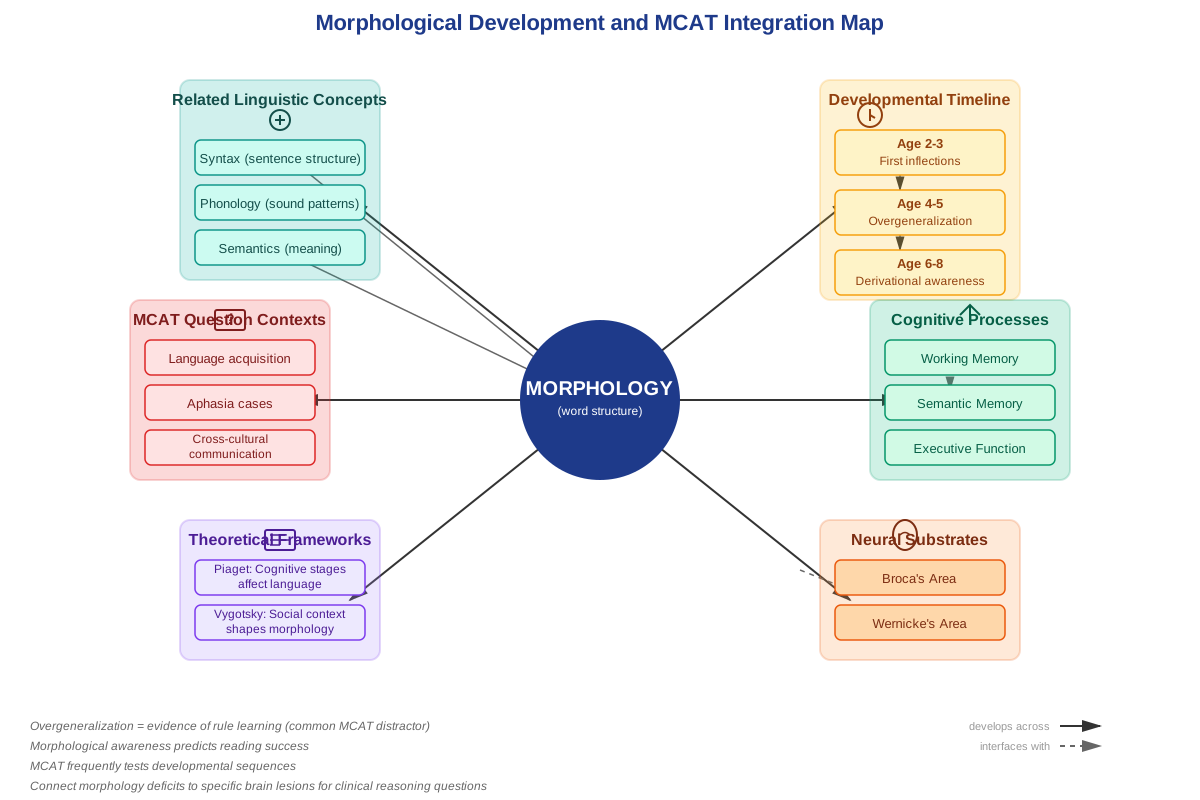
Morphology MCAT content connects intimately with other psychology concepts including semantic memory, language centers in the brain (Broca's and Wernicke's areas), cognitive development theories (particularly Piaget and Vygotsky), and information processing models. Mastering morphology provides the foundation for understanding how humans encode, store, and retrieve linguistic information—processes that are central to consciousness, attention, and higher-order thinking. This topic bridges the gap between biological psychology (neural substrates of language) and social psychology (how language shapes social interaction and cultural transmission).
Learning Objectives
- [ ] Define Morphology using accurate Psychology terminology
- [ ] Explain why Morphology matters for the MCAT
- [ ] Apply Morphology to exam-style questions
- [ ] Identify common mistakes related to Morphology
- [ ] Connect Morphology to related Psychology concepts
- [ ] Distinguish between different types of morphemes and their psychological functions
- [ ] Analyze how morphological processing relates to language disorders and cognitive impairments
- [ ] Evaluate the role of morphology in language acquisition and developmental psychology
Prerequisites
- Basic understanding of language components: Familiarity with the concept that language consists of organized, hierarchical units is necessary to understand how morphology fits within the broader linguistic framework
- Cognitive processing fundamentals: Knowledge of how the brain processes information helps contextualize morphological processing as a cognitive function
- Developmental psychology basics: Understanding stages of human development provides context for when and how morphological awareness emerges
- Brain anatomy related to language: Basic knowledge of language centers (Broca's area, Wernicke's area) helps connect morphological processing to neural substrates
Why This Topic Matters
Clinical and Real-World Significance
Morphological processing is fundamental to diagnosing and treating various language disorders. Clinicians use morphological assessments to identify specific language impairments (SLI), dyslexia, and aphasia subtypes. Children with morphological deficits often struggle with reading comprehension and written expression, making early identification crucial for intervention. In neuropsychology, morphological processing deficits can indicate specific brain lesions or degenerative conditions, helping localize damage and predict functional outcomes.
MCAT Exam Statistics
Morphology appears in approximately 3-5% of Psychology/Sociology section questions, typically integrated within broader passages about language, cognition, or development. Questions most commonly appear in three formats: discrete questions testing definitional knowledge, passage-based questions requiring application to clinical scenarios, and research-based passages examining experimental studies on language processing. The MCAT particularly favors questions that integrate morphology with other psychological concepts, such as how morphological awareness relates to reading development or how brain damage affects morphological processing.
Common Exam Passage Contexts
MCAT passages featuring morphology often present: (1) developmental studies tracking children's acquisition of morphological rules, (2) neuropsychological case studies of patients with aphasia or other language disorders, (3) cross-linguistic research comparing morphological systems across cultures, and (4) experimental studies using priming or reaction time measures to investigate morphological processing. Students must be prepared to extract morphological principles from these diverse contexts and apply them to answer questions about underlying mechanisms, developmental trajectories, or clinical implications.
Core Concepts
Definition and Scope of Morphology
Morphology is the branch of linguistics and cognitive psychology that studies the structure, formation, and classification of words. More specifically, it examines how morphemes—the smallest meaningful units of language—combine to create words and convey meaning. In psychological terms, morphology represents the cognitive processes and mental representations that allow humans to decompose words into meaningful components, understand novel word formations, and produce grammatically correct language.
The psychological study of morphology investigates how the brain stores, accesses, and manipulates morphological information. This includes examining the mental lexicon (how words and word parts are organized in memory), morphological processing during reading and listening, and the development of morphological awareness across the lifespan. Understanding morphology from a psychological perspective requires recognizing it as both a linguistic system and a cognitive capacity that develops, can be impaired, and varies across individuals.
Morphemes: The Building Blocks
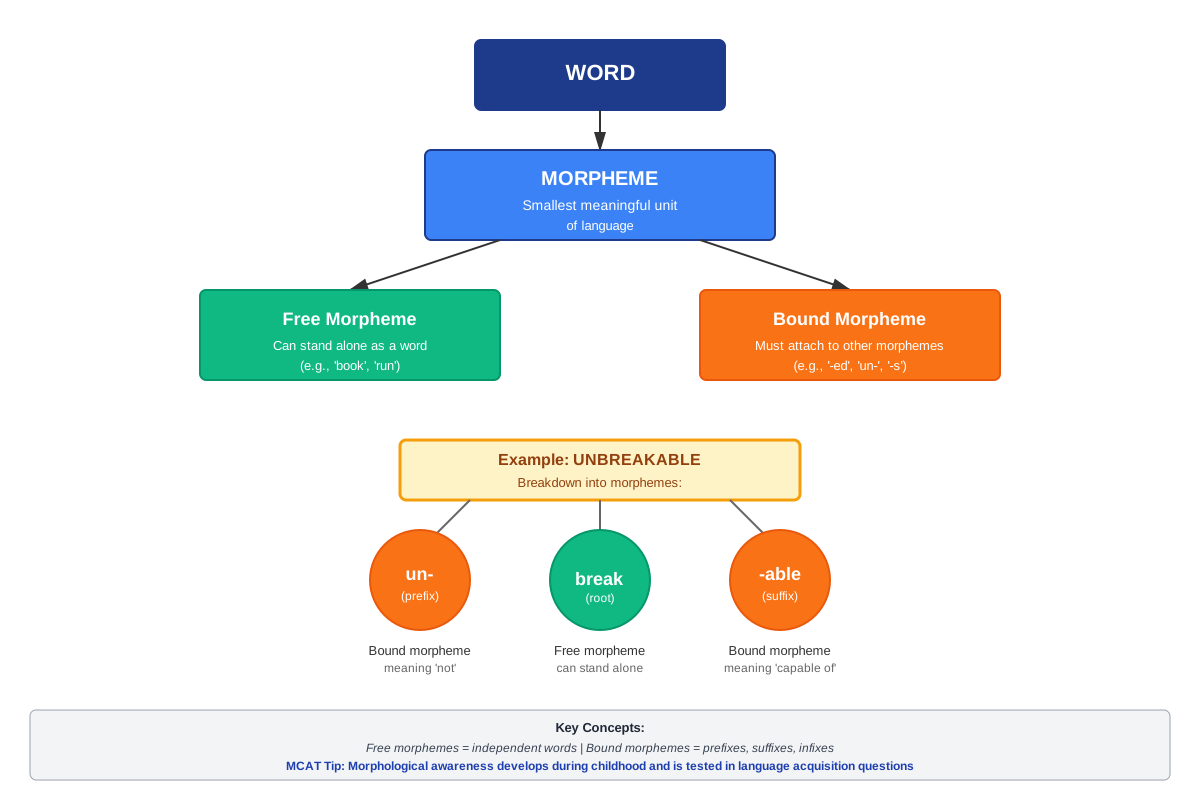
A morpheme is the smallest unit of language that carries meaning or serves a grammatical function. Morphemes cannot be broken down further without losing their meaning. For example, the word "unhappiness" contains three morphemes: "un-" (meaning not), "happy" (the root meaning), and "-ness" (indicating a state or quality). Each morpheme contributes to the overall meaning of the word.
Morphemes are classified into two primary categories:
Free morphemes can stand alone as independent words. Examples include "book," "run," "happy," and "dog." These morphemes carry meaning independently and do not require attachment to other morphemes to function in language.
Bound morphemes cannot stand alone and must attach to other morphemes to convey meaning. These include prefixes (un-, re-, pre-), suffixes (-ing, -ed, -ness), and inflectional endings (-s for plural, -ed for past tense). Bound morphemes modify the meaning or grammatical function of the morphemes they attach to.
Types of Morphemes by Function
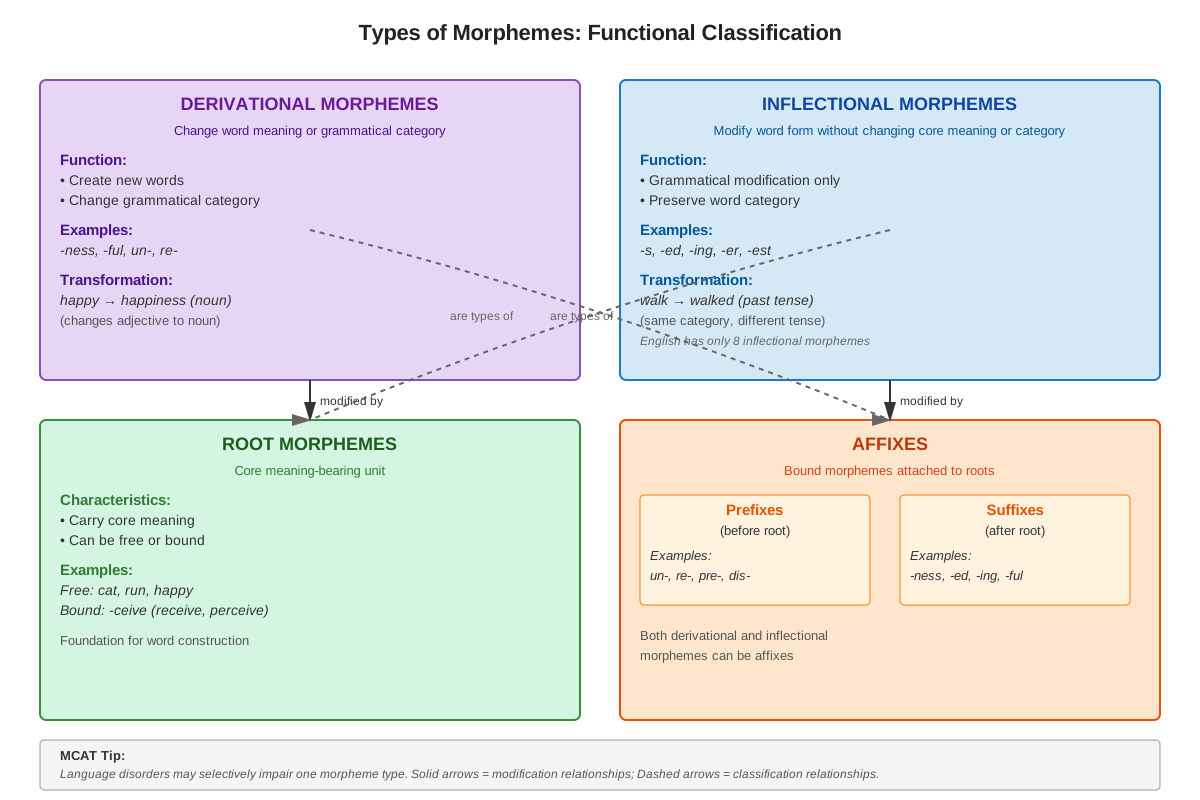
| Morpheme Type | Function | Examples | Psychological Significance |
|---|---|---|---|
| Derivational | Changes word meaning or part of speech | happy → happiness, teach → teacher | Requires semantic processing and understanding of word formation rules |
| Inflectional | Modifies grammatical function without changing core meaning | walk → walked, cat → cats | Indicates grammatical competence and rule application |
| Root/Base | Carries the core meaning | "act" in action, actor, react | Central to semantic memory organization |
| Affix | Attaches to roots (prefixes, suffixes, infixes) | un-, -ness, -ing | Demonstrates productive language capacity |
Morphological Processing in Cognition
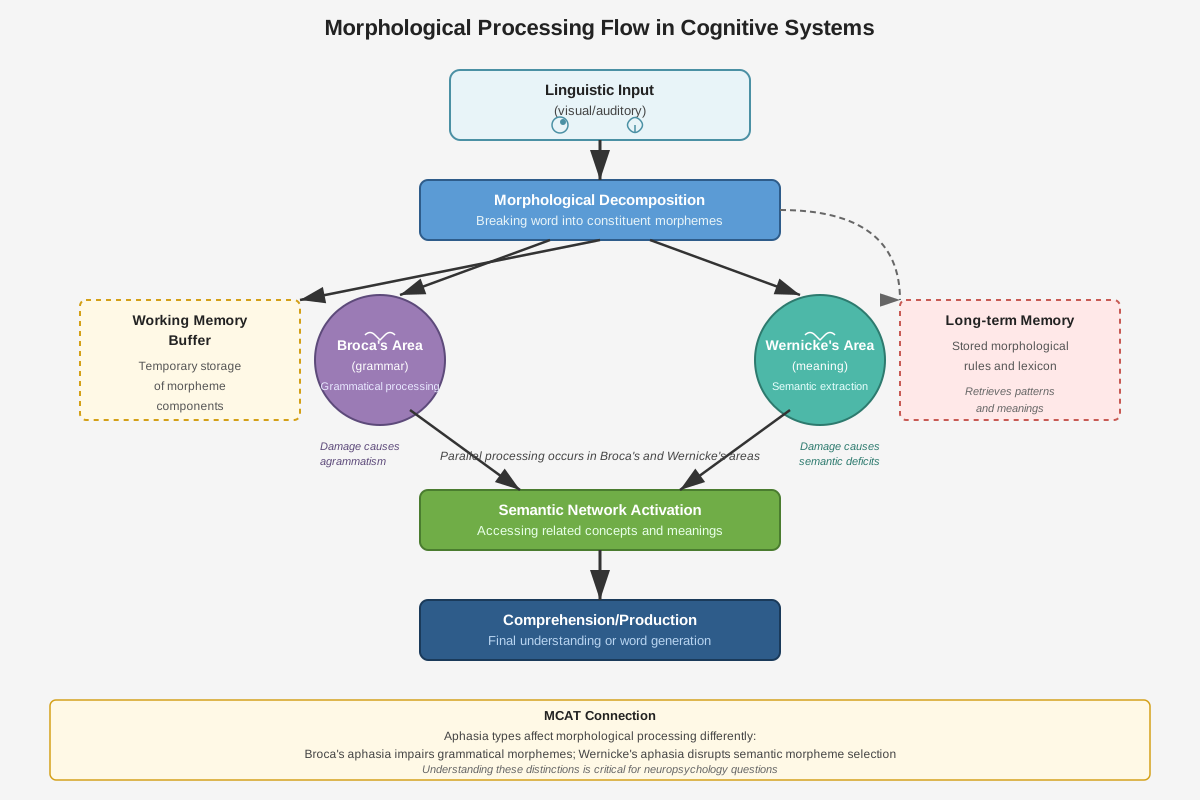
The cognitive processing of morphology involves several mental operations. Morphological decomposition occurs when the brain breaks down complex words into constituent morphemes during comprehension. Research using priming studies demonstrates that reading "teacher" activates the representation for "teach," suggesting automatic morphological parsing. This process is particularly important for understanding novel or low-frequency words, where morphological analysis provides clues to meaning.
Morphological production involves combining morphemes according to linguistic rules to generate words during speaking or writing. This requires accessing stored morphemes from the mental lexicon, applying morphological rules (such as adding "-ed" for past tense), and monitoring for exceptions (irregular forms like "went" instead of "goed"). Errors in morphological production, such as overregularization in children ("goed" instead of "went"), reveal the underlying rule-based nature of morphological processing.
Morphological Development
Morphological awareness develops progressively throughout childhood and adolescence. Young children initially learn words as whole units without recognizing internal structure. Around ages 3-4, children begin demonstrating implicit morphological knowledge by correctly using inflectional morphemes (plurals, past tense) and occasionally overregularizing rules ("foots" instead of "feet"). This overregularization actually indicates cognitive progress—the child has extracted a morphological rule and is applying it systematically, even to exceptions.
Explicit morphological awareness—the conscious ability to reflect on and manipulate morphemes—emerges later, typically during early elementary school years. This awareness correlates strongly with reading development, as children who can identify morphemes in written words show better reading comprehension and vocabulary growth. Morphological awareness continues developing through adolescence as students encounter increasingly complex academic vocabulary built from Greek and Latin morphemes.
Morphology and the Brain
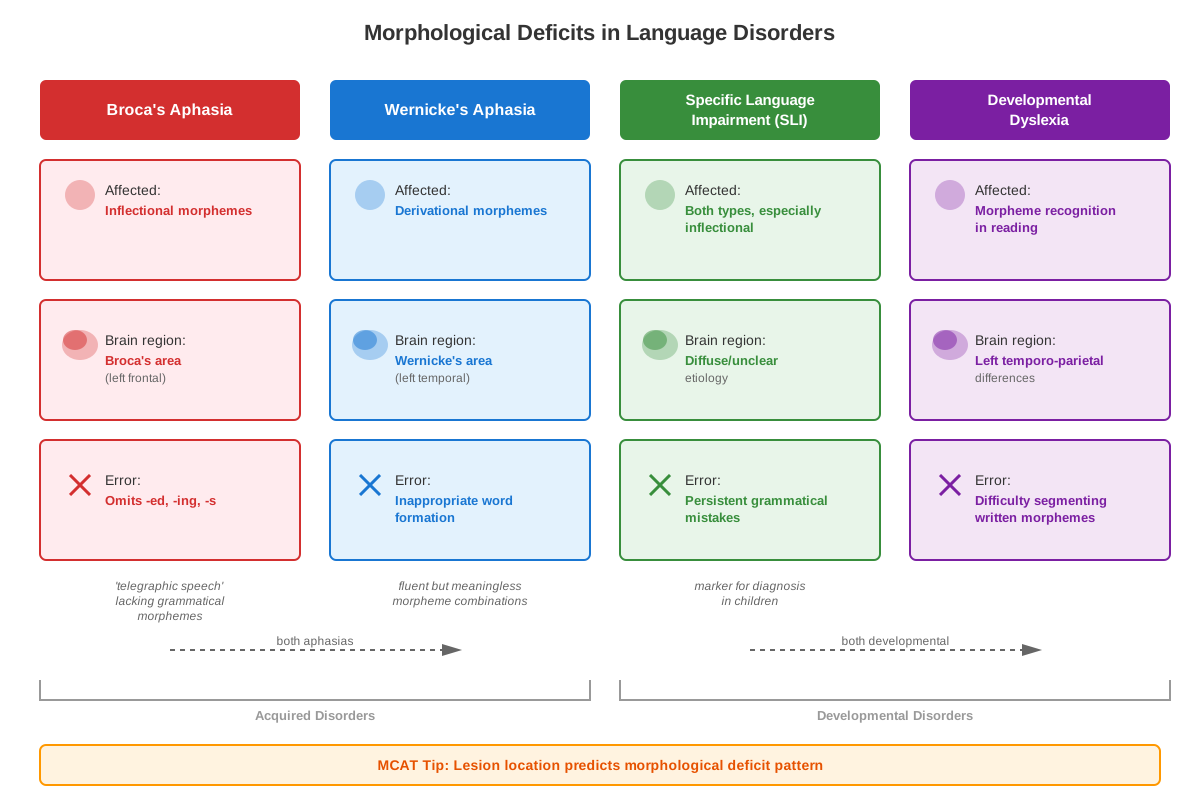
Neuropsychological research has identified brain regions involved in morphological processing. Broca's area (left inferior frontal gyrus) plays a crucial role in morphological production and the application of morphological rules. Damage to this region often results in agrammatic aphasia, characterized by difficulty producing grammatical morphemes, particularly inflectional endings. Patients might say "walk store yesterday" instead of "walked to the store yesterday."
Wernicke's area (left superior temporal gyrus) contributes to morphological comprehension and semantic aspects of morphology. The left temporal lobe more broadly supports storage and retrieval of morphological knowledge in the mental lexicon. Neuroimaging studies show that processing morphologically complex words activates a distributed network including these regions plus the left inferior parietal cortex, suggesting morphological processing integrates phonological, semantic, and syntactic information.
Morphological Productivity
Morphological productivity refers to the capacity to create and understand novel words using morphological rules. This productive capacity distinguishes human language from other communication systems. Speakers can generate words they have never heard before (like "unfriend" or "googling") and listeners can comprehend these novel formations by applying morphological knowledge. This productivity demonstrates that morphological knowledge consists of abstract rules rather than merely memorized word forms.
The psychological reality of morphological productivity is evident in experimental studies where participants readily interpret nonsense words with familiar morphological structure. For example, if told that "blicking" means a particular action, participants immediately understand "blicked" as the past tense and "blicker" as someone who performs the action, demonstrating active application of morphological rules.
Concept Relationships
Morphology connects to multiple levels of linguistic and cognitive processing. At the most basic level, morphemes combine with phonemes (sound units) to create the sound structure of words, while simultaneously combining with semantic features to create meaning. This dual connection places morphology at the intersection of phonological and semantic processing.
Within language processing, morphology relates hierarchically to other linguistic levels: Phonology (sound structure) → Morphology (word structure) → Syntax (sentence structure) → Semantics (meaning). However, this hierarchy is not strictly linear; morphological processing interacts bidirectionally with both phonological and semantic processing. For example, semantic context can influence how quickly morphologically complex words are processed, while morphological structure affects phonological patterns (stress placement, pronunciation).
Morphology connects to cognitive development through the emergence of morphological awareness as a metalinguistic skill. This awareness builds on earlier phonological awareness and supports later development of reading comprehension and vocabulary knowledge. The relationship flows: Phonological awareness → Morphological awareness → Reading comprehension → Academic vocabulary.
In neuropsychology, morphology links to brain lateralization and language localization. Morphological processing predominantly occurs in left hemisphere language areas, connecting to broader principles of hemispheric specialization. Morphological deficits in aphasia connect to the specific functions of damaged brain regions: Broca's area damage → Agrammatic production → Loss of inflectional morphemes, while Wernicke's area damage → Semantic deficits → Impaired derivational morphology.
The relationship between morphology and memory systems is also significant. The mental lexicon, which stores morphological knowledge, represents a component of semantic memory. Morphological processing during language production and comprehension involves working memory to hold and manipulate morphological units. This connects morphology to broader theories of memory organization and cognitive architecture.
High-Yield Facts
⭐ Morphemes are the smallest meaningful units of language and cannot be broken down further without losing meaning
⭐ Free morphemes can stand alone as words, while bound morphemes must attach to other morphemes
⭐ Derivational morphemes change word meaning or part of speech (happy → happiness), while inflectional morphemes modify grammatical function without changing core meaning (walk → walked)
⭐ Broca's area damage typically impairs production of grammatical morphemes, particularly inflectional endings, resulting in agrammatic aphasia
⭐ Morphological awareness (the ability to consciously reflect on and manipulate morphemes) develops during early elementary years and strongly predicts reading comprehension
- Overregularization errors in children (saying "goed" instead of "went") demonstrate rule-based morphological processing rather than mere imitation
- Morphological priming studies show that reading "teacher" automatically activates "teach," indicating decomposition during processing
- The mental lexicon organizes morphological information, allowing productive generation of novel words following morphological rules
- Wernicke's area contributes to morphological comprehension and semantic aspects of morphology
- Cross-linguistic research shows that morphological complexity varies dramatically across languages, affecting cognitive processing demands
Quick check — test yourself on Morphology so far.
Try Flashcards →Common Misconceptions
Misconception: Morphemes are the same as syllables → Correction: Morphemes are units of meaning, while syllables are units of sound. The word "cats" has one syllable but two morphemes (cat + s), while "elephant" has three syllables but only one morpheme.
Misconception: All prefixes and suffixes are morphemes → Correction: Only meaningful prefixes and suffixes are morphemes. The "s" in "cats" is a morpheme (indicating plural), but the "s" in "bus" is not a separate morpheme because it doesn't carry independent meaning.
Misconception: Children learn morphology by memorizing each word form separately → Correction: Children extract morphological rules from language input and apply them productively, as evidenced by overregularization errors like "goed" or "mouses" that they could not have heard from adults.
Misconception: Morphological processing only occurs for complex, unfamiliar words → Correction: Research shows automatic morphological decomposition even for frequent, familiar words. The brain accesses morphological structure as part of routine word processing, not just as a backup strategy.
Misconception: Broca's aphasia eliminates all morphological ability → Correction: Broca's aphasia primarily affects production of grammatical morphemes (inflectional endings) while often preserving comprehension of morphological structure and knowledge of derivational morphology. The deficit is specific, not global.
Misconception: Morphological awareness is innate and doesn't require instruction → Correction: While implicit morphological processing develops naturally, explicit morphological awareness—the conscious ability to identify and manipulate morphemes—benefits significantly from instruction and correlates with literacy development.
Worked Examples
Example 1: Analyzing Morphological Structure in a Clinical Case
Scenario: A 58-year-old patient suffered a stroke affecting the left inferior frontal region. During language assessment, the patient produces the following utterances: "Yesterday I walk store" and "Two dog in yard." When asked to describe a picture of children playing, the patient says "Child play ball." The patient demonstrates good comprehension of spoken language and can name objects accurately.
Question: Based on morphological analysis, what specific language deficit does this patient demonstrate, and what does this reveal about the neural basis of morphological processing?
Step 1 - Identify the morphological pattern: Examine what morphemes are present and absent. The patient produces root morphemes correctly ("walk," "dog," "child," "play") but consistently omits inflectional morphemes (past tense "-ed," plural "-s," present progressive "-ing").
Step 2 - Classify the morpheme type affected: The missing morphemes are all inflectional (grammatical) rather than derivational (meaning-changing). The patient isn't attempting to say "walker" or "playful" (derivational forms) but rather basic grammatical forms.
Step 3 - Connect to neuroanatomy: The lesion location (left inferior frontal region) corresponds to Broca's area. This region is specifically associated with grammatical processing and morphological production, particularly inflectional morphology.
Step 4 - Diagnose the condition: This pattern indicates agrammatic aphasia (or Broca's aphasia), characterized by telegraphic speech lacking grammatical morphemes while content words remain intact.
Step 5 - Explain the psychological mechanism: The deficit reveals that inflectional morpheme production relies on specific neural substrates in Broca's area. The preserved root morphemes and comprehension indicate that morphological knowledge is stored separately from the mechanisms for applying morphological rules during production. This dissociation supports models proposing distinct processing routes for stored word forms versus rule-based morphological generation.
Answer: The patient demonstrates selective impairment of inflectional morpheme production, characteristic of agrammatic aphasia resulting from Broca's area damage. This reveals that morphological production, particularly the application of grammatical rules to generate inflected forms, depends on left inferior frontal regions distinct from areas supporting morphological comprehension and storage.
Example 2: Developmental Morphology Question
Scenario: A researcher studying language development records the following utterances from children at different ages:
- Child A (age 2): "Daddy goed work"
- Child B (age 4): "I have two foots"
- Child C (age 6): "The teacher is teaching us about animals"
Question: Analyze these utterances from a morphological perspective. What do the errors in Children A and B reveal about morphological development, and what does Child C's correct usage demonstrate?
Step 1 - Identify morphological errors: Children A and B both demonstrate overregularization—applying regular morphological rules to irregular forms. Child A applies the regular past tense rule (add "-ed") to the irregular verb "go," producing "goed" instead of "went." Child B applies the regular plural rule (add "-s") to the irregular noun "foot," producing "foots" instead of "feet."
Step 2 - Interpret the cognitive significance: These errors are actually evidence of cognitive progress. The children have extracted morphological rules from language input and are applying them systematically. This demonstrates rule-based processing rather than mere imitation, as adults never model these incorrect forms.
Step 3 - Explain the developmental trajectory: Overregularization typically appears after children have been using some irregular forms correctly (often around ages 2-4). This U-shaped developmental curve occurs because children initially memorize frequent irregular forms as whole units, then discover morphological rules and overapply them, and finally learn to mark exceptions while maintaining rule-based processing for regular forms.
Step 4 - Analyze Child C's production: Child C correctly uses the derivational morpheme "-er" (teach → teacher) and the inflectional morpheme "-ing" (teach → teaching), demonstrating mastery of both morpheme types. This indicates more advanced morphological development, typical of early elementary age.
Step 5 - Connect to broader principles: The progression from overregularization to correct usage demonstrates that morphological development involves both rule extraction and exception learning. This supports dual-route models of morphological processing, where regular forms are generated by rules while irregular forms are stored as whole units in the mental lexicon.
Answer: Children A and B demonstrate overregularization, revealing that they have extracted morphological rules (past tense "-ed," plural "-s") and are applying them productively, even to irregular forms. This indicates rule-based morphological processing is developing. Child C's correct usage of both derivational and inflectional morphemes demonstrates more advanced morphological competence, including mastery of exceptions. The developmental progression reveals that morphological acquisition involves rule extraction, overgeneralization, and gradual learning of exceptions.
Exam Strategy
Approaching MCAT Morphology Questions
When encountering morphology questions on the MCAT, first identify whether the question focuses on definition/classification (what type of morpheme), processing (how morphemes are mentally manipulated), development (how morphological ability emerges), or neuropsychology (brain basis of morphology). This categorization helps activate relevant knowledge and predict answer patterns.
For passage-based questions, pay attention to the experimental design or clinical presentation. If the passage describes a priming study, anticipate questions about morphological decomposition and automatic processing. If it presents a patient case, expect questions linking specific deficits to brain regions or processing mechanisms. Always connect the specific details back to core morphological principles.
Trigger Words and Phrases
Watch for these high-yield trigger words that signal morphology content:
- "Smallest meaningful unit" → Always refers to morphemes
- "Word formation," "word structure" → Morphological processing
- "Grammatical endings," "inflections" → Inflectional morphemes
- "Prefix," "suffix," "root" → Morpheme types requiring classification
- "Overregularization," "goed," "foots" → Developmental morphology, rule extraction
- "Agrammatic," "telegraphic speech" → Broca's aphasia, inflectional morpheme deficit
- "Productive," "novel word formation" → Morphological productivity, rule-based processing
Process of Elimination Tips
When eliminating answer choices for morphology questions:
- Eliminate answers confusing morphemes with phonemes or syllables - These are different linguistic units; morphemes carry meaning, phonemes are sounds, syllables are pronunciation units
- Eliminate answers suggesting morphological deficits affect all language equally - Morphological impairments are typically selective (e.g., inflectional vs. derivational, production vs. comprehension)
- Eliminate answers implying children learn morphology purely through imitation - Overregularization errors prove rule-based learning
- Eliminate answers placing morphological processing in wrong brain regions - Broca's area for production, Wernicke's area for comprehension, left hemisphere dominant
- Eliminate answers confusing free and bound morphemes - If an answer claims a bound morpheme can stand alone, it's incorrect
Time Allocation
For discrete morphology questions, allocate 60-75 seconds. These typically test definitional knowledge or straightforward application. For passage-based questions, spend 90-120 seconds, as you'll need to integrate passage information with morphological principles. If a question requires analyzing multiple utterances or comparing conditions, allow the full 120 seconds to avoid careless errors in classification.
Exam Tip: If a question asks about language deficits following brain damage, immediately consider whether the deficit affects production (Broca's area) or comprehension (Wernicke's area), and whether it involves grammatical morphemes (inflectional) or meaning-based morphemes (derivational). This 2×2 framework rapidly narrows answer choices.
Memory Techniques
Mnemonic for Morpheme Types
"Free Birds Derive Inflections"
- Free = Free morphemes (stand alone)
- Birds = Bound morphemes (must attach)
- Derive = Derivational morphemes (change meaning/part of speech)
- Inflections = Inflectional morphemes (grammatical function)
Visualization for Broca's vs. Wernicke's
Visualize Broca's area as a "grammar factory" in the front of the brain (frontal lobe) that produces grammatical morphemes. When damaged, the factory stops producing inflectional endings, resulting in telegraphic speech.
Visualize Wernicke's area as a "meaning library" in the back (temporal lobe) that stores and comprehends morphological meanings. When damaged, the library becomes disorganized, affecting semantic aspects of morphology.
Acronym for Inflectional Morphemes in English
"PPPPCNG" (pronounced "pipping") represents the eight inflectional morphemes in English:
- Plural -s (cats)
- Possessive -'s (cat's)
- Present tense 3rd person -s (walks)
- Past tense -ed (walked)
- Comparative -er (faster)
- Negative/superlative -est (fastest)
- Gerund/progressive -ing (walking)
Memory Palace for Morphological Development
Create a mental journey through a house representing developmental stages:
- Front door (age 2): Child saying "goed" - entering morphological rule discovery
- Living room (age 3-4): Toys scattered everywhere representing overregularization chaos
- Kitchen (age 5-6): Organized cabinets representing emerging exception learning
- Study (age 7+): Books representing explicit morphological awareness and literacy connection
Summary
Morphology, the study of word structure and formation, represents a critical component of language processing and cognitive psychology tested on the MCAT. Morphemes—the smallest meaningful units of language—combine according to systematic rules to create words and convey meaning. Understanding the distinction between free and bound morphemes, and between derivational and inflectional morphemes, provides the foundation for analyzing language production, comprehension, and development. Morphological processing involves both automatic decomposition during comprehension and rule-based production during speaking and writing, supported by distributed neural networks including Broca's area (production of grammatical morphemes) and Wernicke's area (semantic aspects). Developmental patterns, particularly overregularization errors, reveal that children extract morphological rules and apply them productively rather than merely imitating adult speech. Clinical applications include diagnosing specific language impairments and aphasia subtypes based on morphological deficits. For MCAT success, students must recognize morphological principles across diverse contexts—from developmental studies to neuropsychological cases—and apply this knowledge to analyze language phenomena and predict outcomes.
Key Takeaways
- Morphemes are the smallest meaningful units of language, classified as free (stand alone) or bound (must attach), and as derivational (change meaning) or inflectional (grammatical function)
- Morphological processing involves both decomposition during comprehension and rule-based production, demonstrating the productive capacity of human language
- Broca's area supports production of grammatical morphemes; damage causes agrammatic aphasia with selective loss of inflectional endings while content words remain intact
- Overregularization errors in children (e.g., "goed," "foots") indicate rule extraction and productive morphological processing, not mere imitation
- Morphological awareness develops progressively from implicit use to explicit metalinguistic ability, strongly predicting reading comprehension and vocabulary growth
- The MCAT tests morphology through developmental scenarios, neuropsychological cases, and experimental studies, requiring integration with broader cognitive and biological principles
- Morphological knowledge is organized in the mental lexicon and connects to phonological, semantic, and syntactic processing, placing it at the intersection of multiple cognitive systems
Related Topics
Phonology: The study of sound systems in language, which interacts with morphology in determining pronunciation patterns and word formation rules. Mastering morphology enables deeper understanding of how sound and meaning interface.
Syntax: The rules governing sentence structure, which builds upon morphological knowledge as morphemes combine into words that then combine into phrases and sentences. Understanding morphology is prerequisite to analyzing syntactic processing.
Language Acquisition: The developmental process through which children learn language, heavily dependent on morphological development as a key milestone. Morphological mastery enables analysis of normal and atypical language development trajectories.
Aphasia and Language Disorders: Clinical conditions affecting language production and comprehension, often with specific morphological profiles. Understanding morphology enables differential diagnosis and localization of brain damage.
Reading Development and Dyslexia: Morphological awareness represents a critical component of reading comprehension and a potential intervention target for reading disabilities. Morphological knowledge connects to literacy development and remediation.
Semantic Memory and the Mental Lexicon: The organization of word knowledge in long-term memory, including morphological representations. Understanding morphology deepens comprehension of memory systems and lexical access.
Practice CTA
Now that you've mastered the core concepts of morphology, it's time to solidify your understanding through active practice. Challenge yourself with MCAT-style practice questions that require you to apply morphological principles to novel scenarios, analyze clinical cases, and interpret experimental findings. Use flashcards to reinforce the distinctions between morpheme types and the neural substrates of morphological processing. Remember, morphology appears integrated with other psychological concepts on the exam, so practice identifying morphological principles within complex passages. Your ability to quickly recognize morphological patterns and connect them to broader cognitive principles will distinguish you on test day. You've built a strong foundation—now apply it with confidence!
Sign up free to keep reading
Create a free AnvayaPrep account to finish this MCAT guide on Morphology — plus flashcards and practice questions.