Overview
Negative punishment is a fundamental concept in operant conditioning that describes a learning process in which a behavior decreases in frequency because a desirable stimulus is removed following that behavior. This mechanism is one of four quadrants in B.F. Skinner's operant conditioning framework and represents a critical tool for understanding how organisms learn to modify their behavior based on consequences. Unlike negative reinforcement (which increases behavior by removing an aversive stimulus), negative punishment specifically aims to reduce or eliminate unwanted behaviors by taking away something the organism values.
For MCAT preparation, negative punishment appears frequently in the Psychology and Sociology section, particularly within questions addressing Learning and Memory, behavioral modification, child development, and therapeutic interventions. Understanding this concept requires precise terminology and the ability to distinguish it from the other three operant conditioning quadrants: positive reinforcement, negative reinforcement, and positive punishment. The MCAT tests not only definitional knowledge but also the application of these principles to clinical scenarios, parenting situations, educational settings, and animal behavior studies.
The broader significance of negative punishment extends throughout psychological science, connecting to topics such as behavioral therapy, addiction treatment, classroom management, and developmental psychology. Mastery of this concept enables students to analyze complex behavioral scenarios, predict outcomes of interventions, and understand why certain therapeutic approaches succeed or fail. This topic integrates seamlessly with classical conditioning, observational learning, and cognitive-behavioral frameworks, making it a cornerstone concept for the Negative punishment MCAT preparation strategy.
Learning Objectives
- [ ] Define negative punishment using accurate Psychology terminology
- [ ] Explain why negative punishment matters for the MCAT
- [ ] Apply negative punishment to exam-style questions
- [ ] Identify common mistakes related to negative punishment
- [ ] Connect negative punishment to related Psychology concepts
- [ ] Distinguish negative punishment from all other operant conditioning quadrants with 100% accuracy
- [ ] Analyze clinical vignettes to identify when negative punishment is being employed versus other behavioral modification techniques
- [ ] Predict the long-term behavioral outcomes of negative punishment interventions in various contexts
Prerequisites
- Operant conditioning fundamentals: Understanding that operant conditioning involves learning through consequences is essential for grasping how negative punishment fits into the broader behavioral framework
- Reinforcement versus punishment distinction: Knowing that reinforcement increases behavior while punishment decreases behavior provides the foundation for understanding negative punishment's purpose
- Positive versus negative terminology in Psychology: Recognizing that "positive" means adding a stimulus and "negative" means removing a stimulus prevents the most common source of confusion
- Basic behavioral terminology: Familiarity with terms like stimulus, response, consequence, and contingency enables precise analysis of behavioral scenarios
Why This Topic Matters
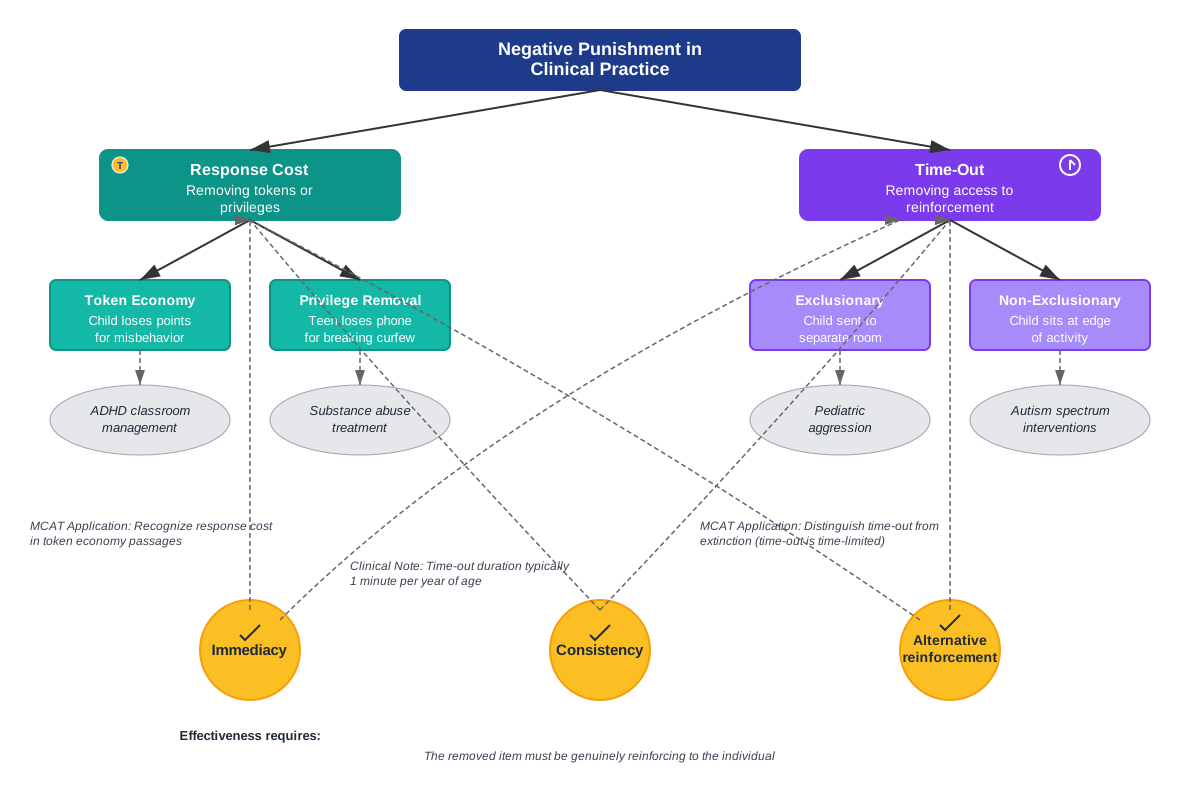
Negative punishment holds substantial clinical and real-world significance across multiple domains of human behavior. In therapeutic settings, techniques like response cost (removing tokens or privileges) and time-out procedures (removing access to reinforcement) represent direct applications of negative punishment principles. Parents, educators, and clinicians regularly employ these strategies to reduce maladaptive behaviors in children and adults. Understanding when and why these interventions work—or fail—requires mastery of the underlying psychological mechanisms.
From an MCAT perspective, negative punishment appears in approximately 3-5% of Psychology and Sociology section questions, often embedded within longer passages about child development, behavioral therapy, or learning theory. The exam frequently presents scenarios requiring students to identify which operant conditioning quadrant is being applied, predict behavioral outcomes, or explain why a particular intervention succeeded or failed. Questions may appear as discrete items testing definitional knowledge or as passage-based questions requiring application to complex clinical vignettes.
Common MCAT question formats include: (1) identifying examples of negative punishment from a list of behavioral interventions, (2) predicting which consequence will most effectively reduce a target behavior, (3) explaining why a punishment strategy failed to produce lasting behavioral change, (4) distinguishing between negative punishment and negative reinforcement in ambiguous scenarios, and (5) analyzing the ethical implications of various punishment strategies. The exam particularly favors questions that test the distinction between negative punishment and negative reinforcement, as this represents the most challenging conceptual boundary for students.
Core Concepts
Definition and Mechanism of Negative Punishment
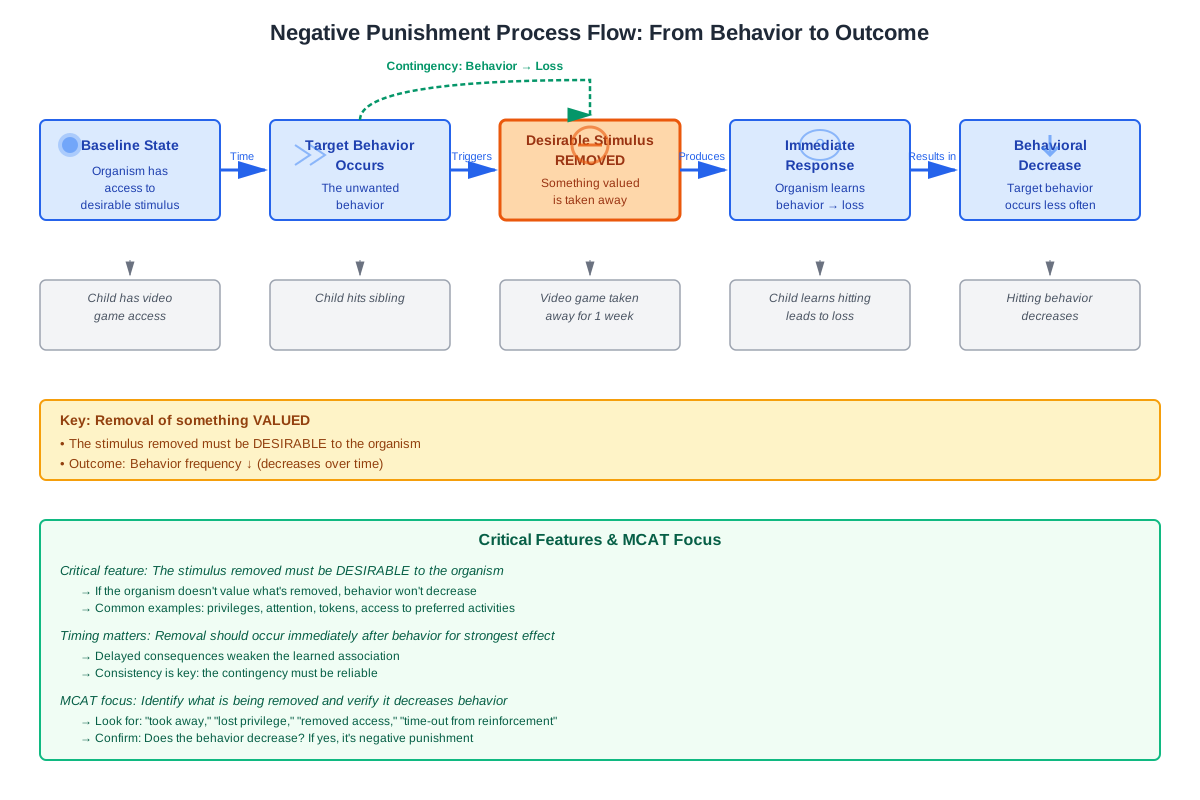
Negative punishment (also called punishment by removal or Type II punishment) is an operant conditioning process in which a behavior decreases in frequency because a desirable or pleasant stimulus is removed contingent upon that behavior occurring. The term "negative" refers specifically to the subtraction or removal of a stimulus, not to anything unpleasant or harmful. The term "punishment" indicates that the consequence decreases the likelihood of the behavior recurring in the future.
The mechanism operates through a three-step contingency: (1) an organism emits a behavior, (2) immediately following that behavior, something the organism values is taken away, and (3) the organism becomes less likely to perform that behavior in the future under similar circumstances. This learning process depends critically on the temporal relationship between behavior and consequence—the removal must occur immediately after the behavior for the association to form effectively.
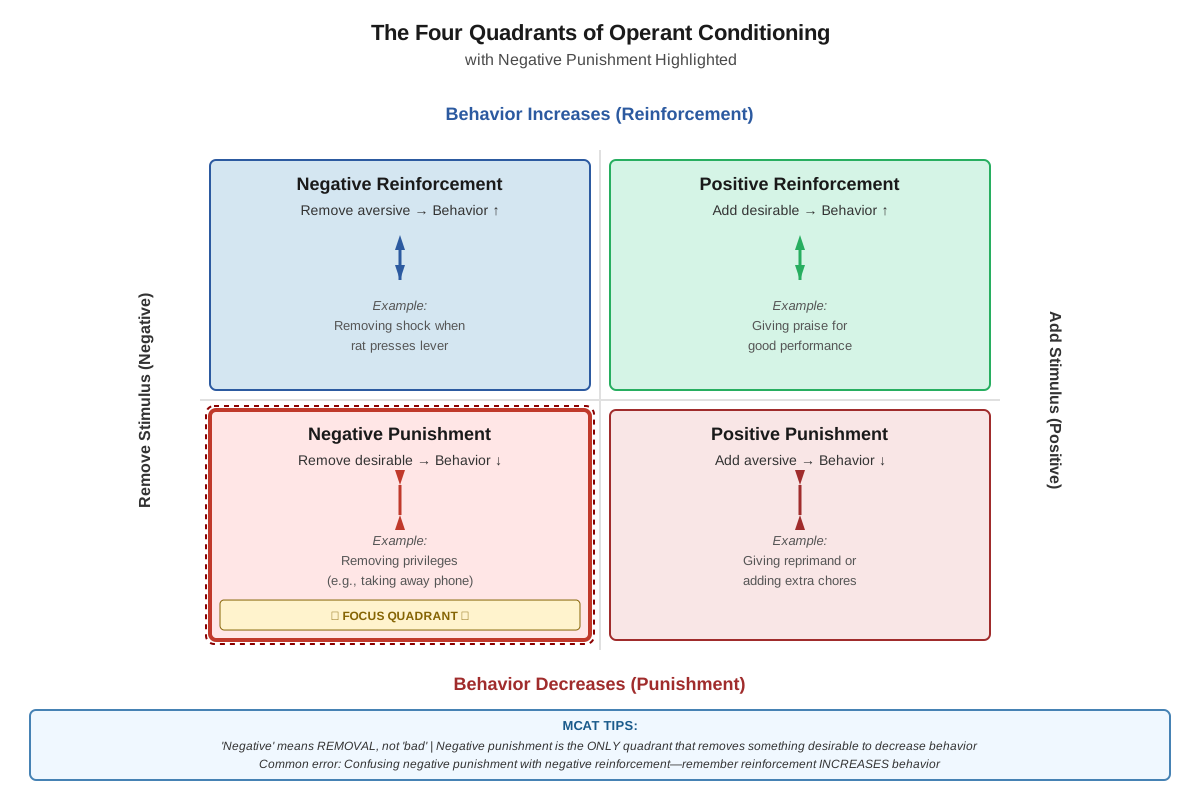
The Four-Quadrant Framework
Understanding negative punishment requires situating it within the complete operant conditioning matrix:
| Consequence Type | Add Stimulus (Positive) | Remove Stimulus (Negative) |
|---|---|---|
| Increases Behavior (Reinforcement) | Positive Reinforcement (add something desirable) | Negative Reinforcement (remove something aversive) |
| Decreases Behavior (Punishment) | Positive Punishment (add something aversive) | Negative Punishment (remove something desirable) |
This framework clarifies that negative punishment occupies a unique position: it decreases behavior (punishment) by removing stimuli (negative). The MCAT frequently tests whether students can correctly categorize behavioral scenarios into these four quadrants.
Key Components of Negative Punishment
Several critical elements determine whether negative punishment will effectively modify behavior:
- Immediacy: The removal must occur immediately after the target behavior for optimal learning
- Consistency: The consequence must follow the behavior reliably across occasions
- Value: The removed stimulus must be genuinely desirable to the organism
- Proportionality: The magnitude of removal should match the severity of the behavior
- Clarity: The organism must understand which specific behavior led to the removal
Common Forms of Negative Punishment
Response cost represents one major category of negative punishment, involving the removal of a specific amount of a reinforcer. Examples include losing points in a token economy system, having money deducted as fines, or losing privileges like screen time. Response cost systems work particularly well when the organism has accumulated reinforcers that can be systematically removed.
Time-out (time-out from positive reinforcement) constitutes another prevalent form, in which the organism is removed from an environment containing reinforcement opportunities. Contrary to popular belief, time-out does not work by isolating the child in an aversive location; rather, it functions by removing access to ongoing reinforcement. For time-out to qualify as negative punishment, the original environment must contain desirable stimuli worth losing.
Privilege removal involves taking away specific activities, objects, or opportunities that the organism values. Examples include revoking driving privileges, canceling planned enjoyable activities, or removing access to preferred toys or electronics. The effectiveness depends entirely on whether the removed item genuinely functions as a reinforcer for that individual.
Factors Affecting Effectiveness
The success of negative punishment interventions depends on multiple variables. Reinforcement history plays a crucial role—if the target behavior has been heavily reinforced in the past, negative punishment alone may prove insufficient. Alternative behaviors must be available and reinforced; simply punishing unwanted behavior without teaching replacement behaviors often leads to frustration and other maladaptive responses.
Satiation effects can undermine negative punishment. If the organism has abundant access to the reinforcer being removed, losing a small amount may not significantly impact behavior. Conversely, deprivation states can enhance effectiveness—removing screen time has greater impact when screen time is limited rather than unlimited.
The schedule of punishment matters considerably. Continuous punishment (removing the reinforcer every time the behavior occurs) typically produces faster learning than intermittent punishment, though intermittent punishment may create more persistent behavior change once established.
Limitations and Ethical Considerations
Negative punishment carries several important limitations. It teaches what not to do but does not directly teach appropriate replacement behaviors. This can lead to behavioral vacuum effects where one problem behavior is eliminated only to be replaced by another. Additionally, negative punishment can produce emotional side effects including frustration, aggression, or escape/avoidance behaviors directed at the punishing agent.
Ethical concerns arise particularly when negative punishment involves removing basic needs or rights, when it is applied inconsistently or arbitrarily, or when it damages the relationship between the punisher and the punished individual. The MCAT may present scenarios requiring students to evaluate whether a punishment strategy crosses ethical boundaries.
Negative Punishment in Applied Settings
In educational contexts, negative punishment appears as loss of recess time, removal of classroom privileges, or point deductions. In clinical settings, behavioral therapists employ response cost systems for conditions like ADHD, oppositional defiant disorder, and substance abuse. Parenting applications include removing toys after aggressive play, ending playdates following rule violations, or taking away electronics after curfew violations.
The criminal justice system employs negative punishment through mechanisms like license suspension, asset forfeiture, and loss of certain civil rights. Understanding these applications helps students recognize negative punishment across diverse MCAT passage contexts.
Concept Relationships
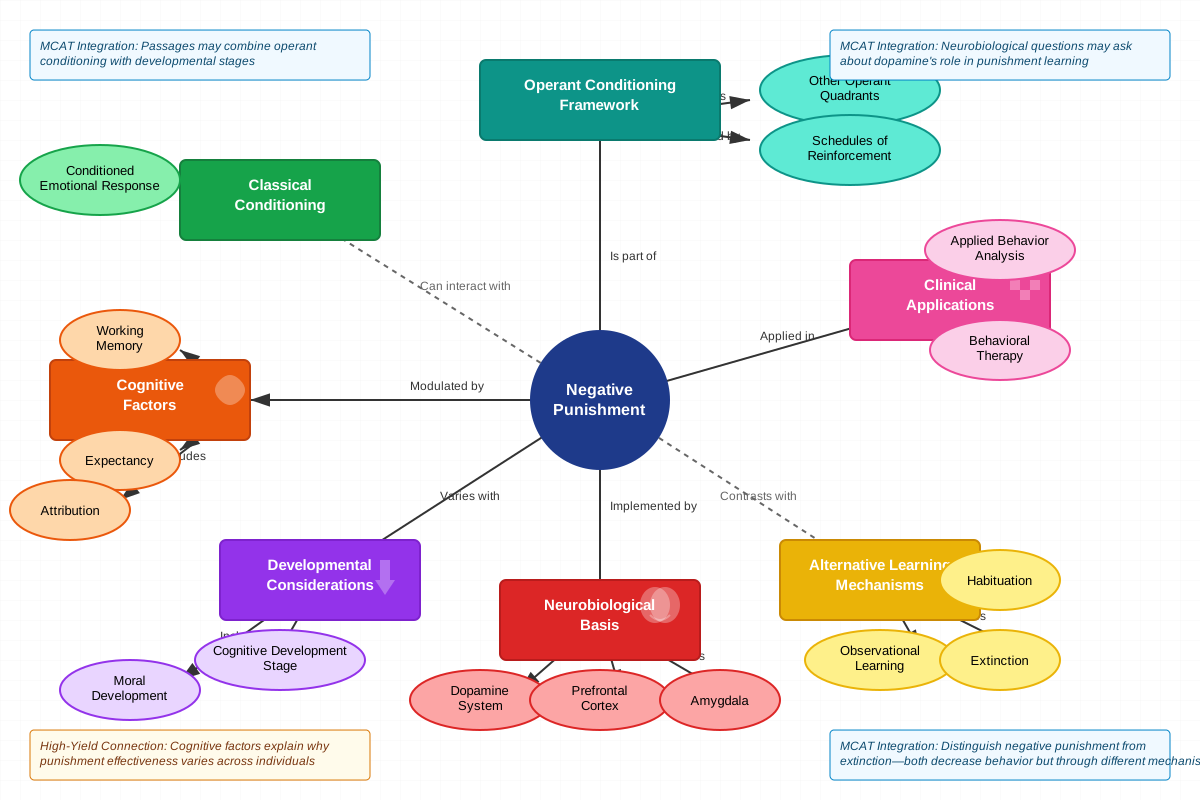
Negative punishment exists within a hierarchical conceptual network. At the broadest level, it falls under Learning and Memory, specifically within the operant conditioning branch of associative learning. It contrasts directly with classical conditioning, which involves learning associations between stimuli rather than between behaviors and consequences.
Within operant conditioning, negative punishment forms a complementary relationship with positive reinforcement—the most effective behavioral interventions typically combine both, punishing unwanted behaviors while simultaneously reinforcing desired alternatives. This relationship appears frequently in MCAT passages about behavioral therapy or classroom management.
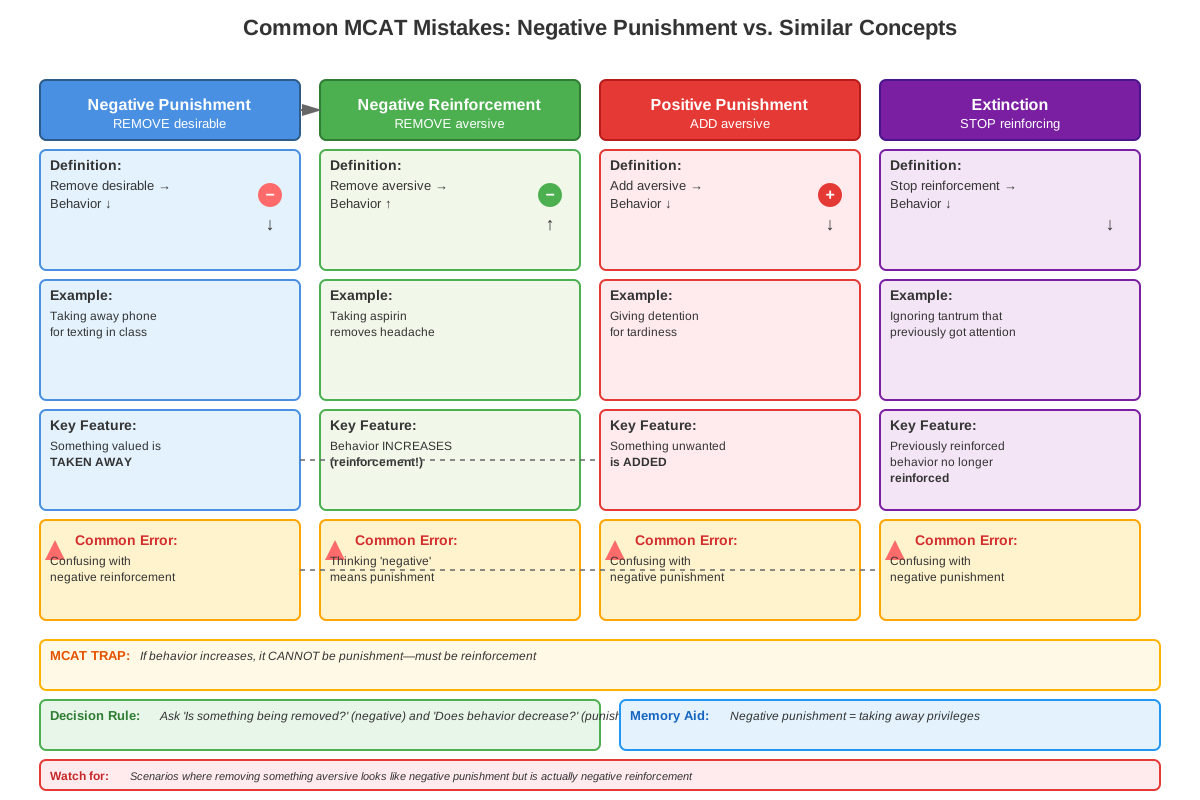
Negative punishment must be carefully distinguished from negative reinforcement, despite the shared "negative" terminology. Both involve removing stimuli, but negative reinforcement increases behavior (reinforcement) while negative punishment decreases it (punishment). This distinction represents the single most tested conceptual boundary in Negative punishment Psychology questions.
The relationship to extinction deserves attention: both processes decrease behavior, but through different mechanisms. Extinction involves withholding reinforcement that previously maintained a behavior, while negative punishment actively removes a reinforcer contingent on the behavior. Extinction typically produces slower behavioral change and more pronounced extinction bursts.
Negative punishment connects to motivation theory through its reliance on the value organisms place on removed stimuli. It relates to developmental psychology through age-appropriate applications and the cognitive capacity required to understand punishment contingencies. Links to social psychology emerge when considering how punishment affects relationships and social dynamics.
The conceptual flow can be mapped as: Operant Conditioning → Punishment (decreases behavior) → Negative Punishment (removal-based) → Specific applications (response cost, time-out, privilege removal) → Behavioral outcomes (decreased target behavior, potential side effects).
Quick check — test yourself on Negative punishment so far.
Try Flashcards →High-Yield Facts
⭐ Negative punishment decreases behavior by removing a desirable stimulus immediately following that behavior
⭐ The term "negative" refers to subtraction/removal, not to anything unpleasant or harmful
⭐ Negative punishment differs from negative reinforcement: punishment decreases behavior, reinforcement increases it
⭐ Time-out works by removing access to reinforcement, not by placing someone in an aversive environment
⭐ Response cost involves removing a specific quantity of accumulated reinforcers (tokens, points, money)
- Negative punishment is most effective when combined with positive reinforcement of alternative behaviors
- Consistency and immediacy are critical factors determining negative punishment effectiveness
- Emotional side effects of punishment can include frustration, aggression, and avoidance of the punishing agent
- Negative punishment does not teach what to do, only what not to do
- The removed stimulus must genuinely function as a reinforcer for that individual for negative punishment to work
- Intermittent punishment schedules can produce more resistant behavioral change than continuous schedules
- Ethical applications of negative punishment avoid removing basic needs or damaging relationships
- Negative punishment effectiveness decreases when the organism has abundant access to the removed reinforcer
Common Misconceptions
Misconception: Negative punishment means something bad or harmful happens to the organism → Correction: "Negative" is a mathematical term meaning subtraction or removal; negative punishment specifically involves removing something desirable, and the term carries no inherent value judgment about whether the procedure is harmful or beneficial.
Misconception: Negative punishment and negative reinforcement are essentially the same thing since both involve removing stimuli → Correction: These are opposite processes—negative reinforcement increases behavior by removing aversive stimuli (like taking pain medication to remove pain), while negative punishment decreases behavior by removing desirable stimuli (like losing phone privileges for breaking curfew).
Misconception: Time-out works because the child is placed somewhere boring or unpleasant → Correction: Time-out functions as negative punishment specifically by removing the child from an environment containing positive reinforcement; if the original environment lacks reinforcement, time-out cannot work as intended and may even function as negative reinforcement if it removes the child from an aversive situation.
Misconception: Any consequence that involves taking something away is negative punishment → Correction: Negative punishment requires that (1) something desirable is removed, (2) the removal is contingent on a specific behavior, and (3) the behavior subsequently decreases; simply removing something without these conditions does not constitute negative punishment.
Misconception: Negative punishment alone is sufficient to eliminate unwanted behaviors permanently → Correction: Effective behavioral interventions typically require combining negative punishment with positive reinforcement of alternative appropriate behaviors; punishment alone teaches what not to do but does not teach replacement skills, often leading to behavioral vacuum effects.
Misconception: If a punishment doesn't work immediately, it means negative punishment is ineffective for that behavior → Correction: Effectiveness depends on multiple factors including the value of the removed stimulus, consistency of application, reinforcement history, and availability of alternative behaviors; failure may indicate improper implementation rather than inherent ineffectiveness of the principle.
Worked Examples
Example 1: Distinguishing Operant Conditioning Quadrants
Scenario: A researcher is studying four different classroom management strategies:
- Strategy A: Students earn stickers for completing homework (behavior increases)
- Strategy B: Students lose 5 minutes of recess for talking out of turn (behavior decreases)
- Strategy C: Students are allowed to leave the noisy cafeteria early if they finish lunch quickly (behavior increases)
- Strategy D: Students receive a verbal reprimand for running in hallways (behavior decreases)
Question: Which strategy represents negative punishment?
Step 1 - Identify behavior change direction: We need a strategy that decreases behavior (punishment), which narrows options to B and D.
Step 2 - Determine whether stimulus is added or removed:
- Strategy B: Recess time is removed (negative/subtraction)
- Strategy D: A reprimand is added (positive/addition)
Step 3 - Apply definitions: Strategy B decreases behavior (punishment) by removing something desirable (negative), making it negative punishment. Strategy D decreases behavior (punishment) by adding something aversive (positive), making it positive punishment.
Answer: Strategy B represents negative punishment.
Connection to learning objectives: This example demonstrates the critical skill of distinguishing negative punishment from other operant conditioning quadrants, particularly positive punishment, which students frequently confuse.
Example 2: Clinical Application Analysis
Scenario: A behavioral therapist is treating a 7-year-old child with ADHD who frequently interrupts others during conversation. The therapist implements a token economy system where the child earns tokens for appropriate behaviors and can exchange them for preferred activities. When the child interrupts, the therapist removes two tokens from the child's collection. After three weeks, interrupting behavior has decreased by 60%.
Question: Analyze this intervention using operant conditioning principles and explain why it was effective.
Step 1 - Identify the operant conditioning mechanism: When interrupting occurs, tokens (desirable stimuli) are removed, and the behavior decreases. This is negative punishment (specifically, response cost).
Step 2 - Identify supporting factors: The intervention includes several elements that enhance effectiveness:
- Tokens have established value (can be exchanged for preferred activities)
- Removal is immediate and consistent
- The system also includes positive reinforcement (earning tokens for appropriate behaviors)
- The magnitude (two tokens) is proportional to the behavior
Step 3 - Explain the mechanism: The child learns that interrupting leads to loss of access to preferred activities (through token removal). The immediate consequence creates a clear contingency between the behavior and its outcome. The combination of punishing interruptions while reinforcing appropriate conversation skills provides both suppression of unwanted behavior and teaching of replacement behaviors.
Step 4 - Consider limitations: The 60% reduction, while substantial, is not complete elimination. This is typical of negative punishment, which may require combination with other strategies for complete behavior change. The therapist should continue monitoring for potential side effects like frustration or attempts to circumvent the system.
Connection to learning objectives: This example demonstrates application to clinical scenarios, identification of factors affecting effectiveness, and recognition that optimal interventions combine negative punishment with positive reinforcement.
Exam Strategy
When approaching Negative punishment MCAT questions, employ a systematic decision tree. First, determine whether the behavior increases or decreases—this immediately divides the four quadrants into reinforcement (increases) versus punishment (decreases). Second, identify whether a stimulus is added or removed—this distinguishes positive (addition) from negative (subtraction) procedures.
Trigger words for negative punishment include: "loses," "forfeits," "removal of," "takes away," "privilege revoked," "time-out," "response cost," "loses access to," and "confiscated." Be alert for scenarios describing children losing recess, teenagers losing phone privileges, or patients losing tokens or points.
Elimination strategies prove particularly valuable. If a question asks about negative punishment, immediately eliminate any answer choices describing:
- Addition of stimuli (these are positive procedures)
- Behavior increases (these are reinforcement)
- Removal of aversive stimuli (this is negative reinforcement)
- Withholding previously delivered reinforcement without contingency (this is extinction)
Exam Tip: The MCAT loves to test the negative punishment versus negative reinforcement distinction. Create a quick mental check: "Does the behavior go up or down?" If down, it's punishment; if up, it's reinforcement. This single question eliminates 50% of wrong answers.
Time allocation for these questions should be approximately 60-90 seconds for discrete items and 90-120 seconds for passage-based applications. The conceptual framework is straightforward once mastered, so avoid overthinking. If you find yourself spending more than two minutes on an operant conditioning question, you likely lack clarity on the fundamental definitions and should flag the question for review.
Common trap answers include:
- Negative reinforcement examples labeled as negative punishment
- Extinction procedures mislabeled as negative punishment
- Positive punishment examples with confusing wording
- Scenarios where the "removed" stimulus was actually aversive (making it negative reinforcement)
When analyzing passages, pay attention to the temporal sequence: the stimulus removal must follow the behavior, not precede it. Also verify that the removed stimulus was genuinely desirable to the organism—removing something the organism dislikes would not constitute negative punishment.
Memory Techniques
The "RAIN" mnemonic for negative punishment:
- Removal of something
- After the behavior
- Immediately following
- Now the behavior decreases
The "Subtraction Punishment" visualization: Picture a minus sign (−) combined with a downward arrow (↓). The minus represents "negative" (removal), and the downward arrow represents "punishment" (behavior decreases). This visual instantly distinguishes negative punishment from negative reinforcement (minus sign with upward arrow).
The "Take Away/Take Away" phrase: Negative punishment "takes away" something desirable, which "takes away" the likelihood of the behavior recurring. This double meaning reinforces both the mechanism and the outcome.
The Four-Quadrant Hand Trick:
- Hold up your right hand, palm facing you
- Top two fingers = reinforcement (behavior goes up)
- Bottom two fingers = punishment (behavior goes down)
- Thumb side = positive (add stimulus)
- Pinky side = negative (remove stimulus)
- Bottom pinky finger = negative punishment
The "Privilege Loss" anchor: Whenever you see "negative punishment" on the exam, immediately think of a teenager losing car privileges for breaking curfew. This concrete, relatable example anchors the abstract concept and helps you evaluate whether other scenarios match the same pattern.
Summary
Negative punishment represents a fundamental operant conditioning mechanism in which behavior decreases because a desirable stimulus is removed contingent upon that behavior. The term "negative" refers specifically to subtraction or removal, while "punishment" indicates that the consequence reduces future behavior frequency. This concept occupies one quadrant of the four-part operant conditioning framework and must be carefully distinguished from negative reinforcement (which increases behavior by removing aversive stimuli), positive punishment (which decreases behavior by adding aversive stimuli), and extinction (which decreases behavior by withholding reinforcement). Common applications include response cost systems, time-out procedures, and privilege removal in educational, clinical, and parenting contexts. Effectiveness depends on factors including immediacy, consistency, the value of the removed stimulus, and the availability of reinforced alternative behaviors. For MCAT success, students must master the definitional distinctions, recognize examples across diverse contexts, and understand both the mechanisms and limitations of negative punishment interventions.
Key Takeaways
- Negative punishment decreases behavior by removing desirable stimuli immediately following that behavior—the "negative" refers to subtraction, not to anything harmful
- The critical distinction from negative reinforcement is behavioral outcome: punishment decreases behavior while reinforcement increases it, despite both involving stimulus removal
- Common forms include response cost (removing tokens/points), time-out (removing access to reinforcement), and privilege removal (taking away valued activities or objects)
- Effectiveness requires that the removed stimulus genuinely functions as a reinforcer for that individual, and that removal occurs immediately and consistently
- Optimal behavioral interventions combine negative punishment of unwanted behaviors with positive reinforcement of appropriate replacement behaviors
- Time-out works specifically by removing access to ongoing reinforcement, not by placing someone in an aversive location
- MCAT questions frequently test the ability to distinguish negative punishment from the other three operant conditioning quadrants, particularly negative reinforcement
Related Topics
Positive Reinforcement: Understanding how adding desirable stimuli increases behavior complements negative punishment knowledge and enables comprehensive analysis of behavioral interventions that combine both approaches.
Negative Reinforcement: Mastering the distinction between removing aversive stimuli (negative reinforcement) and removing desirable stimuli (negative punishment) is essential for MCAT success and represents the most commonly tested conceptual boundary.
Extinction and Spontaneous Recovery: These concepts explain how behaviors decrease when reinforcement is withheld, providing important context for understanding when negative punishment is versus is not the operative mechanism.
Schedules of Reinforcement and Punishment: Learning how continuous versus intermittent consequences affect behavior change helps predict the long-term effectiveness of negative punishment interventions.
Classical Conditioning: Understanding the distinction between associative learning through stimulus-stimulus pairings versus behavior-consequence contingencies provides essential context for operant conditioning principles.
Behavioral Therapy Applications: Clinical applications of operant conditioning principles, including token economies and contingency management, demonstrate how negative punishment integrates into comprehensive treatment approaches.
Practice CTA
Now that you have mastered the core concepts of negative punishment, challenge yourself with practice questions that test your ability to distinguish this mechanism from other operant conditioning quadrants, apply it to clinical scenarios, and predict behavioral outcomes. Work through the accompanying flashcards to reinforce the critical distinctions between negative punishment, negative reinforcement, positive punishment, and positive reinforcement. Remember: the MCAT rewards precision in terminology and systematic analysis of behavioral contingencies. Your ability to quickly categorize scenarios and eliminate wrong answers will directly impact your Psychology section score. You have built a strong foundation—now apply it through deliberate practice!
Sign up free to keep reading
Create a free AnvayaPrep account to finish this MCAT guide on Negative punishment — plus flashcards and practice questions.