Overview
Reinforcement schedules are systematic patterns that determine when and how often a behavior is reinforced in operant conditioning. These schedules represent one of the most fundamental concepts in behavioral psychology and are critical for understanding how behaviors are acquired, maintained, and extinguished. In the context of Learning and Memory within Psychology, reinforcement schedules bridge the gap between basic learning principles and real-world behavioral patterns, explaining everything from gambling addiction to workplace productivity to therapeutic interventions.
For the MCAT, reinforcement schedules appear frequently in both discrete questions and passage-based scenarios. The exam tests not only definitional knowledge but also the ability to analyze behavioral patterns, predict resistance to extinction, and apply these principles to clinical and research contexts. Understanding reinforcement schedules is essential because they form the foundation of operant conditioning—one of the three major learning paradigms alongside classical conditioning and observational learning. Questions often present experimental scenarios or clinical vignettes requiring students to identify which schedule is being used and predict behavioral outcomes.
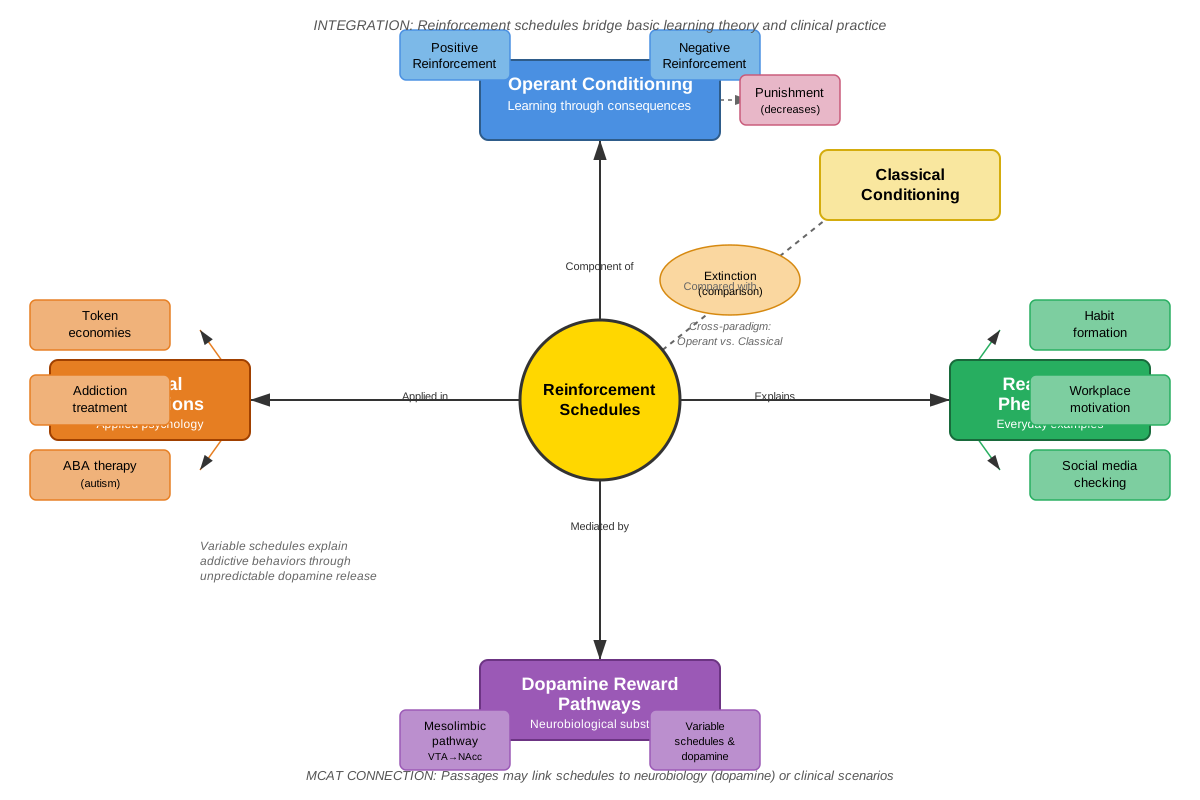
The big-picture relationship to other Psychology concepts is substantial. Reinforcement schedules connect directly to operant conditioning principles (positive/negative reinforcement, punishment), learning theory more broadly, and behavioral modification techniques used in clinical psychology. They also relate to motivation, habit formation, and even neurobiological reward pathways involving dopamine. Mastering this topic provides a framework for understanding how environmental contingencies shape behavior across diverse contexts, from animal research to human psychopathology.
Learning Objectives
- [ ] Define Reinforcement schedules using accurate Psychology terminology
- [ ] Explain why Reinforcement schedules matters for the MCAT
- [ ] Apply Reinforcement schedules to exam-style questions
- [ ] Identify common mistakes related to Reinforcement schedules
- [ ] Connect Reinforcement schedules to related Psychology concepts
- [ ] Distinguish between continuous and partial (intermittent) reinforcement schedules
- [ ] Compare and contrast the four types of partial reinforcement schedules in terms of response patterns and extinction resistance
- [ ] Predict behavioral outcomes based on specific reinforcement schedule parameters
Prerequisites
- Operant conditioning basics: Understanding reinforcement (positive and negative) versus punishment is essential because reinforcement schedules describe when reinforcement occurs, not what reinforcement is.
- Classical conditioning fundamentals: Provides context for comparing different learning paradigms and understanding extinction processes across conditioning types.
- Basic behavioral terminology: Familiarity with terms like stimulus, response, acquisition, extinction, and spontaneous recovery enables precise discussion of schedule effects.
- Experimental design principles: Necessary for interpreting research passages that manipulate reinforcement schedules as independent variables.
Why This Topic Matters
Reinforcement schedules have profound clinical and real-world significance. They explain why certain behaviors persist despite inconsistent rewards (gambling addiction operates on a variable ratio schedule), how to design effective behavioral interventions (token economies in psychiatric settings), and why habits are so difficult to break (behaviors learned under partial reinforcement resist extinction). In clinical psychology, understanding these schedules informs treatment approaches for substance use disorders, behavioral therapy for children with autism spectrum disorder, and workplace motivation strategies.
On the MCAT, reinforcement schedules appear in approximately 3-5% of Psychology/Sociology section questions, making them high-yield content. Questions typically fall into three categories: (1) identification questions asking students to recognize which schedule is described in a scenario, (2) prediction questions requiring students to forecast response rates or extinction resistance, and (3) application questions embedding schedules within research passages about learning experiments or clinical interventions. The AAMC frequently presents graphs showing cumulative response patterns (scalloped curves for fixed interval, steady rates for variable ratio) that students must interpret.
Common passage contexts include animal learning experiments (rats pressing levers, pigeons pecking keys), workplace compensation systems (salary versus commission), educational settings (pop quizzes versus scheduled exams), and clinical behavioral modification programs. The exam particularly favors scenarios that require distinguishing between ratio and interval schedules or explaining why variable schedules produce greater resistance to extinction than fixed schedules.
Core Concepts
Continuous Versus Partial Reinforcement
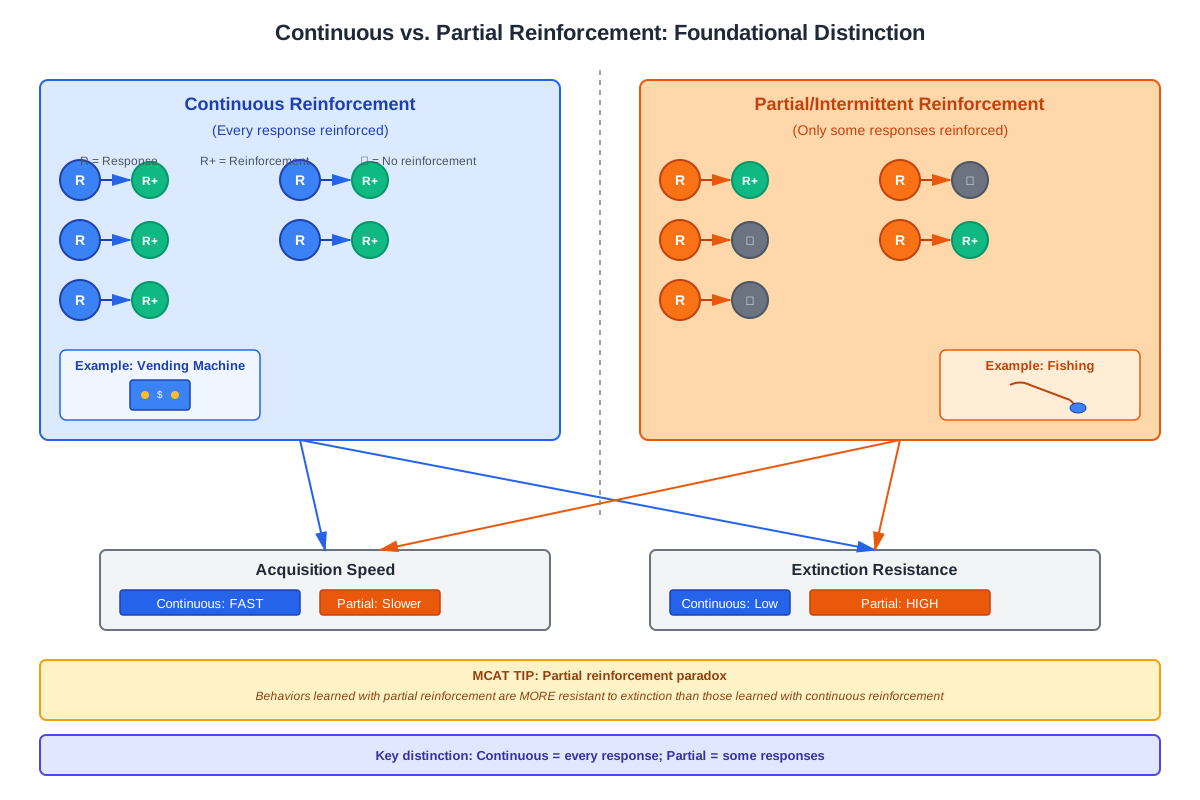
Continuous reinforcement occurs when every instance of the target behavior receives reinforcement. This schedule produces rapid initial learning (acquisition) but also leads to rapid extinction when reinforcement stops. For example, if a vending machine delivers a snack every time correct change is inserted, the behavior is continuously reinforced. However, if the machine breaks and stops delivering snacks, the behavior of using that machine extinguishes quickly.
Partial reinforcement (also called intermittent reinforcement) occurs when only some instances of the behavior are reinforced. This produces slower initial acquisition but much greater resistance to extinction—a phenomenon called the partial reinforcement extinction effect. The unpredictability of reinforcement makes it difficult for the organism to detect when reinforcement has stopped entirely, so responding persists longer during extinction.
The Four Partial Reinforcement Schedules
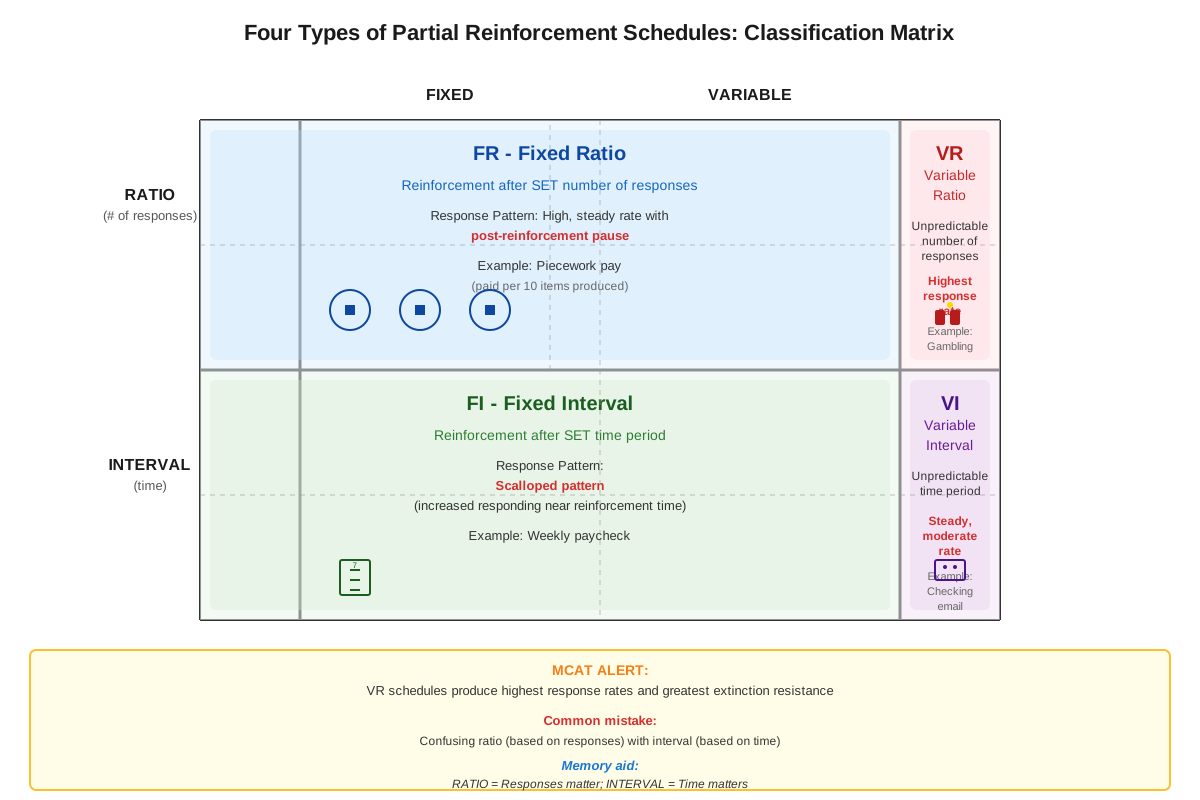
Partial reinforcement schedules are categorized along two dimensions: ratio versus interval (what determines reinforcement delivery) and fixed versus variable (whether the schedule is predictable or unpredictable).
Fixed Ratio (FR) Schedule
In a fixed ratio schedule, reinforcement is delivered after a specific, constant number of responses. For example, FR-5 means reinforcement occurs after every 5 responses. This schedule produces:
- High, steady response rates (the more you respond, the more reinforcement you get)
- Post-reinforcement pause: a brief pause in responding immediately after receiving reinforcement, followed by rapid responding
- Moderate resistance to extinction
Real-world examples include piecework pay (paid per item produced), coffee shop punch cards (buy 10 coffees, get 1 free), and commission-based sales. The predictability of the schedule creates the characteristic pause-and-respond pattern.
Variable Ratio (VR) Schedule
In a variable ratio schedule, reinforcement is delivered after an unpredictable number of responses that average to a specific value. VR-10 means reinforcement occurs on average every 10 responses, but might come after 3, then 15, then 8 responses. This schedule produces:
- Highest response rates of all schedules (rapid, steady responding with no pauses)
- Greatest resistance to extinction (the "slot machine effect")
- No post-reinforcement pause (the next reinforcement could come immediately)
Gambling, particularly slot machines, exemplifies this schedule perfectly. Sales calls (unpredictable number of calls needed to make a sale) and fishing (unpredictable number of casts to catch a fish) also follow VR schedules. The unpredictability maintains persistent responding because "the next one might pay off."
Fixed Interval (FI) Schedule
In a fixed interval schedule, reinforcement is available for the first response after a specific, constant time period has elapsed. FI-30s means the first response after 30 seconds earns reinforcement; responses during the interval are not reinforced. This schedule produces:
- Scalloped response pattern: low responding immediately after reinforcement, gradually increasing as the interval end approaches
- Low overall response rate compared to ratio schedules
- Moderate resistance to extinction
Examples include checking the mailbox (mail arrives once daily at approximately the same time), studying behavior before scheduled exams (cramming increases as exam approaches), and checking a turkey in the oven at regular intervals. The predictability allows organisms to time their responses efficiently.
Variable Interval (VI) Schedule
In a variable interval schedule, reinforcement is available for the first response after an unpredictable time period that averages to a specific value. VI-60s means reinforcement becomes available on average every 60 seconds, but the actual intervals vary unpredictably. This schedule produces:
- Steady, moderate response rate (consistent responding without pauses)
- High resistance to extinction (second only to VR)
- No scalloping (unpredictability prevents timing)
Pop quizzes in school exemplify VI schedules—students cannot predict when quizzes occur, so consistent studying is maintained. Checking email or social media (unpredictable timing of new messages), fishing in a well-stocked pond, and waiting for a bus with an unreliable schedule also follow VI patterns.
Comparative Summary Table
| Schedule | Basis | Predictability | Response Rate | Pattern | Extinction Resistance |
|---|---|---|---|---|---|
| Fixed Ratio (FR) | Number of responses | Fixed | High | Post-reinforcement pause | Moderate |
| Variable Ratio (VR) | Number of responses | Variable | Highest | Steady, no pauses | Highest |
| Fixed Interval (FI) | Time elapsed | Fixed | Low-Moderate | Scalloped | Moderate |
| Variable Interval (VI) | Time elapsed | Variable | Moderate | Steady | High |
Response Patterns and Cumulative Records
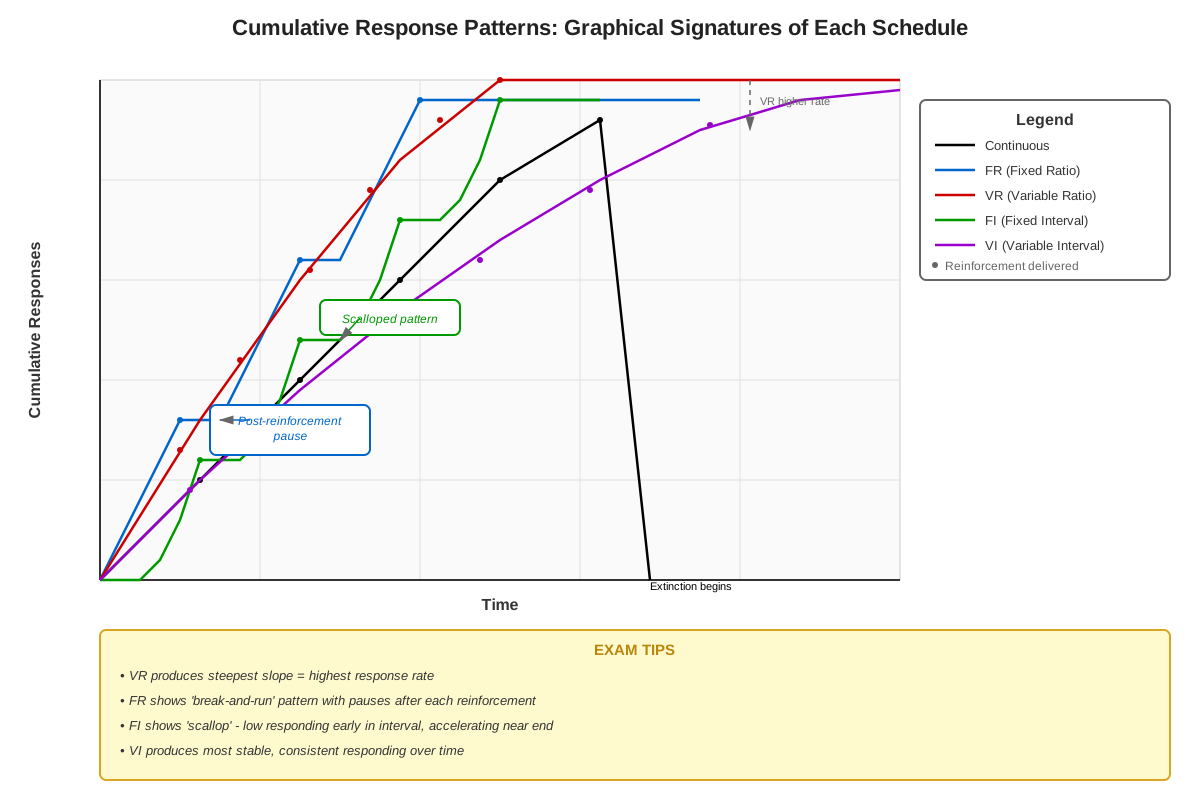
Behavioral psychologists traditionally represent reinforcement schedule effects using cumulative response records—graphs where the x-axis represents time and the y-axis represents cumulative responses. The slope of the line indicates response rate (steeper = faster responding). Understanding these visual representations is crucial for MCAT passages:
- FR schedules: Steep slopes with brief flat periods (pauses) after reinforcement marks
- VR schedules: Consistently steep slopes with no pauses
- FI schedules: Characteristic scalloped curves (flat then steep, repeating)
- VI schedules: Moderate, consistent slopes
Extinction and Resistance
Extinction in operant conditioning occurs when reinforcement stops and the behavior gradually decreases. The partial reinforcement extinction effect explains why behaviors learned under partial schedules (especially variable schedules) persist much longer during extinction than those learned under continuous reinforcement. The organism cannot easily discriminate between "reinforcement is delayed" and "reinforcement has stopped," so responding continues.
This principle has critical clinical implications: maladaptive behaviors maintained by intermittent reinforcement (like tantrums that occasionally result in getting desired items) are particularly difficult to extinguish and require consistent non-reinforcement during behavioral interventions.
Concept Relationships
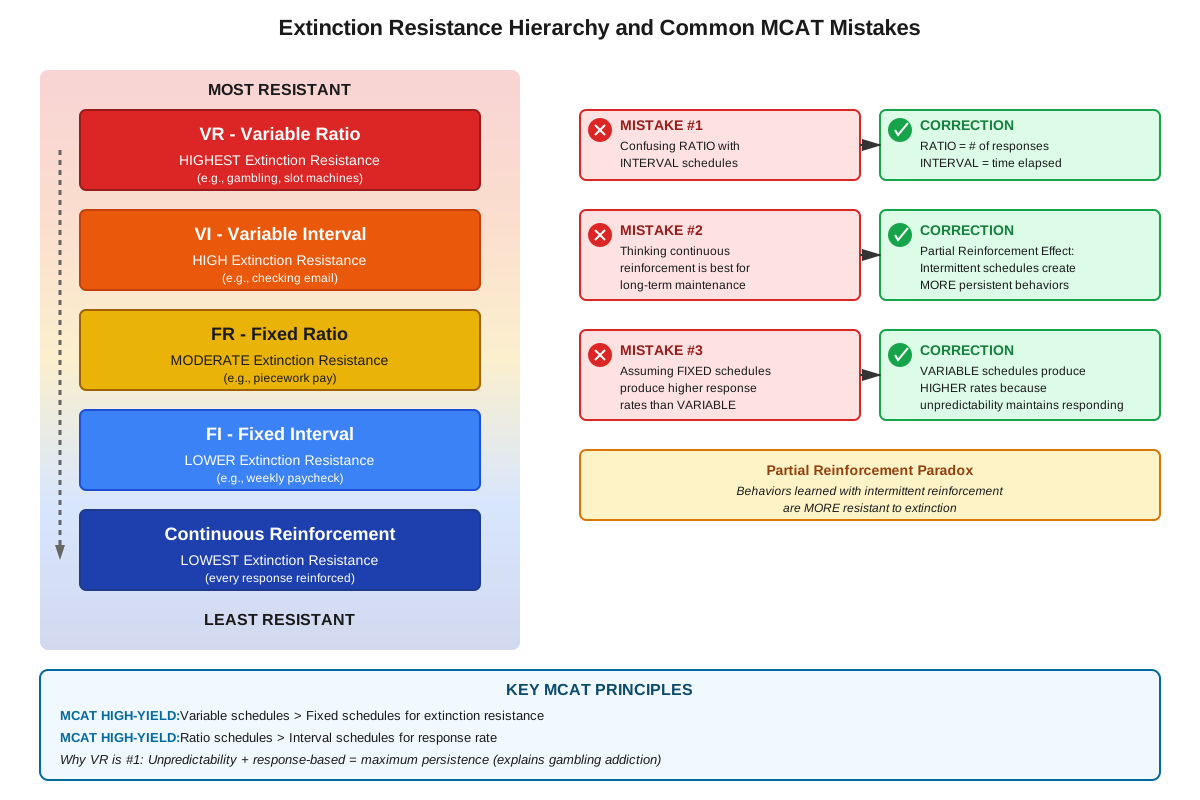
The four partial reinforcement schedules form an interconnected system organized along two orthogonal dimensions. Ratio schedules (FR and VR) share the common feature of reinforcement based on response count, leading to generally higher response rates than interval schedules (FI and VI), which base reinforcement on time passage. Within each category, variable schedules (VR and VI) produce greater resistance to extinction and more consistent responding than fixed schedules (FR and FI) due to unpredictability.
Continuous reinforcement → serves as the foundation for understanding partial schedules by providing the comparison point. It demonstrates that 100% reinforcement produces fastest acquisition but poorest extinction resistance, establishing the inverse relationship between reinforcement consistency and behavioral persistence.
Partial reinforcement extinction effect → emerges from the comparison between continuous and partial schedules, explaining the paradox that less consistent reinforcement produces more persistent behavior. This connects to discrimination learning (the organism's ability to detect when contingencies change) and generalization (responding similarly across similar contexts).
The relationship to broader operant conditioning principles is hierarchical: reinforcement schedules specify when reinforcement (the consequence that increases behavior) is delivered. This connects to shaping (successive approximations often use continuous reinforcement initially, then shift to partial schedules for maintenance) and behavioral modification programs (which strategically manipulate schedules to achieve therapeutic goals).
Connections to motivation and reward pathways in neuroscience reveal that variable ratio schedules produce particularly robust dopamine responses in the nucleus accumbens, explaining their powerful motivational properties and addiction potential. This bridges behavioral and biological levels of analysis—a common MCAT theme.
Quick check — test yourself on Reinforcement schedules so far.
Try Flashcards →High-Yield Facts
⭐ Variable ratio (VR) schedules produce the highest response rates and greatest resistance to extinction of all reinforcement schedules.
⭐ Fixed interval (FI) schedules produce characteristic scalloped response patterns with low responding after reinforcement and increasing responding as the interval end approaches.
⭐ The partial reinforcement extinction effect explains why behaviors learned under intermittent reinforcement are more difficult to extinguish than those learned under continuous reinforcement.
⭐ Ratio schedules (FR and VR) generally produce higher response rates than interval schedules (FI and VI) because reinforcement depends on response count rather than time passage.
⭐ Variable schedules (VR and VI) produce more consistent responding without pauses compared to fixed schedules (FR and FI) due to unpredictability.
- Fixed ratio schedules produce a post-reinforcement pause—a brief period of no responding immediately after reinforcement delivery.
- Continuous reinforcement is optimal for initial acquisition (learning) of new behaviors, while partial schedules are better for maintenance.
- Gambling operates primarily on variable ratio schedules, explaining its addictive properties and resistance to extinction despite losses.
- Variable interval schedules produce steady, moderate response rates without the scalloping seen in fixed interval schedules.
- In applied settings, transitioning from continuous to partial reinforcement (schedule thinning) helps maintain behaviors while reducing reinforcement frequency.
- The predictability of fixed schedules allows organisms to optimize responding (pause when reinforcement is unavailable), while variable schedules maintain consistent responding.
Common Misconceptions
Misconception: Reinforcement schedules and types of reinforcement (positive/negative) are the same thing.
Correction: Reinforcement schedules describe when reinforcement is delivered (timing/frequency), while types of reinforcement describe what the reinforcement is (adding something pleasant or removing something aversive). Any schedule can use any type of reinforcement.
Misconception: Fixed ratio schedules produce the highest response rates because reinforcement is predictable.
Correction: Variable ratio schedules actually produce the highest response rates because unpredictability eliminates post-reinforcement pauses and maintains constant responding. Fixed ratio schedules produce high rates but include characteristic pauses after reinforcement.
Misconception: Interval schedules reinforce the passage of time itself.
Correction: Interval schedules make reinforcement available after time passes, but a response is still required to obtain reinforcement. The organism must respond after the interval elapses; simply waiting does not produce reinforcement.
Misconception: Continuous reinforcement produces the most persistent behaviors because every response is reinforced.
Correction: Continuous reinforcement actually produces the least persistent behaviors during extinction. Partial (intermittent) reinforcement produces greater resistance to extinction because the organism cannot easily detect when reinforcement has stopped entirely.
Misconception: Variable schedules are always better than fixed schedules for behavioral interventions.
Correction: The optimal schedule depends on the goal. Fixed schedules are better when predictability is desired (like regular paychecks maintaining employment) or when teaching temporal discrimination. Variable schedules are better when maintaining high, persistent responding is the goal.
Misconception: In a fixed interval schedule, responses during the interval are punished or discouraged.
Correction: Responses during the interval are simply not reinforced (they have no consequence), which is different from punishment. The organism learns through experience that responses before the interval ends are ineffective, leading to the scalloped pattern.
Worked Examples
Example 1: Identifying Schedules in a Research Passage
Scenario: A researcher studying workplace productivity implements three different payment systems. Group A receives $10 for every 20 widgets assembled. Group B receives $10 at unpredictable times, averaging once per hour. Group C receives $10 for every hour worked, paid at the end of each hour. Which reinforcement schedules are being used, and what response patterns would you predict?
Analysis:
Step 1: Identify the basis of reinforcement for each group.
- Group A: Reinforcement based on number of responses (widgets assembled) = ratio schedule
- Group B: Reinforcement based on time passage = interval schedule
- Group C: Reinforcement based on time passage = interval schedule
Step 2: Determine if schedules are fixed or variable.
- Group A: Specific, constant number (every 20 widgets) = fixed ratio (FR-20)
- Group B: Unpredictable timing, averaging to a value = variable interval (VI-1hr)
- Group C: Specific, constant time period (every hour) = fixed interval (FI-1hr)
Step 3: Predict response patterns based on schedule characteristics.
Group A (FR-20): Expect high response rates with brief post-reinforcement pauses. Workers will assemble widgets rapidly, pause briefly after receiving payment, then resume rapid work. Overall productivity will be high because more work directly produces more pay.
Group B (VI-1hr): Expect steady, moderate response rates without pauses. Workers will maintain consistent productivity throughout the day because payment could come at any time. This schedule prevents "slacking off" periods.
Group C (FI-1hr): Expect scalloped response patterns with low productivity immediately after payment and increasing productivity as the hour-end approaches. Workers might take breaks or work slowly early in each hour, then work more intensely as payment time nears.
Connection to learning objectives: This example demonstrates application of schedule definitions to predict real-world behavioral outcomes, a common MCAT question format.
Example 2: Extinction Resistance in Clinical Context
Scenario: A behavioral therapist is treating a child whose tantrums are maintained by parental attention. The parents report that they "usually ignore the tantrums, but sometimes give in when they become too intense." After implementing a consistent extinction protocol (never reinforcing tantrums), the tantrums initially worsen and persist for weeks before decreasing. Why did extinction take so long, and what principle explains the initial worsening?
Analysis:
Step 1: Identify the reinforcement schedule maintaining the behavior.
The parents "usually ignore but sometimes give in" describes variable ratio reinforcement—the child cannot predict how many tantrums (or how intense) will result in attention, but persistence occasionally pays off. This is analogous to gambling: most attempts fail, but occasional success maintains the behavior.
Step 2: Apply the partial reinforcement extinction effect.
Behaviors maintained by partial (intermittent) reinforcement, especially variable schedules, show the greatest resistance to extinction. The child's tantrums were maintained by a VR schedule, which produces the most persistent responding. When extinction begins, the child cannot easily discriminate between "reinforcement is delayed" (as it often was before) and "reinforcement has stopped permanently." This ambiguity maintains responding during extinction.
Step 3: Explain the initial worsening (extinction burst).
The initial increase in tantrum intensity and frequency represents an extinction burst—a temporary increase in behavior when reinforcement first stops. This occurs because the organism initially responds to non-reinforcement by increasing effort, similar to pressing a broken vending machine button harder and more frequently. This is a normal part of extinction and actually indicates the procedure is working.
Step 4: Connect to clinical implications.
Understanding that extinction will be prolonged and include an initial worsening helps therapists prepare families for the process. Parents who don't understand these principles might interpret the extinction burst as evidence that the intervention is failing and give in—which would actually strengthen the behavior through intermittent reinforcement at an even leaner schedule. Consistency is crucial.
Connection to learning objectives: This example integrates schedule identification, extinction principles, and clinical application—demonstrating how reinforcement schedules matter in real therapeutic contexts.
Exam Strategy
When approaching MCAT questions on reinforcement schedules, use this systematic strategy:
Step 1: Identify the basis of reinforcement
Ask: "Is reinforcement based on number of responses (ratio) or passage of time (interval)?" Look for keywords:
- Ratio triggers: "after X responses," "every Y behaviors," "per item," "each time"
- Interval triggers: "after X minutes/hours," "first response following," "at intervals of"
Step 2: Determine predictability
Ask: "Is the schedule predictable (fixed) or unpredictable (variable)?" Look for keywords:
- Fixed triggers: "every," "each," "constant," "regular," "scheduled"
- Variable triggers: "average," "unpredictable," "random," "sometimes," "occasionally"
Step 3: Predict the outcome
Based on schedule identification, predict response rate, pattern, and extinction resistance. The MCAT often asks "which outcome is most likely?" rather than directly asking for schedule identification.
Exam Tip: If a question describes a graph with cumulative responses, focus on the slope (response rate) and pattern (pauses, scalloping, or steady). Scalloping = FI; steep with pauses = FR; steepest and steady = VR; moderate and steady = VI.
Process of elimination strategies:
- If response rate is described as "highest" or "most rapid," eliminate interval schedules (keep ratio schedules)
- If "resistance to extinction" is mentioned as very high, eliminate fixed schedules and continuous reinforcement
- If "pauses after reinforcement" are described, eliminate variable schedules and interval schedules (answer is FR)
- If "scalloped pattern" appears, the answer is always FI
Time allocation: Schedule questions typically require 60-90 seconds. Spend 20 seconds identifying the schedule type, 20 seconds connecting to predicted outcomes, and 20-30 seconds eliminating wrong answers and confirming the correct choice.
Common question stems to recognize:
- "Which reinforcement schedule is being used?"
- "This pattern of responding is most consistent with..."
- "Which schedule would produce the greatest resistance to extinction?"
- "The scalloped response pattern suggests..."
Memory Techniques
Mnemonic for schedule characteristics - "RATE":
- Ratio schedules = Rapid responding (higher rates than interval)
- Average (variable) schedules = Addictive persistence (high extinction resistance)
- Time-based (interval) schedules = Temporal patterns (scalloping in FI)
- Every time (fixed) schedules = Expectable pauses (post-reinforcement pauses in FR)
Visualization for the four schedules:
Imagine four different ways to get paid:
- FR: Piecework factory—get paid every 10 items (work fast, brief break after payment)
- VR: Slot machine—unpredictable payoff (play constantly, never stop)
- FI: Hourly wage with time clock—paid each hour (slack off after payment, work harder near clock-in)
- VI: Pop quiz teacher—unpredictable quiz timing (study consistently)
Acronym for extinction resistance ranking - "VV > F > C":
Variable Variable (VR and VI) > Fixed (FR and FI) > Continuous
This ranks schedules from most to least resistant to extinction.
Ratio vs. Interval distinction:
"Ratio = Response count" (both start with R)
"Interval = In time" (both start with I)
Fixed vs. Variable response patterns:
"Fixed = Fluctuating patterns" (pauses and scallops)
"Variable = Very steady" (consistent responding)
Summary
Reinforcement schedules are systematic patterns determining when behaviors receive reinforcement in operant conditioning. The fundamental distinction between continuous reinforcement (every response reinforced) and partial reinforcement (only some responses reinforced) establishes that intermittent reinforcement produces greater resistance to extinction despite slower initial learning. The four partial schedules—fixed ratio, variable ratio, fixed interval, and variable interval—differ along two dimensions: whether reinforcement depends on response count (ratio) or time passage (interval), and whether the schedule is predictable (fixed) or unpredictable (variable). Variable ratio schedules produce the highest response rates and greatest extinction resistance, making them particularly relevant to understanding persistent behaviors like gambling addiction. Fixed interval schedules produce characteristic scalloped response patterns. Understanding these schedules enables prediction of behavioral outcomes, interpretation of research data, and application to clinical interventions—all high-yield skills for MCAT success.
Key Takeaways
- Reinforcement schedules specify when behaviors are reinforced; ratio schedules depend on response count while interval schedules depend on time passage
- Variable ratio (VR) schedules produce the highest response rates and greatest resistance to extinction, explaining gambling persistence
- Fixed interval (FI) schedules create scalloped response patterns with increased responding as the interval end approaches
- The partial reinforcement extinction effect explains why intermittently reinforced behaviors are more difficult to extinguish than continuously reinforced behaviors
- Fixed schedules (FR and FI) produce pauses or fluctuating patterns, while variable schedules (VR and VI) produce steady, consistent responding
- Continuous reinforcement is optimal for initial learning but produces rapid extinction; partial schedules maintain behaviors more effectively
- Understanding schedule effects enables prediction of behavioral outcomes in research, clinical, and real-world contexts—a critical MCAT skill
Related Topics
Operant Conditioning Principles: Reinforcement schedules build directly on understanding positive/negative reinforcement and punishment. Mastering schedules deepens comprehension of how consequences shape behavior over time.
Shaping and Successive Approximations: Behavioral shaping typically uses continuous reinforcement during acquisition, then transitions to partial schedules for maintenance—demonstrating practical schedule application.
Classical Conditioning and Extinction: Comparing extinction processes across conditioning paradigms reveals important differences in how learned behaviors decrease when contingencies change.
Behavioral Therapy and Applied Behavior Analysis: Clinical applications of reinforcement schedules in treating autism spectrum disorder, substance use disorders, and other conditions demonstrate real-world significance.
Motivation and Reward Pathways: The neurobiological basis of reinforcement, particularly dopamine signaling in response to variable ratio schedules, connects behavioral and biological psychology.
Habit Formation: Understanding how behaviors transition from goal-directed (outcome-sensitive) to habitual (outcome-insensitive) involves schedule effects on behavioral automaticity.
Practice CTA
Now that you've mastered the core concepts of reinforcement schedules, it's time to solidify your understanding through active practice. Challenge yourself with MCAT-style practice questions that require you to identify schedules from experimental descriptions, predict behavioral outcomes, and apply these principles to clinical scenarios. Use flashcards to drill the distinctive characteristics of each schedule type until recognition becomes automatic. Remember: understanding reinforcement schedules gives you a powerful framework for analyzing any learning scenario on test day. The investment you make in practicing this high-yield topic will pay dividends across multiple questions in the Psychology/Sociology section. You've got this!
Sign up free to keep reading
Create a free AnvayaPrep account to finish this MCAT guide on Reinforcement schedules — plus flashcards and practice questions.