Overview
Weber's law is a foundational principle in sensation and perception that describes the relationship between the magnitude of a physical stimulus and the smallest detectable change in that stimulus. Named after German physician Ernst Heinrich Weber, this law states that the just noticeable difference (JND) between two stimuli is proportional to the magnitude of the original stimulus. In practical terms, this means that detecting a change in a heavy weight requires a larger absolute difference than detecting the same proportional change in a light weight. For example, adding one pound to a five-pound weight is easily noticeable, but adding one pound to a fifty-pound weight is barely perceptible.
Understanding Weber's law is essential for the MCAT because it represents a quantitative approach to Psychology that bridges sensory physiology with perceptual experience. The MCAT frequently tests students' ability to apply mathematical relationships to psychological phenomena, and Weber's law provides one of the clearest examples of this integration. Questions may present experimental scenarios involving sensory discrimination, ask students to calculate threshold values, or require interpretation of graphs showing the relationship between stimulus intensity and perceptual sensitivity. This topic appears regularly in both discrete questions and passage-based items within the Sensation and Perception content category.
Weber's law connects to broader psychological concepts including absolute threshold, difference threshold, signal detection theory, and sensory adaptation. It provides the mathematical foundation for understanding how sensory systems encode information about stimulus intensity and how this encoding translates into conscious perception. The law also has important implications for understanding sensory disorders, designing user interfaces, and explaining everyday phenomena like why stars become visible as the sky darkens or why background noise affects our ability to hear conversations.
Learning Objectives
- [ ] Define Weber's law using accurate Psychology terminology
- [ ] Explain why Weber's law matters for the MCAT
- [ ] Apply Weber's law to exam-style questions
- [ ] Identify common mistakes related to Weber's law
- [ ] Connect Weber's law to related Psychology concepts
- [ ] Calculate the Weber fraction for different sensory modalities given experimental data
- [ ] Distinguish between absolute threshold and difference threshold in the context of Weber's law
- [ ] Predict how changes in baseline stimulus intensity affect the just noticeable difference
- [ ] Analyze experimental designs that test Weber's law and identify potential confounding variables
Prerequisites
- Absolute threshold: The minimum stimulus intensity required for detection 50% of the time; Weber's law builds on this by examining changes from a baseline rather than detection from zero
- Sensory transduction: The process by which physical energy is converted to neural signals; understanding this mechanism helps explain why proportional rather than absolute changes matter
- Basic algebra and proportional reasoning: Weber's law is expressed mathematically, requiring comfort with ratios, fractions, and linear relationships
- Psychophysics fundamentals: The quantitative study of the relationship between physical stimuli and psychological experience provides the framework within which Weber's law operates
Why This Topic Matters
Weber's law has significant real-world applications across multiple domains. In clinical settings, understanding sensory discrimination thresholds helps diagnose sensory deficits and monitor disease progression. Patients with diabetic neuropathy, for instance, show elevated Weber fractions for tactile stimuli, meaning they require larger changes in pressure to detect differences. In product design and human factors engineering, Weber's law informs decisions about control sensitivity, display brightness increments, and audio volume steps. The law explains why high-end audio equipment uses logarithmic volume controls rather than linear ones—matching the proportional nature of human auditory perception.
On the MCAT, Weber's law appears with moderate frequency, typically in 2-4 questions per administration. Questions most commonly take three forms: (1) calculation problems requiring students to determine the JND or Weber fraction from experimental data, (2) conceptual questions asking students to predict how changing baseline intensity affects discrimination ability, and (3) passage-based items presenting research on sensory processing that require application of Weber's law to interpret results. The topic integrates well with other Psychology content, particularly signal detection theory, sensory adaptation, and psychophysical scaling methods.
Passages involving Weber's law often present experimental scenarios where participants judge stimulus differences across various intensities. Students must recognize when Weber's law applies versus when other principles (like Stevens' power law) are more relevant. The topic also appears in questions about sensory disorders, aging effects on perception, and the neural basis of sensory coding. Understanding Weber's law provides a quantitative framework for approaching these diverse question types systematically.
Core Concepts
The Mathematical Foundation of Weber's Law
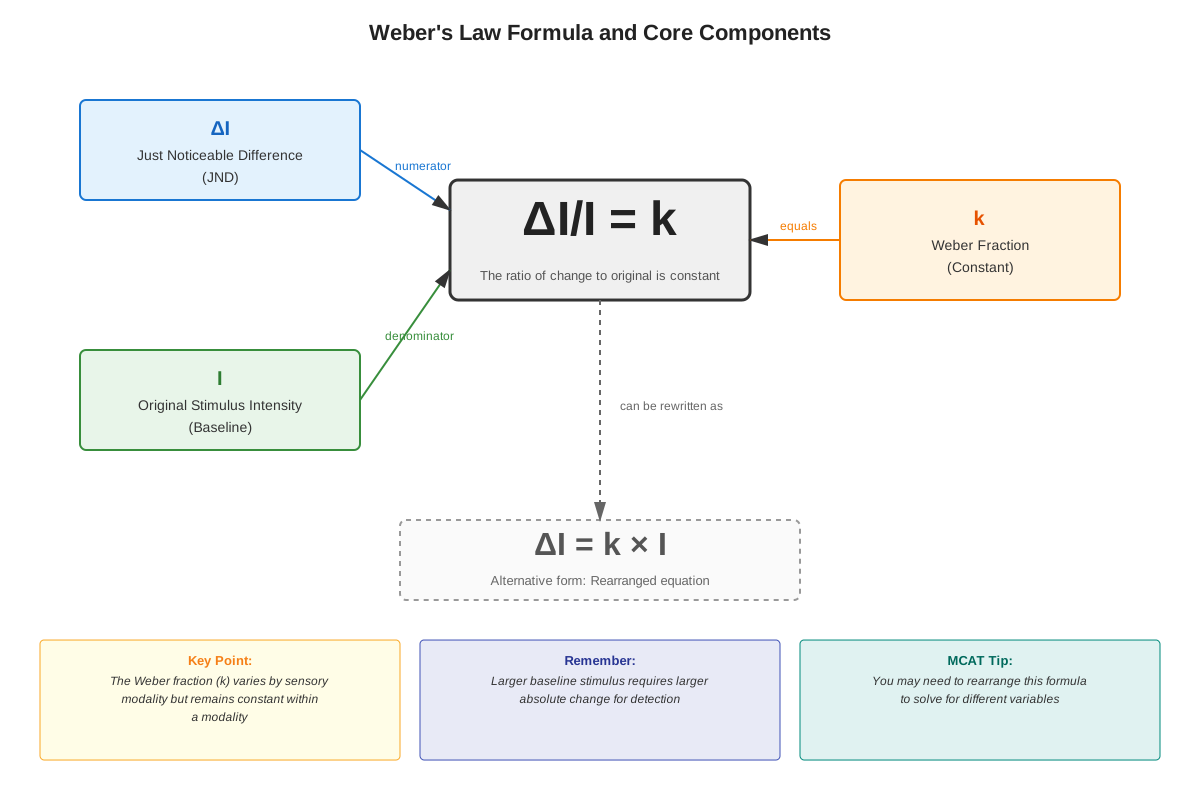
Weber's law formally states that the just noticeable difference (JND) or difference threshold is a constant proportion of the original stimulus intensity. Mathematically, this relationship is expressed as:
ΔI / I = kWhere:
- ΔI (delta I) represents the just noticeable difference—the smallest change in stimulus intensity that can be detected
- I represents the initial stimulus intensity (the baseline or standard stimulus)
- k represents the Weber fraction or Weber constant—a proportionality constant specific to each sensory modality
Rearranging this equation yields: ΔI = k × I, which makes explicit that the absolute magnitude of the JND increases linearly with stimulus intensity. This means that as stimuli become more intense, larger absolute changes are required for detection, but the proportional change remains constant.
The Weber fraction varies across sensory modalities, reflecting differences in sensory system sensitivity. Typical Weber fractions include:
| Sensory Modality | Weber Fraction (k) | Interpretation |
|---|---|---|
| Brightness (vision) | 0.08 (8%) | An 8% change in light intensity is needed for detection |
| Loudness (audition) | 0.05 (5%) | A 5% change in sound intensity is needed for detection |
| Weight (kinesthesis) | 0.02 (2%) | A 2% change in weight is needed for detection |
| Taste (gustation) | 0.20 (20%) | A 20% change in concentration is needed for detection |
These values indicate that weight discrimination is particularly sensitive (small Weber fraction), while taste discrimination is relatively coarse (large Weber fraction).
Just Noticeable Difference and Difference Threshold
The just noticeable difference (JND), also called the difference threshold, represents the minimum change in stimulus intensity that produces a noticeable difference in perception 50% of the time. This probabilistic definition acknowledges that sensory judgments involve variability—sometimes a given change is detected, sometimes it is not. The 50% criterion provides a standardized measurement point.
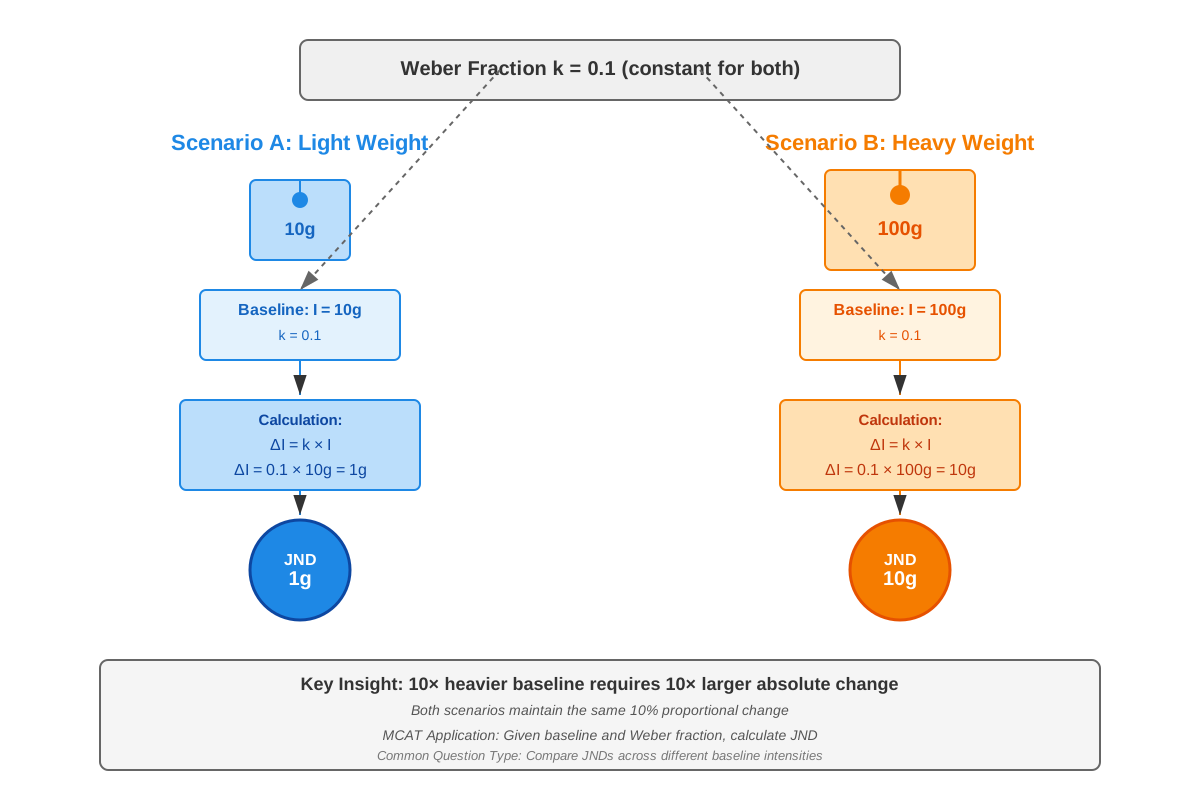
The JND is not a fixed value but rather depends on the baseline stimulus intensity according to Weber's law. For example, if the Weber fraction for weight is 0.02, then:
- For a 100-gram weight, the JND = 0.02 × 100 = 2 grams
- For a 1000-gram weight, the JND = 0.02 × 1000 = 20 grams
Both scenarios require the same 2% proportional change, but the absolute change differs by a factor of ten. This proportional relationship explains many everyday experiences: adding a single person to an empty elevator is immediately noticeable, but adding one person to a crowded elevator goes unnoticed.
Sensory Modality Differences
Weber's law applies across all sensory modalities but with different degrees of precision. The law works best for intermediate stimulus intensities—it breaks down at very low intensities (near absolute threshold) and very high intensities (near the upper limit of sensory range). This limitation is important for MCAT questions that may test boundary conditions.
Vision: For brightness discrimination, the Weber fraction is approximately 0.08 under photopic (daylight) conditions. However, this value changes under scotopic (dim light) conditions when rod photoreceptors dominate. Color discrimination follows different rules and is better described by other psychophysical laws.
Audition: Sound intensity discrimination shows a Weber fraction around 0.05 for pure tones at moderate intensities. Frequency discrimination (pitch) follows a different pattern and is not well-described by Weber's law, particularly at very high and very low frequencies.
Somatosensation: Weight discrimination demonstrates one of the smallest Weber fractions (0.02), indicating high sensitivity. This reflects the sophisticated proprioceptive and kinesthetic systems that integrate information from muscle spindles, Golgi tendon organs, and joint receptors.
Chemosensation: Taste and smell show larger Weber fractions (0.20 or higher), indicating relatively poor discrimination ability. This makes evolutionary sense—detecting the presence of chemicals is more important than precisely quantifying their concentration.
Fechner's Law and the Extension of Weber's Work
Gustav Fechner extended Weber's observations to develop Fechner's law, which describes the relationship between physical stimulus intensity and perceived intensity. Fechner's law states that perceived intensity increases logarithmically with physical intensity:
P = k × log(I)Where P represents perceived intensity. This logarithmic relationship derives directly from Weber's law through mathematical integration. Fechner's law explains why sensory systems can handle enormous ranges of stimulus intensity—the logarithmic compression allows both dim starlight and bright sunlight to be processed by the same visual system.
While Fechner's law extends Weber's work, it has limitations. Stevens' power law later provided a more accurate description for many sensory modalities, using a power function rather than a logarithmic one. However, Weber's law remains fundamental because it describes the local discrimination ability at any given intensity level, regardless of the global scaling function.
Experimental Methods for Measuring Weber's Law
The method of constant stimuli presents pairs of stimuli (a standard and a comparison) in random order, asking participants to judge which is more intense. By varying the comparison stimulus across many trials, researchers construct a psychometric function showing the probability of detecting a difference as a function of stimulus magnitude. The JND is determined from this function.
The method of limits involves gradually increasing or decreasing the comparison stimulus until the participant reports a noticeable difference. Multiple ascending and descending trials are averaged to determine the JND. This method is faster but more susceptible to response biases.
The method of adjustment allows participants to directly manipulate the comparison stimulus until it matches the standard. The variability in these settings provides an estimate of the JND. This method is efficient but may be influenced by motor control precision rather than purely sensory discrimination.
Concept Relationships
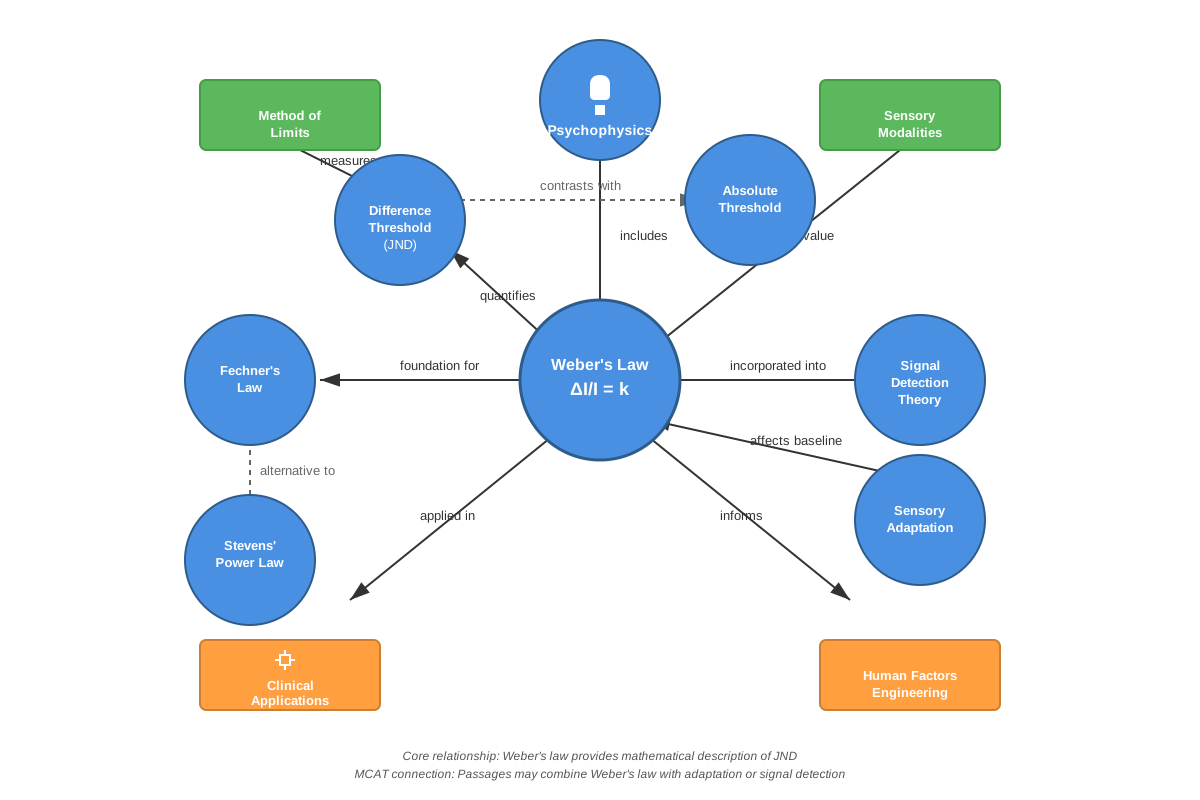
Weber's law sits at the intersection of sensory physiology and perceptual psychology, connecting multiple related concepts. The absolute threshold represents the minimum detectable stimulus intensity, while Weber's law describes the difference threshold—the minimum detectable change from a baseline. Both thresholds reflect the sensitivity limits of sensory systems, but they measure different aspects of detection ability.
Signal detection theory provides a more comprehensive framework that includes Weber's law as a special case. While Weber's law focuses on discrimination thresholds, signal detection theory incorporates decision criteria, motivation, and expectation. In signal detection terms, Weber's law describes how d' (discriminability) changes with stimulus intensity when criterion remains constant.
Sensory adaptation interacts with Weber's law by changing the effective baseline stimulus intensity. When sensory receptors adapt to a sustained stimulus, the adapted state becomes the new baseline for calculating JNDs. This explains why entering a dark room initially seems pitch black, but objects gradually become visible as adaptation occurs—the effective baseline intensity decreases, making smaller absolute light intensities detectable.
The relationship flow can be mapped as:
Physical stimulus intensity → Sensory transduction → Neural coding → Perceptual discrimination (Weber's law) → Conscious perception → Behavioral response
Weber's law also connects to neural coding mechanisms. The proportional nature of the JND reflects how sensory neurons encode intensity through firing rate. The Weber-Fechner law suggests that equal perceptual intervals correspond to equal ratios of stimulus intensity, which aligns with logarithmic neural coding observed in many sensory systems.
Quick check — test yourself on Weber law so far.
Try Flashcards →High-Yield Facts
⭐ Weber's law states that ΔI/I = k, where the ratio of the JND to the baseline intensity is constant for a given sensory modality
⭐ The Weber fraction (k) varies across sensory modalities: weight discrimination (~0.02) is most sensitive, while taste discrimination (~0.20) is least sensitive
⭐ The just noticeable difference (JND) increases linearly with baseline stimulus intensity—doubling the baseline doubles the JND
⭐ Weber's law applies best to intermediate stimulus intensities and breaks down near absolute threshold and at very high intensities
⭐ The JND represents the difference threshold detected 50% of the time, reflecting the probabilistic nature of sensory judgments
- Weber's law applies across all sensory modalities but with different Weber fractions specific to each modality
- Fechner's law (P = k × log I) extends Weber's law to describe the relationship between physical and perceived intensity
- The method of constant stimuli, method of limits, and method of adjustment are three experimental approaches for measuring JNDs
- Sensory adaptation changes the effective baseline intensity, thereby affecting JND calculations
- Weber's law provides the foundation for understanding logarithmic sensory encoding and the enormous dynamic range of sensory systems
- The proportional nature of Weber's law explains why volume controls and brightness adjustments often use logarithmic scales
- Clinical applications include diagnosing sensory deficits through elevated Weber fractions in affected modalities
Common Misconceptions
Misconception: Weber's law means that the JND is constant regardless of stimulus intensity.
Correction: The JND is not constant—it increases proportionally with stimulus intensity. What remains constant is the Weber fraction (ΔI/I), not the absolute JND (ΔI). A 100-gram weight requires a 2-gram change for detection, while a 1000-gram weight requires a 20-gram change, assuming a Weber fraction of 0.02.
Misconception: A smaller Weber fraction means worse sensory discrimination.
Correction: A smaller Weber fraction indicates better discrimination ability. A Weber fraction of 0.02 (2%) means only a 2% change is needed for detection, while a fraction of 0.20 (20%) requires a much larger proportional change. Weight discrimination (k = 0.02) is more sensitive than taste discrimination (k = 0.20).
Misconception: Weber's law applies equally well at all stimulus intensities.
Correction: Weber's law works best at intermediate intensities and breaks down at extremes. Near absolute threshold, the proportional relationship fails because the baseline approaches zero. At very high intensities approaching the upper limit of sensory range, the law also becomes less accurate due to saturation effects.
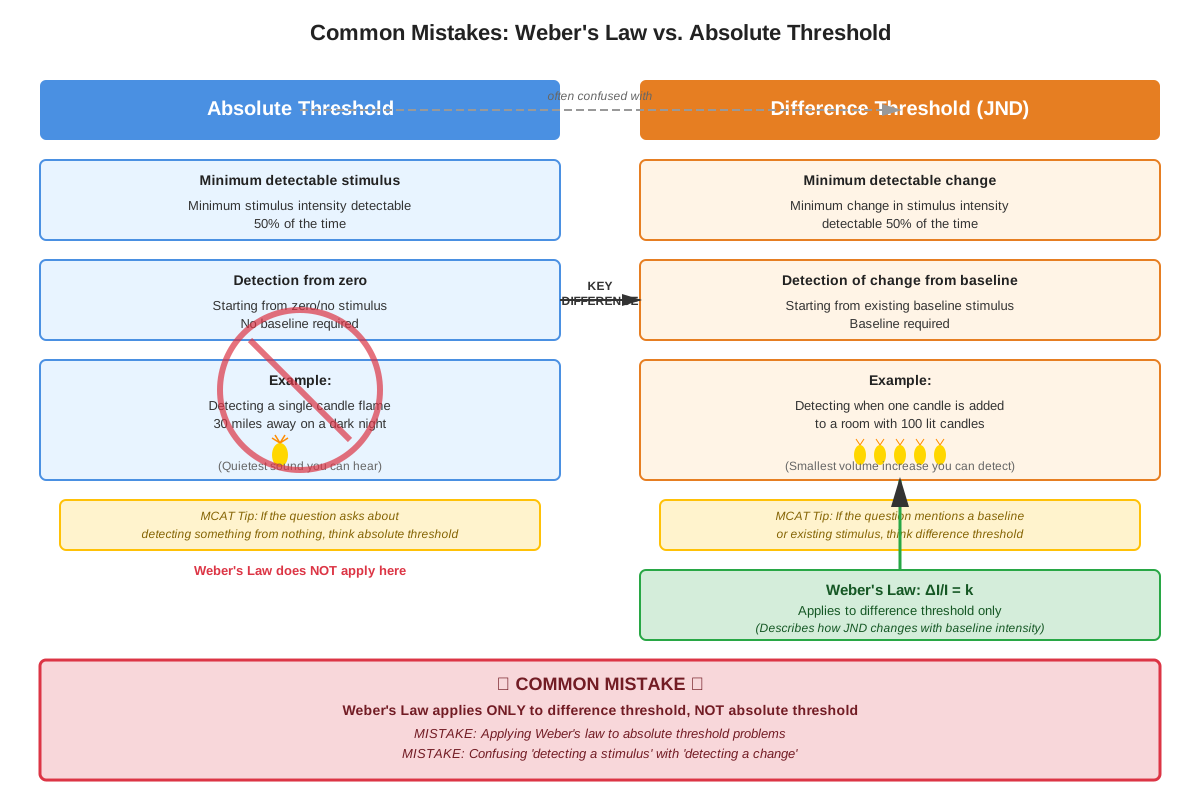
Misconception: The JND and absolute threshold are the same thing.
Correction: The absolute threshold is the minimum stimulus intensity detectable in the absence of any background stimulus, while the JND (difference threshold) is the minimum detectable change from a baseline stimulus. Absolute threshold asks "Can you detect anything?" while JND asks "Can you detect a change?"
Misconception: Weber's law predicts that perceived intensity increases linearly with physical intensity.
Correction: Weber's law describes discrimination thresholds, not the scaling of perceived intensity. Fechner's law (logarithmic) and Stevens' power law describe the relationship between physical and perceived intensity. Weber's law tells us about local discrimination ability at each intensity level, not the global perception-intensity function.
Misconception: All sensory modalities have the same Weber fraction.
Correction: Each sensory modality has its own characteristic Weber fraction reflecting its discrimination sensitivity. These fractions vary by an order of magnitude across modalities, from approximately 0.02 for weight to 0.20 or higher for taste, reflecting different evolutionary pressures and neural mechanisms.
Worked Examples
Example 1: Calculating JND for Weight Discrimination
Question: A participant is holding a 500-gram weight. The Weber fraction for weight discrimination is 0.02. What is the minimum additional weight that must be added for the participant to reliably detect a difference?
Solution:
Step 1: Identify the given information
- Baseline stimulus intensity (I) = 500 grams
- Weber fraction (k) = 0.02
- Need to find: JND (ΔI)
Step 2: Apply Weber's law formula
Weber's law: ΔI/I = k
Rearranging: ΔI = k × I
Step 3: Calculate the JND
ΔI = 0.02 × 500 grams
ΔI = 10 grams
Step 4: Interpret the result
The participant must add at least 10 grams to the 500-gram weight to reliably detect a difference 50% of the time. The new weight would be 510 grams.
Connection to learning objectives: This problem directly applies Weber's law to calculate a JND, demonstrating the proportional relationship between baseline intensity and discrimination threshold. It reinforces that the same Weber fraction (0.02) produces different absolute JNDs depending on the baseline weight.
Example 2: Comparing Discrimination Across Intensities
Question: A researcher tests auditory discrimination at two baseline intensities: 40 dB and 80 dB. The Weber fraction for loudness is 0.05. For each baseline, calculate the JND in decibels. Then explain why the absolute JND differs but discrimination ability remains constant.
Solution:
Step 1: Calculate JND at 40 dB baseline
ΔI = k × I = 0.05 × 40 dB = 2 dB
The sound must increase to 42 dB for detection
Step 2: Calculate JND at 80 dB baseline
ΔI = k × I = 0.05 × 80 dB = 4 dB
The sound must increase to 84 dB for detection
Step 3: Compare the results
- At 40 dB: JND = 2 dB (5% of baseline)
- At 80 dB: JND = 4 dB (5% of baseline)
- The absolute JND doubled, but the proportional change remained constant at 5%
Step 4: Explain the constancy of discrimination
Discrimination ability, measured by the Weber fraction, remains constant because the auditory system encodes intensity proportionally. The same percentage change in stimulus intensity produces the same change in neural firing rate, regardless of absolute intensity. This proportional encoding allows the auditory system to handle a wide dynamic range while maintaining consistent discrimination ability.
Connection to learning objectives: This example demonstrates how Weber's law predicts that JND increases with baseline intensity while the Weber fraction remains constant. It connects to neural coding mechanisms and explains why sensory systems use proportional rather than absolute encoding. This type of comparison question frequently appears on the MCAT.
Exam Strategy
When approaching MCAT questions on Weber's law, first identify whether the question asks about absolute threshold or difference threshold—this distinction eliminates wrong answers. Look for trigger phrases like "just noticeable difference," "minimum detectable change," or "discrimination threshold," which signal Weber's law application. Questions presenting experimental data with multiple stimulus intensities almost always test understanding that JND increases proportionally with baseline intensity.
For calculation problems, write out the Weber's law equation (ΔI/I = k) and identify which variable you need to solve for. Common question types include: (1) given I and k, find ΔI; (2) given ΔI and I, find k; or (3) given k and ΔI, find I. Always check that your answer makes intuitive sense—the JND should increase with baseline intensity, and Weber fractions should fall within typical ranges (0.02-0.20 for most modalities).
Process-of-elimination strategies work well for Weber's law questions. Eliminate answers suggesting that JND remains constant across intensities (violates Weber's law). Eliminate answers confusing absolute and difference thresholds. Eliminate answers suggesting that larger Weber fractions indicate better discrimination (opposite is true). For passage-based questions, identify the independent variable (stimulus intensity) and dependent variable (discrimination performance), then predict how they should relate according to Weber's law before looking at answer choices.
Time allocation for Weber's law questions should be approximately 60-90 seconds for discrete questions and 90-120 seconds for passage-based items. Calculation questions may require slightly more time but should not exceed 2 minutes. If a question seems to require complex calculations, reconsider whether a conceptual approach might be faster—MCAT questions rarely require extensive computation.
Watch for questions that test boundary conditions where Weber's law breaks down. If a question describes stimuli near absolute threshold or at very high intensities, consider whether Weber's law still applies. Questions may also test the distinction between Weber's law (discrimination) and Stevens' power law (perceived magnitude scaling)—these are related but distinct concepts.
Memory Techniques
Mnemonic for Weber's Law Formula: "Weber Watches Weight With Wisdom" reminds you that Weber's law involves the ratio ΔI/I = k, where the change (ΔI) divided by the initial intensity (I) equals a constant (k).
Mnemonic for Weber Fraction Order: "Weight Wins, Taste Trails" helps remember that weight discrimination has the smallest Weber fraction (~0.02, best discrimination) while taste has the largest (~0.20, worst discrimination). The sensory modalities in order of increasing Weber fraction: Weight → Loudness → Brightness → Taste.
Visualization Strategy: Picture a balance scale with weights. Adding a small pebble to an empty scale tips it dramatically (small baseline, small JND detectable). Adding the same pebble to a scale already loaded with bricks produces no visible change (large baseline, larger JND needed). This image reinforces that the same absolute change becomes less noticeable as baseline intensity increases.
Acronym for Experimental Methods: "CLAssic psychophysics" represents the three main methods: Constant stimuli, Limits, Adjustment. Each method measures the JND but with different procedures and trade-offs.
Conceptual Anchor: Remember that Weber's law explains why you can see stars appear as the sky darkens—as background brightness (baseline) decreases, the JND decreases proportionally, making previously invisible stars detectable. This real-world example makes the abstract mathematical relationship concrete and memorable.
Summary
Weber's law is a fundamental principle in sensation and perception that quantifies the relationship between stimulus intensity and discrimination ability. The law states that the just noticeable difference (JND) is a constant proportion of the baseline stimulus intensity, expressed mathematically as ΔI/I = k, where k is the Weber fraction specific to each sensory modality. This proportional relationship means that as stimuli become more intense, larger absolute changes are required for detection, but the percentage change remains constant. Weber fractions vary across sensory modalities, with weight discrimination showing the highest sensitivity (k ≈ 0.02) and taste discrimination showing the lowest (k ≈ 0.20). The law applies best to intermediate stimulus intensities and breaks down near absolute threshold and at very high intensities. Understanding Weber's law is essential for the MCAT because it provides a quantitative framework for analyzing sensory discrimination, connects to neural coding mechanisms, and frequently appears in both discrete and passage-based questions requiring calculation or conceptual application.
Key Takeaways
- Weber's law states that the ratio ΔI/I equals a constant (Weber fraction k) specific to each sensory modality, meaning discrimination ability depends on proportional rather than absolute changes
- The just noticeable difference (JND) increases linearly with baseline stimulus intensity—doubling the baseline doubles the JND while maintaining constant proportional sensitivity
- Weber fractions vary across modalities: smaller fractions indicate better discrimination (weight ≈ 0.02), larger fractions indicate worse discrimination (taste ≈ 0.20)
- Weber's law applies best to intermediate intensities and breaks down near absolute threshold and at very high intensities where sensory systems approach their limits
- The law connects to neural coding mechanisms that use proportional (logarithmic) encoding to handle wide dynamic ranges while maintaining consistent discrimination
- MCAT questions typically test calculation of JND given baseline and Weber fraction, comparison of discrimination across intensities, or application to experimental scenarios
- Distinguish Weber's law (discrimination thresholds) from related concepts like absolute threshold (minimum detection), Fechner's law (perceived intensity scaling), and signal detection theory (decision processes)
Related Topics
Signal Detection Theory: Extends beyond Weber's law to incorporate decision criteria, expectation, and motivation in detection tasks; mastering Weber's law provides the sensory foundation for understanding how psychological factors influence detection performance
Sensory Adaptation: Describes how prolonged exposure to a stimulus reduces sensitivity; connects to Weber's law because adaptation changes the effective baseline intensity from which JNDs are calculated
Stevens' Power Law: Provides an alternative to Fechner's logarithmic law for describing the relationship between physical and perceived intensity; understanding Weber's law helps distinguish between discrimination thresholds and magnitude scaling
Absolute Threshold and Psychophysical Methods: The foundational concepts for measuring sensory sensitivity; Weber's law builds on these by examining discrimination rather than detection
Neural Coding of Stimulus Intensity: Explores how sensory neurons encode intensity through firing rate and population coding; Weber's law reflects the proportional nature of this neural encoding at the perceptual level
Practice CTA
Now that you have mastered the core concepts of Weber's law, it's time to solidify your understanding through active practice. Work through the practice questions to test your ability to calculate JNDs, compare discrimination across modalities, and apply Weber's law to experimental scenarios. Use the flashcards to reinforce key formulas, Weber fractions for different sensory modalities, and the distinctions between related concepts. Remember that Weber's law questions on the MCAT reward both conceptual understanding and quantitative reasoning—practice both types of problems to build comprehensive mastery. Your ability to quickly recognize when Weber's law applies and execute the calculations accurately will directly translate to points on test day. Keep pushing forward—you're building the foundation for excellence in the Psychology and Sociology section!
Sign up free to keep reading
Create a free AnvayaPrep account to finish this MCAT guide on Weber law — plus flashcards and practice questions.