Overview
Functionalism is one of the foundational theoretical perspectives in Sociology that views society as a complex system composed of interdependent parts working together to promote stability and social order. This macro-level perspective, pioneered by sociologists such as Émile Durkheim, Talcott Parsons, and Robert Merton, conceptualizes social structure and institutions as analogous to biological organisms—each component serves a specific function that contributes to the overall health and equilibrium of the social system. Understanding Functionalism Sociology is essential for analyzing how institutions like family, education, religion, and government maintain social cohesion and meet the needs of society.
For the Functionalism MCAT, this theoretical framework appears frequently in the Psychological, Social, and Biological Foundations of Behavior section, particularly when passages discuss social institutions, cultural norms, social integration, or the consequences of social change. The MCAT tests not only the ability to define functionalism but also to apply its principles to analyze social phenomena, identify manifest and latent functions, recognize dysfunctions, and distinguish functionalism from competing theoretical perspectives like conflict theory and symbolic interactionism. Questions may present scenarios involving healthcare systems, educational institutions, family structures, or religious practices and ask students to interpret these through a functionalist lens.
The big-picture relationship of functionalism to other sociology concepts is fundamental: it provides one of three major theoretical lenses (alongside conflict theory and symbolic interactionism) through which all social phenomena can be analyzed. Functionalism emphasizes consensus, stability, and integration, contrasting sharply with conflict theory's focus on power struggles and inequality. This perspective connects directly to concepts of social cohesion, social solidarity, anomie, social institutions, cultural values, and socialization—all high-yield topics for the MCAT. Mastering functionalism enables students to quickly categorize theoretical approaches in passages and predict the types of conclusions functionalist researchers would draw.
Learning Objectives
- [ ] Define Functionalism using accurate Sociology terminology
- [ ] Explain why Functionalism matters for the MCAT
- [ ] Apply Functionalism to exam-style questions
- [ ] Identify common mistakes related to Functionalism
- [ ] Connect Functionalism to related Sociology concepts
- [ ] Distinguish between manifest functions, latent functions, and dysfunctions with specific examples
- [ ] Compare and contrast functionalism with conflict theory and symbolic interactionism
- [ ] Analyze social institutions using functionalist principles to predict their roles in maintaining social stability
Prerequisites
- Basic understanding of sociological theory: Functionalism is one of several theoretical perspectives; recognizing that sociology uses different lenses to analyze society is essential for contextualizing this approach
- Familiarity with social institutions: Knowledge of major institutions (family, education, religion, government, economy) provides the concrete examples through which functionalist principles are applied
- Concept of society as a system: Understanding that societies have interconnected components helps grasp the organismic analogy central to functionalist thinking
- Social norms and values: Functionalism relies heavily on shared norms and values as mechanisms for social cohesion, so basic understanding of these concepts is necessary
Why This Topic Matters
Functionalism represents one of the most frequently tested theoretical frameworks on the MCAT, appearing in approximately 15-20% of sociology-related passages in the Psychological, Social, and Biological Foundations section. The AAMC explicitly lists "major sociological theories" as testable content, and functionalism consistently appears alongside conflict theory and symbolic interactionism as the three primary perspectives students must master. Understanding functionalism is not merely academic—it provides a framework for analyzing real-world healthcare systems, medical institutions, and patient-provider relationships that frequently appear in MCAT passages.
From a clinical perspective, functionalism helps explain why healthcare systems develop particular structures, how medical institutions maintain social order through sick roles and professional norms, and why certain health behaviors persist across populations. For example, functionalist analysis explains how the healthcare system functions to return sick individuals to productive social roles, how medical education socializes physicians into professional norms, and how public health initiatives promote social stability. These applications appear regularly in MCAT passages that ask students to analyze healthcare delivery, medical professionalism, or population health interventions.
On the exam, functionalism typically appears in three formats: (1) passage-based questions asking students to identify which theoretical perspective best explains a described social phenomenon, (2) discrete questions requiring application of functionalist concepts like manifest/latent functions or dysfunctions to specific scenarios, and (3) questions asking students to predict what conclusions a functionalist researcher would draw from presented data. Common passage topics include analysis of educational systems, family structures in different cultures, religious practices and social cohesion, economic institutions and social stability, and healthcare systems and their societal roles. Recognition of functionalist trigger words and concepts enables rapid, accurate question analysis and improves time management on this challenging section.
Core Concepts
Definition and Foundational Principles of Functionalism
Functionalism (also called structural functionalism or functional analysis) is a macro-level theoretical perspective in sociology that views society as a complex system whose parts work together to promote solidarity, stability, and equilibrium. The core premise holds that each element of society—including institutions, norms, customs, and traditions—exists because it serves a function that contributes to society's overall stability and survival. This perspective emerged from the work of early sociologists, particularly Émile Durkheim, who studied how societies maintain cohesion and order despite being composed of diverse individuals with potentially conflicting interests.
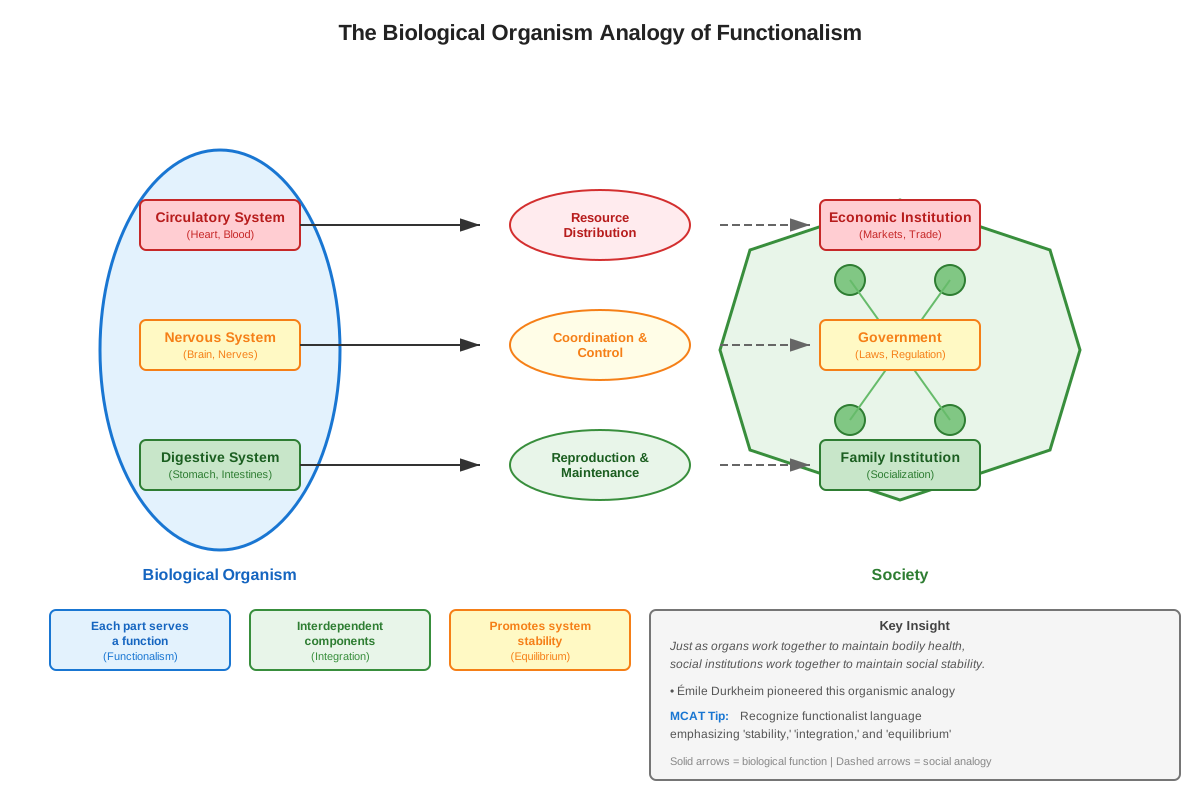
The organismic analogy is central to understanding functionalism: just as biological organisms have organs (heart, lungs, liver) that perform specific functions necessary for survival, societies have social institutions (family, education, religion, government, economy) that fulfill essential societal needs. When all parts function properly, society maintains equilibrium and homeostasis. This perspective assumes that social structures develop and persist because they are adaptive and beneficial for society as a whole, even if their functions are not immediately obvious to individual members.
Key assumptions underlying functionalism include: (1) society is a system of interconnected parts, (2) social structures are relatively stable and well-integrated, (3) each element of society contributes to the functioning of the whole, (4) societies tend toward equilibrium and consensus, and (5) social change is typically gradual and evolutionary rather than revolutionary. These assumptions distinguish functionalism from conflict theory, which emphasizes power struggles and rapid change, and from symbolic interactionism, which focuses on micro-level interactions rather than macro-level structures.
Manifest Functions, Latent Functions, and Dysfunctions
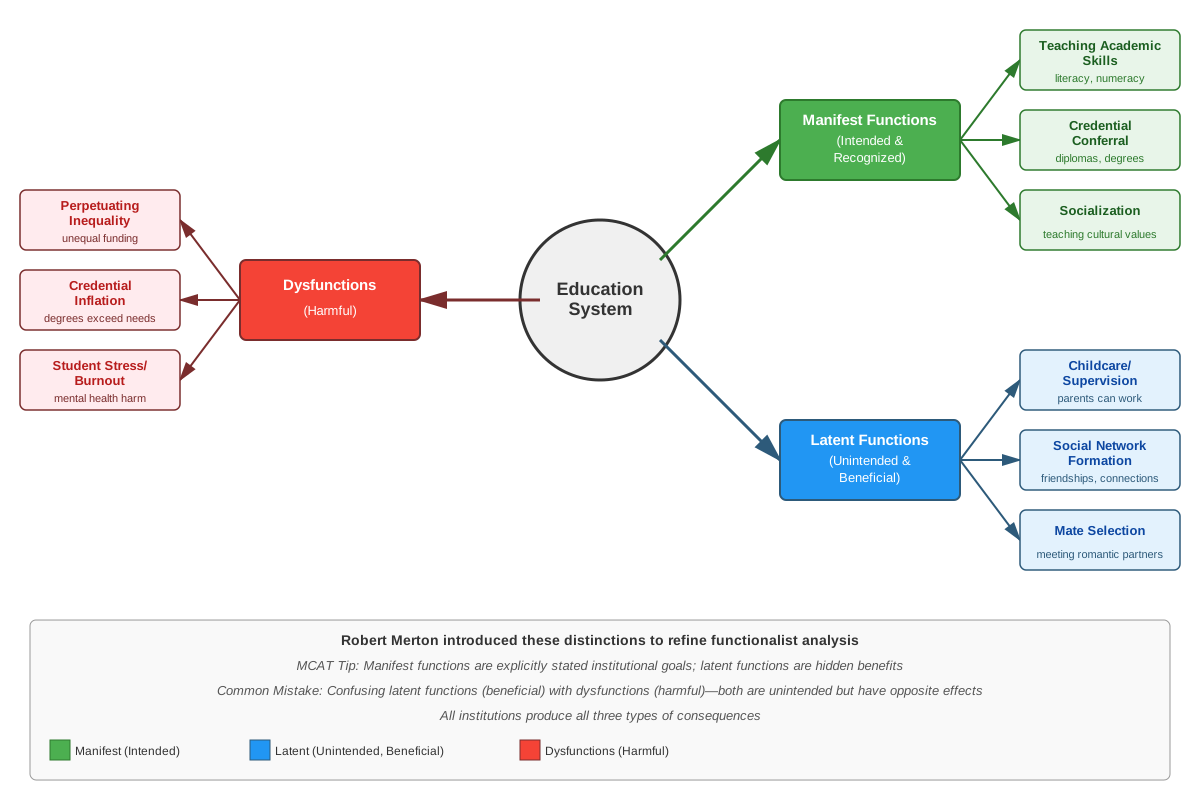
Robert Merton refined functionalist theory by introducing crucial distinctions that address criticisms of early functionalism. Manifest functions are the intended, recognized, and obvious consequences of social structures or institutions. These are the purposes that participants consciously understand and can articulate. For example, the manifest function of education is to transmit knowledge and skills to the next generation, preparing students for future employment and citizenship. The manifest function of hospitals is to treat illness and injury, restoring health to patients.
Latent functions are the unintended, unrecognized, or hidden consequences of social structures that nonetheless contribute to social stability. These functions may not be obvious to participants but still serve important societal purposes. For example, education has latent functions including providing childcare that enables parents to work, creating a marriage market where young adults meet potential partners, and establishing social networks that facilitate future career opportunities. Hospitals have latent functions such as providing employment for healthcare workers, serving as sites for medical research and training, and creating communities of support for patients with similar conditions.
Dysfunctions are elements or consequences of social structures that disrupt social stability or harm society. Merton's recognition of dysfunctions addressed the criticism that early functionalism portrayed all existing structures as beneficial. Dysfunctions can be manifest (recognized and intended negative consequences) or latent (unrecognized negative consequences). For example, while education generally promotes social stability, it can also perpetuate social inequality through tracking systems that limit opportunities for disadvantaged students (a dysfunction). The healthcare system, while treating illness, may also create financial hardship through high costs (a dysfunction that destabilizes families and communities).
Major Functionalist Theorists and Their Contributions
Émile Durkheim (1858-1917) established the foundation for functionalist thinking through his studies of social solidarity, division of labor, and suicide. Durkheim introduced the concept of social facts—external forces that shape individual behavior—and argued that society is more than the sum of its parts. His analysis of mechanical solidarity (cohesion based on similarity in traditional societies) versus organic solidarity (cohesion based on interdependence in modern societies) demonstrated how different social structures serve the function of maintaining social integration. Durkheim's study of suicide showed how even seemingly individual acts reflect the degree of social integration and regulation, illustrating functionalism's power to explain social phenomena.
Talcott Parsons (1902-1979) developed structural functionalism into a comprehensive theoretical system. Parsons identified four functional prerequisites that all societies must meet to survive, known as the AGIL scheme: Adaptation (acquiring and distributing resources), Goal attainment (setting and achieving collective goals), Integration (maintaining solidarity and managing conflict), and Latency (preserving cultural patterns and managing tensions). Each major institution primarily addresses one of these needs: the economy handles adaptation, government manages goal attainment, law and community organizations maintain integration, and family and education preserve latency. This framework provides a systematic method for analyzing how institutions contribute to social stability.
Robert Merton (1910-2003) refined functionalism by introducing middle-range theory, which focuses on specific social phenomena rather than attempting to explain all of society. Beyond his concepts of manifest/latent functions and dysfunctions, Merton emphasized that not all structures are functional for everyone in society (challenging the assumption of universal benefit) and that functional alternatives exist (the same societal need can be met by different structures). These refinements made functionalism more nuanced and better able to address criticisms about its conservative bias and inability to explain social change.
Functionalism and Social Institutions
Functionalist analysis of social institutions examines how each institution contributes to meeting societal needs and maintaining stability. The family serves multiple functions: reproduction (ensuring societal continuity), socialization (transmitting culture and norms to children), economic support (pooling resources), emotional support (providing intimacy and belonging), and social placement (assigning social status to children). From a functionalist perspective, the family structure that predominates in a society exists because it effectively fulfills these functions given that society's particular circumstances.
The education system functions to transmit cultural knowledge and values, sort and train individuals for different occupational roles (social placement), provide custodial care for children, create social integration by bringing together diverse individuals, and promote social and cultural innovation. Educational institutions also serve latent functions like reducing unemployment by keeping young adults out of the labor market and providing opportunities for social mobility. Functionalists view education as essential for maintaining social order by ensuring that individuals internalize shared values and acquire the skills necessary for society to function.
The religious institution serves to provide meaning and purpose, reinforce social norms and values, create social cohesion through shared beliefs and rituals, provide emotional comfort during crises, and offer guidelines for behavior. Durkheim's analysis of religion emphasized its role in creating collective consciousness and social solidarity. Even in increasingly secular societies, functionalists argue that religion or functional alternatives (like civic rituals or shared national identities) continue to serve these integrative functions. The healthcare system functions to treat illness and restore individuals to productive social roles, control epidemics that threaten social stability, provide a legitimate excuse for deviance from normal role obligations (the sick role), and validate suffering through professional diagnosis.
Functionalism vs. Other Theoretical Perspectives
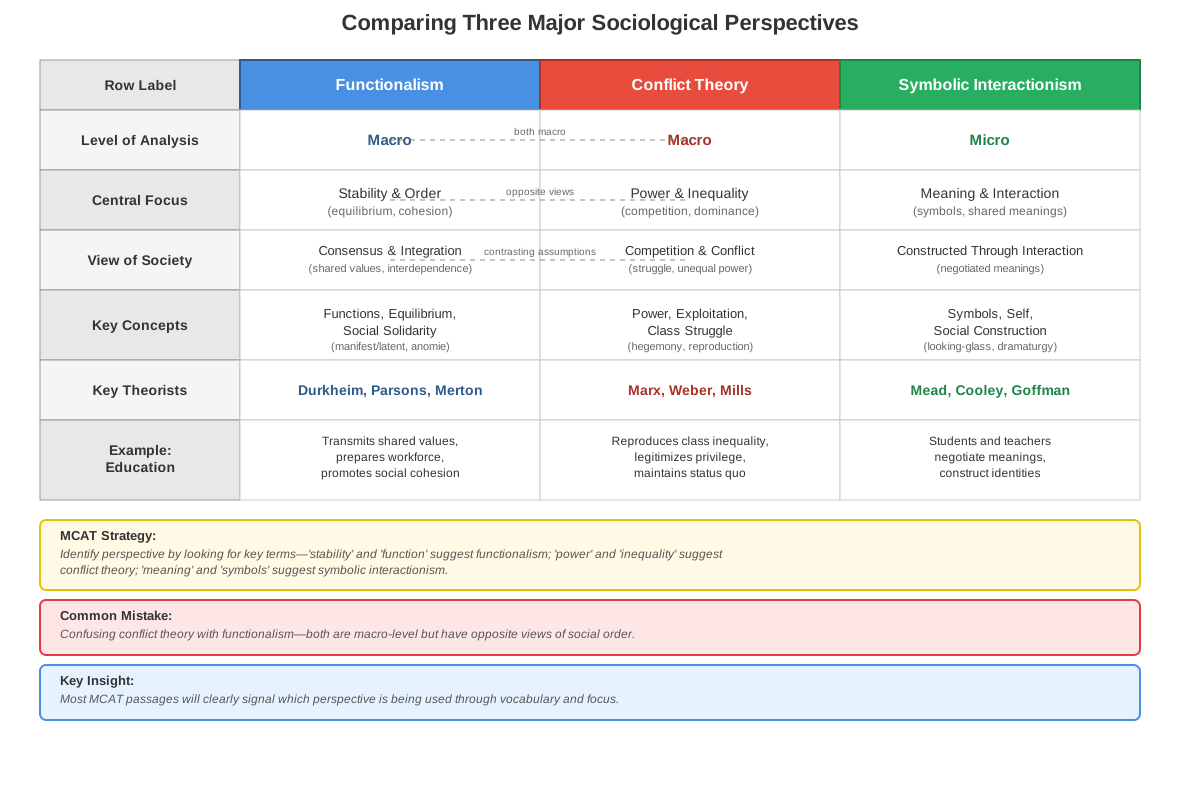
Understanding functionalism requires distinguishing it from competing theoretical frameworks. The table below compares functionalism with conflict theory and symbolic interactionism:
| Dimension | Functionalism | Conflict Theory | Symbolic Interactionism |
|---|---|---|---|
| Level of analysis | Macro (society-wide) | Macro (society-wide) | Micro (individual/small group) |
| Central focus | Social stability and integration | Power, inequality, and conflict | Meaning and interaction |
| View of society | Consensus and cooperation | Competition and coercion | Socially constructed through interaction |
| Social change | Gradual, evolutionary, restores equilibrium | Revolutionary, driven by conflict | Continuous, through changing meanings |
| Key question | What function does this serve? | Who benefits? Who is disadvantaged? | What does this mean to participants? |
| View of inequality | Functional and necessary for society | Result of exploitation and domination | Maintained through labeling and stigma |
| Metaphor | Society as organism | Society as arena of struggle | Society as theater/stage |
Conflict theory, associated with Karl Marx and later theorists, views society as composed of groups competing for scarce resources, with social structures serving to maintain the power of dominant groups rather than benefiting society as a whole. Where functionalists see education as serving society by training workers, conflict theorists see it as reproducing class inequality by providing different quality education to different social classes. Where functionalists see religion as promoting social cohesion, conflict theorists see it as an ideology that justifies inequality ("opiate of the masses").
Symbolic interactionism focuses on micro-level face-to-face interactions and how individuals create meaning through symbols and shared understandings. Rather than asking what function an institution serves for society, symbolic interactionists ask how individuals experience and interpret social situations. This perspective emphasizes agency and the socially constructed nature of reality, contrasting with functionalism's emphasis on external social structures that constrain individual behavior.
Criticisms and Limitations of Functionalism
While functionalism provides valuable insights, several criticisms are important for MCAT preparation. First, functionalism has been criticized for a conservative bias—by emphasizing how existing structures maintain stability, it may justify the status quo and fail to adequately address social problems like inequality, discrimination, and oppression. Critics argue that just because a structure exists doesn't mean it's beneficial or should be preserved.
Second, functionalism struggles to explain social change, particularly rapid or revolutionary change. If all parts of society work together to maintain equilibrium, how do fundamental transformations occur? Functionalists typically describe change as gradual adaptation to new circumstances, but this framework has difficulty accounting for social movements, revolutions, or rapid cultural shifts.
Third, the assumption of universal benefit is problematic. Early functionalists suggested that if a structure exists, it must serve a function for society. However, structures may benefit some groups while harming others. Merton's concept of dysfunctions partially addresses this, but critics argue that functionalism still underemphasizes how structures serve the interests of powerful groups at the expense of marginalized populations.
Fourth, functionalism may commit the teleological fallacy—explaining the existence of something by its consequences. Just because education has the consequence of socializing children doesn't necessarily explain why education systems developed. Critics argue that functionalism sometimes confuses consequences with causes.
Concept Relationships
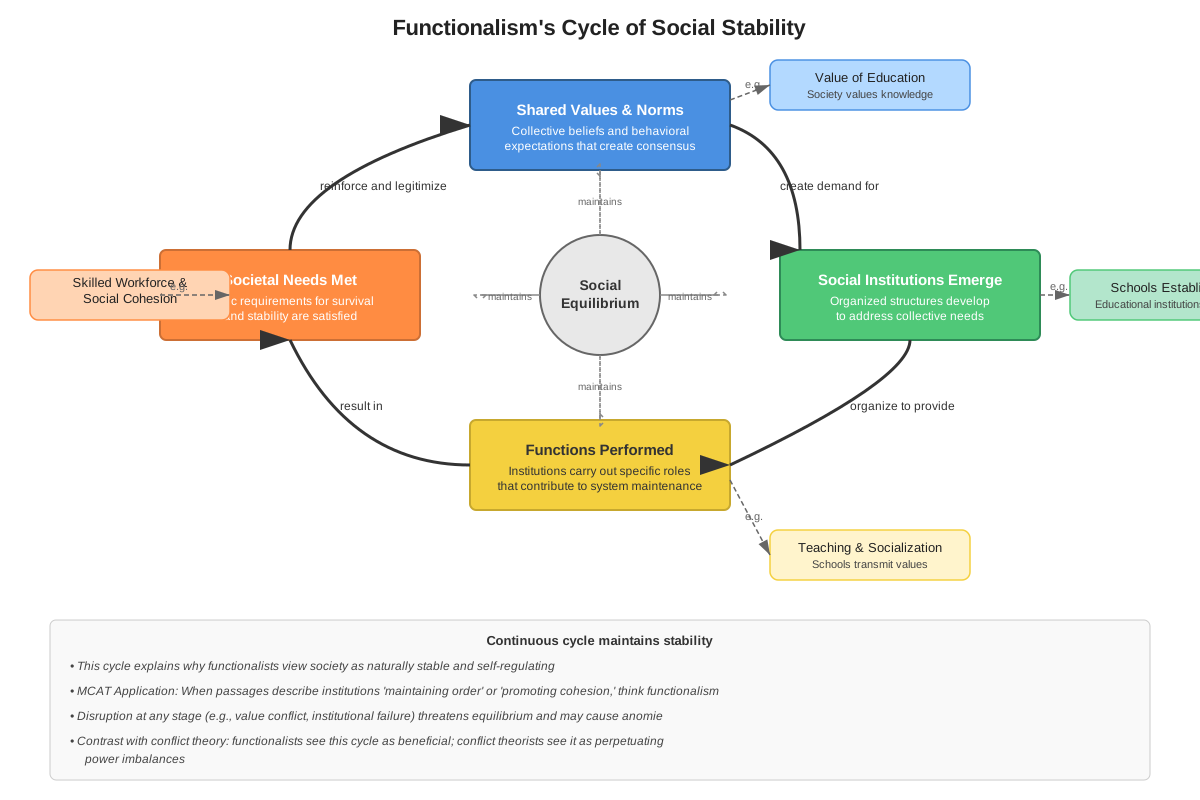
The concepts within functionalism form an interconnected framework for analyzing society. At the foundation lies the organismic analogy → which establishes that society is a system of interdependent parts → leading to the recognition that social institutions serve specific functions → which can be categorized as manifest functions (intended) or latent functions (unintended) → while some consequences may be dysfunctions (harmful) → all of which contribute to or detract from social equilibrium and stability → maintained through shared norms and values → transmitted via socialization through institutions like family and education.
Functionalism connects to prerequisite concepts in important ways. Understanding social institutions (family, education, religion, government, economy) provides the concrete structures that functionalist analysis examines. Knowledge of social norms and values is essential because functionalism explains how these shared expectations maintain social order and integration. The concept of socialization is central to functionalism's explanation of how societies perpetuate themselves by transmitting culture to new generations. Social solidarity and social cohesion, concepts developed by Durkheim, represent the ultimate outcomes that functional social structures produce.
Functionalism also connects forward to related topics. Understanding functionalism is prerequisite for grasping Durkheim's concepts of mechanical and organic solidarity, which describe how different types of societies achieve integration. The concept of anomie (normlessness) represents a dysfunction in Durkheimian functionalism—when social structures fail to adequately regulate behavior, individuals experience disconnection and society becomes unstable. Social stratification can be analyzed through a functionalist lens (Davis-Moore thesis argues inequality is functional) or a conflict lens (inequality results from exploitation), making understanding of functionalism essential for comparative analysis. The sick role concept in medical sociology is explicitly functionalist, describing how illness and healthcare function to maintain social stability.
The relationship between functionalism and competing theories is dialectical. Conflict theory emerged partly as a critique of functionalism, emphasizing power and inequality rather than consensus and stability. Symbolic interactionism provides a micro-level complement to functionalism's macro-level analysis. MCAT questions frequently test the ability to distinguish these perspectives and recognize which theoretical lens best explains a given scenario. Mastering these relationships enables rapid categorization of passage content and accurate prediction of theoretical conclusions.
Quick check — test yourself on Functionalism so far.
Try Flashcards →High-Yield Facts
⭐ Functionalism is a macro-level perspective that views society as a system of interconnected parts working together to maintain stability and equilibrium
⭐ Manifest functions are intended and recognized consequences; latent functions are unintended and unrecognized consequences; dysfunctions are harmful consequences that disrupt social stability
⭐ Émile Durkheim founded functionalist sociology, emphasizing social facts, social solidarity, and how institutions maintain social integration
⭐ Functionalism assumes consensus, shared values, and gradual social change, contrasting with conflict theory's emphasis on power struggles and revolutionary change
⭐ Each major social institution (family, education, religion, government, economy, healthcare) serves specific functions that meet societal needs and promote stability
- Talcott Parsons developed the AGIL scheme: Adaptation, Goal attainment, Integration, and Latency as four functional prerequisites all societies must meet
- Robert Merton refined functionalism by introducing manifest/latent functions, dysfunctions, and the concept that not all structures benefit everyone equally
- The organismic analogy compares society to a biological organism, with institutions serving as organs that perform specific functions necessary for survival
- Functionalism has been criticized for conservative bias, difficulty explaining rapid social change, and underemphasizing inequality and power dynamics
- Functionalist analysis of healthcare emphasizes the sick role, which legitimates temporary deviance from normal obligations while motivating return to health and productivity
Common Misconceptions
Misconception: Functionalism claims that everything in society is good and beneficial → Correction: Functionalism recognizes dysfunctions—elements that harm social stability. Merton specifically introduced this concept to address the criticism that early functionalism portrayed all existing structures as beneficial. Functionalism analyzes what functions structures serve, not whether they are morally good.
Misconception: Manifest functions are more important than latent functions → Correction: Both manifest and latent functions contribute to social stability and are equally important in functionalist analysis. Latent functions are often more sociologically interesting because they reveal hidden consequences that participants don't recognize. For example, the latent function of education in providing childcare may be as important for social stability as its manifest function of transmitting knowledge.
Misconception: Functionalism and conflict theory are completely incompatible and cannot both be correct → Correction: These perspectives offer different lenses for analyzing the same phenomena, and both can provide valid insights. A comprehensive sociological analysis might use functionalism to understand how an institution maintains stability while using conflict theory to examine how it perpetuates inequality. The MCAT tests the ability to recognize which perspective best explains a particular scenario, not to declare one universally correct.
Misconception: Functionalism only applies to traditional or stable societies, not modern changing societies → Correction: Functionalism can analyze any society, including modern complex societies undergoing change. Parsons specifically developed his theory to explain modern industrial societies. Functionalists explain social change as adaptation to new circumstances that restores equilibrium, though critics argue this framework struggles with revolutionary change.
Misconception: If something has negative consequences, it cannot have functions → Correction: A structure can simultaneously have functions (positive contributions to stability) and dysfunctions (negative consequences). For example, the healthcare system functions to treat illness but may also create financial hardship. Additionally, what is functional for society overall may be dysfunctional for particular groups, and vice versa.
Misconception: Functionalism focuses on individual behavior and choices → Correction: Functionalism is a macro-level perspective that analyzes society-wide structures and institutions, not individual behavior. It examines how social structures constrain and shape behavior, not how individuals make choices. Symbolic interactionism, not functionalism, focuses on individual-level meaning and interaction.
Worked Examples
Example 1: Analyzing Education Through a Functionalist Lens
Scenario: A sociologist studies a public school system and observes that schools not only teach academic subjects but also enforce punctuality, respect for authority, and competition for grades. Students from different backgrounds interact daily, and the school provides breakfast and lunch programs. The sociologist notes that schools keep children supervised while parents work and that many students form lasting friendships and social networks.
Question: Identify the manifest functions, latent functions, and potential dysfunctions of this school system from a functionalist perspective.
Analysis:
Step 1: Identify manifest functions (intended, recognized purposes)
- Teaching academic subjects (reading, math, science) - this is the primary stated purpose
- Socializing students into societal norms (punctuality, respect for authority, following rules)
- Providing nutrition through meal programs (recognized purpose of the program)
- Keeping students supervised during work hours (recognized childcare function)
Step 2: Identify latent functions (unintended, unrecognized consequences that still contribute to stability)
- Creating social networks and friendships that may provide future career opportunities
- Serving as a marriage market where young adults meet potential partners (especially in high school/college)
- Reducing youth unemployment by keeping young people out of the labor market
- Promoting social integration by bringing together students from diverse backgrounds
- Establishing a hierarchy and sorting mechanism that prepares students for stratified occupational roles
Step 3: Identify potential dysfunctions (consequences that disrupt stability or harm society)
- Tracking systems may perpetuate inequality by providing different quality education to different groups
- Emphasis on competition may create stress and mental health problems
- Standardized approaches may fail to meet needs of students with different learning styles
- Schools may reinforce rather than reduce existing social inequalities
- Bullying and social exclusion may harm individual students and create social problems
Step 4: Connect to functionalist principles
This analysis demonstrates how functionalism examines both intended and unintended consequences, recognizes that structures can simultaneously contribute to stability and create problems, and views education as serving multiple societal needs beyond its obvious purpose. A functionalist would emphasize how these various functions work together to maintain social order, prepare the next generation for adult roles, and promote social cohesion.
Key takeaway: Functionalist analysis requires identifying multiple levels of consequences (manifest, latent, dysfunction) and connecting them to broader themes of social stability, integration, and equilibrium.
Example 2: Distinguishing Theoretical Perspectives
Scenario: Researchers study the healthcare system in a society where wealthy individuals receive care from private physicians in well-equipped facilities, while poor individuals wait hours in crowded public clinics with limited resources. Three sociologists offer different interpretations:
Sociologist A: "The healthcare system functions to treat illness and return individuals to productive social roles. The existence of different tiers reflects the functional need to allocate scarce medical resources efficiently and to reward individuals who contribute more to society."
Sociologist B: "The healthcare system reflects and perpetuates class inequality. Wealthy individuals use their power to secure better care, while the poor receive inadequate treatment. This system serves the interests of the dominant class."
Sociologist C: "We should examine how patients and doctors interact in these different settings, how they interpret their experiences, and what meanings they attach to health and illness. The experience of being a patient differs dramatically based on these interactions."
Question: Identify which theoretical perspective each sociologist represents and explain the reasoning.
Analysis:
Sociologist A represents Functionalism:
- Uses functionalist language: "functions to," "productive social roles," "functional need"
- Focuses on how the system serves society's needs (treating illness, allocating resources)
- Emphasizes stability and efficiency rather than inequality
- Suggests that stratification in healthcare serves a purpose (rewarding contribution)
- Takes a macro-level view of the entire healthcare system
- Assumes the existing structure exists because it serves societal functions
Sociologist B represents Conflict Theory:
- Focuses on inequality, power, and class differences
- Emphasizes how the system benefits some groups (wealthy) at the expense of others (poor)
- Uses conflict language: "perpetuates inequality," "serves the interests of the dominant class"
- Views the healthcare system as an arena of struggle rather than cooperation
- Takes a macro-level view but emphasizes conflict rather than consensus
- Suggests the system reflects power dynamics rather than functional needs
Sociologist C represents Symbolic Interactionism:
- Focuses on micro-level interactions between patients and doctors
- Emphasizes meaning, interpretation, and subjective experience
- Asks how individuals understand and experience health and illness
- Focuses on face-to-face interactions rather than system-wide structures
- Emphasizes the socially constructed nature of the patient experience
- Takes a micro-level rather than macro-level perspective
Key distinctions for MCAT:
- Level of analysis: Functionalism and conflict theory are both macro-level; symbolic interactionism is micro-level
- Central question: Functionalism asks "What function does this serve?"; conflict theory asks "Who benefits?"; symbolic interactionism asks "What does this mean?"
- View of inequality: Functionalism may see it as functional; conflict theory sees it as exploitation; symbolic interactionism examines how it's experienced and interpreted
- Trigger words: Functionalism uses "function," "stability," "integration," "equilibrium"; conflict theory uses "power," "inequality," "exploitation," "dominant"; symbolic interactionism uses "meaning," "interaction," "interpretation," "experience"
Key takeaway: MCAT questions frequently present scenarios and ask which theoretical perspective best explains them. Recognizing the level of analysis (macro vs. micro), central focus (stability vs. conflict vs. meaning), and trigger words enables rapid, accurate identification.
Exam Strategy
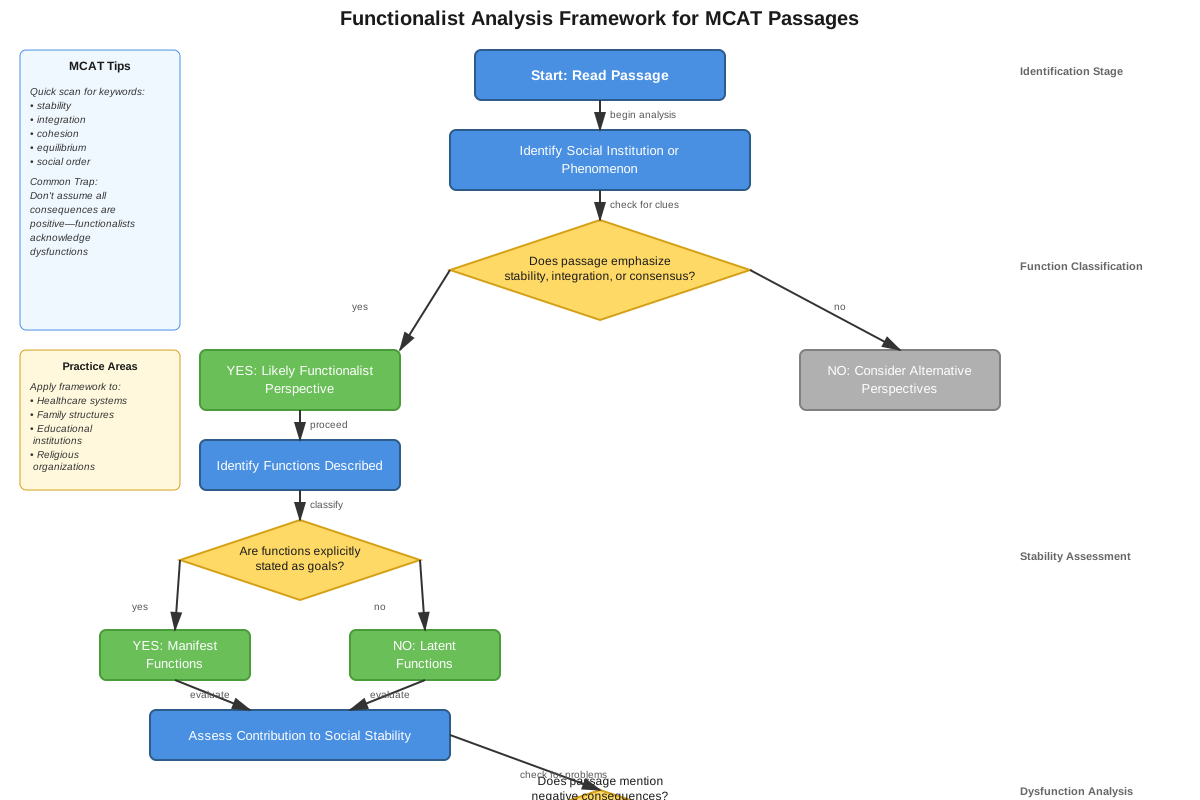
When approaching MCAT questions on functionalism, begin by identifying whether the question asks about theory identification, application, or comparison. Theory identification questions present a scenario or research finding and ask which perspective best explains it. Look for trigger words: "function," "stability," "integration," and "equilibrium" signal functionalism; "power," "inequality," and "conflict" signal conflict theory; "meaning," "interaction," and "interpretation" signal symbolic interactionism. Also identify the level of analysis—macro-level analysis of institutions suggests functionalism or conflict theory, while micro-level analysis of interactions suggests symbolic interactionism.
Application questions provide a functionalist framework and ask you to apply it to a new scenario. These questions often involve identifying manifest functions, latent functions, or dysfunctions. Use a systematic approach: (1) identify the social structure or institution in question, (2) determine its obvious, intended purpose (manifest function), (3) consider unintended consequences that still promote stability (latent functions), and (4) identify any harmful consequences (dysfunctions). Remember that the same structure can have multiple functions and dysfunctions simultaneously.
Comparison questions ask you to distinguish functionalism from other perspectives or to predict what conclusions different theorists would draw from the same data. Create a mental comparison table with key dimensions: level of analysis, view of society (consensus vs. conflict), approach to social change (gradual vs. revolutionary), and central question (function vs. power vs. meaning). Eliminate answer choices that confuse these dimensions—for example, eliminate any choice that describes functionalism as focusing on micro-level interactions or revolutionary change.
Exam Tip: When a passage describes a social institution, immediately ask yourself: "What functions does this serve for society?" This functionalist question helps you anticipate question types and quickly identify relevant information in the passage.
Process-of-elimination strategies specific to functionalism include: (1) eliminate choices that describe functionalism as focusing on conflict or power—that's conflict theory; (2) eliminate choices that describe functionalism as micro-level or focused on individual meaning—that's symbolic interactionism; (3) eliminate choices that suggest functionalism views all social change as revolutionary—functionalism emphasizes gradual change; (4) eliminate choices that claim functionalism ignores negative consequences—Merton's concept of dysfunction specifically addresses this.
Time allocation advice: Functionalism questions are typically straightforward if you've mastered the core concepts. Spend 60-90 seconds on discrete questions about functionalism, using trigger words to quickly identify the correct answer. For passage-based questions, spend 30-45 seconds identifying the theoretical perspective used in the passage (often stated explicitly or implied through language), then 60-90 seconds per question applying that framework. Don't overthink these questions—the MCAT tests clear distinctions between perspectives, not subtle nuances.
Watch for common question formats: (1) "Which of the following best represents a latent function of [institution]?" (2) "A researcher using a functionalist perspective would most likely conclude..." (3) "The passage description is most consistent with which sociological theory?" (4) "Which of the following is a manifest function rather than a latent function?" (5) "A functionalist would explain this phenomenon by emphasizing..." Recognizing these formats helps you quickly identify what the question is asking and what type of answer to look for.
Memory Techniques
Mnemonic for Functionalism's Core Assumptions: "SISCO"
- Stability - society tends toward equilibrium
- Interdependence - parts of society are interconnected
- Structures serve functions - each element contributes to the whole
- Consensus - society based on shared values and norms
- Organism - society is like a biological organism
Mnemonic for Distinguishing Functions: "MLD"
- Manifest - intended, recognized, obvious
- Latent - unintended, unrecognized, hidden
- Dysfunction - harmful, disrupts stability
Visualization Strategy for Functionalism vs. Conflict Theory: Picture a clock for functionalism (all gears working together smoothly to maintain time) versus a tug-of-war for conflict theory (groups pulling against each other for power). This visual distinction helps quickly categorize theoretical perspectives on the exam.
Acronym for Parsons' AGIL Scheme: "A Good Integration Lasts"
- Adaptation - acquiring resources (economy)
- Goal attainment - achieving collective goals (government)
- Integration - maintaining solidarity (law, community)
- Latency - preserving culture (family, education)
Memory Aid for Key Functionalist Theorists: "DPM - Different Perspectives Matter"
- Durkheim - founded functionalism, social solidarity, social facts
- Parsons - structural functionalism, AGIL scheme, comprehensive system
- Merton - manifest/latent functions, dysfunctions, middle-range theory
Trigger Word Association: Create mental associations between trigger words and perspectives:
- "Function/Stability/Integration/Equilibrium" → Picture a balanced scale (functionalism)
- "Power/Inequality/Conflict/Exploitation" → Picture a pyramid with few at top (conflict theory)
- "Meaning/Interaction/Interpretation/Symbol" → Picture two people talking (symbolic interactionism)
Summary
Functionalism is a foundational macro-level sociological perspective that analyzes society as an integrated system of interdependent parts working together to maintain stability and equilibrium. This theoretical framework, developed by Durkheim, Parsons, and Merton, views social institutions as serving specific functions that meet societal needs, analogous to how organs serve functions in biological organisms. Key concepts include manifest functions (intended consequences), latent functions (unintended consequences), and dysfunctions (harmful consequences), all of which must be distinguished for MCAT success. Functionalism emphasizes consensus, shared values, and gradual social change, contrasting sharply with conflict theory's focus on power struggles and inequality, and with symbolic interactionism's micro-level analysis of meaning and interaction. For the MCAT, students must be able to identify functionalist perspectives in passages, apply functionalist analysis to social institutions like healthcare and education, distinguish functionalism from competing theories, and recognize both the strengths and limitations of this perspective. Mastery requires understanding that functionalism provides one valuable lens for analyzing social phenomena while acknowledging its criticisms regarding conservative bias and difficulty explaining rapid social change.
Key Takeaways
- Functionalism views society as an integrated system of interdependent parts that work together to maintain stability, equilibrium, and social order through shared norms and values
- Manifest functions are intended and recognized; latent functions are unintended and unrecognized; dysfunctions are harmful—all three must be identified in functionalist analysis
- Major functionalist theorists include Durkheim (social solidarity, social facts), Parsons (AGIL scheme, structural functionalism), and Merton (manifest/latent functions, dysfunctions)
- Functionalism is a macro-level perspective emphasizing consensus and gradual change, contrasting with conflict theory (power and inequality) and symbolic interactionism (micro-level meaning)
- Each major social institution (family, education, religion, government, economy, healthcare) serves specific functions that contribute to meeting societal needs and maintaining social integration
- Functionalism has been criticized for conservative bias, difficulty explaining rapid social change, and underemphasizing inequality, but remains essential for MCAT success
- MCAT questions test the ability to identify functionalist perspectives, apply functionalist concepts to scenarios, and distinguish functionalism from competing theoretical frameworks
Related Topics
Conflict Theory: The primary alternative macro-level perspective to functionalism, emphasizing power, inequality, and social change through conflict. Mastering functionalism enables clear comparison with conflict theory, a frequent MCAT question type.
Symbolic Interactionism: The major micro-level sociological perspective focusing on meaning, symbols, and face-to-face interaction. Understanding functionalism's macro-level focus clarifies the distinction with symbolic interactionism's micro-level analysis.
Social Solidarity and Anomie: Durkheim's concepts of mechanical and organic solidarity describe how different societies achieve integration, while anomie describes the dysfunction that occurs when social regulation breaks down—both directly apply functionalist principles.
Social Institutions: Deep understanding of how family, education, religion, government, economy, and healthcare function provides the concrete examples through which functionalist theory is applied on the MCAT.
Social Stratification: Can be analyzed through functionalist lens (Davis-Moore thesis argues inequality is functional) or conflict lens (inequality results from exploitation), making this a key topic for comparative theoretical analysis.
Medical Sociology and the Sick Role: Talcott Parsons' concept of the sick role is explicitly functionalist, describing how illness and healthcare function to maintain social stability—highly relevant for MCAT healthcare passages.
Practice CTA
Now that you've mastered the core concepts of functionalism, it's time to solidify your understanding through active practice. Attempt the practice questions and flashcards associated with this topic to test your ability to identify functionalist perspectives, distinguish them from competing theories, and apply functionalist analysis to MCAT-style scenarios. Remember that theoretical perspectives like functionalism appear in 15-20% of sociology passages—mastering this content directly translates to points on test day. Focus particularly on distinguishing manifest functions, latent functions, and dysfunctions, as these distinctions frequently appear in discrete questions. You've built a strong foundation; now reinforce it through deliberate practice and you'll approach functionalism questions with confidence and accuracy.
Sign up free to keep reading
Create a free AnvayaPrep account to finish this MCAT guide on Functionalism — plus flashcards and practice questions.