Overview
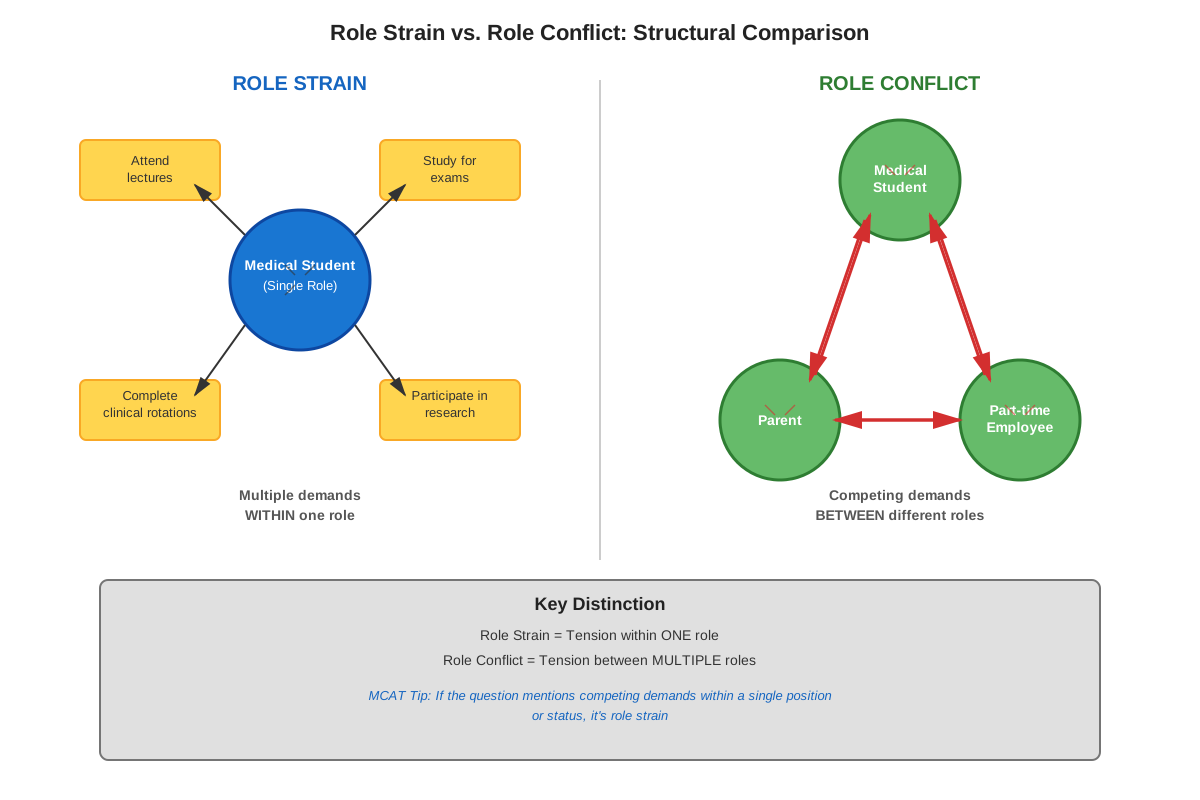
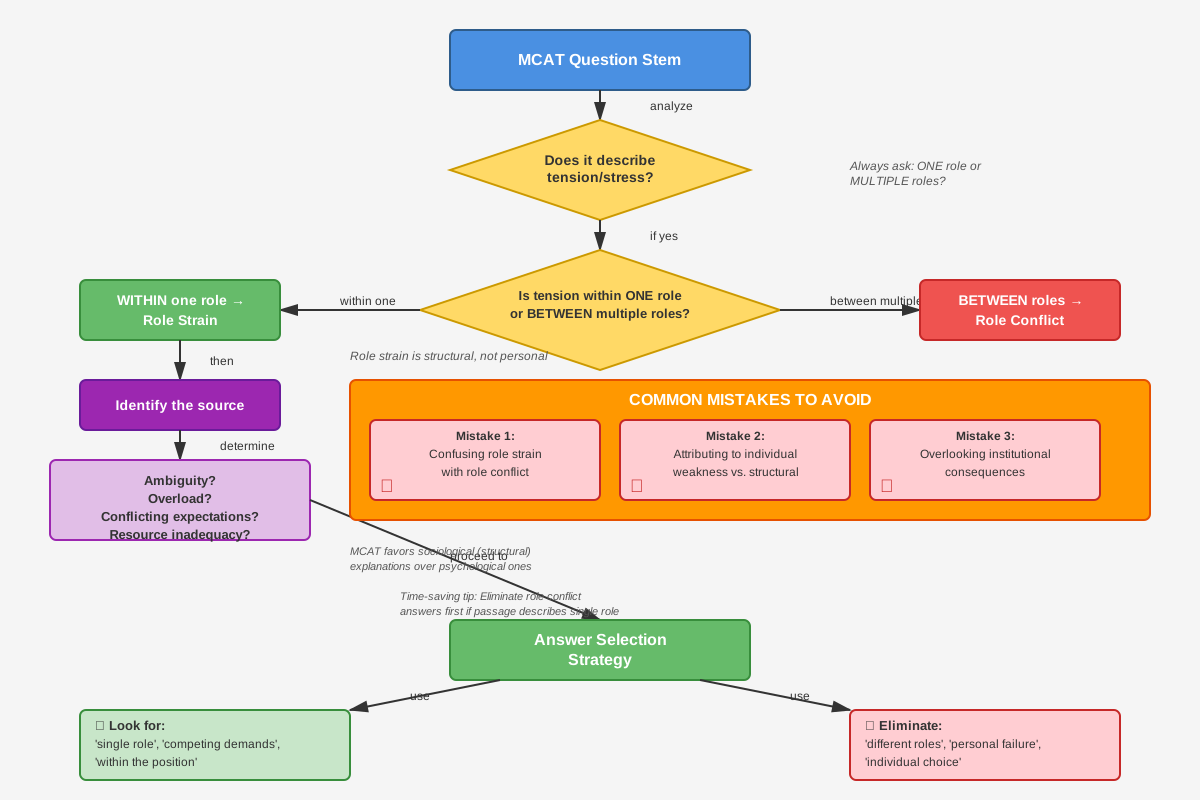
Role strain is a fundamental concept in Sociology that describes the tension and stress experienced when a single social role carries competing or conflicting demands. Unlike role conflict, which involves tension between multiple roles, role strain occurs within a single role when the expectations, responsibilities, or obligations associated with that role become difficult to fulfill simultaneously. For example, a physician may experience role strain when trying to balance the demands of providing compassionate patient care, maintaining detailed medical records, staying current with research, and managing the business aspects of a practice—all within the single role of "doctor."
Understanding role strain is essential for the MCAT because it appears frequently in the Psychological, Social, and Biological Foundations of Behavior section, particularly in passages dealing with healthcare professionals, patient experiences, and institutional dynamics. The concept bridges individual psychology with broader Social Structure and Institutions, making it a high-yield topic that connects micro-level stress experiences with macro-level social organization. Role strain helps explain why individuals in demanding positions may experience burnout, reduced performance, or psychological distress, even when they are committed to their roles.
This topic integrates seamlessly with other Sociology concepts including social roles, status, role conflict, social institutions, and organizational behavior. Mastering role strain provides a framework for analyzing how social structures create pressures on individuals, how people navigate competing demands, and how institutional design can either exacerbate or alleviate these tensions. For the MCAT, this concept frequently appears in passages about medical education, healthcare delivery, professional identity, and patient-provider relationships, making it both clinically relevant and exam-critical.
Learning Objectives
- [ ] Define Role strain using accurate Sociology terminology
- [ ] Explain why Role strain matters for the MCAT
- [ ] Apply Role strain to exam-style questions
- [ ] Identify common mistakes related to Role strain
- [ ] Connect Role strain to related Sociology concepts
- [ ] Distinguish between role strain and role conflict with specific examples
- [ ] Analyze how social institutions contribute to role strain
- [ ] Evaluate strategies individuals use to manage role strain
- [ ] Predict the consequences of unresolved role strain on individual and institutional levels
Prerequisites
- Social roles and status: Understanding that roles are sets of expected behaviors associated with particular social positions is fundamental to recognizing when those expectations create internal tension
- Social structure: Knowledge of how society organizes relationships and institutions provides context for why certain roles carry multiple, sometimes incompatible demands
- Stress and coping mechanisms: Basic understanding of psychological stress helps explain the individual experience and consequences of role strain
- Social institutions: Familiarity with institutions (healthcare, education, family) provides real-world contexts where role strain commonly occurs
Why This Topic Matters
Role strain has profound clinical and real-world significance, particularly in healthcare settings. Medical professionals routinely experience role strain as they navigate the competing demands of patient care, administrative duties, continuing education, research obligations, and personal well-being. Understanding this concept helps future physicians recognize and address burnout, compassion fatigue, and professional dissatisfaction—issues that directly impact patient care quality and physician retention. The concept also applies to patient experiences, as individuals managing chronic illness may experience strain within their "patient role" when balancing treatment adherence, work responsibilities, and family obligations.
On the MCAT, role strain appears with moderate to high frequency, typically in 2-4 questions per exam administration. Questions most commonly appear in discrete format or embedded within passages about healthcare professionals, medical students, or patients navigating complex treatment regimens. The topic appears in approximately 15-20% of Social Structure and Institutions questions and frequently serves as a distractor option in questions actually testing role conflict. The AAMC has consistently included role strain in passages about physician burnout, medical education challenges, and healthcare system organization.
Common exam presentations include:
- Passages describing medical students balancing clinical responsibilities with academic requirements
- Vignettes about physicians managing patient care demands alongside administrative burdens
- Scenarios involving patients with chronic conditions juggling multiple treatment protocols
- Research studies examining workplace stress in healthcare settings
- Questions asking students to identify the source of tension in professional scenarios
Core Concepts
Definition and Fundamental Characteristics
Role strain refers to the stress, tension, or difficulty experienced when a single social role contains incompatible or competing demands, expectations, or obligations. The term was coined by sociologist Robert Merton, who distinguished it from role conflict by emphasizing that the tension occurs within one role rather than between multiple roles. The key defining feature is that all the competing demands originate from the same social position.
A social role consists of the expected behaviors, rights, obligations, and norms associated with a particular status or position in society. When these expectations multiply, contradict each other, or exceed an individual's capacity to fulfill them, role strain emerges. The strain is not simply about having many responsibilities—it specifically involves incompatibility or tension among those responsibilities within the single role framework.
Components of Role Strain
Role strain manifests through several distinct mechanisms:
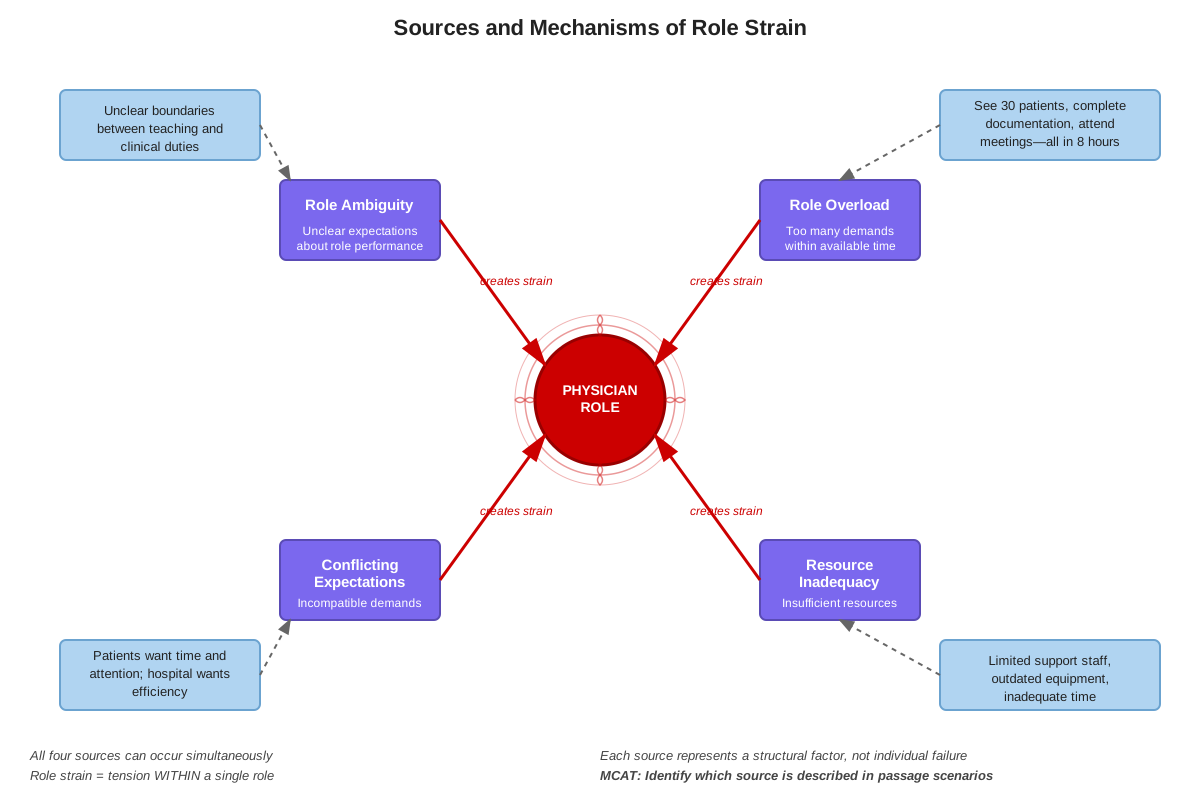
- Expectation overload: The sheer volume of expectations exceeds what one person can reasonably accomplish
- Contradictory expectations: Different aspects of the role require mutually exclusive behaviors or priorities
- Resource insufficiency: The role demands exceed available time, energy, knowledge, or material resources
- Value conflicts: Role expectations conflict with personal values or beliefs
- Ambiguous expectations: Unclear or poorly defined role requirements create uncertainty and stress
Role Strain vs. Role Conflict
Understanding the distinction between these related concepts is crucial for MCAT success:
| Feature | Role Strain | Role Conflict |
|---|---|---|
| Source of tension | Within a single role | Between multiple roles |
| Number of roles involved | One role | Two or more roles |
| Example | A physician struggling to balance patient care with paperwork (both part of "doctor" role) | A physician struggling to balance work demands with family time (two separate roles) |
| Resolution strategy | Prioritizing within role, delegating tasks, redefining role expectations | Time management between roles, role exit, boundary setting |
Sources and Causes of Role Strain
Role strain arises from multiple sources within Social Structure and Institutions:
Institutional design: Organizations may structure roles with inherently incompatible demands. Healthcare systems that require physicians to maximize patient volume while providing thorough, personalized care create built-in role strain.
Role expansion: As professions evolve, roles accumulate additional responsibilities without shedding old ones. Modern physicians must master electronic health records, quality metrics, and business management alongside traditional clinical skills.
Inadequate resources: When institutions fail to provide sufficient support, training, or resources, individuals experience strain trying to meet role expectations with insufficient means.
Cultural expectations: Societal norms may attach unrealistic or contradictory expectations to certain roles. The expectation that physicians be both scientifically objective and emotionally empathetic can create tension.
Status inconsistency: When an individual's various statuses don't align in prestige or authority, the resulting role expectations may conflict, creating strain.
Consequences of Role Strain
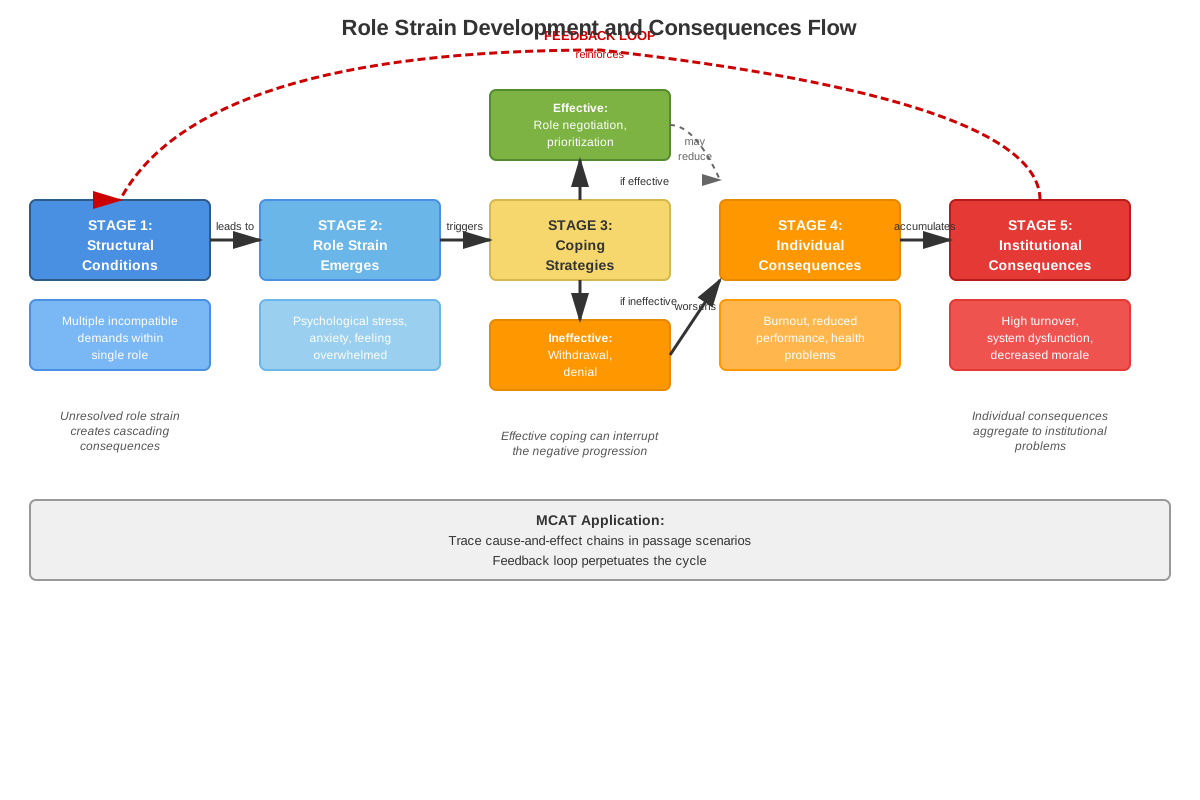
Unresolved role strain produces significant individual and institutional consequences:
Individual level:
- Psychological stress, anxiety, and depression
- Burnout and emotional exhaustion
- Reduced job satisfaction and professional fulfillment
- Physical health problems related to chronic stress
- Decreased performance quality
- Identity confusion or crisis
Institutional level:
- Higher turnover and attrition rates
- Reduced organizational effectiveness
- Lower quality of service delivery
- Increased errors and safety concerns
- Difficulty recruiting and retaining qualified individuals
- Negative organizational culture
Coping Strategies and Resolution
Individuals and institutions employ various strategies to manage role strain:
Individual strategies:
- Prioritization: Ranking role demands and focusing on highest-priority expectations
- Compartmentalization: Separating different aspects of the role temporally or mentally
- Delegation: Distributing tasks to others when possible
- Negotiation: Discussing role expectations with supervisors or stakeholders to modify demands
- Role redefinition: Reinterpreting what the role requires or means
- Seeking support: Utilizing social support networks or professional resources
Institutional strategies:
- Role clarification: Clearly defining expectations and priorities
- Resource allocation: Providing adequate time, staff, and materials
- Structural redesign: Reorganizing roles to reduce incompatible demands
- Training and development: Equipping individuals with skills to manage multiple demands
- Support systems: Creating mentorship, counseling, or peer support programs
Concept Relationships
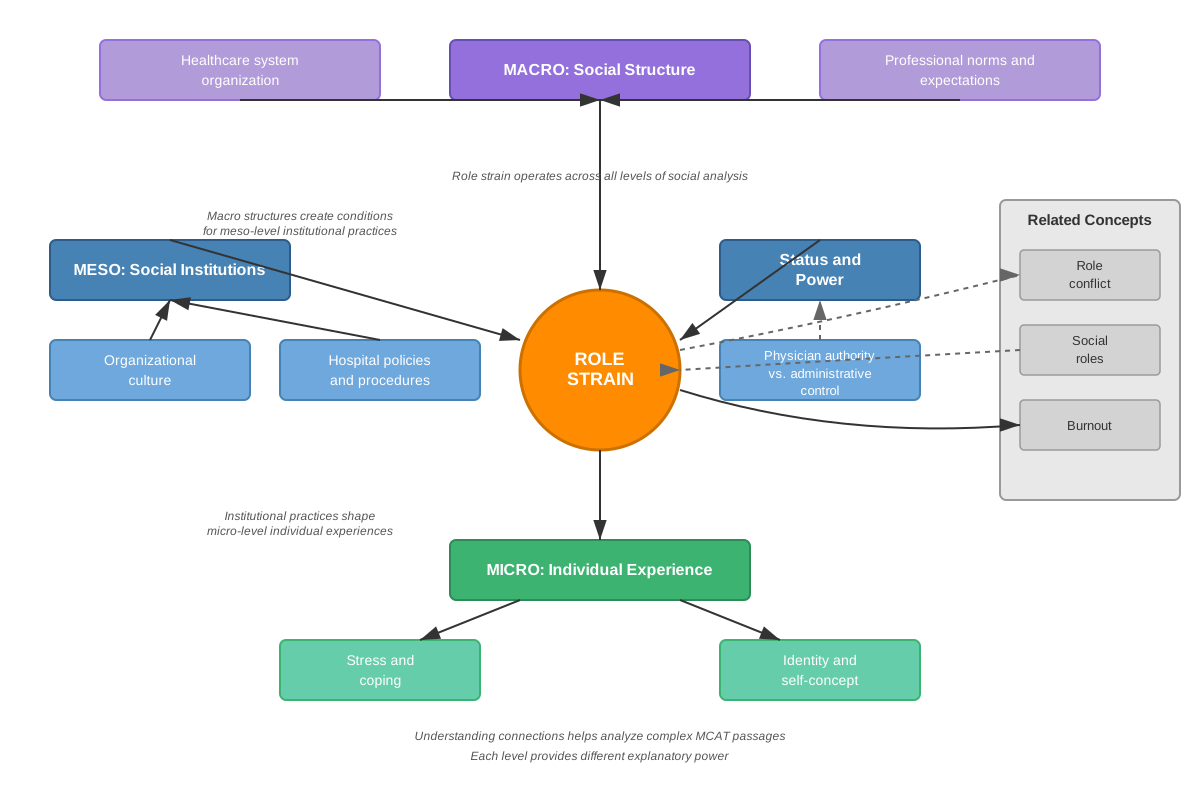
Role strain exists within a network of interconnected sociological concepts. At its foundation, the concept depends on understanding social roles and status—the positions individuals occupy in social structures and the expected behaviors associated with those positions. When a single status carries multiple, incompatible role expectations, role strain emerges.
The concept connects directly to role conflict, but the relationship is one of distinction rather than similarity. Both involve tension around role expectations, but role strain is intra-role (within one role) while role conflict is inter-role (between multiple roles). This distinction → determines appropriate coping strategies → which influences individual well-being and institutional functioning.
Role strain → contributes to → stress and burnout → which affects → organizational behavior and institutional effectiveness. This chain is particularly relevant in healthcare settings where physician burnout → reduces → quality of patient care → which impacts → health outcomes and system costs.
The concept also connects to social institutions because institutions structure roles and create the conditions for strain. Healthcare institutions, educational institutions, and family structures → establish role expectations → which may contain inherent contradictions → leading to role strain. Understanding this relationship helps explain why certain professions or positions consistently produce high strain levels.
Role strain relates to socialization because individuals learn role expectations through socialization processes. When socialization is incomplete or when roles evolve faster than socialization can adapt → role ambiguity increases → exacerbating role strain.
Finally, role strain connects to theories of social structure and agency. The concept illustrates how social structures constrain individual action (structural forces create role demands) while individuals exercise agency (choosing coping strategies and negotiating expectations). This tension between structure and agency is fundamental to sociological analysis.
High-Yield Facts
⭐ Role strain occurs within a single role when that role contains incompatible or competing demands, distinguishing it from role conflict which occurs between multiple roles
⭐ Robert Merton coined the term "role strain" to describe intra-role tension as distinct from inter-role conflict
⭐ Healthcare professionals, particularly physicians, commonly experience role strain due to competing demands of patient care, documentation, continuing education, and administrative responsibilities
⭐ The five main sources of role strain are expectation overload, contradictory expectations, resource insufficiency, value conflicts, and ambiguous expectations
⭐ Unresolved role strain leads to burnout, reduced job satisfaction, decreased performance quality, and higher turnover rates
- Role strain can be managed through individual strategies (prioritization, delegation, negotiation) and institutional strategies (role clarification, resource allocation, structural redesign)
- Medical students frequently experience role strain balancing the expectations of being both learners and caregivers simultaneously
- Role strain differs from role overload, which simply involves too many responsibilities without necessarily involving incompatibility
- Chronic role strain can lead to role exit, where individuals abandon the role entirely to escape the tension
- Social institutions often inadvertently create role strain through poorly designed organizational structures or unrealistic expectations
Quick check — test yourself on Role strain so far.
Try Flashcards →Common Misconceptions
Misconception: Role strain and role conflict are the same thing → Correction: Role strain occurs within a single role when that role has competing demands, while role conflict occurs between two or more different roles. A physician experiencing tension between patient care and paperwork (both part of the doctor role) experiences role strain; tension between being a doctor and being a parent involves role conflict.
Misconception: Role strain only occurs when someone has too many responsibilities → Correction: While overload can contribute to role strain, the defining feature is incompatibility or contradiction among expectations, not simply quantity. A role with just two expectations can produce severe strain if those expectations are mutually exclusive.
Misconception: Role strain is purely an individual problem caused by poor time management → Correction: Role strain often results from structural and institutional factors, including poorly designed roles, inadequate resources, or contradictory organizational demands. It is a sociological phenomenon, not merely a personal failing.
Misconception: Experiencing role strain means someone is unsuited for their role → Correction: Role strain is a normal consequence of complex social roles, particularly in demanding professions. Experiencing strain indicates that the role contains inherent tensions, not that the individual lacks competence.
Misconception: Role strain can be completely eliminated through better organization → Correction: While management strategies can reduce role strain, some roles contain inherent contradictions that cannot be fully resolved without structural changes to the role itself or the institution that defines it.
Misconception: Role strain only affects people in high-status professional roles → Correction: Role strain can occur in any social role, including student, patient, parent, or employee. Any role with multiple, competing expectations can produce strain regardless of status level.
Worked Examples
Example 1: Medical Student Scenario
Vignette: Maria is a third-year medical student on her surgery rotation. She is expected to arrive early to pre-round on patients, participate in lengthy surgeries, complete detailed patient notes, study for her shelf exam, attend mandatory educational conferences, and demonstrate enthusiasm and engagement throughout 80-hour work weeks. She finds herself unable to provide thorough patient care while also completing all documentation requirements and maintaining the knowledge base expected of her. She feels constantly behind and inadequate despite working to exhaustion.
Analysis:
Step 1: Identify the number of roles involved. Maria occupies one primary role: medical student. All the competing demands (patient care, documentation, studying, attendance, enthusiasm) are expectations within this single role.
Step 2: Identify the nature of the tension. The demands are incompatible given time and energy constraints. Spending more time with patients means less time for documentation and studying. The expectations exceed available resources (time, energy).
Step 3: Classify the phenomenon. This is role strain, not role conflict, because all tensions exist within the single role of medical student. Specifically, Maria experiences both expectation overload (too many demands) and contradictory expectations (thorough patient care vs. efficient documentation).
Step 4: Predict consequences. Without intervention, Maria risks burnout, decreased learning, reduced patient care quality, and potential health problems from chronic stress.
Step 5: Identify potential solutions. Individual strategies might include prioritization (focusing on highest-yield activities) and seeking mentorship. Institutional strategies might include reducing work hours, clarifying priorities, or providing additional support staff.
MCAT Connection: This scenario exemplifies how role strain appears in exam passages—embedded in realistic healthcare contexts requiring students to distinguish between role strain and role conflict while identifying sources and consequences.
Example 2: Physician in Community Practice
Vignette: Dr. Johnson is a family physician who prides himself on building long-term relationships with patients and providing comprehensive, unhurried care. His practice recently joined a large healthcare system that requires him to see patients every 15 minutes, complete extensive electronic documentation for each visit, meet specific productivity metrics, and maintain high patient satisfaction scores. He finds that spending adequate time with patients makes him fall behind schedule and fail productivity metrics, but rushing through appointments compromises the quality of care he values and reduces patient satisfaction.
Analysis:
Step 1: Identify the role. Dr. Johnson occupies the single role of physician. The competing demands (relationship-building, time efficiency, documentation, productivity, quality, satisfaction) all stem from this one role.
Step 2: Identify the type of strain. This involves contradictory expectations—the role simultaneously demands both efficiency (15-minute appointments, high volume) and thoroughness (comprehensive care, relationship-building). These expectations are mutually exclusive given time constraints.
Step 3: Identify the source. The role strain originates from institutional design. The healthcare system has structured the physician role with inherently incompatible demands, creating structural role strain.
Step 4: Distinguish from related concepts. This is not role conflict (no tension between being a physician and another role like parent or spouse). This is not simply role overload (the issue isn't just quantity but incompatibility of expectations).
Step 5: Analyze consequences and solutions. Consequences include physician burnout, reduced job satisfaction, potential decline in care quality, and possible role exit (leaving the practice). Solutions require institutional changes: restructuring appointment schedules, revising productivity metrics, or providing support staff to handle documentation.
MCAT Connection: This example demonstrates how Social Structure and Institutions create conditions for role strain and how institutional factors must be considered in sociological analysis, not just individual characteristics.
Exam Strategy
When approaching MCAT questions about role strain, employ this systematic strategy:
Step 1: Count the roles. Immediately determine whether the scenario involves one role or multiple roles. If the tension exists within a single role, consider role strain. If tension exists between different roles (work vs. family, student vs. athlete), consider role conflict instead.
Step 2: Identify trigger words. Watch for phrases like "within their position as," "different aspects of being a," "competing demands of the same role," or "contradictory expectations for." These signal role strain. Conversely, phrases like "balancing work and family" or "juggling multiple responsibilities" often indicate role conflict.
Step 3: Analyze the source of incompatibility. Determine whether the strain comes from overload, contradiction, resource insufficiency, value conflict, or ambiguity. This helps eliminate wrong answers and select the most precise option.
Step 4: Apply the exclusion principle. Eliminate answers that:
- Describe tension between multiple roles (that's role conflict)
- Describe simple stress without incompatible demands (that's general stress)
- Describe interpersonal conflict (that's a different concept)
- Describe inadequate role preparation (that's incomplete socialization)
Step 5: Consider context. Healthcare scenarios involving physicians, nurses, or medical students frequently test role strain. Patient scenarios may involve role strain within the "patient role" when treatment demands conflict.
Exam Tip: If a question asks about a physician struggling with patient care versus administrative duties, or a medical student balancing learning versus patient care responsibilities, the answer is almost always role strain, not role conflict.
Time allocation: Spend 60-70 seconds on discrete questions about role strain. For passage-based questions, locate the relevant information in the passage first (usually in paragraphs describing a single individual's experience within one position), then apply the decision framework above. Don't overthink the distinction—if all demands come from one role, it's role strain.
Common trap answers: Watch for options that correctly identify stress or tension but misclassify it as role conflict, role overload, or interpersonal conflict. The MCAT frequently includes these as distractors.
Memory Techniques
Mnemonic for sources of role strain - "OCEAN":
- Overload of expectations
- Contradictory expectations
- Expectation ambiguity
- Ambivalence (value conflicts)
- Need for resources (insufficiency)
Visualization strategy: Picture a single person wearing one hat (representing one role) but being pulled in multiple directions by ropes attached to that same hat. This contrasts with role conflict, where you'd picture someone wearing multiple hats simultaneously.
Distinction memory aid: "STRAIN stays in one LANE" (one role), while "CONFLICT crosses LANES" (multiple roles).
For remembering Robert Merton: "Merton's strain remains in one domain" (domain = role).
Acronym for consequences - "BRITE":
- Burnout
- Reduced satisfaction
- Increased turnover
- Tension and stress
- Exhaustion
Conceptual anchor: Always remember the physician example—competing demands of patient care, documentation, and administrative work within the single role of "doctor." This concrete example can serve as a reference point for evaluating other scenarios.
Summary
Role strain is a fundamental sociological concept describing tension that occurs within a single social role when that role contains incompatible, contradictory, or overwhelming demands. Distinguished from role conflict by its intra-role nature, role strain emerges from expectation overload, contradictory expectations, resource insufficiency, value conflicts, or ambiguous expectations. The concept is particularly relevant in healthcare contexts where professionals navigate competing demands of patient care, documentation, continuing education, and administrative responsibilities within their professional roles. Understanding role strain requires recognizing that it stems from both individual experiences and structural factors within social institutions. Unresolved role strain produces significant consequences including burnout, reduced performance, and organizational dysfunction, while management strategies range from individual prioritization and delegation to institutional role redesign and resource allocation. For the MCAT, mastering this concept means being able to distinguish it from role conflict, identify its sources and consequences, and apply it to realistic healthcare scenarios.
Key Takeaways
- Role strain occurs within a single role when that role contains incompatible or competing demands, while role conflict occurs between multiple different roles
- The five primary sources of role strain are expectation overload, contradictory expectations, resource insufficiency, value conflicts, and ambiguous expectations
- Healthcare professionals commonly experience role strain due to competing demands of patient care, administrative duties, documentation, and continuing education within their professional role
- Unresolved role strain leads to burnout, reduced job satisfaction, decreased performance quality, and higher turnover rates at individual and institutional levels
- Role strain can be managed through individual strategies (prioritization, delegation, negotiation) and institutional strategies (role clarification, resource allocation, structural redesign)
- On the MCAT, role strain appears frequently in passages about medical education, physician experiences, and healthcare system organization
- The key to identifying role strain on exam questions is counting roles—if all competing demands come from one role, it's role strain; if demands come from multiple roles, it's role conflict
Related Topics
Role conflict: Understanding the distinction between role strain (intra-role) and role conflict (inter-role) is essential. Mastering role strain provides the foundation for recognizing when tensions cross role boundaries versus remaining within a single role.
Social roles and status: Deeper exploration of how roles are defined, learned, and enacted provides context for understanding why certain roles are more prone to strain than others.
Burnout and occupational stress: Role strain is a primary contributor to burnout, particularly in healthcare professions. Understanding this relationship connects sociological concepts to psychological outcomes.
Organizational behavior and institutional structure: Examining how organizations design roles and allocate resources explains the structural sources of role strain and potential institutional solutions.
Socialization and role learning: Understanding how individuals learn role expectations helps explain why role ambiguity contributes to strain and how better socialization might reduce it.
Coping mechanisms and stress management: Exploring psychological strategies for managing stress complements the sociological understanding of role strain with individual-level interventions.
Practice CTA
Now that you've mastered the concept of role strain, it's time to reinforce your understanding through active practice. Complete the associated practice questions to test your ability to distinguish role strain from related concepts, identify its sources in complex scenarios, and apply your knowledge to MCAT-style passages. Use the flashcards to drill the key distinctions, sources, and consequences until they become automatic. Remember, the MCAT rewards not just knowledge but the ability to apply concepts quickly and accurately under time pressure. Your thorough understanding of role strain will serve you well not only on exam day but throughout your medical career as you navigate the complex demands of healthcare professions. You've got this!
Sign up free to keep reading
Create a free AnvayaPrep account to finish this MCAT guide on Role strain — plus flashcards and practice questions.