Overview
Roles are fundamental building blocks of social structure that define expected behaviors, rights, and obligations associated with particular positions in society. In Sociology, a role represents the dynamic, behavioral component of a social status—the script that individuals follow when occupying a particular position within social institutions. Understanding roles is essential for comprehending how societies maintain order, how individuals navigate multiple social identities simultaneously, and how social expectations shape behavior across different contexts.
For the MCAT, roles represent a high-yield topic that appears frequently in the Psychological, Social, and Biological Foundations of Behavior section. Questions often present clinical scenarios, research studies, or social situations where test-takers must identify role conflicts, role strain, role exit processes, or the relationship between ascribed and achieved statuses and their corresponding roles. The MCAT tests not only definitional knowledge but also the ability to apply role theory to analyze complex social interactions, healthcare settings, and patient-provider relationships.
Roles connect intimately to broader concepts within Social Structure and Institutions. They serve as the mechanism through which social institutions (family, education, healthcare, religion) maintain stability and predictability. Roles link individual behavior to macro-level social structures, bridging micro-sociology (individual interactions) and macro-sociology (large-scale social patterns). Understanding roles provides the foundation for analyzing social stratification, group dynamics, organizational behavior, and the socialization processes that teach individuals how to perform their various social positions effectively.
Learning Objectives
- [ ] Define Roles using accurate Sociology terminology
- [ ] Explain why Roles matters for the MCAT
- [ ] Apply Roles to exam-style questions
- [ ] Identify common mistakes related to Roles
- [ ] Connect Roles to related Sociology concepts
- [ ] Distinguish between role conflict, role strain, and role overload with clinical examples
- [ ] Analyze the relationship between social status and role performance
- [ ] Evaluate how role transitions affect individual identity and social functioning
Prerequisites
- Social Status: Understanding the difference between ascribed and achieved status is essential because roles are the behavioral expectations attached to statuses
- Socialization: Knowledge of how individuals learn social norms and expectations provides context for how people acquire role knowledge
- Social Norms: Familiarity with normative expectations helps explain the prescriptive nature of roles
- Social Institutions: Basic understanding of major institutions (family, education, healthcare) provides the contexts where roles operate
Why This Topic Matters
Clinical and Real-World Significance
Roles are particularly relevant in healthcare settings where multiple role relationships intersect. Physicians must navigate the doctor role (authority, expertise, care provider) while patients occupy the sick role (exemption from normal responsibilities, obligation to seek help and comply with treatment). Healthcare professionals frequently experience role strain when institutional demands conflict with patient care ideals, and understanding these dynamics improves clinical communication and reduces burnout.
Role theory explains critical social phenomena including work-life balance challenges, caregiver stress, professional identity formation during medical training, and the social determinants of health. When individuals cannot fulfill expected roles due to illness, disability, or social barriers, significant psychological and social consequences emerge, affecting mental health, self-esteem, and social integration.
Exam Statistics and Question Types
Roles appear in approximately 15-20% of MCAT Sociology questions, making it one of the highest-yield topics in the discipline. Questions typically present:
- Passage-based scenarios describing research studies on role transitions, healthcare interactions, or organizational behavior
- Discrete questions requiring identification of role conflict versus role strain
- Application questions asking students to predict behavioral outcomes based on role expectations
- Analysis questions connecting role theory to health disparities, patient compliance, or professional socialization
The MCAT frequently embeds role concepts within passages about medical education, patient experiences, workplace dynamics, or family caregiving, requiring students to recognize role terminology even when not explicitly stated.
Core Concepts
Definition and Components of Roles
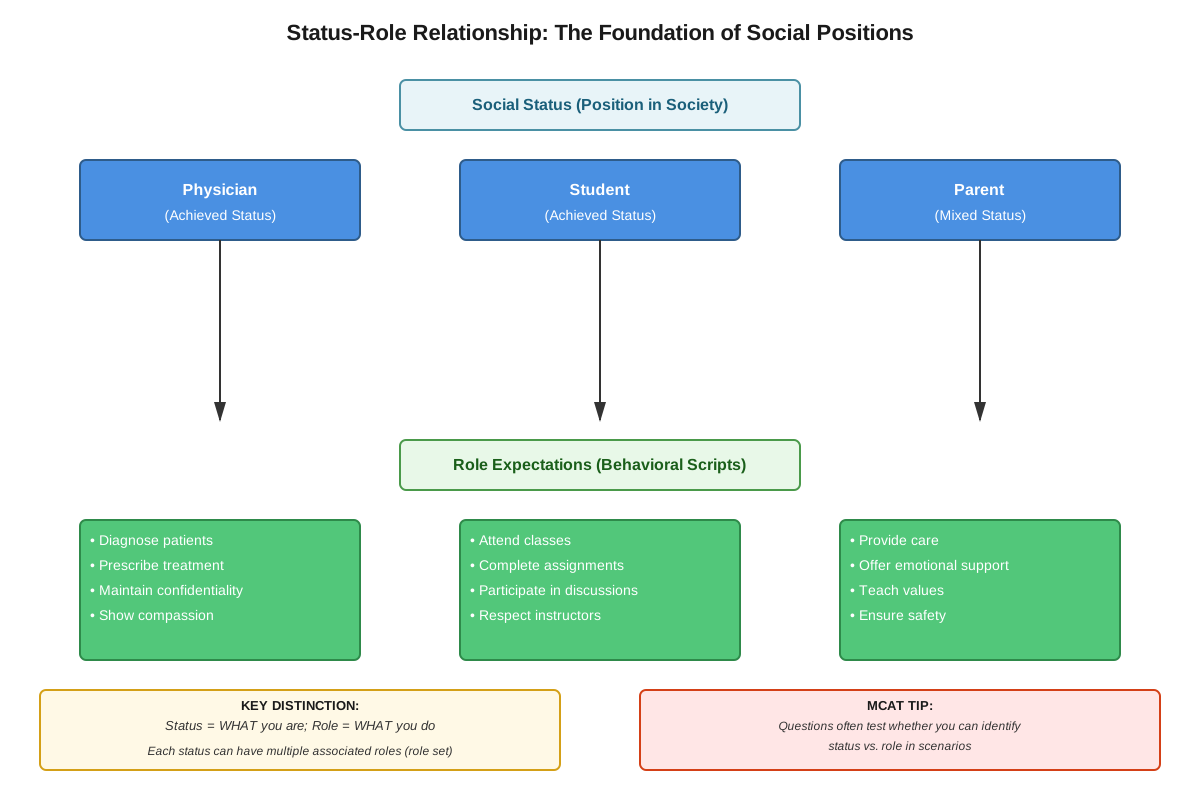
A role is the set of behavioral expectations, obligations, privileges, and norms associated with a particular social status or position. While status represents the position itself (student, parent, physician), the role encompasses what that person is expected to do, how they should act, and what rights they possess. Roles provide the behavioral blueprint that guides social interaction and makes behavior predictable.
Role performance refers to how an individual actually enacts a role, which may vary from the ideal role expectations. This variation occurs because individuals bring their own personalities, interpretations, and circumstances to role enactment. Role-taking describes the process of imaginatively occupying another person's role to understand their perspective—a concept central to symbolic interactionism and empathy development.
Roles possess several key characteristics:
- Prescriptive nature: Roles dictate what should be done
- Relational quality: Roles exist in relationship to other roles (teacher-student, doctor-patient)
- Contextual variation: The same status may involve different role expectations across cultures or situations
- Multiple dimensions: Roles include behavioral, attitudinal, and emotional components
Types of Roles
| Role Type | Definition | Example | MCAT Relevance |
|---|---|---|---|
| Ascribed Role | Roles assigned at birth or involuntarily later in life | Daughter, elderly person, patient with chronic illness | Questions about health disparities, sick role |
| Achieved Role | Roles acquired through effort, choice, or accomplishment | Physician, college graduate, volunteer | Professional identity, medical training scenarios |
| Master Status | A status that dominates others and shapes overall identity | Physician identity, disability status | How one role overshadows others in social perception |
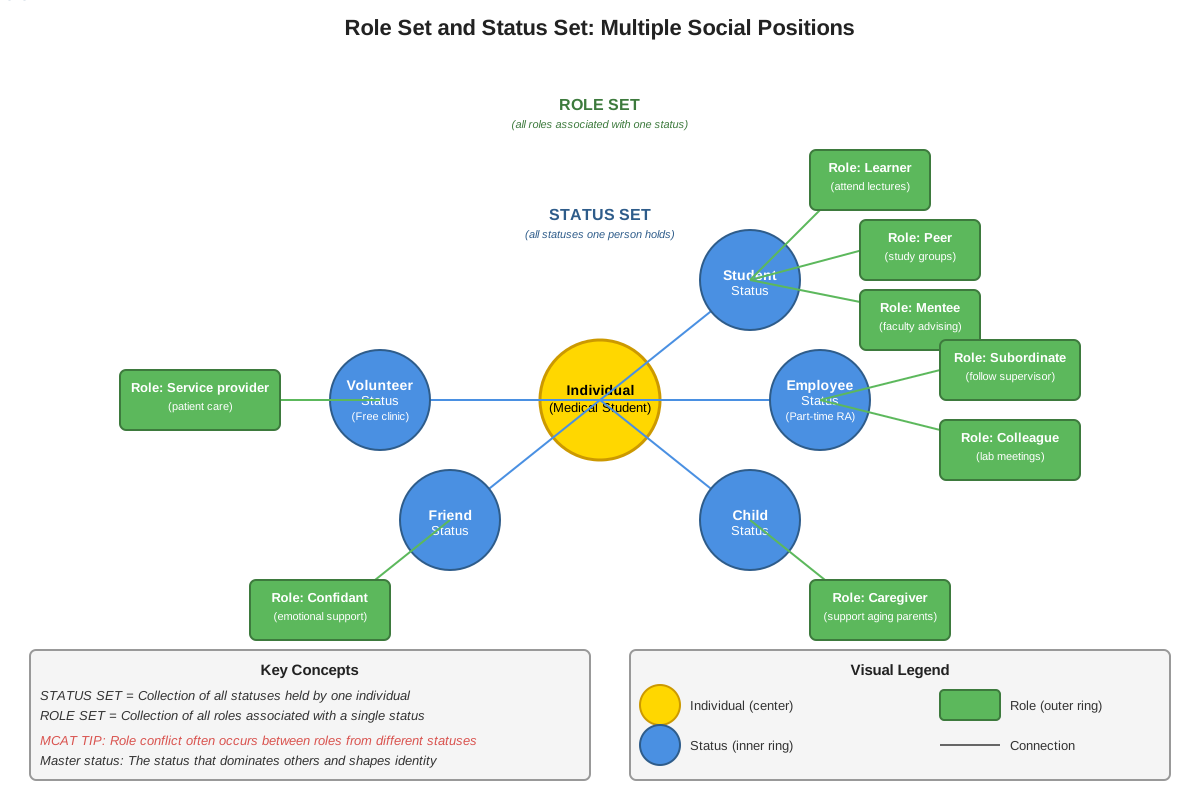
| Role Set | All roles associated with a single status | A physician's roles: diagnostician, educator, researcher, administrator | Healthcare professional complexity |
Role Conflict
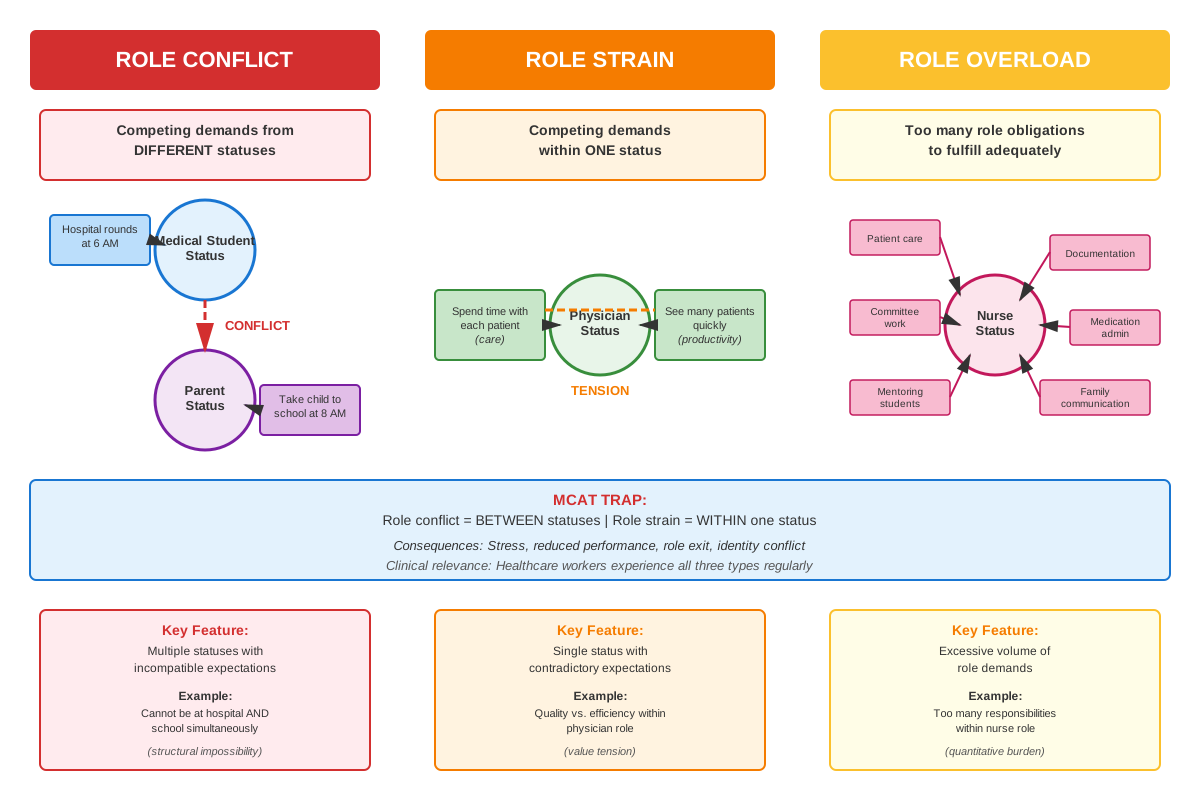
Role conflict occurs when incompatible expectations arise from two or more roles held simultaneously by the same person. This inter-role conflict creates tension because fulfilling one role's demands makes it difficult or impossible to meet another role's expectations. Role conflict represents a structural problem—the issue lies in the incompatibility between different social positions.
Common examples include:
- A medical resident (professional role) missing a child's school event (parent role)
- A nurse (employee role) advocating for a patient against hospital cost-cutting policies (institutional role)
- A medical student (learner role) witnessing unethical behavior by a supervising physician (professional ethics role)
The MCAT frequently tests role conflict in scenarios involving work-family balance, professional ethics versus institutional demands, or cultural expectations conflicting with professional obligations. Resolution strategies include:
- Compartmentalization: Separating roles by time or space
- Prioritization: Ranking roles by importance in specific situations
- Negotiation: Modifying expectations with relevant others
- Role exit: Leaving one of the conflicting roles entirely
Role Strain
Role strain involves tension among competing demands within a single role—an intra-role conflict. Unlike role conflict where different statuses clash, role strain emerges from contradictory expectations within the same status position. This represents a more subtle but equally significant source of stress.
Examples particularly relevant to healthcare:
- A physician expected to spend adequate time with each patient (quality care) while seeing high patient volumes (productivity demands)
- A medical student expected to learn through practice (educational needs) while providing perfect patient care (professional standards)
- A parent expected to be nurturing and supportive while also maintaining discipline and setting boundaries
Role overload, a specific type of role strain, occurs when a single role involves more responsibilities than one person can reasonably fulfill, even when those responsibilities don't directly contradict each other. A primary care physician managing 2,000+ patients, handling administrative tasks, staying current with medical literature, and participating in quality improvement initiatives experiences role overload.
The Sick Role
Talcott Parsons developed the sick role concept to describe the social expectations and privileges granted to ill individuals. This role includes four components:
Rights (Exemptions):
- Exemption from normal social responsibilities proportional to illness severity
- Not held responsible for the illness condition
Obligations:
- Must want to get well and view illness as undesirable
- Must seek technically competent help and cooperate with medical advice
The sick role legitimizes illness as a social status while creating mechanisms to prevent illness from becoming a permanent escape from social obligations. However, critics note the sick role concept has limitations:
- Assumes acute rather than chronic illness
- Reflects Western, middle-class values about individual responsibility
- May not apply to stigmatized conditions (mental illness, addiction)
- Doesn't account for structural barriers to healthcare access
MCAT questions often present scenarios testing whether students recognize when the sick role applies, when patients violate sick role expectations, or how healthcare providers enforce sick role obligations.
Role Transitions and Role Exit
Role transition describes the process of moving from one role to another, which can be predictable (graduation, retirement) or unexpected (sudden illness, job loss). Transitions involve three phases:
- Separation: Disengaging from the previous role
- Liminality: An in-between state where the old role has ended but the new role isn't fully established
- Incorporation: Full integration into the new role
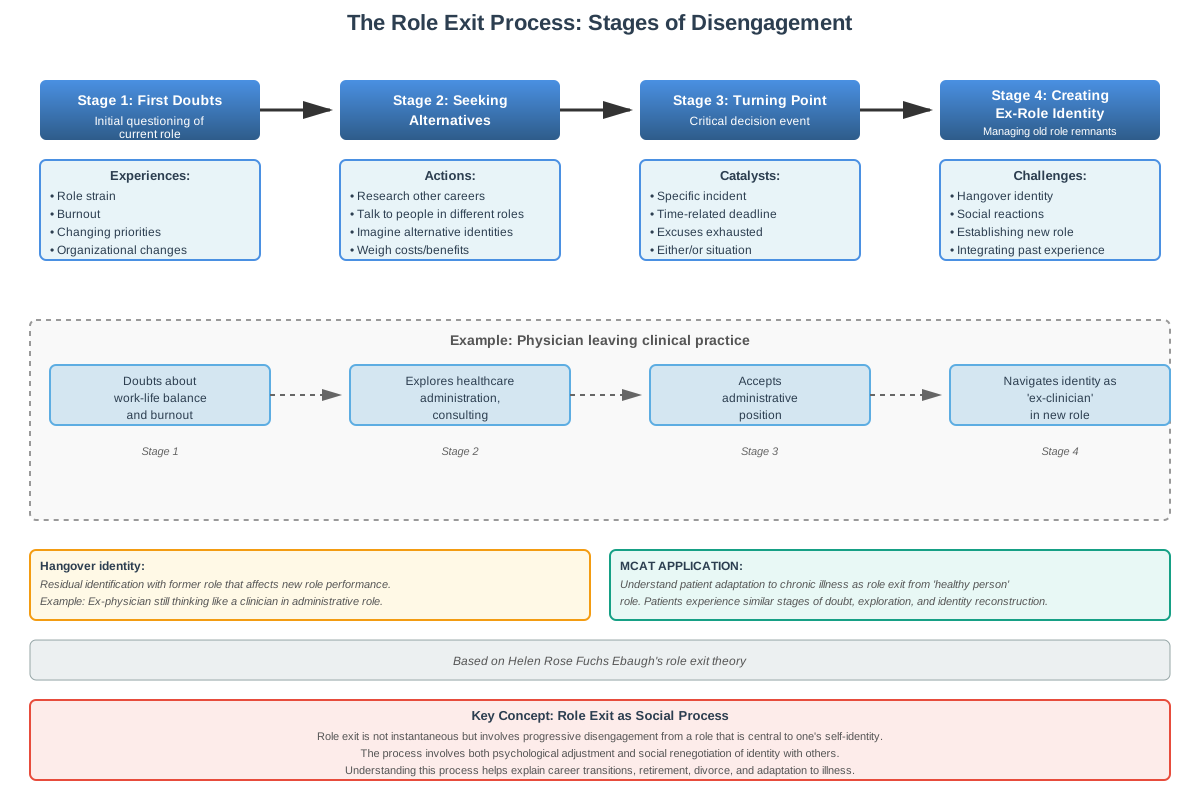
Role exit specifically describes leaving a role that has been central to one's identity. Helen Rose Fuchs Ebaugh identified four stages:
- First doubts: Questioning role satisfaction and fit
- Seeking alternatives: Exploring other options and identities
- The turning point: A specific event triggering the decision to exit
- Creating the ex-role: Establishing a new identity that incorporates but transcends the previous role
Medical training involves multiple role transitions (pre-med to medical student, student to resident, resident to attending physician), each requiring identity reconstruction. Patients experiencing chronic illness undergo role exit from their pre-illness identity, which significantly impacts psychological adjustment and quality of life.
Role Ambiguity and Role Clarity
Role ambiguity exists when role expectations are unclear, inconsistent, or poorly communicated. This uncertainty creates stress because individuals don't know what behaviors will be evaluated positively or negatively. New medical students often experience role ambiguity regarding appropriate assertiveness, when to ask questions, and how to balance observation with participation.
Role clarity provides well-defined expectations, reducing anxiety and improving performance. Healthcare organizations that clearly define roles, responsibilities, and decision-making authority experience better teamwork, fewer errors, and higher job satisfaction.
Concept Relationships
The concepts within role theory form an interconnected system. Social status serves as the foundation, with roles representing the behavioral expectations attached to each status. When individuals occupy multiple statuses simultaneously (as everyone does), they must manage a role set—all the roles associated with those statuses.
This multiplicity creates potential for role conflict (between different statuses) and role strain (within a single status). Both phenomena increase during role transitions, particularly when moving between major life stages or experiencing unexpected status changes. The sick role represents a specific, culturally-defined role that temporarily modifies other role obligations.
Role ambiguity versus role clarity affects how successfully individuals can perform any role, influencing whether they experience strain or conflict. Role exit becomes necessary when role conflict or strain becomes unmanageable, or when life circumstances change.
The relationship map flows as follows:
Social Status → generates → Role Expectations → performed through → Role Performance → which may involve → Role Set (multiple roles) → potentially creating → Role Conflict (between roles) or Role Strain (within roles) → managed through → Coping Strategies or Role Exit → influenced by → Role Clarity/Ambiguity → all occurring within → Social Institutions
These concepts connect to broader sociological frameworks: roles link to functionalism (roles maintain social stability), symbolic interactionism (roles are negotiated through interaction), and conflict theory (roles reflect and perpetuate power inequalities).
Quick check — test yourself on Roles so far.
Try Flashcards →High-Yield Facts
⭐ Roles are the behavioral expectations associated with a social status, while status is the position itself
⭐ Role conflict occurs between different roles (inter-role); role strain occurs within a single role (intra-role)
⭐ The sick role includes both rights (exemption from responsibilities, not blamed for illness) and obligations (must seek help, must want to recover)
⭐ Role transitions involve separation, liminality, and incorporation phases
⭐ Master status is a status that dominates others and shapes a person's entire social identity
- Role performance varies from ideal role expectations based on individual interpretation and circumstances
- Role set refers to all roles associated with a single status position
- Role overload is a type of role strain where demands exceed capacity even without direct contradiction
- Role exit involves four stages: first doubts, seeking alternatives, turning point, and creating the ex-role
- Role ambiguity creates stress and reduces performance; role clarity improves both
- Ascribed roles are assigned involuntarily; achieved roles are earned through effort or choice
- Role-taking is the process of imaginatively occupying another's role to understand their perspective
Common Misconceptions
Misconception: Role and status are interchangeable terms
Correction: Status is the position or rank in society (noun), while role is the behavioral expectations and actions associated with that status (verb-like). A person holds a status but performs a role.
Misconception: Role conflict and role strain are the same thing
Correction: Role conflict involves incompatible expectations from different roles (work vs. family), while role strain involves competing demands within the same single role (a physician balancing patient care quality with productivity demands).
Misconception: The sick role applies equally to all illnesses and cultures
Correction: The sick role concept was developed for acute illnesses in Western societies. It applies poorly to chronic conditions, mental illness, stigmatized diseases, and non-Western cultural contexts where illness may be viewed differently.
Misconception: Role exit means completely abandoning all aspects of a previous identity
Correction: Role exit involves creating an "ex-role" identity that incorporates elements of the previous role into a new identity. Former physicians who become administrators still identify partly with their medical background.
Misconception: Role performance should always match ideal role expectations
Correction: Role performance naturally varies from ideal expectations due to individual differences, resource constraints, and situational factors. This variation is normal and doesn't necessarily indicate role failure.
Misconception: Master status is always positive or prestigious
Correction: Master status can be stigmatizing (ex-convict, person with disability) and may overshadow other identities in negative ways, limiting social opportunities and shaping how others interact with the person.
Misconception: Role transitions are always stressful and negative
Correction: While role transitions involve adjustment and can be challenging, they can also be positive, anticipated, and growth-promoting (graduation, promotion, becoming a parent by choice). The stress level depends on whether the transition is voluntary, expected, and desired.
Worked Examples
Example 1: Identifying Role Conflict vs. Role Strain
Scenario: Dr. Martinez is a family medicine physician who feels torn between spending more time with each patient to provide thorough care and meeting the clinic's requirement to see 25 patients per day. Additionally, she struggles to attend her daughter's soccer games because they occur during clinic hours.
Analysis:
Step 1: Identify all relevant statuses
- Physician (professional status)
- Parent (family status)
Step 2: Identify the conflicts described
- Conflict A: Quality patient care vs. productivity demands
- Conflict B: Work obligations vs. attending daughter's games
Step 3: Determine whether each conflict is inter-role or intra-role
Conflict A involves competing demands within the physician role itself—both quality care and productivity are expectations of being a physician. This is role strain (specifically role overload, as the demands exceed available time).
Conflict B involves incompatible expectations from two different roles—the physician role (be at clinic during work hours) and the parent role (attend child's activities). This is role conflict.
MCAT Application: Questions might ask which statement best describes Dr. Martinez's situation. The correct answer would identify both role strain (within physician role) and role conflict (between physician and parent roles). Incorrect options might confuse the two or suggest only one type of conflict exists.
Example 2: Analyzing the Sick Role
Scenario: A research study examines patients with chronic lower back pain. Researchers find that some patients continue working despite pain, avoid seeking medical care, and resist taking prescribed medications. Healthcare providers express frustration that these patients aren't "taking their condition seriously."
Analysis:
Step 1: Identify sick role components present or absent
Rights:
- Exemption from responsibilities: Patients are NOT claiming this (continuing to work)
- Not blamed for condition: Not directly addressed
Obligations:
- Must want to get well: Patients appear to want wellness but define it differently
- Must seek help and cooperate: Patients are NOT fulfilling this (avoiding care, not taking medications)
Step 2: Analyze why sick role doesn't fit
Chronic pain differs from acute illness in several ways:
- No clear endpoint or "cure" expected
- Legitimacy often questioned by others
- Patients may resist sick role to maintain normal identity
- Structural barriers (work demands, healthcare costs) may prevent role adoption
Step 3: Identify the conflict
Healthcare providers expect patients to adopt the sick role (seek help, comply with treatment), but patients resist this role because:
- Chronic conditions make permanent sick role adoption impractical
- Adopting sick role might mean losing employment
- Pain is invisible, making legitimacy harder to establish
- Cultural values may emphasize stoicism over help-seeking
MCAT Application: Questions might ask why the sick role concept doesn't fully explain these patients' behavior, or what sociological concept best explains the provider-patient tension. The correct answer would recognize limitations of sick role theory for chronic conditions and structural barriers to role adoption.
Exam Strategy
Approaching MCAT Questions on Roles
- Identify all statuses first: Before determining role issues, list every social position mentioned (physician, parent, student, patient, etc.)
- Map role expectations: For each status, note what behaviors or obligations are expected
- Look for conflicts or tensions: Determine whether incompatibilities exist between roles (conflict) or within a single role (strain)
- Consider the context: Healthcare settings, family situations, and workplace scenarios each activate different role expectations
Trigger Words and Phrases
Watch for these terms that signal role concepts:
- "Competing demands" → likely role conflict or strain
- "Obligations," "expectations," "responsibilities" → role components
- "Work-life balance" → typically role conflict
- "Burnout," "overwhelmed" → often role overload (type of strain)
- "Patient compliance," "seeking treatment" → sick role obligations
- "Exemption from duties" → sick role rights
- "Career change," "retirement," "diagnosis" → role transitions or exit
- "Unclear expectations" → role ambiguity
Process of Elimination Tips
When distinguishing between answer choices:
- Role conflict answers mention two different statuses or positions
- Role strain answers mention competing demands within one position
- Sick role answers specifically involve illness, patient status, and healthcare seeking
- Role transition answers involve movement between statuses or time periods
- Master status answers emphasize one identity dominating all others
If an answer choice uses "role" terminology but doesn't match the scenario's actual conflict structure, eliminate it even if it sounds sophisticated.
Time Allocation
Role questions typically require 60-90 seconds:
- 20-30 seconds: Read and identify statuses/roles
- 20-30 seconds: Determine the type of role issue
- 20-30 seconds: Evaluate answer choices
Don't overthink these questions—they test conceptual clarity more than complex reasoning. If you've correctly identified the type of role issue, the answer usually becomes obvious.
Memory Techniques
Mnemonic for Role Conflict vs. Role Strain
"CONFLICT = CROSS roles" (the C's match)
- Role conflict crosses between different roles
"STRAIN = SAME role" (the S's match)
- Role strain stays within the same role
Sick Role Components: "REES"
Rights:
- Relief from normal responsibilities
- Exemption from blame
Expectations (Obligations):
- Earnestly want to recover
- Seek competent help
Role Transition Phases: "SLI"
Think of someone who "SLI-des" from one role to another:
- Separation from old role
- Liminality (in-between state)
- Incorporation into new role
Visualization Strategy
Picture roles as different hats a person wears:
- Role conflict: Trying to wear two hats simultaneously (they don't fit together)
- Role strain: One hat is too tight or has conflicting decorations on it
- Role set: A hat rack with multiple hats for one person
- Role transition: Taking off one hat and putting on another
- Master status: One hat is so large it covers all the others
Summary
Roles represent the behavioral expectations, obligations, and privileges associated with social statuses, forming the foundation of predictable social interaction within social structures and institutions. The MCAT emphasizes distinguishing between role conflict (incompatible expectations from different roles) and role strain (competing demands within a single role), understanding the sick role's rights and obligations, and recognizing how role transitions affect identity and behavior. Roles connect individual behavior to larger social structures, explaining how societies maintain order while individuals navigate multiple, sometimes competing, social identities. Healthcare contexts provide rich examples of role dynamics, including physician-patient relationships, professional socialization, work-life balance challenges, and the impact of illness on social functioning. Mastering role theory requires understanding not just definitions but the ability to analyze complex social scenarios, identify the type of role issue present, and predict behavioral and psychological consequences of role conflicts, strains, transitions, and exits.
Key Takeaways
- Roles are behavioral expectations attached to statuses; status is what you are, role is what you do
- Role conflict occurs between different roles (inter-role); role strain occurs within one role (intra-role)
- The sick role grants exemptions from responsibilities and blame while requiring help-seeking and desire to recover
- Role transitions involve separation, liminality, and incorporation phases, often affecting identity and psychological well-being
- Master status dominates other identities and shapes how others perceive and interact with an individual
- Role ambiguity creates stress and reduces performance; role clarity improves both outcomes
- Healthcare settings frequently involve role conflicts (work-family), role strain (quality vs. productivity), and sick role dynamics
Related Topics
Social Status and Stratification: Understanding ascribed versus achieved status, status inconsistency, and how status hierarchies shape role expectations and opportunities
Socialization: Examining how individuals learn role expectations through primary and secondary socialization, anticipatory socialization for future roles, and resocialization during role transitions
Social Institutions: Analyzing how major institutions (family, education, healthcare, economy) structure roles and create role expectations that maintain institutional stability
Symbolic Interactionism: Exploring how roles are negotiated through social interaction, how role-taking develops empathy and social understanding, and how the looking-glass self shapes role performance
Group Dynamics: Investigating how roles within groups (task roles, social roles, leadership roles) affect group functioning, cohesion, and productivity
Identity and Self-Concept: Understanding how multiple roles contribute to overall identity, how role conflicts affect self-concept, and how role exits require identity reconstruction
Practice CTA
Now that you've mastered the core concepts of roles in sociology, test your understanding with practice questions and flashcards. Focus on distinguishing role conflict from role strain, applying sick role theory to healthcare scenarios, and analyzing role transitions in clinical contexts. The more you practice applying these concepts to MCAT-style passages, the more automatic your recognition of role dynamics will become. Remember, roles appear in approximately 15-20% of sociology questions—making this one of your highest-yield study investments. You've built a strong conceptual foundation; now reinforce it through active practice and application!
Sign up free to keep reading
Create a free AnvayaPrep account to finish this MCAT guide on Roles — plus flashcards and practice questions.