Overview
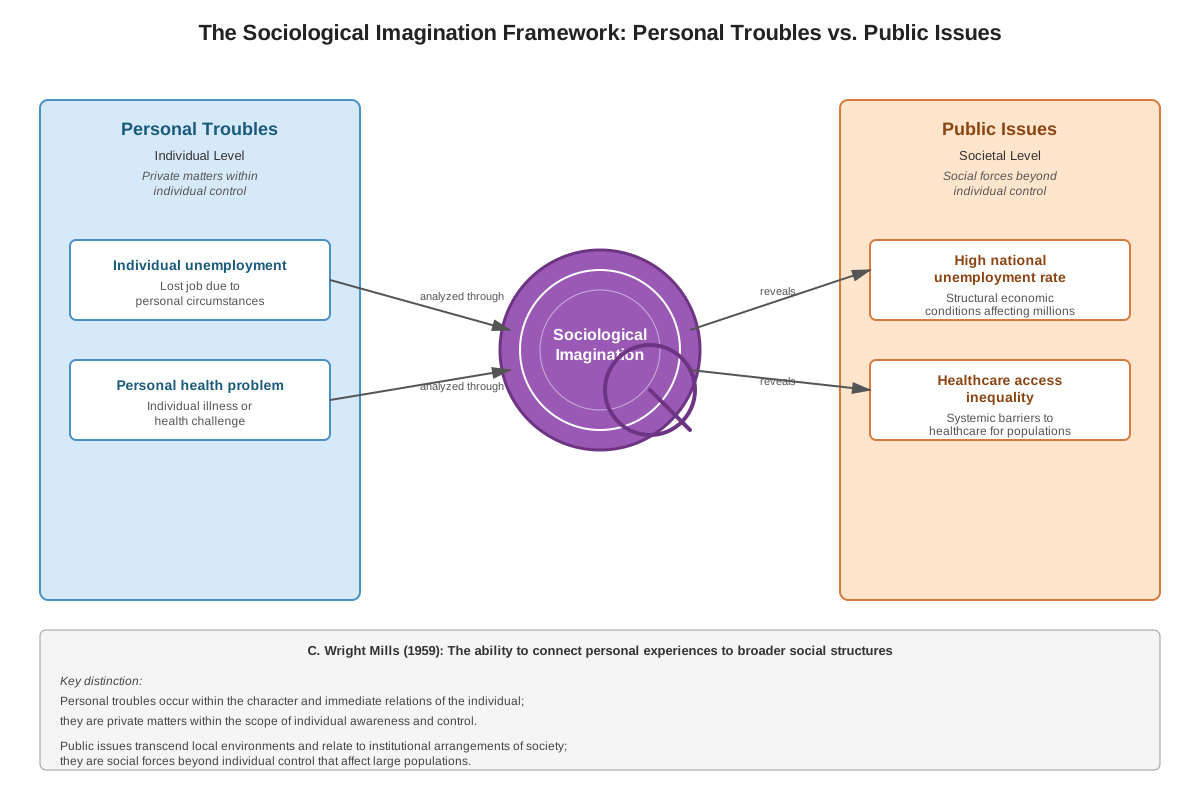
Sociological imagination is one of the most foundational and frequently tested concepts in the MCAT Sociology section. Coined by sociologist C. Wright Mills in 1959, this concept represents a fundamental shift in how individuals understand their personal experiences by connecting them to broader social forces, historical contexts, and institutional structures. The sociological imagination enables individuals to distinguish between "personal troubles" (individual challenges) and "public issues" (societal problems), recognizing that what appears to be a private matter often reflects larger patterns within social structure and institutions.
For the MCAT, understanding sociological imagination is critical because it forms the conceptual foundation for analyzing how individual behavior, health outcomes, and life circumstances are shaped by social forces beyond personal control. This perspective is essential for future physicians who must recognize that patient health is not solely determined by individual choices but is profoundly influenced by socioeconomic status, cultural norms, institutional policies, and historical inequalities. The AAMC emphasizes this concept because it reflects the biopsychosocial model of health, which requires understanding patients within their complete social context.
The sociological imagination connects to virtually every other topic in Sociology for the MCAT, including social inequality, stratification, institutions, culture, and social change. It provides the analytical framework through which all other sociological concepts should be understood. When students master this concept, they gain the ability to analyze MCAT passages that present individual cases or health disparities and correctly identify the underlying social, structural, or institutional factors at play—a skill that appears across multiple question types in the Psychological, Social, and Biological Foundations of Behavior section.
Learning Objectives
- [ ] Define Sociological imagination using accurate Sociology terminology
- [ ] Explain why Sociological imagination matters for the MCAT
- [ ] Apply Sociological imagination to exam-style questions
- [ ] Identify common mistakes related to Sociological imagination
- [ ] Connect Sociological imagination to related Sociology concepts
- [ ] Distinguish between personal troubles and public issues in clinical scenarios
- [ ] Analyze how historical context and social structures influence individual health outcomes
- [ ] Evaluate MCAT passages using the sociological imagination framework to identify structural versus individual factors
Prerequisites
- Basic understanding of social structure: The organization of society into institutions, groups, and hierarchies is necessary to understand how these structures influence individuals
- Familiarity with sociological perspective: Recognizing that sociology studies patterns of human behavior at the group level rather than focusing solely on individual psychology
- Awareness of social institutions: Knowledge that institutions (family, education, healthcare, economy) shape individual experiences and opportunities
- Understanding of culture and socialization: Recognition that individuals are shaped by the cultural contexts and socialization processes they experience
Why This Topic Matters
Clinical and Real-World Significance
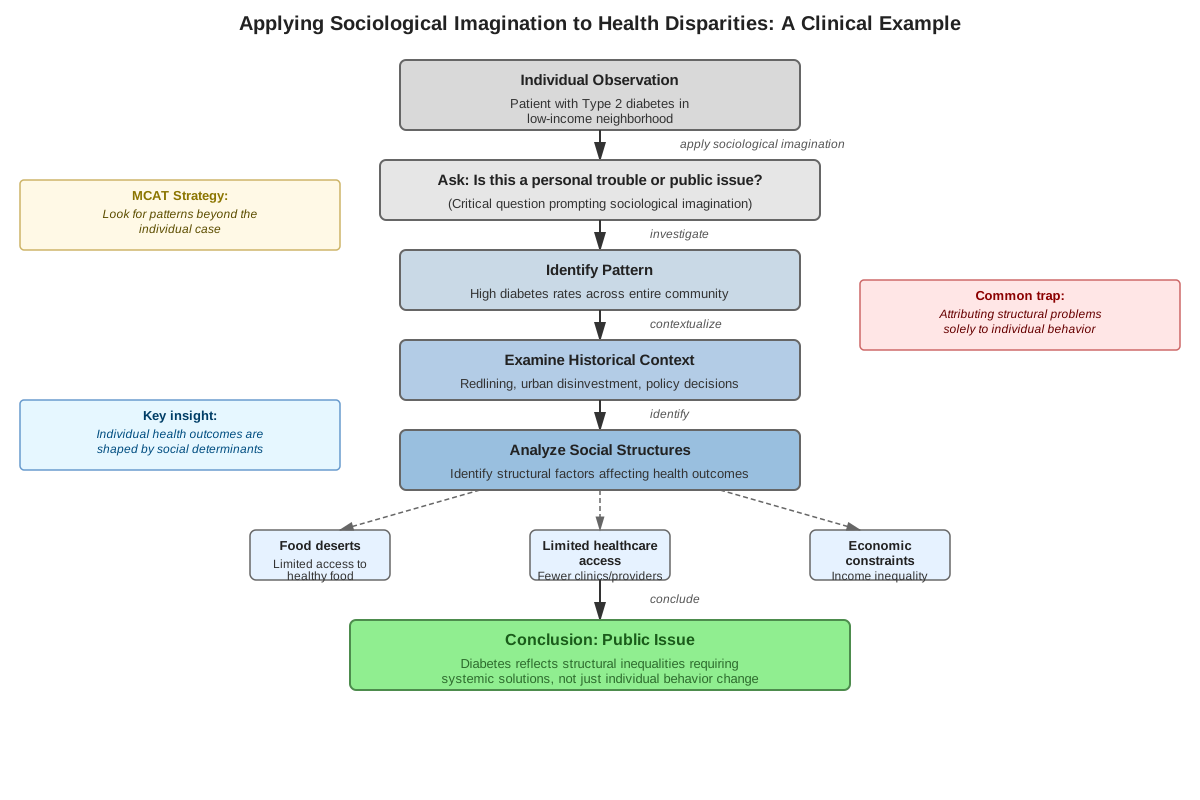
The sociological imagination is essential for medical practice because it enables healthcare providers to understand that patient health outcomes result from complex interactions between individual behaviors and social determinants of health. For example, a physician using sociological imagination recognizes that a patient's diabetes is not simply a result of poor dietary choices but may reflect limited access to healthy food (food deserts), economic constraints, work schedules that prevent meal planning, cultural food traditions, and neighborhood safety issues that limit exercise opportunities. This perspective is crucial for developing effective, patient-centered treatment plans and for advocating for public health interventions that address root causes rather than merely treating symptoms.
MCAT Exam Statistics and Frequency
Sociological imagination appears frequently on the MCAT, both as a direct concept tested in discrete questions and as an underlying framework for analyzing passages. Approximately 15-20% of Sociology questions require students to distinguish between individual-level and structural-level explanations for behavior or health outcomes. The concept appears most commonly in:
- Passage-based questions presenting health disparities or social problems requiring structural analysis
- Discrete questions asking students to identify which explanation best reflects sociological versus psychological perspectives
- Questions about social determinants of health where students must recognize institutional and structural factors
- Scenario-based questions requiring differentiation between personal troubles and public issues
Common Exam Presentation Formats
The MCAT typically presents sociological imagination through clinical vignettes describing individual patients or communities facing health challenges. Students must identify whether answer choices reflect individual-level explanations (psychological, biological, or behavioral) or structural-level explanations (institutional, economic, cultural, or historical). Passages may describe patterns such as higher rates of cardiovascular disease in certain communities, educational achievement gaps, or mental health disparities, requiring students to apply sociological imagination to identify the social forces at work.
Core Concepts
Definition and Origin of Sociological Imagination
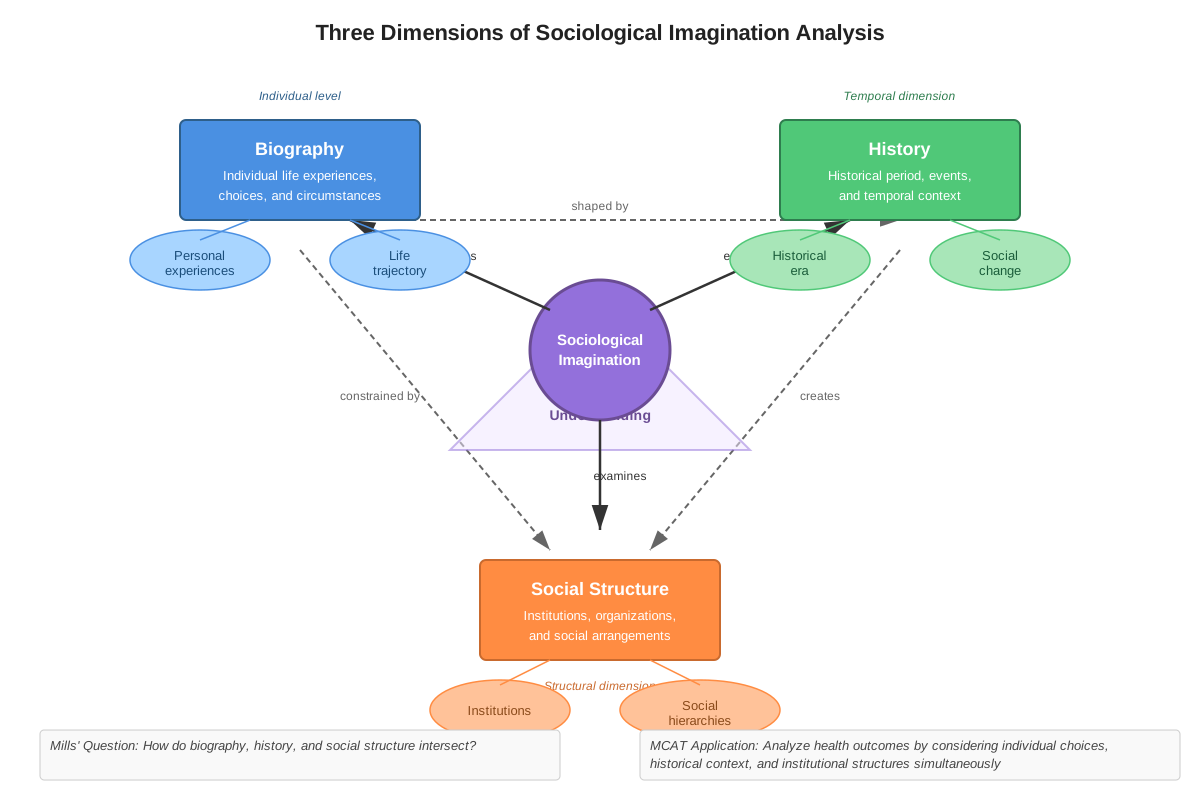
The sociological imagination is the ability to understand the relationship between individual experiences and larger social forces. C. Wright Mills defined it as the capacity to shift perspective from the personal to the social, recognizing how biography (individual life history) intersects with history (broader social, economic, and political changes) and social structure (the organized patterns of social relationships and institutions). This concept fundamentally challenges the tendency toward individualism—the belief that personal outcomes result solely from individual effort, talent, or choices.
The sociological imagination requires three interconnected analytical moves:
- Contextualizing individual experience: Placing personal circumstances within their broader social, historical, and institutional context
- Recognizing patterns: Identifying when individual experiences reflect widespread social patterns rather than isolated incidents
- Identifying structural causes: Tracing how social structures, institutions, and historical forces shape individual opportunities and constraints
Personal Troubles vs. Public Issues
The cornerstone distinction within sociological imagination is between personal troubles and public issues. This framework helps identify whether a problem should be understood primarily at the individual level or as a reflection of broader social structures.
Personal troubles are challenges that:
- Affect individuals and their immediate relationships
- Occur within the character and immediate relations of the individual
- Can be resolved through individual action or personal change
- Are limited in scope to the individual's biography and milieu
Public issues are problems that:
- Affect large numbers of people in similar ways
- Transcend the individual's immediate environment
- Require institutional or structural solutions
- Reflect crises in institutional arrangements or historical circumstances
| Aspect | Personal Trouble | Public Issue |
|---|---|---|
| Scope | Individual or small group | Large populations or entire society |
| Cause | Individual choices, circumstances, or characteristics | Social structures, institutions, or historical forces |
| Solution | Personal change, individual intervention | Policy change, institutional reform, structural transformation |
| Example | One person unemployed due to poor work habits | Millions unemployed due to economic recession |
The Three Components: Biography, History, and Social Structure
Mills argued that sociological imagination requires understanding the intersection of three dimensions:
Biography refers to the individual's personal life trajectory, including their experiences, choices, relationships, and circumstances. This is the micro-level of analysis focusing on individual lives.
History encompasses the broader temporal context, including economic conditions, political events, technological changes, and cultural shifts that characterize a particular era. Historical context shapes what opportunities and constraints individuals face.
Social structure includes the organized patterns of social relationships, institutions, norms, and hierarchies that persist across time and shape individual behavior. This includes economic systems, political institutions, educational systems, family structures, and stratification systems.
The sociological imagination reveals how these three dimensions constantly interact. For example, an individual's educational attainment (biography) is influenced by when they were born (history—such as during economic prosperity or recession) and by their family's socioeconomic status and the quality of schools available to them (social structure).
Application to Health and Medicine
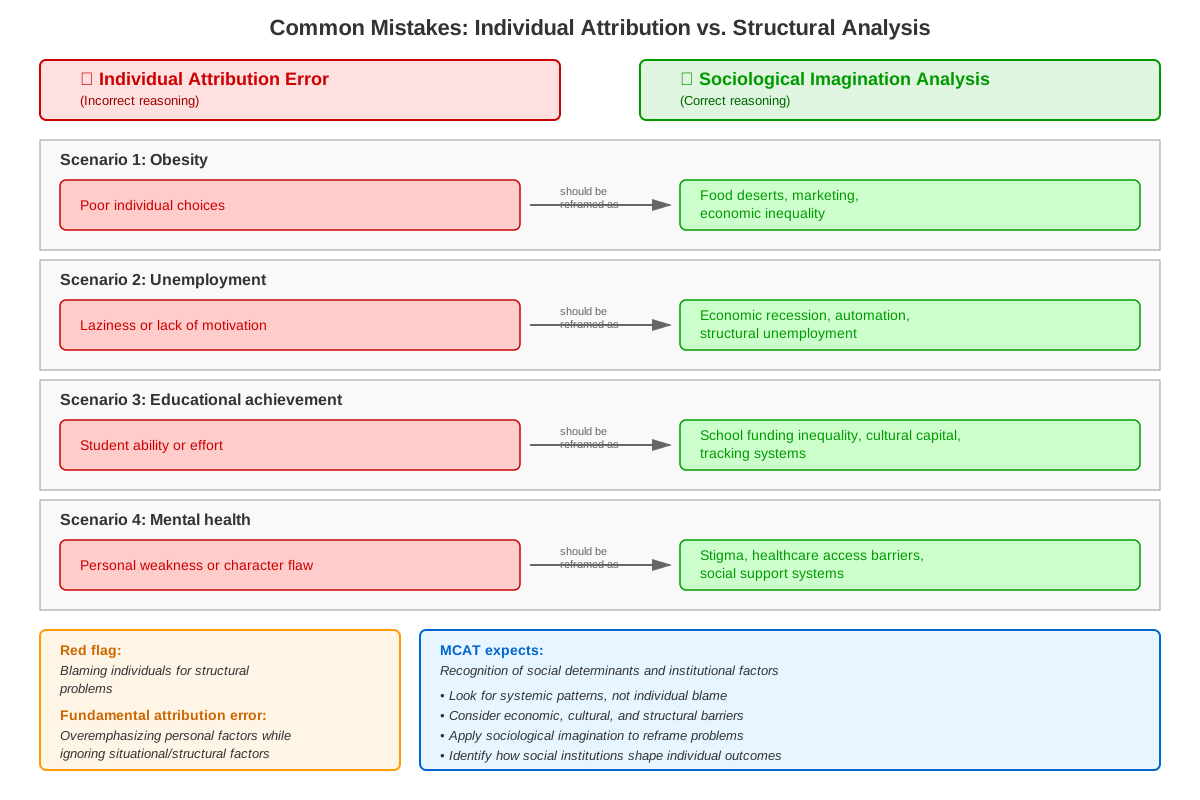
For the MCAT, applying sociological imagination to health contexts is particularly important. Consider obesity as an example:
Individual-level explanation (lacking sociological imagination): A person is obese because they make poor dietary choices and don't exercise enough. The solution is individual behavior change through willpower and education.
Sociological imagination explanation: Obesity rates have increased dramatically across entire populations over recent decades, suggesting structural causes. These include:
- Economic factors: Healthy food costs more than processed food; low-wage workers have multiple jobs leaving little time for meal preparation
- Built environment: Many neighborhoods lack safe spaces for exercise and access to fresh food (food deserts)
- Historical changes: Agricultural policies subsidizing corn and soy have made processed foods cheaper; technological changes have created sedentary jobs
- Cultural factors: Marketing of unhealthy foods disproportionately targets certain communities
- Institutional factors: School lunch programs, workplace cafeterias, and healthcare access vary by socioeconomic status
This analysis doesn't deny individual agency but recognizes that individual choices occur within constraining or enabling structural contexts.
Levels of Analysis
Sociological imagination requires moving between different levels of analysis:
Micro-level: Individual interactions, personal experiences, and face-to-face relationships. This is where personal troubles are experienced.
Meso-level: Organizations, institutions, and communities. This intermediate level shows how institutions mediate between individuals and broader structures.
Macro-level: Large-scale social structures, cultural patterns, economic systems, and historical forces. This is where public issues originate.
The sociological imagination specifically involves the ability to connect micro-level experiences to macro-level forces, recognizing how large-scale social patterns manifest in individual lives.
Structural Determinism vs. Agency
An important nuance in applying sociological imagination is balancing structural analysis with recognition of human agency. Structural determinism is the view that social structures completely determine individual outcomes, leaving no room for individual choice. Agency refers to the capacity of individuals to act independently and make choices.
The sociological imagination recognizes that:
- Social structures constrain and enable individual action but don't completely determine it
- Individuals have varying degrees of agency depending on their social position
- Structures are created and maintained through human action, meaning they can be changed
- Understanding structural constraints doesn't mean blaming individuals is appropriate, but neither does it eliminate all personal responsibility
For MCAT purposes, questions typically require recognizing structural factors that are often overlooked, rather than debating the precise balance between structure and agency.
Concept Relationships
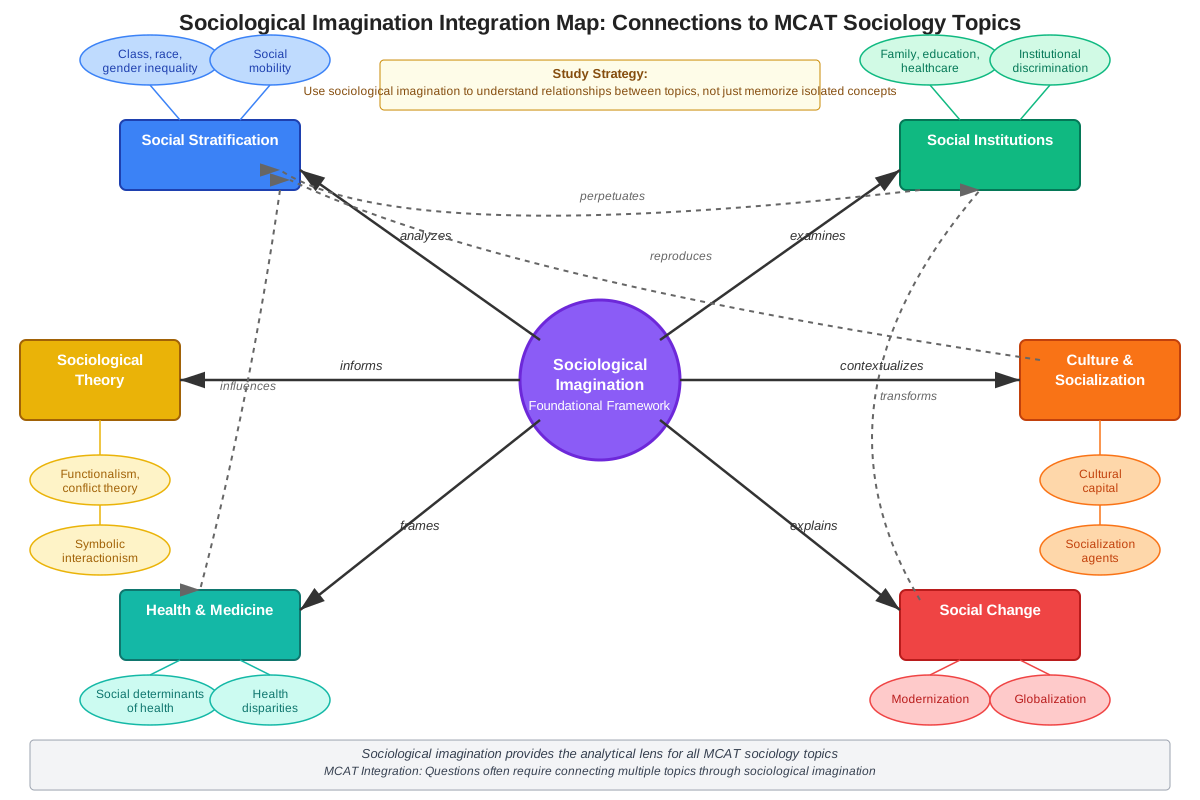
The sociological imagination serves as the foundational framework connecting multiple sociology concepts tested on the MCAT. Understanding these relationships is essential for comprehensive mastery.
Sociological imagination → Social stratification and inequality: The sociological imagination reveals how individual socioeconomic outcomes reflect structural systems of inequality rather than purely individual merit. It explains why certain groups consistently experience disadvantage across generations, connecting personal economic circumstances to historical patterns of discrimination, institutional barriers, and unequal resource distribution.
Sociological imagination → Social institutions: Institutions (family, education, healthcare, economy, government) are the structural mechanisms through which social forces shape individual lives. The sociological imagination analyzes how institutional arrangements create patterns of opportunity and constraint that appear in individual biographies.
Sociological imagination → Culture and socialization: Individual beliefs, values, and behaviors (biography) are shaped by cultural contexts and socialization processes (social structure) that vary historically. The sociological imagination connects personal identity to cultural and historical contexts.
Sociological imagination → Social determinants of health: This concept directly applies sociological imagination to health outcomes, recognizing that individual health reflects structural factors including socioeconomic status, education, neighborhood environment, and access to healthcare. The sociological imagination framework is essential for understanding health disparities.
Sociological imagination → Functionalism, conflict theory, and symbolic interactionism: These theoretical perspectives provide different lenses for applying sociological imagination. Functionalism examines how social structures serve societal needs; conflict theory analyzes how structures maintain inequality; symbolic interactionism explores how individuals create meaning within structural contexts.
Relationship map:
Individual experience (biography) ← shaped by → Social structures (institutions, stratification systems) ← influenced by → Historical context (economic conditions, political events, cultural shifts) → creates patterns of → Public issues (widespread problems) → manifested as → Personal troubles (individual challenges) → analyzed through → Sociological imagination → reveals → Structural solutions needed
High-Yield Facts
⭐ Sociological imagination is the ability to connect personal experiences (biography) to broader social forces (history and social structure)
⭐ Personal troubles affect individuals and their immediate relationships; public issues affect large populations and reflect structural problems
⭐ When many individuals experience the same "personal" problem, it indicates a public issue requiring structural solutions
⭐ The sociological imagination requires analyzing problems at multiple levels: micro (individual), meso (institutional), and macro (societal)
⭐ C. Wright Mills coined the term "sociological imagination" in 1959 to describe this analytical perspective
- The sociological imagination challenges individualistic explanations that attribute all outcomes to personal choices or characteristics
- Historical context matters: the same individual choices produce different outcomes in different historical periods due to varying structural conditions
- Social structures both constrain (limit options) and enable (provide opportunities) individual action
- Applying sociological imagination to health reveals social determinants that influence disease patterns and health disparities
- The sociological imagination is essential for understanding why certain groups consistently experience disadvantage despite individual variation in effort and ability
- Recognizing public issues doesn't eliminate individual responsibility but shifts focus to structural solutions alongside individual interventions
- The sociological imagination reveals that "common sense" explanations often overlook structural factors and overemphasize individual factors
Quick check — test yourself on Sociological imagination so far.
Try Flashcards →Common Misconceptions
Misconception: Sociological imagination means ignoring individual responsibility and blaming everything on society.
Correction: Sociological imagination recognizes both structural constraints and individual agency. It doesn't eliminate personal responsibility but contextualizes individual choices within structural realities. The goal is to understand how structures shape the range of choices available and the consequences of those choices, not to excuse all individual behavior.
Misconception: If something happens to an individual, it's automatically a personal trouble; if it happens to many people, it's automatically a public issue.
Correction: The distinction isn't purely about numbers. A personal trouble becomes a public issue when the cause is structural rather than individual. For example, if one person can't find work due to lack of effort, that's a personal trouble. If millions can't find work despite effort because of economic recession, that's a public issue—even though it's experienced individually.
Misconception: Sociological imagination and psychological perspective are the same thing.
Correction: Psychology typically focuses on individual-level factors (cognition, personality, mental processes), while sociological imagination specifically connects individual experiences to social structures and historical forces. A psychological explanation for depression might focus on cognitive patterns or neurotransmitters; a sociological imagination approach would also consider how social isolation, economic stress, or cultural changes contribute to depression rates.
Misconception: Using sociological imagination means always choosing the "social structure" answer on the MCAT.
Correction: While sociological imagination emphasizes structural factors, the MCAT may present scenarios where individual-level factors are genuinely most relevant, or where both individual and structural factors matter. The key is recognizing when structural factors are present but being overlooked, not automatically dismissing individual-level explanations.
Misconception: Historical context only matters for events in the distant past.
Correction: Historical context includes recent changes and current conditions. For example, the 2008 economic recession, COVID-19 pandemic, or changes in healthcare policy are all historical contexts that shape current individual experiences. "History" in Mills' framework means the broader temporal and social context, not just ancient history.
Misconception: Sociological imagination applies only to negative outcomes or problems.
Correction: While often used to analyze social problems, sociological imagination can also explain positive outcomes. For example, understanding why certain groups have better health outcomes requires examining structural advantages (access to resources, safe neighborhoods, quality healthcare) not just individual healthy behaviors.
Worked Examples
Example 1: Analyzing Unemployment
Scenario: A passage describes how unemployment rates in a community increased from 5% to 25% over two years following the closure of the region's major manufacturing plant. Individual interviews reveal that many unemployed workers feel ashamed and blame themselves for not finding new jobs, despite having strong work histories.
Question: Which concept best explains why the workers' self-blame may be misplaced?
Answer choices:
A) Fundamental attribution error
B) Sociological imagination
C) Self-serving bias
D) Cognitive dissonance
Analysis using sociological imagination:
Step 1: Identify whether this is a personal trouble or public issue
- The problem affects 20% of the community (25% - 5% = 20% increase)
- The timing coincides with a structural change (plant closure)
- Many individuals with good work histories are affected
- Conclusion: This is a public issue, not individual personal troubles
Step 2: Examine the three dimensions
- Biography: Individual workers have strong work histories, indicating the problem isn't individual work ethic or skills
- History: The plant closure represents an economic change in this historical moment
- Social structure: The local economy was structured around one major employer; when that structure changed, individual outcomes changed regardless of personal characteristics
Step 3: Connect to the question
The workers are experiencing what Mills called the "personal troubles" manifestation of a "public issue." They're internalizing a structural problem as personal failure. Sociological imagination would reveal that their unemployment reflects economic restructuring, not individual inadequacy.
Correct answer: B) Sociological imagination
Why other answers are incorrect:
- A) Fundamental attribution error (attributing others' behavior to disposition rather than situation) doesn't capture the structural analysis
- C) Self-serving bias (attributing success to self, failure to external factors) is the opposite of what's happening
- D) Cognitive dissonance (discomfort from conflicting beliefs) doesn't address the structural versus individual distinction
Key takeaway: When many individuals experience the same outcome following a structural change, sociological imagination reveals it as a public issue requiring structural solutions, not individual failings.
Example 2: Health Disparities in Diabetes
Scenario: Research shows that diabetes rates are three times higher in low-income neighborhoods compared to affluent neighborhoods within the same city. A health educator proposes addressing this disparity through nutrition education classes teaching residents about healthy eating.
Question: From a sociological imagination perspective, what is the primary limitation of this intervention?
Analysis:
Step 1: Apply sociological imagination framework
- Pattern recognition: The disparity is systematic across neighborhoods, not random individual variation
- Structural factors present: Income level (economic structure), neighborhood (built environment, food access)
- Level of analysis: The problem exists at the community/structural level, but the proposed solution targets only the individual level
Step 2: Distinguish personal troubles from public issues
- If diabetes were randomly distributed, individual education might be appropriate
- The systematic pattern by neighborhood indicates structural causes:
- Food deserts (limited access to fresh, healthy food)
- Food costs (healthy food is more expensive)
- Time constraints (low-wage workers often work multiple jobs)
- Built environment (lack of safe spaces for exercise)
- Chronic stress from economic insecurity (affects metabolism)
- Limited healthcare access (delayed diagnosis and treatment)
Step 3: Evaluate the proposed solution
The nutrition education assumes the problem is lack of knowledge (individual-level factor). However, sociological imagination reveals that residents likely know healthy eating principles but face structural barriers to implementing them. Education alone doesn't address:
- Food availability and cost
- Time and economic constraints
- Neighborhood safety for exercise
- Chronic stress from poverty
- Healthcare access
Answer: The intervention addresses individual knowledge but ignores structural barriers including food access, economic constraints, built environment, and healthcare availability. A sociological imagination approach would recommend structural interventions such as improving food access, economic support, neighborhood development, and healthcare expansion alongside education.
Key takeaway: Sociological imagination reveals when individual-level interventions are insufficient because they don't address structural causes. Effective solutions must match the level at which problems originate.
Exam Strategy
Approaching MCAT Questions on Sociological Imagination
Step 1: Identify the scope of the problem
- Is this affecting one individual or many people in similar circumstances?
- Is there a pattern based on social group membership (class, race, gender, etc.)?
- Did the problem emerge following a structural or historical change?
Step 2: Analyze the level of explanation in answer choices
- Individual-level: focuses on personal choices, characteristics, psychology, or biology
- Structural-level: focuses on institutions, economic systems, policies, or social patterns
- Look for answer choices that connect individual experiences to broader social forces
Step 3: Watch for trigger words and phrases
Trigger words indicating sociological imagination/structural analysis:
- "Social structure"
- "Institutional"
- "Systemic"
- "Historical context"
- "Social determinants"
- "Structural barriers"
- "Public issue"
- "Social forces"
- "Economic system"
- "Policy"
Trigger words indicating individual-level analysis (often incorrect when pattern exists):
- "Personal choice"
- "Individual responsibility"
- "Lack of motivation"
- "Poor decisions"
- "Character flaw"
- "Personal trouble" (when used alone without recognizing underlying public issue)
Process of Elimination Strategy
Eliminate answers that:
- Blame individuals for problems that affect entire groups systematically
- Ignore historical or structural context when it's clearly relevant
- Propose only individual-level solutions to problems with structural causes
- Confuse correlation with causation without considering structural confounds
Keep answers that:
- Connect individual experiences to social structures or historical forces
- Recognize patterns across groups as indicating structural causes
- Distinguish between personal troubles and public issues appropriately
- Propose solutions matching the level at which problems originate
Time Allocation Advice
Sociological imagination questions often appear in passages requiring careful analysis of whether problems are individual or structural. Budget time as follows:
- Passage reading (3-4 minutes): Identify patterns, note whether problems affect individuals or groups, look for structural factors mentioned
- Question analysis (30-45 seconds): Determine if the question asks for individual or structural explanation
- Answer evaluation (30-45 seconds): Eliminate answers at the wrong level of analysis first, then choose the best remaining option
Exam Tip: When a passage describes a health disparity or social problem affecting a specific demographic group, the correct answer will almost always require sociological imagination to identify structural factors rather than individual-level explanations.
Memory Techniques
Mnemonic for Three Dimensions: "BHS"
Biography (individual life)
History (temporal context)
Social structure (institutional patterns)
Remember: "BHS - Bringing History and Structure" to individual analysis
Visualization Strategy: The Zoom Lens
Imagine sociological imagination as a camera zoom lens:
- Zoomed in (micro): You see one individual and their immediate circumstances (personal trouble)
- Zooming out (meso): You see the institutions and organizations shaping that individual
- Fully zoomed out (macro): You see the entire social structure, historical forces, and patterns affecting many individuals (public issue)
Sociological imagination is the ability to zoom in and out, connecting what you see at each level.
Acronym for Identifying Public Issues: "MAPS"
Many people affected
Across similar social positions
Pattern is systematic
Structural causes identifiable
If a problem shows MAPS, it's a public issue requiring structural solutions.
Memory Palace Technique
Create a mental image of C. Wright Mills standing at the intersection of three roads:
- One road labeled "Biography" (individual's path)
- One road labeled "History" (timeline stretching into past and future)
- One road labeled "Social Structure" (buildings representing institutions)
Mills stands at the intersection, showing how all three roads meet—this is the sociological imagination.
Contrast Table Memory Aid
Keep this mental table for quick reference:
| Personal Trouble | Public Issue |
|---|---|
| ONE person | MANY people |
| Individual cause | Structural cause |
| Personal solution | Policy solution |
| Psychology focus | Sociology focus |
Summary
Sociological imagination, coined by C. Wright Mills, is the foundational concept enabling individuals to connect personal experiences to broader social forces, historical contexts, and institutional structures. This analytical perspective distinguishes between personal troubles (individual challenges) and public issues (structural problems affecting many people), recognizing that what appears to be private often reflects larger social patterns. For the MCAT, mastering sociological imagination is essential because it provides the framework for analyzing how health outcomes, behaviors, and life circumstances result from the intersection of biography (individual life), history (temporal context), and social structure (institutional arrangements). This concept appears frequently in MCAT passages requiring students to identify structural versus individual explanations for health disparities and social problems. The sociological imagination doesn't eliminate individual agency but contextualizes personal choices within structural realities, revealing when problems require institutional solutions rather than only individual interventions. Understanding this concept enables future physicians to recognize social determinants of health and develop more effective, contextually appropriate interventions.
Key Takeaways
- Sociological imagination connects individual experiences (biography) to social structures and historical forces, revealing how personal troubles often reflect public issues
- The distinction between personal troubles and public issues is central: personal troubles affect individuals and have individual causes; public issues affect many people and have structural causes
- C. Wright Mills' framework requires analyzing the intersection of biography, history, and social structure to understand individual outcomes
- For the MCAT, sociological imagination most commonly appears in questions about health disparities, requiring identification of structural factors (economic, institutional, environmental) rather than only individual factors
- Applying sociological imagination means recognizing patterns across groups as indicators of structural causes, not coincidental individual failures
- The concept challenges individualistic explanations that attribute all outcomes to personal choices, revealing how social structures constrain and enable individual action
- Effective solutions must match the level at which problems originate: structural problems require structural solutions, though individual interventions may complement them
Related Topics
Social Determinants of Health: Directly applies sociological imagination to health outcomes, examining how socioeconomic status, education, neighborhood environment, and healthcare access shape individual health. Mastering sociological imagination provides the conceptual foundation for understanding why health disparities exist and persist.
Social Stratification and Inequality: Explores the systems of hierarchy and unequal resource distribution that sociological imagination reveals as shaping individual opportunities. Understanding stratification shows the specific structural mechanisms through which biography and social structure intersect.
Social Institutions: Examines the organized patterns of relationships and norms (family, education, healthcare, economy, government) that constitute the "social structure" dimension of sociological imagination. Each institution represents a structural force shaping individual lives.
Functionalism and Conflict Theory: These theoretical perspectives provide different frameworks for applying sociological imagination. Functionalism analyzes how structures serve societal needs; conflict theory examines how structures maintain inequality. Both require the sociological imagination's ability to connect individual experiences to structural arrangements.
Culture and Socialization: Explores how individuals internalize social norms, values, and beliefs through socialization processes embedded in social structures. Understanding these processes shows how social structure shapes biography through cultural transmission.
Practice CTA
Now that you've mastered the foundational concept of sociological imagination, it's time to reinforce your understanding through active practice. Complete the practice questions and flashcards to test your ability to distinguish between personal troubles and public issues, identify structural factors in clinical scenarios, and apply the sociological imagination framework to MCAT-style passages. Remember, sociological imagination isn't just an abstract concept—it's an analytical skill that improves with deliberate practice. Each practice question you work through strengthens your ability to quickly identify when MCAT questions require structural versus individual-level analysis, a skill that will serve you throughout the Psychological, Social, and Biological Foundations of Behavior section. You've built the foundation; now solidify it through application!
Sign up free to keep reading
Create a free AnvayaPrep account to finish this MCAT guide on Sociological imagination — plus flashcards and practice questions.