Overview
The midpoint formula is a fundamental coordinate geometry tool that allows students to find the exact center point between two given points on a coordinate plane. This formula appears regularly on the SAT Math section and serves as a building block for more complex geometric problems involving distance, symmetry, and spatial relationships. Understanding how to quickly and accurately apply the midpoint formula can help students solve problems involving line segments, geometric figures, and real-world scenarios that require finding central locations.
On the SAT, the midpoint formula frequently appears in questions that test spatial reasoning and algebraic manipulation simultaneously. Students may encounter direct applications where they must find the midpoint of a line segment, or inverse problems where they know the midpoint and one endpoint and must determine the other endpoint. The formula integrates seamlessly with other coordinate geometry concepts, making it essential for solving multi-step problems that combine distance, slope, and geometric properties.
Mastering the sat midpoint formula is crucial because it appears in approximately 2-3 questions per test, either directly or as part of a larger problem-solving sequence. The concept connects to broader math topics including symmetry, transformations, and optimization problems. Students who develop fluency with this formula gain confidence in tackling coordinate geometry questions and can often solve problems more efficiently than those who rely on graphing or estimation methods.
Learning Objectives
- [ ] Identify key features of Midpoint formula
- [ ] Explain how Midpoint formula appears on the SAT
- [ ] Apply Midpoint formula to answer SAT-style questions
- [ ] Derive the midpoint formula from the average of coordinates
- [ ] Solve inverse midpoint problems where one endpoint is unknown
- [ ] Integrate the midpoint formula with other coordinate geometry concepts such as distance and slope
Prerequisites
- Basic coordinate plane understanding: Students must be able to plot points using (x, y) coordinates, as the midpoint formula operates entirely within the coordinate system
- Arithmetic mean (average) calculation: The midpoint formula essentially finds the average of x-coordinates and y-coordinates separately, requiring comfort with adding numbers and dividing by two
- Algebraic manipulation: Students need to solve simple equations and isolate variables when working with inverse midpoint problems
- Understanding of line segments: Recognizing that a midpoint divides a segment into two equal parts provides the conceptual foundation for the formula
Why This Topic Matters
The midpoint formula has practical applications far beyond standardized testing. Urban planners use midpoint calculations to determine optimal locations for public facilities that serve two communities. GPS navigation systems employ midpoint concepts to calculate waypoints and route optimization. In computer graphics and game design, midpoint algorithms help render smooth curves and determine collision points between objects.
On the SAT, midpoint problems appear in approximately 10-15% of coordinate geometry questions, which themselves constitute roughly 15% of the Math section. This translates to 1-3 questions per test where midpoint knowledge is either directly tested or serves as a crucial step in solving a more complex problem. The College Board frequently combines midpoint questions with other geometric concepts, making this a high-yield topic that enables students to access multiple question types.
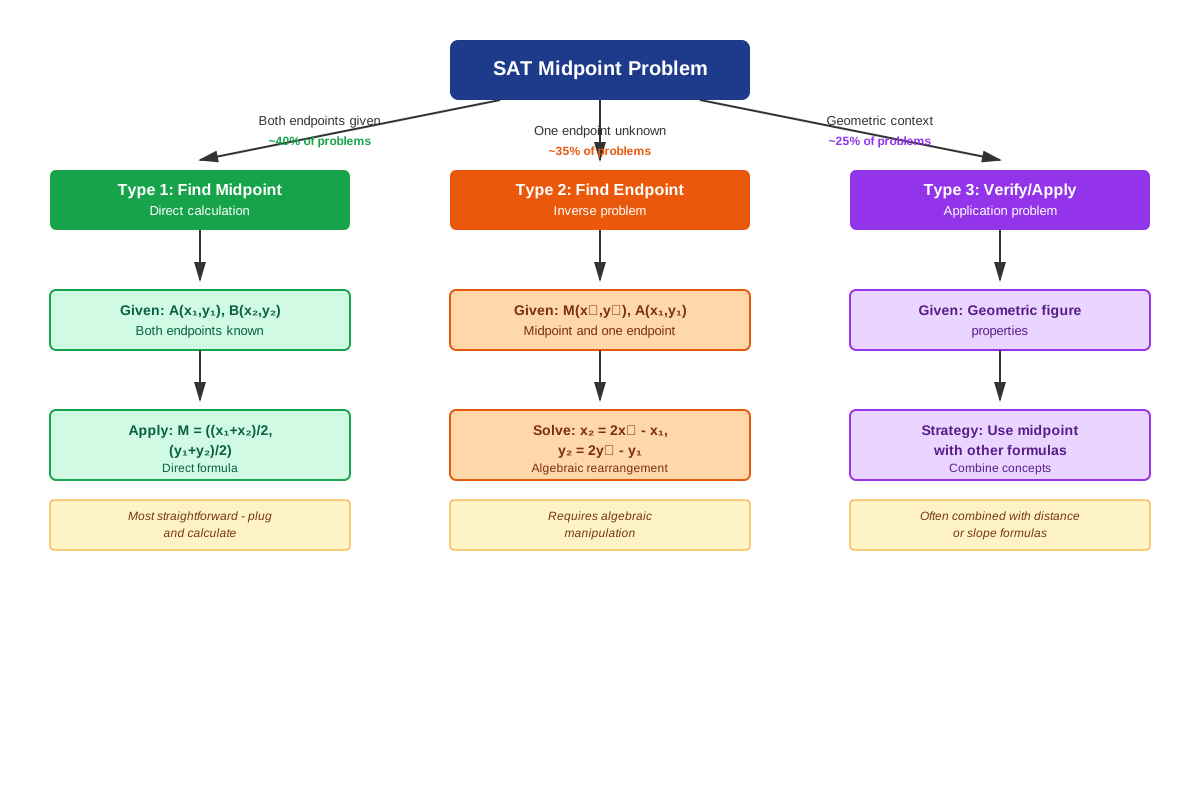
Common SAT question formats include: finding the midpoint of a segment with given endpoints; determining an unknown endpoint when the midpoint and one endpoint are provided; verifying whether a point is the midpoint of a segment; and applying midpoint concepts to geometric figures like parallelograms, rectangles, and triangles where diagonals bisect each other. The formula also appears in word problems involving real-world scenarios such as finding meeting points, central locations, or average positions.
Core Concepts
The Midpoint Formula Definition
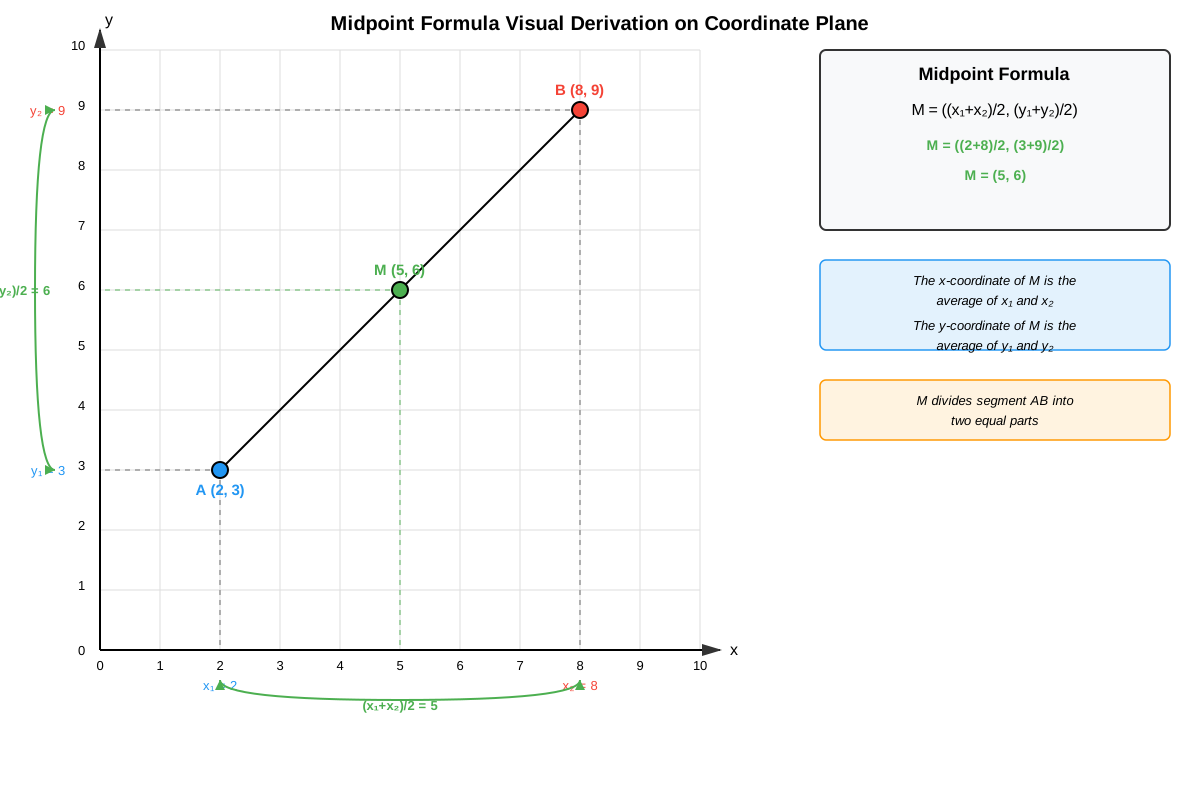
The midpoint formula states that for any two points (x₁, y₁) and (x₂, y₂) on a coordinate plane, the midpoint M has coordinates:
M = ((x₁ + x₂)/2, (y₁ + y₂)/2)This formula works by finding the arithmetic mean (average) of the x-coordinates and the y-coordinates separately. The resulting point lies exactly halfway between the two original points, dividing the line segment connecting them into two congruent segments.
Conceptual Understanding
The midpoint represents the balance point of a line segment. If you imagine the segment as a physical rod with equal weight distribution, the midpoint is where you could balance it on your finger. Mathematically, this means the distance from the first endpoint to the midpoint equals the distance from the midpoint to the second endpoint.
The formula emerges naturally from the concept of averaging. Just as the average of two numbers on a number line falls exactly between them, the midpoint's x-coordinate is the average of the two x-coordinates, and its y-coordinate is the average of the two y-coordinates. This two-dimensional averaging creates a point that is equidistant from both endpoints.
Step-by-Step Application Process
- Identify and label the endpoints: Assign (x₁, y₁) to one point and (x₂, y₂) to the other (the order doesn't matter)
- Calculate the x-coordinate of the midpoint: Add x₁ and x₂, then divide by 2
- Calculate the y-coordinate of the midpoint: Add y₁ and y₂, then divide by 2
- Write the midpoint as an ordered pair: Combine the results as (x-midpoint, y-midpoint)
- Verify if needed: Check that the midpoint makes geometric sense relative to the endpoints
Working with Different Coordinate Types
The midpoint formula works identically whether coordinates are positive, negative, integers, fractions, or decimals. When working with negative numbers, students must be careful with addition:
| Endpoint 1 | Endpoint 2 | x-coordinate calculation | y-coordinate calculation |
|---|---|---|---|
| (2, 5) | (8, 11) | (2 + 8)/2 = 5 | (5 + 11)/2 = 8 |
| (-3, 4) | (5, -2) | (-3 + 5)/2 = 1 | (4 + (-2))/2 = 1 |
| (1.5, -6) | (4.5, 2) | (1.5 + 4.5)/2 = 3 | (-6 + 2)/2 = -2 |
| (0, 0) | (6, 8) | (0 + 6)/2 = 3 | (0 + 8)/2 = 4 |
Inverse Midpoint Problems
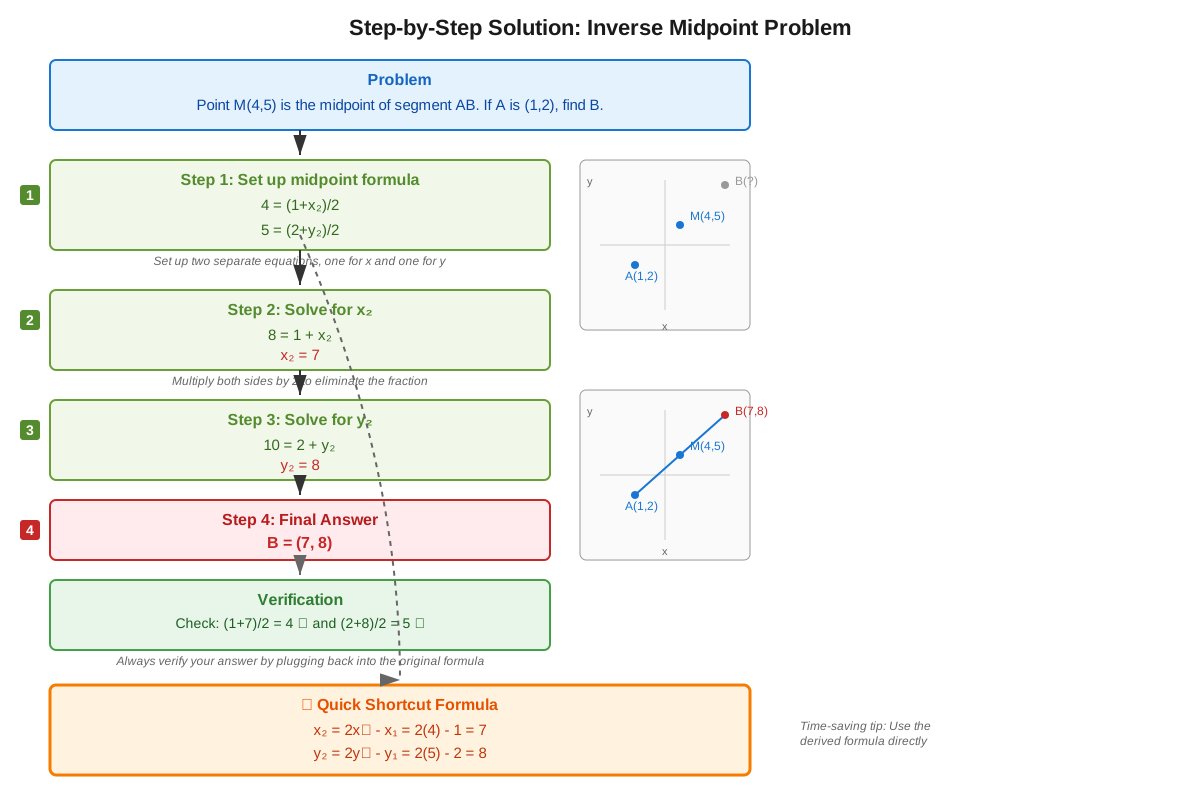
A common SAT variation provides the midpoint and one endpoint, requiring students to find the unknown endpoint. This requires algebraic manipulation of the midpoint formula. If M = (mx, my) is the midpoint and (x₁, y₁) is the known endpoint, then the unknown endpoint (x₂, y₂) can be found using:
x₂ = 2mx - x₁
y₂ = 2my - y₁
This formula comes from solving the midpoint equation for the unknown variables. The logic: if the midpoint is the average of two numbers, then twice the average minus one number equals the other number.
Midpoint in Geometric Figures
The midpoint formula becomes particularly powerful when analyzing geometric shapes on the coordinate plane:
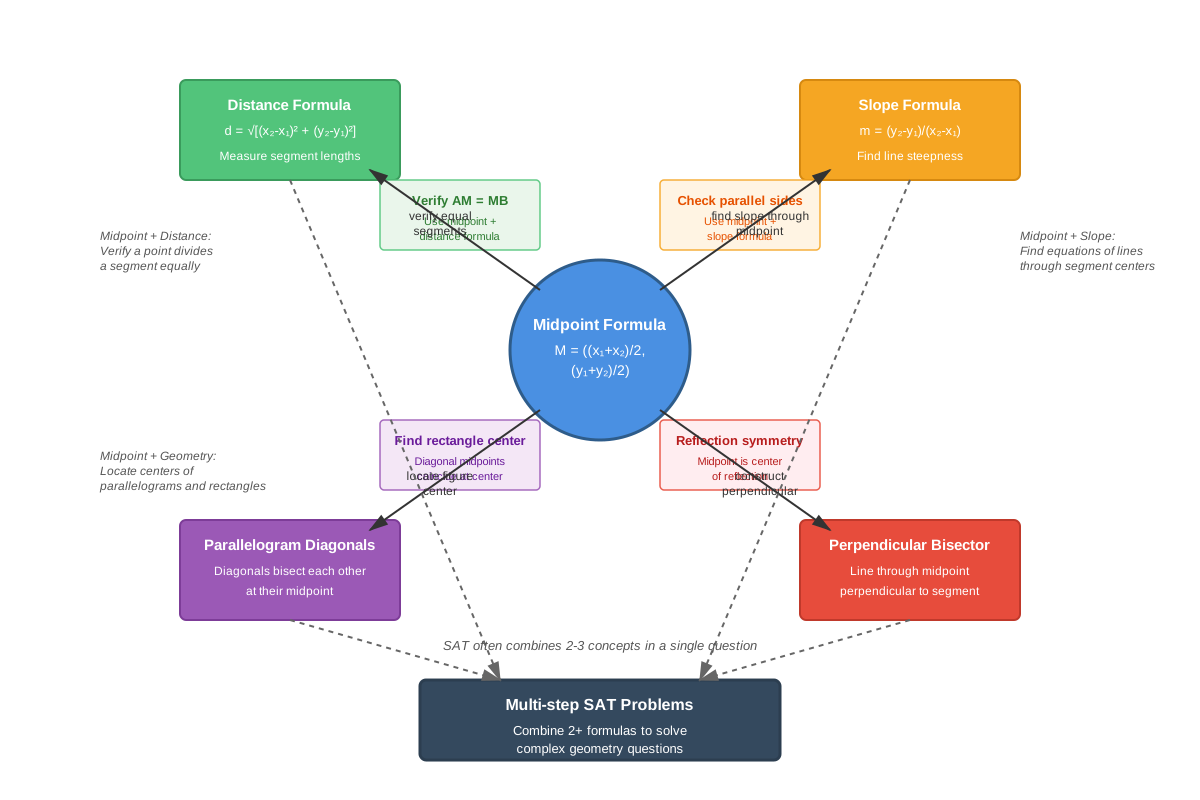
- Diagonals of parallelograms: The diagonals of any parallelogram bisect each other, meaning they share the same midpoint
- Medians of triangles: A median connects a vertex to the midpoint of the opposite side
- Perpendicular bisectors: These lines pass through the midpoint of a segment and are perpendicular to it
- Rectangles and squares: The midpoint of the diagonal equals the center of the figure
Combining Midpoint with Other Formulas
The midpoint formula frequently appears alongside:
- Distance formula: To verify that the midpoint is equidistant from both endpoints
- Slope formula: To analyze properties of line segments and their perpendicular bisectors
- Equation of a line: To find equations of medians, perpendicular bisectors, or lines through midpoints
Concept Relationships
The midpoint formula connects directly to the concept of arithmetic mean, as it essentially calculates the average position between two points. This relationship helps students understand why the formula works: arithmetic mean → produces central value → midpoint represents central position.
Within coordinate geometry, the midpoint formula serves as a bridge between basic point plotting and more advanced concepts. The progression flows: coordinate plane basics → plotting points → connecting points with segments → finding midpoint → analyzing geometric figures → solving complex spatial problems.
The formula also relates to symmetry concepts. If a figure has a line of symmetry, corresponding points on opposite sides of that line will have their midpoint on the line of symmetry. This connection extends to transformations: reflection symmetry → paired points → midpoint on line of symmetry.
When combined with the distance formula, the midpoint formula enables complete analysis of line segments: two endpoints → midpoint formula gives center → distance formula gives length → slope formula gives direction → complete segment characterization.
Quick check — test yourself on Midpoint formula so far.
Try Flashcards →High-Yield Facts
⭐ The midpoint formula is M = ((x₁ + x₂)/2, (y₁ + y₂)/2) for points (x₁, y₁) and (x₂, y₂)
⭐ The order of the endpoints doesn't matter when calculating the midpoint
⭐ To find an unknown endpoint when given the midpoint and one endpoint, use x₂ = 2mx - x₁ and y₂ = 2my - y₁
⭐ The midpoint is always equidistant from both endpoints
⭐ In a parallelogram, the diagonals always share the same midpoint
- The midpoint's x-coordinate is the average of the two x-coordinates
- The midpoint's y-coordinate is the average of the two y-coordinates
- The midpoint formula works with negative coordinates, fractions, and decimals
- A median of a triangle connects a vertex to the midpoint of the opposite side
- The perpendicular bisector of a segment passes through its midpoint
- If three points are collinear and one is the midpoint of the other two, the distances from the midpoint to each endpoint are equal
- The center of a rectangle is the midpoint of either diagonal
Common Misconceptions
Misconception: The midpoint formula requires subtracting coordinates before dividing by 2 → Correction: The formula requires adding coordinates, not subtracting. The distance formula uses subtraction, but the midpoint formula uses addition to find the average position.
Misconception: The order of endpoints matters when applying the midpoint formula → Correction: Because addition is commutative, (x₁ + x₂)/2 = (x₂ + x₁)/2, so labeling which point is "first" or "second" doesn't affect the result.
Misconception: When finding an unknown endpoint, you can use the midpoint formula directly → Correction: You must rearrange the formula algebraically. If M is the midpoint and you know one endpoint, the unknown endpoint requires solving: x₂ = 2mx - x₁ (not simply plugging values into the standard formula).
Misconception: The midpoint must have integer coordinates if both endpoints have integer coordinates → Correction: When the sum of coordinates is odd, the midpoint will have fractional coordinates. For example, the midpoint of (1, 3) and (4, 6) is (2.5, 4.5).
Misconception: The midpoint is always closer to the origin than both endpoints → Correction: The midpoint's position relative to the origin depends on the endpoints' locations. If both endpoints are far from the origin in the same direction, the midpoint will also be far from the origin.
Misconception: You need to graph the points to find the midpoint → Correction: While graphing can provide a visual check, the midpoint formula gives the exact answer through calculation alone, which is faster and more accurate on the SAT.
Worked Examples
Example 1: Direct Midpoint Calculation
Problem: Find the midpoint of the line segment connecting points A(-3, 7) and B(5, -1).
Solution:
Step 1: Identify the coordinates
- Point A: (x₁, y₁) = (-3, 7)
- Point B: (x₂, y₂) = (5, -1)
Step 2: Apply the midpoint formula for the x-coordinate
- x-coordinate of midpoint = (x₁ + x₂)/2
- x-coordinate = (-3 + 5)/2 = 2/2 = 1
Step 3: Apply the midpoint formula for the y-coordinate
- y-coordinate of midpoint = (y₁ + y₂)/2
- y-coordinate = (7 + (-1))/2 = 6/2 = 3
Step 4: Write the final answer
- Midpoint M = (1, 3)
Verification: The midpoint (1, 3) should be between the x-values of -3 and 5 (✓ it is), and between the y-values of 7 and -1 (✓ it is). This confirms our answer makes geometric sense.
Connection to Learning Objectives: This example demonstrates the direct application of the midpoint formula, addressing the objective to "Apply Midpoint formula to answer SAT-style questions."
Example 2: Inverse Midpoint Problem
Problem: The midpoint of segment CD is M(4, -2). If point C has coordinates (1, 3), what are the coordinates of point D?
Solution:
Step 1: Identify what we know
- Midpoint M: (mx, my) = (4, -2)
- Known endpoint C: (x₁, y₁) = (1, 3)
- Unknown endpoint D: (x₂, y₂) = (?, ?)
Step 2: Use the inverse midpoint formula for x-coordinate
- x₂ = 2mx - x₁
- x₂ = 2(4) - 1
- x₂ = 8 - 1 = 7
Step 3: Use the inverse midpoint formula for y-coordinate
- y₂ = 2my - y₁
- y₂ = 2(-2) - 3
- y₂ = -4 - 3 = -7
Step 4: Write the final answer
- Point D = (7, -7)
Verification: Check using the standard midpoint formula:
- x-coordinate of midpoint: (1 + 7)/2 = 8/2 = 4 ✓
- y-coordinate of midpoint: (3 + (-7))/2 = -4/2 = -2 ✓
Connection to Learning Objectives: This example addresses "Solve inverse midpoint problems where one endpoint is unknown" and demonstrates algebraic manipulation skills essential for SAT success.
Exam Strategy
When approaching midpoint questions on the SAT, begin by identifying what information is provided and what is being asked. Trigger words to watch for include "midpoint," "halfway between," "center of the segment," "bisects," and "equidistant from both endpoints." These phrases signal that the midpoint formula will be relevant.
For direct midpoint problems, the fastest approach is to immediately write down the formula and substitute values. Don't waste time graphing unless the problem specifically requires it or you need to verify an answer. The calculation takes 15-30 seconds, while accurate graphing takes much longer.
When facing inverse problems (finding an unknown endpoint), recognize the question type immediately. If you see "the midpoint is..." followed by "one endpoint is...", you know you need the rearranged formula. Write x₂ = 2mx - x₁ and y₂ = 2my - y₁ at the top of your scratch work to avoid errors.
Process of elimination tips: If answer choices are given, you can often eliminate options that don't make geometric sense. The midpoint's x-coordinate must fall between the two x-coordinates of the endpoints (or equal them if they're the same). The same applies to y-coordinates. Any answer choice that violates this rule can be immediately eliminated.
Time allocation: Straightforward midpoint problems should take 30-60 seconds. If a problem combines midpoint with other concepts (like finding the equation of a perpendicular bisector), allocate 90-120 seconds. If you're spending more than two minutes, mark the question and return to it later.
For multi-step problems, identify all the formulas you'll need before starting calculations. If a problem asks about a parallelogram's diagonals, remember that they bisect each other—this means both diagonals share the same midpoint, which can be a powerful shortcut.
Memory Techniques
Mnemonic for the formula: "Add Across, Divide by Deuce" (AADD)
- Add the x-coordinates Across
- Add the y-coordinates Across
- Divide both by Deuce (2)
Visualization strategy: Picture a seesaw or balance beam. The midpoint is the fulcrum that perfectly balances two equal weights placed at the endpoints. This mental image reinforces that the midpoint is equidistant from both ends.
Acronym for inverse problems: "Twice Midpoint Minus Known" (TMMK)
- Twice the Midpoint coordinate
- Minus the Known endpoint coordinate
- Gives the unknown coordinate
Coordinate memory trick: Think "Midpoint = Mean" to remember that you're finding the average (mean) of the coordinates. The letter M serves as a double reminder.
Checking your work: Use the phrase "Between Both" to remember that the midpoint's coordinates must fall between (or equal to) the corresponding coordinates of both endpoints.
Summary
The midpoint formula is an essential coordinate geometry tool that finds the exact center point between two given points by averaging their x-coordinates and y-coordinates separately. The formula M = ((x₁ + x₂)/2, (y₁ + y₂)/2) appears regularly on the SAT in both direct applications and inverse problems where students must find an unknown endpoint. Mastery requires understanding that the midpoint represents the arithmetic mean of coordinates, recognizing that endpoint order doesn't affect the result, and developing fluency with algebraic manipulation for inverse problems. The formula integrates with other coordinate geometry concepts including distance, slope, and properties of geometric figures, particularly the principle that parallelogram diagonals bisect each other. Success on SAT midpoint questions depends on quick formula recall, careful arithmetic with negative numbers and fractions, and the ability to verify answers through geometric reasoning.
Key Takeaways
- The midpoint formula calculates the average of x-coordinates and y-coordinates separately: M = ((x₁ + x₂)/2, (y₁ + y₂)/2)
- For inverse problems where the midpoint and one endpoint are known, use x₂ = 2mx - x₁ and y₂ = 2my - y₁ to find the unknown endpoint
- The midpoint is always equidistant from both endpoints and its coordinates must fall between (or equal) the corresponding endpoint coordinates
- Endpoint order doesn't matter when calculating the midpoint due to the commutative property of addition
- The formula works with all number types: positive, negative, integers, fractions, and decimals
- Parallelogram diagonals always share the same midpoint, making this a powerful property for SAT geometry problems
- Combining the midpoint formula with distance and slope formulas enables complete analysis of line segments and geometric figures
Related Topics
Distance Formula: After mastering the midpoint formula, students should study the distance formula to calculate the length of line segments. Together, these formulas provide complete information about segments: the midpoint gives the center, and the distance gives the length.
Slope and Linear Equations: Understanding how to find the slope of a line through the midpoint and another point enables solving problems about perpendicular bisectors and medians of triangles, which frequently appear on the SAT.
Properties of Quadrilaterals: The midpoint formula is essential for proving properties of parallelograms, rectangles, and rhombuses, particularly theorems about diagonals bisecting each other.
Transformations and Symmetry: Midpoint concepts extend naturally to reflection symmetry, where the midpoint of a point and its reflection lies on the line of symmetry.
Circle Equations: Finding the center of a circle (which is the midpoint of any diameter) connects midpoint knowledge to circle geometry problems on the SAT.
Practice CTA
Now that you've mastered the midpoint formula, it's time to solidify your understanding through practice! Work through the practice questions to test your ability to apply the formula in various SAT-style scenarios, including both direct calculations and inverse problems. Use the flashcards to reinforce the formula itself and key properties until recall becomes automatic. Remember, the difference between knowing the formula and scoring points is consistent, accurate application under test conditions. Each practice problem you complete builds the confidence and speed you'll need on test day. You've got this!
Sign up free to keep reading
Create a free AnvayaPrep account to finish this SAT guide on Midpoint formula — plus flashcards and practice questions.