Overview
Chords are fundamental components of circle geometry that appear regularly on the SAT Math section. A chord is any line segment whose endpoints both lie on a circle, making it one of the most versatile geometric elements students encounter. Understanding chords is essential because they connect to numerous other circle properties, including radii, diameters, central angles, inscribed angles, and arc measures. The SAT frequently tests chord relationships through problems involving perpendicular bisectors, equal chords, and the relationship between chords and their distances from the center.
Mastering chord properties provides students with powerful problem-solving tools for the math section. Questions involving chords often integrate multiple geometric concepts, requiring students to recognize patterns and apply theorems efficiently. These problems typically appear in both the calculator and no-calculator portions of the exam, with difficulty ranging from straightforward applications to multi-step reasoning challenges. The ability to visualize chord relationships and apply key theorems can mean the difference between solving a problem in 30 seconds versus struggling for several minutes.
The strategic importance of chords extends beyond isolated circle problems. Chord concepts frequently appear in coordinate geometry questions, where students must work with circles on the coordinate plane, and in problems involving inscribed polygons. Additionally, understanding chords builds spatial reasoning skills that transfer to other geometric topics, including triangles, quadrilaterals, and three-dimensional figures. For students aiming for top scores, chord mastery is non-negotiable—these questions often separate high scorers from perfect scorers.
Learning Objectives
- [ ] Identify key features of chords, including their endpoints, midpoints, and relationship to the circle's center
- [ ] Explain how chords appears on the SAT, including common question formats and integrated concepts
- [ ] Apply chords to answer SAT-style questions involving distances, angles, and arc measures
- [ ] Calculate chord lengths using the Pythagorean theorem and perpendicular bisector properties
- [ ] Determine the relationship between equal chords and their distances from the center
- [ ] Solve problems involving chords and inscribed angles in complex geometric configurations
Prerequisites
- Basic circle terminology: Understanding terms like radius, diameter, center, and circumference is essential because chords are defined relative to these fundamental circle components
- Pythagorean theorem: This theorem is frequently used to calculate chord lengths when perpendicular distances from the center are known
- Properties of perpendicular bisectors: Recognizing that perpendicular bisectors create right angles and equal segments is crucial for chord theorem applications
- Basic angle relationships: Knowledge of complementary, supplementary, and vertical angles helps when working with chords and inscribed angles
- Coordinate geometry fundamentals: Understanding how to work with points, distances, and equations on the coordinate plane enables solving chord problems in coordinate contexts
Why This Topic Matters
Chord problems appear on virtually every SAT administration, making them one of the most reliable topics to master for guaranteed points. Statistical analysis of recent SAT exams shows that approximately 2-3 questions per test directly involve chord properties, with additional questions incorporating chords as part of more complex geometric scenarios. These questions typically appear in the medium-to-hard difficulty range, meaning they're accessible to students who have studied the material but challenging enough to differentiate among test-takers.
In real-world applications, chord concepts appear in engineering, architecture, and design. Architects use chord calculations when designing arched structures, bridges, and domed buildings. Engineers apply chord principles in wheel design, gear systems, and circular motion analysis. Even in fields like astronomy and navigation, understanding how chords relate to circles helps calculate distances and angles across curved surfaces.
On the SAT, chord questions commonly appear in several formats: direct calculation problems asking for chord length, comparison questions involving multiple chords and their distances from the center, coordinate geometry problems where students must find chord endpoints or midpoints, and integrated problems combining chords with inscribed angles or arc measures. The most challenging questions often present chords within inscribed polygons or require students to recognize that a perpendicular from the center bisects a chord—a relationship that isn't explicitly stated in the problem.
Core Concepts
Definition and Basic Properties
A chord is a line segment connecting any two points on a circle. This simple definition encompasses enormous geometric power. Every circle has infinitely many possible chords, ranging from very short segments near the edge to the longest possible chord—the diameter. The diameter is unique among chords because it passes through the center of the circle, making it exactly twice the length of the radius.
Key properties of chords include:
- Both endpoints must lie on the circle's circumference
- A chord divides the circle into two arcs (a major arc and a minor arc)
- The perpendicular distance from the center to a chord is always less than or equal to the radius
- Chords of equal length are equidistant from the center
- The diameter is the longest possible chord in any circle
The Perpendicular Bisector Theorem
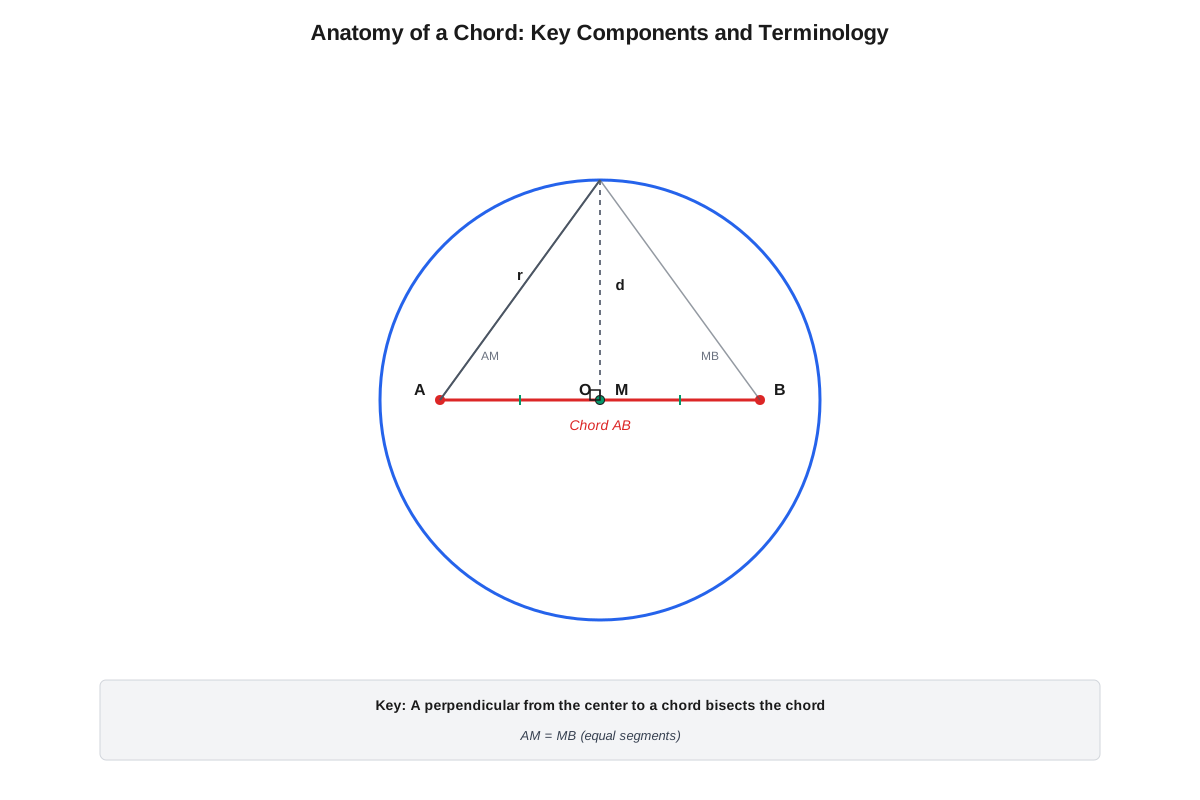
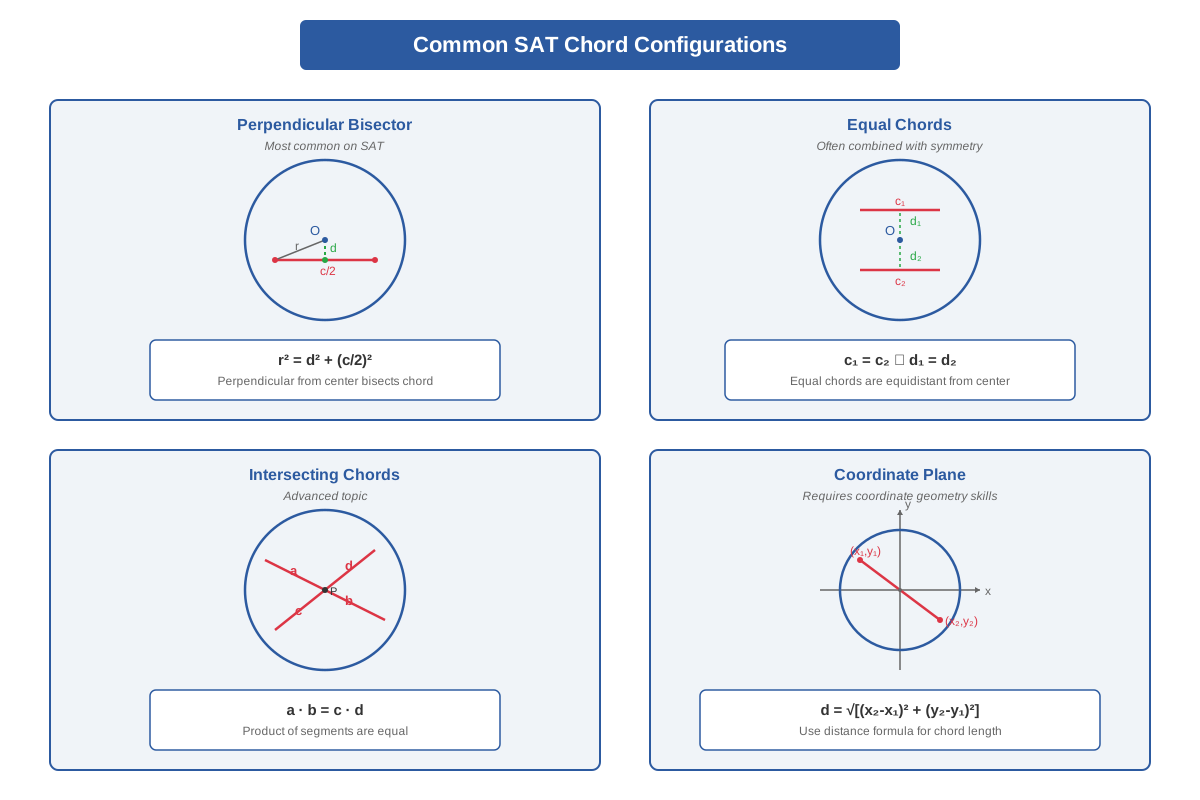
The most important theorem for SAT chord problems states: A perpendicular line from the center of a circle to a chord bisects that chord. This relationship works in both directions—if a line from the center is perpendicular to a chord, it bisects the chord; conversely, if a line from the center bisects a chord, it must be perpendicular to that chord.
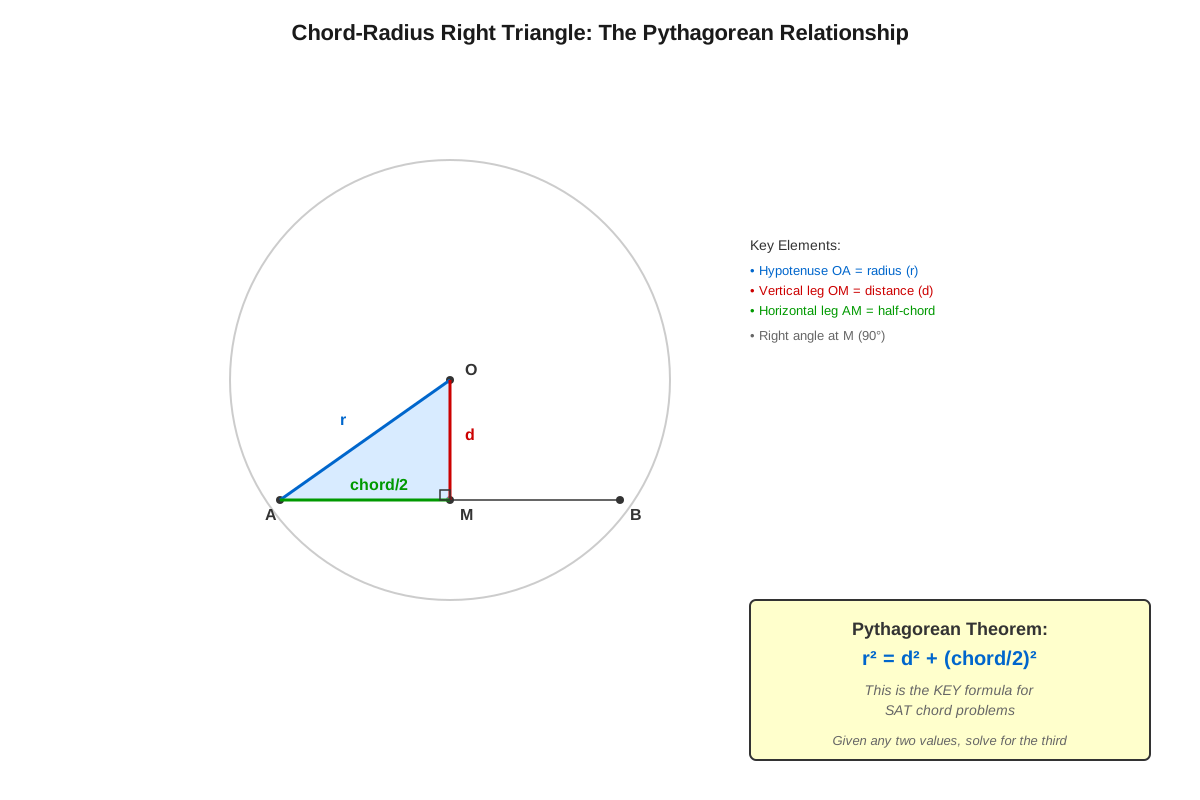
This theorem creates a powerful right triangle that appears repeatedly on the SAT. When you draw a radius to one endpoint of a chord and drop a perpendicular from the center to the chord, you form a right triangle where:
- The hypotenuse is the radius (r)
- One leg is half the chord length (c/2)
- The other leg is the perpendicular distance from center to chord (d)
This relationship yields the formula: r² = d² + (c/2)²
Equal Chords and Distance from Center
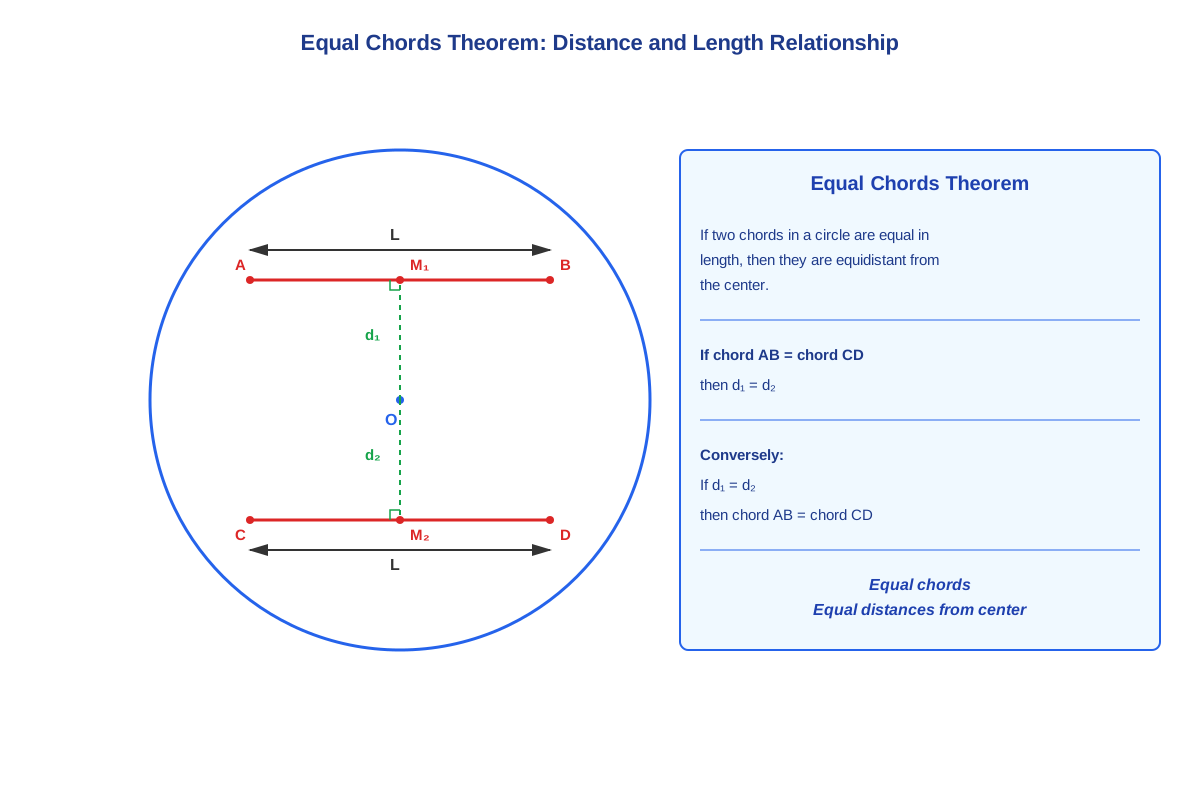
A fundamental theorem states: Chords that are equal in length are equidistant from the center of the circle. This relationship also works in reverse—chords that are equidistant from the center must be equal in length. This property frequently appears in SAT problems that ask students to compare chord lengths or determine relationships between multiple chords.
The practical application involves recognizing that if two chords have the same length, drawing perpendiculars from the center to each chord will create congruent right triangles. This congruence means the perpendicular distances must be equal.
Chord-Angle Relationships
When two chords intersect inside a circle, they create specific angle relationships. The measure of an angle formed by two intersecting chords equals half the sum of the intercepted arcs. If chords AB and CD intersect at point P inside the circle, then:
Angle APD = (arc AD + arc BC) / 2
This relationship becomes particularly important in problems involving inscribed polygons or when multiple chords create complex angle configurations.
Chord Length Calculation Methods
Several methods exist for calculating chord lengths on the SAT:
Method 1: Using the perpendicular distance formula
chord length = 2√(r² - d²)where r is the radius and d is the perpendicular distance from center to chord.
Method 2: Using central angles
When the central angle θ (in degrees) is known:
chord length = 2r × sin(θ/2)Method 3: Using coordinates
When chord endpoints are given as coordinates (x₁, y₁) and (x₂, y₂):
chord length = √[(x₂ - x₁)² + (y₂ - y₁)²]Chords in Coordinate Geometry
On the coordinate plane, chord problems often require students to work with the circle equation (x - h)² + (y - k)² = r², where (h, k) is the center. Common tasks include:
- Finding chord endpoints given the circle equation and a line equation
- Calculating the perpendicular distance from center to chord
- Determining whether a given line segment is a chord of a specific circle
- Finding the midpoint of a chord and verifying perpendicularity
Concept Relationships
The chord concepts form an interconnected web of geometric relationships. The perpendicular bisector theorem serves as the foundation, connecting directly to the Pythagorean theorem through the right triangle formed by the radius, half-chord, and perpendicular distance. This triangle relationship → enables → chord length calculations, which in turn connect to equal chord properties when comparing multiple chords.
Equal chords → relate to → distance from center, creating a bidirectional relationship where knowing one property determines the other. Both of these concepts → feed into → chord-angle relationships, particularly when multiple chords intersect or when working with inscribed polygons.
The coordinate geometry applications → integrate → all previous concepts, requiring students to apply perpendicular bisector properties, distance calculations, and the circle equation simultaneously. This integration → connects to → prerequisite knowledge of the Pythagorean theorem and coordinate distance formula.
Finally, chord-angle relationships → extend to → inscribed angle theorems and arc measures, bridging the gap between linear chord properties and angular measurements. This connection makes chords a central hub in circle geometry, linking linear measurements, angular relationships, and coordinate applications into a unified framework.
High-Yield Facts
⭐ A perpendicular from the center of a circle to a chord always bisects that chord
⭐ The diameter is the longest chord in any circle and equals twice the radius
⭐ Equal chords are equidistant from the center of the circle
⭐ The relationship r² = d² + (c/2)² connects radius, perpendicular distance, and chord length
⭐ When two chords intersect inside a circle, the angle formed equals half the sum of the intercepted arcs
- A chord divides a circle into exactly two arcs: one major arc and one minor arc
- The perpendicular distance from the center to a chord is always less than or equal to the radius
- If two chords are equidistant from the center, they must have equal length
- The midpoint of any chord lies on the perpendicular from the center to that chord
- In a circle with radius r, the maximum chord length is 2r (the diameter)
- Chords that are closer to the center are longer than chords farther from the center
- The perpendicular bisector of any chord passes through the center of the circle
Quick check — test yourself on Chords so far.
Try Flashcards →Common Misconceptions
Misconception: All chords pass through the center of the circle → Correction: Only the diameter passes through the center; all other chords are positioned away from the center. Most chords do not pass through the center, which is what makes the perpendicular distance from center to chord a meaningful measurement.
Misconception: The perpendicular from the center to a chord creates two equal arcs → Correction: The perpendicular bisects the chord (creating two equal linear segments), but it does not necessarily bisect the arc. The arc is only bisected when the chord is a diameter or when the perpendicular extends to the circle's edge at the arc's midpoint.
Misconception: Longer chords are always farther from the center → Correction: The opposite is true—longer chords are closer to the center. The diameter, which passes through the center (distance = 0), is the longest possible chord. As chords get shorter, their perpendicular distance from the center increases.
Misconception: Any line from the center to a chord bisects that chord → Correction: Only a perpendicular line from the center bisects the chord. A non-perpendicular line from the center to a chord will intersect the chord at some point, but it won't divide the chord into two equal segments.
Misconception: The formula r² = d² + (c/2)² can be used with the full chord length → Correction: The formula specifically requires half the chord length (c/2), not the full chord length. Using the full chord length will produce an incorrect result. This is because the perpendicular from the center creates a right triangle where one leg is half the chord.
Misconception: Equal chords must be parallel → Correction: Equal chords are equidistant from the center, but they don't need to be parallel. Two chords of equal length can be positioned at any angle relative to each other, as long as their perpendicular distances from the center are equal.
Worked Examples
Example 1: Finding Chord Length Using Perpendicular Distance
Problem: A circle has a radius of 13 cm. A chord is positioned 5 cm from the center of the circle (measured perpendicularly). What is the length of the chord?
Solution:
Step 1: Identify the given information
- Radius (r) = 13 cm
- Perpendicular distance from center to chord (d) = 5 cm
- Need to find: chord length (c)
Step 2: Recognize the right triangle relationship
When we draw a perpendicular from the center to the chord, it bisects the chord and creates a right triangle where:
- Hypotenuse = radius = 13 cm
- One leg = perpendicular distance = 5 cm
- Other leg = half the chord length = c/2
Step 3: Apply the Pythagorean theorem
r² = d² + (c/2)²
13² = 5² + (c/2)²
169 = 25 + (c/2)²
144 = (c/2)²
12 = c/2
Step 4: Solve for the full chord length
c = 2 × 12 = 24 cm
Answer: The chord length is 24 cm.
Connection to learning objectives: This problem directly applies the perpendicular bisector theorem and demonstrates how to calculate chord lengths using the fundamental relationship between radius, perpendicular distance, and chord length.
Example 2: Comparing Chords and Distances
Problem: Circle O has a radius of 10 inches. Chord AB has a length of 16 inches, and chord CD has a length of 12 inches. Which chord is closer to the center of the circle, and by how much?
Solution:
Step 1: Find the distance from center to chord AB
Using r² = d² + (c/2)²:
10² = d₁² + (16/2)²
100 = d₁² + 64
36 = d₁²
d₁ = 6 inches
Step 2: Find the distance from center to chord CD
10² = d₂² + (12/2)²
100 = d₂² + 36
64 = d₂²
d₂ = 8 inches
Step 3: Compare the distances
Chord AB is 6 inches from the center
Chord CD is 8 inches from the center
Difference: 8 - 6 = 2 inches
Step 4: Interpret the result
Since chord AB has a smaller perpendicular distance from the center, it is closer to the center. This confirms the principle that longer chords are closer to the center.
Answer: Chord AB is closer to the center by 2 inches.
Connection to learning objectives: This problem demonstrates the relationship between chord length and distance from center, reinforcing the concept that equal chords are equidistant from the center and that longer chords are positioned closer to the center.
Exam Strategy
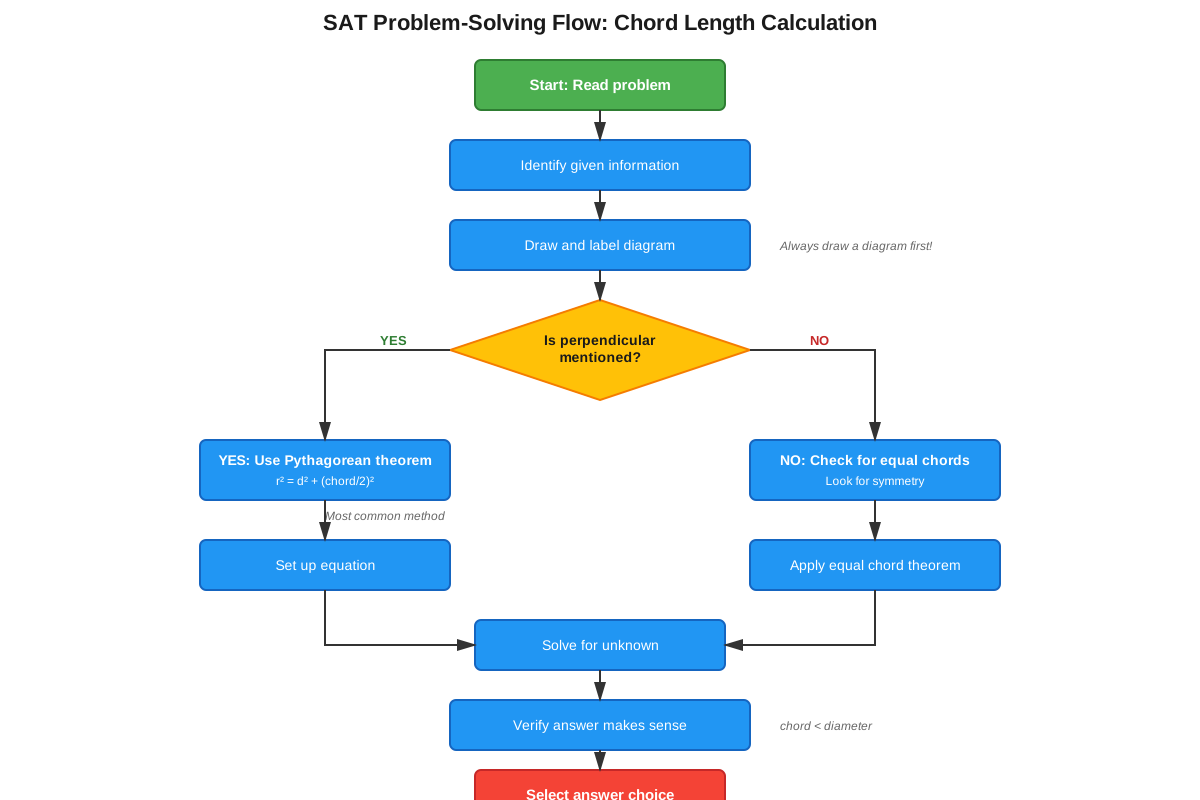
When approaching SAT chord problems, begin by drawing a clear diagram if one isn't provided. Mark the center of the circle, label the chord endpoints, and immediately draw the perpendicular from the center to the chord. This perpendicular is the key to unlocking most chord problems because it creates the right triangle that connects all the important measurements.
Trigger words and phrases to watch for include:
- "perpendicular distance from the center" → signals use of the r² = d² + (c/2)² formula
- "equal chords" → indicates you should consider distances from the center
- "bisects the chord" → confirms a perpendicular relationship with the center
- "intersecting chords" → may involve angle-arc relationships
- "inscribed in a circle" → often involves chords as sides of polygons
For process of elimination, remember these principles:
- Eliminate any answer choice that suggests a chord can be longer than the diameter
- If comparing chord lengths, eliminate choices that place longer chords farther from the center
- When calculating distances, eliminate answers that exceed the radius
- For chord length problems, the answer must be positive and less than or equal to 2r
Time allocation: Most chord problems should take 60-90 seconds once you've mastered the concepts. If you find yourself spending more than 2 minutes on a chord problem, you may be missing a key insight—usually the perpendicular bisector relationship. Mark the question and return to it after completing easier problems.
Exam Tip: If a problem gives you the chord length and asks for the perpendicular distance (or vice versa), you're almost certainly using r² = d² + (c/2)². Set up this equation immediately and solve algebraically.
Memory Techniques
CHORD mnemonic for problem-solving steps:
- Center: Identify the center of the circle
- Half: Remember the perpendicular bisects the chord (use c/2)
- Orthogonal: Draw the perpendicular (90° angle)
- Radius: Mark the radius to the chord endpoint
- Distance: Calculate using the Pythagorean theorem
Visualization strategy: Picture a bicycle wheel where the spokes are radii and the chords are like strings stretched across the wheel. The closer a string is to the center hub, the longer it must be. The longest possible string would go straight through the hub (the diameter).
"Perpendicular Bisector Power" acronym (PBP): Whenever you see a chord problem, think PBP:
- Perpendicular from center
- Bisects the chord
- Pythagorean theorem applies
Distance-Length relationship: Remember "CLOSE = LONG" → chords that are CLOSEr to the center are LONGer. This helps you quickly eliminate wrong answers on comparison problems.
Summary
Chords are line segments connecting two points on a circle, and they represent one of the most frequently tested circle concepts on the SAT. The fundamental theorem—that a perpendicular from the center bisects any chord—creates a right triangle relationship that enables calculation of chord lengths, perpendicular distances, and radius measurements. This relationship is expressed mathematically as r² = d² + (c/2)², where r is the radius, d is the perpendicular distance from center to chord, and c is the chord length. Equal chords are always equidistant from the center, and conversely, chords equidistant from the center must be equal in length. Longer chords are positioned closer to the center, with the diameter being the longest possible chord. On the SAT, chord problems typically require students to apply the perpendicular bisector theorem, use the Pythagorean theorem to solve for unknown measurements, or recognize relationships between multiple chords. Success with chord problems depends on quickly identifying the right triangle formed by the radius, perpendicular distance, and half-chord, then applying algebraic problem-solving skills to find the requested measurement.
Key Takeaways
- A perpendicular from the center of a circle to any chord bisects that chord, creating a right triangle with the radius as the hypotenuse
- The formula r² = d² + (c/2)² is the most important equation for SAT chord problems, connecting radius, perpendicular distance, and chord length
- Equal chords are equidistant from the center, and chords equidistant from the center are equal in length
- Longer chords are closer to the center; the diameter (passing through the center) is the longest possible chord
- Always draw a diagram showing the center, chord, and perpendicular distance when solving chord problems
- Chord problems frequently integrate with coordinate geometry, requiring application of the distance formula and circle equations
- When two chords intersect inside a circle, the angle formed equals half the sum of the intercepted arcs
Related Topics
Inscribed Angles: Understanding how angles formed by chords relate to the arcs they intercept builds directly on chord concepts and is essential for advanced circle problems involving polygons inscribed in circles.
Arc Length and Sector Area: Chords divide circles into arcs, and calculating arc lengths and sector areas requires understanding the relationship between chords, central angles, and the portions of the circle they define.
Tangent Lines: While chords have both endpoints on the circle, tangent lines touch the circle at exactly one point, creating different but related geometric relationships that often appear together in SAT problems.
Circle Equations in Coordinate Geometry: Mastering chords enables progression to more complex problems involving circles on the coordinate plane, where students must find intersection points, tangent lines, and chord properties using algebraic methods.
Inscribed Polygons: Many SAT problems involve regular polygons inscribed in circles, where each side of the polygon is a chord, requiring integration of chord properties with polygon angle and side relationships.
Practice CTA
Now that you've mastered the core concepts of chords, it's time to cement your understanding through active practice. Attempt the practice questions to test your ability to recognize chord relationships, apply the perpendicular bisector theorem, and solve multi-step problems efficiently. Use the flashcards to reinforce the key formulas and theorems until they become automatic. Remember, chord problems are high-yield SAT content—every minute you invest in practice translates directly to points on test day. Challenge yourself to solve each practice problem within 90 seconds, and review any questions where you needed more time to identify where you can streamline your approach. You've got this!
Sign up free to keep reading
Create a free AnvayaPrep account to finish this SAT guide on Chords — plus flashcards and practice questions.