Overview
The mode is one of the fundamental measures of central tendency in statistics, representing the value that appears most frequently in a dataset. While mean and median often receive more attention in introductory statistics courses, the mode plays a critical role in SAT math questions, particularly in the Data Analysis and Statistics domain. Understanding mode is essential not only for direct questions asking students to identify the most frequent value but also for interpreting data distributions, analyzing frequency tables, and solving complex multi-step problems that combine multiple statistical measures.
On the SAT, mode questions typically appear in both the calculator and no-calculator sections, often embedded within real-world contexts such as survey results, test scores, sales data, or scientific measurements. The College Board frequently tests students' ability to identify modes in various data representations including lists, frequency tables, histograms, and dot plots. Questions may ask students to find the mode directly, determine how adding or removing data points affects the mode, or compare the mode with other measures of central tendency to draw conclusions about data distribution.
The mode connects intimately with other statistical concepts tested on the SAT, including mean, median, range, and data distribution patterns. Understanding mode helps students recognize whether data is unimodal (one mode), bimodal (two modes), multimodal (multiple modes), or has no mode at all. This knowledge becomes particularly valuable when analyzing skewed distributions or identifying outliers, as the mode remains unaffected by extreme values—a property that distinguishes it from the mean and makes it especially useful in certain analytical contexts.
Learning Objectives
- [ ] Identify key features of Mode
- [ ] Explain how Mode appears on the SAT
- [ ] Apply Mode to answer SAT-style questions
- [ ] Determine the mode from various data representations including lists, tables, and graphs
- [ ] Analyze how changes to a dataset affect the mode
- [ ] Distinguish between unimodal, bimodal, multimodal, and no-mode datasets
- [ ] Compare and contrast mode with mean and median to select the most appropriate measure of central tendency
Prerequisites
- Basic arithmetic operations: Required for counting frequencies and comparing values to determine which appears most often
- Understanding of data sets: Necessary to recognize collections of numerical values and organize them for analysis
- Familiarity with number ordering: Helps in organizing data systematically, though mode doesn't require sorted data
- Reading tables and graphs: Essential since SAT mode questions frequently present data in frequency tables, histograms, and dot plots
Why This Topic Matters
In real-world applications, the mode provides valuable insights that other measures of central tendency cannot offer. Businesses use mode to identify the most popular product size, color, or price point—information that directly influences inventory decisions. In education, teachers analyze the mode of test scores to understand which score students achieved most frequently, helping identify common performance levels. Healthcare professionals use mode to determine the most common blood type in a population or the most frequent symptom reported by patients. Unlike mean, which can be distorted by outliers, the mode reflects actual values that exist in the dataset, making it particularly useful for categorical data or when identifying typical cases.
On the SAT, mode questions appear with moderate frequency, typically comprising 1-3 questions per test administration. These questions most commonly appear in Problem Solving and Data Analysis questions, which constitute approximately 29% (17 out of 58) of all math questions on the digital SAT. Mode questions often take the form of multiple-choice problems requiring students to identify the mode from a dataset, or they may appear as multi-step problems where finding the mode is one component of a larger analytical task. The College Board particularly favors questions that combine mode with other statistical concepts or require students to interpret what the mode reveals about a real-world situation.
Common SAT question formats include: identifying the mode from a frequency table showing survey results; determining how adding specific data points would change or create a mode; comparing mode with mean or median to describe data distribution; and interpreting histograms or dot plots to find the modal class or value. Questions may also present scenarios where students must recognize when mode is the most appropriate measure to use, such as with categorical data or highly skewed distributions.
Core Concepts
Definition and Basic Identification
The mode is defined as the value or values that appear most frequently in a dataset. Unlike the mean (average) or median (middle value), the mode focuses exclusively on frequency—how many times each value occurs. To find the mode, count how many times each distinct value appears in the dataset and identify which value has the highest count. If multiple values tie for the highest frequency, all of them are modes of the dataset.
For example, in the dataset {3, 7, 7, 9, 12, 7, 15}, the value 7 appears three times while all other values appear only once, making 7 the mode. In the dataset {2, 4, 4, 6, 8, 8, 10}, both 4 and 8 appear twice (the highest frequency), so this dataset is bimodal with modes of 4 and 8.
Types of Modal Distributions
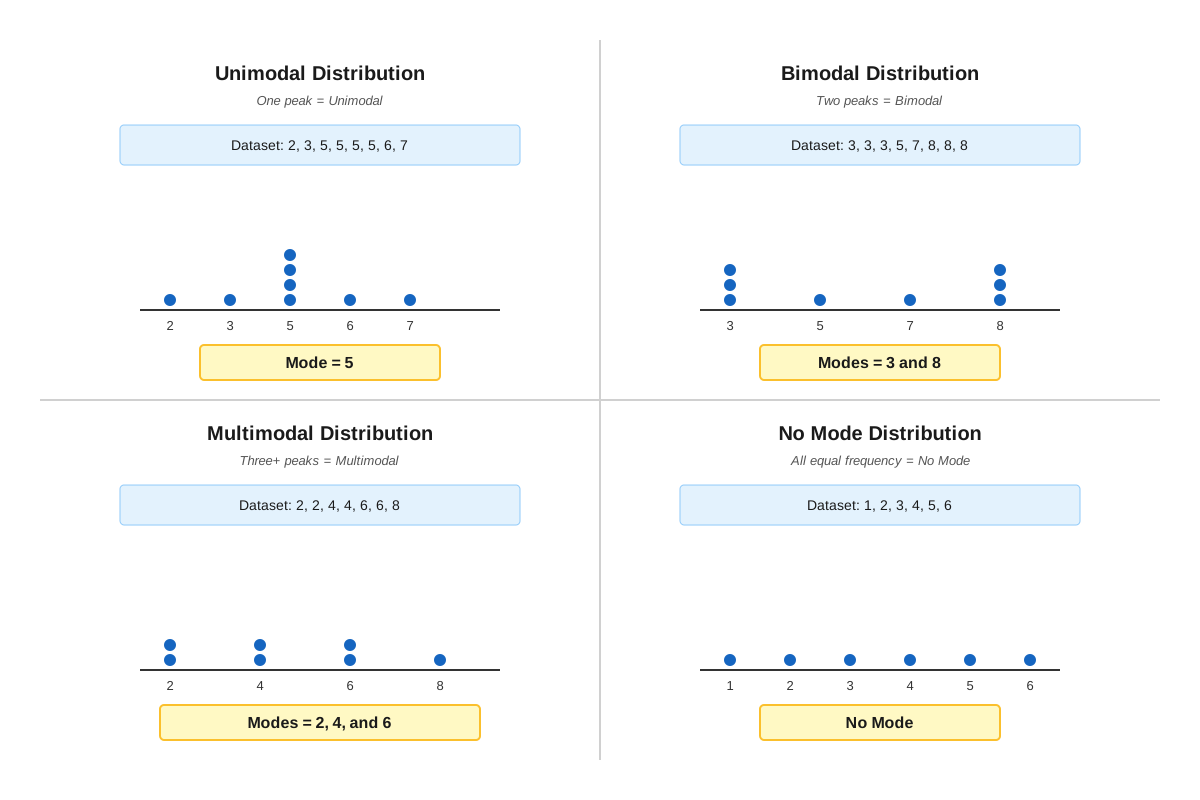
Understanding the different types of modal distributions is crucial for SAT questions that ask students to characterize datasets:
| Distribution Type | Definition | Example |
|---|---|---|
| Unimodal | Dataset has exactly one mode | {1, 2, 2, 2, 3, 4, 5} → mode is 2 |
| Bimodal | Dataset has exactly two modes | {1, 1, 2, 3, 4, 4, 5} → modes are 1 and 4 |
| Multimodal | Dataset has three or more modes | {2, 2, 3, 4, 4, 5, 6, 6} → modes are 2, 4, and 6 |
| No Mode | All values appear with equal frequency | {1, 2, 3, 4, 5} → no mode |
The SAT frequently tests whether students can recognize these different distribution types, particularly distinguishing between unimodal and bimodal datasets.
Mode in Different Data Representations
Frequency Tables: When data is presented in a frequency table, the mode is the value associated with the highest frequency. For instance:
| Score | Frequency |
|---|---|
| 85 | 3 |
| 90 | 7 |
| 95 | 5 |
| 100 | 2 |
The mode is 90 because it has the highest frequency (7).
Histograms: In a histogram, the mode corresponds to the tallest bar, representing the interval or value with the highest frequency. When dealing with grouped data in histograms, the modal class is the interval with the highest frequency, though the exact mode value may not be determinable without the raw data.
Dot Plots: In a dot plot, count the number of dots above each value. The value with the most dots is the mode. This visual representation makes mode identification particularly straightforward.
Lists of Data: When data appears as a simple list, organize the values (mentally or on paper) and count occurrences. While sorting helps with finding median, it's not strictly necessary for mode—you simply need to count frequencies.
Properties and Characteristics of Mode
The mode possesses several important properties that distinguish it from other measures of central tendency:
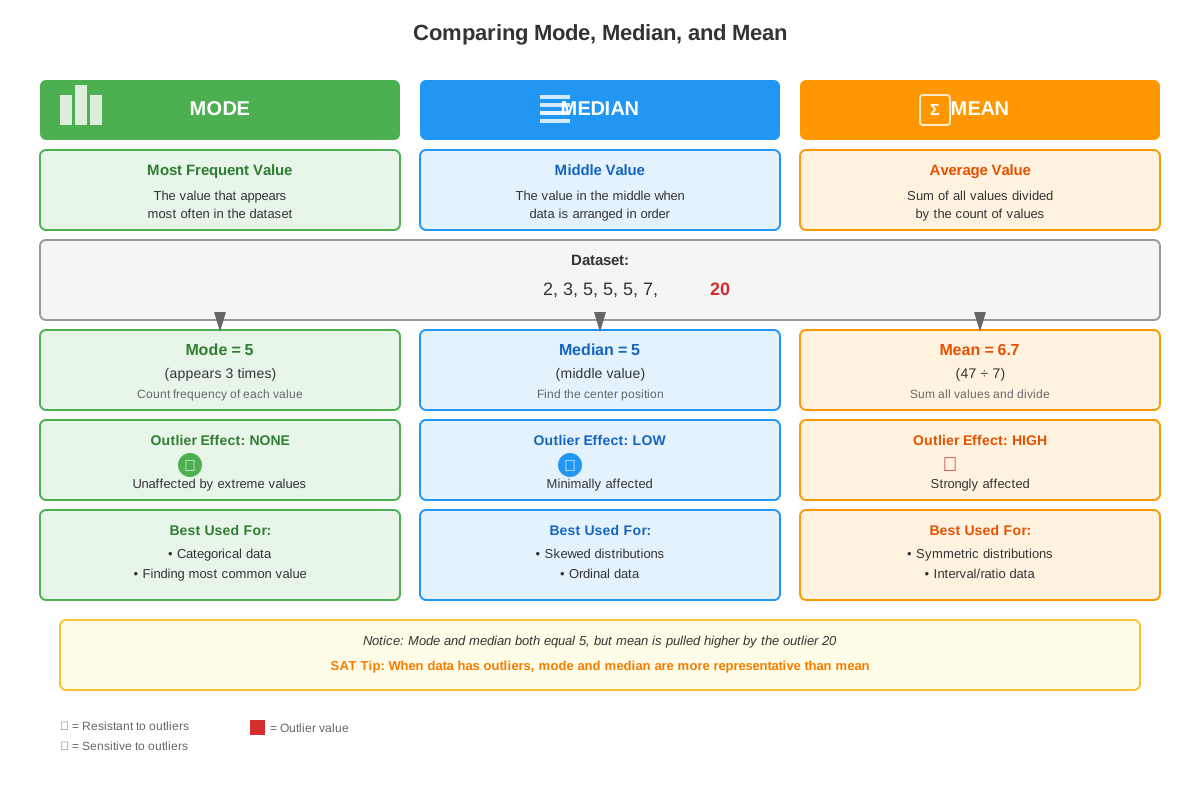
- Resistance to outliers: Unlike the mean, the mode is completely unaffected by extreme values. Adding a very large or very small number to a dataset will not change the mode unless that number becomes the most frequent value.
- Applicability to categorical data: Mode is the only measure of central tendency that can be used with non-numerical categorical data. For example, if surveying favorite colors, mode can identify "blue" as the most common response, while mean and median are meaningless for such data.
- May not be unique: A dataset can have multiple modes, one mode, or no mode at all, unlike mean and median which always produce a single value.
- May not be central: The mode doesn't necessarily fall near the center of the data distribution. In a dataset like {1, 2, 2, 2, 50, 60, 70}, the mode is 2, which lies at the lower end of the range.
- Existence depends on repetition: If no value repeats in a dataset, there is no mode. This contrasts with mean and median, which always exist for numerical datasets.
Comparing Mode with Mean and Median
Understanding when to use mode versus other measures is a high-yield SAT skill:
Mode vs. Mean: The mean is calculated by summing all values and dividing by the count, making it sensitive to every value in the dataset. The mode only considers frequency. In skewed distributions or datasets with outliers, mode often provides a better representation of "typical" values than mean. For example, in income data where a few extremely high earners skew the mean upward, the modal income better represents what most people earn.
Mode vs. Median: The median is the middle value when data is ordered, representing the 50th percentile. While median is also resistant to outliers, it doesn't indicate which value is most common. In a dataset like {1, 2, 3, 3, 3, 4, 100}, the median is 3 and the mode is also 3, but they arrived at this value through different reasoning.
Symmetric distributions: In perfectly symmetric, unimodal distributions, the mean, median, and mode are all equal. This relationship helps students verify their calculations and understand distribution shapes.
Manipulating Datasets to Affect Mode
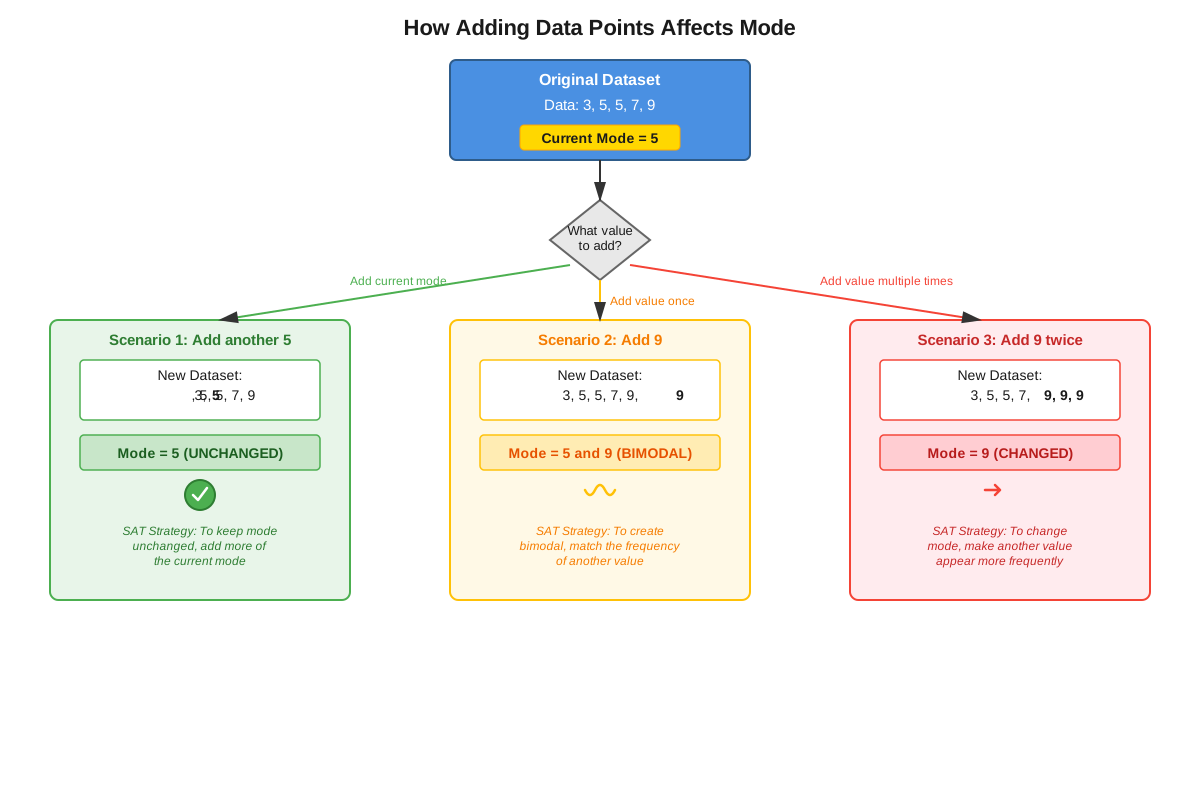
SAT questions frequently ask how adding, removing, or changing values affects the mode. Key principles include:
- Adding a new value: If the added value already exists in the dataset and its new frequency exceeds the current mode's frequency, it becomes the new mode. If it equals the mode's frequency, the dataset becomes bimodal.
- Removing a value: Removing an instance of the current mode may eliminate the mode, create a new mode, or result in no mode, depending on the remaining frequencies.
- Changing a value: Converting one value to another affects both values' frequencies and may shift the mode accordingly.
- Adding multiple identical values: This is a common SAT scenario where students must determine how many instances of a particular value must be added to make it the mode.
Concept Relationships
The mode serves as a foundational concept within the broader framework of descriptive statistics. Mode → connects to → measures of central tendency (mean and median), forming a trio of statistics that describe the "center" or "typical value" of a dataset. While mean uses all values arithmetically and median uses positional ordering, mode uses frequency, making these three measures complementary rather than interchangeable.
Mode → relates to → frequency distributions, as identifying the mode requires understanding how often each value occurs. This connection extends to frequency tables and histograms, which are visual and tabular representations that make mode identification more efficient. The concept of frequency itself underlies probability calculations, creating a bridge between descriptive statistics and probability theory.
Mode → informs → distribution shape analysis. The number of modes (unimodal, bimodal, multimodal) provides insights into whether data clusters around one central value or multiple distinct values, which has implications for understanding the underlying population or process generating the data. This connects to more advanced concepts like skewness and kurtosis, though these are beyond typical SAT scope.
Mode → contrasts with → mean in terms of outlier sensitivity. This relationship is crucial for SAT questions asking students to select the most appropriate measure of central tendency for a given situation. When data contains extreme values or is highly skewed, mode often provides more meaningful information than mean.
Mode → applies to → categorical data analysis, distinguishing it from mean and median which require numerical data. This makes mode the gateway to analyzing non-numerical survey responses, demographic categories, and qualitative data—skills that appear in SAT data interpretation questions.
Quick check — test yourself on Mode so far.
Try Flashcards →High-Yield Facts
⭐ The mode is the value that appears most frequently in a dataset—count occurrences to identify it.
⭐ A dataset can have one mode (unimodal), two modes (bimodal), multiple modes (multimodal), or no mode at all if all values appear with equal frequency.
⭐ Mode is the only measure of central tendency that can be used with categorical (non-numerical) data, such as favorite colors or types of vehicles.
⭐ The mode is completely unaffected by outliers or extreme values, unlike the mean which can be heavily influenced by them.
⭐ In a frequency table, the mode is the value with the highest frequency count; in a histogram, it corresponds to the tallest bar.
- The mode may not be near the center of the data distribution and can lie at either extreme of the range.
- Adding a value to a dataset can change the mode, create a bimodal distribution, or leave the mode unchanged depending on frequencies.
- In a perfectly symmetric, unimodal distribution, the mean, median, and mode are all equal.
- When data is presented in a dot plot, the mode is the value with the most dots stacked above it.
- A dataset with all unique values (no repeating values) has no mode.
- The mode is particularly useful for identifying the most common category, size, or preference in survey data.
- Unlike mean and median, the mode must be an actual value that exists in the dataset—it cannot be a calculated value between data points.
Common Misconceptions
Misconception: The mode is always the middle value of a dataset.
Correction: The mode is the most frequent value, not the middle value. The middle value when data is ordered is the median. Mode depends entirely on frequency of occurrence, not position.
Misconception: Every dataset must have exactly one mode.
Correction: Datasets can have one mode, multiple modes, or no mode at all. If all values appear with equal frequency, there is no mode. If two values tie for highest frequency, the dataset is bimodal.
Misconception: The mode must be calculated using a formula like mean or median.
Correction: The mode is found by counting—simply identify which value appears most often. There is no arithmetic calculation involved unless you're counting frequencies in a large dataset.
Misconception: The mode is always affected when you add any new value to a dataset.
Correction: Adding a value only changes the mode if the new value's frequency becomes higher than the current mode's frequency, or if it creates a tie. Adding a unique value to a dataset with a clear mode doesn't change the mode.
Misconception: In a histogram, the mode is the middle bar.
Correction: In a histogram, the mode (or modal class) is represented by the tallest bar, which indicates the highest frequency, regardless of its position along the horizontal axis.
Misconception: The mode is less important than mean and median.
Correction: Each measure of central tendency serves different purposes. Mode is essential for categorical data, identifying most common values, and analyzing data where frequency matters more than arithmetic average. On the SAT, mode questions appear regularly and carry equal weight to other statistical concepts.
Misconception: You must sort data before finding the mode.
Correction: While sorting can help organize your work, it's not necessary for finding the mode. You only need to count how many times each value appears. Sorting is required for finding the median, but not the mode.
Worked Examples
Example 1: Identifying Mode from a List and Analyzing Changes
Problem: A teacher records the number of books read by students during summer break: 3, 5, 7, 5, 8, 5, 6, 9, 5, 7.
(a) What is the mode of this dataset?
(b) If two students who read 7 books each are added to the class, how does this affect the mode?
Solution:
(a) To find the mode, count the frequency of each value:
- 3 appears 1 time
- 5 appears 4 times
- 6 appears 1 time
- 7 appears 2 times
- 8 appears 1 time
- 9 appears 1 time
The value 5 appears most frequently (4 times), so the mode is 5.
(b) Adding two students who read 7 books changes the frequency of 7:
- Original frequency of 7: 2 times
- New frequency of 7: 2 + 2 = 4 times
Now both 5 and 7 appear 4 times each, which is the highest frequency. The dataset becomes bimodal with modes of 5 and 7.
Connection to Learning Objectives: This example demonstrates identifying the mode from a list (Objective 1), applying mode concepts to answer questions (Objective 3), and analyzing how changes to a dataset affect the mode (Objective 5).
Example 2: Mode in a Frequency Table with Real-World Context
Problem: A coffee shop tracks the sizes of drinks ordered during one morning:
| Size | Number of Orders |
|---|---|
| Small | 12 |
| Medium | 28 |
| Large | 19 |
| Extra Large | 8 |
(a) What is the mode of drink sizes ordered?
(b) The manager wants to ensure the modal size represents at least 50% of all orders. How many additional Medium drinks would need to be ordered to achieve this?
Solution:
(a) In a frequency table, the mode is the category with the highest frequency. Medium has 28 orders, which is more than any other size. The mode is Medium.
(b) First, calculate the total number of current orders:
12 + 28 + 19 + 8 = 67 orders
For Medium to represent 50% of all orders, we need:
Medium orders ≥ 0.50 × (Total orders)
Let x = additional Medium orders needed
28 + x ≥ 0.50 × (67 + x)
28 + x ≥ 33.5 + 0.50x
0.50x ≥ 5.5
x ≥ 11
At least 11 additional Medium drinks would need to be ordered (making it 39 Medium out of 78 total, which equals 50%).
Connection to Learning Objectives: This example shows how mode appears in SAT-style real-world contexts (Objective 2), demonstrates determining mode from a frequency table (Objective 4), and involves multi-step problem-solving with mode (Objective 3). It also illustrates why mode matters for business decisions—the most popular size affects inventory and staffing decisions.
Exam Strategy
When approaching SAT mode questions, follow this systematic process:
Step 1: Identify the data representation. Quickly determine whether data is presented as a list, frequency table, histogram, dot plot, or word problem. This determines your counting strategy.
Step 2: Count systematically. For lists, make tally marks or organize values mentally. For tables, scan the frequency column for the highest value. For graphs, identify the tallest bar or most dots. Avoid rushing—miscounting is the most common error on mode questions.
Step 3: Watch for trigger words and phrases:
- "Most common," "most frequent," or "most popular" → these directly indicate mode
- "Typical" or "usual" → may indicate mode, especially with categorical data
- "Occurs most often" → definitely asking for mode
- "Central tendency" → may involve comparing mode with mean and median
Step 4: Check for multiple modes or no mode. Don't assume there's exactly one mode. If the question asks "what is the mode" and two values tie, both are correct answers. Some SAT questions specifically test whether students recognize bimodal distributions.
Step 5: For manipulation questions (adding/removing values), calculate new frequencies carefully. Draw a quick frequency table if needed. Remember that adding one instance of a value increases its frequency by exactly one.
Process of elimination tips:
- Eliminate any answer choice that doesn't actually appear in the dataset (mode must be an actual data value)
- Eliminate values that appear less frequently than others
- If a question asks about mode and an answer choice is the mean or median, it's likely a distractor unless the distribution is symmetric
- For "which measure is most appropriate" questions, eliminate mean if outliers are mentioned; eliminate median if the question emphasizes "most common"
Time allocation: Mode questions typically require 30-60 seconds. If you're spending more than 90 seconds, you may be overcomplicating the problem. Mode is fundamentally about counting—if you find yourself doing complex calculations, reconsider your approach.
Calculator usage: For simple mode questions, mental math is faster. Use your calculator for frequency calculations in large datasets or when verifying totals in manipulation problems.
Memory Techniques
MODE = Most Often Data Entry: This acronym helps remember that mode is about frequency—which data entry appears most often.
"Mode is the MOST": The simplest mnemonic—both words start with "MO" and mode is about the MOST frequent value.
Visual memory technique: Picture a fashion show where one outfit appears on the runway more than any other—that outfit is the "mode" (most popular style). This connects "mode" with "most common."
The Three M's hierarchy:
- Mode = Most frequent (count occurrences)
- Median = Middle value (order and find center)
- Mean = Mathematical average (add and divide)
This parallel structure helps distinguish the three measures of central tendency.
Categorical Connection: Remember "Mode works for Categories" (both start with C). This helps recall that mode is the only measure of central tendency applicable to categorical data like colors, brands, or preferences.
Frequency First: Before finding mode, always think "Frequency First"—you must count frequencies before identifying the mode. This prevents the common error of confusing mode with median or mean.
Bimodal = Two Peaks: Visualize a camel with two humps to remember that bimodal means two modes. Multimodal would be a creature with many humps.
Summary
The mode represents the most frequently occurring value in a dataset and serves as one of three primary measures of central tendency alongside mean and median. Unlike these other measures, mode focuses exclusively on frequency rather than arithmetic calculation or positional ordering, making it the only measure applicable to categorical data and particularly useful when identifying the most common or typical value matters more than calculating an average. On the SAT, mode questions appear regularly in various formats including frequency tables, histograms, dot plots, and lists, often embedded in real-world contexts. Students must be able to identify modes quickly, recognize when datasets are unimodal, bimodal, multimodal, or have no mode, and understand how adding or removing values affects the mode. The mode's resistance to outliers distinguishes it from the mean, making it valuable for analyzing skewed distributions. Success on SAT mode questions requires systematic counting, careful attention to frequency comparisons, and recognition of trigger words like "most common" or "most frequent." Mastering mode involves not just identifying the most frequent value but understanding when mode is the most appropriate measure to use and how it relates to the broader picture of data distribution and analysis.
Key Takeaways
- Mode is the value appearing most frequently in a dataset—find it by counting occurrences, not by calculation
- Datasets can have one mode, multiple modes, or no mode, depending on whether values tie for highest frequency
- Mode is the only measure of central tendency that works with categorical data like colors, preferences, or categories
- Mode is completely unaffected by outliers, making it more representative than mean for skewed distributions
- In frequency tables and histograms, mode corresponds to the highest frequency or tallest bar, making visual identification straightforward
- Adding or removing values changes the mode only if it affects which value has the highest frequency
- SAT mode questions often combine mode with real-world contexts and may require comparing mode with mean or median
Related Topics
Mean (Arithmetic Average): Understanding mean alongside mode enables comparison of these measures and recognition of when each is most appropriate. Mean is more sensitive to outliers than mode, making the contrast between them important for data analysis questions.
Median: Like mode, median is resistant to outliers, but it focuses on positional ordering rather than frequency. Mastering both concepts allows students to tackle questions asking which measure best represents a dataset.
Range and Variability: While mode describes central tendency, range describes spread. Together, these concepts provide a complete picture of data distribution, frequently tested in combined SAT questions.
Frequency Distributions and Histograms: These visual representations make mode identification more efficient and appear frequently on the SAT. Understanding how to read these displays is essential for quick mode determination.
Probability and Expected Value: Mode connects to probability through frequency—the modal value is the most probable outcome in a dataset. This relationship becomes important in more advanced statistics.
Data Interpretation and Analysis: Mode serves as a building block for more complex data analysis skills, including comparing datasets, identifying trends, and making data-driven decisions.
Practice CTA
Now that you've mastered the concept of mode, it's time to solidify your understanding through practice! Attempt the practice questions to test your ability to identify modes in various formats, analyze how dataset changes affect the mode, and apply mode concepts to SAT-style problems. Use the flashcards to reinforce key definitions and properties until mode identification becomes automatic. Remember, mode questions on the SAT are highly scorable—they test straightforward counting skills that, with practice, you can execute quickly and accurately. Every practice problem you complete builds the pattern recognition and confidence you need to excel on test day. You've got this!
Sign up free to keep reading
Create a free AnvayaPrep account to finish this SAT guide on Mode — plus flashcards and practice questions.