Overview
Adding radicals is a fundamental algebraic skill that appears consistently throughout the SAT math section, particularly in questions involving simplification, equation solving, and geometric applications. This topic requires students to understand when radical expressions can be combined and how to perform these operations correctly—skills that parallel the addition of like terms in polynomial expressions. Mastery of adding radicals enables students to simplify complex expressions efficiently, solve radical equations, and tackle geometry problems involving distances, areas, and the Pythagorean theorem.
On the SAT, sat adding radicals questions typically appear in both multiple-choice and student-produced response formats, often embedded within larger algebraic or geometric contexts. Students must recognize that only radicals with identical radicands (the numbers under the radical symbol) and identical indices can be combined through addition or subtraction. This seemingly simple rule becomes the foundation for more complex problem-solving scenarios where simplification is required before combining terms, or where radical expressions must be manipulated to reveal hidden like terms.
Understanding this topic connects directly to broader mathematical concepts including polynomial operations, factoring, rational expressions, and coordinate geometry. The ability to add radicals efficiently saves valuable time on the SAT and prevents common algebraic errors that can cascade through multi-step problems. Since radical expressions frequently appear in answer choices and intermediate steps of calculations, proficiency in this area directly impacts overall test performance and mathematical confidence.
Learning Objectives
- [ ] Identify key features of adding radicals, including like radicals and unlike radicals
- [ ] Explain how adding radicals appears on the SAT in various question formats and contexts
- [ ] Apply adding radicals to answer SAT-style questions accurately and efficiently
- [ ] Simplify radical expressions to reveal like terms before combining
- [ ] Distinguish between operations that can and cannot be performed on radical expressions
- [ ] Solve multi-step problems requiring radical addition combined with other algebraic operations
Prerequisites
- Basic radical notation and terminology: Understanding what the radical symbol represents, identifying the radicand and index, and recognizing square roots versus other roots is essential for manipulating these expressions.
- Simplifying radicals: The ability to reduce radicals to simplest form (e.g., √50 = 5√2) is necessary because many addition problems require simplification before like terms become apparent.
- Combining like terms in polynomials: The conceptual framework for adding radicals directly parallels combining like terms (e.g., 3x + 5x = 8x), making this prior knowledge the foundation for the current topic.
- Prime factorization: Breaking numbers into prime factors helps identify perfect square factors that can be extracted from under radical symbols during simplification.
Why This Topic Matters
In real-world applications, radical expressions appear in physics formulas (kinetic energy, wave frequencies), engineering calculations (stress analysis, signal processing), financial mathematics (compound interest with continuous compounding), and computer graphics (distance calculations, vector operations). The ability to manipulate and combine radical expressions efficiently translates to practical problem-solving across STEM fields and quantitative disciplines.
On the SAT, adding radicals appears in approximately 2-4 questions per test, representing roughly 3-7% of the math section. These questions may appear as standalone simplification problems, within algebraic equation-solving contexts, embedded in geometry problems (especially those involving the Pythagorean theorem or distance formula), or as part of function evaluation and manipulation tasks. The College Board frequently tests this concept because it assesses both procedural fluency and conceptual understanding of algebraic structure.
Common SAT question formats include: simplifying expressions with multiple radical terms, solving equations where radical addition is an intermediate step, identifying equivalent expressions among answer choices, and applying radical operations within word problems involving geometric measurements or real-world scenarios. Questions often combine radical addition with other operations like multiplication, factoring, or rationalization to test comprehensive algebraic proficiency.
Core Concepts
Definition of Like Radicals
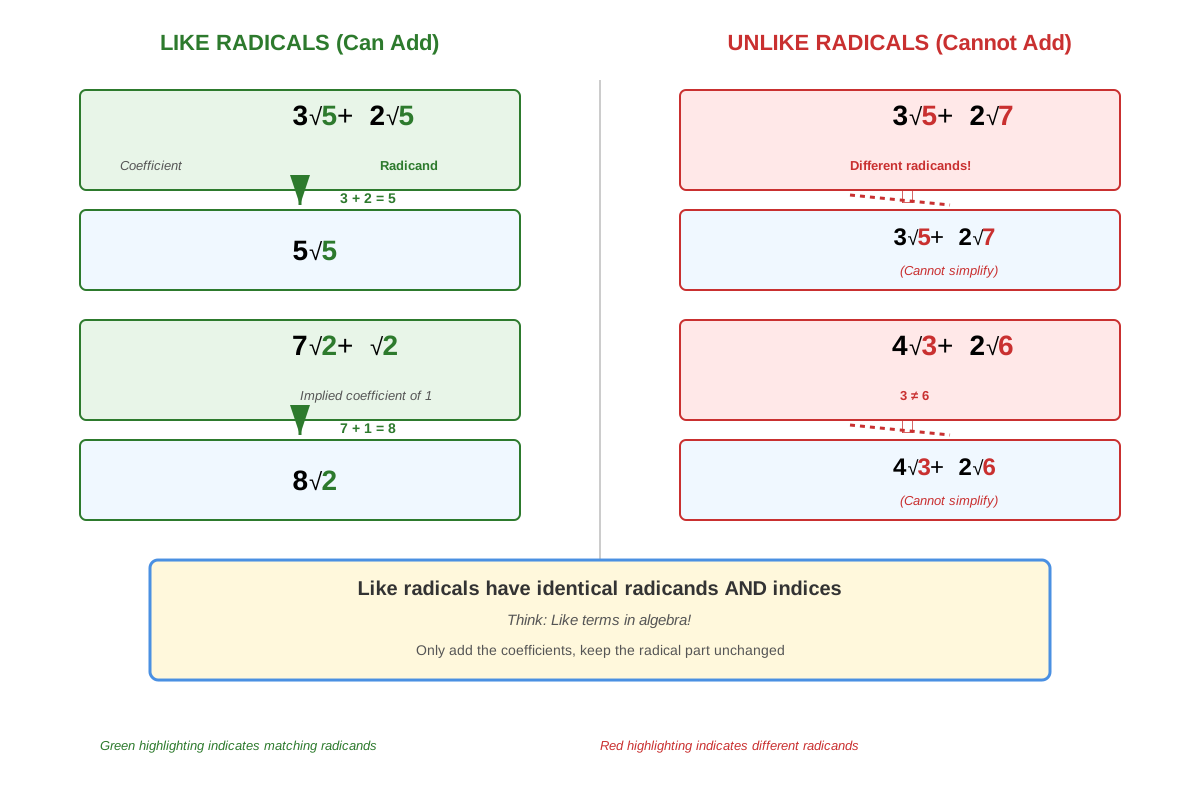
Like radicals are radical expressions that have identical radicands and identical indices. Just as 3x and 5x are like terms that can be combined to form 8x, radical expressions such as 3√2 and 5√2 are like radicals that can be combined to form 8√2. The coefficient (the number in front of the radical) can differ, but the radical portion must be exactly the same for addition or subtraction to occur.
For example:
- 4√7 and 9√7 are like radicals (same radicand: 7, same index: 2)
- 2√5 and 2√3 are NOT like radicals (different radicands)
- 3√2 and 3∛2 are NOT like radicals (different indices: square root vs. cube root)
The Addition Rule for Radicals
When adding radicals, the fundamental rule states: only like radicals can be combined by adding their coefficients. The radical portion remains unchanged, serving as the "unit" being counted, similar to how the variable remains unchanged when combining like terms in algebra.
The general form is:
a√x + b√x = (a + b)√xFor example:
- 5√3 + 2√3 = 7√3
- 8√11 - 3√11 = 5√11
- 6√5 + 4√5 - 2√5 = 8√5
Unlike radicals cannot be combined through addition. The expression 3√2 + 4√5 cannot be simplified further because the radicands differ. This expression must remain as written, just as 3x + 4y cannot be combined into a single term.
Simplifying Before Adding
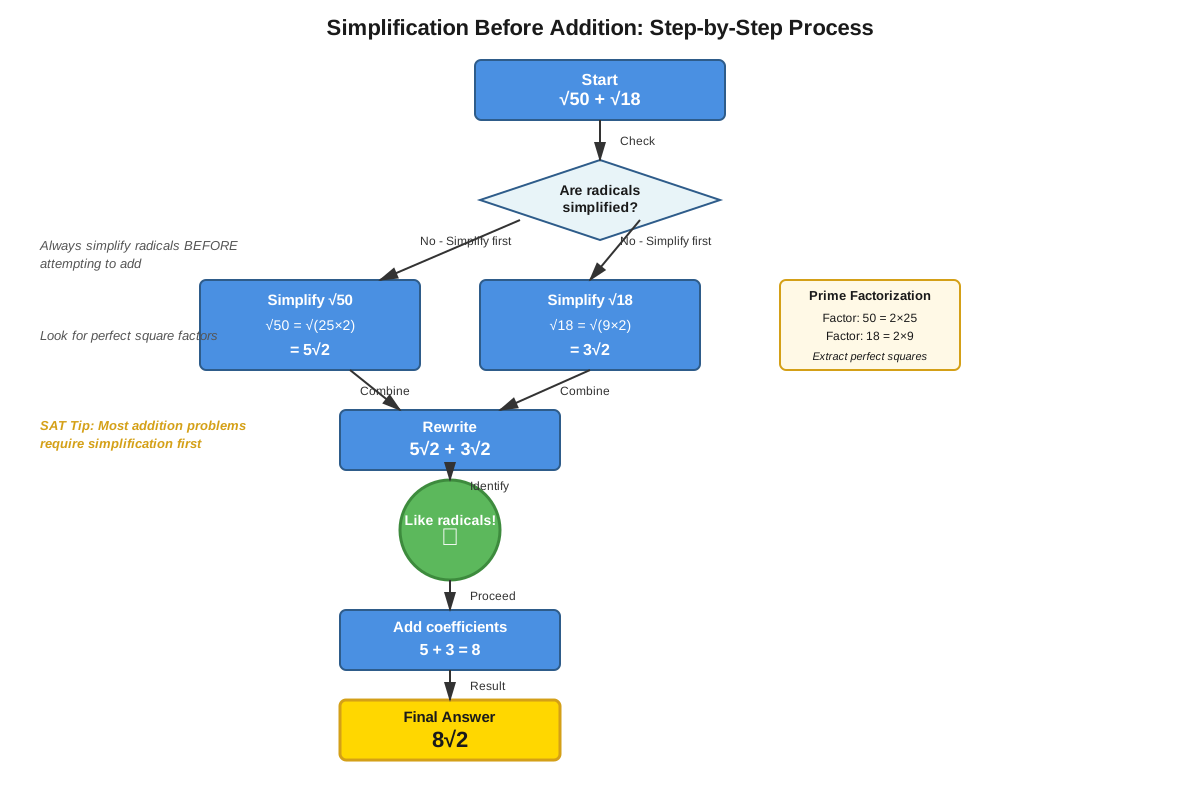
Many SAT problems require simplification of one or more radicals before like terms become apparent. This process involves factoring the radicand to extract perfect squares (or perfect cubes for cube roots), converting unlike radicals into like radicals.
The simplification process follows these steps:
- Factor each radicand into prime factors or identify perfect square factors
- Extract perfect squares from under the radical
- Identify like radicals among the simplified terms
- Combine coefficients of like radicals
Example: Simplify √12 + √27
Step 1: Factor the radicands
- √12 = √(4 × 3) = √4 × √3 = 2√3
- √27 = √(9 × 3) = √9 × √3 = 3√3
Step 2: Now both terms are like radicals
- 2√3 + 3√3 = 5√3
Common Simplification Patterns
Recognizing these frequently-tested perfect squares accelerates simplification:
| Number | Prime Factorization | Simplified Radical |
|---|---|---|
| √8 | √(4 × 2) | 2√2 |
| √12 | √(4 × 3) | 2√3 |
| √18 | √(9 × 2) | 3√2 |
| √20 | √(4 × 5) | 2√5 |
| √27 | √(9 × 3) | 3√3 |
| √32 | √(16 × 2) | 4√2 |
| √45 | √(9 × 5) | 3√5 |
| √48 | √(16 × 3) | 4√3 |
| √50 | √(25 × 2) | 5√2 |
| √75 | √(25 × 3) | 5√3 |
Operations That Cannot Be Performed
Understanding what operations are not valid with radicals prevents common errors:
- Cannot add radicands: √3 + √5 ≠ √8
- Cannot distribute addition under a radical: √(x + y) ≠ √x + √y
- Cannot combine different indices: √2 + ∛2 cannot be simplified
- Cannot factor out coefficients incorrectly: 2√3 + 4√3 ≠ 6√6
Multi-Term Expressions
When working with expressions containing three or more radical terms, the process remains systematic:
- Simplify each radical completely
- Group like radicals together
- Combine coefficients for each group of like radicals
- Write the final expression with all unlike radicals separated
Example: Simplify 2√8 + 3√18 - √32 + 5√2
Step 1: Simplify each term
- 2√8 = 2(2√2) = 4√2
- 3√18 = 3(3√2) = 9√2
- √32 = 4√2
- 5√2 = 5√2
Step 2: Combine like radicals
- 4√2 + 9√2 - 4√2 + 5√2 = (4 + 9 - 4 + 5)√2 = 14√2
Radicals with Variables
When radicals contain variables, the same principles apply, but additional attention must be paid to the domain and simplification rules for variables:
- √(x²) = |x| (absolute value for even roots)
- For SAT purposes, often assume variables represent positive values
- Combine like radicals: 3√x + 5√x = 8√x
- Simplify before combining: √(4x) + √(9x) = 2√x + 3√x = 5√x
Concept Relationships
The concept of adding radicals builds directly upon combining like terms in polynomial algebra, where the variable acts as the unchanging unit while coefficients are added. This parallel structure helps students transfer their understanding from familiar polynomial operations to radical expressions.
Simplifying radicals serves as the essential prerequisite that enables radical addition. Without simplification skills, students cannot recognize hidden like radicals in expressions such as √8 + √18, which only become combinable after simplification to 2√2 + 3√2. This relationship flows as: Prime Factorization → Simplifying Radicals → Identifying Like Radicals → Adding Radicals.
Within the broader unit on Exponents and Radicals, adding radicals connects to multiplying radicals (which uses different rules), rationalizing denominators (which often requires radical addition in the numerator), and solving radical equations (where addition may be needed to isolate radical terms). The conceptual map flows:
Radical Notation → Simplifying Radicals → Adding/Subtracting Radicals → Multiplying/Dividing Radicals → Rationalizing → Solving Radical Equations
This topic also connects forward to quadratic equations (where the quadratic formula produces radical expressions that may need simplification and combination), distance formula applications in coordinate geometry (which generate radical expressions requiring addition), and trigonometry (where exact values often involve radical expressions).
Quick check — test yourself on Adding radicals so far.
Try Flashcards →High-Yield Facts
⭐ Only radicals with identical radicands and identical indices can be added by combining their coefficients
⭐ The expression √a + √b cannot be simplified to √(a+b)—this is a common error to avoid
⭐ Before adding radicals, always simplify each radical completely to reveal potential like terms
⭐ The coefficient of a radical is the number multiplied by the radical; when no coefficient is written, it equals 1
⭐ Perfect squares to memorize for quick simplification: 4, 9, 16, 25, 36, 49, 64, 81, 100
- When subtracting radicals, distribute the negative sign carefully: a√x - (b√x + c√x) = a√x - b√x - c√x
- Radical expressions with different radicands remain as separate terms in the final answer
- The process of adding radicals mirrors combining like terms: 3x + 5x = 8x parallels 3√2 + 5√2 = 8√2
- Zero can be a coefficient: 5√3 - 5√3 = 0, not 0√3
- Multiple groups of like radicals can exist in one expression: 2√3 + 4√5 + 6√3 = 8√3 + 4√5
Common Misconceptions
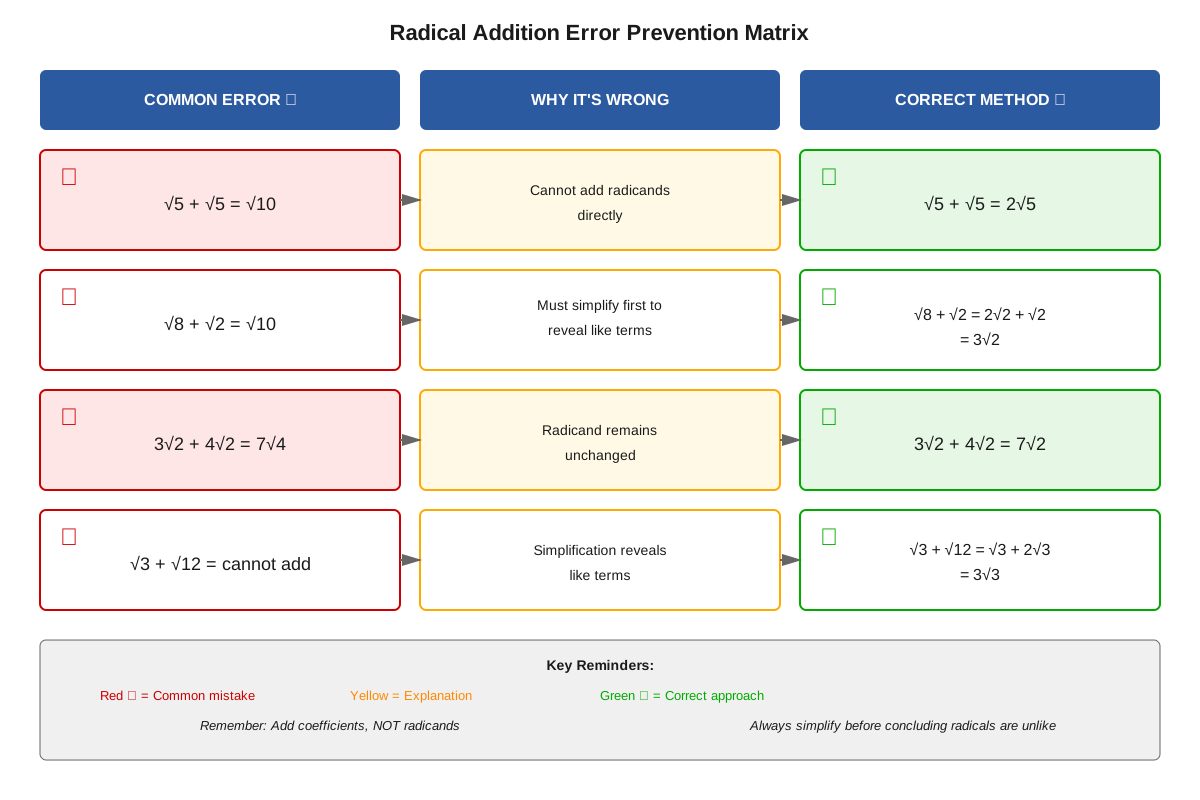
Misconception: √a + √b = √(a + b)
Correction: Radicals cannot be distributed over addition. For example, √9 + √16 = 3 + 4 = 7, but √(9 + 16) = √25 = 5. These are different values. Addition under a radical and addition of radicals are fundamentally different operations.
Misconception: When adding 2√3 + 4√3, multiply the radicands to get 6√9 = 18
Correction: Only the coefficients are added; the radicand remains unchanged. The correct answer is (2 + 4)√3 = 6√3. The radical portion acts as the unit being counted, not a factor to be multiplied.
Misconception: √8 and √2 are unlike radicals and cannot be combined
Correction: After simplification, √8 = 2√2, which reveals that these are like radicals. Always simplify completely before determining whether radicals can be combined. The expression √8 + √2 simplifies to 2√2 + √2 = 3√2.
Misconception: The expression 3√5 + 2√5 equals 5√10
Correction: When adding like radicals, add the coefficients but keep the radicand the same. The correct answer is (3 + 2)√5 = 5√5. The radicand does not change during addition—only the coefficient changes.
Misconception: If radicals have different coefficients, they cannot be added
Correction: Coefficients can be any real numbers—what matters for addition is that the radical portions (radicand and index) are identical. For example, 2.5√7 + 3.2√7 = 5.7√7, and even π√3 + 2√3 = (π + 2)√3.
Worked Examples
Example 1: Multi-Step Simplification and Addition
Problem: Simplify completely: 3√12 + 2√27 - √48 + 5√3
Solution:
Step 1: Simplify each radical term by factoring out perfect squares.
For 3√12:
- 12 = 4 × 3
- √12 = √(4 × 3) = √4 × √3 = 2√3
- Therefore: 3√12 = 3(2√3) = 6√3
For 2√27:
- 27 = 9 × 3
- √27 = √(9 × 3) = √9 × √3 = 3√3
- Therefore: 2√27 = 2(3√3) = 6√3
For √48:
- 48 = 16 × 3
- √48 = √(16 × 3) = √16 × √3 = 4√3
- Therefore: -√48 = -4√3
For 5√3:
- Already in simplest form
Step 2: Rewrite the expression with all simplified terms.
6√3 + 6√3 - 4√3 + 5√3
Step 3: All terms are like radicals (all have √3), so combine coefficients.
(6 + 6 - 4 + 5)√3 = 13√3
Answer: 13√3
This problem demonstrates the essential SAT skill of recognizing that simplification must precede addition, and it tests knowledge of common perfect square factors.
Example 2: Mixed Radicals with Different Radicands
Problem: Simplify: √50 + √32 - √18 + 2√8
Solution:
Step 1: Simplify each radical.
√50:
- 50 = 25 × 2
- √50 = 5√2
√32:
- 32 = 16 × 2
- √32 = 4√2
√18:
- 18 = 9 × 2
- √18 = 3√2
2√8:
- 8 = 4 × 2
- √8 = 2√2
- 2√8 = 2(2√2) = 4√2
Step 2: Rewrite with simplified terms.
5√2 + 4√2 - 3√2 + 4√2
Step 3: All terms contain √2, so combine coefficients.
(5 + 4 - 3 + 4)√2 = 10√2
Answer: 10√2
This example reinforces that even when initial radicands appear different (50, 32, 18, 8), simplification may reveal that all terms are actually like radicals. This pattern appears frequently on the SAT to test whether students can recognize hidden structure.
Exam Strategy
When approaching SAT questions involving adding radicals, begin by scanning all radical terms to determine whether simplification is necessary. If any radicand is not a prime number or contains factors that are perfect squares, simplification should be the first step. This prevents the error of prematurely concluding that radicals cannot be combined.
Trigger words and phrases that signal radical addition problems include: "simplify," "combine," "express in simplest form," "which expression is equivalent to," and "the sum of." When you see these phrases accompanying radical expressions, immediately check whether the radicals are already in simplest form.
For process of elimination on multiple-choice questions:
- Eliminate any answer choice that incorrectly combines unlike radicals (different radicands)
- Eliminate choices that show √(a + b) when the problem involves √a + √b
- Eliminate answers with unsimplified radicals when other choices show simplified forms
- Check coefficients carefully—a common wrong answer will have the correct radical but incorrect coefficient
Time allocation: Simple radical addition problems should take 30-45 seconds. If a problem requires simplification of multiple terms, allocate 60-90 seconds. If you find yourself spending more than 90 seconds, mark the question and return to it after completing easier problems. Often, a fresh look reveals a simplification pattern you initially missed.
When checking your work, substitute simple values to verify your answer makes sense. For instance, if your answer to √8 + √18 is 5√2, you can verify: √8 ≈ 2.83 and √18 ≈ 4.24, so the sum is approximately 7.07. Meanwhile, 5√2 ≈ 5(1.414) ≈ 7.07, confirming the answer is reasonable.
Memory Techniques
SCIC Method for adding radicals:
- Simplify each radical completely
- Check for like radicals (same radicand and index)
- Identify and group like terms together
- Combine coefficients, keeping the radical unchanged
Perfect Square Rhyme: "Four, nine, sixteen, twenty-five, thirty-six, forty-nine, sixty-four, eighty-one, one hundred—these perfect squares help radicals be done!" Memorizing this sequence enables rapid recognition of factors to extract.
The Coefficient Rule Analogy: Remember "radicals are like fruit"—you can add 3 apples + 5 apples = 8 apples, but you cannot add 3 apples + 5 oranges to get 8 "apporanges." Similarly, 3√2 + 5√2 = 8√2, but 3√2 + 5√3 cannot be combined. The radical is the "type of fruit" that must match.
Visualization Strategy: Picture the radical symbol as a container holding the radicand. When adding, you're counting how many containers of the same type you have. If the containers hold different contents (different radicands), you cannot combine them into one container.
PRIME Acronym for simplification:
- Prime factorization of the radicand
- Recognize perfect square factors
- Isolate the perfect square
- Multiply the square root of the perfect square by the remaining radical
- Express in simplest form
Summary
Adding radicals is a fundamental SAT math skill that requires understanding when radical expressions can be combined and executing the proper procedure for combination. Only like radicals—those with identical radicands and identical indices—can be added by combining their coefficients while keeping the radical portion unchanged. This process directly parallels combining like terms in polynomial expressions, where the variable remains constant while coefficients are added. Most SAT problems require simplification of radicals before addition, as initial radicands often contain perfect square factors that must be extracted to reveal like terms. The key to success is systematic simplification using prime factorization or recognition of common perfect squares (4, 9, 16, 25, 36, 49, 64, 81, 100), followed by careful identification of like radicals and accurate coefficient combination. Students must avoid the critical error of incorrectly distributing addition under a radical symbol (√a + √b ≠ √(a+b)) and must recognize that unlike radicals remain as separate terms in the final answer. Mastery of this topic enables efficient problem-solving across algebra, geometry, and equation-solving contexts on the SAT.
Key Takeaways
- Only radicals with identical radicands and identical indices can be combined through addition; the coefficients are added while the radical portion remains unchanged
- Always simplify radicals completely before attempting to add them, as simplification often reveals hidden like terms
- The most common SAT error is incorrectly assuming √a + √b = √(a+b); these are fundamentally different operations
- Memorize perfect squares (4, 9, 16, 25, 36, 49, 64, 81, 100) to enable rapid simplification of common radicands
- The process of adding radicals mirrors combining like terms in algebra: 3x + 5x = 8x parallels 3√2 + 5√2 = 8√2
- Unlike radicals cannot be combined and must remain as separate terms in the final simplified expression
- Systematic approach (simplify, identify like terms, combine coefficients) prevents errors and saves time on test day
Related Topics
Multiplying Radicals: While adding radicals requires like radicands, multiplying radicals uses different rules where radicands are multiplied together (√a × √b = √(ab)). Mastering addition provides the foundation for understanding why multiplication follows different procedures.
Rationalizing Denominators: This technique often produces radical expressions in numerators that require addition or subtraction, making radical addition skills essential for complete rationalization problems.
Solving Radical Equations: Isolating radical terms frequently requires adding or subtracting radicals on one side of an equation, making this topic a direct application of radical addition skills.
The Quadratic Formula: Solutions to quadratic equations often involve radical expressions that may need simplification and combination, particularly when working with discriminants and expressing answers in simplest form.
Distance and Midpoint Formulas: Coordinate geometry applications generate radical expressions (from the Pythagorean theorem) that may require addition when calculating perimeters or comparing distances.
Practice CTA
Now that you understand the principles and procedures for adding radicals, it's time to solidify your mastery through practice. Attempt the practice questions to test your ability to identify like radicals, simplify expressions correctly, and avoid common pitfalls. Use the flashcards to reinforce perfect square recognition and key rules. Remember, the SAT rewards both accuracy and speed—consistent practice with these problems will build the automaticity you need to handle radical addition confidently under test conditions. Each problem you solve strengthens your algebraic foundation and brings you closer to your target score!
Sign up free to keep reading
Create a free AnvayaPrep account to finish this SAT guide on Adding radicals — plus flashcards and practice questions.