Overview
Multiplying radicals is a fundamental algebraic skill that appears frequently on the SAT math section, testing students' ability to manipulate expressions involving square roots and other radical expressions. This topic requires understanding both the properties of radicals and the rules for combining them through multiplication. Mastery of multiplying radicals is essential because these problems appear in multiple contexts throughout the exam—from straightforward algebraic simplification questions to more complex geometry problems involving area, distance, and the Pythagorean theorem.
The SAT consistently includes questions that require students to multiply radical expressions, simplify the results, and recognize equivalent forms. These questions may appear as multiple-choice problems where students must identify simplified forms, or as student-produced response questions requiring exact numerical answers. Understanding how to multiply radicals efficiently can save valuable time during the exam and prevent common calculation errors that lead to incorrect answer choices.
Beyond its direct application, multiplying radicals connects to broader mathematical concepts including exponent rules, polynomial multiplication, and rational expressions. The skills developed in this topic form the foundation for more advanced algebraic manipulation and appear in conjunction with other SAT topics such as solving quadratic equations, working with complex numbers, and analyzing geometric relationships. Students who master sat multiplying radicals gain confidence in handling algebraic expressions and develop problem-solving strategies applicable across multiple question types.
Learning Objectives
- [ ] Identify key features of multiplying radicals
- [ ] Explain how multiplying radicals appears on the SAT
- [ ] Apply multiplying radicals to answer SAT-style questions
- [ ] Simplify products of radical expressions by combining like terms under a single radical
- [ ] Multiply binomial expressions containing radicals using distributive properties
- [ ] Recognize and apply the relationship between radical multiplication and exponent rules
- [ ] Convert between radical and exponential notation to facilitate multiplication
Prerequisites
- Understanding of square roots and radical notation: Essential for recognizing what radicals represent and how to interpret radical symbols in expressions
- Exponent rules and properties: Necessary because radicals are fractional exponents, and multiplication of radicals follows from exponent multiplication rules
- Basic algebraic manipulation: Required for distributing terms, combining like terms, and simplifying expressions after multiplication
- Prime factorization: Needed to simplify radicals by identifying perfect square factors within radicands
- FOIL method and distributive property: Critical for multiplying binomial expressions that contain radical terms
Why This Topic Matters
Multiplying radicals has significant real-world applications in fields requiring precise measurements and calculations. Engineers use radical multiplication when calculating distances in three-dimensional space, physicists apply these principles when working with wave functions and energy calculations, and architects employ radical operations when determining diagonal measurements and structural relationships. The ability to manipulate radical expressions accurately translates to practical problem-solving in construction, navigation, and scientific research.
On the SAT, multiplying radicals appears with high frequency, typically showing up in 2-4 questions per exam across both the calculator and no-calculator sections. These questions account for approximately 5-8% of the total math score, making this a high-yield topic for focused study. The College Board tests this concept through various question formats: direct simplification problems, equation-solving questions where radical multiplication is an intermediate step, geometry problems requiring the Pythagorean theorem with radical answers, and questions asking students to identify equivalent expressions.
Common SAT question types include: simplifying products like √6 · √15, expanding expressions such as (2 + √3)(5 - √3), recognizing that √a · √b = √(ab) when both a and b are non-negative, and identifying which answer choice represents the simplified form of a radical product. The exam also tests this concept indirectly through geometry problems where students must calculate areas or distances that involve multiplying radical expressions, and through algebraic problems where rationalizing denominators requires multiplying by conjugate radical expressions.
Core Concepts
The Product Rule for Radicals
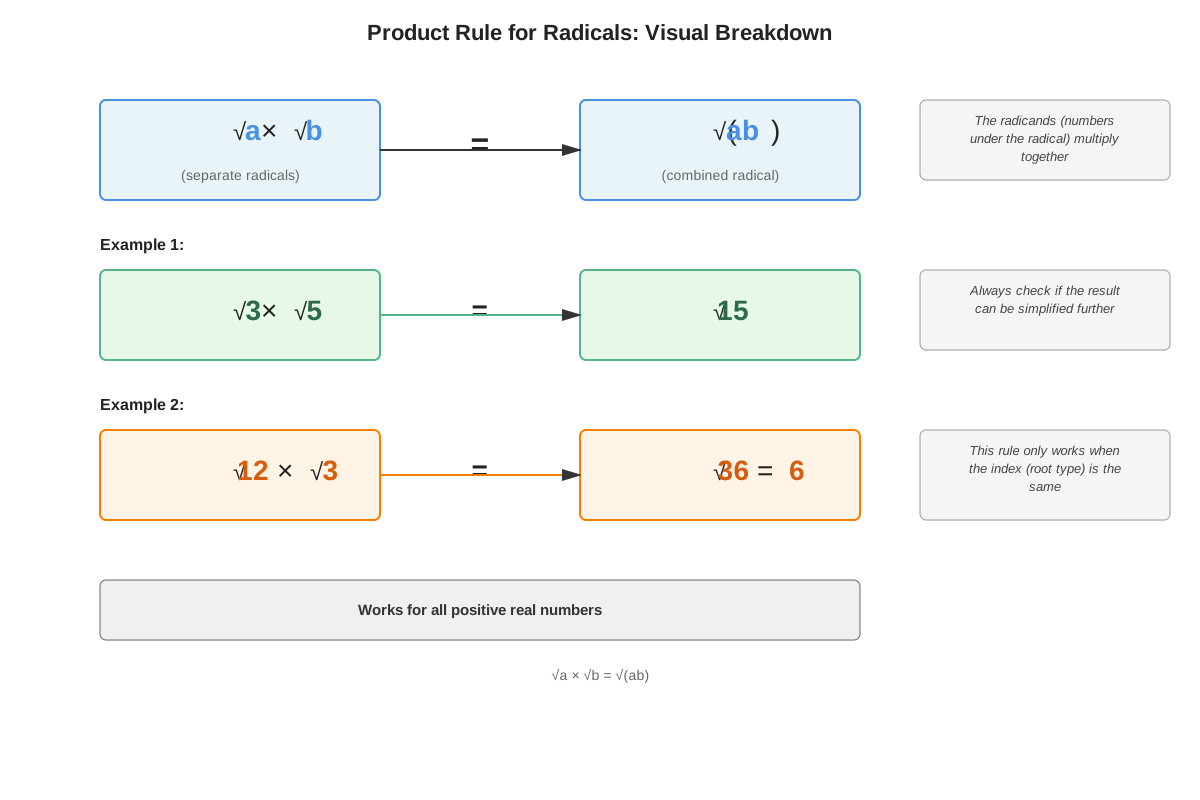
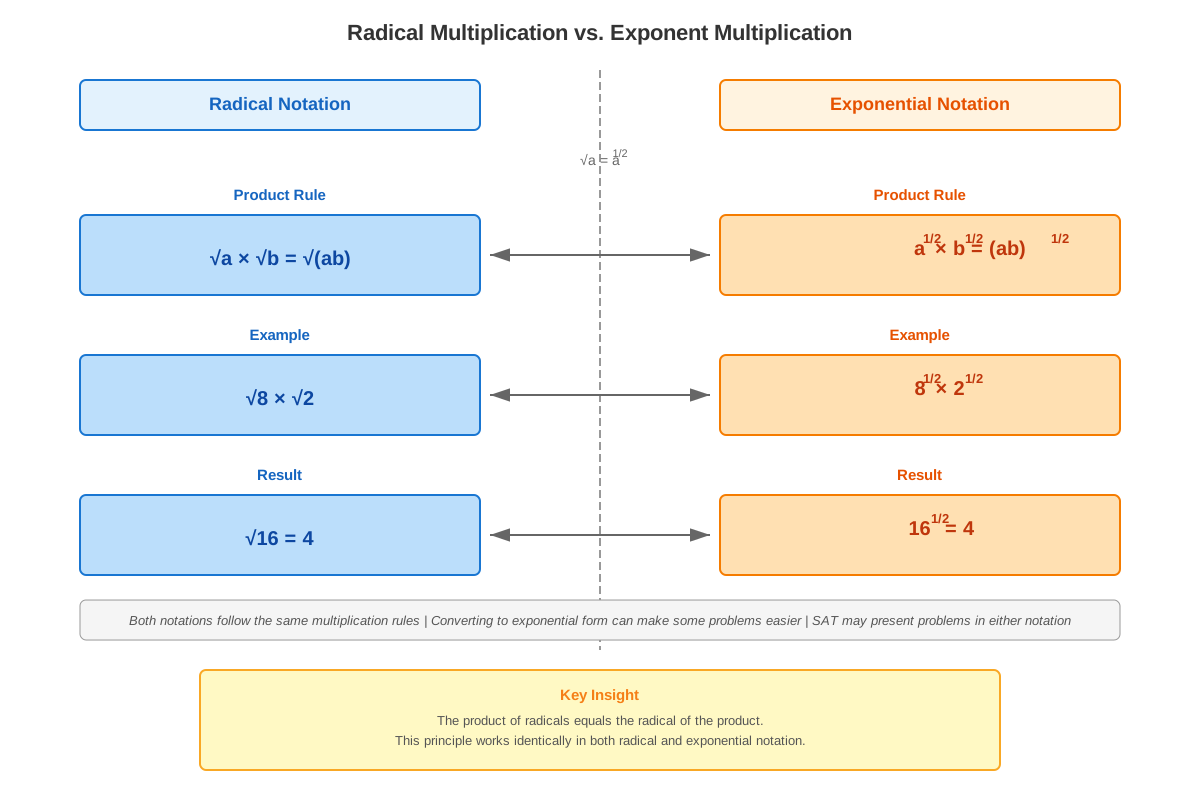
The fundamental principle underlying multiplying radicals is the product rule for radicals, which states that for non-negative real numbers a and b, √a · √b = √(ab). This rule allows students to combine two separate radical expressions into a single radical containing the product of the radicands (the numbers under the radical symbols). This property works because radicals represent fractional exponents: √a = a^(1/2), and when multiplying expressions with the same exponent, we multiply the bases and keep the exponent.
For example, √3 · √5 = √(3 · 5) = √15. Similarly, √2 · √8 = √(2 · 8) = √16 = 4. The second example demonstrates an important application: sometimes multiplying radicals produces a perfect square under the radical, allowing for complete simplification to a rational number.
The product rule extends to radicals with coefficients (numbers outside the radical). When multiplying expressions like 2√3 · 5√7, multiply the coefficients together and the radicands together separately: (2 · 5)(√3 · √7) = 10√21. This separation of coefficient multiplication and radical multiplication streamlines the calculation process and reduces errors.
Simplifying Radical Products
After multiplying radicals, the resulting expression often requires simplification. Simplifying radical products involves identifying perfect square factors within the radicand and extracting them from under the radical symbol. This process uses the reverse of the product rule: √(ab) = √a · √b, where we strategically choose a to be the largest perfect square factor.
The systematic approach to simplification follows these steps:
- Multiply the radicands to find the product under the radical
- Find the prime factorization of the resulting number
- Identify pairs of identical prime factors (which form perfect squares)
- Extract each pair as a single factor outside the radical
- Multiply all extracted factors together as the coefficient
- Leave unpaired factors under the radical
For instance, √6 · √10 = √60. The prime factorization of 60 is 2² · 3 · 5. The pair of 2s forms the perfect square 4, which extracts as 2: √60 = √(4 · 15) = 2√15.
Multiplying Radicals with Different Indices
While the SAT primarily focuses on square roots (index 2), understanding that the product rule applies only to radicals with the same index is important. √a · ∛b cannot be simplified using the basic product rule because the indices differ. However, converting to exponential notation allows multiplication: √a = a^(1/2) and ∛b = b^(1/3), so the product is a^(1/2) · b^(1/3), which generally cannot be simplified further without specific values.
For SAT purposes, nearly all problems involve square roots exclusively, but recognizing this limitation prevents errors when encountering cube roots or other radical types in more challenging problems.
Multiplying Binomial Expressions with Radicals
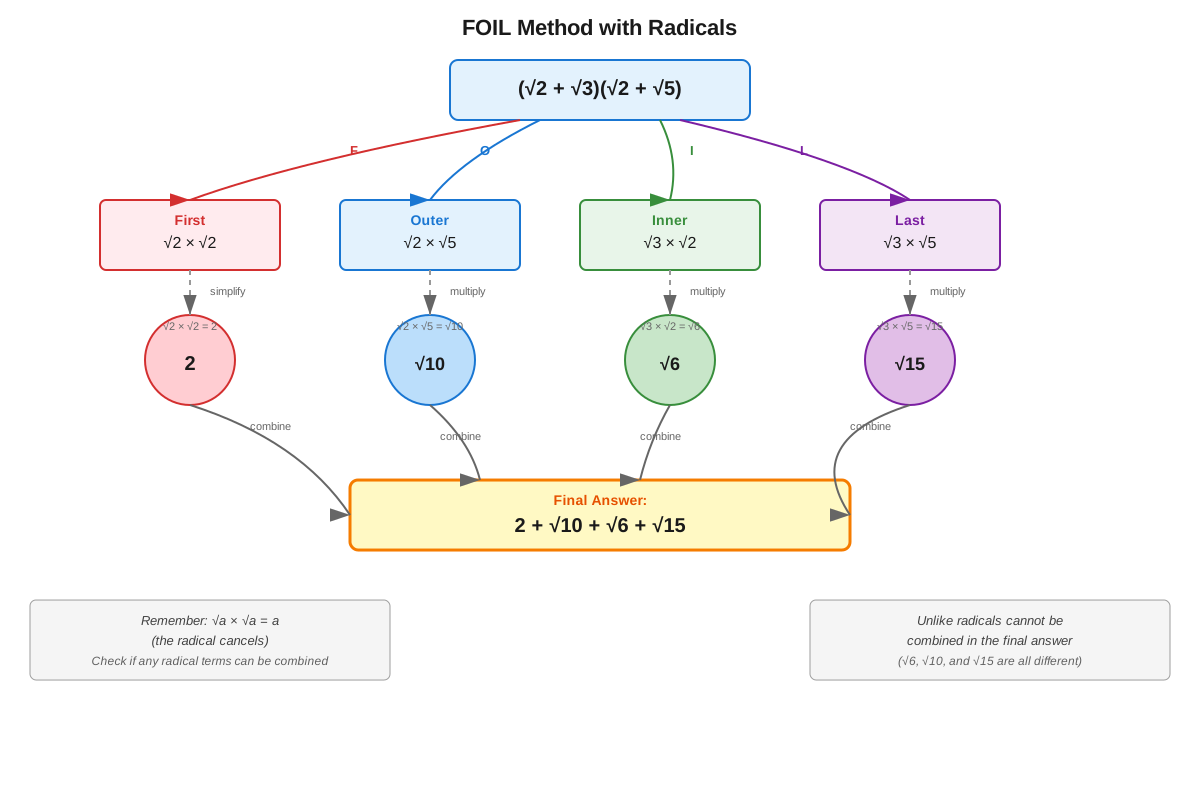
A high-yield SAT skill involves multiplying binomial expressions containing radicals, such as (a + √b)(c + √d). This operation requires applying the distributive property (often remembered as FOIL: First, Outer, Inner, Last) to multiply each term in the first binomial by each term in the second binomial.
The process follows this pattern:
(a + √b)(c + √d) = ac + a√d + c√b + √b · √d = ac + a√d + c√b + √(bd)
A particularly important case is multiplying conjugate pairs, expressions of the form (a + √b)(a - √b). This multiplication produces a rational result because the radical terms cancel:
(a + √b)(a - √b) = a² - a√b + a√b - (√b)² = a² - b
This conjugate multiplication technique is essential for rationalizing denominators, a common SAT task where students eliminate radicals from the denominator of a fraction by multiplying both numerator and denominator by the conjugate of the denominator.
Special Products and Patterns
Certain radical multiplication patterns appear frequently on the SAT and merit memorization:
| Expression Type | Example | Simplified Result |
|---|---|---|
| √a · √a | √5 · √5 | 5 |
| √a · √(a²) | √3 · √9 | 3√3 |
| (√a)² | (√7)² | 7 |
| (a√b)² | (3√2)² | 18 |
| (√a + √b)² | (√3 + √5)² | 8 + 2√15 |
| (√a - √b)² | (√7 - √2)² | 9 - 2√14 |
The squared binomial patterns deserve special attention. When squaring (a + √b), students must remember to include the middle term: (a + √b)² = a² + 2a√b + b, not simply a² + b. This is a frequent source of SAT errors.
Radical Multiplication in Geometric Contexts
The SAT often embeds radical multiplication within geometry problems. Common scenarios include:
- Area calculations: Finding the area of a rectangle with dimensions √6 and √10 requires multiplying these radicals: A = √6 · √10 = √60 = 2√15
- Pythagorean theorem applications: When a right triangle has legs of length √8 and √18, the hypotenuse is √(8 + 18) = √26, but intermediate calculations may require multiplying radicals
- Distance formula: Computing distance between points may yield radical expressions that require multiplication during simplification
These geometric applications demonstrate why radical multiplication is classified as high-importance for the SAT—it appears not only in pure algebra questions but also throughout the geometry and coordinate geometry sections.
Concept Relationships
The concepts within multiplying radicals build upon each other in a logical progression. The product rule for radicals serves as the foundation → enabling simplification of radical products → which then extends to multiplying binomial expressions with radicals → culminating in special products and conjugate multiplication. Each level requires mastery of the previous concepts while adding complexity.
Multiplying radicals connects directly to prerequisite knowledge of exponent rules because √a = a^(1/2), making radical multiplication a specific application of the rule a^m · b^m = (ab)^m. This connection also links to rational exponents, allowing students to verify radical multiplication results by converting to exponential form.
The topic relates forward to several advanced SAT concepts. Rationalizing denominators requires multiplying by conjugates, which depends on understanding conjugate multiplication patterns. Solving radical equations often involves squaring both sides, which requires facility with multiplying radical expressions. Complex numbers use similar multiplication patterns, as i = √(-1) behaves like a radical in multiplication operations.
The relationship map flows as follows:
Exponent Rules → Product Rule for Radicals → Simplifying Products → Multiplying Monomials with Radicals → Multiplying Binomials with Radicals → Conjugate Multiplication → Rationalizing Denominators → Solving Radical Equations
Quick check — test yourself on Multiplying radicals so far.
Try Flashcards →High-Yield Facts
⭐ The product rule for radicals states that √a · √b = √(ab) for all non-negative real numbers a and b
⭐ When multiplying radicals with coefficients, multiply coefficients separately from radicands: (a√b)(c√d) = ac√(bd)
⭐ Conjugate pairs (a + √b)(a - √b) always simplify to a² - b, eliminating all radical terms
⭐ Squaring a radical eliminates the radical symbol: (√a)² = a
⭐ After multiplying radicals, always check if the result can be simplified by extracting perfect square factors
- The product rule only applies to radicals with the same index (square roots with square roots, cube roots with cube roots)
- When expanding (a + √b)², the result is a² + 2a√b + b, not a² + b
- √a · √a = a, which is equivalent to (√a)²
- Multiplying a radical by itself n times is equivalent to raising it to the nth power: √a · √a · √a = (√a)³ = a^(3/2)
- The largest perfect square factor should always be extracted when simplifying radical products
- Radical multiplication is commutative: √a · √b = √b · √a
- When multiplying three or more radicals, multiply all radicands together first, then simplify: √2 · √3 · √6 = √36 = 6
- Converting radicals to exponential form (√a = a^(1/2)) can help verify multiplication results
Common Misconceptions
Misconception: √a · √b = √a + √b → Correction: The product rule states √a · √b = √(ab), not √(a + b). Multiplication of radicals requires multiplying the radicands, not adding them. For example, √4 · √9 = √36 = 6, not √13.
Misconception: (√a + √b)² = a + b → Correction: Squaring a binomial requires using the formula (x + y)² = x² + 2xy + y². Therefore, (√a + √b)² = a + 2√(ab) + b. The middle term 2√(ab) cannot be omitted. For instance, (√3 + √5)² = 3 + 2√15 + 5 = 8 + 2√15, not 8.
Misconception: √8 · √2 cannot be simplified further than √16 → Correction: √16 is a perfect square and simplifies completely to 4. Always check if the product under the radical is a perfect square that can be extracted entirely, leaving no radical in the final answer.
Misconception: 2√3 · 4√5 = 6√8 → Correction: When multiplying radicals with coefficients, multiply coefficients together (2 · 4 = 8) and radicands together (3 · 5 = 15) separately. The correct answer is 8√15. Students incorrectly add coefficients or add radicands instead of multiplying.
Misconception: √(-4) · √(-9) = √36 = 6 → Correction: The product rule √a · √b = √(ab) only applies when both a and b are non-negative. For negative radicands, the expression involves imaginary numbers: √(-4) = 2i and √(-9) = 3i, so the product is 6i² = -6, not 6.
Misconception: √12 is already in simplest form → Correction: √12 can be simplified by factoring out the perfect square 4: √12 = √(4 · 3) = 2√3. Always factor the radicand to identify and extract perfect square factors.
Misconception: (a + √b)(a - √b) = a² - b² → Correction: While the form resembles the difference of squares pattern, the correct result is a² - b (not b²), because (√b)² = b, not b². For example, (5 + √3)(5 - √3) = 25 - 3 = 22.
Worked Examples
Example 1: Simplifying a Product of Radicals with Coefficients
Problem: Simplify 3√8 · 2√18
Solution:
Step 1: Identify the coefficients and radicands separately.
- Coefficients: 3 and 2
- Radicands: 8 and 18
Step 2: Multiply the coefficients together.
- 3 · 2 = 6
Step 3: Multiply the radicands together.
- 8 · 18 = 144
Step 4: Combine the results.
- 6√144
Step 5: Simplify the radical (144 is a perfect square).
- √144 = 12
- Final answer: 6 · 12 = 72
Alternative approach: Simplify each radical before multiplying.
- 3√8 = 3√(4 · 2) = 3 · 2√2 = 6√2
- 2√18 = 2√(9 · 2) = 2 · 3√2 = 6√2
- 6√2 · 6√2 = 36 · 2 = 72
Both methods yield the same answer, demonstrating that simplification can occur before or after multiplication. This example addresses the learning objective of applying multiplying radicals to solve problems and shows how recognizing perfect squares leads to complete simplification.
Example 2: Expanding a Binomial Product with Radicals
Problem: Expand and simplify (3 + √5)(2 - √5)
Solution:
Step 1: Apply the distributive property (FOIL method).
- First: 3 · 2 = 6
- Outer: 3 · (-√5) = -3√5
- Inner: √5 · 2 = 2√5
- Last: √5 · (-√5) = -√25 = -5
Step 2: Combine all terms.
- 6 - 3√5 + 2√5 - 5
Step 3: Combine like terms (constants together, radical terms together).
- Constants: 6 - 5 = 1
- Radical terms: -3√5 + 2√5 = -√5
Step 4: Write the final simplified expression.
- 1 - √5 or simply 1 - √5
Key insight: Notice that this is not a conjugate pair (which would be (3 + √5)(3 - √5)), so the radical terms do not completely cancel. The result still contains a radical term. This example demonstrates the learning objective of multiplying binomial expressions containing radicals and shows the importance of carefully combining like terms.
SAT Connection: This type of problem frequently appears in the no-calculator section, testing whether students can accurately expand and simplify without computational aids. The answer choices typically include common errors like forgetting the middle terms or incorrectly simplifying √5 · √5.
Exam Strategy
When approaching SAT questions on multiplying radicals, begin by identifying whether the problem requires direct multiplication or is embedded within a larger algebraic or geometric context. Look for trigger phrases such as "simplify," "which expression is equivalent to," "rationalize the denominator," or "find the area" in geometry problems with radical dimensions.
Time-saving strategy: Before multiplying, check if either radical can be simplified first. Simplifying √18 to 3√2 before multiplying by another radical often makes the subsequent multiplication easier and reduces the chance of arithmetic errors with large numbers. However, if both radicals are already in simplest form, multiply the radicands directly and simplify the result.
Process of elimination tips: When answer choices are given, eliminate options that violate basic radical properties. If you're multiplying two radicals and all terms are positive, eliminate any answer choice with a negative coefficient. If you're multiplying radicals with small radicands (like √2 · √3), eliminate answer choices with large radicands that couldn't result from that multiplication. Check whether the answer should contain a radical at all—multiplying √4 · √9 should yield a rational number (6), so eliminate choices with radicals.
Calculator usage: On calculator-permitted sections, verify your simplified radical answer by computing the decimal approximation. For example, if you simplified √6 · √10 to 2√15, check that both expressions equal approximately 7.746. However, never leave a decimal answer when the question asks for exact form—the SAT expects simplified radical notation.
Common question formats:
- Direct simplification: "Simplify √12 · √27" → multiply radicands, then simplify
- Equivalence: "Which expression is equivalent to (√3 + 2)(√3 - 5)?" → expand using FOIL
- Rationalization: "Rationalize the denominator of 6/(2 + √3)" → multiply by conjugate (2 - √3)/(2 - √3)
- Geometric application: "A rectangle has dimensions √8 by √18. What is its area?" → multiply radicals
Time allocation: Straightforward radical multiplication should take 30-45 seconds. Binomial expansion with radicals may require 60-90 seconds. If a problem is taking longer, mark it for review and move forward—these problems rarely require more than basic application of the product rule and simplification.
Memory Techniques
Mnemonic for the Product Rule: "Radicals Multiply Inside" (RMI) - When multiplying radicals, the Radicands Multiply Inside a single radical: √a · √b = √(ab).
Conjugate Pattern Visualization: Picture conjugates as "radical opposites" that cancel each other out. Visualize (a + √b)(a - √b) as two terms that "hug" the radical terms away, leaving only a² - b. The middle terms always cancel because they're opposites: +a√b and -a√b.
FOIL Reminder for Radicals: Use the acronym FOIL (First, Outer, Inner, Last), but add S for Simplify: FOILS. This reminds students that after expanding, they must simplify by combining like terms and extracting perfect squares.
Perfect Square Recognition: Memorize perfect squares up to 225 (15²) to quickly identify simplification opportunities:
- 1, 4, 9, 16, 25, 36, 49, 64, 81, 100, 121, 144, 169, 196, 225
Coefficient-Radicand Separation: Think "Coefficients Outside, Radicands Inside" (CORI). When multiplying expressions like 3√5 · 4√7, multiply Coefficients Outside (3 · 4 = 12) and Radicands Inside (√5 · √7 = √35) separately.
Squaring Radicals: Remember "Square Kills Radical" (SKR) - Squaring a square root eliminates the radical symbol: (√a)² = a. This works because the square and square root are inverse operations.
Summary
Multiplying radicals is a high-yield SAT math topic that requires understanding the product rule (√a · √b = √(ab)), systematic simplification by extracting perfect square factors, and the ability to multiply binomial expressions containing radicals. Success on SAT questions depends on recognizing that coefficients and radicands multiply separately, that conjugate pairs eliminate radical terms, and that simplification should always follow multiplication. The most common question types involve direct simplification of radical products, expansion of binomial expressions using the distributive property, and geometric applications requiring area or distance calculations with radical dimensions. Students must avoid common errors such as adding instead of multiplying radicands, forgetting middle terms when squaring binomials, and failing to simplify results by extracting perfect squares. Mastery requires both procedural fluency with the multiplication algorithms and conceptual understanding of why these rules work, connecting back to exponent properties and the definition of radicals as fractional powers. The ability to multiply radicals efficiently and accurately is essential not only for dedicated radical questions but also for success on problems involving the Pythagorean theorem, rationalizing denominators, and solving radical equations throughout the SAT math section.
Key Takeaways
- The product rule √a · √b = √(ab) is the foundation for all radical multiplication and applies only when both radicands are non-negative
- Always multiply coefficients separately from radicands: (a√b)(c√d) = ac√(bd)
- After multiplying radicals, simplify by factoring out perfect squares from the radicand
- Conjugate pairs (a + √b)(a - √b) always simplify to a² - b, completely eliminating radical terms
- When expanding binomials with radicals, use FOIL and remember that (√a + √b)² = a + 2√(ab) + b, not a + b
- Squaring a radical eliminates the radical symbol: (√a)² = a
- Radical multiplication appears frequently on the SAT in both pure algebra questions and geometric applications, making it essential for achieving a high math score
Related Topics
Simplifying Radicals: Before multiplying radicals effectively, students must master simplifying individual radical expressions by extracting perfect square factors. This foundational skill makes radical multiplication more efficient and accurate.
Rationalizing Denominators: This advanced application of radical multiplication requires multiplying by conjugates to eliminate radicals from denominators, directly building on conjugate multiplication patterns learned in this topic.
Solving Radical Equations: Equations containing radicals often require multiplying radical expressions as an intermediate step, and solving them involves squaring both sides, which requires facility with multiplying radical expressions.
The Pythagorean Theorem: Many geometry problems yield radical answers that must be multiplied when calculating areas or comparing distances, making radical multiplication essential for geometric applications.
Complex Numbers: The imaginary unit i = √(-1) behaves similarly to radicals in multiplication, and many complex number operations parallel radical multiplication techniques, making this topic excellent preparation for advanced algebra.
Practice CTA
Now that you've mastered the core concepts of multiplying radicals, it's time to solidify your understanding through active practice. Attempt the practice questions to test your ability to apply these techniques under exam-like conditions, and use the flashcards to reinforce the key rules and patterns until they become automatic. Remember, the SAT rewards both accuracy and speed—consistent practice with these high-yield problems will build the confidence and fluency you need to excel on test day. Every problem you solve correctly strengthens your mathematical foundation and brings you closer to your target score!
Sign up free to keep reading
Create a free AnvayaPrep account to finish this SAT guide on Multiplying radicals — plus flashcards and practice questions.