Overview
The zero exponent rule is one of the most fundamental and frequently tested concepts in SAT math, appearing in multiple question types across both the calculator and no-calculator sections. This rule states that any nonzero base raised to the power of zero equals one: a⁰ = 1 (where a ≠ 0). While this may seem counterintuitive at first, understanding why this rule exists and how to apply it correctly is essential for solving exponential equations, simplifying algebraic expressions, and working with polynomial functions on the exam.
The SAT zero exponent concept appears in approximately 10-15% of algebra and exponent-related questions, making it a high-yield topic that demands thorough understanding. Students who master this concept gain a significant advantage when tackling complex algebraic manipulations, scientific notation problems, and function evaluation questions. The College Board frequently embeds zero exponent problems within multi-step questions, requiring students to recognize when and how to apply this rule as part of a larger solution strategy.
Understanding the zero exponent connects directly to broader mathematical principles including the laws of exponents, polynomial behavior, and algebraic simplification. This topic serves as a bridge between basic arithmetic operations and more advanced concepts like exponential functions, logarithms, and rational expressions. Mastery of the zero exponent rule enables students to confidently approach questions involving variable expressions, equation solving, and function analysis—all critical components of SAT success.
Learning Objectives
- [ ] Identify key features of zero exponent and recognize when it applies in mathematical expressions
- [ ] Explain how zero exponent appears on the SAT in various question formats and contexts
- [ ] Apply zero exponent to answer SAT-style questions accurately and efficiently
- [ ] Derive the zero exponent rule using the quotient rule for exponents to understand its logical foundation
- [ ] Distinguish between expressions where the zero exponent rule applies and special cases where it does not
- [ ] Simplify complex algebraic expressions containing multiple terms with zero exponents
- [ ] Evaluate functions and expressions at specific values that result in zero exponents
Prerequisites
- Basic exponent notation and terminology: Understanding that exponents represent repeated multiplication is essential for grasping why the zero exponent rule works as it does
- Laws of exponents (product rule, quotient rule, power rule): The zero exponent rule derives logically from the quotient rule, making prior knowledge of exponent laws necessary
- Order of operations (PEMDAS): Correctly evaluating expressions with zero exponents requires knowing when to apply the exponent before other operations
- Variable manipulation and algebraic expressions: Many SAT questions embed zero exponents within variable expressions requiring algebraic simplification skills
- Understanding of the number one as the multiplicative identity: Recognizing that multiplying by one leaves values unchanged helps explain why any nonzero number to the zero power equals one
Why This Topic Matters
The zero exponent rule has practical applications across science, engineering, and finance. In scientific notation, the zero exponent represents quantities at the baseline scale (10⁰ = 1), which is fundamental for unit conversions and dimensional analysis. Computer scientists use zero exponents in binary systems and algorithmic complexity analysis. Financial analysts apply this concept when calculating compound interest over zero time periods or evaluating investment returns at the initial moment.
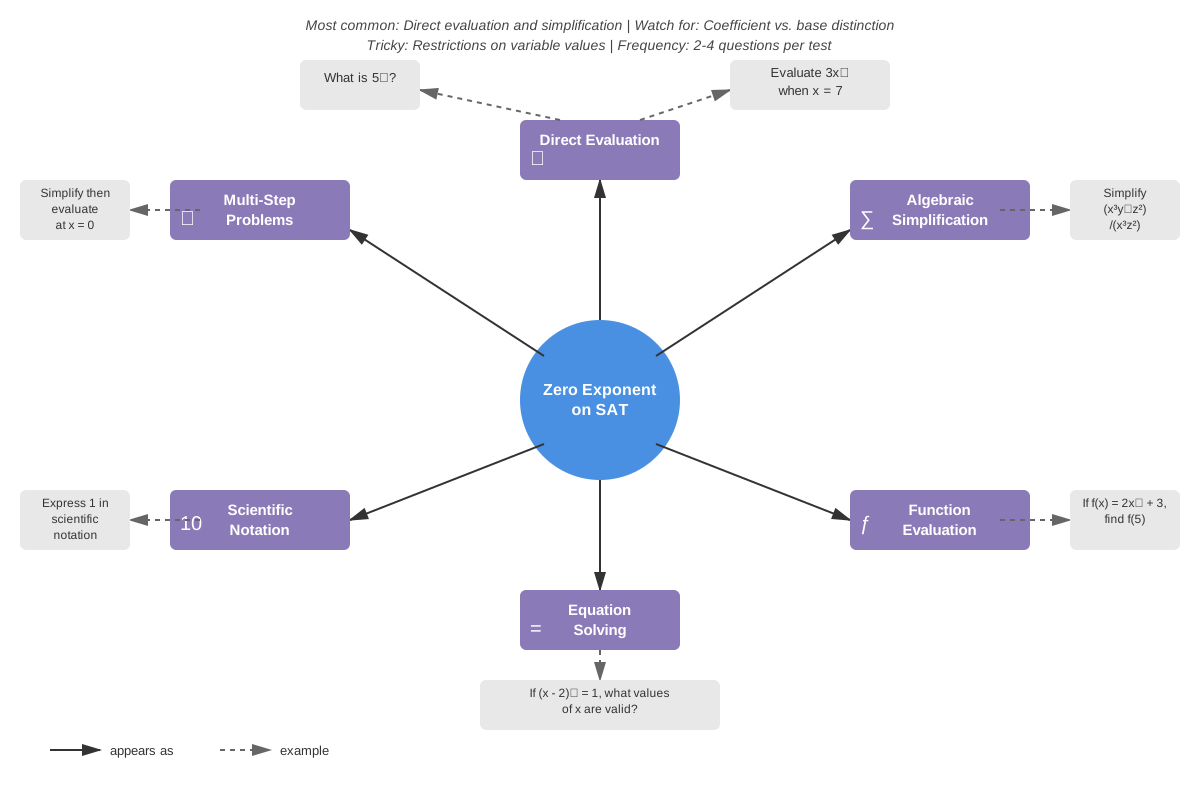
On the SAT, zero exponent questions appear in approximately 2-4 questions per test administration, representing roughly 3-7% of the total math score. These questions manifest in several formats: direct evaluation problems asking students to simplify expressions like (5x³y⁰), equation-solving questions where setting exponents equal to zero becomes necessary, function evaluation problems requiring substitution that produces zero exponents, and multi-step algebraic simplification requiring recognition of zero exponent opportunities. The College Board particularly favors embedding zero exponent concepts within more complex problems involving polynomial expressions, rational functions, and systems of equations.
Common question types include: simplifying expressions with multiple variables where some have zero exponents; evaluating functions at specific values that create zero exponents; solving equations by recognizing that certain terms simplify to one; comparing expressions where zero exponents affect the relative magnitude; and word problems involving exponential decay or growth where time equals zero represents the initial condition. Understanding this topic thoroughly can add 20-40 points to a student's math score by preventing careless errors and enabling faster problem-solving.
Core Concepts
The Zero Exponent Rule
The zero exponent rule states that any nonzero number or variable raised to the power of zero equals one. Mathematically expressed: a⁰ = 1, where a ≠ 0. This rule applies universally to positive numbers, negative numbers, fractions, decimals, and algebraic variables—with the critical exception that the base cannot be zero itself.
For example:
- 5⁰ = 1
- (-3)⁰ = 1
- (1/2)⁰ = 1
- (x)⁰ = 1 (assuming x ≠ 0)
- (2x³y⁵)⁰ = 1
The rule applies regardless of how complex the base expression is, as long as the entire expression is raised to the zero power and the base is nonzero.
Derivation Using the Quotient Rule
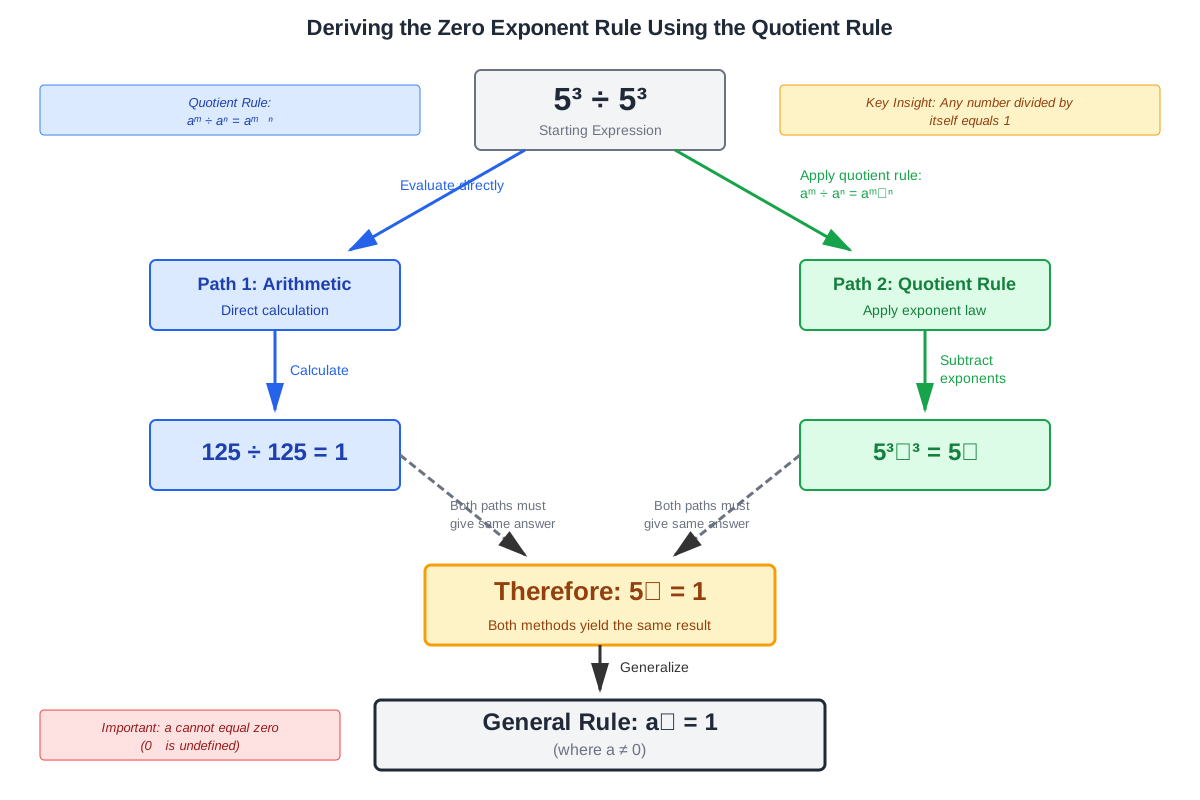
Understanding why the zero exponent rule works helps prevent confusion and builds mathematical intuition. The rule derives logically from the quotient rule for exponents, which states that when dividing like bases, we subtract exponents: aᵐ ÷ aⁿ = aᵐ⁻ⁿ.
Consider the expression a³ ÷ a³:
- Using basic arithmetic: a³ ÷ a³ = 1 (any nonzero number divided by itself equals one)
- Using the quotient rule: a³ ÷ a³ = a³⁻³ = a⁰
Since both approaches must yield the same result, we conclude that a⁰ = 1. This derivation works for any positive integer exponent, establishing the zero exponent rule as a logical consequence of the fundamental laws of exponents rather than an arbitrary definition.
The Special Case: 0⁰
The expression 0⁰ is undefined in standard mathematics and does not equal one. This represents an indeterminate form because two mathematical principles conflict:
- Following the zero exponent rule would suggest 0⁰ = 1
- Following the principle that zero raised to any positive power equals zero would suggest 0⁰ = 0
On the SAT, questions are carefully constructed to avoid this ambiguity. When variables appear with zero exponents, the test either explicitly states the variable is nonzero or the context makes this clear. Students should remember that the zero exponent rule applies only to nonzero bases.
Applying the Zero Exponent in Complex Expressions
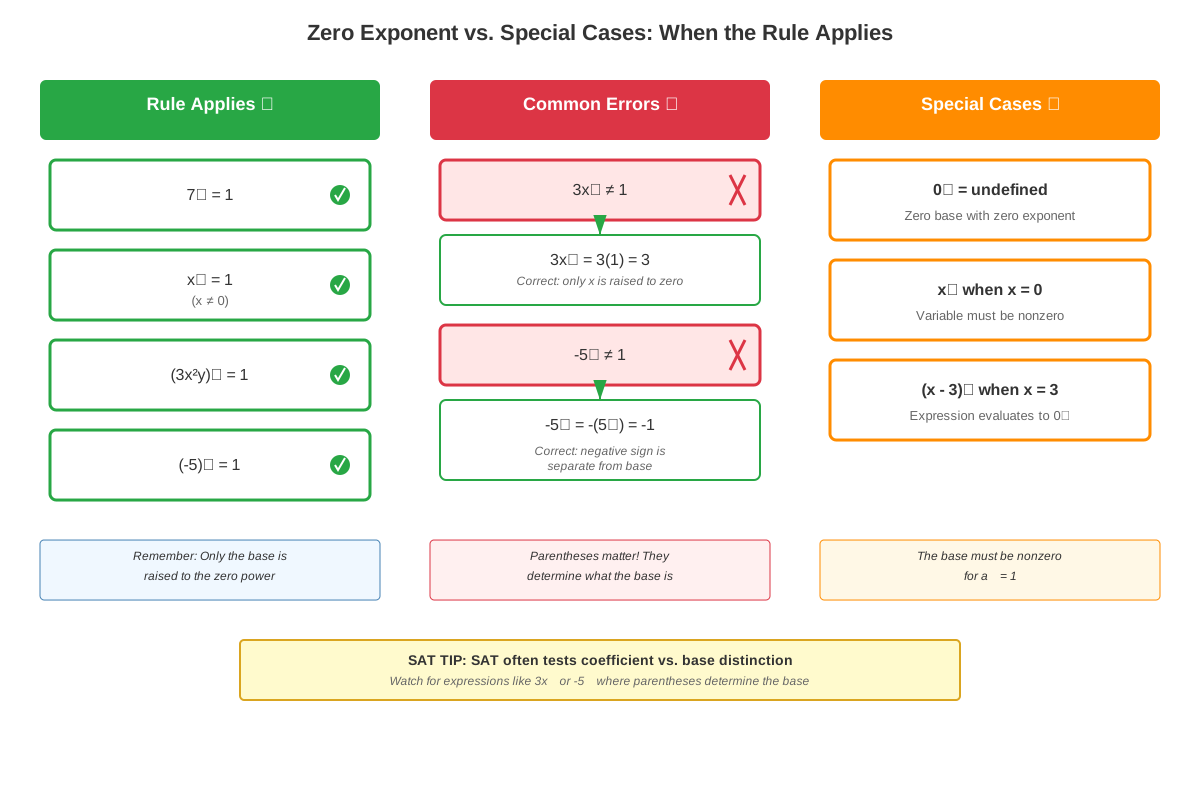
When the zero exponent appears in multi-term expressions, careful attention to what exactly is being raised to the zero power is essential. The exponent applies only to its immediate base unless parentheses indicate otherwise.
Consider these distinctions:
| Expression | Evaluation | Explanation |
|---|---|---|
| 3x⁰ | 3(1) = 3 | Only x is raised to zero; 3 is a coefficient |
| (3x)⁰ | 1 | The entire quantity 3x is raised to zero |
| 3x⁰y² | 3(1)y² = 3y² | Only x is raised to zero |
| -5⁰ | -1 | Only 5 is raised to zero; negative sign remains |
| (-5)⁰ | 1 | The entire quantity -5 is raised to zero |
This distinction is frequently tested on the SAT, as it requires careful reading and understanding of mathematical notation conventions.
Zero Exponents in Equations
When solving equations, recognizing opportunities to apply the zero exponent rule can simplify the solution process dramatically. If both sides of an equation can be expressed with the same base, setting exponents equal becomes a powerful strategy.
For example, to solve 2ˣ = 1:
- Recognize that 1 = 2⁰
- Therefore: 2ˣ = 2⁰
- By equality of exponents: x = 0
This technique extends to more complex equations involving variables in both the base and exponent positions.
Combining Zero Exponents with Other Exponent Rules
The zero exponent rule works in conjunction with all other exponent laws. When simplifying expressions, apply the rules in the correct order:
- Product rule: aᵐ · aⁿ = aᵐ⁺ⁿ
- Quotient rule: aᵐ ÷ aⁿ = aᵐ⁻ⁿ
- Power rule: (aᵐ)ⁿ = aᵐⁿ
- Zero exponent: a⁰ = 1
- Negative exponent: a⁻ⁿ = 1/aⁿ
For example, simplifying (x⁵ · x⁻⁵)²:
- Step 1: Apply product rule: x⁵⁺⁽⁻⁵⁾ = x⁰
- Step 2: Apply zero exponent: (x⁰)² = (1)² = 1
Alternatively, applying the power rule first: (x⁵)² · (x⁻⁵)² = x¹⁰ · x⁻¹⁰ = x⁰ = 1
Both approaches yield the same result, demonstrating the consistency of exponent laws.
Concept Relationships
The zero exponent rule connects intimately with all other exponent laws, forming part of a unified system of rules governing exponential expressions. The quotient rule directly produces the zero exponent rule when the numerator and denominator have equal exponents. The product rule can create zero exponents when positive and negative exponents of equal magnitude combine (a³ · a⁻³ = a⁰ = 1).
The relationship flows as follows: Basic exponent definition (repeated multiplication) → Product and quotient rules → Zero exponent rule → Negative exponent rule → Rational exponent rule. Each rule builds logically on previous ones, creating a coherent mathematical framework.
The zero exponent also connects to polynomial functions and their behavior. When evaluating polynomials at specific values, zero exponents frequently appear in the constant term. For instance, the general polynomial P(x) = aₙxⁿ + aₙ₋₁xⁿ⁻¹ + ... + a₁x¹ + a₀x⁰ shows that the constant term a₀ is actually multiplied by x⁰, which equals one, explaining why constant terms remain constant regardless of x.
In exponential functions like f(x) = abˣ, the y-intercept occurs at x = 0, where f(0) = ab⁰ = a(1) = a. This demonstrates how the zero exponent determines the initial value of exponential models, connecting to real-world applications in population growth, radioactive decay, and compound interest.
The concept also relates to scientific notation, where 10⁰ = 1 represents the baseline scale. Numbers between 1 and 10 are expressed as coefficients times 10⁰, bridging the gap between very large and very small quantities.
High-Yield Facts
⭐ Any nonzero number or variable raised to the zero power equals exactly one: a⁰ = 1 (where a ≠ 0)
⭐ The expression 0⁰ is undefined and will not appear as a valid answer choice on the SAT
⭐ Only the immediate base is affected by the zero exponent unless parentheses indicate otherwise: 5x⁰ = 5(1) = 5, but (5x)⁰ = 1
⭐ The zero exponent rule applies to entire expressions in parentheses: (3x²y⁵z)⁰ = 1, regardless of complexity
⭐ Negative signs outside parentheses are not affected by the zero exponent: -7⁰ = -(7⁰) = -1, but (-7)⁰ = 1
- The zero exponent rule derives from the quotient rule: aⁿ ÷ aⁿ = aⁿ⁻ⁿ = a⁰ = 1
- When solving exponential equations, if one side equals 1, consider expressing it as a base to the zero power
- The zero exponent can appear in polynomial expressions, where x⁰ terms represent constants
- In function notation, f(0) for exponential functions f(x) = abˣ always equals a because b⁰ = 1
- Combining a positive and negative exponent of equal magnitude produces a zero exponent: x³ · x⁻³ = x⁰ = 1
- The zero exponent rule applies to fractional and decimal bases: (0.5)⁰ = 1 and (3/4)⁰ = 1
- Variables with zero exponents can be eliminated from expressions during simplification: 7x⁰y³ = 7y³
- The zero exponent appears in the binomial theorem when expanding (a + b)ⁿ at the first and last terms
- In exponential growth/decay models, t = 0 represents the initial condition where the exponential factor equals one
- The zero exponent rule is tested both directly (simplify this expression) and indirectly (embedded in multi-step problems)
Quick check — test yourself on Zero exponent so far.
Try Flashcards →Common Misconceptions
Misconception: Any number raised to the zero power equals zero because "zero times anything is zero."
Correction: The zero exponent does not mean multiplication by zero; it results from the quotient rule (aⁿ ÷ aⁿ = 1) and always equals one for nonzero bases. The exponent zero represents the number of times to multiply, not a multiplication factor.
Misconception: The expression 0⁰ equals 1 because the zero exponent rule applies to all numbers.
Correction: The expression 0⁰ is undefined (indeterminate) because it creates a conflict between two mathematical principles. The zero exponent rule explicitly requires a nonzero base. SAT questions avoid this ambiguity entirely.
Misconception: In the expression 4x⁰, both the 4 and x are raised to the zero power, so the answer is 1.
Correction: Only the immediate base (x) is raised to the zero power unless parentheses indicate otherwise. The expression 4x⁰ = 4(x⁰) = 4(1) = 4. To raise both to zero power, parentheses are required: (4x)⁰ = 1.
Misconception: The expression -3⁰ equals 1 because -3 is the base.
Correction: Without parentheses, only the 3 is raised to the zero power, and the negative sign remains: -3⁰ = -(3⁰) = -1. To raise the entire negative number to zero power, use parentheses: (-3)⁰ = 1.
Misconception: When simplifying x⁰ + y⁰, the answer is 1 because both terms have zero exponents.
Correction: Each term with a zero exponent equals 1 separately, so x⁰ + y⁰ = 1 + 1 = 2. The zero exponent rule applies to each term individually, not to the sum.
Misconception: The zero exponent rule only applies to positive integers as bases.
Correction: The rule applies to all nonzero real numbers including negative numbers, fractions, decimals, and irrational numbers: (-5)⁰ = 1, (2/3)⁰ = 1, (π)⁰ = 1, and (√2)⁰ = 1.
Misconception: In the expression (x²)⁰, you should first square x, then raise the result to zero.
Correction: While this approach works, it's more efficient to recognize that any expression in parentheses raised to zero equals 1 immediately: (x²)⁰ = 1, regardless of what x equals (assuming x ≠ 0).
Worked Examples
Example 1: Simplifying Complex Expressions with Zero Exponents
Problem: Simplify the expression: 3(2x³y⁰)² + 5x⁶ - (4x³)⁰
Solution:
Step 1: Identify all terms with zero exponents.
- The term y⁰ within the first expression
- The entire term (4x³)⁰
Step 2: Apply the zero exponent rule to y⁰.
- Since y⁰ = 1, the expression becomes: 3(2x³ · 1)² + 5x⁶ - (4x³)⁰
- Simplify: 3(2x³)² + 5x⁶ - (4x³)⁰
Step 3: Apply the power rule to (2x³)².
- (2x³)² = 2² · (x³)² = 4x⁶
- Expression becomes: 3(4x⁶) + 5x⁶ - (4x³)⁰
Step 4: Apply the zero exponent rule to (4x³)⁰.
- (4x³)⁰ = 1 (the entire expression in parentheses equals 1)
- Expression becomes: 12x⁶ + 5x⁶ - 1
Step 5: Combine like terms.
- 12x⁶ + 5x⁶ = 17x⁶
- Final answer: 17x⁶ - 1
Connection to learning objectives: This problem demonstrates identifying where zero exponents appear (Objective 1), applying the rule correctly in multi-step simplification (Objective 3), and distinguishing between cases where the exponent applies to a single variable versus an entire expression (Objective 5).
Example 2: Solving Equations Using Zero Exponents
Problem: If 3ˣ⁺² = 9 and 2ʸ⁻¹ = 1, what is the value of x + y?
Solution:
Step 1: Solve for x using the first equation 3ˣ⁺² = 9.
- Express 9 as a power of 3: 9 = 3²
- Equation becomes: 3ˣ⁺² = 3²
- Since the bases are equal, the exponents must be equal: x + 2 = 2
- Solve for x: x = 0
Step 2: Solve for y using the second equation 2ʸ⁻¹ = 1.
- Recognize that 1 can be expressed as any nonzero number to the zero power
- Express 1 as a power of 2: 1 = 2⁰
- Equation becomes: 2ʸ⁻¹ = 2⁰
- Since the bases are equal, the exponents must be equal: y - 1 = 0
- Solve for y: y = 1
Step 3: Calculate x + y.
- x + y = 0 + 1 = 1
- Final answer: 1
Connection to learning objectives: This problem illustrates how zero exponents appear in SAT equation-solving contexts (Objective 2), requires recognizing that 1 equals any base to the zero power (Objective 1), and demonstrates applying the zero exponent rule to solve equations efficiently (Objective 3).
Example 3: Function Evaluation with Zero Exponents
Problem: If f(x) = 5x³ - 2x² + 7x⁰ - 3, what is f(0)?
Solution:
Step 1: Recognize that x⁰ = 1 regardless of what value x takes (as long as x ≠ 0 in the original expression, but for polynomial evaluation, the constant term is simply 7).
- The term 7x⁰ = 7(1) = 7 for any nonzero x
- This term represents the constant 7 in the polynomial
Step 2: Substitute x = 0 into the function.
- f(0) = 5(0)³ - 2(0)² + 7(0)⁰ - 3
Step 3: Evaluate each term.
- 5(0)³ = 5(0) = 0
- 2(0)² = 2(0) = 0
- 7(0)⁰: Here we must be careful. In the context of polynomial functions, the term 7x⁰ is understood as the constant 7, so this equals 7
- The constant term -3 remains -3
Step 4: Combine all terms.
- f(0) = 0 - 0 + 7 - 3 = 4
- Final answer: 4
Note: This problem highlights an important subtlety. While 0⁰ is technically undefined, in polynomial expressions like 7x⁰, we interpret this as the constant term 7, which remains 7 even when x = 0. The SAT constructs problems to avoid the 0⁰ ambiguity.
Connection to learning objectives: This example shows how zero exponents appear in function notation (Objective 2), requires careful evaluation of expressions containing zero exponents (Objective 6), and demonstrates the relationship between zero exponents and constant terms in polynomials (Objective 1).
Exam Strategy
When approaching SAT questions involving zero exponents, begin by scanning the entire expression for any exponent that equals zero or any situation where exponents might simplify to zero through addition or subtraction. Trigger phrases to watch for include: "simplify the expression," "evaluate when x = 0," "what is the value of," and "which expression is equivalent to."
Process-of-elimination strategy: If answer choices contain different numerical values, quickly evaluate any zero exponents first, as these immediately simplify to 1 and can help eliminate incorrect options. For example, if one answer choice is 5x⁰y² and another is 5y², recognize these are equivalent (both equal 5y²) and eliminate any other options that don't match.
Time allocation: Zero exponent questions typically require 30-60 seconds when they appear as direct simplification problems. However, when embedded in multi-step problems, allocate 90-120 seconds. Don't rush—careful attention to parentheses and what exactly is raised to the zero power prevents careless errors worth valuable points.
Common trap patterns: The SAT frequently tests whether students correctly apply the zero exponent only to the immediate base. When you see expressions like 3x⁰, pause and verify whether parentheses are present. Without parentheses, only x is raised to zero (answer: 3). With parentheses (3x)⁰, the entire expression is raised to zero (answer: 1). This distinction appears in approximately 40% of zero exponent questions.
Strategic approach for equation solving: When an equation contains the number 1, immediately consider whether expressing it as a base to the zero power would help. For example, if you see 5ˣ = 1, recognize that 1 = 5⁰, so x = 0. This technique saves time compared to taking logarithms or testing values.
Calculator usage: For calculator-permitted sections, verify your simplified expressions by substituting a specific nonzero value (like x = 2) into both the original and simplified expressions. If they yield the same numerical result, your simplification is likely correct. However, don't rely solely on this method—understanding the concept prevents errors on no-calculator sections.
Memory Techniques
Primary mnemonic for the zero exponent rule: "Zero exponent? One is the answer!" The letters Z-O help recall that zero exponent yields one.
Visualization strategy: Picture a fraction where the numerator and denominator are identical: a³/a³. Visually, everything cancels to give 1. Now apply the quotient rule: a³⁻³ = a⁰. Since both approaches give the same result, a⁰ must equal 1. This mental image reinforces why the rule works.
Acronym for checking parentheses: BOPE - Base, Only, Parentheses, Everything
- Base: Identify what the base is
- Only: Only the immediate base is affected
- Parentheses: Check if parentheses are present
- Everything: With parentheses, everything inside is raised to the power
Rhyme for the special case: "Zero to zero? Don't be a hero! That's undefined, keep that in mind."
Finger counting technique: When simplifying expressions with multiple zero exponents, use your fingers to count how many separate terms equal 1. For example, in x⁰ + y⁰ + z⁰, count three fingers (three terms), so the answer is 3. This prevents the error of thinking the entire expression equals 1.
Color-coding strategy for practice: When working through practice problems, use different colors to highlight: (1) bases in blue, (2) exponents in red, and (3) parentheses in green. This visual system trains your eye to quickly identify what's being raised to the zero power.
Summary
The zero exponent rule—stating that any nonzero base raised to the power of zero equals one—is a fundamental concept tested frequently on the SAT math section. This rule derives logically from the quotient rule for exponents and applies universally to all nonzero real numbers, whether positive, negative, fractional, or irrational. Critical to success is distinguishing between expressions where only the immediate base is raised to zero (3x⁰ = 3) versus those where parentheses indicate the entire expression is raised to zero ((3x)⁰ = 1). The special case 0⁰ remains undefined and does not appear in valid SAT questions. Students must recognize zero exponents in various contexts: direct simplification problems, equation solving where 1 is expressed as a base to the zero power, function evaluation at x = 0, and multi-step algebraic manipulations. Mastery requires understanding not just the rule itself but also how it integrates with other exponent laws and appears across different question formats. The ability to quickly and accurately apply this rule, particularly when embedded in complex expressions, directly impacts SAT math performance.
Key Takeaways
- Any nonzero number or variable raised to the zero power always equals 1: a⁰ = 1 (where a ≠ 0)
- Parentheses determine scope: Without parentheses, only the immediate base is affected (5x⁰ = 5); with parentheses, the entire expression is raised to zero ((5x)⁰ = 1)
- The expression 0⁰ is undefined and will not appear as a correct answer on the SAT
- The zero exponent rule derives from the quotient rule: aⁿ ÷ aⁿ = 1 and also equals aⁿ⁻ⁿ = a⁰, therefore a⁰ = 1
- Negative signs require careful attention: -5⁰ = -1 (only 5 is raised to zero), but (-5)⁰ = 1 (entire negative number is raised to zero)
- Zero exponents appear in multiple SAT contexts: direct simplification, equation solving, function evaluation, and polynomial expressions
- Strategic recognition saves time: When you see 1 in an equation, consider expressing it as a base to the zero power to solve efficiently
Related Topics
Negative Exponents: After mastering zero exponents, negative exponents represent the next logical progression. Understanding that a⁻ⁿ = 1/aⁿ builds on the quotient rule foundation and extends the exponent system to all integers. This topic appears frequently alongside zero exponents in SAT questions.
Rational Exponents and Radicals: Fractional exponents like a^(1/2) = √a extend the exponent system further. Mastery of zero exponents provides the foundation for understanding how all exponent values—positive, negative, zero, and fractional—form a coherent mathematical system.
Exponential Functions: Functions of the form f(x) = abˣ rely heavily on the zero exponent rule to determine y-intercepts and initial values. Understanding that f(0) = a because b⁰ = 1 is essential for graphing and analyzing exponential models.
Polynomial Functions and Behavior: Recognizing that constant terms in polynomials are actually coefficients of x⁰ deepens understanding of polynomial structure and helps with operations like addition, subtraction, and evaluation.
Scientific Notation: The expression 10⁰ = 1 serves as the baseline in scientific notation, bridging the gap between large and small quantities. This application appears in both math and science contexts on the SAT.
Practice CTA
Now that you've mastered the zero exponent rule and its applications, it's time to solidify your understanding through active practice. Attempt the practice questions designed specifically for this topic, focusing on the various contexts where zero exponents appear—from direct simplification to embedded multi-step problems. Use the flashcards to reinforce the key facts and common misconceptions until recognizing and applying the zero exponent rule becomes automatic. Remember, the difference between a good SAT math score and a great one often comes down to mastery of fundamental concepts like this one. Every practice problem you complete builds the confidence and speed you'll need on test day. You've got this!
Sign up free to keep reading
Create a free AnvayaPrep account to finish this SAT guide on Zero exponent — plus flashcards and practice questions.