Overview
The average rate of change is a fundamental concept in math that measures how one quantity changes relative to another over a specific interval. On the SAT, this topic bridges algebra, functions, and real-world problem-solving, making it one of the most versatile and frequently tested concepts in the Functions and Nonlinear Models unit. Understanding average rate of change allows students to analyze how functions behave between two points, interpret graphs, and solve practical problems involving speed, growth, and other changing quantities.
The SAT average rate of change questions typically appear in both calculator and no-calculator sections, often embedded within word problems, function notation questions, or graph interpretation tasks. These questions test whether students can extract information from various representations—tables, graphs, equations, or verbal descriptions—and apply the rate of change formula correctly. Mastering this topic is essential because it appears in approximately 3-5 questions per SAT exam, making it a high-yield area for score improvement.
This concept serves as a critical foundation for understanding more advanced mathematical ideas, including derivatives in calculus (which represent instantaneous rate of change), linear functions (which have constant rates of change), and nonlinear functions (which have varying rates of change). The average rate of change connects directly to slope calculations for linear functions and provides the framework for analyzing any function's behavior over an interval, whether that function is quadratic, exponential, or any other type.
Learning Objectives
- [ ] Identify key features of Average rate of change
- [ ] Explain how Average rate of change appears on the SAT
- [ ] Apply Average rate of change to answer SAT-style questions
- [ ] Calculate the average rate of change for various function types using the standard formula
- [ ] Interpret the meaning of average rate of change in real-world contexts
- [ ] Compare average rates of change across different intervals to analyze function behavior
- [ ] Distinguish between average rate of change and instantaneous rate of change
Prerequisites
- Function notation and evaluation: Understanding f(x) notation is essential because the average rate of change formula requires evaluating functions at specific input values
- Coordinate plane and ordered pairs: Recognizing points as (x, y) coordinates enables students to extract the necessary values from graphs
- Basic algebraic manipulation: Simplifying fractions and performing arithmetic operations with positive and negative numbers is required for calculating rates of change
- Slope of a line: The average rate of change generalizes the concept of slope to all function types, not just linear functions
- Reading and interpreting graphs: Many SAT questions present functions visually, requiring students to extract coordinate information accurately
Why This Topic Matters
The average rate of change has profound real-world applications that extend far beyond the SAT. In physics, it represents average velocity when analyzing position over time. In economics, it measures average cost changes or revenue growth rates. In biology, it quantifies population growth or decay rates. Environmental scientists use it to track climate changes, while business analysts apply it to understand profit trends. This versatility makes the concept both practically valuable and academically essential.
On the SAT, average rate of change questions appear with remarkable consistency. Statistical analysis of recent SAT exams reveals that 2-4 questions directly test this concept, while an additional 2-3 questions incorporate it as part of more complex problem-solving scenarios. These questions typically appear in the Heart of Algebra and Passport to Advanced Math domains, accounting for approximately 4-6% of the total math score. Given that each math question contributes roughly 10 points to the overall 800-point math score, mastering this topic can directly impact a student's results by 40-60 points.
The SAT presents average rate of change in multiple formats: explicit calculation problems where students must apply the formula, interpretation questions where students explain what a calculated rate means in context, comparison problems where students determine which interval has a greater rate of change, and graph-based questions where students must extract coordinates before calculating. This variety demands both computational proficiency and conceptual understanding, making thorough preparation essential for exam success.
Core Concepts
Definition and Formula
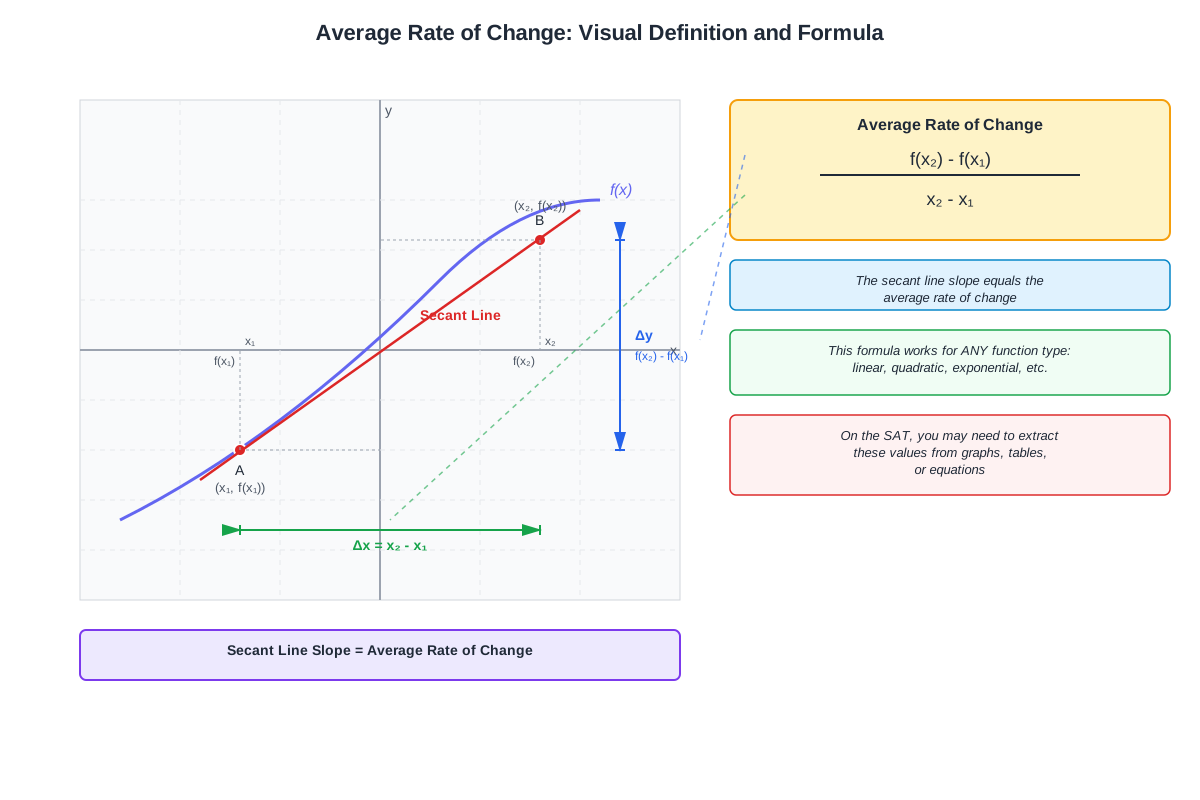
The average rate of change of a function over an interval measures how much the function's output (dependent variable) changes per unit change in the input (independent variable). For a function f(x) over the interval from x = a to x = b, the average rate of change is calculated using the formula:
Average Rate of Change = [f(b) - f(a)] / (b - a)This formula is structurally identical to the slope formula for a line connecting two points: (y₂ - y₁)/(x₂ - x₁). The numerator represents the change in output values (often called "rise" or Δy), while the denominator represents the change in input values (often called "run" or Δx). The result tells us the average amount by which the function increases or decreases per unit of input.
Geometric Interpretation
Geometrically, the average rate of change represents the slope of the secant line connecting two points on a function's graph. A secant line is a straight line that intersects a curve at exactly two points. When you calculate the average rate of change between points (a, f(a)) and (b, f(b)), you're finding the slope of the line segment connecting these points.
This geometric interpretation provides valuable insight: even if a function curves between two points, the average rate of change treats the journey from start to finish as if it were a straight line. For a linear function, the secant line coincides with the function itself, so the average rate of change equals the constant slope. For nonlinear functions, the secant line provides an approximation of the function's overall behavior across the interval.
Positive, Negative, and Zero Rates
The sign of the average rate of change reveals important information about function behavior:
- Positive rate of change: The function is increasing overall from left to right across the interval. The output values are growing as input values increase.
- Negative rate of change: The function is decreasing overall from left to right across the interval. The output values are declining as input values increase.
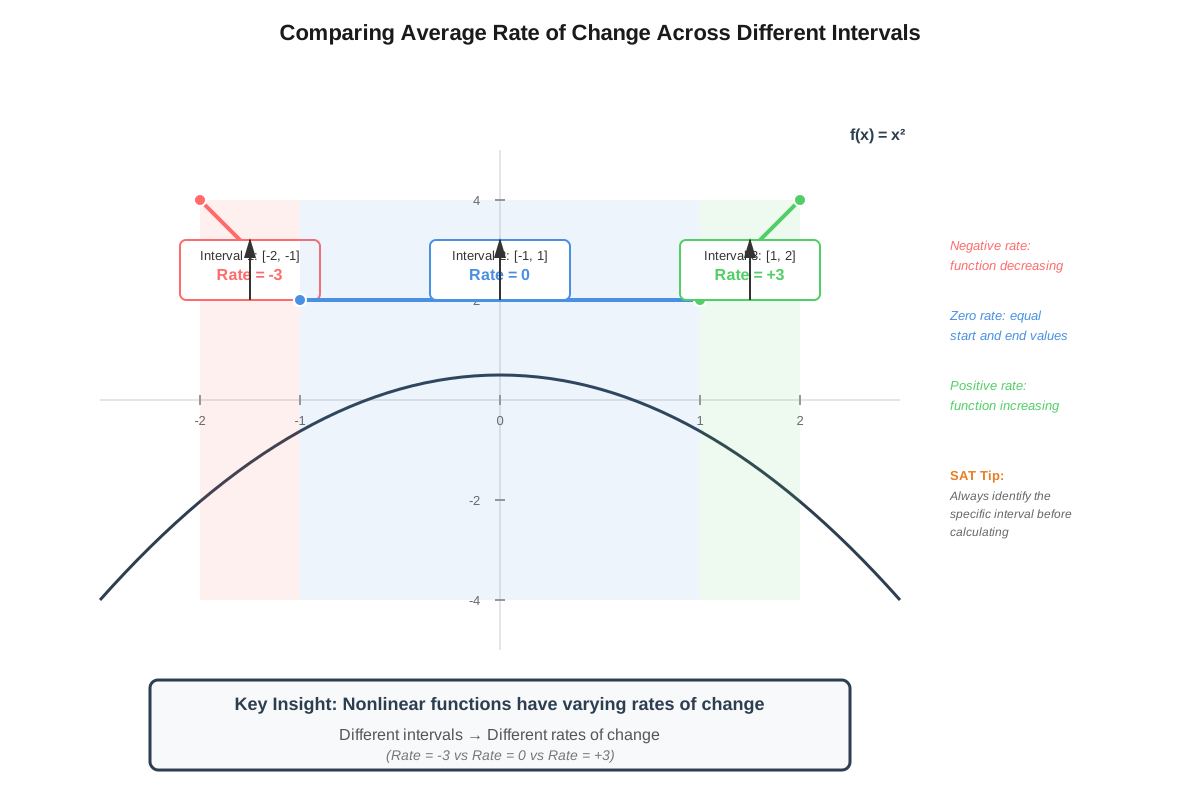
- Zero rate of change: The function has the same output value at both endpoints of the interval, indicating no net change despite possible variations within the interval.
Application to Different Function Types
| Function Type | Rate of Change Behavior | Example | ||
|---|---|---|---|---|
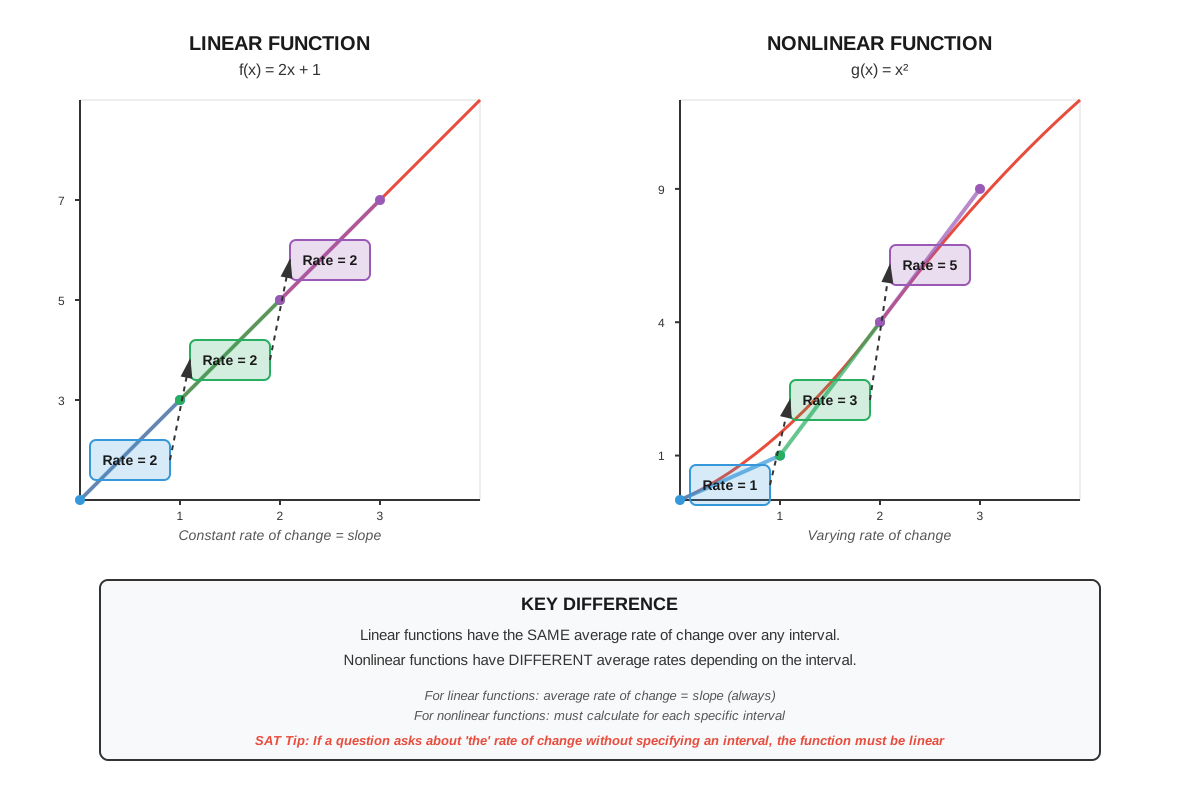
| Linear | Constant across all intervals | f(x) = 2x + 3 has rate of change = 2 everywhere | ||
| Quadratic | Varies by interval; symmetric around vertex | f(x) = x² has different rates on [0,1] vs [1,2] | ||
| Exponential | Increases in magnitude as x increases | f(x) = 2ˣ has increasing rates of change | ||
| Absolute Value | Different rates on either side of vertex | f(x) = \ | x\ | has rate -1 for x < 0, rate +1 for x > 0 |
Interval Selection and Interpretation
The choice of interval significantly affects the calculated average rate of change. For nonlinear functions, different intervals yield different rates. Consider f(x) = x²:
- From x = 0 to x = 2: Average rate = [f(2) - f(0)]/(2 - 0) = [4 - 0]/2 = 2
- From x = 2 to x = 4: Average rate = [f(4) - f(2)]/(4 - 2) = [16 - 4]/2 = 6
This demonstrates that the quadratic function's rate of change increases as x increases, reflecting the function's accelerating growth.
Units and Contextual Meaning
In applied problems, the average rate of change carries units derived from the output and input quantities. If f(t) represents distance in miles and t represents time in hours, then the average rate of change has units of miles per hour, representing average velocity. Understanding these units helps students interpret their answers meaningfully and catch calculation errors.
Calculation Steps
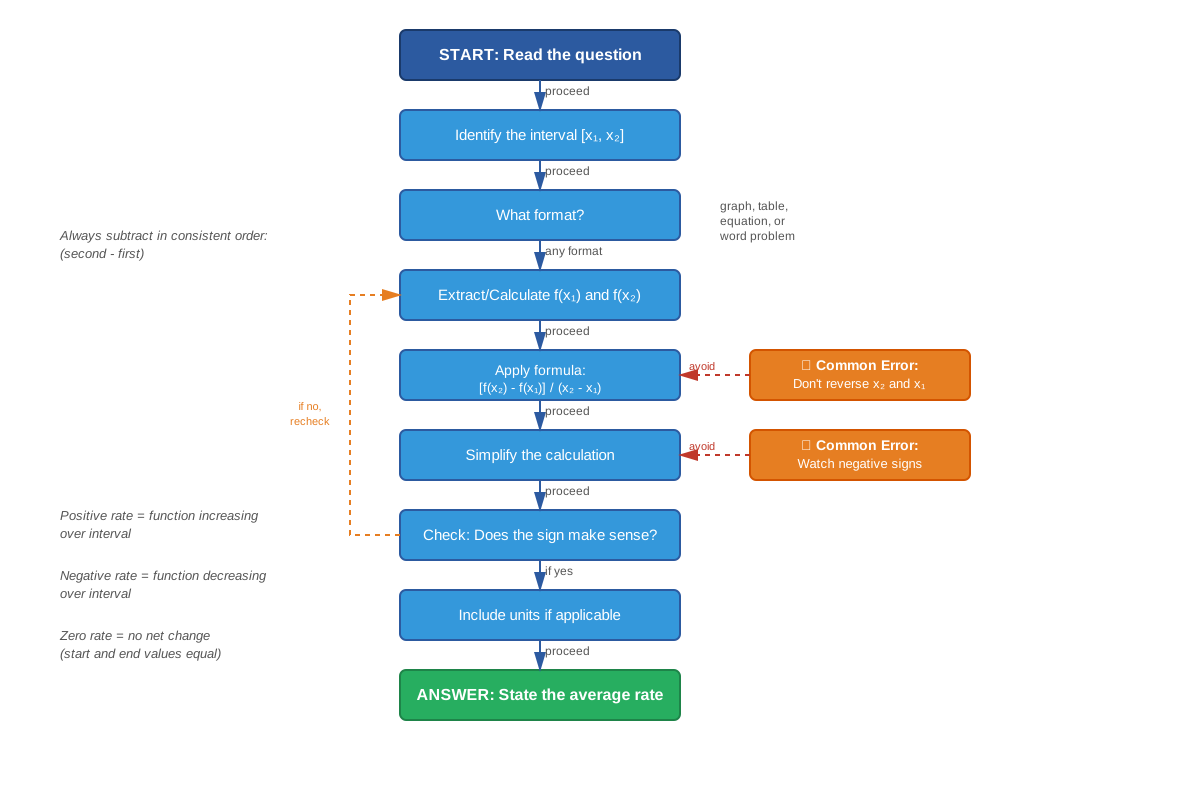
To calculate average rate of change systematically:
- Identify the interval: Determine the starting point (a) and ending point (b)
- Evaluate the function at both endpoints: Find f(a) and f(b)
- Calculate the change in output: Compute f(b) - f(a)
- Calculate the change in input: Compute b - a
- Divide: Form the quotient [f(b) - f(a)]/(b - a)
- Simplify and interpret: Reduce the fraction and explain the meaning in context
Concept Relationships
The average rate of change concept builds directly on the foundation of slope calculation from linear functions. While slope applies specifically to straight lines, average rate of change extends this idea to any function type, creating a unified framework for analyzing change. This generalization represents a crucial conceptual leap: students move from "slope is constant for lines" to "we can measure average change for any function over any interval."
Within this topic, several concepts interconnect hierarchically: The formula serves as the computational tool → The geometric interpretation (secant line) provides visual understanding → The sign analysis (positive/negative/zero) enables qualitative function analysis → The contextual interpretation connects mathematics to real-world applications. Each layer builds on the previous, creating a comprehensive understanding.
The relationship to function notation is bidirectional. Function notation provides the language for expressing average rate of change calculations, while average rate of change problems reinforce function evaluation skills. Similarly, coordinate plane skills enable students to extract information from graphs, which then feeds into rate of change calculations.
Looking forward, average rate of change serves as the conceptual foundation for derivatives in calculus. The derivative represents the instantaneous rate of change—essentially the average rate of change as the interval shrinks to zero. Understanding average rate of change thoroughly makes the transition to calculus significantly smoother.
The connection to linear vs. nonlinear functions is particularly important: Linear functions have constant average rates of change (equal to their slope), while nonlinear functions have varying rates depending on the interval chosen. This distinction helps students classify functions and predict their behavior.
High-Yield Facts
⭐ The average rate of change formula is [f(b) - f(a)]/(b - a), which is identical in structure to the slope formula
⭐ For linear functions, the average rate of change equals the slope and is constant across all intervals
⭐ A positive average rate of change indicates the function is increasing overall on that interval
⭐ The average rate of change represents the slope of the secant line connecting two points on the function's graph
⭐ Different intervals on the same nonlinear function will generally produce different average rates of change
- The units of average rate of change are (output units)/(input units), such as miles per hour or dollars per year
- A zero average rate of change means f(a) = f(b), though the function may vary between these points
- Negative average rate of change indicates the function is decreasing overall on the interval
- For quadratic functions opening upward, the average rate of change increases as you move right along the x-axis
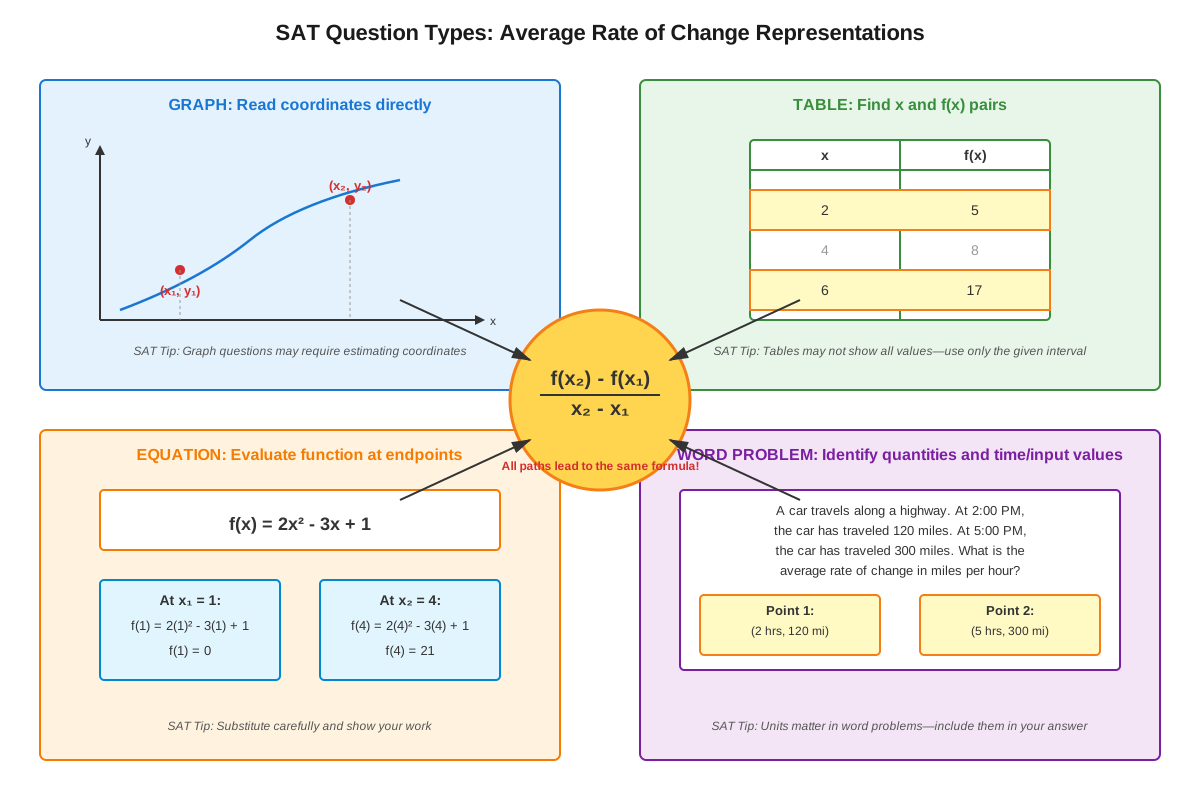
- The average rate of change can be calculated from tables, graphs, equations, or verbal descriptions
- Reversing the interval endpoints (calculating from b to a instead of a to b) produces the opposite sign
- The magnitude of the average rate of change indicates how steeply the function rises or falls on average
Quick check — test yourself on Average rate of change so far.
Try Flashcards →Common Misconceptions
Misconception: The average rate of change tells you the function's behavior at every point in the interval → Correction: The average rate of change only describes the overall change from start to finish. A function might increase and decrease multiple times within an interval while still having a positive average rate of change if it ends higher than it started.
Misconception: Average rate of change and slope are different concepts → Correction: Average rate of change is a generalization of slope. For linear functions, they are identical. For nonlinear functions, average rate of change is the slope of the secant line connecting two points, extending the slope concept beyond straight lines.
Misconception: If the average rate of change is zero, the function must be constant on that interval → Correction: A zero average rate of change only means the function has equal values at the endpoints. The function could increase then decrease (or vice versa) within the interval, returning to its starting value.
Misconception: You can only calculate average rate of change from equations → Correction: Average rate of change can be determined from any function representation: equations, graphs (by reading coordinates), tables (by extracting values), or verbal descriptions (by identifying the relevant quantities).
Misconception: The order of subtraction doesn't matter in the formula → Correction: The order must be consistent in both numerator and denominator. If you calculate f(b) - f(a) in the numerator, you must calculate b - a in the denominator. Reversing one but not the other produces an incorrect sign.
Misconception: A larger average rate of change always means a function is "better" or "faster" → Correction: The interpretation depends on context. In a profit scenario, a larger positive rate is favorable. In a cost scenario, a larger positive rate might be unfavorable. In a disease spread scenario, a larger rate could be concerning. Context determines whether a particular rate is desirable.
Misconception: Average rate of change only applies to time-based problems → Correction: While many examples involve change over time, average rate of change applies to any two-variable relationship. It can measure how cost changes with quantity, how temperature changes with altitude, or how population changes with area—any situation with dependent and independent variables.
Worked Examples
Example 1: Calculating from an Equation
Problem: A ball's height in feet is modeled by h(t) = -16t² + 64t + 5, where t is time in seconds. Find the average rate of change of the ball's height from t = 1 to t = 3 seconds, and interpret the result.
Solution:
Step 1: Identify the interval: a = 1, b = 3
Step 2: Evaluate h(1):
h(1) = -16(1)² + 64(1) + 5 = -16 + 64 + 5 = 53 feet
Step 3: Evaluate h(3):
h(3) = -16(3)² + 64(3) + 5 = -16(9) + 192 + 5 = -144 + 192 + 5 = 53 feet
Step 4: Apply the formula:
Average rate of change = [h(3) - h(1)]/(3 - 1) = (53 - 53)/2 = 0/2 = 0 feet per second
Step 5: Interpret:
The average rate of change is 0 feet per second, meaning the ball has the same height at t = 1 and t = 3. This doesn't mean the ball was stationary—it likely went up and came back down to the same height. The ball's average vertical velocity over this interval was zero.
Connection to Learning Objectives: This example demonstrates applying the average rate of change formula to a nonlinear function (quadratic) and interpreting the result in a real-world context, directly addressing the application and explanation objectives.
Example 2: Comparing Rates from a Graph
Problem: The graph of function f passes through points (-2, 5), (0, 1), (2, 3), and (4, 9). On which interval is the average rate of change greatest: [-2, 0], [0, 2], or [2, 4]?
Solution:
Interval [-2, 0]:
Average rate = [f(0) - f(-2)]/[0 - (-2)] = (1 - 5)/(0 + 2) = -4/2 = -2
Interval [0, 2]:
Average rate = [f(2) - f(0)]/(2 - 0) = (3 - 1)/2 = 2/2 = 1
Interval [2, 4]:
Average rate = [f(4) - f(2)]/(4 - 2) = (9 - 3)/2 = 6/2 = 3
Analysis: The interval [2, 4] has the greatest average rate of change at 3. This means the function increases most steeply (on average) during this interval. Note that [-2, 0] has a negative rate, indicating decrease, while the other intervals show increase.
Connection to Learning Objectives: This example shows how to identify key features of average rate of change from graphical information, compare rates across intervals, and apply the concept to answer SAT-style comparison questions.
Exam Strategy
When approaching SAT average rate of change questions, begin by identifying the function representation: equation, graph, table, or verbal description. Each format requires a slightly different extraction strategy, but all lead to the same formula application.
Trigger words and phrases that signal average rate of change questions include: "average rate," "rate of change," "how fast," "on average," "per unit," "slope of the secant line," and "between x = a and x = b." Questions asking "by how much does y change per unit change in x" are also testing this concept, even without using the exact terminology.
For graph-based questions, carefully read coordinates from the graph before calculating. If exact coordinates aren't marked, look for grid intersections or use the scale to determine values. Double-check that you're reading the correct axis—mixing up x and y values is a common error that leads to incorrect calculations.
For equation-based questions, write out the function evaluations explicitly: f(a) = ? and f(b) = ?. This prevents arithmetic errors and makes your work easier to check. Use parentheses carefully when substituting negative values or complex expressions.
Process of elimination works well when answer choices have different signs. Calculate whether the function increases or decreases on the interval to eliminate answers with the wrong sign. If the function clearly increases, eliminate negative answers immediately. For magnitude, estimate roughly: if the function changes by about 10 units over an interval of length 2, the rate should be near 5, allowing you to eliminate unreasonable answers.
Time allocation: Most average rate of change questions should take 60-90 seconds. If you're spending more than 2 minutes, you may be overcomplicating the problem. The SAT rarely requires complex algebraic manipulation—if your calculation becomes very messy, reconsider your approach.
Calculator usage: For calculator-permitted sections, use your calculator to evaluate functions and perform arithmetic, but write down intermediate steps. This prevents transcription errors and allows you to check your work if time permits.
Exam Tip: Always check that your answer makes sense in context. If a car's average velocity comes out to 500 miles per hour or a plant's growth rate is negative when the problem states it's growing, you've made an error.
Memory Techniques
Formula Mnemonic: Remember "Final minus Initial over Change in X" → FICX (sounds like "fix"). This reminds you that the numerator is f(final) - f(initial) and the denominator is the change in x-values.
Slope Connection: Think "Secant Line Slope" → SLS. Whenever you see average rate of change, visualize the secant line connecting two points. This reinforces the geometric interpretation and connects to your prior knowledge of slope.
Sign Visualization: Create a mental image: Positive rate = uphill climb (function increasing), Negative rate = downhill slide (function decreasing), Zero rate = flat ground (same height at start and end). This visual association helps you quickly interpret signs.
Unit Analysis Acronym: Output Over Input → OOI (sounds like "ooey"). The units of average rate of change are always output units over input units. This helps you interpret answers and catch errors.
Interval Order: Remember "Always Be Consistent" → ABC. Whatever order you choose for subtraction (b - a or a - b), use that same order in both numerator and denominator. Consistency prevents sign errors.
Summary
The average rate of change is a versatile mathematical tool that measures how a function's output changes per unit change in input over a specified interval. Calculated using the formula [f(b) - f(a)]/(b - a), it represents the slope of the secant line connecting two points on a function's graph. This concept extends the idea of slope from linear functions to all function types, providing a unified framework for analyzing change. On the SAT, average rate of change appears in multiple contexts—from pure calculation problems to real-world applications involving motion, growth, and other changing quantities. Success requires both computational proficiency with the formula and conceptual understanding of what the calculated rate means. Students must be able to extract information from various representations (equations, graphs, tables, verbal descriptions), perform accurate calculations, and interpret results meaningfully. The sign of the rate indicates whether the function increases, decreases, or remains unchanged overall, while the magnitude indicates the steepness of change. Mastering this high-yield topic provides a strong foundation for success on SAT math questions and prepares students for advanced mathematical concepts.
Key Takeaways
- The average rate of change formula [f(b) - f(a)]/(b - a) is structurally identical to the slope formula and represents the slope of the secant line between two points
- Positive rates indicate overall increase, negative rates indicate overall decrease, and zero rates indicate equal values at endpoints
- Linear functions have constant average rates of change equal to their slope, while nonlinear functions have varying rates depending on the interval
- Average rate of change can be calculated from any function representation: equations, graphs, tables, or verbal descriptions
- The units of average rate of change are (output units)/(input units), which helps with interpretation and error-checking
- SAT questions test both calculation skills and conceptual understanding, requiring students to interpret rates in context
- Different intervals on the same function typically produce different average rates of change, especially for nonlinear functions
Related Topics
Instantaneous Rate of Change and Derivatives: While average rate of change measures change over an interval, instantaneous rate of change (the foundation of calculus) measures change at a single point. Understanding average rate of change provides the conceptual foundation for limits and derivatives.
Linear Functions and Slope: Linear functions represent the special case where average rate of change is constant across all intervals. Mastering average rate of change deepens understanding of why slope is so significant for linear relationships.
Quadratic Functions and Parabolas: Quadratic functions provide excellent examples of varying rates of change. Analyzing how average rate of change differs across intervals helps students understand parabolic behavior and symmetry.
Exponential Growth and Decay: Exponential functions have average rates of change that increase or decrease exponentially themselves. This topic extends rate of change analysis to rapidly changing phenomena.
Optimization Problems: Finding maximum and minimum values often involves analyzing where rates of change equal zero or change sign, connecting average rate of change to optimization strategies.
Practice CTA
Now that you've mastered the core concepts of average rate of change, it's time to solidify your understanding through practice. Attempt the practice questions to test your ability to calculate rates from various representations, interpret results in context, and apply strategic thinking to SAT-style problems. Use the flashcards to reinforce key formulas, definitions, and common question patterns. Remember: understanding the concept is just the first step—fluency comes from repeated application. Each practice problem you solve strengthens your pattern recognition and builds the confidence you need to excel on test day. You've invested the time to learn this high-yield topic thoroughly; now invest a few more minutes to ensure that knowledge translates into points on the SAT!
Sign up free to keep reading
Create a free AnvayaPrep account to finish this SAT guide on Average rate of change — plus flashcards and practice questions.