Overview
The range of linear functions is a fundamental concept in algebra that appears frequently on the SAT Math section. Understanding range requires students to identify all possible output values (y-values) that a function can produce given its domain and characteristics. For linear functions specifically, the range behavior is directly tied to whether the function is constant or non-constant, making this topic both conceptually accessible and strategically important for test-takers.
On the SAT, questions about the range of linear functions test students' ability to analyze function behavior, interpret graphs, and understand the relationship between a function's equation and its output values. These questions may appear as multiple-choice problems requiring identification of range from equations or graphs, or as student-produced response questions asking for specific range values under given constraints. Mastery of this topic is essential because it connects to broader themes in the math section, including function notation, coordinate geometry, and algebraic reasoning.
The range concept serves as a bridge between basic algebraic manipulation and more advanced function analysis. While linear functions represent the simplest category of functions students encounter, understanding their range behavior establishes critical thinking patterns applicable to quadratic, exponential, and other function types tested on the SAT. Additionally, range questions often integrate multiple skills—reading graphs, solving inequalities, and interpreting real-world contexts—making them high-value targets for comprehensive preparation.
Learning Objectives
- [ ] Identify key features of range of linear functions from equations and graphs
- [ ] Explain how range of linear functions appears on the SAT in various question formats
- [ ] Apply range of linear functions concepts to answer SAT-style questions accurately
- [ ] Distinguish between unrestricted and restricted ranges based on domain constraints
- [ ] Determine range values for linear functions in real-world application problems
- [ ] Analyze how slope affects the range characteristics of linear functions
- [ ] Convert between different representations (equation, graph, table) to identify range
Prerequisites
- Function notation and evaluation: Understanding f(x) notation is essential for identifying output values that comprise the range
- Linear equations in slope-intercept form: The equation y = mx + b provides the foundation for analyzing how linear functions behave
- Domain of functions: Range is the output counterpart to domain (input), so understanding domain restrictions is necessary
- Coordinate plane and graphing: Visualizing functions on the xy-plane helps identify range through vertical extent
- Inequality notation: Range is often expressed using inequality symbols or interval notation
Why This Topic Matters
The range of linear functions appears in approximately 3-5 questions per SAT Math section, making it a high-frequency topic that directly impacts scores. These questions test mathematical reasoning and function literacy—skills that the College Board identifies as essential for college readiness. Understanding range demonstrates mastery of the relationship between algebraic expressions and their graphical representations, a core competency measured throughout the exam.
In real-world applications, range represents the possible outcomes or results of a process modeled by a function. For instance, if a linear function models the cost of a taxi ride based on distance traveled, the range represents all possible costs a customer might pay. Similarly, in physics, a linear function might model velocity over time, with the range indicating achievable speeds. These practical contexts frequently appear in SAT word problems, requiring students to interpret range within meaningful constraints.
On the exam, range questions appear in multiple formats: identifying range from graphs, determining range from equations with domain restrictions, solving for unknown parameters that produce specific ranges, and interpreting range in context-based problems. The topic integrates with systems of equations, inequalities, and function transformations, making it a versatile concept that connects multiple mathematical domains. Students who master range can efficiently eliminate incorrect answer choices and verify their solutions through multiple approaches.
Core Concepts
Definition of Range
The range of a function is the set of all possible output values (y-values) that the function can produce. For any function f(x), the range consists of every value y for which there exists at least one input x such that f(x) = y. Understanding this definition is crucial because it shifts focus from what goes into a function (domain) to what comes out of it.
For linear functions, the range behavior depends entirely on whether the function is constant or non-constant. This binary classification makes linear functions particularly straightforward to analyze compared to other function types.
Range of Non-Constant Linear Functions
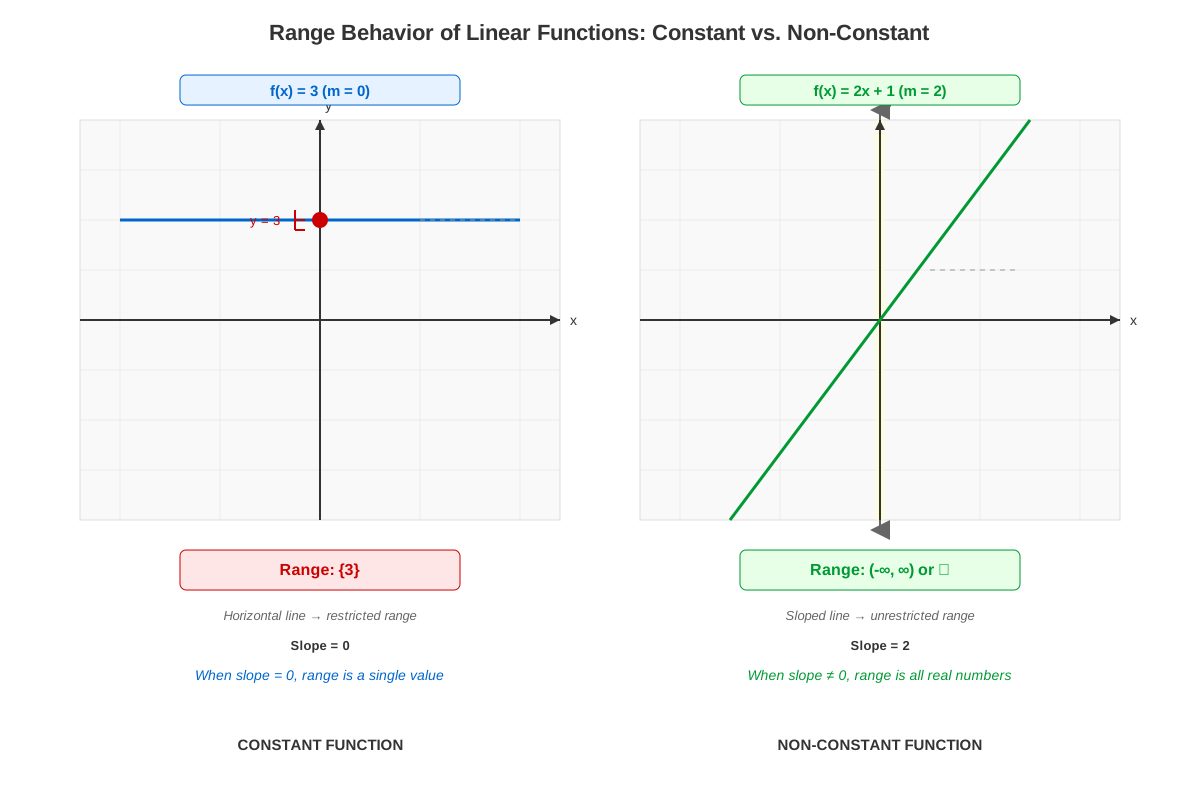
A non-constant linear function has the form f(x) = mx + b where m ≠ 0. The slope m being non-zero means the function is either increasing (m > 0) or decreasing (m < 0) across its domain. This monotonic behavior has a critical implication: if the domain is unrestricted (all real numbers), the function will eventually reach any y-value given sufficient x-values.
Key principle: For non-constant linear functions with unrestricted domains, the range is all real numbers, expressed as (-∞, ∞) or {y | y ∈ ℝ}.
This occurs because:
- As x increases without bound (x → ∞), the function value mx + b also increases without bound if m > 0, or decreases without bound if m < 0
- As x decreases without bound (x → -∞), the opposite behavior occurs
- By the Intermediate Value Theorem, the function takes on every value between any two points
Range of Constant Linear Functions
A constant linear function has the form f(x) = b where the slope m = 0. This function produces the same output regardless of input, appearing as a horizontal line on the coordinate plane. The range consists of a single value: the constant b itself.
Key principle: For constant linear functions f(x) = b, the range is {b}, a set containing only one element.
For example:
- f(x) = 5 has range {5}
- g(x) = -2 has range {-2}
- h(x) = 0 has range {0}
Range with Domain Restrictions
When a linear function's domain is restricted to a specific interval or set of values, the range must be calculated based on those constraints. This scenario is extremely common on the SAT, particularly in real-world application problems where variables have natural limitations.
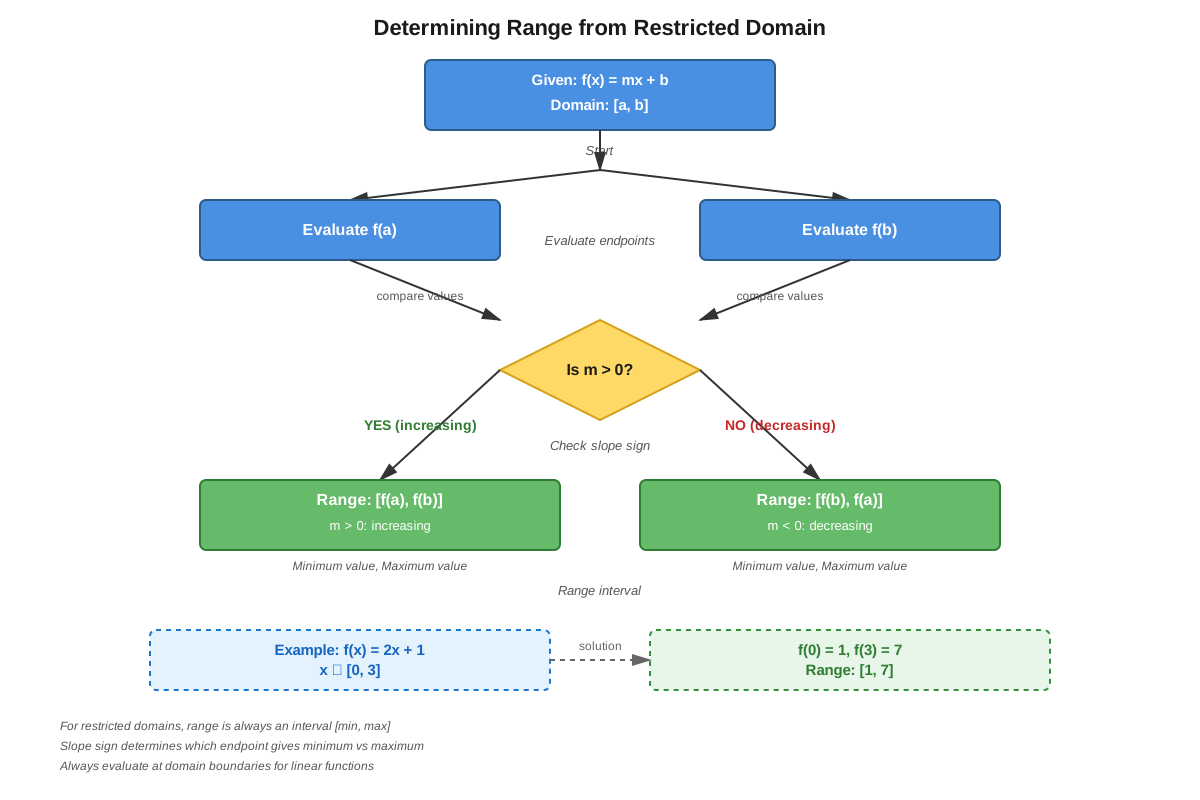
Process for finding range with restricted domain:
- Identify the domain restrictions (often given as inequalities or intervals)
- Evaluate the function at the domain endpoints
- Determine whether endpoints are included (closed interval) or excluded (open interval)
- For non-constant linear functions, the range extends from the minimum to maximum function values
- Express the range using appropriate interval notation
Example: If f(x) = 2x + 3 with domain [1, 5]:
- At x = 1: f(1) = 2(1) + 3 = 5
- At x = 5: f(5) = 2(5) + 3 = 13
- Since the function is increasing (m = 2 > 0) and the domain includes both endpoints, the range is [5, 13]
Graphical Interpretation of Range
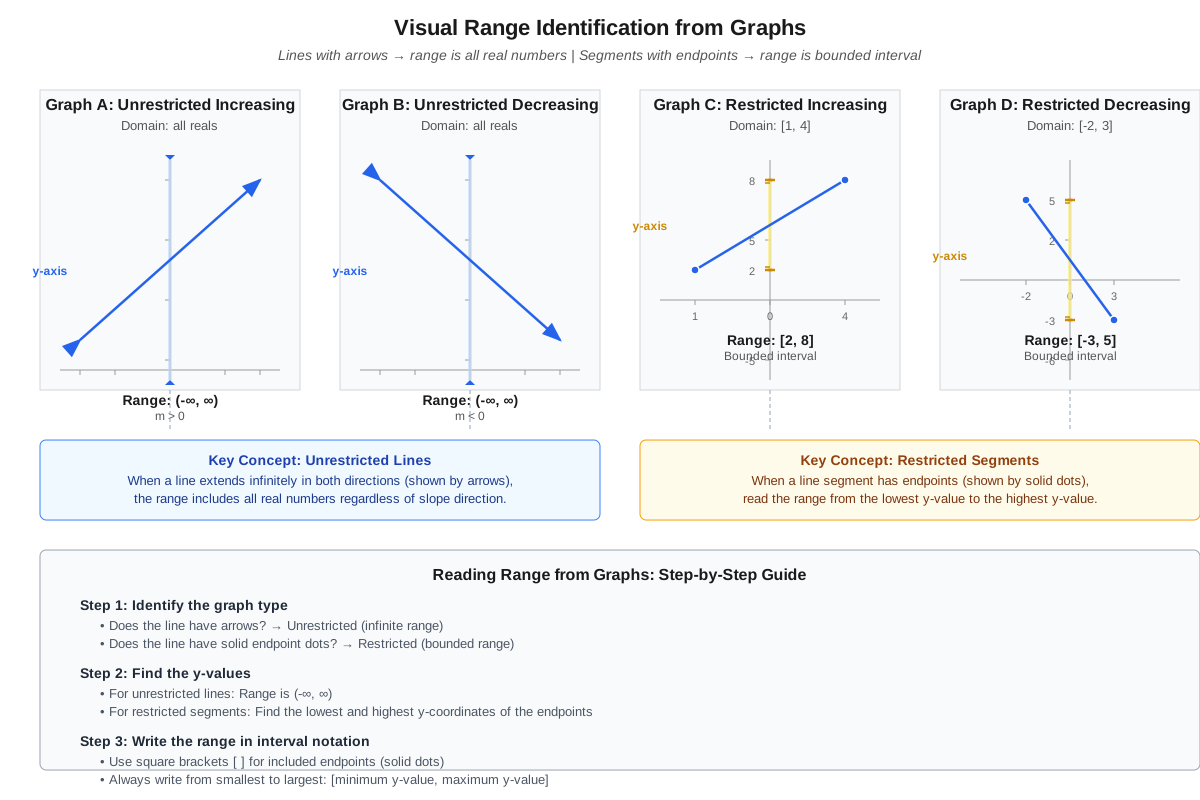
On a coordinate plane, the range corresponds to the vertical extent of the function's graph. To identify range graphically:
- Observe the lowest y-value the graph reaches (minimum)
- Observe the highest y-value the graph reaches (maximum)
- Determine whether these extremes are included (solid dots) or excluded (open circles)
- The range spans all y-values between these extremes
For non-constant linear functions graphed without domain restrictions, the line extends infinitely in both vertical directions, confirming the range is all real numbers. For restricted domains, the graph shows only a line segment, and the range corresponds to the vertical span of that segment.
Range in Function Notation
SAT questions often present range problems using function notation. Students must recognize equivalent expressions:
| Expression | Meaning | |
|---|---|---|
| Range of f | All possible values of f(x) | |
| {f(x) \ | x ∈ domain} | Set-builder notation for range |
| {y \ | y = f(x) for some x} | Alternative set-builder form |
| [a, b] or (a, b) | Interval notation for bounded range | |
| (-∞, ∞) | Interval notation for all real numbers |
Determining Range from Tables
When linear functions are presented in table format, students can identify range by:
- Examining all y-values in the table
- Determining if the pattern continues beyond the table (check if the function is linear by verifying constant rate of change)
- Considering whether the domain extends beyond the table values
- If the table shows a complete, finite domain, the range is the set of y-values shown
- If the domain continues indefinitely, use the slope to determine range behavior
Concept Relationships
The range of linear functions connects directly to the domain concept—they are complementary aspects of function analysis. Domain (input) → Function rule → Range (output) forms the fundamental flow of function evaluation. Understanding that range depends on domain is essential for solving restricted-domain problems.
The slope of a linear function determines range behavior: non-zero slope → unrestricted range (for unrestricted domain), while zero slope → single-value range. This connects to the broader concept of function behavior and monotonicity. Slope analysis → Range determination represents a key reasoning pathway.
Graphical representation serves as a bridge between algebraic and visual understanding. Equation → Graph → Range identification forms a complete analytical cycle. The vertical line test (for functions) relates to range through the horizontal line test: for non-constant linear functions, any horizontal line intersects the graph exactly once, confirming each y-value appears in the range.
Range concepts extend to inverse functions: the range of a function becomes the domain of its inverse. For linear functions (except constants), this relationship is particularly clean, as the inverse is also linear. This connection appears in more advanced SAT questions involving function composition and inverse operations.
Finally, range integrates with inequalities and systems: finding range with restrictions often requires solving inequalities, and comparing ranges of multiple functions involves system-like reasoning. Range of f ∩ Range of g (intersection of ranges) appears in problems about function combinations.
Quick check — test yourself on Range of linear functions so far.
Try Flashcards →High-Yield Facts
⭐ The range of any non-constant linear function with unrestricted domain is all real numbers: (-∞, ∞)
⭐ The range of a constant function f(x) = b is the single value {b}
⭐ For restricted domains, evaluate the function at domain endpoints to find range endpoints
⭐ On a graph, range corresponds to the vertical extent of the function
⭐ If a linear function has positive slope and restricted domain [a, b], the range is [f(a), f(b)]
- If a linear function has negative slope and restricted domain [a, b], the range is [f(b), f(a)]
- The range of a linear function is always an interval (possibly infinite) or a single point
- Domain restrictions in real-world problems always affect range calculations
- A horizontal line on a graph indicates a constant function with single-value range
- The y-intercept (b in y = mx + b) is always in the range if 0 is in the domain
- For discrete domains (specific x-values only), the range consists only of the corresponding y-values
- Range can be expressed in set notation, interval notation, or inequality notation
- The minimum and maximum of the range occur at the minimum and maximum of the domain for monotonic functions
- If two linear functions have the same slope but different y-intercepts, they have the same range behavior (both all real numbers or both restricted similarly)
Common Misconceptions
Misconception: The range of every linear function is all real numbers.
Correction: Only non-constant linear functions with unrestricted domains have range (-∞, ∞). Constant functions have single-value ranges, and domain restrictions limit the range of any linear function.
Misconception: The range is found by substituting y = 0 into the equation.
Correction: Setting y = 0 finds the x-intercept (a domain value), not the range. Range is found by analyzing all possible y-values the function produces, often by evaluating at domain extremes.
Misconception: If the domain is [a, b], the range is automatically [a, b].
Correction: Domain and range are independent sets. The range is [f(a), f(b)] or [f(b), f(a)] depending on whether the function is increasing or decreasing, not simply the domain values themselves.
Misconception: A linear function's range always includes its y-intercept.
Correction: The y-intercept is in the range only if x = 0 is in the domain. If the domain is restricted to positive numbers only, for example, the y-intercept may not be in the range.
Misconception: Range can be found by looking at the x-values on a graph.
Correction: Range corresponds to y-values (vertical extent), not x-values (horizontal extent). Students must examine how high and low the graph extends vertically.
Misconception: For a table of values, the range is always the set of y-values shown.
Correction: This is true only if the table represents the complete domain. If the function continues beyond the table values, the range must be determined by analyzing the function's behavior across its entire domain.
Misconception: The range of f(x) = 2x is [0, ∞) because x starts at 0.
Correction: Unless explicitly stated, the domain of algebraic functions is all real numbers. Therefore, f(x) = 2x has range (-∞, ∞), not [0, ∞). Domain restrictions must be explicitly given.
Worked Examples
Example 1: Range from Equation with Restricted Domain
Problem: A function is defined by f(x) = -3x + 7 for 1 ≤ x ≤ 4. What is the range of f?
Solution:
Step 1: Identify that this is a non-constant linear function (slope m = -3 ≠ 0) with restricted domain [1, 4].
Step 2: Since the slope is negative (m = -3 < 0), the function is decreasing. This means the maximum value occurs at the left endpoint (x = 1) and the minimum at the right endpoint (x = 4).
Step 3: Evaluate at x = 1:
f(1) = -3(1) + 7 = -3 + 7 = 4Step 4: Evaluate at x = 4:
f(4) = -3(4) + 7 = -12 + 7 = -5Step 5: Since the domain includes both endpoints (closed interval), the range also includes both endpoint values.
Step 6: The function decreases from 4 to -5, so the range is [-5, 4].
Answer: The range is [-5, 4] or equivalently {y | -5 ≤ y ≤ 4}.
Connection to learning objectives: This example demonstrates identifying range from an equation (Objective 1), applying the concept to determine range with domain restrictions (Objective 4), and analyzing how slope affects range (Objective 6).
Example 2: Range from Graph with Real-World Context
Problem: The graph below shows the amount of water w (in gallons) in a tank as a function of time t (in minutes) as the tank is being filled. The graph is a line segment from point (0, 50) to point (10, 200). What is the range of this function?
Solution:
Step 1: Identify the given information. The function is linear (straight line segment) with domain [0, 10] representing time in minutes.
Step 2: Identify the endpoints on the graph:
- At t = 0: w = 50 gallons (starting amount)
- At t = 10: w = 200 gallons (ending amount)
Step 3: Determine if the function is increasing or decreasing. Since water is being added, and the amount increases from 50 to 200, the function is increasing.
Step 4: For an increasing linear function on a closed interval, the range extends from the minimum value (at the left endpoint) to the maximum value (at the right endpoint).
Step 5: Both endpoints are included because the graph shows a line segment (not open circles), and the time interval includes both t = 0 and t = 10.
Step 6: The range is [50, 200].
Interpretation: The tank contains between 50 and 200 gallons (inclusive) during the filling process. Every value between these amounts is achieved at some point during the 10-minute interval.
Answer: The range is [50, 200] gallons.
Connection to learning objectives: This example shows how to identify range from a graph (Objective 1), demonstrates how range appears in SAT real-world contexts (Objective 2), and requires converting graphical representation to range notation (Objective 7).
Exam Strategy
When approaching SAT questions about the range of linear functions, follow this systematic process:
Step 1: Identify the function type. Determine immediately whether the function is constant (horizontal line, m = 0) or non-constant (m ≠ 0). Constant functions have single-value ranges; non-constant functions have interval ranges.
Step 2: Check for domain restrictions. Look for phrases like "for x ≥ 0," "where 1 ≤ x ≤ 5," or contextual limitations (time can't be negative, number of items must be whole numbers). Unrestricted domains typically mean range is all real numbers for non-constant linear functions.
Step 3: Evaluate at boundaries. For restricted domains, calculate function values at the minimum and maximum domain values. These will be your range endpoints (though you must determine which is larger).
Trigger words to watch for:
- "Possible values of y" → asking for range
- "Output values" → asking for range
- "Vertical extent" → asking for range
- "For all x in [a, b]" → domain restriction that affects range
- "Real-world context" (time, cost, distance) → likely has domain restrictions
Process of elimination tips:
- Eliminate any answer choice that includes values outside what the function can produce
- For non-constant linear functions with unrestricted domains, eliminate any bounded interval
- For constant functions, eliminate any answer with more than one value
- Check if the slope sign matches the range direction (positive slope with restricted domain: range increases from left to right)
Time allocation: Range questions typically require 45-60 seconds. If a question involves complex domain restrictions or requires solving for an unknown parameter, allocate up to 90 seconds. Don't spend time graphing unless absolutely necessary—algebraic evaluation is usually faster.
Exam Tip: If you're unsure whether endpoints are included in the range, check whether the corresponding domain endpoints are included. Closed domain intervals produce closed range intervals for linear functions.
Memory Techniques
Mnemonic for range identification: "VEND"
- Vertical extent on graphs
- Evaluate at endpoints
- Non-constant = all reals (unrestricted)
- Domain restrictions limit range
Visualization strategy: Picture a linear function as a ramp. If the ramp extends infinitely in both directions (unrestricted domain), you can reach any height (range is all real numbers). If the ramp is cut to a specific segment (restricted domain), you can only reach heights between the two cut points (bounded range).
Acronym for constant functions: "SOLO"
- Slope is zero
- Output never changes
- Line is horizontal
- One value in range
Memory device for slope and range relationship:
- Positive slope + restricted domain = Range rises from left to right
- Negative slope + restricted domain = Range falls from left to right
- Think: "Slope shows the direction, endpoints show the limits"
Rhyme for domain-range connection:
"Domain is where x can go, range is where y will flow"
Summary
The range of linear functions represents all possible output values a function can produce and is determined by the function's form and domain restrictions. Non-constant linear functions (m ≠ 0) with unrestricted domains have range equal to all real numbers because they extend infinitely in both directions. Constant linear functions (m = 0) have ranges consisting of a single value—the constant term. When domain restrictions apply, the range is found by evaluating the function at domain endpoints and determining which produces the minimum and maximum values based on the slope's sign. Graphically, range corresponds to vertical extent, making visualization a powerful tool for verification. On the SAT, range questions integrate multiple skills including function evaluation, inequality interpretation, and graphical analysis, appearing in both pure mathematical and real-world contexts. Mastery requires understanding the relationship between domain and range, recognizing how slope affects output behavior, and systematically evaluating functions at critical points. Success on these questions comes from identifying function type quickly, checking for restrictions carefully, and applying the appropriate method—whether algebraic evaluation, graphical analysis, or logical reasoning about function behavior.
Key Takeaways
- The range of a non-constant linear function with unrestricted domain is always all real numbers: (-∞, ∞)
- Constant functions have single-value ranges equal to the constant term
- Domain restrictions require evaluating the function at domain endpoints to determine range boundaries
- Positive slope means the function increases; negative slope means it decreases—this determines which endpoint gives the maximum range value
- On graphs, range is the vertical extent; on tables, range depends on whether the domain continues beyond shown values
- Range questions on the SAT frequently involve real-world contexts with natural domain restrictions
- Always check whether endpoints are included (closed intervals) or excluded (open intervals) when expressing range
Related Topics
Domain of linear functions: Understanding domain restrictions is essential for determining range accurately. Mastering range enables deeper analysis of function behavior and prepares students for domain-range relationships in other function types.
Inverse functions: The range of a function becomes the domain of its inverse. Linear function inverses provide excellent practice for understanding this reciprocal relationship.
Piecewise functions: Linear pieces within piecewise functions each have their own ranges that must be combined to find the overall range—an extension of single linear function range analysis.
Systems of linear equations: Comparing ranges of multiple linear functions appears in problems about function intersections and solution sets.
Quadratic and exponential functions: The systematic approach to finding range for linear functions—analyzing endpoints and function behavior—extends to these more complex function types with appropriate modifications.
Practice CTA
Now that you've mastered the core concepts of range for linear functions, it's time to solidify your understanding through active practice. Attempt the practice questions to test your ability to identify range from equations, graphs, and real-world contexts. Use the flashcards to reinforce key definitions and relationships until they become automatic. Remember: understanding range isn't just about memorizing rules—it's about developing the analytical skills to approach any function systematically. Each practice problem you solve builds the confidence and speed you'll need on test day. You've got this!
Sign up free to keep reading
Create a free AnvayaPrep account to finish this SAT guide on Range of linear functions — plus flashcards and practice questions.