Overview
The domain of linear functions is a foundational concept in algebra that appears frequently on the SAT Math section. Understanding domain means identifying all possible input values (x-values) for which a function is defined and produces a valid output. For linear functions specifically, this concept becomes particularly important because while most linear functions have an unrestricted domain of all real numbers, real-world contexts and SAT problems often impose practical restrictions that students must recognize and interpret correctly.
On the SAT, questions about the domain of linear functions test not only computational skills but also conceptual understanding and the ability to translate between mathematical representations and real-world scenarios. Students encounter these questions in multiple formats: identifying domain from graphs, determining domain from word problems with contextual constraints, and analyzing function notation to establish valid input ranges. The ability to quickly identify whether a linear function has restrictions—and what those restrictions are—can mean the difference between a correct answer and a costly mistake.
This topic connects directly to broader math concepts including function notation, inequalities, coordinate geometry, and modeling with linear equations. Mastery of domain concepts for linear functions provides the foundation for understanding more complex function types (quadratic, exponential, rational) that students will encounter later in the exam. Additionally, domain questions often integrate with other SAT topics such as interpreting graphs, solving systems of equations, and analyzing data in context, making this a high-yield area for focused study.
Learning Objectives
- [ ] Identify key features of domain of linear functions
- [ ] Explain how domain of linear functions appears on the SAT
- [ ] Apply domain of linear functions to answer SAT-style questions
- [ ] Distinguish between theoretical domain (all real numbers) and practical domain (contextual restrictions)
- [ ] Translate word problems into domain restrictions using inequality notation
- [ ] Analyze graphs to determine the domain of linear functions visually
- [ ] Evaluate whether specific values belong to the domain of a given linear function
Prerequisites
- Function notation: Understanding f(x) notation is essential because domain questions require identifying valid input values for functions
- Linear equations: Familiarity with equations in the form y = mx + b enables recognition of linear functions and their properties
- Inequality notation: Knowledge of inequality symbols and interval notation is necessary for expressing domain restrictions mathematically
- Coordinate plane basics: Understanding x and y axes helps visualize domain as horizontal extent on graphs
- Real number system: Recognizing different number sets (integers, whole numbers, real numbers) allows proper domain classification
Why This Topic Matters
In real-world applications, the domain of linear functions represents the practical limits of mathematical models. When a linear function models the cost of producing x items, the domain cannot include negative numbers because negative production makes no physical sense. When modeling time-dependent processes, domain restrictions reflect realistic time constraints. Engineers, economists, scientists, and data analysts regularly work with linear models where identifying valid input ranges is critical for accurate predictions and decision-making.
On the SAT, domain questions appear in approximately 3-5% of Math section problems, making them moderately frequent but highly predictable. These questions typically appear in two main formats: (1) word problems requiring students to identify contextual restrictions on variables, and (2) graph interpretation questions where students must determine the horizontal extent of a function. The College Board particularly favors questions that combine domain concepts with real-world modeling scenarios, testing whether students can bridge abstract mathematical concepts with practical applications.
Common SAT presentations include: linear functions modeling business scenarios (where domain might be restricted to non-negative integers representing whole units), time-based models (where domain represents valid time intervals), measurement contexts (where physical constraints limit possible values), and piecewise scenarios where linear functions apply only over specific intervals. Questions may ask students to identify which values are NOT in the domain, determine the maximum or minimum domain value, or select the correct inequality representing domain restrictions.
Core Concepts
Definition of Domain
The domain of a function is the complete set of all possible input values (x-values) for which the function is defined and produces a valid output. For any function f(x), the domain answers the question: "What values can I substitute for x?" In mathematical notation, domain is often expressed using set notation, inequality notation, or interval notation.
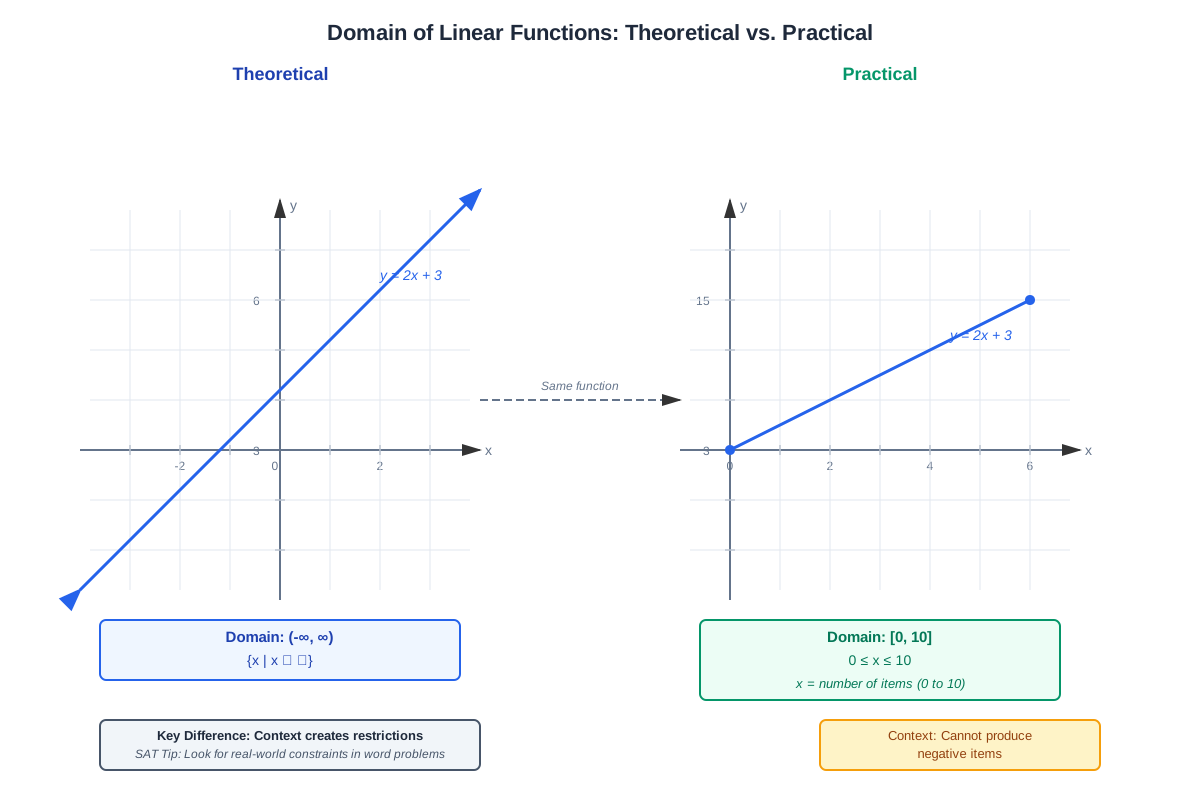
For a linear function in the form f(x) = mx + b (where m and b are constants and m ≠ 0), the theoretical domain is all real numbers, written as (-∞, ∞) or {x | x ∈ ℝ}. This is because you can substitute any real number for x in a linear equation and always obtain a valid output—there are no mathematical operations that would make the function undefined (such as division by zero or taking the square root of a negative number).
Unrestricted vs. Restricted Domain
Unrestricted domain occurs when a linear function has no mathematical or contextual limitations on input values. The function f(x) = 2x + 5, considered purely as a mathematical object, has an unrestricted domain of all real numbers. Any value—positive, negative, fraction, or irrational—can be substituted for x.
Restricted domain occurs when external factors limit the valid input values. These restrictions typically arise from:
- Contextual constraints: Real-world scenarios impose practical limits
- Explicit statements: Problems may specify "for x ≥ 0" or similar conditions
- Physical impossibilities: Negative quantities where only positive values make sense
- Discrete requirements: Situations requiring whole numbers or integers only
Domain from Context
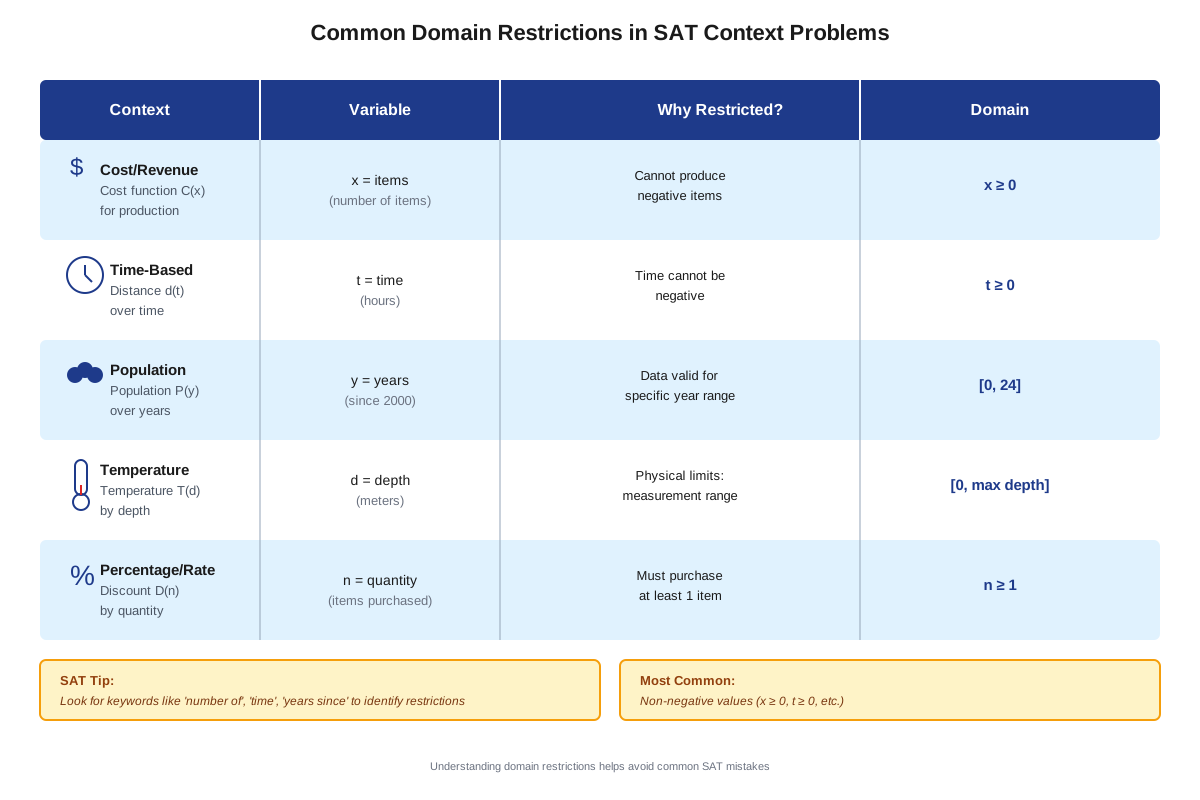
When linear functions model real-world situations, context determines domain restrictions. Consider these common scenarios:
| Context | Typical Domain Restriction | Reasoning |
|---|---|---|
| Number of items produced | x ≥ 0, x is an integer | Cannot produce negative or fractional items |
| Time elapsed | t ≥ 0 | Time cannot be negative in most models |
| Distance traveled | d ≥ 0 | Distance is non-negative |
| Temperature in Celsius | No restriction (can be negative) | Temperatures can be below zero |
| Percentage | 0 ≤ p ≤ 100 | Percentages range from 0% to 100% |
| Money spent | m ≥ 0 | Cannot spend negative money |
The SAT frequently tests whether students can extract these implicit restrictions from word problems and translate them into mathematical notation.
Domain from Graphs
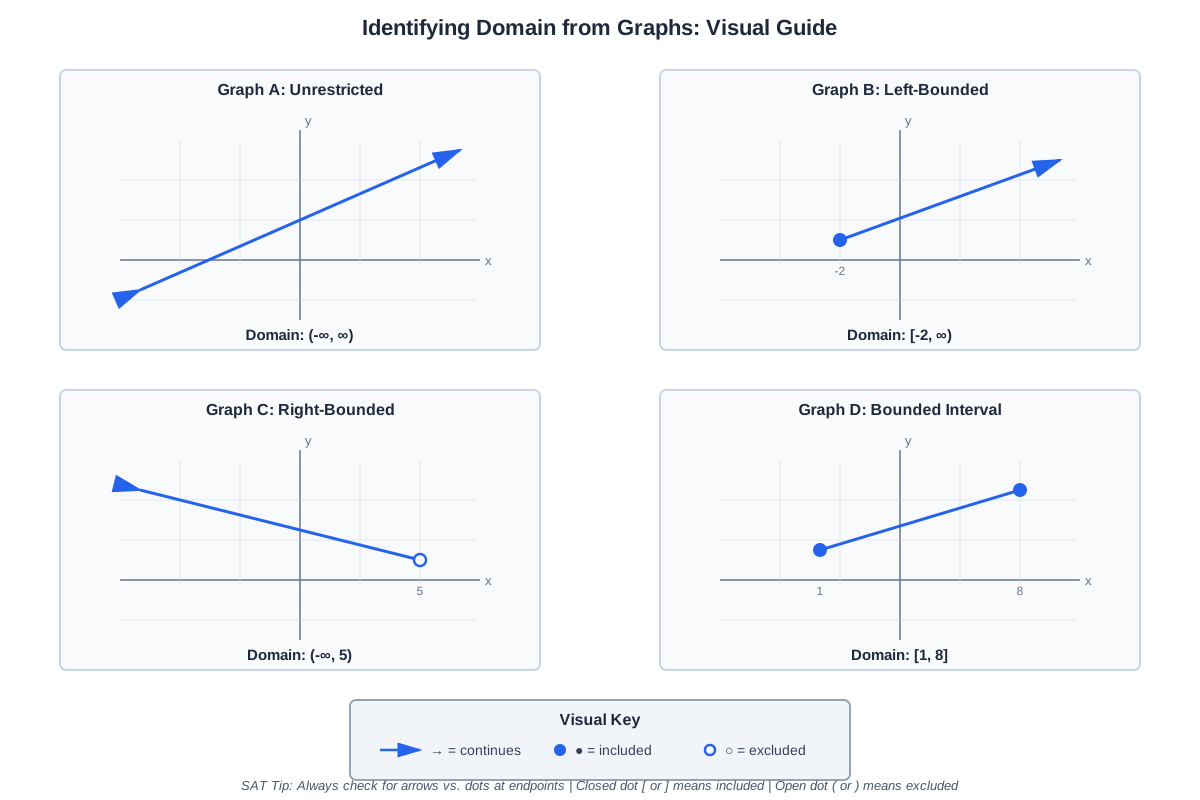
When a linear function is presented graphically, the domain is determined by examining the horizontal extent of the graph—specifically, which x-values have corresponding points on the function.
For a complete line extending infinitely in both directions, the domain is all real numbers. However, SAT problems often show:
- Ray graphs: Lines with one endpoint and extending infinitely in one direction (domain: x ≥ a or x ≤ a)
- Line segments: Lines with two endpoints (domain: a ≤ x ≤ b)
- Discrete points: Individual points following a linear pattern (domain: specific x-values only)
When reading domain from a graph, pay attention to:
- Solid dots: The endpoint IS included in the domain (use ≤ or ≥)
- Open circles: The endpoint is NOT included in the domain (use < or >)
- Arrows: The graph continues infinitely in that direction
Domain Notation
The SAT domain of linear functions can be expressed in multiple equivalent ways:
Inequality notation: x ≥ 0, x < 10, 0 ≤ x ≤ 5
Interval notation: [0, ∞), (-∞, 10), [0, 5]
Set-builder notation: {x | x ≥ 0}, {x | x is a real number}
Verbal description: "all non-negative real numbers," "all real numbers between 0 and 5, inclusive"
The SAT most commonly uses inequality notation and verbal descriptions, though familiarity with interval notation helps with efficient problem-solving.
Determining Domain: Step-by-Step Process
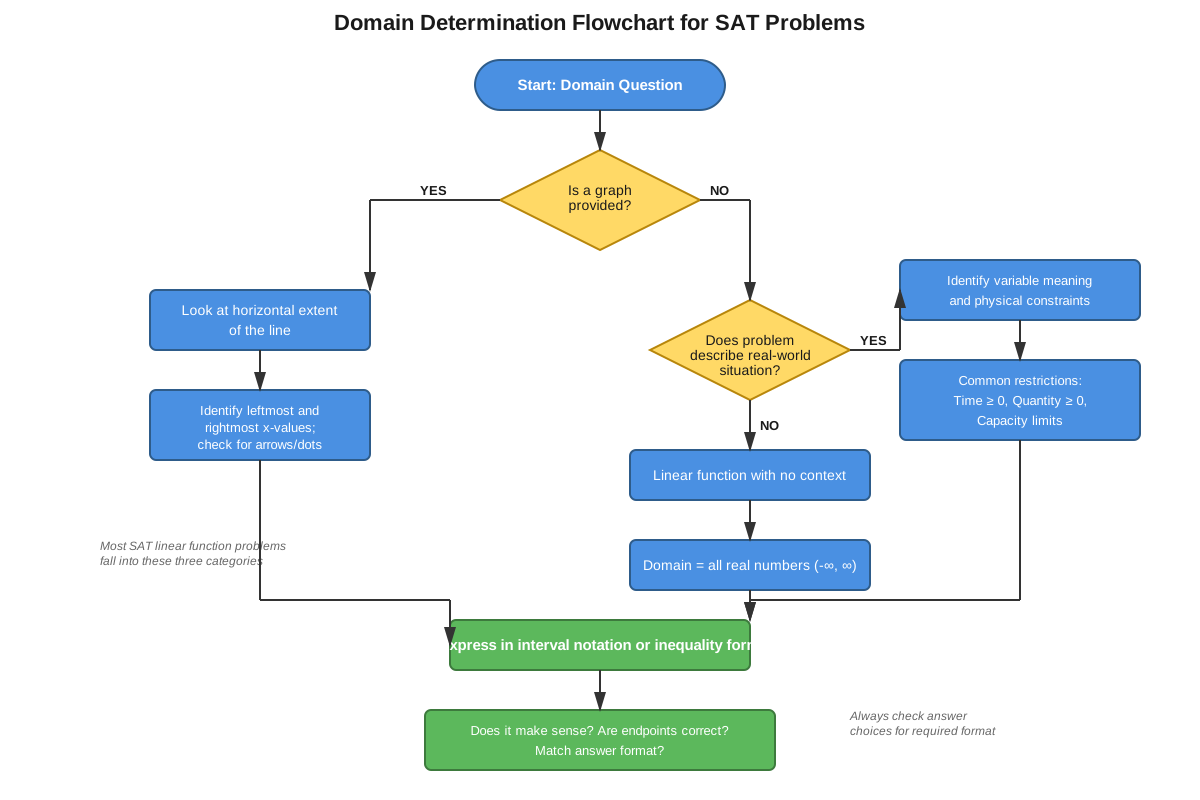
To identify the domain of a linear function on the SAT:
- Identify the function type: Confirm it's linear (form y = mx + b or equivalent)
- Check for mathematical restrictions: Linear functions have none inherently
- Read the context carefully: Look for words indicating limits (non-negative, at most, between, etc.)
- Identify the independent variable: Determine what x represents in the problem
- Apply logical constraints: Consider what values make sense for that variable
- Express mathematically: Write the domain using appropriate notation
- Verify boundary cases: Check if endpoints should be included or excluded
Common Domain Restrictions on the SAT
The SAT repeatedly uses certain domain restriction patterns:
- x ≥ 0: Non-negative values (counts, quantities, distances)
- x > 0: Strictly positive values (when zero is excluded)
- 0 ≤ x ≤ n: Bounded intervals (percentages, limited time periods)
- x is an integer: Discrete values (whole items, people, days)
- x is a whole number: Non-negative integers (combining two restrictions)
Recognizing these patterns quickly allows for efficient problem-solving and reduces the chance of misinterpreting contextual clues.
Concept Relationships
The domain concept serves as the foundation for understanding functions comprehensively. Domain → determines → valid inputs → which produce → range values (outputs). This input-output relationship is central to all function analysis.
Within linear functions specifically: linear equation form (y = mx + b) → suggests → unrestricted theoretical domain → but → real-world context → imposes → practical domain restrictions → which must be → expressed mathematically using inequality or interval notation.
The domain concept connects to prerequisite knowledge through: coordinate plane understanding → enables → visual domain identification from graphs → which reinforces → algebraic domain determination → both supporting → function notation comprehension (f(x) where x represents domain values).
Domain relationships extend to related topics: domain of linear functions → provides foundation for → domain of quadratic functions (where x² creates no restrictions) → and → domain of rational functions (where denominators create restrictions) → and → domain of radical functions (where radicands create restrictions). Mastering linear function domain makes these more complex cases more accessible.
Additionally: domain restrictions → often pair with → inequality solving → and connect to → systems of inequalities → which appear in → linear programming problems on the SAT. The ability to work with domain restrictions strengthens overall algebraic reasoning skills.
Quick check — test yourself on Domain of linear functions so far.
Try Flashcards →High-Yield Facts
⭐ The theoretical domain of any linear function f(x) = mx + b is all real numbers unless explicitly restricted by context or problem conditions.
⭐ On the SAT, domain restrictions for linear functions almost always come from real-world context, not mathematical limitations.
⭐ When a linear function models a quantity that cannot be negative (items, people, distance), the domain is restricted to x ≥ 0.
⭐ Solid dots on graph endpoints indicate the value IS included in the domain (use ≤ or ≥); open circles indicate the value is NOT included (use < or >).
⭐ If a problem states a linear function is defined "for all real numbers" or gives no restrictions, the domain is (-∞, ∞).
- When x represents time in a problem, the domain typically starts at t = 0 (or the starting time) and may have an upper bound based on context.
- Integer restrictions on domain (x must be a whole number) often appear when the function models discrete quantities like number of tickets, people, or items.
- The domain of a linear function segment shown on a graph is determined by the leftmost and rightmost x-values where the segment exists.
- Domain questions may ask "which value is NOT in the domain" or "what is the maximum value in the domain"—read carefully to answer what's actually asked.
- If a linear function is defined piecewise (different rules for different intervals), each piece has its own specified domain that together forms the complete domain.
- The phrase "for x ≥ 0" or similar restrictions in a problem statement directly tells you the domain—don't overlook these explicit statements.
- When converting word problems to functions, the domain often corresponds to the range of the independent variable mentioned in the problem setup.
Common Misconceptions
Misconception: All linear functions have domain restrictions because they're straight lines with endpoints.
Correction: Linear functions graphed as complete lines extend infinitely in both directions and have unrestricted domain (all real numbers). Only when context or explicit conditions impose limits, or when graphed as segments or rays, does the domain become restricted.
Misconception: If a problem mentions negative numbers, the domain must include negative numbers.
Correction: The domain depends on what the variable represents, not what numbers appear elsewhere in the problem. A function might have a negative y-intercept (output) while still having a domain restricted to non-negative x-values (inputs).
Misconception: Domain and range are the same thing for linear functions.
Correction: Domain refers to possible input values (x-values), while range refers to possible output values (y-values). For a linear function with unrestricted domain, the range is also all real numbers, but when domain is restricted, range becomes restricted differently based on the function's slope and the specific domain interval.
Misconception: When a graph shows a line segment, the domain includes all real numbers because it's still a linear function.
Correction: The domain of a graphed function is only the x-values where the graph actually exists. A line segment has a restricted domain corresponding to the interval between its endpoints, even though the underlying linear relationship could theoretically extend further.
Misconception: If x can be any real number mathematically, that's always the answer for domain questions.
Correction: SAT questions about domain almost always involve contextual restrictions. Even though linear functions have no mathematical restrictions, the real-world scenario being modeled typically imposes practical limits that define the actual domain for that problem.
Misconception: Domain restrictions always use "greater than or equal to" (≥) symbols.
Correction: Domain restrictions can use any inequality symbol depending on context. Some situations require strict inequalities (< or >) when boundary values are excluded, and domains can have upper bounds, lower bounds, or both, creating various inequality combinations.
Worked Examples
Example 1: Domain from Context
Problem: A company charges a flat fee of $50 plus $15 per hour for consulting services. The function C(h) = 15h + 50 represents the total cost in dollars for h hours of service. The company offers consulting sessions between 1 and 8 hours, inclusive. What is the domain of this function?
Solution:
Step 1: Identify what the variable represents.
The variable h represents hours of consulting service.
Step 2: Identify contextual restrictions.
The problem explicitly states sessions are "between 1 and 8 hours, inclusive." The word "inclusive" means both 1 and 8 are included in the valid values.
Step 3: Consider additional logical constraints.
Since h represents hours of service, it must be non-negative. However, the problem gives more specific bounds than just h ≥ 0.
Step 4: Express the domain mathematically.
The domain is: 1 ≤ h ≤ 8
Step 5: Verify boundary cases.
- Can h = 1? Yes, the problem says "inclusive" and 1 hour is the minimum.
- Can h = 8? Yes, "inclusive" means 8 hours is allowed.
- Can h = 0.5? No, this is below the minimum of 1 hour.
- Can h = 10? No, this exceeds the maximum of 8 hours.
Answer: The domain is 1 ≤ h ≤ 8, or in interval notation [1, 8]. This can also be expressed as "all real numbers from 1 to 8, inclusive."
Connection to learning objectives: This example demonstrates applying domain concepts to SAT-style questions by identifying contextual restrictions and translating them into mathematical notation.
Example 2: Domain from a Graph
Problem: The graph below shows a linear function f(x). The graph shows a line segment starting at the point (2, 3) with a solid dot and ending at the point (7, 8) with an open circle. What is the domain of f(x)?
Solution:
Step 1: Identify the type of graph.
This is a line segment (not a complete line), so the domain will be restricted to the x-values where the segment exists.
Step 2: Identify the leftmost x-value.
The segment begins at x = 2. There is a solid dot at this point, meaning x = 2 IS included in the domain.
Step 3: Identify the rightmost x-value.
The segment ends at x = 7. There is an open circle at this point, meaning x = 7 is NOT included in the domain.
Step 4: Express the domain using appropriate inequality symbols.
- Since x = 2 is included: use ≥
- Since x = 7 is not included: use <
- The domain is: 2 ≤ x < 7
Step 5: Verify the notation matches the graph.
- Solid dot at x = 2 → use ≤ or ≥ → we use ≥ because x starts at 2
- Open circle at x = 7 → use < or > → we use < because x approaches but doesn't reach 7
- The segment exists for all x-values between 2 and 7 → continuous interval
Answer: The domain is 2 ≤ x < 7, or in interval notation [2, 7). This means all real numbers from 2 to 7, including 2 but not including 7.
Connection to learning objectives: This example demonstrates identifying key features of domain from visual representations and explains how domain appears on the SAT through graph interpretation questions.
Exam Strategy
When approaching SAT domain of linear functions questions, follow this systematic approach:
1. Identify the question type immediately: Determine whether you're working with a word problem, a graph, or a function given algebraically. This dictates your strategy.
2. For word problems: Read carefully for trigger words and phrases that indicate restrictions:
- "non-negative" → x ≥ 0
- "positive" → x > 0
- "at least" → x ≥ [value]
- "at most" → x ≤ [value]
- "between... and..." → bounded interval
- "whole number" or "integer" → discrete values only
3. For graphs: Immediately locate the leftmost and rightmost points where the function exists. Check endpoint notation (solid vs. open) before writing your answer.
4. For algebraic functions: First confirm it's linear (no x², no x in denominator, no √x). If purely algebraic with no context, the domain is all real numbers. If context is given, apply contextual restrictions.
5. Process of elimination tips:
- Eliminate answer choices that include negative values when the context involves quantities that cannot be negative
- Eliminate choices with wrong inequality symbols by testing the boundary values
- Eliminate "all real numbers" if any contextual restriction is mentioned
- For graph questions, eliminate any choice that includes x-values where no graph exists
6. Time allocation: Domain questions typically require 30-60 seconds. If you're spending more than 90 seconds, you may be overcomplicating. Remember: most SAT domain questions test reading comprehension and contextual reasoning more than complex mathematics.
7. Double-check boundary values: SAT questions often hinge on whether endpoints are included or excluded. If you're choosing between two similar answers, the difference is likely ≤ vs. < or ≥ vs. >.
Exam Tip: If a problem asks "which value is NOT in the domain," test each answer choice by considering whether it makes sense in context. This is often faster than determining the complete domain first.
Memory Techniques
SOLID = Included: Remember that SOLID dots on graphs mean the endpoint is INCLUDED in the domain (use ≤ or ≥). Both words contain the letter "I."
OPEN = Excluded: OPEN circles mean the endpoint is EXCLUDED from the domain (use < or >). Both words contain the letter "E."
The "Real World Reality Check": Before finalizing your domain answer, ask: "Does this make sense in the real world?" This catches most contextual restriction errors. Can you have -5 people? Can you work -3 hours? If not, adjust your domain.
NIND - No Inherent Negative Domain: Linear functions have No Inherent Negative Domain restrictions mathematically. If you see domain restrictions, they come from context, not the function type.
The Three C's of Domain:
- Context (what does x represent?)
- Constraints (what limits apply?)
- Correct notation (how do I write it?)
Visualization technique: Picture the domain as the "walking space" on the x-axis. Where can you walk? If there's a solid dot, you can step on it. If there's an open circle, you must stop just before it. If there's an arrow, you can walk forever in that direction.
Summary
The domain of linear functions represents all valid input values for which the function is defined. While linear functions have no inherent mathematical restrictions—meaning their theoretical domain is all real numbers—SAT problems almost always involve contextual restrictions that limit the practical domain. These restrictions arise from real-world scenarios where variables represent quantities that cannot be negative, must be whole numbers, or fall within specific ranges. Success on SAT domain questions requires careful reading to identify contextual clues, understanding of inequality notation to express restrictions mathematically, and the ability to interpret graphs by examining horizontal extent and endpoint notation. The key distinction students must master is between unrestricted theoretical domain and restricted practical domain, recognizing that context determines which applies. Domain questions integrate multiple skills: function notation comprehension, inequality reasoning, graph interpretation, and real-world modeling, making this a high-yield topic that connects to broader mathematical reasoning tested throughout the SAT Math section.
Key Takeaways
- Linear functions have a theoretical domain of all real numbers, but SAT questions typically impose contextual restrictions based on what the variable represents in real-world scenarios
- Domain restrictions most commonly require non-negative values (x ≥ 0) when variables represent quantities like items, people, distance, or time that cannot be negative
- On graphs, solid dots indicate included endpoints (use ≤ or ≥) while open circles indicate excluded endpoints (use < or >)
- Always read word problems carefully for trigger phrases like "non-negative," "at least," "at most," "between," and "whole number" that signal domain restrictions
- The domain of a graphed linear function is determined by the horizontal extent—the leftmost to rightmost x-values where the graph exists
- Express domain using inequality notation (most common on SAT), interval notation, or verbal descriptions, ensuring boundary values are correctly included or excluded
- When in doubt, apply the "real world reality check"—does your domain answer make logical sense for what the variable represents in the problem context?
Related Topics
Range of Linear Functions: After mastering domain (input values), understanding range (output values) completes function analysis. For linear functions, domain restrictions directly affect range restrictions based on the function's slope and intercepts.
Domain of Quadratic Functions: Building on linear function domain concepts, quadratic functions also have unrestricted theoretical domain but contextual restrictions in applications. The parabolic shape creates different range considerations.
Domain of Rational Functions: Linear functions in denominators create mathematical domain restrictions (values that make denominators zero must be excluded), introducing a new type of domain limitation beyond contextual restrictions.
Piecewise Functions: Linear functions often appear as pieces of piecewise functions, each with specified domain intervals. Mastering linear function domain is essential for understanding how pieces combine.
Function Transformations: Understanding domain helps predict how transformations (shifts, stretches, reflections) affect the set of valid input values for transformed functions.
Practice CTA
Now that you've mastered the core concepts of domain for linear functions, it's time to solidify your understanding through active practice. Attempt the practice questions to test your ability to identify domain from context, graphs, and algebraic representations. Use the flashcards to reinforce key definitions and common domain restrictions that appear repeatedly on the SAT. Remember: domain questions reward careful reading and logical reasoning—skills that improve dramatically with focused practice. Each problem you solve strengthens your pattern recognition and builds the confidence you need to tackle these high-yield questions efficiently on test day. You've got this!
Sign up free to keep reading
Create a free AnvayaPrep account to finish this SAT guide on Domain of linear functions — plus flashcards and practice questions.