Overview
Flipping inequality signs is one of the most critical yet frequently misunderstood concepts in SAT algebra. This topic addresses the specific conditions under which the direction of an inequality symbol must be reversed when solving inequalities. While many students master the mechanics of solving equations, they often struggle with the additional rule that applies uniquely to inequalities: when multiplying or dividing both sides by a negative number, the inequality sign must flip from less than to greater than (or vice versa). This single rule distinguishes inequality manipulation from equation solving and represents a common trap on the SAT.
Understanding when and why to flip inequality signs is essential for success on the math section of the SAT. Questions involving this concept appear regularly in both the calculator and no-calculator portions, often embedded within word problems, systems of inequalities, or algebraic manipulation tasks. The College Board specifically tests whether students can correctly apply this rule under pressure, making it a high-yield topic that directly impacts scores. Missing this concept can lead to selecting answer choices that are the exact opposite of the correct solution.
This topic connects fundamentally to the broader study of linear inequalities and algebraic reasoning. It builds upon basic inequality notation and solution techniques while serving as a foundation for more complex topics like compound inequalities, absolute value inequalities, and systems of inequalities. Mastery of flipping inequality signs ensures students can confidently navigate any inequality problem on the SAT, making it an indispensable component of test preparation.
Learning Objectives
- [ ] Identify key features of flipping inequality signs
- [ ] Explain how flipping inequality signs appears on the SAT
- [ ] Apply flipping inequality signs to answer SAT-style questions
- [ ] Determine precisely when an inequality sign must be flipped during algebraic manipulation
- [ ] Distinguish between operations that require flipping and those that do not
- [ ] Verify solutions to inequalities by testing boundary values and checking direction
- [ ] Recognize common SAT traps related to inequality sign errors
Prerequisites
- Basic inequality notation (< , >, ≤, ≥): Understanding these symbols is essential because flipping inequality signs involves changing their direction
- Solving linear equations: The process of isolating variables in inequalities mirrors equation solving, with the additional flipping rule
- Properties of negative numbers: Recognizing how multiplication and division by negatives affect order relationships is fundamental to understanding why flipping occurs
- Order of operations: Correctly sequencing algebraic steps ensures the flipping rule is applied at the appropriate moment
Why This Topic Matters
In real-world applications, inequalities model constraints, ranges, and boundaries in fields from economics to engineering. Budget constraints (spending ≤ income), safety thresholds (temperature > 32°F to prevent freezing), and optimization problems all rely on inequality relationships. Understanding when relationships reverse—such as when converting between profit and loss scenarios—requires the same logical framework as flipping inequality signs.
On the SAT, inequality problems appear in approximately 10-15% of math questions, with flipping inequality signs being tested either directly or as part of multi-step problems. The College Board frequently embeds this concept in:
- Word problems requiring inequality setup and solution
- Algebraic manipulation questions where students must isolate variables
- Graph interpretation problems involving inequality regions
- Systems of inequalities questions
The most common exam presentation involves giving students an inequality to solve that requires dividing or multiplying by a negative number, then asking them to identify the solution set or select the correct inequality statement. The College Board deliberately includes answer choices that represent the solution with the inequality sign in the wrong direction, making this a high-stakes concept where a single error guarantees an incorrect answer.
Core Concepts
The Fundamental Rule of Flipping Inequality Signs
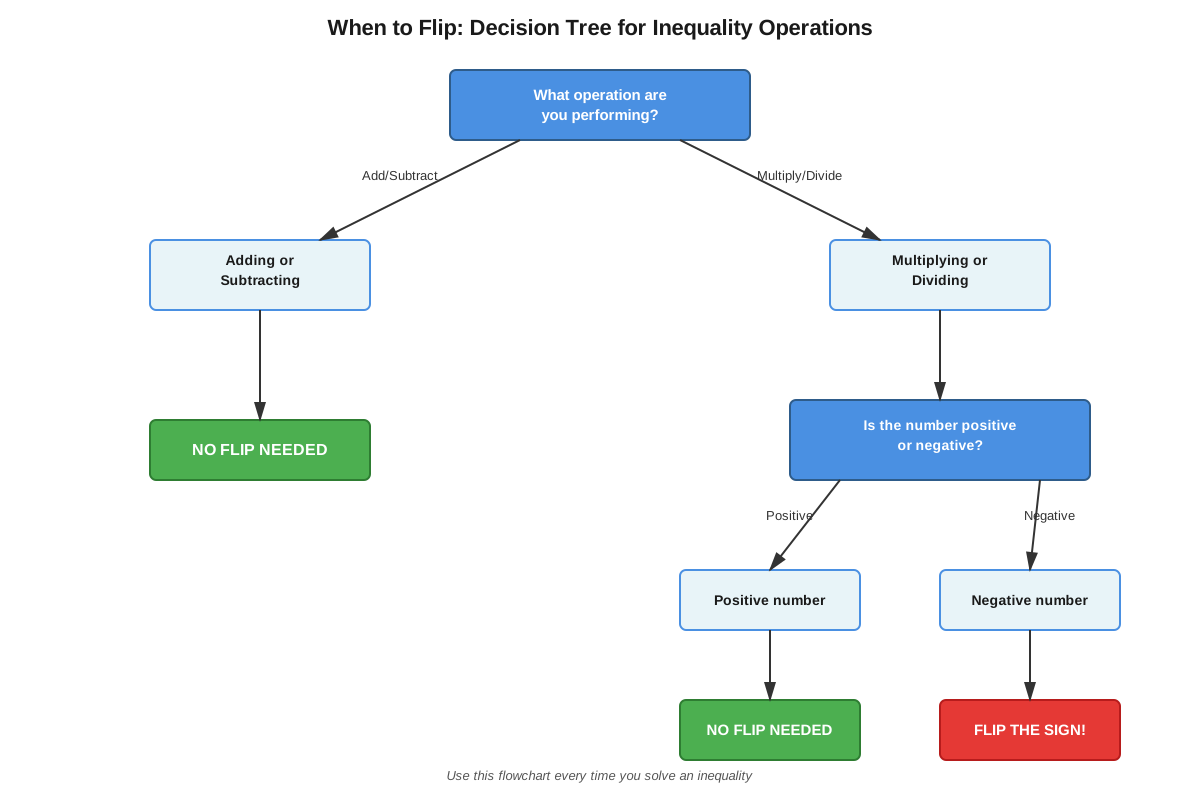
The core principle is straightforward: when multiplying or dividing both sides of an inequality by a negative number, the inequality sign must be reversed. This means < becomes >, > becomes <, ≤ becomes ≥, and ≥ becomes ≤. This rule exists because multiplication or division by a negative number reverses the order relationship between numbers on the number line.
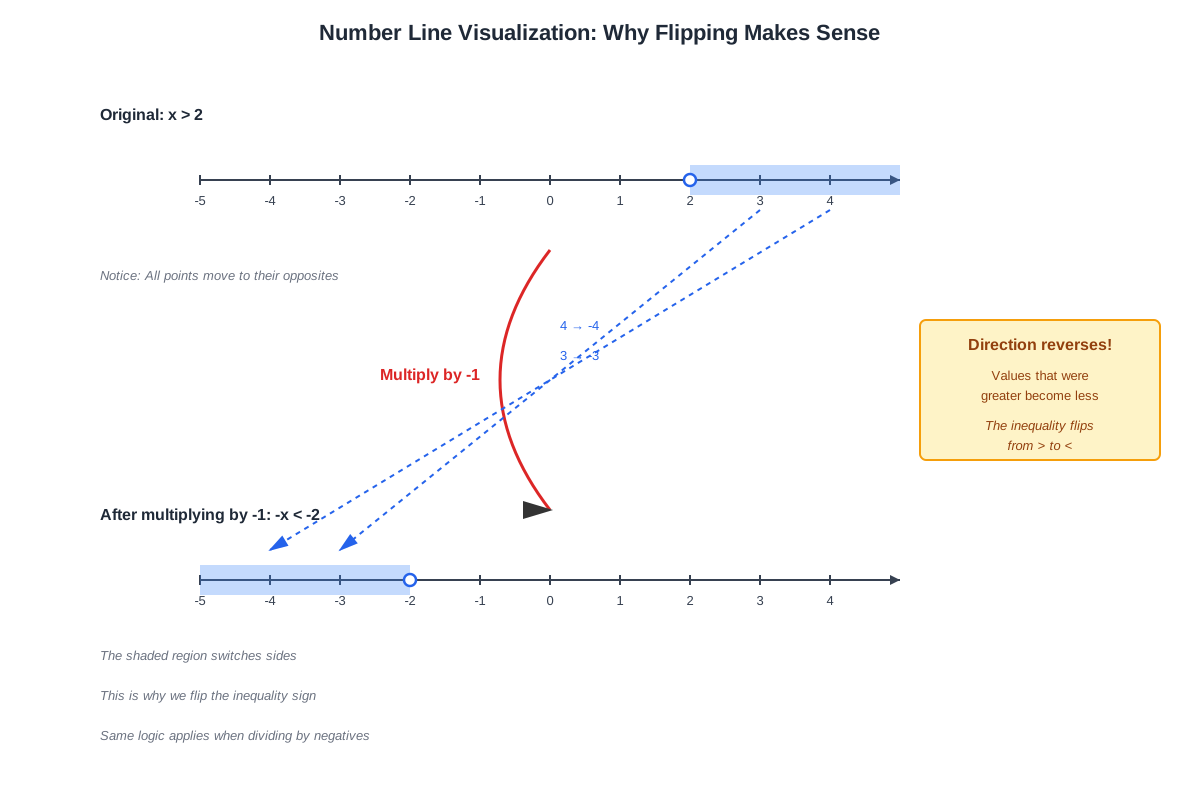
Consider the true statement: 3 < 5. If we multiply both sides by -1, we get -3 and -5. However, -3 is NOT less than -5; rather, -3 > -5. The order has reversed because negative numbers increase in value as they move left on the number line (toward zero and beyond). This fundamental property of negative numbers necessitates the flipping rule.
Operations That Require Flipping
Only two operations require flipping the inequality sign:
- Multiplying both sides by a negative number
- Dividing both sides by a negative number
These operations fundamentally change the order relationship. For example:
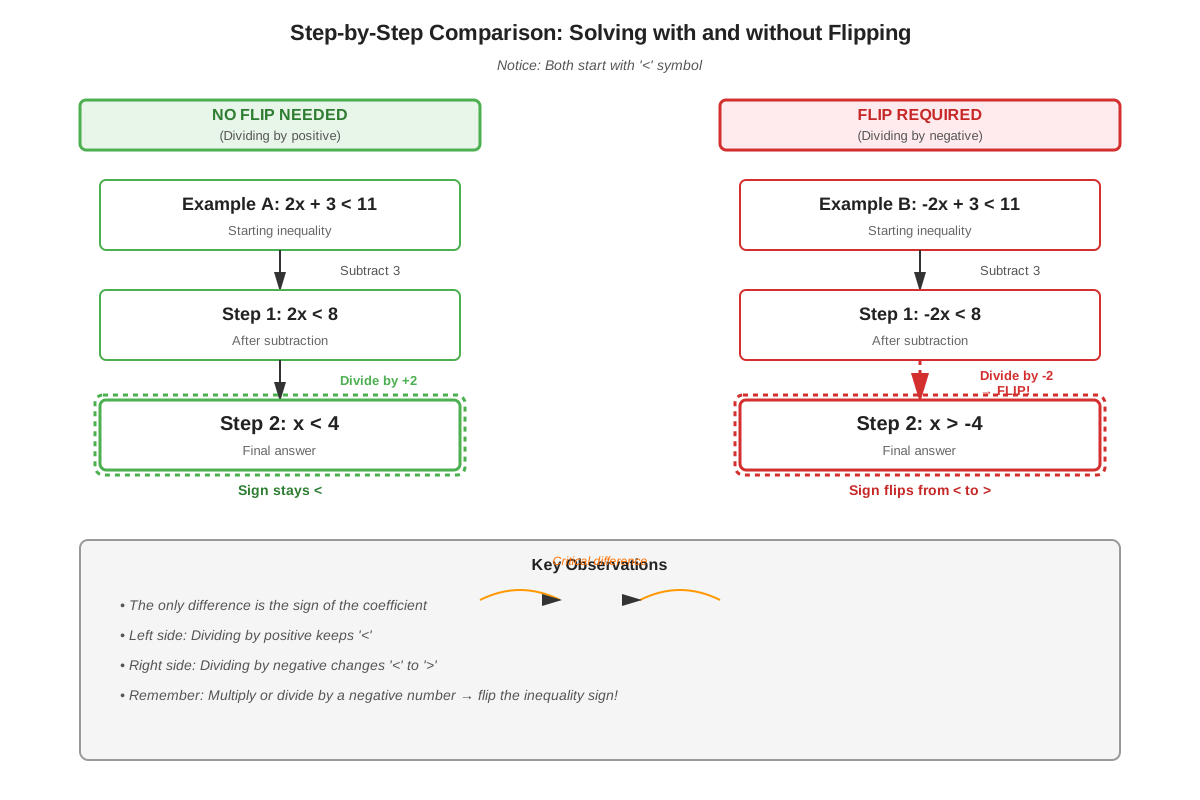
- Starting with: -2x < 6
- Dividing both sides by -2: x > -3 (sign flipped from < to >)
Operations That Do NOT Require Flipping
Understanding what doesn't require flipping is equally important:
| Operation | Requires Flipping? | Example |
|---|---|---|
| Adding any number | No | x - 3 < 5 → x < 8 |
| Subtracting any number | No | x + 4 > 2 → x > -2 |
| Multiplying by a positive number | No | 2x < 10 → x < 5 |
| Dividing by a positive number | No | 3x ≥ 12 → x ≥ 4 |
| Multiplying by zero | Special case (creates equality) | Not typically tested |
Step-by-Step Process for Solving Inequalities
- Simplify both sides of the inequality (combine like terms, distribute)
- Isolate the variable term using addition or subtraction (no flipping needed)
- Isolate the variable by multiplying or dividing
- Check the coefficient of the variable term:
- If positive: divide/multiply without flipping
- If negative: divide/multiply AND flip the sign
- Verify by testing a value from the solution set
Why the Rule Exists: The Mathematical Foundation
The flipping rule stems from the transitive property of order and how negative multiplication affects it. On a number line, if a < b, then a is to the left of b. Multiplying both by -1 reflects them across zero: -a is now to the right of -b, meaning -a > -b. This geometric interpretation helps visualize why the relationship reverses.
Algebraically, the rule preserves truth. If we didn't flip the sign when multiplying by a negative, we would create false statements. The flipping rule is not arbitrary; it's a logical necessity that maintains the validity of mathematical relationships.
Common Scenarios on the SAT
Scenario 1: Negative coefficient already present
-3x + 7 > 13
-3x > 6
x < -2  (flipped when dividing by -3)
Scenario 2: Creating a negative coefficient
5 - 2x ≤ 11
-2x ≤ 6
x ≥ -3  (flipped when dividing by -2)
Scenario 3: Variable on the right side
8 < -4x
-2 > x  (flipped when dividing by -4)
or equivalently: x < -2
Compound Inequalities and Flipping
When dealing with compound inequalities (like -3 < 2x - 1 < 5), the flipping rule applies to all parts simultaneously. If you multiply or divide the entire compound inequality by a negative number, flip all inequality signs:
-6 < -2x < 4
3 > x > -2  (both signs flipped when dividing by -2)
or rewritten: -2 < x < 3
Concept Relationships
The concept of flipping inequality signs sits at the intersection of several mathematical ideas. It directly builds upon basic inequality notation, requiring students to understand what inequality symbols mean before learning when to reverse them. The concept relies heavily on properties of negative numbers, particularly how multiplication by negatives reverses order relationships on the number line.
Flipping inequality signs → enables → solving linear inequalities → which enables → graphing inequality solutions → which connects to → systems of inequalities
The relationship to equation solving is both parallel and distinct: the processes are nearly identical except for the flipping rule. This makes the concept a natural extension of equation-solving skills while requiring additional vigilance. The concept also connects forward to absolute value inequalities, where the flipping rule applies when isolating the absolute value expression with a negative coefficient.
Within the topic itself, understanding when to flip (negative multiplication/division) is inseparable from understanding when not to flip (all other operations). These form two sides of the same conceptual coin. The verification process (testing solutions) serves as a feedback mechanism that reinforces correct application of the flipping rule.
High-Yield Facts
⭐ The inequality sign flips ONLY when multiplying or dividing both sides by a negative number
⭐ Adding or subtracting any number (positive or negative) NEVER requires flipping the inequality sign
⭐ Multiplying or dividing by a positive number NEVER requires flipping the inequality sign
⭐ When dividing or multiplying a compound inequality by a negative, ALL inequality signs must flip
⭐ The most common SAT trap is forgetting to flip when dividing by a negative coefficient
- If -x < 5, then x > -5 (multiplying by -1 flips the sign)
- The inequality x < 3 and 3 > x express the same relationship (the variable's position doesn't determine flipping)
- When solving -ax > b (where a is positive), the solution is x < -b/a (sign flips)
- Flipping preserves the truth of the inequality; not flipping creates a false statement
- Testing a value from your solution set in the original inequality verifies correct flipping
- The direction of the inequality sign indicates which side of the boundary point contains solutions
Quick check — test yourself on Flipping inequality signs so far.
Try Flashcards →Common Misconceptions
Misconception: The inequality sign flips whenever you perform any operation involving a negative number.
Correction: The sign flips ONLY when multiplying or dividing by a negative. Adding or subtracting negative numbers does not require flipping. For example, x + (-3) < 5 becomes x < 8 without any flipping.
Misconception: If the variable has a negative coefficient, the inequality sign should be flipped immediately.
Correction: The sign flips only when you perform the operation of dividing or multiplying to remove that negative coefficient. The presence of a negative coefficient alone doesn't trigger flipping; the action of dividing by it does.
Misconception: When moving a term with a negative sign to the other side, you must flip the inequality.
Correction: Moving terms using addition or subtraction never requires flipping. For example, -2x + 3 < 7 becomes -2x < 4 (subtracted 3 from both sides, no flip). The flip occurs only when you divide by -2: x > -2.
Misconception: In compound inequalities, you only flip one of the inequality signs when dividing by a negative.
Correction: When multiplying or dividing a compound inequality by a negative number, ALL inequality signs must flip simultaneously. For -4 < -2x < 6, dividing by -2 gives 2 > x > -3 (both signs flipped).
Misconception: The inequality sign direction depends on whether the variable is on the left or right side of the inequality.
Correction: The position of the variable doesn't determine flipping; only the operation performed does. Whether you write x < 3 or 3 > x, these are equivalent statements. Flipping occurs based on multiplication/division by negatives, not variable position.
Misconception: Multiplying or dividing by a variable requires flipping the inequality sign.
Correction: On the SAT, you should avoid multiplying or dividing by variables in inequalities because you don't know if the variable is positive or negative. If it's negative, you'd need to flip; if positive, you wouldn't. SAT problems are designed to avoid this ambiguity.
Worked Examples
Example 1: Direct Application with Negative Division
Problem: Solve for x: -3x + 5 ≤ 14
Solution:
Step 1: Isolate the term with x by subtracting 5 from both sides
-3x + 5 ≤ 14
-3x ≤ 9
Note: Subtracting 5 does NOT require flipping the inequality sign.
Step 2: Divide both sides by -3 to isolate x
-3x ≤ 9
x ≥ -3
Critical step: We divided by -3 (a negative number), so we MUST flip the inequality sign from ≤ to ≥.
Step 3: Verify by testing a value
Let's test x = 0 (which is in our solution set x ≥ -3):
-3(0) + 5 ≤ 14
5 ≤ 14 ✓ True
Let's test x = -4 (which is NOT in our solution set):
-3(-4) + 5 ≤ 14
12 + 5 ≤ 14
17 ≤ 14 ✗ FalseAnswer: x ≥ -3
This example directly addresses the learning objective of applying flipping inequality signs to solve problems. The key insight is recognizing that only the division by -3 required flipping, not the subtraction of 5.
Example 2: SAT-Style Word Problem
Problem: A company's profit P (in thousands of dollars) is modeled by the inequality -2P + 15 > 7. Which of the following represents all possible values of P?
A) P > 4
B) P < 4
C) P > -4
D) P < -4
Solution:
Step 1: Solve the inequality
-2P + 15 > 7Step 2: Subtract 15 from both sides
-2P > -8No flipping occurs here; we only subtracted.
Step 3: Divide both sides by -2
P < 4Critical: We divided by -2 (negative), so we flip from > to <.
Step 4: Identify the trap
Notice that answer choice A (P > 4) is what you'd get if you forgot to flip. This is the most common wrong answer and exactly the trap the SAT sets.
Step 5: Verify with a test value
Test P = 0 (which is in P < 4):
-2(0) + 15 > 7
15 > 7 ✓ True
Test P = 5 (which is NOT in P < 4):
-2(5) + 15 > 7
-10 + 15 > 7
5 > 7 ✗ FalseAnswer: B) P < 4
This example demonstrates how the SAT tests flipping inequality signs in context, embedding it within a word problem and providing the "forgot to flip" answer as a distractor. Recognizing this pattern is essential for exam success.
Exam Strategy
When approaching SAT questions involving inequalities, follow this systematic approach:
Step 1: Identify the inequality - Look for symbols <, >, ≤, ≥ rather than = signs. This immediately signals that flipping rules may apply.
Step 2: Plan your solution path - Before manipulating, identify whether you'll need to multiply or divide by a negative number. If yes, mentally prepare to flip.
Step 3: Watch for trigger phrases:
- "Solve for x" or "Which inequality represents..."
- "All possible values"
- "Solution set"
- Any problem with negative coefficients on variables
Step 4: Execute carefully - Perform one operation at a time. After each step involving multiplication or division, check the sign of the number you're using.
Step 5: Verify quickly - If time permits, plug in a simple test value from your solution set. This catches flipping errors immediately.
Exam Tip: The SAT almost always includes the "forgot to flip" answer as a distractor. If you see your answer and its opposite both listed, double-check your flipping.
Process of Elimination Strategy:
- Eliminate answers that would be correct if the problem were an equation (these often represent the "forgot to flip" trap)
- If you're unsure, test the boundary value in each answer choice
- Remember that ≤ and < point in the same direction; if you know the direction, you can often eliminate two answers immediately
Time Allocation:
- Simple inequality solving: 30-45 seconds
- Word problems with inequalities: 60-90 seconds
- Always reserve 10-15 seconds for verification if possible
Red Flags - Double-check your work if:
- You divided or multiplied by a negative but didn't flip
- The problem has multiple negative signs
- You see your answer and its opposite in the choices
- The inequality direction seems counterintuitive to the word problem context
Memory Techniques
Primary Mnemonic: "FLIP for NEGATIVE TIMES"
- Flip the sign
- Like clockwork
- If you
- Perform multiplication or division by a NEGATIVE
Visual Memory Aid: Picture a number line. When you multiply by -1, imagine the entire line flipping/rotating 180° around zero. Numbers that were on the right (greater) are now on the left (lesser), and vice versa.
The "Opposite Operation" Reminder:
- Negative numbers are "opposite" of positive numbers
- So multiplication/division by negatives creates "opposite" inequality directions
- Opposite × Opposite = Flip
Acronym for Operations: "ASMD-PN"
- Addition: No flip
- Subtraction: No flip
- Multiplication: Flip if negative
- Division: Flip if negative
- Positive: Never flip
- Negative: Always flip (for M and D only)
The "Test Value" Habit: Always test x = 0 or another simple value after solving. Make this automatic. If your solution doesn't work when tested, you likely forgot to flip.
Rhyme Memory Device:
"When you multiply or divide by less than zero,
Flip that sign to be a hero!"
Summary
Flipping inequality signs is a precise rule that distinguishes inequality solving from equation solving: when multiplying or dividing both sides of an inequality by a negative number, the inequality sign must be reversed. This rule exists because negative multiplication reverses order relationships on the number line. The SAT tests this concept frequently, often embedding it in word problems or multi-step algebraic manipulations, with answer choices specifically designed to catch students who forget to flip. Mastery requires understanding that only multiplication and division by negatives trigger flipping—addition, subtraction, and operations with positive numbers never do. Success on SAT inequality questions depends on systematic problem-solving: identifying when flipping is necessary, executing the flip correctly, and verifying solutions by testing values. The most common error is forgetting to flip when dividing by a negative coefficient, which produces an answer that is the exact opposite of the correct solution. Students who internalize the flipping rule and develop the habit of verification can confidently tackle any inequality problem on the SAT.
Key Takeaways
- Flipping inequality signs occurs ONLY when multiplying or dividing both sides by a negative number—this is the single most important rule for SAT inequalities
- Addition and subtraction never require flipping, regardless of whether the numbers involved are positive or negative
- The SAT deliberately includes "forgot to flip" answers as distractors, making verification essential
- In compound inequalities, all inequality signs must flip simultaneously when dividing or multiplying by a negative
- Testing a simple value (like x = 0) in your solution set provides immediate confirmation that you flipped correctly
- The flipping rule preserves mathematical truth; forgetting to flip creates false statements and wrong answers
- Recognizing negative coefficients early in the problem-solving process helps you anticipate when flipping will be necessary
Related Topics
Compound Inequalities: Building on flipping inequality signs, compound inequalities involve solving two inequalities simultaneously (e.g., -3 < 2x + 1 < 7), requiring application of the flipping rule to multiple parts at once.
Absolute Value Inequalities: These problems often require splitting into two cases and frequently involve negative coefficients, making the flipping rule essential for correct solutions.
Systems of Inequalities: Graphing and solving systems requires correctly solving individual inequalities first, making flipping inequality signs a foundational skill for this more complex topic.
Quadratic Inequalities: While more advanced, these build on linear inequality concepts and require the same flipping rules when manipulating expressions with negative coefficients.
Linear Programming: This application-focused topic uses systems of linear inequalities to model real-world optimization problems, requiring mastery of basic inequality manipulation including flipping.
Mastering flipping inequality signs creates a solid foundation for all these advanced topics and ensures confidence across the entire SAT math section's inequality content.
Practice CTA
Now that you understand the critical concept of flipping inequality signs, it's time to cement your mastery through practice. Work through the practice questions to apply these concepts under test-like conditions, and use the flashcards to reinforce the key rules and common traps. Remember: the difference between a good SAT math score and a great one often comes down to avoiding simple errors like forgetting to flip. Every practice problem you solve correctly builds the automatic habits that will serve you on test day. You've got this—now prove it with practice!
Sign up free to keep reading
Create a free AnvayaPrep account to finish this SAT guide on Flipping inequality signs — plus flashcards and practice questions.