Overview
Solving inequalities is a fundamental algebraic skill that appears frequently on the SAT math section, representing a critical bridge between basic equation-solving and more complex mathematical reasoning. Unlike equations that yield single solutions, inequalities describe ranges of values that satisfy given conditions, requiring students to think about solution sets rather than isolated answers. This topic typically appears in 3-5 questions per SAT exam, making it a high-yield area for score improvement.
Mastery of SAT solving inequalities extends beyond mechanical manipulation of symbols. Students must understand how operations affect inequality signs, interpret solutions on number lines, recognize when to reverse inequality directions, and translate word problems into algebraic inequalities. The SAT tests these skills through direct algebraic problems, real-world application scenarios, and questions requiring interpretation of solution sets in context.
The relationship between solving inequalities and other math concepts is extensive. Inequalities build directly on equation-solving techniques while introducing unique considerations about direction and range. They connect to absolute value problems, systems of equations, graphing linear relationships, and function analysis. Understanding inequalities also provides essential groundwork for optimization problems, constraint-based reasoning, and interpreting mathematical models—all of which appear throughout the SAT math section.
Learning Objectives
- [ ] Identify key features of solving inequalities, including inequality symbols, solution sets, and boundary values
- [ ] Explain how solving inequalities appears on the SAT, including question formats and common contexts
- [ ] Apply solving inequalities to answer SAT-style questions with accuracy and efficiency
- [ ] Determine when to reverse inequality signs during algebraic manipulation
- [ ] Represent inequality solutions using interval notation, number lines, and set-builder notation
- [ ] Translate real-world constraints into algebraic inequalities and interpret solutions in context
- [ ] Solve compound inequalities and identify intersection or union of solution sets
Prerequisites
- Basic algebraic manipulation: Adding, subtracting, multiplying, and dividing both sides of equations—these same operations apply to inequalities with additional rules
- Understanding of number line representation: Visualizing numbers and intervals on a line helps interpret inequality solutions spatially
- Order of operations (PEMDAS): Correctly simplifying expressions before applying inequality-solving techniques prevents errors
- Negative number operations: Multiplying or dividing by negative numbers triggers the inequality reversal rule, making this knowledge essential
- Equation-solving fundamentals: The process of isolating variables in equations transfers directly to inequality solving with modifications
Why This Topic Matters
Inequalities model real-world constraints that equations cannot capture. Budget limitations, minimum requirements, speed limits, temperature ranges, and capacity restrictions all require inequality reasoning. In professional fields from engineering to economics, inequalities describe feasible regions, optimization constraints, and acceptable parameter ranges. This practical relevance makes inequality problems particularly common in SAT word problems that test mathematical modeling skills.
On the SAT, solving inequalities appears in approximately 10-15% of math questions, distributed across both calculator and no-calculator sections. Questions range from straightforward algebraic manipulation to multi-step word problems requiring translation, solving, and interpretation. The College Board frequently embeds inequality concepts within questions about functions, systems, and real-world scenarios, making this topic a connector between different mathematical domains.
Common SAT question formats include: direct "solve for x" problems with inequality symbols; word problems describing constraints or ranges; questions asking which values satisfy given conditions; problems requiring interpretation of solution sets; and questions combining inequalities with absolute values or systems. The exam also tests whether students understand that inequality solutions represent infinite sets of values rather than single numbers, often through answer choices that distinguish between correct ranges and incorrect single values.
Core Concepts
Understanding Inequality Symbols
The foundation of solving inequalities begins with understanding the four primary inequality symbols and their meanings. The symbol < means "less than," indicating that the left side is strictly smaller than the right side. The symbol > means "greater than," showing the left side exceeds the right side. The symbols ≤ (less than or equal to) and ≥ (greater than or equal to) include the boundary value itself in the solution set, representing a crucial distinction from strict inequalities.
| Symbol | Meaning | Example | Solution Description |
|---|---|---|---|
| < | Less than | x < 5 | All values smaller than 5 |
| > | Greater than | x > -2 | All values larger than -2 |
| ≤ | Less than or equal to | x ≤ 3 | All values up to and including 3 |
| ≥ | Greater than or equal to | x ≥ 0 | All values from 0 upward |
Basic Inequality Solving Procedures
Solving linear inequalities follows procedures nearly identical to solving equations, with one critical exception. The fundamental principle involves isolating the variable on one side through inverse operations while maintaining the inequality relationship.
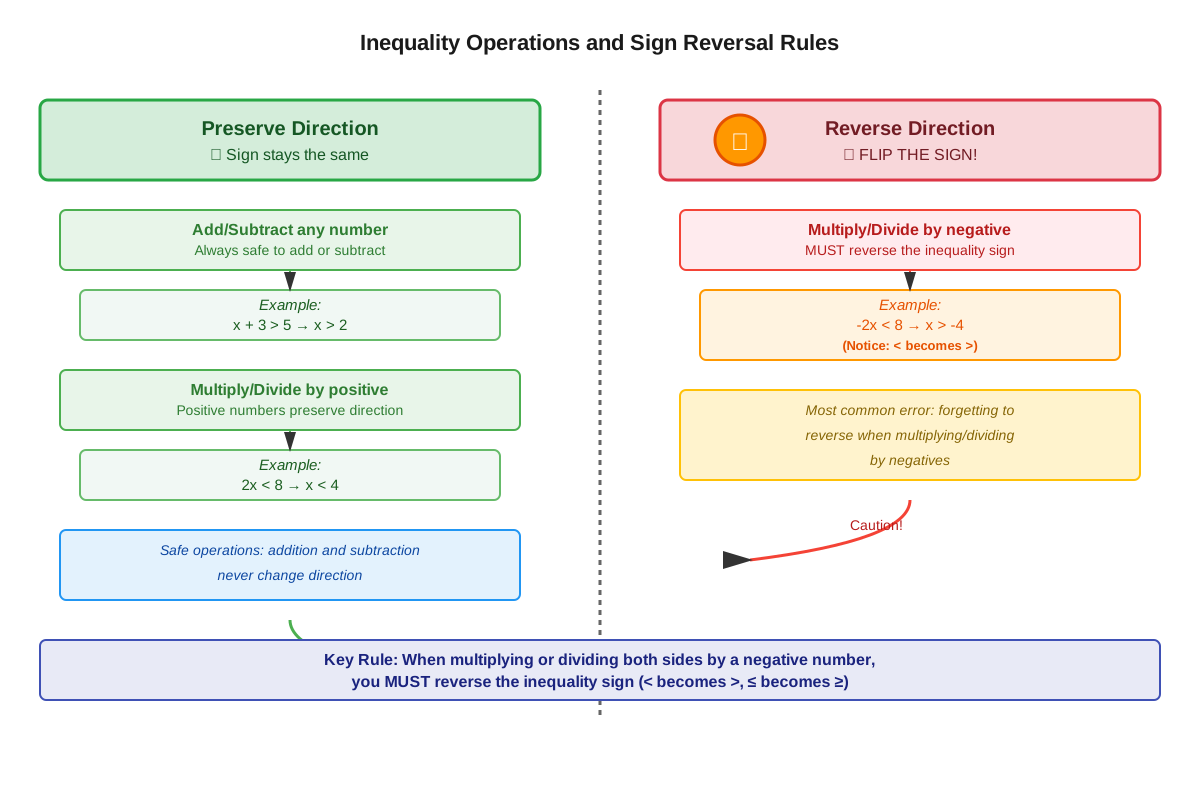
Addition and Subtraction Property: Adding or subtracting the same value from both sides preserves the inequality direction. If x + 7 > 12, subtracting 7 from both sides yields x > 5. This property works identically to equations because adding or subtracting shifts all values equally without changing their relative order.
Multiplication and Division by Positive Numbers: Multiplying or dividing both sides by a positive number maintains the inequality direction. If 3x < 15, dividing both sides by 3 gives x < 5. The relative order of numbers remains unchanged when scaling by positive factors.
The Reversal Rule: When multiplying or dividing both sides by a negative number, the inequality sign must reverse direction. This is the most critical distinction between equations and inequalities. If -2x > 8, dividing both sides by -2 requires flipping the inequality: x < -4. This reversal occurs because multiplying by a negative number inverts the number line order (larger numbers become smaller and vice versa).
Step-by-Step Solving Process
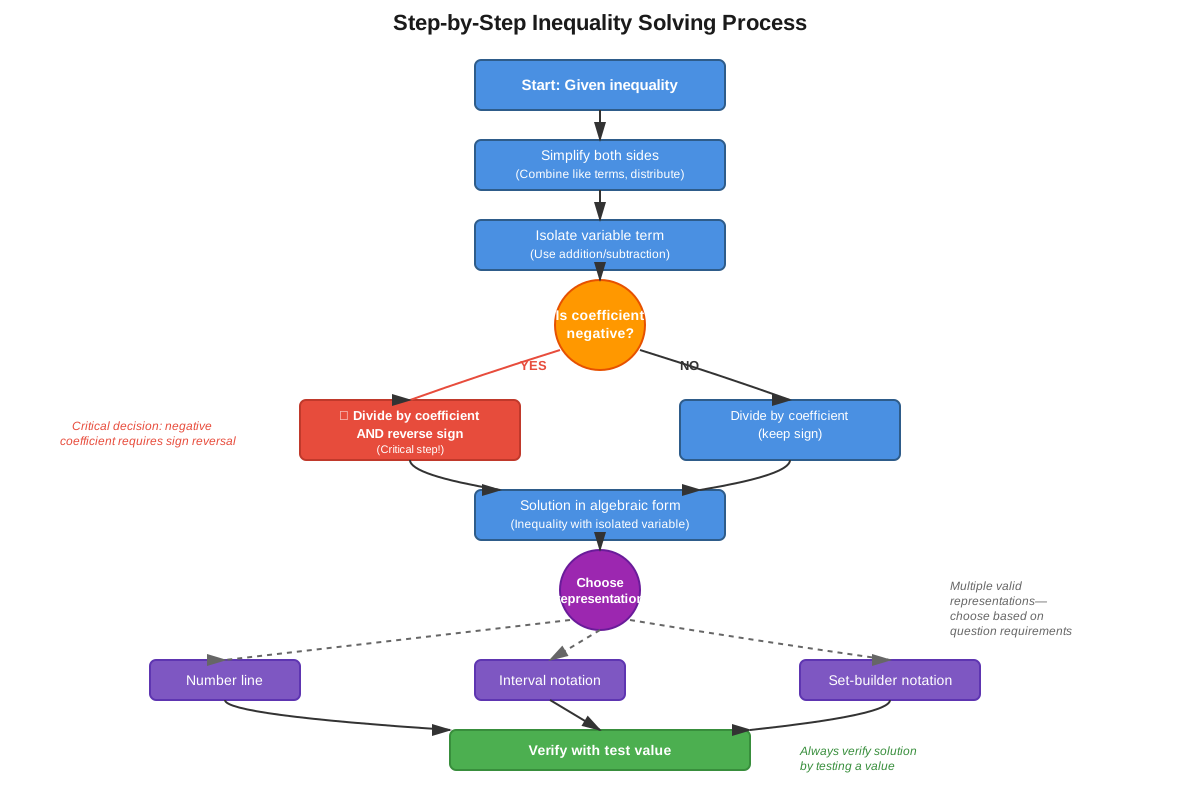
- Simplify both sides: Combine like terms and distribute as needed
- Collect variable terms: Move all terms containing the variable to one side using addition/subtraction
- Collect constant terms: Move all numbers without variables to the opposite side
- Isolate the variable: Divide or multiply to get the variable alone, reversing the inequality if using a negative number
- Express the solution: Write the answer in appropriate notation and verify with a test value
Compound Inequalities
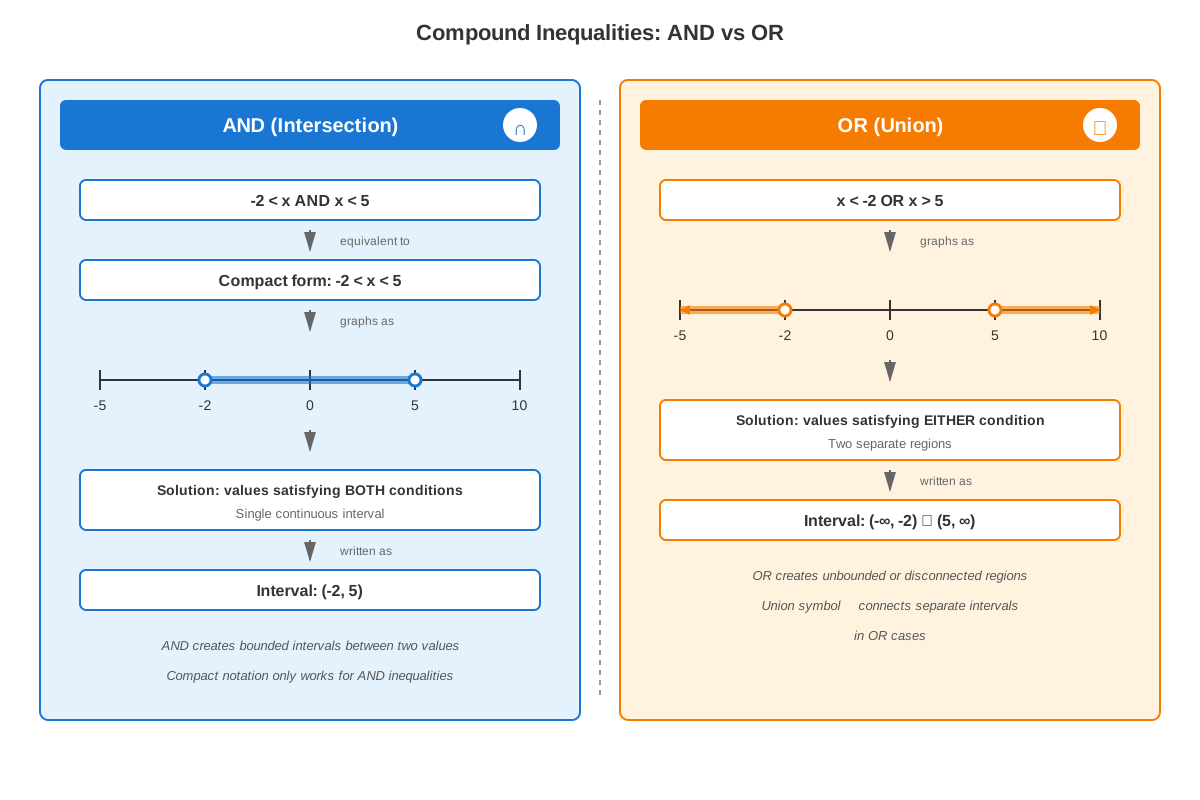
Compound inequalities involve two inequality statements connected by "and" or "or." An "and" compound inequality like 2 < x < 7 means x must satisfy both x > 2 AND x < 7 simultaneously, creating an intersection of solution sets. An "or" compound inequality like x < -1 or x > 3 means x satisfies at least one condition, creating a union of solution sets.
To solve compound inequalities with three parts (like 1 < 2x + 3 ≤ 9), perform the same operation to all three parts simultaneously. Subtract 3 from all parts: -2 < 2x ≤ 6. Then divide all parts by 2: -1 < x ≤ 3. This maintains the relationships between all three expressions.
Representing Solutions
Solutions to inequalities can be expressed in multiple equivalent forms:
Inequality notation: x > 3 or x ≤ -2
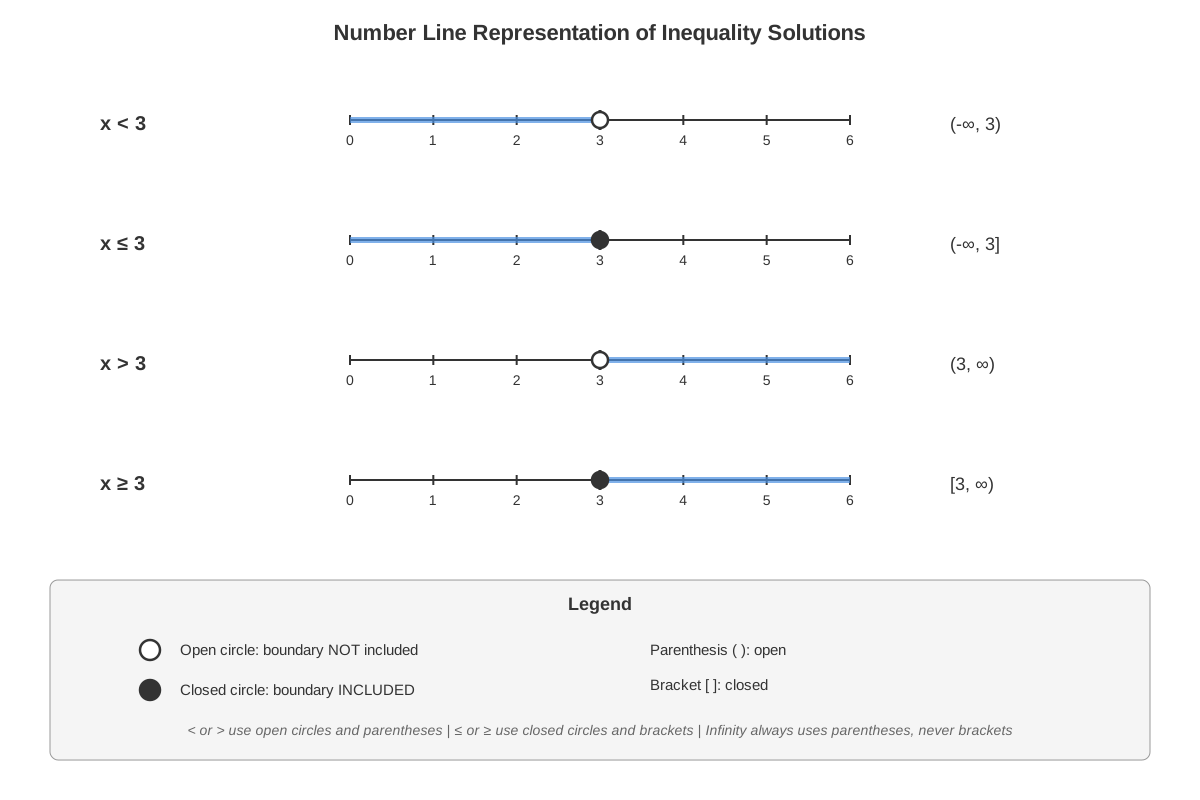
Interval notation: (3, ∞) or (-∞, -2]—parentheses indicate excluded endpoints, brackets indicate included endpoints
Number line graphs: Open circles for strict inequalities (< or >), closed circles for inclusive inequalities (≤ or ≥), with shading showing the solution region
Set-builder notation: {x | x > 3}, read as "the set of all x such that x is greater than 3"
Special Cases and Edge Scenarios
Some inequalities simplify to statements that are always true or always false. If solving yields 5 > 2 (a true statement with no variables), the solution is all real numbers because any value satisfies the original inequality. If solving yields 3 < 1 (a false statement), there is no solution because no value can satisfy the original inequality.
When dealing with absolute value inequalities, the approach differs based on the inequality direction. For |x| < a (where a > 0), the solution is -a < x < a. For |x| > a, the solution is x < -a or x > a. These patterns reflect the distance interpretation of absolute value.
Concept Relationships
The core concepts within solving inequalities form a logical progression: understanding inequality symbols → applying basic solving procedures → recognizing when to reverse inequalities → handling compound inequalities → representing solutions in multiple forms. Each step builds on previous knowledge while adding complexity.
The reversal rule connects directly to negative number operations from prerequisite knowledge. Understanding why multiplying by negatives reverses order requires visualizing the number line transformation. Basic solving procedures extend equation-solving techniques, making that prerequisite essential. The connection flows: equation solving → inequality solving → compound inequalities → systems of inequalities.
Solving inequalities also connects forward to numerous SAT topics. Graphing linear inequalities requires solving for y and understanding solution regions. Systems of inequalities combine multiple constraints. Function domain and range problems often involve inequality reasoning. Optimization problems require setting up and solving inequalities representing constraints. The relationship map flows: Solving inequalities → Graphing inequalities → Systems of inequalities → Linear programming → Optimization problems.
High-Yield Facts
⭐ When multiplying or dividing both sides of an inequality by a negative number, the inequality sign must reverse direction.
⭐ The solution to an inequality is typically a range of values (infinite set), not a single value.
⭐ For compound inequalities with "and," the solution is the intersection (overlap) of both conditions; for "or," it's the union (combination) of both conditions.
- Adding or subtracting the same value from both sides never requires reversing the inequality sign.
⭐ Open circles on number lines represent strict inequalities (< or >); closed circles represent inclusive inequalities (≤ or ≥).
- Multiplying or dividing both sides by a positive number preserves the inequality direction.
⭐ To solve three-part compound inequalities like a < bx + c < d, perform the same operation to all three parts simultaneously.
- Interval notation uses parentheses ( ) for excluded endpoints and brackets [ ] for included endpoints.
- If an inequality simplifies to a true statement like 5 > 2, the solution is all real numbers.
- If an inequality simplifies to a false statement like 3 < 1, there is no solution.
⭐ The inequality x < 5 includes all values less than 5 but not 5 itself; x ≤ 5 includes 5 in the solution set.
- When solving word problems, phrases like "at least" translate to ≥, while "at most" translates to ≤.
- "More than" translates to >, while "less than" translates to <.
Quick check — test yourself on Solving inequalities so far.
Try Flashcards →Common Misconceptions
Misconception: The inequality sign always stays the same when solving, just like the equals sign in equations.
Correction: The inequality sign must reverse when multiplying or dividing both sides by a negative number. This is the fundamental difference between equations and inequalities. For example, solving -3x > 6 requires dividing by -3, which reverses the inequality to x < -2.
Misconception: The solution x < 5 means x equals 4 (the largest integer less than 5).
Correction: The solution x < 5 represents all real numbers less than 5, including 4.9, 4.99, 4.999, and infinitely many non-integer values. Inequality solutions are continuous ranges, not discrete values.
Misconception: When graphing x > 3 on a number line, use a closed circle at 3.
Correction: Strict inequalities (< and >) require open circles because the boundary value is not included in the solution. Only ≤ and ≥ use closed circles. The notation x > 3 means 3 itself is not a solution.
Misconception: For compound inequalities like x < 2 or x > 5, the solution is the overlap between the two conditions.
Correction: "Or" compound inequalities represent a union (combination) of solution sets, not an intersection. The solution includes all values less than 2 AND all values greater than 5. "And" compound inequalities require intersection (overlap).
Misconception: Reversing the inequality sign is necessary whenever there's a negative number anywhere in the problem.
Correction: The reversal rule only applies when multiplying or dividing both sides by a negative number. Simply having negative numbers in the inequality (like -3 < x or x + (-5) > 2) doesn't trigger reversal unless you perform multiplication or division by a negative value.
Misconception: The inequality 3 < x < 7 can be solved by working on one side at a time independently.
Correction: Three-part compound inequalities must maintain their relationships throughout solving. Perform the same operation to all three parts simultaneously. Solving one inequality at a time and then combining can lead to errors in tracking the relationships.
Misconception: Interval notation (3, 7) and the ordered pair (3, 7) mean the same thing.
Correction: Interval notation (3, 7) represents all real numbers between 3 and 7, while the ordered pair (3, 7) represents a single point in the coordinate plane. Context determines meaning, but on inequality problems, parentheses indicate interval notation.
Worked Examples
Example 1: Multi-Step Inequality with Negative Coefficient
Problem: Solve for x: -4x + 7 ≤ 23
Solution:
Step 1: Isolate the term containing x by subtracting 7 from both sides.
-4x + 7 - 7 ≤ 23 - 7
-4x ≤ 16
Step 2: Divide both sides by -4 to isolate x. Since we're dividing by a negative number, reverse the inequality sign.
-4x ≤ 16
x ≥ -4  (inequality reversed)
Step 3: Express the solution. The solution is x ≥ -4, meaning all values greater than or equal to -4 satisfy the original inequality.
Verification: Test a value in the solution set, such as x = 0:
-4(0) + 7 = 7, and 7 ≤ 23 ✓
Test the boundary value x = -4:
-4(-4) + 7 = 16 + 7 = 23, and 23 ≤ 23 ✓
This example demonstrates the critical reversal rule and connects to the learning objective of applying solving techniques to SAT-style questions. The verification step models good test-taking practice.
Example 2: Compound Inequality Word Problem
Problem: A rental car company charges a flat fee of $30 plus $0.25 per mile driven. Sarah has a budget of at least $50 but no more than $80 for the rental. Write and solve a compound inequality to find the possible number of miles Sarah can drive.
Solution:
Step 1: Define the variable. Let m = number of miles driven.
Step 2: Write the cost expression. Total cost = 30 + 0.25m
Step 3: Translate the constraints into a compound inequality. "At least $50" means ≥ 50, and "no more than $80" means ≤ 80.
50 ≤ 30 + 0.25m ≤ 80Step 4: Solve by performing the same operations to all three parts. Subtract 30 from all parts:
50 - 30 ≤ 30 + 0.25m - 30 ≤ 80 - 30
20 ≤ 0.25m ≤ 50
Step 5: Divide all parts by 0.25 (a positive number, so no reversal):
20 ÷ 0.25 ≤ m ≤ 50 ÷ 0.25
80 ≤ m ≤ 200Answer: Sarah can drive between 80 and 200 miles, inclusive.
Interpretation: The solution 80 ≤ m ≤ 200 means Sarah must drive at least 80 miles to spend her minimum budget of $50, and she can drive up to 200 miles while staying within her maximum budget of $80.
This example addresses the learning objective of translating real-world scenarios into inequalities and interpreting solutions in context—a high-yield SAT skill. It demonstrates compound inequality solving and connects mathematical solutions back to practical meaning.
Exam Strategy
When approaching SAT inequality questions, first identify whether the problem requires setting up an inequality from a word problem or solving a given inequality. Word problems typically contain trigger phrases: "at least" (≥), "at most" (≤), "more than" (>), "less than" (<), "minimum" (≥), "maximum" (≤), "no more than" (≤), and "no less than" (≥). Underline these phrases to ensure correct translation.
Before solving, scan for negative coefficients attached to the variable. If present, mentally prepare to reverse the inequality when dividing or multiplying to isolate the variable. This anticipation prevents the most common error on inequality questions. Many SAT wrong answer choices are specifically designed to trap students who forget to reverse the sign.
Exam Tip: When you see a negative coefficient with the variable, write "REVERSE" next to the problem as a reminder before you begin solving.
For multiple-choice questions, use the answer choices strategically. If answers are given as inequalities or intervals, test the boundary values in the original inequality. The correct answer's boundary should make the inequality true (for ≤ or ≥) or false (for < or >). This verification technique catches reversal errors and arithmetic mistakes.
Process of elimination works powerfully on inequality questions. If the original inequality has x on the left side with a < symbol, and you're solving for x, the final answer should still have x on the left with either < or ≤ (unless you divided by a negative). Eliminate answers with reversed variable positions or incompatible inequality directions.
Time allocation for inequality questions should average 45-60 seconds for straightforward algebraic problems and 90-120 seconds for word problems requiring translation and interpretation. If a problem requires more than two minutes, mark it for review and move forward. Many inequality questions are designed to be solved quickly by students who recognize patterns.
Watch for questions asking "which value is NOT a solution" or "which value satisfies the inequality." These require different approaches: testing each answer choice in the original inequality. Start with the middle value if answers are numerical, as this can sometimes eliminate multiple choices at once.
Memory Techniques
Reversal Rule Mnemonic: "Negative Division Flips Inequalities" (NDFI). When you Need to Divide by a negative, Flip the Inequality sign. Visualize flipping a pancake—the negative operation flips the inequality direction.
Inequality Symbol Memory: Think of the inequality symbol as an alligator mouth that always wants to eat the bigger number. The open side faces the larger value: 5 > 3 (the mouth opens toward 5, the bigger number).
Compound Inequality Connector: "And means All must overlap" (both A's)—"and" compound inequalities require intersection. "Or means One is enough" (both O's)—"or" compound inequalities create unions.
Circle Type Visualization: Open circles for strict inequalities (< and >) because the O in "open" matches the O shape of the circle. Closed circles for inclusive inequalities (≤ and ≥) because you're closing the boundary into the solution set.
Interval Notation Brackets: Parentheses Prevent inclusion (both P's)—use ( ) when the endpoint is not included. Brackets Bring in the boundary (both B's)—use [ ] when the endpoint is included.
Translation Phrase Acronym: "MALL" for common inequality phrases:
- More than: >
- At least: ≥
- Less than: <
- Limit (at most): ≤
Summary
Solving inequalities represents a critical SAT math skill that extends equation-solving techniques while introducing the essential reversal rule for negative multiplication and division. Unlike equations that yield single solutions, inequalities describe ranges of values, requiring students to think about solution sets and represent them using inequality notation, interval notation, or number line graphs. The fundamental procedures mirror equation solving—using inverse operations to isolate variables—with the crucial distinction that multiplying or dividing by negative numbers reverses the inequality direction. Compound inequalities combine multiple constraints using "and" (intersection) or "or" (union), requiring simultaneous operations across all parts. SAT questions test these concepts through direct algebraic problems, word problems requiring translation of real-world constraints, and interpretation questions assessing understanding of solution sets. Mastery requires recognizing trigger phrases, anticipating reversal situations, verifying solutions with test values, and translating between different solution representations. Success on inequality questions directly impacts SAT scores because these problems appear frequently and connect to numerous other mathematical concepts including graphing, systems, functions, and optimization.
Key Takeaways
- The reversal rule is non-negotiable: Multiplying or dividing both sides by a negative number requires flipping the inequality sign—this is the most tested concept
- Inequality solutions are ranges, not single values: Understanding that x < 5 represents infinitely many values, not just 4, is essential for interpretation questions
- Master the translation phrases: "At least" (≥), "at most" (≤), "more than" (>), and "less than" (<) appear in virtually every word problem
- Compound inequalities require different approaches: "And" means intersection (overlap), "or" means union (combination)—confusing these leads to wrong answers
- Verification catches errors: Testing boundary values and values within the solution set confirms correct solving and identifies reversal mistakes
- Multiple representations strengthen understanding: Converting between inequality notation, interval notation, and number line graphs demonstrates complete mastery
- Negative coefficients demand attention: Scan for negative signs attached to variables before solving to mentally prepare for the reversal step
Related Topics
Graphing Linear Inequalities: Extends solving inequalities to two variables, requiring shading of solution regions on coordinate planes—mastery of one-variable inequalities is essential for understanding boundary lines and test points.
Systems of Inequalities: Combines multiple inequality constraints to find feasible regions—builds directly on compound inequality concepts and requires understanding intersection of solution sets.
Absolute Value Inequalities: Applies inequality solving to expressions containing absolute values, requiring case-by-case analysis—connects distance interpretation with inequality reasoning.
Quadratic Inequalities: Extends inequality concepts to expressions involving x², requiring sign analysis and interval testing—builds on linear inequality foundations while adding complexity.
Function Domain and Range: Uses inequality notation to describe input and output constraints for functions—understanding inequality representation is prerequisite for function analysis.
Practice CTA
Now that you've mastered the core concepts of solving inequalities, it's time to cement your understanding through active practice. The practice questions and flashcards are specifically designed to mirror SAT question formats and difficulty levels, giving you the repetition needed to build speed and accuracy. Each problem you solve strengthens your pattern recognition and reinforces the reversal rule, translation skills, and solution interpretation that appear on test day. Remember: understanding the concepts is the first step, but fluency comes from practice. Challenge yourself with the exercises, and watch your confidence—and your score—rise!
Sign up free to keep reading
Create a free AnvayaPrep account to finish this SAT guide on Solving inequalities — plus flashcards and practice questions.