Overview
Discounts represent one of the most practical and frequently tested applications of percentages on the SAT exam. At its core, a discount problem involves calculating the reduced price of an item after a percentage decrease has been applied to its original price. These questions appear regularly in both the calculator and no-calculator sections of SAT Math, making them essential for achieving a competitive score. Understanding discounts requires fluency with percentage calculations, decimal conversions, and the ability to work backward from final prices to original values.
The SAT tests discount problems in various contexts: retail sales, sequential discounts (multiple discounts applied one after another), tax and discount combinations, and word problems that require students to set up equations involving discounted prices. These questions assess not only computational accuracy but also conceptual understanding of how percentages interact with base values. Students who master discount calculations gain confidence in tackling a wide range of percentage-based problems, as the underlying mathematical principles extend to markup, interest, growth, and decay scenarios.
Discount problems connect directly to broader mathematical concepts including proportional reasoning, algebraic equation solving, and real-world modeling. They serve as a bridge between abstract percentage theory and practical applications, requiring students to translate verbal descriptions into mathematical operations. The ability to quickly identify whether a problem asks for the discount amount, the sale price, or the original price—and to select the appropriate calculation method—distinguishes high-scoring students from those who struggle with these seemingly straightforward questions.
Learning Objectives
- [ ] Identify key features of discounts including original price, discount rate, discount amount, and final sale price
- [ ] Explain how discounts appears on the SAT in various question formats and contexts
- [ ] Apply discounts to answer SAT-style questions involving single and multiple percentage reductions
- [ ] Calculate original prices when given sale prices and discount percentages
- [ ] Solve problems involving sequential discounts and understand why they differ from single equivalent discounts
- [ ] Distinguish between discount amount and discount rate in word problems
- [ ] Combine discount calculations with tax, tip, or markup in multi-step problems
Prerequisites
- Basic percentage concepts: Understanding that percentages represent parts per hundred is fundamental to calculating what portion of the original price is removed
- Decimal and fraction conversions: Converting percentages to decimals (e.g., 25% = 0.25) enables efficient calculation of discounted prices
- Order of operations: Correctly sequencing calculations ensures accurate results, especially in problems with multiple discounts or combined operations
- Basic algebraic manipulation: Setting up and solving equations is necessary when working backward from sale price to original price
- Multiplication and division fluency: Quick computation allows students to allocate time efficiently during the timed exam
Why This Topic Matters
Discount problems appear on virtually every SAT administration, typically accounting for 2-4 questions across the Math sections. These questions test fundamental quantitative reasoning skills that colleges view as indicators of mathematical maturity. Beyond the exam, understanding discounts develops financial literacy—a life skill essential for making informed consumer decisions, evaluating savings claims, and understanding how businesses price products.
On the SAT, discount questions appear in multiple formats: straightforward calculation problems, word problems embedded in real-world scenarios, and multi-step problems that combine discounts with other operations. The College Board frequently tests whether students understand that a 30% discount means paying 70% of the original price, not simply subtracting 30 from the price. Questions may also involve sequential discounts, where students must recognize that two 20% discounts do not equal a 40% discount—a conceptual distinction that separates superficial understanding from true mastery.
Real-world applications abound: calculating actual savings during sales, comparing discount offers, understanding promotional pricing strategies, and evaluating whether "buy one get one 50% off" truly represents a better deal than "25% off everything." These practical connections make discount problems among the most relatable mathematical concepts on the SAT, yet they remain a source of errors for students who rush through calculations or misinterpret the relationship between percentages and base values.
Core Concepts
Understanding Discount Components
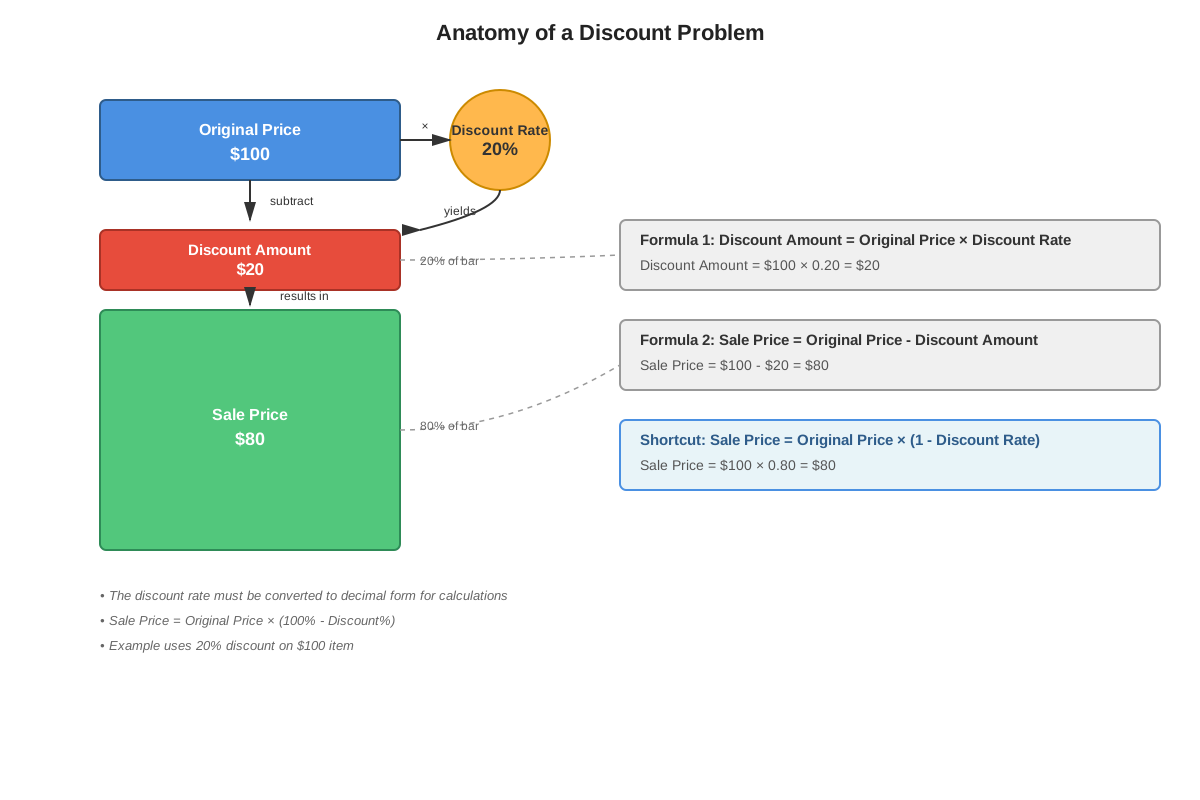
A discount is a reduction in the original price of an item, typically expressed as a percentage. Every discount problem involves four key components:
- Original Price (or list price): The starting price before any reduction
- Discount Rate: The percentage by which the price is reduced
- Discount Amount: The actual dollar value subtracted from the original price
- Sale Price (or final price): The amount paid after applying the discount
The fundamental relationship connecting these components is:
Sale Price = Original Price - Discount Amount
Sale Price = Original Price - (Discount Rate × Original Price)
Sale Price = Original Price × (1 - Discount Rate)
This third formulation is the most efficient for SAT problems. If an item costs $80 and is discounted 25%, the sale price equals $80 × (1 - 0.25) = $80 × 0.75 = $60.
Single Discount Calculations
When solving single discount problems, students must identify what the question asks for and select the appropriate calculation method:
Finding Sale Price: Multiply the original price by (1 - discount rate as a decimal)
- Example: A $120 jacket is 30% off. Sale price = $120 × 0.70 = $84
Finding Discount Amount: Multiply the original price by the discount rate
- Example: A $120 jacket is 30% off. Discount amount = $120 × 0.30 = $36
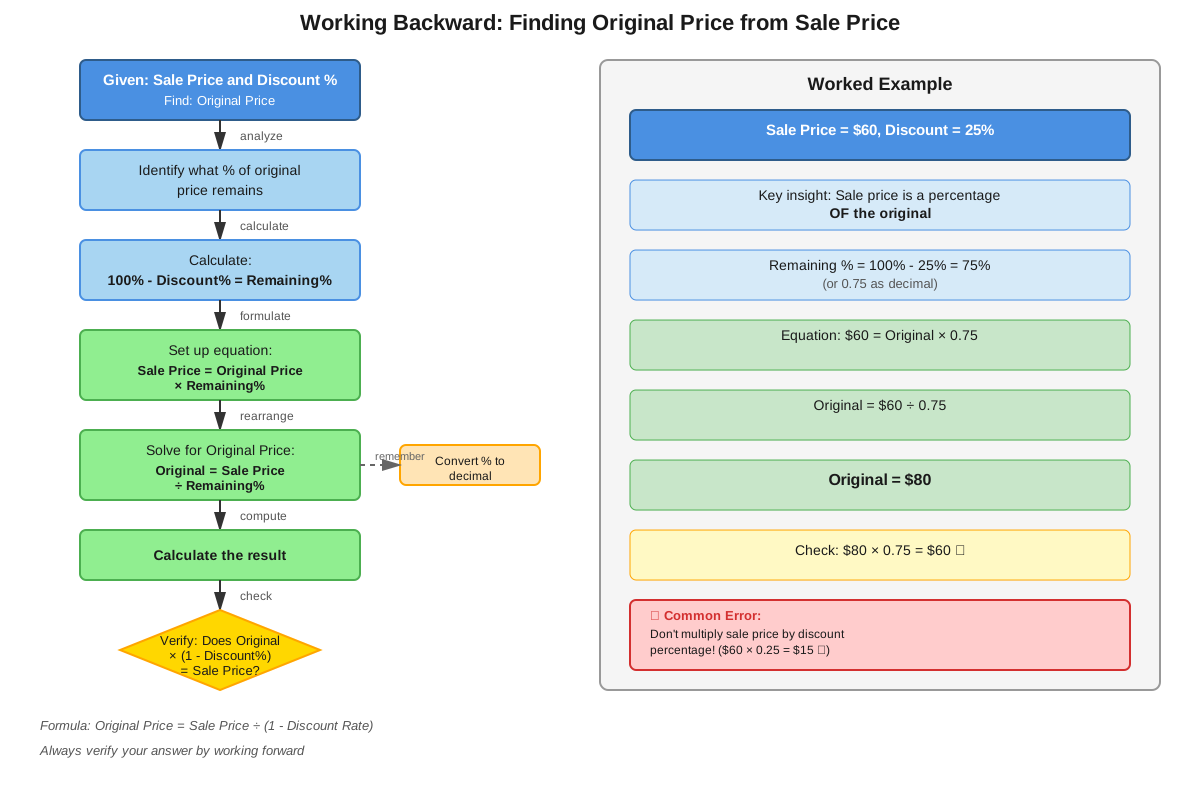
Finding Original Price: Divide the sale price by (1 - discount rate)
- Example: After a 30% discount, a jacket costs $84. Original price = $84 ÷ 0.70 = $120
This third type—working backward from sale price to original price—frequently appears on the SAT and causes difficulty for unprepared students. The key insight is recognizing that the sale price represents a percentage of the original price (in this case, 70%), so dividing by that percentage recovers the original value.
Sequential Discounts
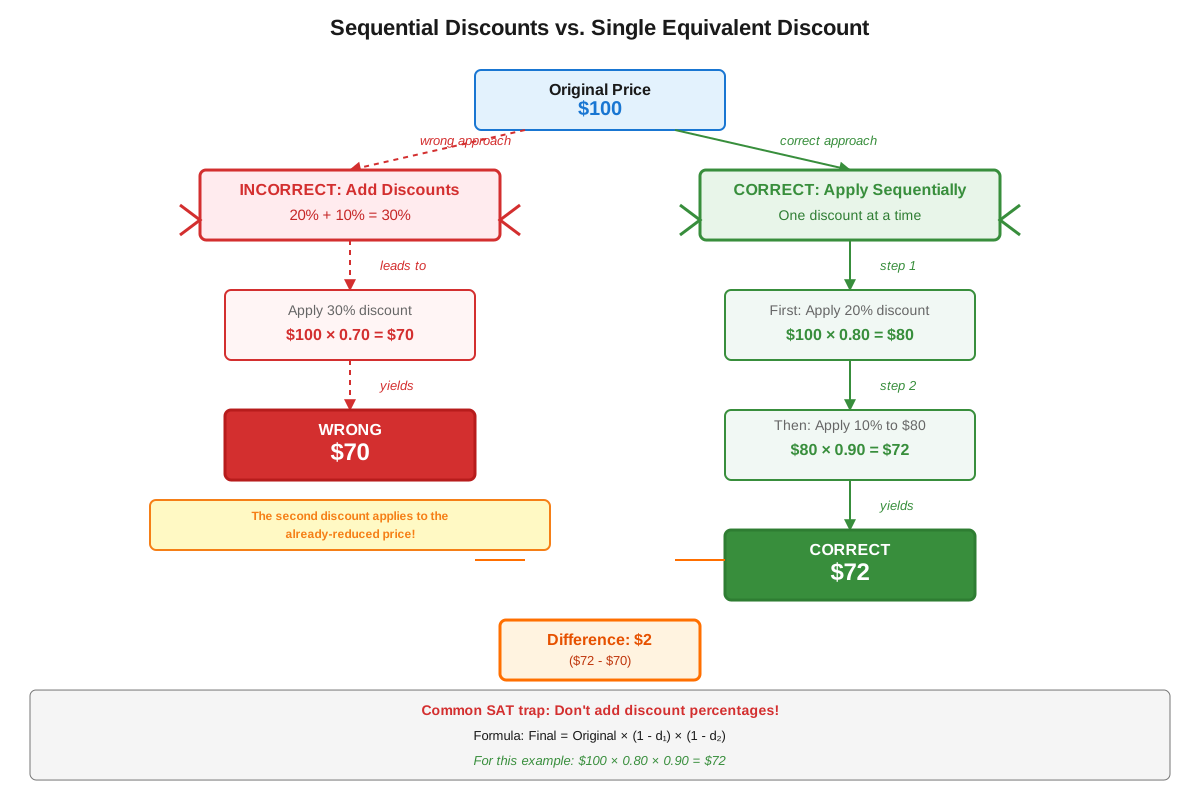
Sequential discounts (also called successive discounts) occur when multiple discounts are applied one after another. A critical concept: sequential discounts are NOT additive. A 20% discount followed by a 10% discount does NOT equal a 30% discount.
To calculate sequential discounts:
- Apply the first discount to find the intermediate price
- Apply the second discount to the intermediate price (not the original price)
- Continue for any additional discounts
Example: An item originally costs $100. It receives a 20% discount, then an additional 10% discount.
- After first discount: $100 × 0.80 = $80
- After second discount: $80 × 0.90 = $72
- Total discount: $28 (which is 28%, not 30%)
Alternatively, multiply the original price by all the "remaining percentage" factors:
$100 × 0.80 × 0.90 = $72
The SAT tests whether students understand this non-additive property through questions that ask for the "equivalent single discount" or compare sequential discount scenarios.
Discount vs. Markup Relationships
Understanding the relationship between discounts and markups helps solve complex SAT problems. A markup increases price by a percentage, while a discount decreases it. Importantly, a 25% markup followed by a 25% discount does NOT return to the original price:
- Original: $100
- After 25% markup: $100 × 1.25 = $125
- After 25% discount: $125 × 0.75 = $93.75
This asymmetry occurs because the discount applies to the larger marked-up price. The SAT may test this concept by asking students to find what discount percentage would return a marked-up item to its original price.
Discount Tables and Comparisons
| Discount Rate | Multiplier (1 - rate) | Meaning |
|---|---|---|
| 10% | 0.90 | Pay 90% of original |
| 15% | 0.85 | Pay 85% of original |
| 20% | 0.80 | Pay 80% of original |
| 25% | 0.75 | Pay 75% of original |
| 30% | 0.70 | Pay 70% of original |
| 50% | 0.50 | Pay 50% of original |
| 75% | 0.25 | Pay 25% of original |
Memorizing common discount multipliers accelerates calculation and reduces errors on the SAT.
Concept Relationships
Discount problems build directly on percentage fundamentals, requiring students to convert between percentages, decimals, and fractions. The core operation—finding a percentage of a number—extends to calculating the discount amount, while the complementary percentage (100% minus the discount rate) determines the sale price multiplier.
Sequential discounts connect to exponential thinking and compound operations. Each successive discount acts as a multiplier on the previous result, creating a multiplicative chain rather than an additive sequence. This relationship parallels compound interest calculations and exponential decay models, though SAT discount problems typically involve only 2-3 sequential operations.
The relationship map flows as follows:
Percentage Basics → Single Discount Calculations → Sequential Discounts → Combined Operations (discount + tax/tip)
Working backward from sale price to original price requires algebraic equation solving, connecting discounts to the broader algebra domain. These "reverse percentage" problems strengthen proportional reasoning skills that apply across SAT Math topics including ratios, rates, and scaling.
Discount problems also relate to markup, profit margin, and sales tax calculations. Understanding that discounts decrease values while markups and taxes increase them helps students navigate multi-step problems where these operations combine. The SAT frequently tests whether students can correctly sequence operations: typically, discounts apply before sales tax is added.
High-Yield Facts
⭐ The sale price equals the original price multiplied by (1 - discount rate as a decimal)
⭐ To find the original price from a sale price, divide the sale price by (1 - discount rate)
⭐ Sequential discounts multiply together; they do NOT add
⭐ A 20% discount followed by 10% off equals a 28% total discount, not 30%
⭐ After a discount, the customer pays the complement percentage (e.g., 30% off means paying 70%)
- The discount amount equals the original price multiplied by the discount rate as a decimal
- Two 25% discounts do not return an item to its original price after a 25% markup
- Sales tax is typically applied AFTER discounts are calculated
- "50% off" and "half price" mean the same thing: multiply by 0.50
- A discount cannot exceed 100% in realistic SAT problems
- The phrase "additional discount" signals a sequential discount problem
- Discount problems may be disguised as "sale," "clearance," or "markdown" scenarios
- When comparing discount offers, calculate the final price for each option
- The greater the original price, the greater the dollar value of the same percentage discount
- Discount rate and discount amount are different: rate is a percentage, amount is a dollar value
Quick check — test yourself on Discounts so far.
Try Flashcards →Common Misconceptions
Misconception: A 30% discount means subtracting 30 from the price.
Correction: A 30% discount means multiplying the price by 0.30 to find the discount amount, then subtracting that from the original price. Alternatively, multiply the price by 0.70 to find the sale price directly. The number 30 alone has no meaning without considering the original price.
Misconception: Two 20% discounts equal a 40% discount.
Correction: Sequential discounts multiply, not add. Two 20% discounts mean paying 80% of 80% of the original price: 0.80 × 0.80 = 0.64, so you pay 64% of the original price, representing a 36% total discount, not 40%.
Misconception: If an item is marked up 25% then discounted 25%, it returns to the original price.
Correction: The 25% discount applies to the higher marked-up price, not the original price. Starting at $100: markup gives $125, then discount gives $125 × 0.75 = $93.75, which is less than the original $100.
Misconception: To find the original price, add the discount percentage back to the sale price.
Correction: You cannot simply add percentages. If an item is 20% off and costs $80, the original price is not $80 + 20 = $100. Instead, recognize that $80 represents 80% of the original, so divide: $80 ÷ 0.80 = $100.
Misconception: A larger discount percentage always saves more money.
Correction: The dollar savings depends on both the discount rate AND the original price. A 50% discount on a $10 item saves $5, while a 10% discount on a $100 item saves $10. Always calculate the actual discount amount when comparing offers on different-priced items.
Misconception: Sales tax should be calculated on the original price before applying discounts.
Correction: In real-world scenarios and SAT problems, sales tax applies to the final sale price after all discounts. First calculate the discounted price, then multiply by (1 + tax rate) to find the total amount paid.
Worked Examples
Example 1: Sequential Discounts with Comparison
Problem: A store advertises two promotional offers for a $200 coat. Option A: 30% off the original price. Option B: 20% off, then an additional 15% off the reduced price. Which option provides the lower final price, and by how much?
Solution:
Option A Calculation:
- Single 30% discount
- Sale price = $200 × (1 - 0.30) = $200 × 0.70 = $140
Option B Calculation:
- First discount: $200 × (1 - 0.20) = $200 × 0.80 = $160
- Second discount: $160 × (1 - 0.15) = $160 × 0.85 = $136
- Alternatively: $200 × 0.80 × 0.85 = $136
Comparison:
- Option A: $140
- Option B: $136
- Difference: $140 - $136 = $4
Answer: Option B provides the lower final price by $4.
Connection to Learning Objectives: This problem requires applying sequential discount calculations and comparing different discount structures—both high-yield SAT skills. It demonstrates that two smaller discounts can exceed a single larger discount when applied sequentially.
Example 2: Working Backward from Sale Price
Problem: During a clearance sale, Marcus purchased a laptop for $680 after a 15% discount was applied. What was the original price of the laptop before the discount?
Solution:
Identify what we know:
- Sale price = $680
- Discount rate = 15%
- Original price = unknown (let's call it P)
Set up the relationship:
- After a 15% discount, Marcus paid 85% of the original price
- Sale price = Original price × (1 - 0.15)
- $680 = P × 0.85
Solve for original price:
- P = $680 ÷ 0.85
- P = $800
Verification:
- Check: $800 × 0.85 = $680 ✓
- Discount amount: $800 × 0.15 = $120
- Original price minus discount: $800 - $120 = $680 ✓
Answer: The original price was $800.
Connection to Learning Objectives: This problem tests the ability to work backward from a sale price to find the original price—a common SAT question type that requires algebraic thinking and understanding of the inverse relationship between discounts and original prices.
Exam Strategy
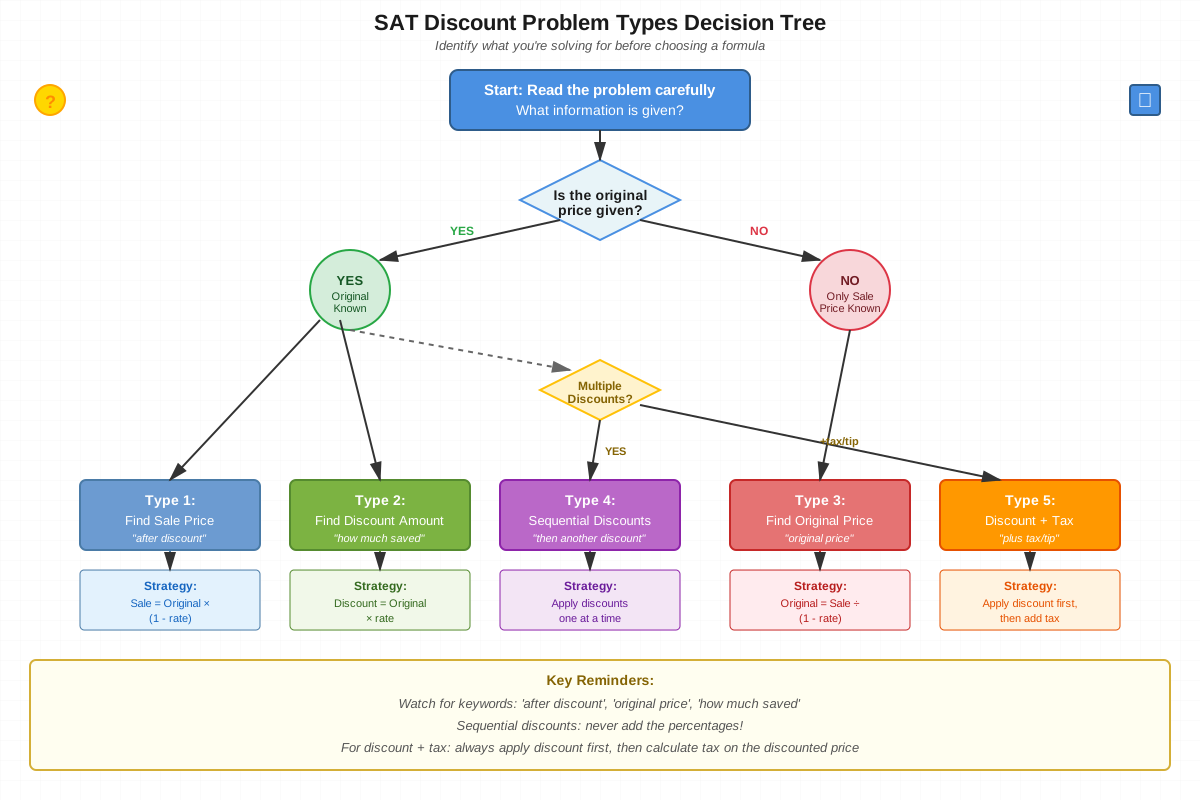
When approaching discount questions on the SAT, begin by identifying the four key components: original price, discount rate, discount amount, and sale price. Determine which three are given and which one you need to find. This classification immediately suggests the appropriate calculation method.
Trigger words and phrases to watch for:
- "Percent off," "discount," "sale," "clearance," "markdown" → indicates a price reduction
- "Additional," "further," "then another" → signals sequential discounts
- "Original price," "list price," "regular price" → the starting value before discounts
- "Final price," "sale price," "paid" → the amount after discounts
- "How much did [person] save" → asking for discount amount, not sale price
Process-of-elimination strategies:
- Eliminate answers greater than the original price (discounts reduce prices)
- For sequential discount problems, eliminate the answer that simply adds the discount percentages
- If the question asks for original price and gives sale price, eliminate answers less than the sale price
- Check whether the answer choices are in dollars or percentages—match your calculation to the requested format
Time allocation advice: Single discount problems should take 30-45 seconds. Sequential discount problems may require 60-90 seconds. If a problem involves working backward from sale price to original price, allocate up to 90 seconds. If you're spending more than 2 minutes on a discount problem, mark it and return later—these questions test straightforward concepts and shouldn't require extensive time.
Calculation efficiency tips:
- Memorize common discount multipliers (0.75 for 25% off, 0.80 for 20% off, 0.90 for 10% off)
- For sequential discounts, multiply all the "remaining percentage" factors together, then multiply by the original price
- Use the calculator strategically: for problems like "15% off $80," it's often faster to calculate $80 × 0.85 = $68 than to find $80 × 0.15 = $12, then subtract $80 - $12 = $68
Exam Tip: When a problem mentions "additional discount" or "further reduced," immediately recognize this as a sequential discount situation. Calculate step-by-step, applying each discount to the result of the previous calculation.
Memory Techniques
The "Pay the Complement" Rule: Remember that a discount percentage tells you what you DON'T pay, so subtract from 100% to find what you DO pay. Create the mental image: "30% off means I pay the other 70%." Visualize a pie chart with the discount portion removed and the remaining portion representing what you pay.
Sequential Discount Mnemonic - "Multiply, Don't Add": Create the phrase "Sequential Savings Stack, but Separately" to remember that sequential discounts multiply together rather than add. Visualize stacking discount coupons where each applies only to what remains after the previous one.
The Reverse Percentage Acronym - "DIVIDE":
- Determine the sale price
- Identify the discount rate
- Visualize what percentage was paid (100% - discount%)
- Invert the operation (divide instead of multiply)
- Divide sale price by the decimal form of percentage paid
- Evaluate and verify your answer
Original Price Recovery: Remember "Sale price is SMALL, so make it TALL" → when finding original price from sale price, you're making a smaller number larger, which requires division. This prevents the common error of multiplying when you should divide.
The 25-50-75 Visualization: Memorize these three key discounts visually:
- 25% off = 3/4 price = 0.75 multiplier
- 50% off = 1/2 price = 0.50 multiplier
- 75% off = 1/4 price = 0.25 multiplier
Notice the pattern: the multiplier equals (100 - discount)/100.
Summary
Discounts represent a fundamental application of percentages on the SAT Math sections, testing students' ability to calculate reduced prices, work backward to original prices, and handle sequential discount scenarios. Mastery requires understanding that a discount rate indicates the percentage reduction while the complement (100% minus the discount rate) represents the percentage actually paid. The most efficient calculation method multiplies the original price by (1 - discount rate) to find the sale price directly. Sequential discounts multiply rather than add, creating a total discount smaller than the sum of individual discount rates. Working backward from sale price to original price requires dividing the sale price by the complement percentage—a conceptual leap that distinguishes strong students from those with superficial understanding. SAT discount problems appear in various contexts including retail sales, clearance events, and combined operations with tax or markup, making them among the most practical and frequently tested percentage applications. Success requires both computational accuracy and conceptual clarity about the relationships between original prices, discount rates, discount amounts, and final sale prices.
Key Takeaways
- Sale price = Original price × (1 - discount rate) is the most efficient formula for single discount calculations
- Sequential discounts multiply together; two 20% discounts equal a 36% total discount, not 40%
- To find original price from sale price, divide the sale price by (1 - discount rate as a decimal)
- The discount rate tells you what percentage is removed; the complement tells you what percentage you pay
- Discount problems appear on virtually every SAT, often combined with tax, markup, or multi-step scenarios
- Common errors include adding sequential discounts, confusing discount rate with discount amount, and using incorrect operations when working backward
- Memorizing key multipliers (0.75 for 25% off, 0.80 for 20% off, 0.90 for 10% off) accelerates calculation and reduces errors
Related Topics
Markup and Profit Margins: Understanding how businesses increase prices above cost connects directly to discount calculations, as markup and discount are inverse operations. Mastering discounts provides the foundation for analyzing profit scenarios.
Sales Tax and Tips: These percentage increases typically apply after discounts are calculated, creating multi-step problems that combine discount and markup operations in sequence.
Percent Change and Percent Difference: Discount problems are specific applications of percent decrease. The broader concept of percent change extends to population growth, price fluctuations, and data analysis questions throughout SAT Math.
Exponential Growth and Decay: Sequential discounts model exponential decay, where each step multiplies by a constant factor less than 1. This connection extends to compound interest and exponential function questions in advanced SAT problems.
Proportional Reasoning: Discount calculations strengthen proportional thinking skills that apply to ratio problems, scale factors, and direct/inverse variation—all tested concepts on the SAT.
Practice CTA
Now that you've mastered the core concepts of discounts, it's time to solidify your understanding through practice. Attempt the practice questions to test your ability to identify discount components, calculate sale prices, work backward to original prices, and handle sequential discount scenarios. Use the flashcards to reinforce key formulas and common discount multipliers until they become automatic. Remember: discount problems appear on virtually every SAT, and with focused practice, they become reliable points that boost your Math score. Each problem you solve correctly builds confidence and speed for test day. Start practicing now to transform discounts from a potential challenge into a guaranteed strength!
Sign up free to keep reading
Create a free AnvayaPrep account to finish this SAT guide on Discounts — plus flashcards and practice questions.