Overview
Successive percent changes represent one of the most frequently tested concepts in the SAT math section, appearing in approximately 3-5 questions per exam. This topic involves calculating the cumulative effect of multiple percentage increases or decreases applied sequentially to an initial value. Unlike simple percentage problems where a single change is applied, successive percent changes require understanding that each subsequent percentage is calculated based on the new value after the previous change, not the original amount.
The complexity and importance of this concept stem from a counterintuitive mathematical reality: successive percent changes do not simply add together. For example, a 20% increase followed by a 20% decrease does not return you to the original value, as many students incorrectly assume. This non-additive property makes successive percent changes a powerful discriminator on the SAT, separating students who truly understand percentage operations from those who rely on superficial pattern recognition. The College Board frequently embeds this concept within word problems involving sales, discounts, population growth, investment returns, and scientific measurements.
Mastering successive percent changes provides a foundation for understanding compound interest, exponential growth and decay, and proportional reasoning—all critical topics in both SAT Math and real-world quantitative literacy. This concept bridges basic percentage calculations with more advanced algebraic thinking, requiring students to translate verbal descriptions into mathematical operations and recognize when multiplication (rather than addition) governs the relationship between sequential changes.
Learning Objectives
- [ ] Identify key features of successive percent changes
- [ ] Explain how successive percent changes appears on the SAT
- [ ] Apply successive percent changes to answer SAT-style questions
- [ ] Calculate the net effect of two or more consecutive percentage changes
- [ ] Determine whether successive percent changes result in a net increase, decrease, or return to the original value
- [ ] Convert word problems involving multiple discounts, markups, or changes into correct mathematical expressions
- [ ] Recognize when the order of successive percent changes matters and when it doesn't
Prerequisites
- Basic percentage calculations: Understanding how to convert between percentages, decimals, and fractions is essential for performing the multiplication operations required in successive changes
- Decimal multiplication: Successive percent changes require multiplying by decimal multipliers (e.g., 1.15 for a 15% increase), making fluency with decimal operations critical
- Order of operations: Correctly sequencing multiple percentage calculations depends on understanding that operations must be performed left-to-right in the order described
- Algebraic thinking: Representing unknown values with variables and manipulating expressions helps solve problems where the initial or final value is unknown
Why This Topic Matters
In real-world contexts, successive percent changes appear constantly in financial decisions, scientific measurements, and business operations. When a store advertises "20% off, then take an additional 10% off at checkout," consumers need to understand this doesn't equal 30% off. Investment portfolios experience successive gains and losses across multiple periods. Population studies track growth rates compounded over years. Medical dosages may be adjusted by successive percentages based on patient response. Understanding this concept prevents costly financial mistakes and enables informed decision-making.
On the SAT, successive percent changes questions appear in both the calculator and no-calculator sections, typically as word problems worth 1 point each. The College Board reports that approximately 8-12% of SAT Math questions involve percentage concepts, with successive changes representing a significant subset. These questions most commonly appear in Problem Solving and Data Analysis contexts but can also emerge in Heart of Algebra questions involving algebraic expressions with percentage-based coefficients.
The SAT presents successive percent changes through various scenarios: retail pricing with multiple discounts, population changes over multiple years, investment growth and decline, measurement errors compounded across instruments, and scientific experiments with sequential dilutions or concentrations. Questions may ask for the final value after changes, the net percentage change, or require working backward from a final value to determine an initial amount or one of the percentage changes applied.
Core Concepts
Understanding the Multiplier Method
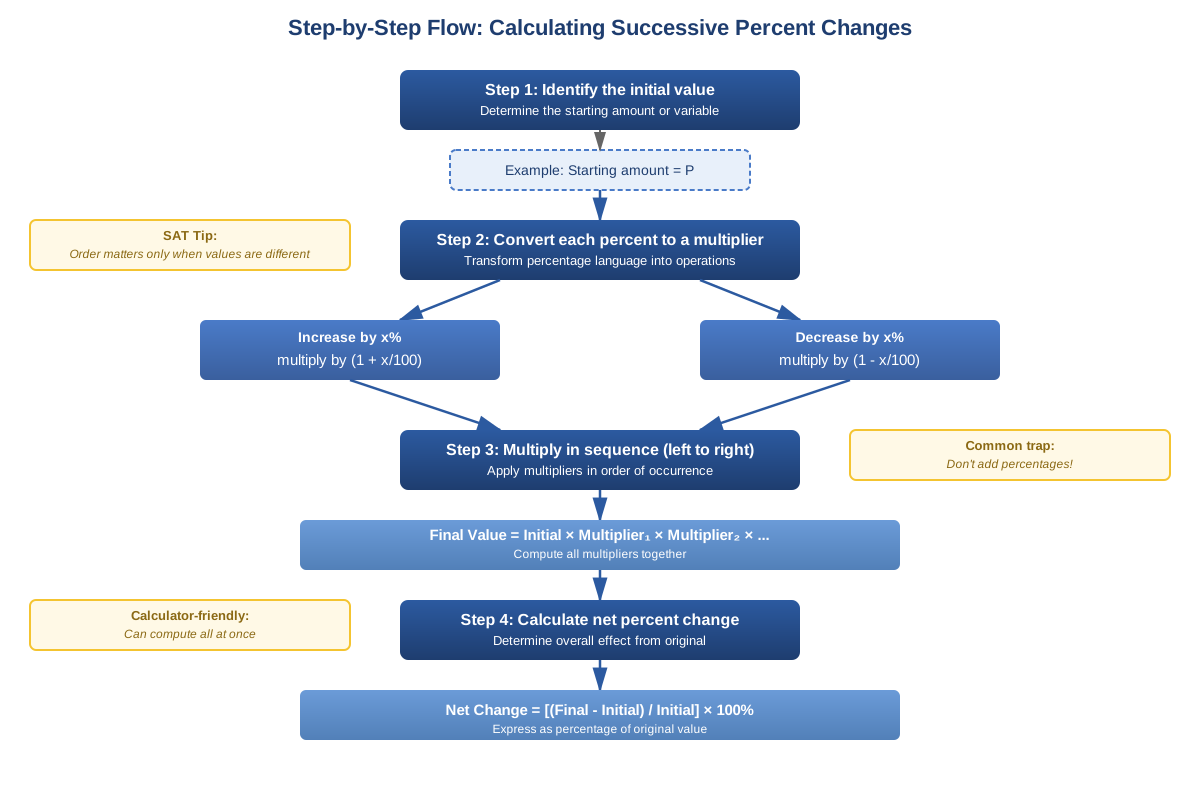
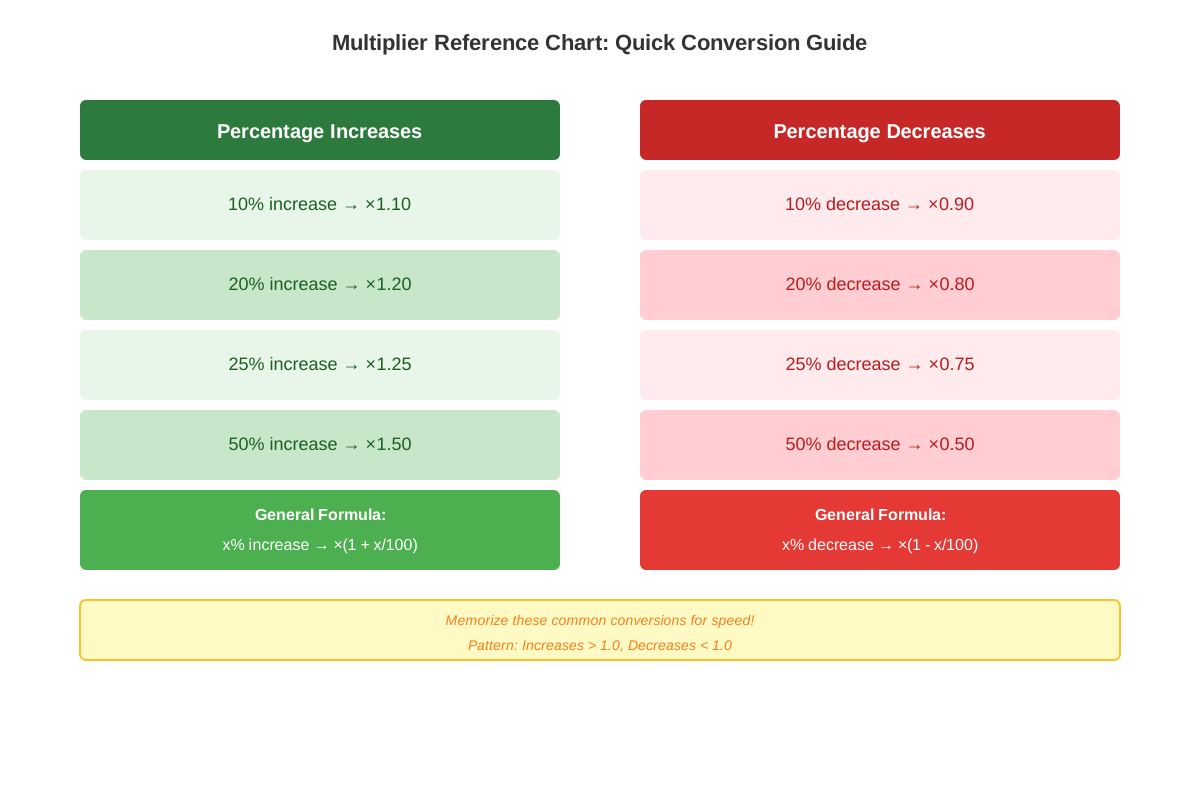
The most efficient approach to successive percent changes involves converting each percentage change into a multiplier and then multiplying these factors together. A percentage increase of r% corresponds to multiplying by (1 + r/100), while a percentage decrease of r% corresponds to multiplying by (1 - r/100).
For example:
- A 25% increase means multiplying by 1.25 (since 1 + 25/100 = 1.25)
- A 15% decrease means multiplying by 0.85 (since 1 - 15/100 = 0.85)
- A 100% increase means multiplying by 2.00 (doubling the value)
- A 50% decrease means multiplying by 0.50 (halving the value)
When multiple percentage changes occur successively, multiply all the individual multipliers together, then apply this combined multiplier to the initial value:
Final Value = Initial Value × Multiplier₁ × Multiplier₂ × Multiplier₃ × ...Why Successive Changes Don't Add
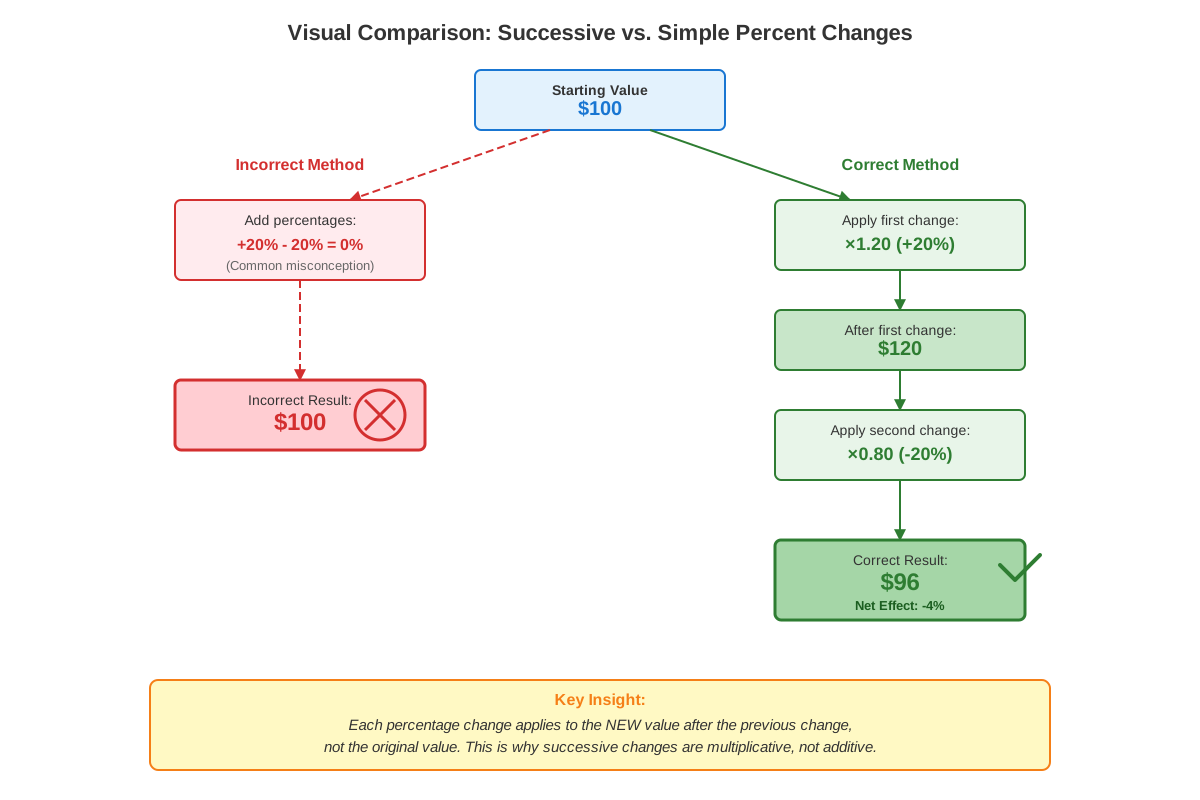
A critical insight for SAT success is understanding why successive percentage changes cannot be simply added together. Consider an initial value of 100 that increases by 20% and then decreases by 20%:
Incorrect approach (adding percentages): +20% - 20% = 0% change, so final value = 100
Correct approach (multiplying):
- After 20% increase: 100 × 1.20 = 120
- After 20% decrease: 120 × 0.80 = 96
- Net result: 96 (a 4% decrease from the original)
The reason these don't cancel is that the second percentage operates on a different base value. The 20% decrease is calculated from 120, not from the original 100, so it removes more absolute value (24) than the increase added (20).
Calculating Net Percentage Change
To find the overall percentage change after successive changes, use this process:
- Convert each percentage change to a multiplier
- Multiply all multipliers together to get the combined multiplier
- Subtract 1 from the combined multiplier
- Convert back to a percentage
Net Percentage Change = (Combined Multiplier - 1) × 100%Example: A price increases by 30%, then decreases by 10%, then increases by 5%.
Combined multiplier = 1.30 × 0.90 × 1.05 = 1.2285
Net percentage change = (1.2285 - 1) × 100% = 22.85% increase
Order Independence for Multiplication
An important property that simplifies many SAT problems: the order of successive percent changes does not affect the final result because multiplication is commutative. Whether a value increases by 20% then decreases by 10%, or decreases by 10% then increases by 20%, the final value is identical:
- Path 1: 100 × 1.20 × 0.90 = 108
- Path 2: 100 × 0.90 × 1.20 = 108
This property allows flexibility in problem-solving and helps verify answers.
Working Backward from Final Values
Some SAT questions provide the final value after successive changes and ask for the initial value or one of the percentage changes. The strategy involves:
- Set up an equation: Initial Value × (combined multipliers) = Final Value
- Solve algebraically for the unknown quantity
Example: After a 25% increase followed by a 20% decrease, a stock is worth $120. What was the initial value?
Initial × 1.25 × 0.80 = 120
Initial × 1.00 = 120
Initial = 120
Special Cases and Patterns
| Scenario | Combined Multiplier | Net Effect |
|---|---|---|
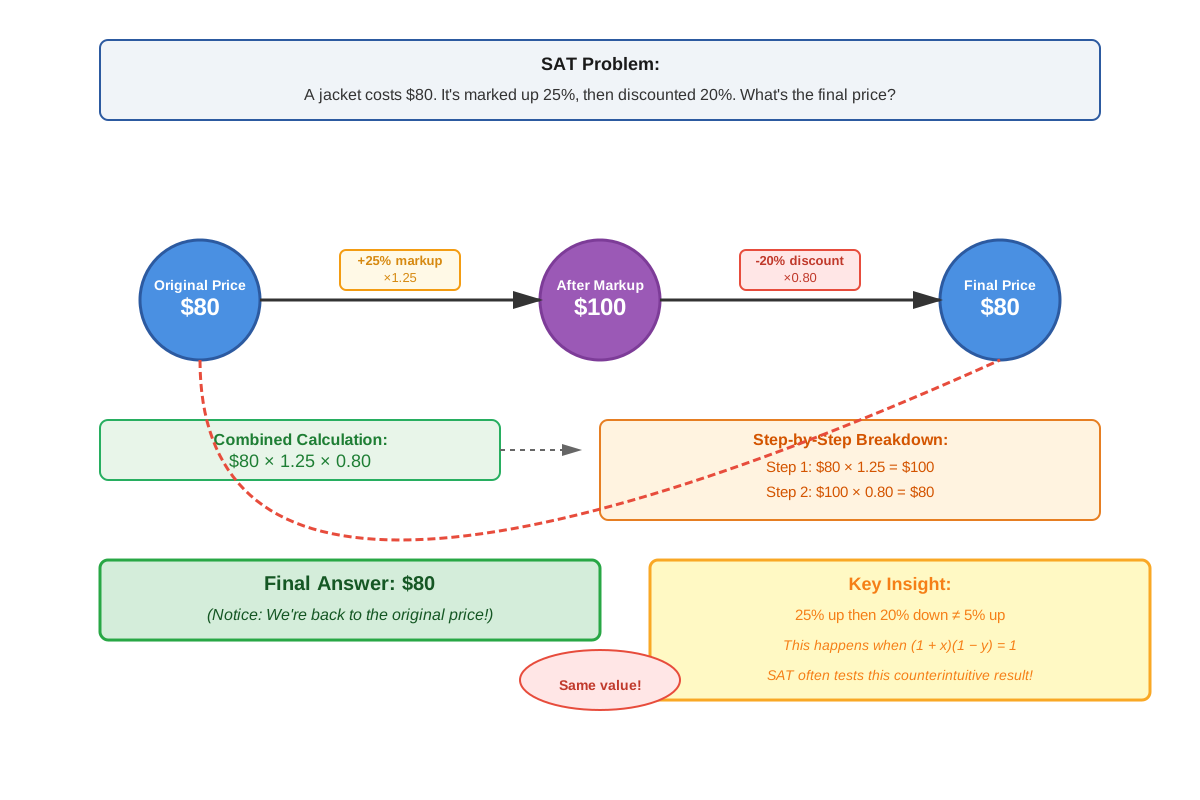
| Increase by r%, then decrease by r% | (1 + r/100)(1 - r/100) = 1 - (r/100)² | Always a net decrease |
| Two increases of r% each | (1 + r/100)² | Greater than 2r% increase |
| Increase by 50%, decrease by 50% | 1.50 × 0.50 = 0.75 | 25% decrease overall |
| Increase by 100%, decrease by 50% | 2.00 × 0.50 = 1.00 | Returns to original |
Concept Relationships
The foundation of successive percent changes rests on basic percentage operations, where understanding how to calculate a single percentage increase or decrease provides the building blocks. Each individual change in a succession → applies the percentage operation → to the result of the previous change, creating a chain of dependent calculations.
The multiplier method connects directly to algebraic thinking, as each percentage change becomes a coefficient in a multiplication expression. This algebraic representation → enables generalization → allowing students to work with variables when specific values aren't provided. The concept that successive changes multiply rather than add → relates to exponential functions → which govern compound interest and growth models tested elsewhere on the SAT.
Order independence (commutativity) → derives from the commutative property of multiplication → which students learned in elementary arithmetic but must now apply in a percentage context. The special case where equal increases and decreases don't cancel → illustrates the difference between additive and multiplicative relationships → a distinction fundamental to proportional reasoning throughout SAT Math.
Working backward from final values → requires inverse operations → connecting to equation-solving skills from algebra. The net percentage change calculation → synthesizes all individual changes into a single equivalent change → demonstrating how complex multi-step processes can be simplified into single operations, a problem-solving strategy valuable across mathematical domains.
Quick check — test yourself on Successive percent changes so far.
Try Flashcards →High-Yield Facts
⭐ Successive percent changes multiply; they do not add. A 20% increase followed by a 20% decrease does NOT result in no change.
⭐ The multiplier for an r% increase is (1 + r/100); for an r% decrease is (1 - r/100).
⭐ The order of successive percent changes does not affect the final result due to the commutative property of multiplication.
⭐ An increase of r% followed by a decrease of r% always results in a net decrease, specifically by (r/100)² of the original value.
⭐ To find net percentage change: multiply all individual multipliers, subtract 1, then convert to percentage.
- A 50% increase followed by a 50% decrease leaves you with 75% of the original value (25% net decrease).
- A 100% increase (doubling) followed by a 50% decrease returns you to the original value.
- When working backward from a final value, divide by the combined multiplier to find the initial value.
- Three successive 10% increases result in a 33.1% total increase, not 30%.
- The combined multiplier for successive changes equals the product of all individual multipliers.
- If the combined multiplier is less than 1, there's a net decrease; if greater than 1, there's a net increase.
- Successive percent changes appear most frequently in SAT word problems involving retail pricing, investments, and population changes.
Common Misconceptions
Misconception: Successive percentage changes can be added together to find the total change.
Correction: Percentage changes must be multiplied using the multiplier method because each subsequent change operates on the new value, not the original. A 10% increase followed by a 20% increase equals a 32% increase (1.10 × 1.20 = 1.32), not 30%.
Misconception: An increase of r% followed by a decrease of r% returns to the original value.
Correction: These changes do not cancel because they operate on different base values. The decrease removes more absolute value than the increase added, always resulting in a net decrease equal to (r/100)² times the original value.
Misconception: The order of successive percent changes affects the final result.
Correction: Due to the commutative property of multiplication, the order doesn't matter. Whether you apply a 25% increase then a 10% decrease, or vice versa, the final value is identical: 100 × 1.25 × 0.90 = 100 × 0.90 × 1.25 = 112.5.
Misconception: To reverse a percentage change, apply the opposite percentage (e.g., a 20% increase can be reversed by a 20% decrease).
Correction: To reverse an r% increase, you must decrease by r/(100+r) × 100%. For example, to reverse a 25% increase (multiplier 1.25), you need a 20% decrease (1/1.25 = 0.80), not a 25% decrease.
Misconception: When a problem states "an additional 10% off," this means 10% off the original price.
Correction: "Additional" indicates a successive change applied to the already-reduced price. If an item was already 20% off, an additional 10% off means multiplying by 0.80 × 0.90 = 0.72, resulting in 28% off the original price, not 30% off.
Misconception: Successive percent changes only apply when both changes are increases or both are decreases.
Correction: The multiplier method works for any combination of increases and decreases in any order. Simply use multipliers greater than 1 for increases and less than 1 for decreases, then multiply them all together.
Worked Examples
Example 1: Retail Pricing with Multiple Discounts
Problem: A jacket originally priced at $180 is marked down by 25% during a sale. At checkout, the customer receives an additional 20% discount for being a loyalty member. What is the final price of the jacket, and what is the total percentage discount from the original price?
Solution:
Step 1: Identify the successive percent changes.
- First change: 25% decrease
- Second change: 20% decrease
Step 2: Convert to multipliers.
- First multiplier: 1 - 0.25 = 0.75
- Second multiplier: 1 - 0.20 = 0.80
Step 3: Calculate the final price.
Final Price = $180 × 0.75 × 0.80
Final Price = $180 × 0.60
Final Price = $108
Step 4: Calculate the net percentage discount.
Combined multiplier = 0.60
This means the customer pays 60% of the original price.
Therefore, the discount is 100% - 60% = 40%
Alternatively: Net change = (0.60 - 1) × 100% = -40% (negative indicates a decrease)
Answer: The final price is $108, representing a 40% total discount from the original price.
Key Insight: Notice that 25% + 20% = 45%, but the actual discount is only 40%. This demonstrates why successive discounts don't simply add—the second discount applies to the already-reduced price, not the original price.
Example 2: Population Change Over Multiple Years
Problem: A town's population increased by 15% from 2020 to 2021, then decreased by 10% from 2021 to 2022, and finally increased by 8% from 2022 to 2023. If the population in 2023 was 13,284 people, what was the population in 2020? Round to the nearest whole number.
Solution:
Step 1: Identify the successive percent changes and their multipliers.
- 2020 to 2021: 15% increase → multiplier = 1.15
- 2021 to 2022: 10% decrease → multiplier = 0.90
- 2022 to 2023: 8% increase → multiplier = 1.08
Step 2: Calculate the combined multiplier.
Combined multiplier = 1.15 × 0.90 × 1.08 = 1.1178
Step 3: Set up the equation.
Let P = population in 2020
P × 1.1178 = 13,284
Step 4: Solve for P.
P = 13,284 ÷ 1.1178
P = 11,883.7...
P ≈ 11,884 people
Step 5: Verify (optional but recommended).
11,884 × 1.15 = 13,666.6
13,666.6 × 0.90 = 12,299.94
12,299.94 × 1.08 = 13,283.9 ≈ 13,284 ✓
Answer: The population in 2020 was approximately 11,884 people.
Key Insight: This problem demonstrates working backward from a final value. The combined multiplier of 1.1178 tells us the population increased by about 11.78% overall across the three years, despite the decrease in the middle year.
Exam Strategy
When approaching SAT successive percent changes questions, begin by identifying trigger phrases that signal multiple percentage operations: "then," "followed by," "additional," "subsequently," "after which," and "next." These words indicate that you're dealing with successive changes rather than a single percentage calculation.
Step-by-step approach:
- Read carefully to identify each change: Underline or circle each percentage and note whether it's an increase or decrease
- Convert immediately to multipliers: Write down each multiplier (>1 for increases, <1 for decreases) before calculating
- Multiply all multipliers: Combine them into a single value before applying to the initial amount
- Check reasonableness: If you have increases and decreases, estimate whether the net effect should be positive or negative
Process of elimination tips:
- Eliminate answer choices that simply add the percentages together—this is the most common trap answer
- If the problem involves equal percentage increases and decreases, eliminate any answer suggesting no net change
- For "additional discount" problems, eliminate answers that represent the sum of discounts
- When working backward, eliminate answers that would produce unreasonably large or small initial values
Time management: Successive percent change problems typically require 60-90 seconds. If you find yourself taking longer, you may be calculating each step individually rather than using the multiplier method. Practice the multiplier approach until it becomes automatic—it's both faster and less error-prone than calculating intermediate values.
Calculator usage: On calculator-permitted sections, enter the entire multiplication chain at once (e.g., 180 × 0.75 × 0.80) rather than calculating step-by-step. This reduces rounding errors and saves time. Store the combined multiplier in memory if you need to use it multiple times.
Memory Techniques
MIND - Multipliers, Identify changes, Net effect, Don't add
This acronym reminds you of the core process: convert to Multipliers, Identify each change in sequence, calculate the Net effect by multiplying, and Don't add percentages together.
The "1-Plus/Minus" Rule: Visualize a number line with 1 in the center. Increases move right (1.10, 1.25, 1.50), decreases move left (0.90, 0.75, 0.50). The final position relative to 1 tells you the net effect.
The "Different Base" Visualization: Picture a stack of blocks representing the initial value. After the first percentage change, the stack height changes. The second percentage operates on this NEW stack height, not the original. This mental image reinforces why changes don't simply add.
Opposite Operations Mnemonic: "To undo a 25% increase, don't decrease by 25%—divide by 1.25." Remember: Undo with Division (UD), not subtraction.
The 50-50 Special Case: Memorize that a 50% increase followed by a 50% decrease always leaves you with 75% of the original (1.5 × 0.5 = 0.75). This serves as a quick check for similar problems and helps build intuition about why equal changes don't cancel.
Summary
Successive percent changes represent a critical SAT Math concept where multiple percentage increases or decreases are applied sequentially to a value. The fundamental principle is that these changes multiply rather than add because each subsequent percentage operates on the new value created by the previous change, not the original amount. The multiplier method—converting each percentage change to a multiplier (1 + r/100 for increases, 1 - r/100 for decreases) and multiplying them together—provides the most efficient solution approach. Understanding that equal percentage increases and decreases don't cancel, that the order of changes doesn't affect the final result, and that "additional" discounts apply to already-reduced prices are essential for avoiding common traps. Students must be able to calculate final values, determine net percentage changes, and work backward from final values to find initial amounts or missing percentages. Mastery requires recognizing the multiplicative nature of successive changes and applying the multiplier method automatically.
Key Takeaways
- Successive percent changes multiply, never add—each change operates on the result of the previous change, not the original value
- Use the multiplier method: convert each percentage to (1 ± r/100), multiply all multipliers together, then apply to the initial value
- Order doesn't matter: due to commutativity of multiplication, successive changes can be applied in any sequence with identical results
- Equal increases and decreases don't cancel: an r% increase followed by an r% decrease always produces a net decrease
- Net percentage change formula: (Combined Multiplier - 1) × 100% gives the overall percentage change
- "Additional" means successive: when problems mention "additional" or "then" discounts, apply the multiplier method, not simple addition
- Work backward by dividing: to find an initial value from a final value, divide by the combined multiplier
Related Topics
Compound Interest: Builds directly on successive percent changes by applying the same percentage increase repeatedly over multiple time periods, introducing the compound interest formula as a shortcut for many identical successive changes.
Exponential Growth and Decay: Extends successive percent changes to continuous or very frequent changes, connecting discrete percentage operations to exponential functions and their graphs.
Percent Error and Percent Difference: Applies percentage concepts to measurement accuracy and comparison problems, requiring similar calculation skills but different conceptual frameworks.
Ratios and Proportional Relationships: Successive percent changes deepen understanding of multiplicative relationships, which underlie ratio problems and direct/inverse variation.
Linear vs. Exponential Models: Distinguishes between additive changes (linear) and multiplicative changes (exponential), with successive percent changes exemplifying exponential behavior.
Practice CTA
Now that you've mastered the core concepts of successive percent changes, it's time to cement your understanding through active practice. The practice questions and flashcards have been specifically designed to mirror actual SAT question formats and difficulty levels. Work through each problem methodically, applying the multiplier method and checking your reasoning against the worked examples. Remember: understanding why an answer is correct matters more than getting the right answer quickly. Each practice problem you complete builds the pattern recognition and procedural fluency that will make these questions feel automatic on test day. You've got this!
Sign up free to keep reading
Create a free AnvayaPrep account to finish this SAT guide on Successive percent changes — plus flashcards and practice questions.