Overview
The leading coefficient is a fundamental concept in polynomial algebra that appears frequently on the SAT Math section. This term refers to the numerical coefficient of the term with the highest degree in a polynomial expression when written in standard form. For example, in the polynomial 3x⁴ + 2x² - 5x + 7, the leading coefficient is 3 because it multiplies the term with the highest power of x. Understanding leading coefficients is essential not only for identifying polynomial characteristics but also for predicting graph behavior, solving equations, and manipulating algebraic expressions—all skills that the SAT tests extensively.
Mastery of leading coefficients connects directly to broader polynomial concepts including end behavior, factoring, and function transformations. The SAT frequently embeds leading coefficient questions within multi-step problems involving graphing, equation solving, and real-world modeling scenarios. Students who can quickly identify and work with leading coefficients gain a significant advantage in both the calculator and no-calculator sections of the exam.
This topic serves as a bridge between basic algebraic manipulation and advanced function analysis. The leading coefficient determines critical features of polynomial graphs, influences the number and nature of solutions, and plays a vital role in understanding how polynomials behave as input values become very large or very small. For SAT success, students must move beyond simple identification to apply this concept in complex problem-solving contexts that integrate multiple mathematical domains.
Learning Objectives
- [ ] Identify key features of leading coefficient in polynomial expressions
- [ ] Explain how leading coefficient appears on the SAT in various question formats
- [ ] Apply leading coefficient to answer SAT-style questions involving polynomials
- [ ] Determine the end behavior of polynomial functions using the leading coefficient
- [ ] Recognize how changes to the leading coefficient affect polynomial graphs
- [ ] Solve problems involving leading coefficients in factored and expanded forms
- [ ] Connect leading coefficient properties to real-world modeling scenarios
Prerequisites
- Standard form of polynomials: Understanding how to arrange polynomial terms in descending order of degree is essential for identifying which coefficient is "leading"
- Exponent rules: Recognizing which term has the highest degree requires comfort with comparing exponents and understanding power notation
- Basic graphing concepts: Familiarity with coordinate planes and function behavior helps visualize how leading coefficients affect polynomial graphs
- Coefficient identification: The ability to distinguish between coefficients, variables, and constants forms the foundation for this topic
Why This Topic Matters
In real-world applications, leading coefficients appear in physics equations modeling projectile motion, economics formulas predicting revenue growth, and engineering calculations involving polynomial approximations. The sign and magnitude of a leading coefficient determine whether a quantity increases or decreases without bound, making this concept crucial for interpreting mathematical models in practical contexts.
On the SAT, leading coefficient questions appear in approximately 3-5 questions per test, representing roughly 5-8% of the math section. These questions span multiple formats including multiple-choice, grid-in, and multi-step problems. The College Board tests this concept both directly (asking students to identify the leading coefficient) and indirectly (requiring students to use leading coefficient properties to solve more complex problems).
Common SAT question types involving leading coefficients include: identifying end behavior from graphs or equations, determining which polynomial matches a given graph, solving for unknown coefficients when given specific function properties, and analyzing how transformations affect polynomial expressions. The sat leading coefficient concept also appears in questions about polynomial division, factoring, and systems of equations where understanding the highest-degree term becomes critical for efficient problem-solving.
Core Concepts
Definition and Identification
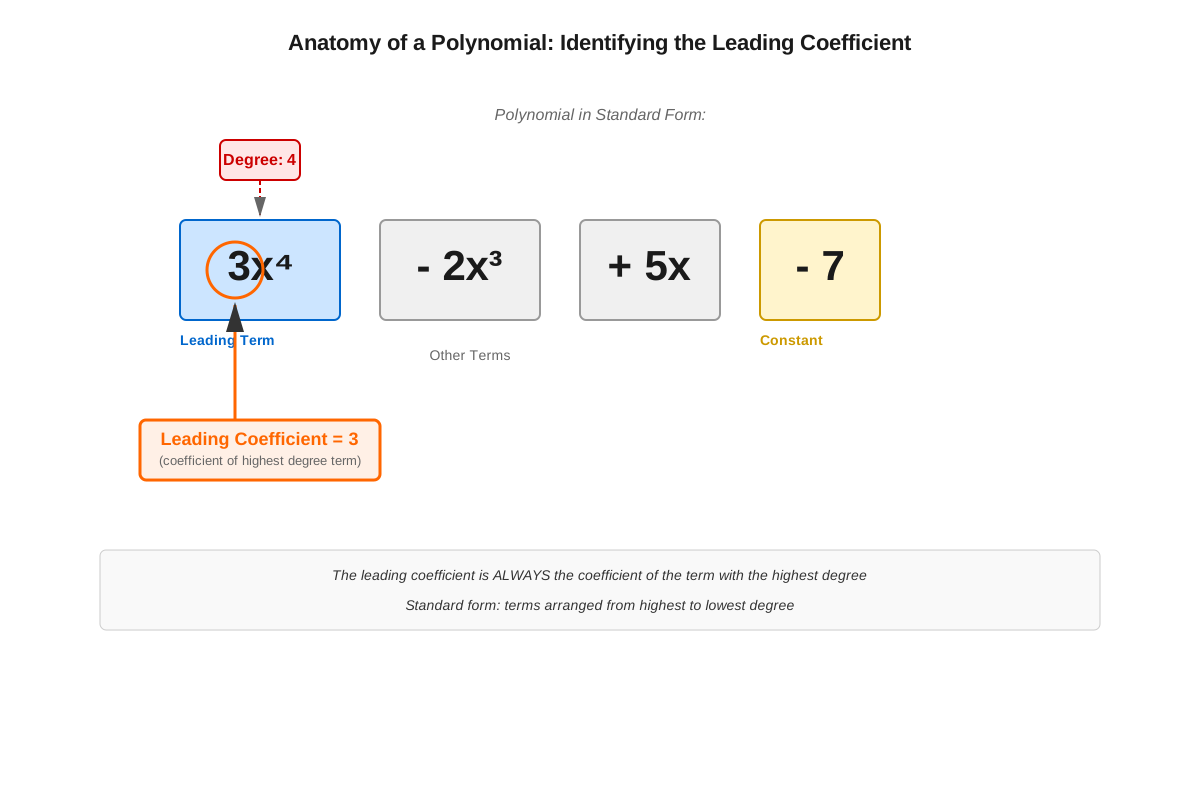
The leading coefficient is the numerical coefficient of the term with the highest degree in a polynomial when written in standard form (terms arranged in descending order by degree). In the expression 5x³ - 2x² + 8x - 1, the leading coefficient is 5. In -7x⁴ + 3x³ + x² - 9, the leading coefficient is -7. Note that the leading coefficient can be positive, negative, or even a fraction.
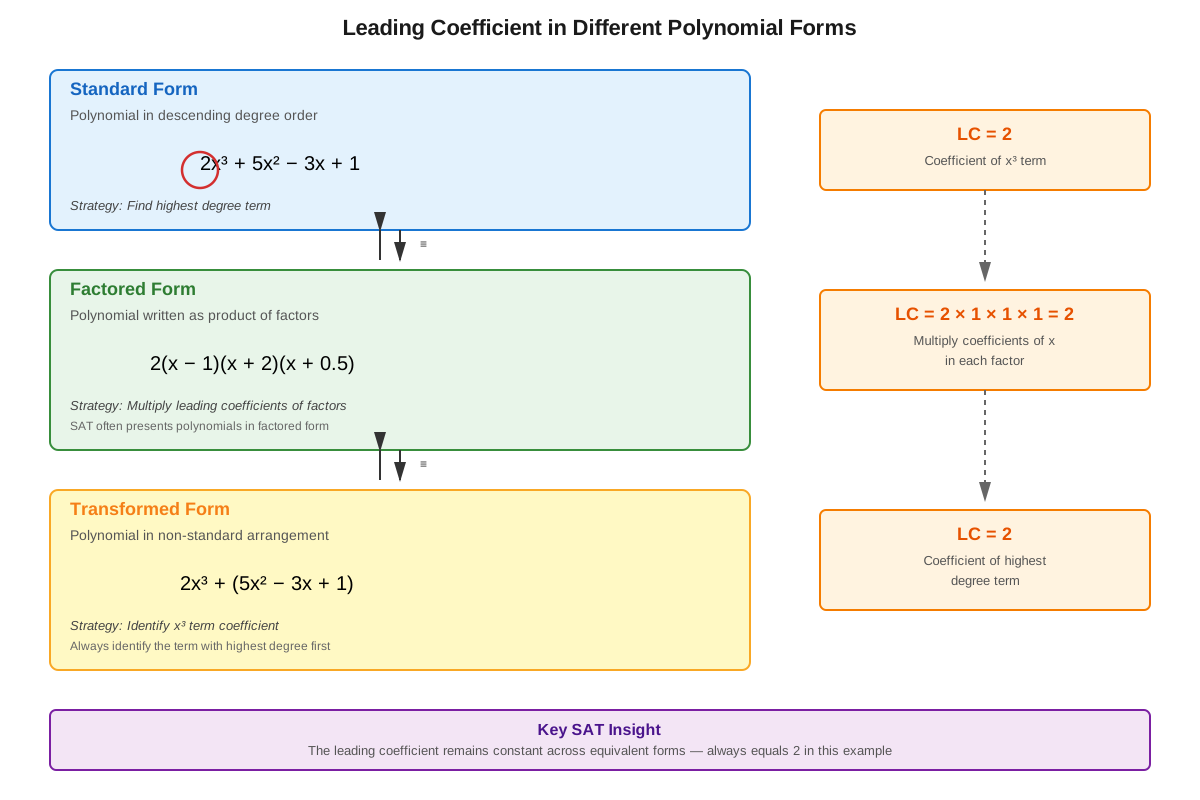
When identifying leading coefficients, students must first ensure the polynomial is in standard form. The expression 4x² - 9x⁵ + 2x has a leading coefficient of -9, not 4, because -9x⁵ is the highest-degree term. If a polynomial is given in factored form, such as 3(x - 2)(x + 1)(x - 5), the leading coefficient is found by identifying what coefficient would appear on the highest-degree term when fully expanded—in this case, 3.
Leading Coefficient and Degree
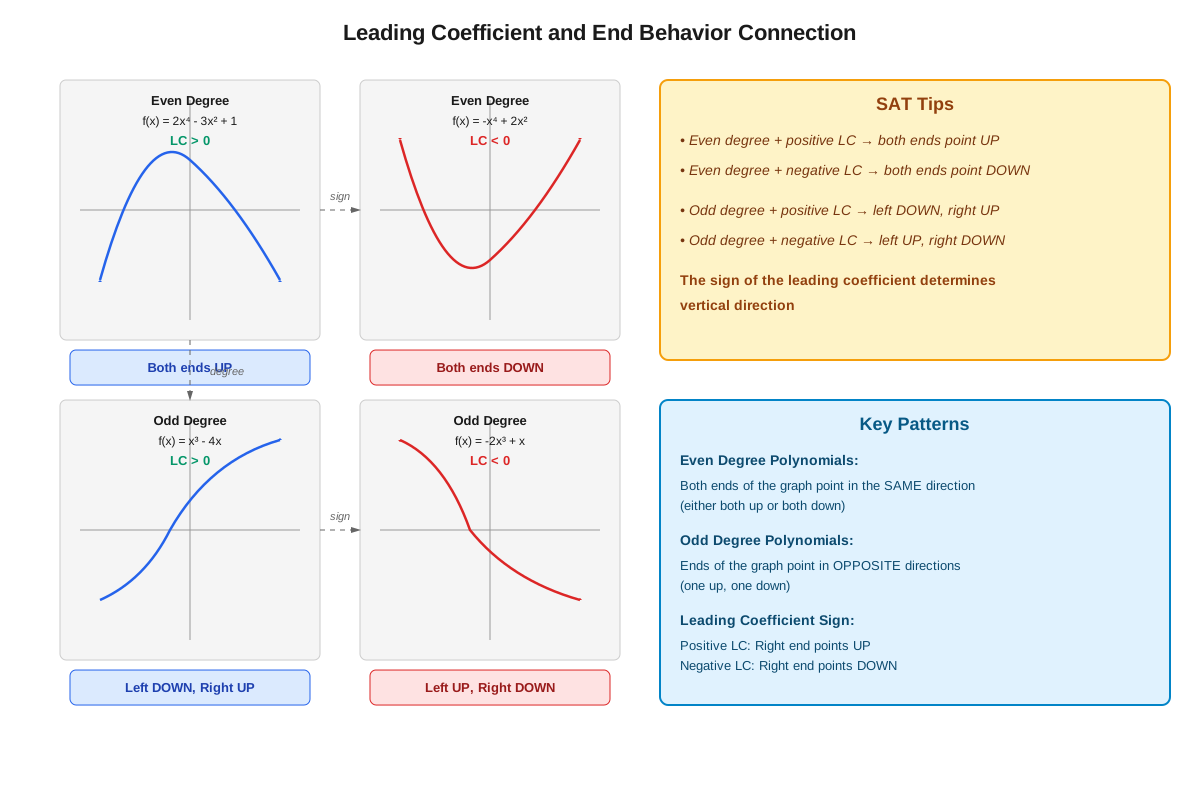
The relationship between leading coefficient and degree determines fundamental polynomial behavior. The degree of a polynomial is the highest exponent appearing on the variable, while the leading coefficient is the number multiplying that highest-power term. Together, these two features control the polynomial's end behavior:
| Degree | Leading Coefficient | Left End Behavior | Right End Behavior |
|---|---|---|---|
| Even | Positive | Rises (→ +∞) | Rises (→ +∞) |
| Even | Negative | Falls (→ -∞) | Falls (→ -∞) |
| Odd | Positive | Falls (→ -∞) | Rises (→ +∞) |
| Odd | Negative | Rises (→ +∞) | Falls (→ -∞) |
This table represents one of the most tested concepts on the SAT. Questions frequently provide a graph and ask which polynomial could represent it, requiring students to match end behavior with the appropriate degree and leading coefficient combination.
Standard Form and Leading Terms
Standard form requires arranging polynomial terms from highest to lowest degree: ax^n + bx^(n-1) + ... + k, where a is the leading coefficient and n is the degree. The leading term is the entire expression including both the leading coefficient and the highest-degree variable: ax^n. For example, in 2x⁴ - 5x³ + x - 8, the leading term is 2x⁴.
Understanding the distinction between leading coefficient (just the number) and leading term (coefficient plus variable with exponent) prevents common errors on SAT questions. Some problems ask specifically for the leading term, while others ask for just the coefficient—reading carefully is essential.
Effects on Graph Behavior
The magnitude (absolute value) of the leading coefficient affects how steeply a polynomial rises or falls. A larger absolute value creates a steeper graph, while a smaller absolute value (between 0 and 1) creates a flatter graph. Compare y = x² with y = 5x² and y = 0.2x²: all three are parabolas opening upward, but they have different widths and steepness.
The sign of the leading coefficient determines the direction of end behavior. For polynomials of odd degree, a positive leading coefficient means the graph ultimately rises to the right and falls to the left, while a negative leading coefficient reverses this pattern. For even-degree polynomials, a positive leading coefficient means both ends rise, while a negative coefficient means both ends fall.
Leading Coefficients in Factored Form
When polynomials appear in factored form, such as 4(x - 1)(x + 3)(x - 2), the leading coefficient can be determined without full expansion. The leading coefficient equals the product of all numerical coefficients outside the factors and the coefficients of x within each factor (when expanded). In 4(x - 1)(x + 3)(x - 2), since each factor has an implied coefficient of 1 on x, the leading coefficient is simply 4.
For expressions like -2(x - 5)(3x + 1), the leading coefficient is -2 × 3 = -6, because when expanded, the highest-degree term comes from multiplying the x terms together: (-2)(x)(3x) = -6x². This skill is particularly valuable on SAT questions that provide factored polynomials and ask about graph behavior without requiring full expansion.
Applications in Polynomial Operations
When adding or subtracting polynomials, the leading coefficient of the result depends on the leading terms of the original polynomials. If (3x³ + 2x - 1) + (5x³ - 4x² + 7) is simplified, the leading coefficient is 3 + 5 = 8. However, if the leading terms have opposite coefficients that cancel, the degree of the resulting polynomial may be lower than expected.
In polynomial multiplication, the leading coefficient of the product equals the product of the individual leading coefficients. If f(x) = 3x² + 2x - 1 and g(x) = 2x³ - x + 5, then the leading coefficient of f(x) · g(x) is 3 × 2 = 6, and the degree is 2 + 3 = 5, making the leading term 6x⁵.
Concept Relationships
The leading coefficient concept connects intimately with polynomial degree to determine end behavior, which then influences graph sketching and function analysis. This relationship flows as: Polynomial Expression → Standard Form → Identify Leading Term → Extract Leading Coefficient → Combine with Degree → Determine End Behavior → Predict Graph Shape.
Leading coefficients also connect to factoring because the leading coefficient of a polynomial constrains which factorizations are possible. When factoring ax² + bx + c, the value of a (the leading coefficient) determines the factoring strategy and possible factor pairs. This relationship extends to the Rational Root Theorem, where the leading coefficient determines possible rational zeros.
The concept bridges to function transformations because multiplying a polynomial by a constant changes its leading coefficient, which corresponds to a vertical stretch or compression. Understanding that f(x) = x³ and g(x) = 3x³ differ only in their leading coefficient helps students recognize vertical scaling transformations.
Within the broader polynomial unit, leading coefficients connect to: polynomial division (the leading term guides long division steps), remainder theorem (leading coefficients affect remainder calculations), and polynomial inequalities (end behavior determines solution intervals for inequalities).
Quick check — test yourself on Leading coefficient so far.
Try Flashcards →High-Yield Facts
⭐ The leading coefficient is the numerical coefficient of the highest-degree term when a polynomial is in standard form
⭐ For even-degree polynomials, positive leading coefficients mean both ends of the graph rise; negative means both ends fall
⭐ For odd-degree polynomials, positive leading coefficients mean the graph falls left and rises right; negative reverses this
⭐ The leading coefficient can be found in factored form by multiplying all numerical factors and the coefficients of the variable terms
⭐ A larger absolute value of the leading coefficient creates a steeper graph; smaller absolute values create flatter graphs
- The leading coefficient is never zero (if it were, that term wouldn't be the highest degree)
- When polynomials are added, the leading coefficient of the sum is the sum of the leading coefficients (unless they cancel)
- When polynomials are multiplied, the leading coefficient of the product is the product of the individual leading coefficients
- The sign of the leading coefficient determines whether a polynomial's absolute value eventually increases without bound in the positive or negative direction
- In real-world modeling, the leading coefficient often represents the most significant factor affecting long-term behavior
Common Misconceptions
Misconception: The leading coefficient is always the first number that appears in a polynomial expression. → Correction: The leading coefficient is the coefficient of the highest-degree term, which is only first when the polynomial is written in standard form. In 5x + 3x³ - 2, the leading coefficient is 3, not 5.
Misconception: A polynomial with a positive leading coefficient always has positive y-values. → Correction: The leading coefficient determines end behavior, not the sign of all function values. The polynomial 2x² - 100 has a positive leading coefficient but is negative for many x-values near zero.
Misconception: The leading coefficient and the degree are the same thing. → Correction: The degree is the highest exponent (a whole number indicating the power), while the leading coefficient is the numerical multiplier of that term. In 5x⁷, the degree is 7 and the leading coefficient is 5.
Misconception: Changing the leading coefficient changes the x-intercepts of a polynomial. → Correction: While changing the leading coefficient affects the graph's steepness and end behavior, it does not change the x-intercepts (zeros) of the polynomial. The polynomial 2(x - 3)(x + 1) and 5(x - 3)(x + 1) have the same zeros at x = 3 and x = -1.
Misconception: The leading coefficient must be a positive integer. → Correction: Leading coefficients can be negative, fractional, or decimal. The polynomial -0.5x⁴ + 3x² - 1 has a leading coefficient of -0.5.
Misconception: In factored form like (x + 2)(x - 3), the leading coefficient is 2 or 3. → Correction: The numbers 2 and 3 are constants in the factors, not coefficients of x. The leading coefficient here is 1 (the implied coefficient of x in each factor), so when expanded, the leading term is 1x² or simply x².
Worked Examples
Example 1: Identifying Leading Coefficient and Predicting End Behavior
Problem: Given the polynomial f(x) = -2x⁴ + 5x³ - 3x² + 7x - 1, identify the leading coefficient and describe the end behavior of the graph.
Solution:
Step 1: Verify the polynomial is in standard form. The terms are arranged from highest degree (4) to lowest degree (0), so it is in standard form.
Step 2: Identify the leading term. The highest-degree term is -2x⁴.
Step 3: Extract the leading coefficient. The leading coefficient is -2.
Step 4: Note the degree. The degree is 4, which is even.
Step 5: Apply the end behavior rules. For an even-degree polynomial with a negative leading coefficient:
- As x → -∞, f(x) → -∞ (left end falls)
- As x → +∞, f(x) → -∞ (right end falls)
Answer: The leading coefficient is -2. Both ends of the graph fall downward (the graph opens downward like an upside-down parabola, but with more complexity due to the higher degree).
Connection to Learning Objectives: This example demonstrates identifying the leading coefficient and applying it to determine graph behavior, addressing the first and third learning objectives.
Example 2: Finding Leading Coefficient from Factored Form
Problem: The polynomial g(x) = 3(x - 2)(2x + 1)(x + 4) is given in factored form. Without fully expanding, determine the leading coefficient and the degree of the polynomial.
Solution:
Step 1: Identify all numerical factors. The factor 3 is outside the parentheses.
Step 2: Identify the coefficient of x in each factor:
- (x - 2): coefficient of x is 1
- (2x + 1): coefficient of x is 2
- (x + 4): coefficient of x is 1
Step 3: Calculate the leading coefficient. When expanded, the highest-degree term comes from multiplying all the x terms together: 3 × 1 × 2 × 1 = 6.
Step 4: Determine the degree. Since there are three linear factors (each with degree 1), the degree of the expanded polynomial is 1 + 1 + 1 = 3.
Step 5: Verify the reasoning. The leading term when expanded would be 3(x)(2x)(x) = 6x³.
Answer: The leading coefficient is 6, and the degree is 3.
Follow-up analysis: Since the degree is odd (3) and the leading coefficient is positive (6), the end behavior is: as x → -∞, g(x) → -∞, and as x → +∞, g(x) → +∞. This means the graph falls to the left and rises to the right.
Connection to Learning Objectives: This example shows how to identify leading coefficients in factored form and apply that knowledge to predict function behavior, addressing multiple learning objectives including application to SAT-style questions.
Exam Strategy
When approaching sat leading coefficient questions, first determine whether the polynomial is in standard form or factored form, as this dictates the identification strategy. For standard form, scan directly to the highest-degree term; for factored form, multiply the numerical factors and the coefficients of the variable terms.
Trigger words and phrases to watch for include: "end behavior," "as x approaches infinity," "which graph could represent," "highest-degree term," and "leading term." These phrases signal that leading coefficient analysis is required. Questions asking about "long-term behavior" or "eventual behavior" almost always involve leading coefficient and degree.
For process-of-elimination on multiple-choice questions:
- Eliminate answer choices with incorrect end behavior based on the leading coefficient sign and degree parity
- Eliminate choices with incorrect steepness if the magnitude of the leading coefficient is specified
- Check middle behavior (turning points, intercepts) only after eliminating based on end behavior
Time allocation: Simple identification questions should take 30-45 seconds. Multi-step problems involving leading coefficients combined with other concepts (like finding zeros or analyzing transformations) may require 90-120 seconds. If a question asks for end behavior, don't waste time finding exact intercepts or turning points unless specifically asked.
Exam Tip: On graph-matching questions, always check end behavior first. This single step often eliminates 2-3 answer choices immediately, saving valuable time.
When questions provide graphs and ask which polynomial could represent them, use the "corner test": look at the far left and far right of the graph to determine end behavior, then match to the appropriate degree (even/odd) and leading coefficient sign (positive/negative) combination.
Memory Techniques
EPON Mnemonic for end behavior:
- Even degree, Positive leading coefficient: both ends point Up (same direction)
- Even degree, Negative leading coefficient: both ends point Down (same direction)
- Odd degree, Positive leading coefficient: Negative to positive (falls left, rises right)
- Odd degree, Negative leading coefficient: Positive to negative (rises left, falls right)
Visualization Strategy: Picture the leading coefficient as the "steering wheel" of the polynomial—it controls which direction the graph ultimately goes. A positive coefficient "steers upward" on the right side for odd-degree polynomials; a negative coefficient "steers downward."
The "Standard First" Rule: Always convert to or visualize standard form before identifying the leading coefficient. Create a mental habit: "Highest degree first, then read the coefficient."
Factored Form Shortcut: Remember "multiply the outsides"—multiply all numbers outside parentheses and all coefficients of x inside parentheses to get the leading coefficient without full expansion.
The "Ends Match" vs. "Ends Opposite" Rule: Even degrees make ends match (both up or both down); odd degrees make ends opposite (one up, one down). The leading coefficient sign determines which specific direction.
Summary
The leading coefficient is the numerical coefficient of the highest-degree term in a polynomial written in standard form, and it plays a crucial role in determining polynomial behavior, particularly end behavior. Combined with the degree of the polynomial, the leading coefficient dictates whether the graph rises or falls at its extremes: even-degree polynomials with positive leading coefficients rise on both ends, while those with negative leading coefficients fall on both ends; odd-degree polynomials with positive leading coefficients fall left and rise right, while those with negative leading coefficients do the opposite. The SAT tests this concept both directly through identification questions and indirectly through graph analysis, equation solving, and modeling problems. Students must be able to identify leading coefficients in both standard and factored forms, understand how changes to the leading coefficient affect graph steepness, and apply these principles to eliminate incorrect answer choices efficiently. Mastery requires connecting leading coefficient properties to broader polynomial concepts including factoring, transformations, and function analysis.
Key Takeaways
- The leading coefficient is the numerical multiplier of the highest-degree term in standard form and determines end behavior direction when combined with degree parity
- Even-degree polynomials have matching end behavior (both ends go the same direction), while odd-degree polynomials have opposite end behavior
- The sign of the leading coefficient determines whether ends rise (positive) or fall (negative)
- Leading coefficients can be identified in factored form by multiplying all numerical factors and variable coefficients without full expansion
- The magnitude of the leading coefficient affects graph steepness: larger absolute values create steeper graphs
- SAT questions frequently test leading coefficients through graph-matching problems where end behavior analysis eliminates multiple answer choices
- Always verify that a polynomial is in standard form before identifying the leading coefficient to avoid selecting the wrong term
Related Topics
Polynomial End Behavior: Building directly on leading coefficient concepts, this topic explores the comprehensive behavior of polynomials as input values approach infinity, including the role of lower-degree terms in local behavior.
Polynomial Graphs and Turning Points: Understanding how the degree and leading coefficient relate to the maximum number of turning points and the overall shape of polynomial graphs.
Polynomial Division and the Remainder Theorem: The leading coefficient plays a crucial role in polynomial long division and synthetic division, determining the first term of quotients.
Transformations of Polynomial Functions: Changes to the leading coefficient represent vertical stretches and compressions, connecting algebraic and graphical representations.
Rational Functions and Asymptotes: The leading coefficients of numerator and denominator polynomials determine horizontal asymptote behavior, extending polynomial concepts to rational expressions.
Practice CTA
Now that you understand the fundamental concepts of leading coefficients and their critical role in polynomial analysis, it's time to solidify your mastery through practice. Attempt the practice questions designed specifically for this topic, focusing on both quick identification problems and complex multi-step applications. Use the flashcards to reinforce the end behavior rules and the relationships between degree, leading coefficient, and graph behavior. Remember: the SAT rewards both accuracy and speed, so practice until identifying leading coefficients and predicting their effects becomes automatic. Each practice problem you complete builds the pattern recognition skills that will help you quickly eliminate wrong answers and confidently select correct ones on test day. You've got this!
Sign up free to keep reading
Create a free AnvayaPrep account to finish this SAT guide on Leading coefficient — plus flashcards and practice questions.