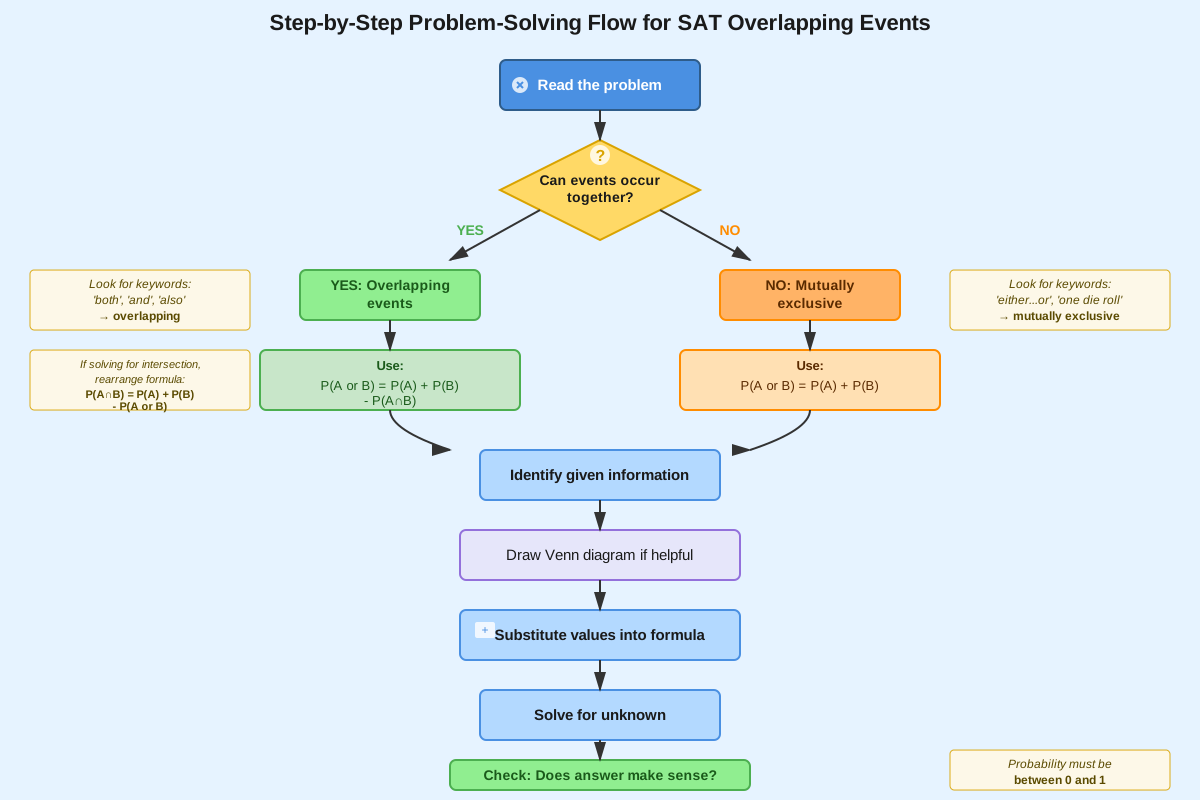
Overview
Overlapping events represent one of the most frequently tested probability concepts on the SAT math section. Unlike mutually exclusive events where outcomes cannot occur simultaneously, overlapping events can share common outcomes, requiring students to account for these intersections when calculating probabilities. Understanding this concept is essential because the SAT regularly presents scenarios involving surveys, Venn diagrams, and real-world situations where multiple characteristics or outcomes can coexist.
The foundation of sat overlapping events lies in the Addition Rule for Probability, which states that when calculating the probability of either event A or event B occurring, students must subtract the probability of both events occurring together to avoid double-counting. This principle extends beyond pure probability calculations into data interpretation, set theory, and logical reasoning—all high-yield areas on the SAT. Questions involving overlapping events frequently appear in both the calculator and no-calculator sections, often disguised within word problems about student clubs, survey results, or demographic data.
Mastery of overlapping events connects directly to broader mathematical reasoning skills tested throughout the SAT. This topic bridges basic probability concepts with more complex statistical analysis, set operations, and algebraic problem-solving. Students who thoroughly understand overlapping events gain a significant advantage not only in probability questions but also in data analysis passages and multi-step reasoning problems that require careful attention to logical relationships between different groups or outcomes.
Learning Objectives
- [ ] Identify key features of overlapping events
- [ ] Explain how overlapping events appears on the SAT
- [ ] Apply overlapping events to answer SAT-style questions
- [ ] Calculate probabilities using the Addition Rule for overlapping events
- [ ] Interpret and construct Venn diagrams representing overlapping sets
- [ ] Distinguish between overlapping and mutually exclusive events in problem contexts
- [ ] Solve multi-step problems involving three or more overlapping categories
Prerequisites
- Basic probability concepts: Understanding sample spaces, outcomes, and simple probability calculations provides the foundation for more complex overlapping event problems
- Fractions and percentages: Converting between these forms is essential since SAT probability questions present data in various formats
- Set notation and terminology: Familiarity with unions, intersections, and complements helps interpret overlapping event problems efficiently
- Algebraic manipulation: Solving equations with multiple variables appears frequently when working with overlapping event formulas
- Data interpretation: Reading tables, charts, and survey results is necessary since overlapping events often appear in data analysis contexts
Why This Topic Matters
Overlapping events appear in countless real-world scenarios that the SAT uses to test mathematical reasoning. Survey analysis, medical testing, demographic studies, and market research all involve situations where individuals or outcomes can belong to multiple categories simultaneously. A student might be both an athlete and a musician, a customer might purchase both products A and B, or a patient might exhibit multiple symptoms. Understanding how to properly count and calculate probabilities in these situations is fundamental to data literacy.
On the SAT, overlapping events questions appear with remarkable consistency, typically comprising 2-4 questions per test administration. These questions most commonly appear as word problems requiring students to interpret survey data, analyze Venn diagrams, or calculate conditional probabilities. The College Board frequently embeds overlapping events within the Problem Solving and Data Analysis domain, which accounts for approximately 29% of SAT math questions. Questions range from straightforward two-set Venn diagram interpretations to complex multi-step problems involving three overlapping categories.
The SAT presents overlapping events through several recurring formats: two-way frequency tables showing overlapping characteristics, Venn diagram problems requiring calculation of specific regions, word problems describing survey results with multiple response options, and probability questions where events can occur simultaneously. Recognizing these patterns allows students to quickly identify the appropriate solution strategy and avoid common calculation errors that result from double-counting shared outcomes.
Core Concepts
The Addition Rule for Overlapping Events
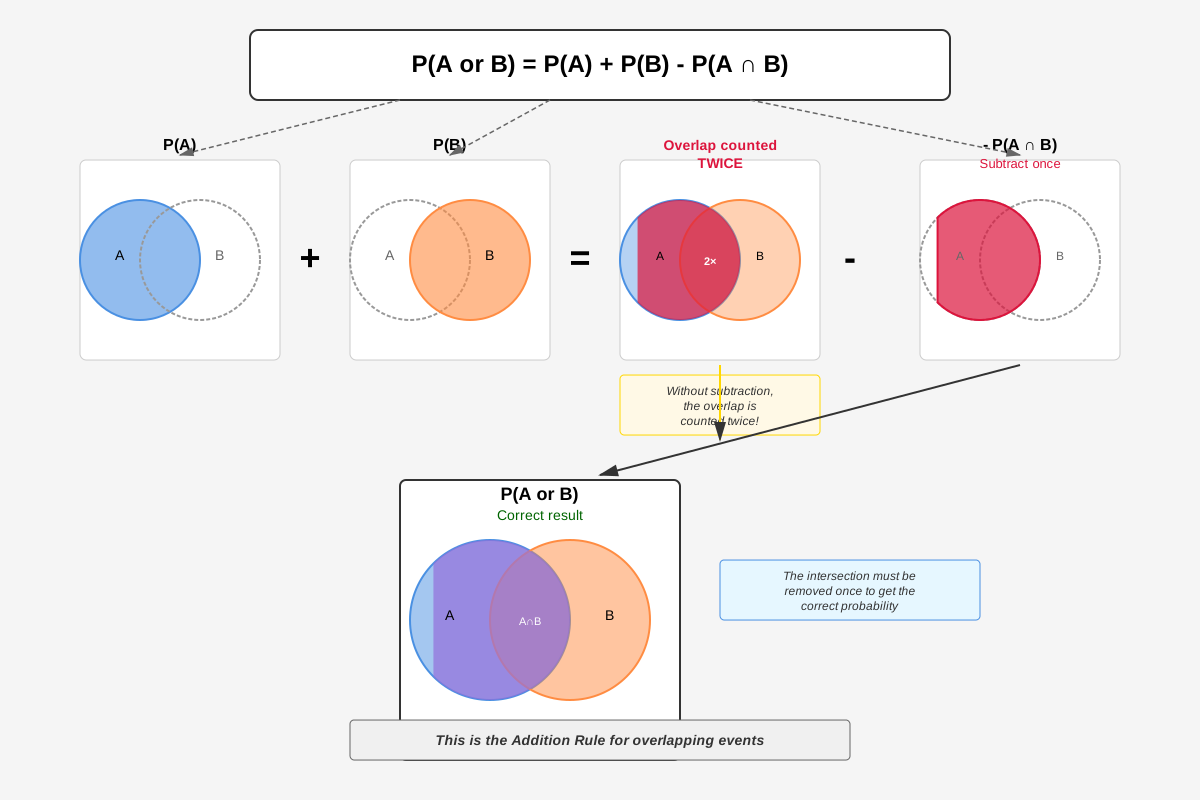
The fundamental principle governing overlapping events is the Addition Rule for Probability. When calculating the probability that event A or event B occurs (denoted as P(A or B) or P(A ∪ B)), the formula is:
P(A or B) = P(A) + P(B) - P(A and B)The subtraction of P(A and B) is crucial because when adding P(A) and P(B), the outcomes that belong to both events get counted twice. Subtracting the intersection once corrects this double-counting. This formula applies whether working with probabilities, frequencies, or percentages.
For example, if 60% of students play sports, 40% play musical instruments, and 25% do both, the percentage playing sports or instruments is: 60% + 40% - 25% = 75%. Without subtracting the 25% who do both, the incorrect answer of 100% would suggest every student participates in at least one activity.
Venn Diagrams and Visual Representation
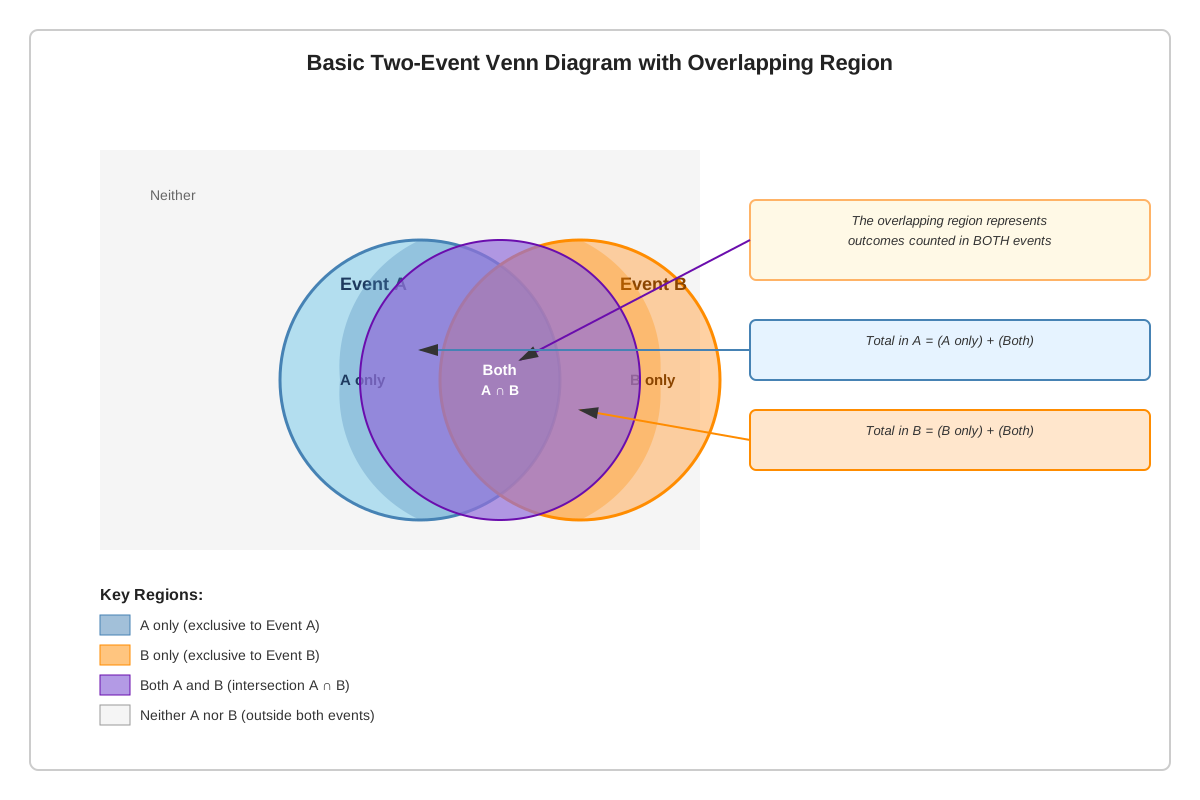
Venn diagrams provide the most intuitive visual representation of overlapping events. These diagrams use circles (or other shapes) to represent different sets, with overlapping regions showing elements that belong to multiple sets simultaneously.
A standard two-set Venn diagram contains four distinct regions:
- Elements only in set A (A but not B)
- Elements only in set B (B but not A)
- Elements in both sets (A and B, the intersection)
- Elements in neither set (outside both circles)
When solving SAT problems with Venn diagrams, always start by filling in the intersection region first, then work outward to the exclusive regions. This prevents calculation errors and ensures all regions are properly accounted for.
Set Notation and Terminology
Understanding precise mathematical language is essential for interpreting overlapping events problems correctly:
| Notation | Meaning | Description |
|---|---|---|
| A ∪ B | Union | All elements in A or B or both |
| A ∩ B | Intersection | Only elements in both A and B |
| A' or Ā | Complement | All elements not in A |
| n(A) | Cardinality | The number of elements in set A |
The SAT may use either symbolic notation or plain English descriptions. "Students who play sports or instruments" refers to the union, while "students who play both sports and instruments" refers to the intersection.
Calculating Individual Regions
When given total counts or probabilities for overlapping sets, systematically calculate each region:
Step-by-step process:
- Identify the total population or sample space
- Record the intersection value (both A and B)
- Calculate "only A" by subtracting the intersection from total A
- Calculate "only B" by subtracting the intersection from total B
- Calculate "neither A nor B" by subtracting all other regions from the total
For example, in a class of 30 students where 18 study Spanish, 15 study French, and 8 study both:
- Both languages: 8 students
- Only Spanish: 18 - 8 = 10 students
- Only French: 15 - 8 = 7 students
- Neither language: 30 - (10 + 8 + 7) = 5 students
Three-Set Overlapping Events
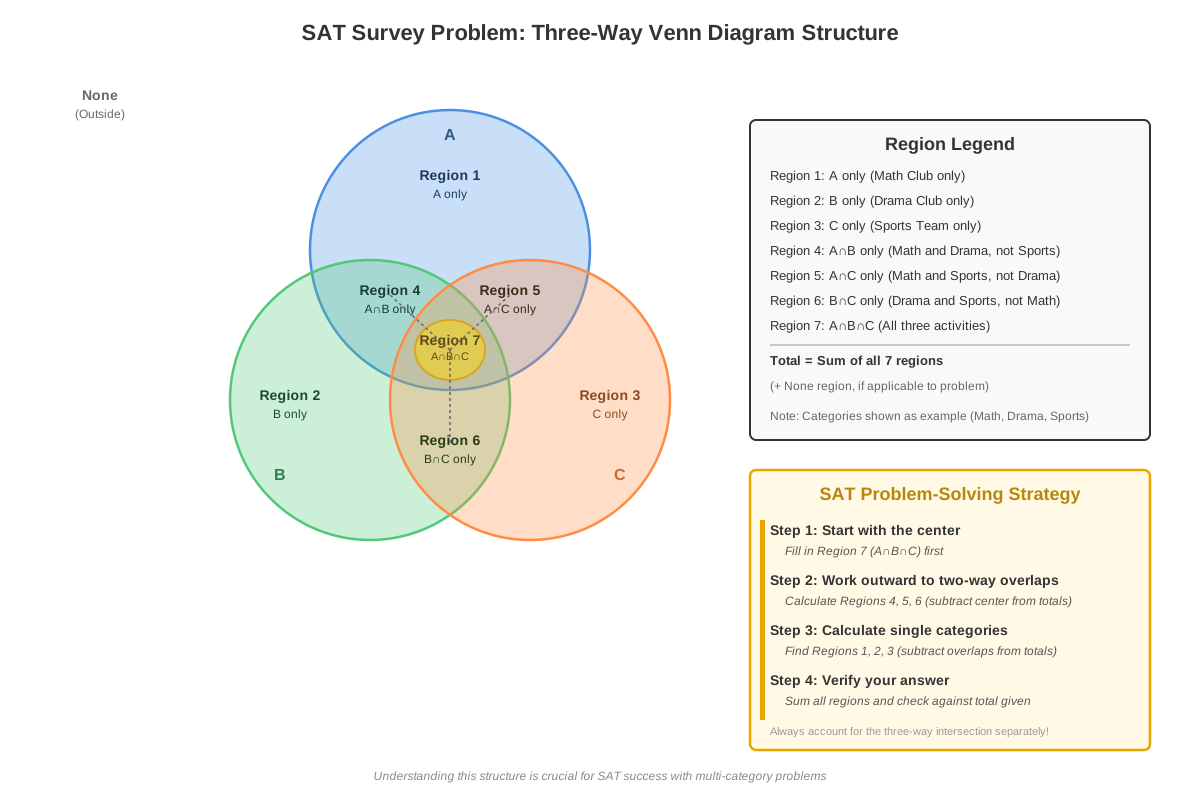
More challenging SAT problems involve three overlapping categories. The Addition Rule extends to:
P(A or B or C) = P(A) + P(B) + P(C) - P(A and B) - P(A and C) - P(B and C) + P(A and B and C)The addition of P(A and B and C) at the end corrects for the fact that this central region gets subtracted three times in the pairwise intersections but should only be subtracted twice.
Three-set Venn diagrams contain eight distinct regions, and problems typically require careful organization to track all values correctly. The SAT rarely requires students to derive the three-set formula but may present problems requiring its application.
Mutually Exclusive vs. Overlapping Events
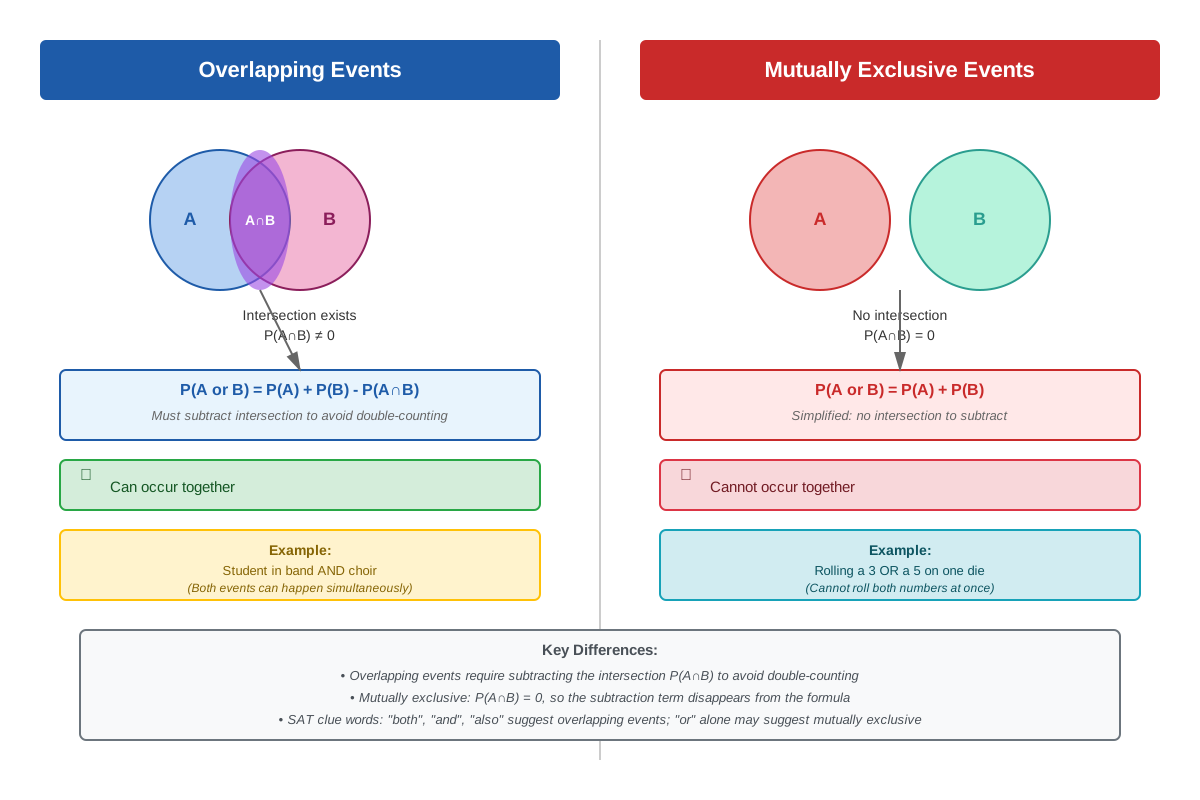
A critical distinction that frequently appears on the SAT is recognizing when events are mutually exclusive (cannot occur together) versus overlapping (can occur together):
Mutually exclusive events:
- Rolling a 3 and rolling a 5 on a single die
- Being born in January and being born in March
- P(A and B) = 0
- P(A or B) = P(A) + P(B)
Overlapping events:
- Being a senior and being on the basketball team
- Owning a car and owning a bicycle
- P(A and B) > 0
- P(A or B) = P(A) + P(B) - P(A and B)
The SAT tests whether students recognize which formula applies to a given situation. Reading comprehension and careful attention to problem context determine the correct approach.
Complement Rule with Overlapping Events
The complement rule states that P(A) = 1 - P(not A). This principle combines powerfully with overlapping events, particularly when calculating "at least one" probabilities. The probability that at least one of several events occurs equals one minus the probability that none of them occur:
P(at least one) = 1 - P(none)This approach often simplifies calculations significantly compared to adding multiple overlapping probabilities directly.
Concept Relationships
The concepts within overlapping events build upon each other in a logical progression. The Addition Rule serves as the foundational principle → which requires understanding set notation to interpret correctly → which connects to Venn diagrams as visual representations → which enable systematic calculation of individual regions → which extends to three-set problems as increased complexity → all while maintaining awareness of the distinction between mutually exclusive and overlapping events → and leveraging the complement rule for efficient problem-solving.
Overlapping events connects backward to prerequisite topics including basic probability (providing the framework for calculating individual event probabilities), fractions and percentages (the formats in which probabilities are expressed), and set theory (the mathematical foundation for unions and intersections). Looking forward, mastering overlapping events enables progression to conditional probability, where the sample space changes based on given information, and to more advanced statistical concepts involving dependent and independent events.
The relationship between overlapping events and data analysis is particularly strong on the SAT. Two-way tables, which organize data by two categorical variables, represent overlapping events in tabular rather than diagrammatic form. Understanding that table cells represent intersections while row and column totals represent unions allows students to translate between different representations of the same underlying concept.
Quick check — test yourself on Overlapping events so far.
Try Flashcards →High-Yield Facts
⭐ The Addition Rule formula P(A or B) = P(A) + P(B) - P(A and B) is the single most important equation for overlapping events
⭐ Always subtract the intersection when calculating unions to avoid double-counting
⭐ In Venn diagrams, start by filling in the intersection region first, then work outward
⭐ The four regions of a two-set Venn diagram are: only A, only B, both A and B, and neither A nor B
⭐ When events are mutually exclusive, P(A and B) = 0, so the Addition Rule simplifies to P(A or B) = P(A) + P(B)
- The complement of "A or B" is "neither A nor B," expressed as P(neither) = 1 - P(A or B)
- Three-set problems require adding back the central intersection after subtracting pairwise intersections
- "At least one" probability problems are often easier to solve using complements: P(at least one) = 1 - P(none)
- Two-way tables and Venn diagrams represent the same information in different formats
- The total of all regions in a Venn diagram must equal the total population or sample space
- Overlapping events questions frequently appear in the Problem Solving and Data Analysis domain
- Survey data problems almost always involve overlapping events unless explicitly stated otherwise
- Converting between counts, fractions, and percentages is essential for overlapping events problems
Common Misconceptions
Misconception: When calculating P(A or B), simply add P(A) and P(B) without any adjustment → Correction: This only works for mutually exclusive events. For overlapping events, you must subtract P(A and B) to avoid counting the intersection twice. The correct formula is P(A or B) = P(A) + P(B) - P(A and B).
Misconception: The intersection region in a Venn diagram represents the total number in both sets → Correction: The intersection represents only those elements that belong to both sets simultaneously, not the sum of both sets. The union (A or B) represents all elements in either or both sets.
Misconception: "Only A" means the same thing as "A" → Correction: "A" includes everything in set A, including the intersection with B. "Only A" specifically excludes the intersection, representing elements in A but not in B. Mathematically, "only A" = n(A) - n(A and B).
Misconception: If 40% of students play sports and 30% play instruments, then 70% play at least one → Correction: This conclusion assumes the events are mutually exclusive, which is rarely true in real-world scenarios. Without knowing the overlap, you cannot determine the percentage playing at least one. The actual percentage could range from 40% (if all instrument players also play sports) to 70% (if no one does both).
Misconception: In three-set problems, you only need to subtract the three pairwise intersections → Correction: After subtracting the pairwise intersections, you must add back the central region (A and B and C) because it gets subtracted three times but should only be subtracted twice. The complete formula includes "+ P(A and B and C)" at the end.
Misconception: Venn diagram problems always provide enough information to fill in every region → Correction: Some SAT problems intentionally provide incomplete information, requiring students to recognize what can and cannot be determined. Always check whether you have sufficient data before attempting to calculate every region.
Worked Examples
Example 1: Two-Set Survey Problem
Problem: In a survey of 200 students, 120 students have a smartphone, 90 students have a tablet, and 50 students have both devices.
a) How many students have a smartphone or a tablet?
b) How many students have only a smartphone?
c) What is the probability that a randomly selected student has neither device?
Solution:
Part a: Use the Addition Rule for overlapping events.
- Let S = students with smartphones, T = students with tablets
- n(S or T) = n(S) + n(T) - n(S and T)
- n(S or T) = 120 + 90 - 50 = 160 students
Part b: Calculate "only smartphone" by subtracting the intersection.
- Only smartphone = Total smartphone - Both devices
- Only smartphone = 120 - 50 = 70 students
Part c: Find students with neither device, then calculate probability.
- Neither device = Total students - (S or T)
- Neither device = 200 - 160 = 40 students
- P(neither) = 40/200 = 1/5 or 0.20 or 20%
Connection to learning objectives: This problem demonstrates identifying overlapping events (smartphones and tablets can both be owned), applying the Addition Rule, and calculating probabilities from survey data—all core SAT skills.
Example 2: Three-Set Venn Diagram Problem
Problem: At a school club fair, 100 students signed up for activities. The data shows:
- 45 students joined the Drama club
- 50 students joined the Science club
- 40 students joined the Art club
- 20 students joined both Drama and Science
- 15 students joined both Drama and Art
- 18 students joined both Science and Art
- 8 students joined all three clubs
How many students joined exactly one club?
Solution:
Step 1: Identify what we're looking for—students in exactly one club means only Drama, only Science, or only Art (not in any intersections).
Step 2: Calculate each "only" region by working from the center outward.
For only Drama:
- Start with total Drama: 45
- Subtract those in Drama and Science (including all three): 20
- Subtract those in Drama and Art (including all three): 15
- Add back those in all three (because we subtracted them twice): 8
- Only Drama = 45 - 20 - 15 + 8 = 18 students
For only Science:
- Only Science = 50 - 20 - 18 + 8 = 20 students
For only Art:
- Only Art = 40 - 15 - 18 + 8 = 15 students
Step 3: Add the three "only" regions.
- Exactly one club = 18 + 20 + 15 = 53 students
Connection to learning objectives: This problem requires systematic calculation of individual regions in a complex three-set scenario, demonstrating advanced application of overlapping events concepts. The key insight is working from the center (all three) outward to avoid calculation errors.
Exam Strategy
When approaching sat overlapping events questions, begin by identifying the problem type. Look for trigger words and phrases such as "or," "both," "at least one," "neither," "only," and "exactly." These words signal which regions of a Venn diagram or which formula components you need to calculate. Questions using "or" typically require the Addition Rule, while "both" indicates you need the intersection.
Create a visual representation even when the problem doesn't provide one. Drawing a quick Venn diagram takes 10-15 seconds but dramatically reduces errors by organizing information spatially. Label each region clearly and fill in known values before attempting calculations. This visual approach transforms abstract word problems into concrete, manageable calculations.
For process-of-elimination strategies, recognize that answer choices violating basic logical constraints can be eliminated immediately. For example, the number of students doing "both A and B" cannot exceed the number doing "only A" plus "both A and B" (which equals total A). Similarly, the union cannot be smaller than either individual set. These logical boundaries often eliminate 2-3 answer choices without calculation.
Time allocation for overlapping events problems should be approximately 60-90 seconds for straightforward two-set problems and 90-120 seconds for three-set or multi-step problems. If a problem requires more than two minutes, mark it for review and move forward. These problems reward systematic organization more than complex mathematical skills, so rushing increases error rates significantly.
Exam Tip: When the problem provides a two-way table instead of a Venn diagram, recognize that the table cells represent intersections, row/column totals represent individual sets, and the grand total represents the universal set. You can solve these problems using either table arithmetic or by converting to a Venn diagram—choose whichever feels more intuitive.
Watch for questions that ask about complements disguised as direct questions. "What is the probability that a student plays at least one sport?" is often easier to solve as "1 minus the probability of playing no sports." This complement approach is particularly powerful when dealing with "at least one" scenarios involving multiple overlapping events.
Memory Techniques
VENN mnemonic for systematic problem-solving:
- Verify what the question asks (union, intersection, complement, or specific region)
- Establish the total population or sample space
- Note the intersection values first
- Navigate outward to calculate remaining regions
"Add, Add, Subtract" for the Addition Rule: When calculating P(A or B), the process is Add P(A), Add P(B), Subtract P(A and B). This rhythm helps recall the formula structure during time pressure.
The "Both First" rule: In any Venn diagram problem, always fill in the "both" (intersection) region first, then work outward. This prevents the most common calculation error—forgetting to account for the overlap when calculating exclusive regions.
Visualization strategy: Picture overlapping events as two overlapping circles of different colors. Where the colors mix (the intersection), you see a third color. This visual metaphor reinforces that the intersection is distinct from either individual set and must be handled separately in calculations.
"Neither = Total minus Union": The number or probability of elements in neither category always equals the total minus the union. This relationship provides a quick check for calculation accuracy and a shortcut for finding the "outside" region.
Summary
Overlapping events represent situations where outcomes or elements can belong to multiple categories simultaneously, requiring careful accounting to avoid double-counting shared elements. The Addition Rule—P(A or B) = P(A) + P(B) - P(A and B)—provides the fundamental formula for calculating unions of overlapping sets. Venn diagrams offer powerful visual representations, with distinct regions for "only A," "only B," "both A and B," and "neither A nor B." Success on SAT overlapping events problems requires systematic approaches: filling in intersections first, working outward to exclusive regions, and verifying that all regions sum to the total population. The distinction between overlapping and mutually exclusive events determines which formula applies, while complement rules provide efficient shortcuts for "at least one" and "neither" calculations. Three-set problems extend these principles with additional complexity but follow the same logical structure. Mastery of overlapping events enables students to tackle survey analysis, probability calculations, and data interpretation questions that consistently appear across multiple SAT administrations.
Key Takeaways
- The Addition Rule P(A or B) = P(A) + P(B) - P(A and B) corrects for double-counting the intersection in overlapping events
- Always start Venn diagram problems by filling in the intersection region first, then calculate exclusive regions by subtraction
- "Or" means union (all elements in at least one set), while "and" means intersection (only elements in both sets)
- The four regions of a two-set Venn diagram must sum to the total population—use this as a calculation check
- Complement approaches (1 - P(none)) often simplify "at least one" probability problems significantly
- Distinguish between mutually exclusive events (P(A and B) = 0) and overlapping events (P(A and B) > 0) to apply the correct formula
- Two-way tables and Venn diagrams represent the same overlapping events information in different formats
Related Topics
Conditional Probability: Building on overlapping events, conditional probability examines how probabilities change when given information restricts the sample space. The formula P(A|B) = P(A and B)/P(B) directly uses intersection values from overlapping events problems.
Independent vs. Dependent Events: Understanding whether events overlap relates to whether they influence each other. Independent events can overlap but don't affect each other's probabilities, while dependent events show correlation in their intersections.
Two-Way Tables and Frequency Analysis: These data organization tools represent overlapping categorical variables in tabular form. Mastering overlapping events enables efficient interpretation of two-way tables, a high-frequency SAT question type.
Set Theory and Logic: The mathematical foundation underlying overlapping events extends into formal set theory, including operations like unions, intersections, and complements that appear in advanced mathematics.
Statistical Sampling and Survey Design: Real-world applications of overlapping events appear throughout statistics, particularly in understanding how survey respondents can belong to multiple demographic or preference categories simultaneously.
Practice CTA
Now that you've mastered the core concepts of overlapping events, it's time to solidify your understanding through active practice. The practice questions and flashcards designed for this topic will challenge you to apply the Addition Rule, interpret Venn diagrams, and solve multi-step problems under timed conditions—exactly as they appear on the SAT. Remember, overlapping events questions reward systematic organization and careful reading more than complex calculations. Each practice problem you complete builds the pattern recognition and problem-solving speed that translates directly into points on test day. You've built a strong foundation—now put it to work!
Sign up free to keep reading
Create a free AnvayaPrep account to finish this SAT guide on Overlapping events — plus flashcards and practice questions.