Overview
Factoring special cases represents one of the most powerful and time-saving techniques in the SAT math section. These special patterns—difference of squares, perfect square trinomials, and sum/difference of cubes—appear repeatedly throughout the exam, not just in algebra questions but also in geometry, functions, and even word problems. Mastering these patterns allows students to recognize and factor complex expressions in seconds rather than minutes, providing a critical advantage on a timed test.
The SAT frequently tests whether students can identify these special patterns embedded within larger problems. Rather than requiring tedious trial-and-error factoring or the quadratic formula, recognizing a difference of squares like x² - 49 immediately yields (x + 7)(x - 7). This pattern recognition becomes essential when solving equations, simplifying rational expressions, or finding zeros of functions—all high-frequency question types on the digital SAT. Questions involving sat factoring special cases typically appear 3-5 times per test, making this topic one of the highest-yield areas for focused study.
Within the broader landscape of quadratic equations and polynomial algebra, factoring special cases serves as both a foundational skill and an advanced problem-solving tool. These patterns connect directly to graphing parabolas (finding x-intercepts), solving systems of equations, and understanding function transformations. Students who internalize these special cases gain not only computational speed but also deeper algebraic intuition that transfers across multiple SAT math domains.
Learning Objectives
- [ ] Identify key features of factoring special cases
- [ ] Explain how factoring special cases appears on the SAT
- [ ] Apply factoring special cases to answer SAT-style questions
- [ ] Recognize difference of squares patterns in various algebraic contexts
- [ ] Factor perfect square trinomials efficiently without trial and error
- [ ] Distinguish between factorable and non-factorable expressions using special case criteria
- [ ] Apply special factoring patterns to solve equations and simplify complex expressions
Prerequisites
- Basic factoring techniques: Understanding how to factor out greatest common factors and simple trinomials provides the foundation for recognizing when special patterns apply versus when standard methods are needed.
- Polynomial operations: Familiarity with multiplying binomials using FOIL or the distributive property helps students verify their factored forms and understand why these special patterns work.
- Perfect squares recognition: Knowing perfect square numbers (1, 4, 9, 16, 25, 36, 49, 64, 81, 100, 121, 144...) and perfect square variables (x², x⁴, x⁶...) enables instant pattern identification.
- Exponent rules: Understanding how exponents behave during multiplication and division is essential for recognizing when terms can form special case patterns.
Why This Topic Matters
In real-world applications, factoring special cases appears in physics formulas (kinetic energy differences), engineering calculations (stress-strain relationships), financial modeling (compound interest variations), and computer graphics (distance calculations). The difference of squares pattern, for instance, underlies the Pythagorean theorem's applications and appears in optimization problems across STEM fields.
On the SAT specifically, factoring special cases appears in approximately 15-20% of algebra questions, translating to 3-5 questions per test administration. These questions typically appear as:
- Direct factoring problems asking students to rewrite expressions
- Equation-solving questions where factoring is the most efficient approach
- Function problems requiring identification of zeros or x-intercepts
- Rational expression simplification where special patterns appear in numerators or denominators
- Word problems where setting up equations naturally produces special case patterns
The College Board deliberately includes these patterns because they test both procedural fluency and conceptual understanding. Students who memorize formulas without understanding often miss these questions, while those who recognize patterns can solve them in under 30 seconds. Given that the digital SAT provides approximately 1.5 minutes per math question, this efficiency gain is substantial.
Core Concepts
Difference of Squares
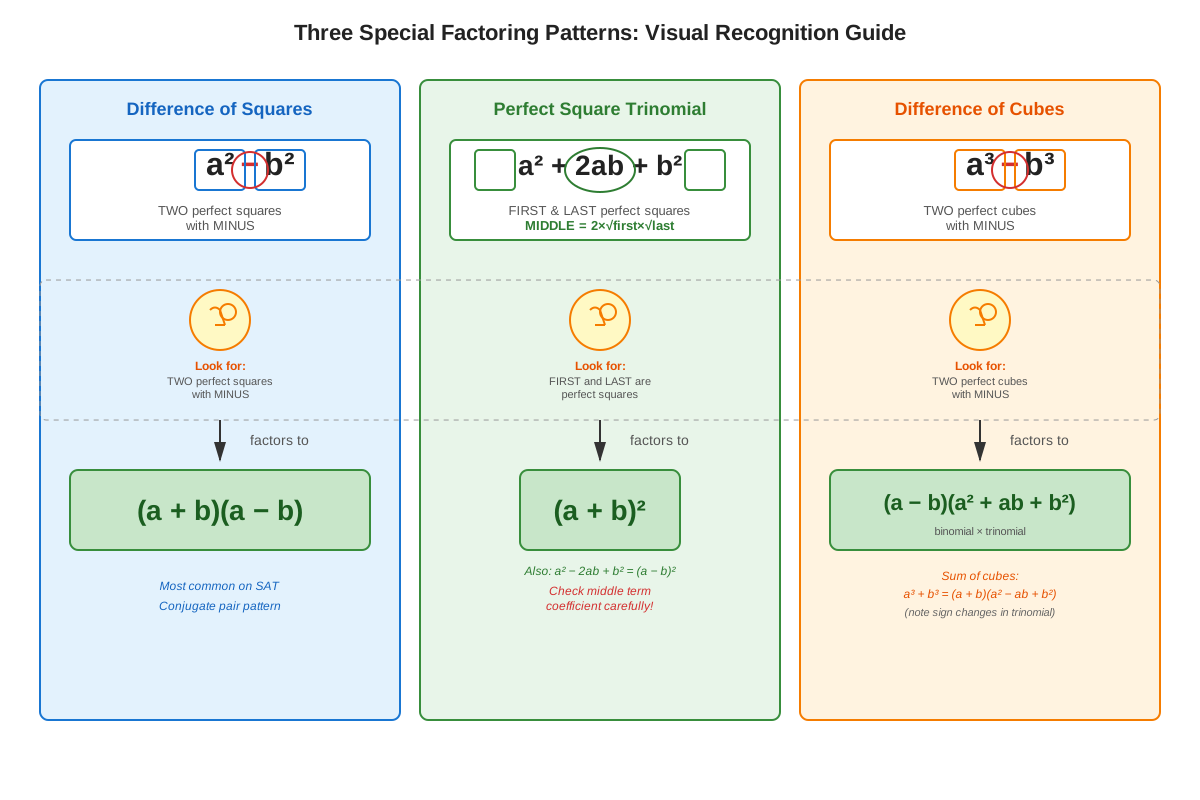
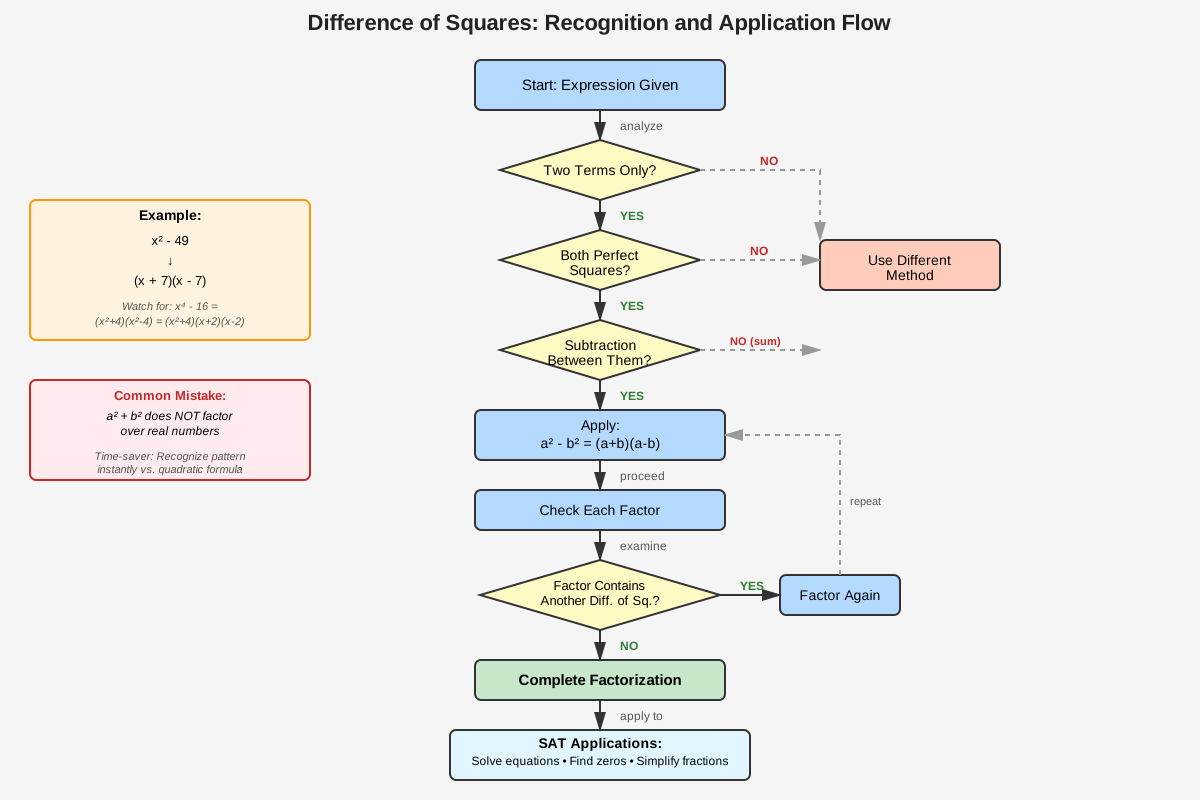
The difference of squares is the most frequently tested special case on the SAT. This pattern occurs when subtracting two perfect square terms:
a² - b² = (a + b)(a - b)The key identifying features are:
- Exactly two terms (binomial)
- Both terms are perfect squares
- A subtraction operation between them
- No coefficient other than 1 or perfect squares on the squared terms
Example patterns:
- x² - 25 = (x + 5)(x - 5)
- 4x² - 9 = (2x + 3)(2x - 3)
- 49y² - 64 = (7y + 8)(7y - 8)
- x⁴ - 16 = (x² + 4)(x² - 4) = (x² + 4)(x + 2)(x - 2)
The last example demonstrates nested factoring: after applying the difference of squares once, check if either factor can be factored further. The term (x² - 4) is itself a difference of squares and factors further, while (x² + 4) cannot be factored using real numbers (sum of squares is not factorable).
Exam Tip: The SAT often disguises difference of squares by using larger coefficients or higher powers. Always check if coefficients are perfect squares (4, 9, 16, 25, 36, 49, 64, 81, 100) and if exponents are even numbers.
Perfect Square Trinomials
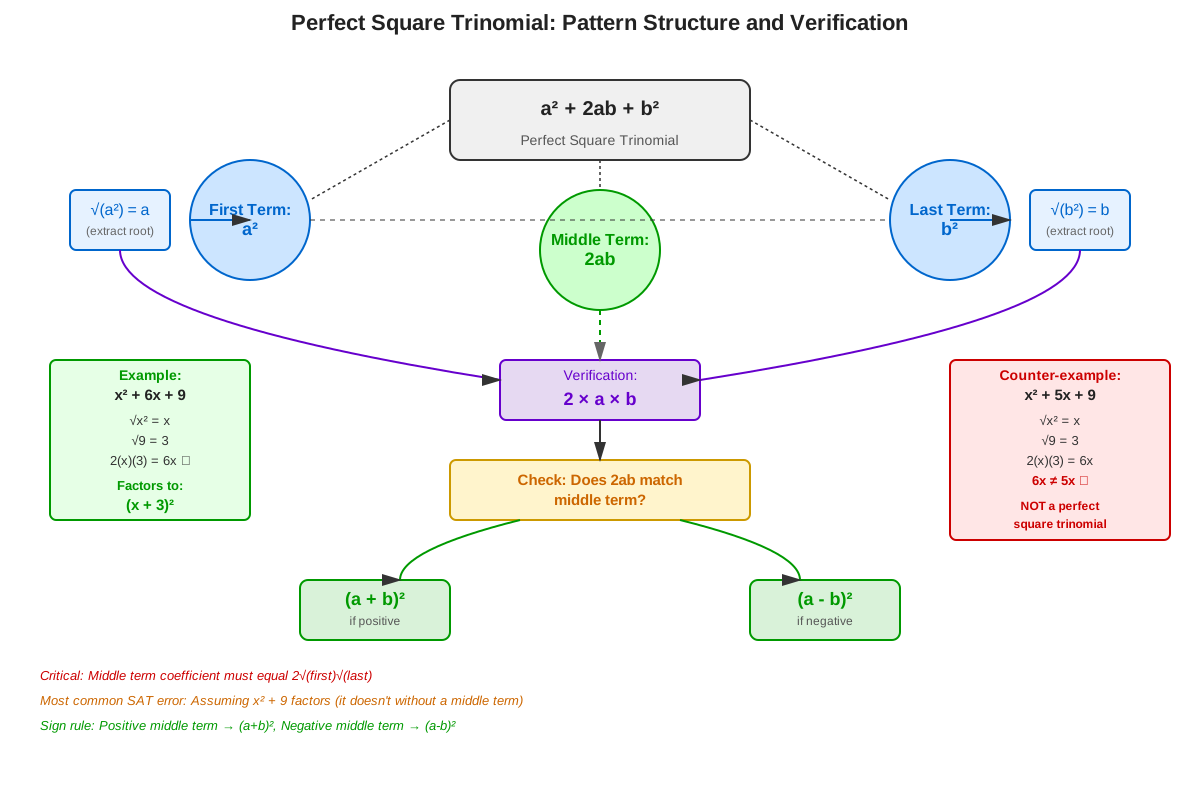
A perfect square trinomial results from squaring a binomial. These appear as three-term expressions following specific patterns:
a² + 2ab + b² = (a + b)²
a² - 2ab + b² = (a - b)²
Identifying characteristics:
- Three terms (trinomial)
- First and last terms are perfect squares
- Middle term equals twice the product of the square roots of the first and last terms
- First and last terms are always positive
- Middle term can be positive or negative
Recognition process:
- Verify the first term is a perfect square: √(first term) = a
- Verify the last term is a perfect square: √(last term) = b
- Calculate 2ab and compare to the middle term
- If they match, factor as (a ± b)²
Examples:
- x² + 6x + 9: √x² = x, √9 = 3, and 2(x)(3) = 6x ✓ → (x + 3)²
- 4x² - 12x + 9: √4x² = 2x, √9 = 3, and 2(2x)(3) = 12x ✓ → (2x - 3)²
- 25y² + 20y + 4: √25y² = 5y, √4 = 2, and 2(5y)(2) = 20y ✓ → (5y + 2)²
- x² + 8x + 16: √x² = x, √16 = 4, and 2(x)(4) = 8x ✓ → (x + 4)²
Non-example:
- x² + 5x + 9: √x² = x, √9 = 3, but 2(x)(3) = 6x ≠ 5x ✗ (not a perfect square trinomial)
Sum and Difference of Cubes
While less common on the SAT than the previous two patterns, sum and difference of cubes occasionally appear in advanced algebra questions:
a³ + b³ = (a + b)(a² - ab + b²)
a³ - b³ = (a - b)(a² + ab + b²)
Key features:
- Two terms involving cube powers
- Can be either addition or subtraction
- Both patterns are factorable (unlike sum of squares)
- The second factor is always a trinomial that typically cannot be factored further
Memory aid for signs:
- Sum of cubes: "same sign, opposite sign, always positive" → (a + b)(a² - ab + b²)
- Difference of cubes: "same sign, opposite sign, always positive" → (a - b)(a² + ab + b²)
Examples:
- x³ + 8 = x³ + 2³ = (x + 2)(x² - 2x + 4)
- 27x³ - 64 = (3x)³ - 4³ = (3x - 4)(9x² + 12x + 16)
- 125 + y³ = 5³ + y³ = (5 + y)(25 - 5y + y²)
Comparison Table
| Pattern | Form | Number of Terms | Factored Form | SAT Frequency |
|---|---|---|---|---|
| Difference of Squares | a² - b² | 2 | (a + b)(a - b) | Very High |
| Perfect Square Trinomial | a² ± 2ab + b² | 3 | (a ± b)² | High |
| Sum of Cubes | a³ + b³ | 2 | (a + b)(a² - ab + b²) | Low |
| Difference of Cubes | a³ - b³ | 2 | (a - b)(a² + ab + b²) | Low |
| Sum of Squares | a² + b² | 2 | Not factorable* | N/A |
*Sum of squares cannot be factored using real numbers
Recognizing Disguised Patterns
The SAT frequently presents special cases in non-obvious forms:
Coefficient manipulation:
- 18x² - 8 = 2(9x² - 4) = 2(3x + 2)(3x - 2)
- First factor out the GCF, then identify the special pattern
Higher degree terms:
- x⁴ - 81 = (x²)² - 9² = (x² + 9)(x² - 9) = (x² + 9)(x + 3)(x - 3)
- Treat x² as a single unit when identifying squares
Fractional coefficients:
- x² - 1/4 = x² - (1/2)² = (x + 1/2)(x - 1/2)
- Recognize that fractions can be perfect squares
Multiple variables:
- x²y² - 25z² = (xy)² - (5z)² = (xy + 5z)(xy - 5z)
- Group variables together as single terms
Concept Relationships
The three main special factoring patterns form a hierarchy of complexity and frequency. Difference of squares serves as the foundational pattern, appearing most frequently and requiring the simplest recognition (two terms, subtraction, perfect squares). This pattern directly connects to nested factoring, where applying difference of squares multiple times fully factors expressions like x⁴ - 16.
Perfect square trinomials build upon difference of squares conceptually—they represent the reverse process of expanding (a ± b)². Understanding how FOIL produces the middle term 2ab helps students verify whether a trinomial fits the pattern. Both difference of squares and perfect square trinomials connect to solving quadratic equations by factoring, which leads to finding zeros of functions and x-intercepts of parabolas.
Sum and difference of cubes represent advanced extensions of the special case concept, appearing less frequently but following similar pattern-recognition logic. These connect to polynomial division and rational expressions, where cube patterns often appear in numerators or denominators requiring simplification.
Relationship map:
Basic Factoring (GCF) → Difference of Squares → Nested Factoring → Solving Equations → Finding Zeros → Graphing Functions
Perfect Square Recognition → Perfect Square Trinomials → Completing the Square → Vertex Form
Cube Recognition → Sum/Difference of Cubes → Polynomial Division → Rational Expression Simplification
All special cases connect back to polynomial operations (multiplication/division) and forward to function analysis and equation solving—making them central nodes in the SAT algebra knowledge network.
High-Yield Facts
⭐ The difference of squares formula a² - b² = (a + b)(a - b) is the single most tested factoring pattern on the SAT
⭐ Sum of squares (a² + b²) CANNOT be factored using real numbers—if you see this pattern, look for alternative solution methods
⭐ Perfect square trinomials always have positive first and last terms; the middle term's sign determines whether the factored form uses + or -
⭐ When factoring difference of squares, always check if either resulting factor can be factored further (nested factoring)
⭐ The middle term of a perfect square trinomial must equal exactly 2ab, where a and b are the square roots of the first and last terms
- Coefficients in difference of squares must be perfect squares (1, 4, 9, 16, 25, 36, 49, 64, 81, 100, 121, 144)
- Exponents in difference of squares must be even numbers (x², x⁴, x⁶, x⁸...)
- Sum of cubes and difference of cubes both factor, but the trinomial factor rarely factors further
- Always factor out the greatest common factor BEFORE checking for special patterns
- On the SAT, if a factoring problem seems difficult, check for special cases first—they're designed to save time
- Difference of squares can involve multiple variables: x²y² - 9z² = (xy + 3z)(xy - 3z)
- Perfect square trinomials with even middle terms are more common on the SAT than those with odd middle terms
Quick check — test yourself on Factoring special cases so far.
Try Flashcards →Common Misconceptions
Misconception: Sum of squares a² + b² can be factored like difference of squares.
Correction: Sum of squares CANNOT be factored using real numbers. Only difference of squares (a² - b²) factors into (a + b)(a - b). If you encounter a² + b², you must use different solution methods like the quadratic formula or completing the square.
Misconception: Any trinomial with perfect square first and last terms is a perfect square trinomial.
Correction: The middle term must equal exactly 2ab. For example, x² + 5x + 9 has perfect squares (x² and 9), but 2(x)(3) = 6x ≠ 5x, so it's not a perfect square trinomial. Always verify the middle term before factoring.
Misconception: After factoring a difference of squares once, the work is complete.
Correction: Always check both factors to see if they can be factored further. For x⁴ - 16, the first factoring gives (x² + 4)(x² - 4), but (x² - 4) is itself a difference of squares that factors to (x + 2)(x - 2). The complete factorization is (x² + 4)(x + 2)(x - 2).
Misconception: The signs in the factored form of difference of squares don't matter.
Correction: While (a + b)(a - b) and (a - b)(a + b) are equivalent due to the commutative property of multiplication, maintaining consistent sign patterns helps avoid errors. More importantly, when solving equations, both factors must be considered: x² - 25 = 0 gives x = 5 OR x = -5.
Misconception: Coefficients must be 1 for special patterns to apply.
Correction: Special patterns work with any perfect square coefficients. For example, 4x² - 9 = (2x)² - 3² = (2x + 3)(2x - 3). The key is recognizing that 4 = 2² and treating 2x as a single unit. Always check if coefficients are perfect squares (4, 9, 16, 25, 36, 49, 64, 81, 100).
Misconception: Perfect square trinomials must have positive middle terms.
Correction: Perfect square trinomials can have either positive or negative middle terms. The pattern a² - 2ab + b² = (a - b)² is just as valid as a² + 2ab + b² = (a + b)². The middle term's sign determines whether the factored binomial uses addition or subtraction.
Misconception: Fractional terms cannot be part of special factoring patterns.
Correction: Fractions can absolutely be perfect squares. For example, x² - 1/4 = (x + 1/2)(x - 1/2) because 1/4 = (1/2)². Similarly, x² + x + 1/4 = (x + 1/2)² because 2(x)(1/2) = x.
Worked Examples
Example 1: Multi-Step Difference of Squares
Problem: Factor completely: 3x⁴ - 48
Solution:
Step 1: Look for a greatest common factor (GCF).
Both terms are divisible by 3:
3x⁴ - 48 = 3(x⁴ - 16)
Step 2: Identify the special pattern.
Inside the parentheses, we have x⁴ - 16, which is a difference of squares:
- x⁴ = (x²)²
- 16 = 4²
- Pattern: a² - b² where a = x² and b = 4
Step 3: Apply difference of squares formula.
3(x⁴ - 16) = 3[(x²)² - 4²] = 3(x² + 4)(x² - 4)
Step 4: Check for additional factoring (nested pattern).
- (x² + 4) is a sum of squares—cannot be factored further
- (x² - 4) is a difference of squares: x² - 4 = (x + 2)(x - 2)
Step 5: Write the complete factorization.
3x⁴ - 48 = 3(x² + 4)(x + 2)(x - 2)
Connection to learning objectives: This problem demonstrates identifying special cases (difference of squares), recognizing nested patterns, and applying the technique multiple times—all essential SAT skills. The initial GCF step shows why checking for common factors first is crucial.
Example 2: Perfect Square Trinomial in an Equation
Problem: Solve for x: 4x² + 12x + 9 = 25
Solution:
Step 1: Recognize the left side as a potential perfect square trinomial.
Check the pattern a² + 2ab + b²:
- First term: 4x² = (2x)² ✓
- Last term: 9 = 3² ✓
- Middle term: Should be 2(2x)(3) = 12x ✓
The left side is indeed (2x + 3)²
Step 2: Rewrite the equation using the factored form.
(2x + 3)² = 25
Step 3: Recognize the right side as a perfect square.
25 = 5²
Step 4: Take the square root of both sides (remember ± for even roots).
2x + 3 = ±5
Step 5: Solve both cases.
Case 1: 2x + 3 = 5
2x = 2
x = 1
Case 2: 2x + 3 = -5
2x = -8
x = -4
Step 6: Verify solutions.
For x = 1: 4(1)² + 12(1) + 9 = 4 + 12 + 9 = 25 ✓
For x = -4: 4(-4)² + 12(-4) + 9 = 64 - 48 + 9 = 25 ✓
Answer: x = 1 or x = -4
Connection to learning objectives: This example shows how recognizing perfect square trinomials enables efficient equation solving—a common SAT question type. The alternative approach (expanding and using the quadratic formula) would take significantly longer. This demonstrates why pattern recognition is a high-yield test strategy.
Exam Strategy
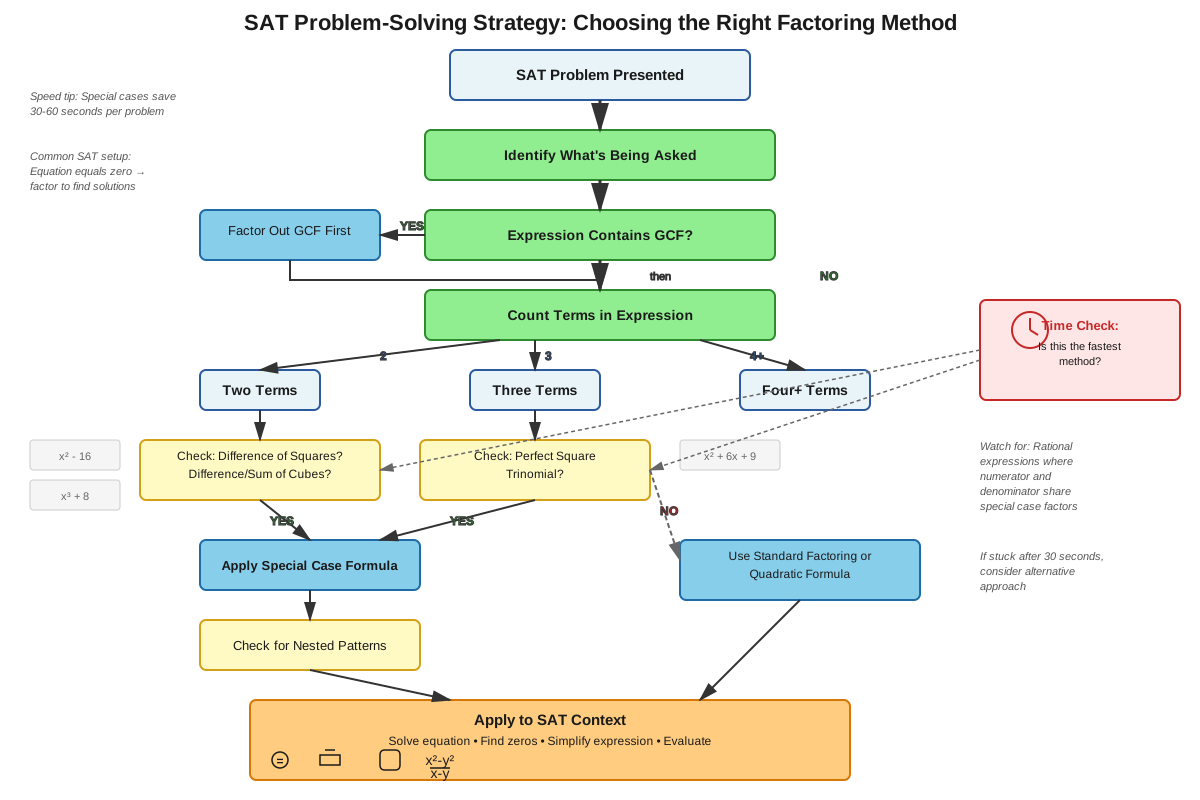
Approach sequence for SAT factoring questions:
- Scan for special patterns first (5-10 seconds): Before attempting standard factoring methods, quickly check for difference of squares (two terms, subtraction, perfect squares) or perfect square trinomials (three terms, perfect square first/last terms, middle term = 2ab). This initial scan can save 30-60 seconds per problem.
- Factor out GCF immediately: If terms share common factors, factor them out first. This often reveals hidden special patterns: 2x² - 50 becomes 2(x² - 25) = 2(x + 5)(x - 5).
- Check for nested patterns: After factoring once, examine each factor to see if it can be factored further. This is especially common with x⁴ or higher degree terms.
- Verify by expanding: If time permits and the answer seems unusual, quickly expand your factored form using FOIL to confirm it matches the original expression.
Trigger words and phrases:
- "Factor completely" → Check for nested patterns; don't stop after one factorization
- "Simplify the expression" → Often requires factoring numerator/denominator and canceling
- "Solve the equation" → Factor first, then set each factor equal to zero
- "Find the zeros" or "Find the x-intercepts" → Factor and solve for x
- "Which expression is equivalent to" → Factor the given expression and match to answer choices
Process of elimination tips:
- If answer choices are in factored form, expand them mentally or use strategic substitution (plug in x = 0, x = 1, or x = -1)
- Eliminate answers with incorrect signs: (x + 5)(x + 5) ≠ x² - 25
- Check the constant term: it must equal the product of the constants in the factors
- For perfect square trinomials, the middle term's sign must match the factored form's sign
Time allocation:
- Simple difference of squares: 20-30 seconds
- Perfect square trinomial recognition: 30-45 seconds
- Nested factoring problems: 45-75 seconds
- Equation solving using special cases: 60-90 seconds
Critical Exam Tip: On the digital SAT, if you don't immediately recognize a special pattern, mark the question and return to it. Don't waste time trying to force-factor an expression that might require the quadratic formula or might not factor at all.
Memory Techniques
SOAP for Difference of Squares:
- Subtraction (must be minus sign)
- Only two terms
- All perfect squares
- Product of sum and difference: (a + b)(a - b)
"First-Last-Twice" for Perfect Square Trinomials:
- First term is a perfect square → find its square root (a)
- Last term is a perfect square → find its square root (b)
- Middle term should be Twice the product: 2ab
- If yes, factor as (a ± b)²
Visualization for Difference of Squares:
Picture a square with side length a, then cut out a smaller square with side length b from one corner. The remaining area can be rearranged into a rectangle with dimensions (a + b) by (a - b). This geometric representation reinforces why a² - b² = (a + b)(a - b).
"Same, Opposite, Positive" for Cubes:
For sum/difference of cubes, remember the sign pattern in the trinomial factor:
- First sign: Same as the original operation
- Second sign: Opposite of the original operation
- Third sign: Always Positive
Example: a³ + b³ = (a + b)(a² - ab + b²)
- Same: + in binomial
- Opposite: - in trinomial
- Positive: + in trinomial
Acronym DOS for quick checks:
- Difference (not sum)
- Of (two terms)
- Squares (perfect squares)
Rhyme for Perfect Squares:
"Square the first, square the last, twice their product in the middle fast!"
Summary
Factoring special cases—difference of squares, perfect square trinomials, and sum/difference of cubes—represents essential pattern recognition skills for SAT success. The difference of squares (a² - b² = (a + b)(a - b)) appears most frequently and requires identifying two perfect square terms separated by subtraction. Perfect square trinomials (a² ± 2ab + b² = (a ± b)²) demand verification that the middle term equals exactly twice the product of the square roots of the first and last terms. These patterns enable rapid equation solving, function analysis, and expression simplification—skills tested across multiple SAT math domains. Success requires memorizing the formulas, practicing pattern recognition with various coefficient types, and checking for nested factoring opportunities. Students must also remember that sum of squares cannot be factored and that factoring out the GCF first often reveals hidden special patterns. Mastering these techniques provides both time savings and accuracy improvements on test day.
Key Takeaways
- Difference of squares (a² - b²) factors to (a + b)(a - b) and is the most frequently tested special case on the SAT
- Perfect square trinomials require the middle term to equal exactly 2ab, where a and b are square roots of the first and last terms
- Always factor out the greatest common factor before checking for special patterns
- Sum of squares (a² + b²) cannot be factored using real numbers—recognize this to avoid wasting time
- Check for nested factoring: after applying a special pattern once, examine each factor for additional factoring opportunities
- Special case recognition saves 30-60 seconds per problem compared to standard factoring methods
- Coefficients can be perfect squares (4, 9, 16, 25, 36, 49, 64, 81, 100)—don't assume coefficients must be 1
Related Topics
Solving Quadratic Equations: Factoring special cases provides the fastest method for solving many quadratic equations. After mastering these patterns, students can efficiently find solutions without relying on the quadratic formula, which is more time-consuming and error-prone.
Graphing Quadratic Functions: The zeros found through factoring special cases directly correspond to x-intercepts on parabola graphs. Understanding this connection enables quick sketching of quadratic functions and analysis of their key features.
Rational Expressions: Special factoring patterns frequently appear in numerators and denominators of rational expressions. Mastering these patterns is essential for simplifying complex fractions and solving rational equations.
Completing the Square: Perfect square trinomials form the foundation for completing the square, a technique used to convert quadratic equations to vertex form and derive the quadratic formula itself.
Polynomial Division and Remainder Theorem: Sum and difference of cubes connect to polynomial long division and synthetic division, enabling factorization of higher-degree polynomials.
Practice CTA
Now that you've mastered the core concepts of factoring special cases, it's time to solidify your understanding through active practice. Attempt the practice questions to test your pattern recognition speed and accuracy under timed conditions. Use the flashcards to drill the formulas and identification criteria until they become automatic. Remember: recognizing these patterns instantly on test day can save you valuable minutes and boost your confidence. The difference between a good SAT math score and a great one often comes down to mastering high-yield topics like this one. You've got this!
Sign up free to keep reading
Create a free AnvayaPrep account to finish this SAT guide on Factoring special cases — plus flashcards and practice questions.