Overview
The opening direction of a parabola is one of the most fundamental visual characteristics of quadratic functions, determining whether the graph opens upward or downward. This concept is critical for understanding the behavior of quadratic equations and appears frequently on the SAT in various forms—from identifying graph features to solving optimization problems. When students master opening direction, they gain immediate insight into maximum and minimum values, the sign of the leading coefficient, and the overall shape of the parabola.
On the SAT math section, questions about opening direction often appear integrated with other quadratic concepts such as vertex location, axis of symmetry, and roots. The College Board regularly tests whether students can quickly determine a parabola's orientation from its equation, match equations to graphs, or predict the behavior of a quadratic function in real-world contexts. Understanding opening direction serves as a gateway skill that enables students to tackle more complex problems involving quadratic inequalities, systems of equations, and applied optimization scenarios.
The relationship between opening direction and other mathematical concepts extends beyond quadratics alone. This topic connects to function transformations, the behavior of polynomial functions, and even calculus concepts like concavity. For SAT purposes, opening direction forms part of the essential toolkit for analyzing any quadratic relationship, whether presented algebraically, graphically, or in word problem format. Students who can instantly recognize opening direction save valuable time and avoid common algebraic errors on test day.
Learning Objectives
- [ ] Identify key features of opening direction
- [ ] Explain how opening direction appears on the SAT
- [ ] Apply opening direction to answer SAT-style questions
- [ ] Determine opening direction from standard form, vertex form, and factored form equations
- [ ] Connect opening direction to real-world optimization problems and maximum/minimum values
- [ ] Analyze how changes in the leading coefficient affect opening direction and graph width
Prerequisites
- Basic algebraic manipulation: Students must be comfortable with simplifying expressions and working with variables, as quadratic equations require these foundational skills to identify coefficients and rearrange terms.
- Understanding of coordinate planes: Recognizing how x and y values relate on a graph is essential for visualizing parabolas and their opening direction.
- Familiarity with function notation: The ability to interpret f(x) notation helps students understand quadratic functions as mathematical relationships.
- Knowledge of positive and negative numbers: Determining opening direction depends entirely on identifying whether the leading coefficient is positive or negative.
Why This Topic Matters
Opening direction has profound real-world applications in physics, engineering, economics, and everyday problem-solving. Projectile motion follows parabolic paths where opening direction determines whether an object is being launched upward or falling downward. In business, profit functions often take quadratic form, and opening direction reveals whether a company is maximizing profit or minimizing cost. Architects use parabolic arches where opening direction affects structural integrity, and satellite dishes employ parabolic reflectors with specific orientations.
On the SAT, opening direction appears in approximately 8-12% of all math questions, making it a high-yield topic for test preparation. The College Board tests this concept through multiple question types: direct identification from equations, graph matching problems, word problems requiring interpretation of maximum or minimum values, and multi-step problems where opening direction is one component of a larger solution. Questions may present quadratic functions in various forms and ask students to determine which graph corresponds to the equation, or conversely, which equation matches a given graph.
The most common SAT presentations include: (1) multiple-choice questions showing four parabola graphs with students selecting the correct opening direction based on an equation; (2) word problems about projectile motion, profit maximization, or area optimization where students must identify whether to find a maximum or minimum value; (3) questions asking students to determine the sign of the leading coefficient from a graph; and (4) problems requiring students to write a quadratic equation that matches specific criteria, including opening direction.
Core Concepts
The Leading Coefficient Rule
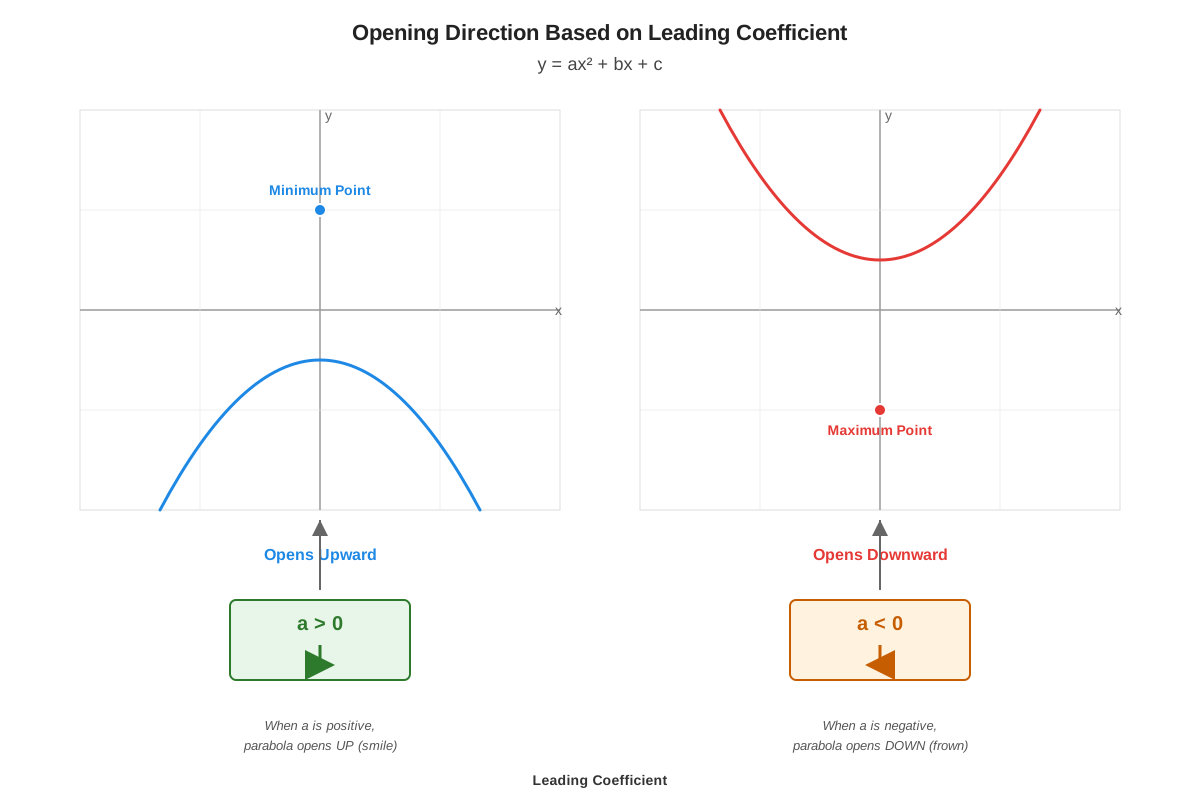
The opening direction of a parabola is determined exclusively by the sign of the leading coefficient (the coefficient of the x² term) in a quadratic equation. This fundamental rule applies regardless of how the quadratic equation is written. When a quadratic function is expressed in standard form as f(x) = ax² + bx + c, the value of 'a' controls the opening direction:
- If a > 0 (positive), the parabola opens upward (concave up)
- If a < 0 (negative), the parabola opens downward (concave down)
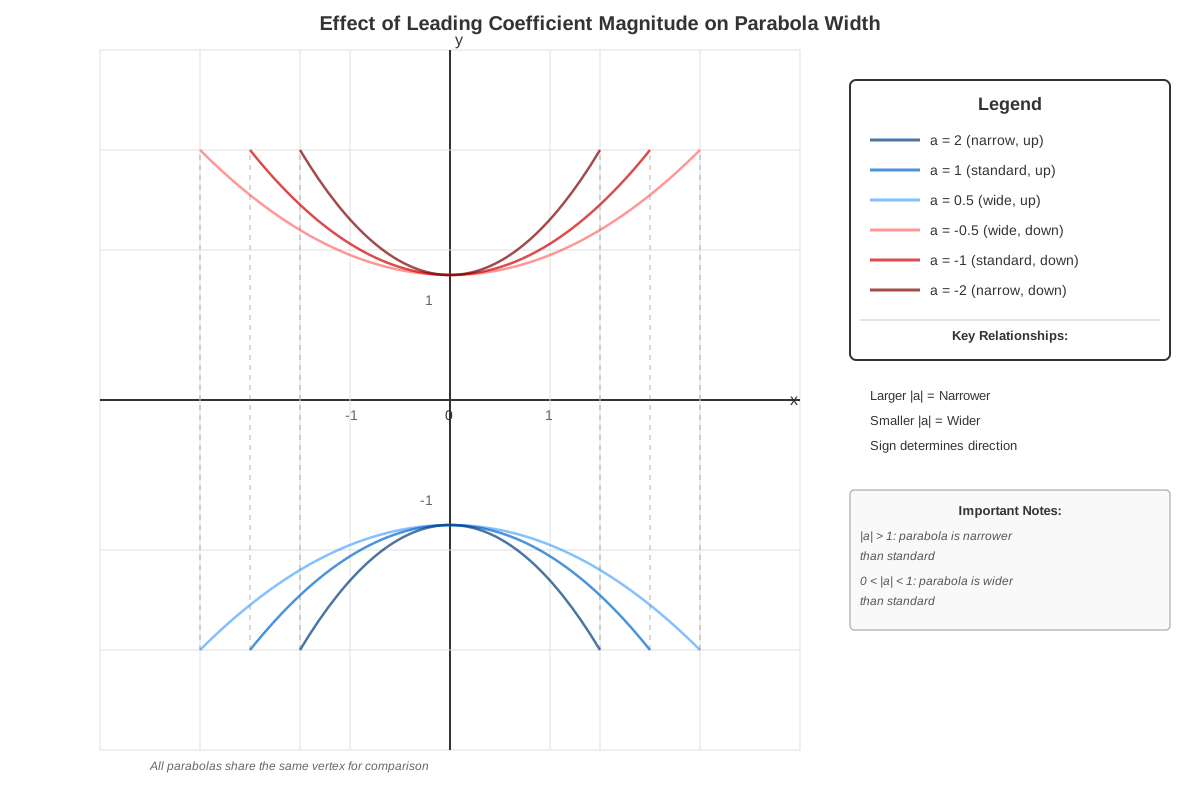
This relationship is absolute and never varies. The coefficient 'a' not only determines direction but also affects the "width" or "narrowness" of the parabola—larger absolute values of 'a' create narrower parabolas, while smaller absolute values create wider ones. However, for opening direction specifically, only the sign matters.
Visual Characteristics by Opening Direction
Understanding the visual appearance of parabolas based on opening direction helps students quickly analyze graphs on the SAT:
| Opening Direction | Leading Coefficient | Visual Shape | Vertex Type | Range |
|---|---|---|---|---|
| Upward | a > 0 | U-shaped, like a cup | Minimum point | y ≥ k (where k is y-coordinate of vertex) |
| Downward | a < 0 | ∩-shaped, like a frown | Maximum point | y ≤ k (where k is y-coordinate of vertex) |
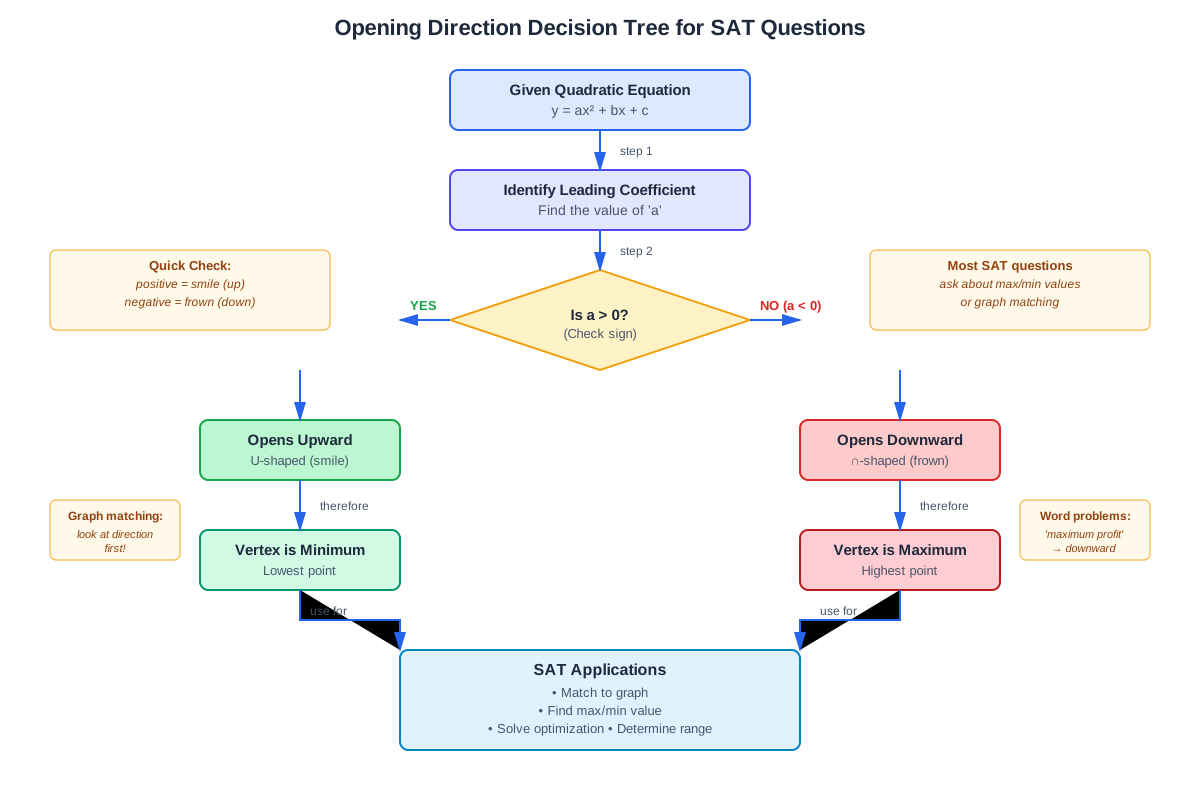
When a parabola opens upward, it has a lowest point called the vertex, which represents the minimum value of the function. The arms of the parabola extend infinitely upward on both sides. Conversely, when a parabola opens downward, the vertex represents the maximum value, and the arms extend infinitely downward.
Opening Direction in Different Forms
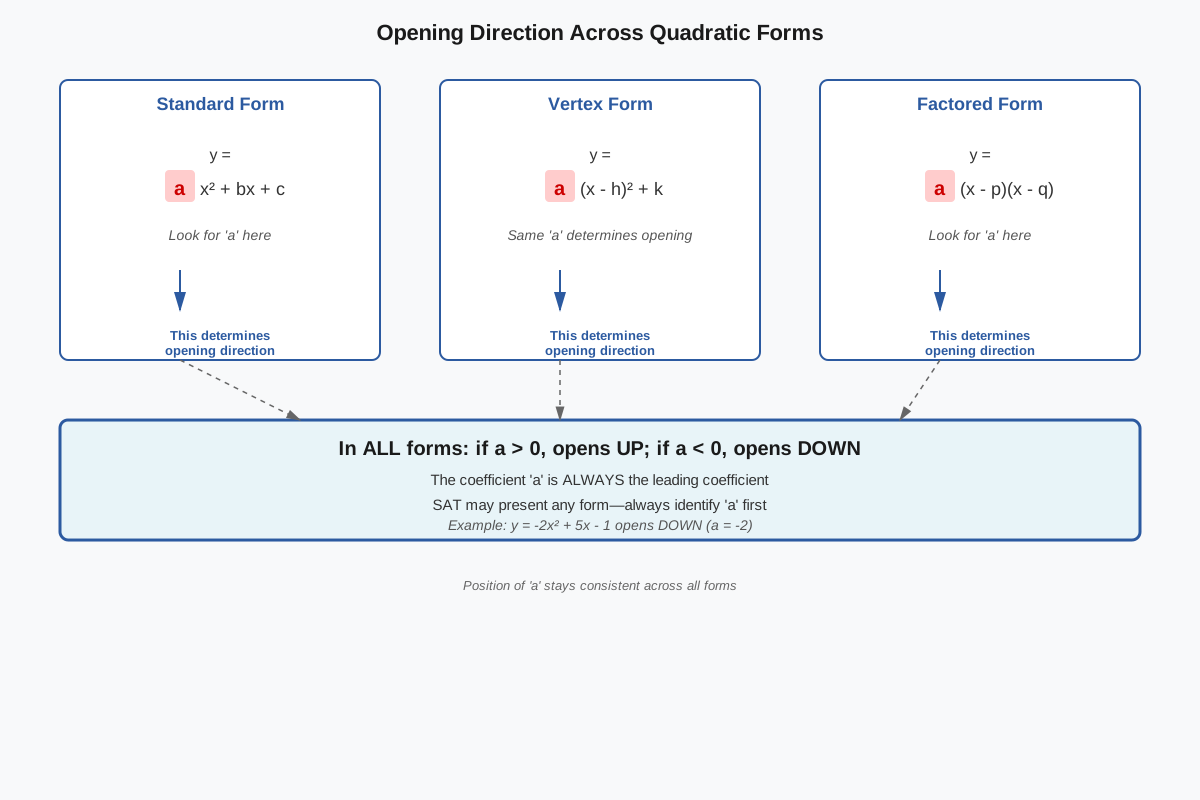
Quadratic equations appear in three primary forms on the SAT, and students must identify opening direction from each:
Standard Form: f(x) = ax² + bx + c
- The coefficient 'a' directly indicates opening direction
- Example: f(x) = -3x² + 5x - 2 opens downward because a = -3 (negative)
Vertex Form: f(x) = a(x - h)² + k
- The coefficient 'a' still determines opening direction
- Example: f(x) = 2(x - 3)² + 1 opens upward because a = 2 (positive)
Factored Form: f(x) = a(x - r₁)(x - r₂)
- The coefficient 'a' remains the determining factor
- Example: f(x) = -(x + 2)(x - 4) opens downward because a = -1 (negative)
Connection to Maximum and Minimum Values
The opening direction has direct implications for optimization problems, which frequently appear on the SAT. When a parabola opens upward, the function has a minimum value at the vertex but no maximum value (the function increases without bound as x moves away from the vertex). When a parabola opens downward, the function has a maximum value at the vertex but no minimum value.
This relationship is crucial for word problems. If a problem asks for maximum profit, maximum height, or maximum area, students should expect a downward-opening parabola. If the problem asks for minimum cost, minimum distance, or minimum time, students should expect an upward-opening parabola.
The Effect of Transformations
While various transformations can shift, stretch, or compress a parabola, only one transformation affects opening direction: reflection across the x-axis. This transformation multiplies the entire function by -1, which changes the sign of the leading coefficient and reverses the opening direction. All other transformations (horizontal shifts, vertical shifts, horizontal stretches/compressions) preserve the opening direction.
Concept Relationships
Opening direction serves as the foundational concept that connects to multiple aspects of quadratic analysis. The leading coefficient → determines → opening direction → determines → whether the vertex is a maximum or minimum → influences → the range of the function → affects → solution strategies for optimization problems.
The relationship between opening direction and the coordinate plane is bidirectional: students can determine opening direction from an equation and predict the graph's appearance, or they can observe a graph and deduce the sign of the leading coefficient. This connection to graphical analysis makes opening direction essential for graph-matching questions.
Opening direction also connects to function behavior: an upward-opening parabola has a minimum value and increases on both sides of the vertex, while a downward-opening parabola has a maximum value and decreases on both sides. This relationship extends to domain and range concepts, as opening direction directly determines whether the range is bounded above or below.
The concept links to real-world modeling through applications in physics (projectile motion always involves downward-opening parabolas due to gravity), economics (profit functions may open either direction depending on the cost structure), and geometry (area optimization problems often involve upward-opening parabolas when minimizing perimeter or downward-opening parabolas when maximizing area).
High-Yield Facts
⭐ The sign of the leading coefficient (a) is the ONLY factor that determines opening direction—positive means upward, negative means downward.
⭐ Upward-opening parabolas have minimum values at their vertex; downward-opening parabolas have maximum values at their vertex.
⭐ In standard form f(x) = ax² + bx + c, vertex form f(x) = a(x - h)² + k, and factored form f(x) = a(x - r₁)(x - r₂), the coefficient 'a' always controls opening direction.
⭐ Maximum value problems (maximum height, profit, area) typically involve downward-opening parabolas with negative leading coefficients.
⭐ Minimum value problems (minimum cost, time, distance) typically involve upward-opening parabolas with positive leading coefficients.
- The absolute value of 'a' affects the width of the parabola but not its opening direction.
- A parabola opening upward has range y ≥ k; a parabola opening downward has range y ≤ k (where k is the y-coordinate of the vertex).
- Reflecting a parabola across the x-axis reverses its opening direction by changing the sign of 'a'.
- The opening direction remains unchanged by horizontal or vertical shifts of the parabola.
- On a graph, if the parabola's arms point toward positive y-values, it opens upward; if they point toward negative y-values, it opens downward.
Quick check — test yourself on Opening direction so far.
Try Flashcards →Common Misconceptions
Misconception: The constant term 'c' in standard form affects opening direction.
→ Correction: Only the coefficient of x² (the 'a' value) determines opening direction. The constant 'c' only affects the y-intercept and vertical position of the parabola.
Misconception: A wider parabola opens differently than a narrower one.
→ Correction: Width is determined by the absolute value of 'a', while opening direction is determined by the sign of 'a'. A parabola can be wide or narrow regardless of whether it opens upward or downward.
Misconception: The vertex coordinates (h, k) influence opening direction.
→ Correction: The vertex location only determines where the parabola is positioned on the coordinate plane, not which direction it opens. Opening direction depends solely on the sign of the leading coefficient.
Misconception: If a quadratic equation has no x² term visible, it doesn't have an opening direction.
→ Correction: Every quadratic equation must have an x² term by definition. If it's not visible, the coefficient is 1 (for x²) or -1 (for -x²), which still determines opening direction.
Misconception: In word problems, "maximum" always means the parabola opens upward.
→ Correction: This is backwards. Maximum value problems involve downward-opening parabolas (negative 'a'), while minimum value problems involve upward-opening parabolas (positive 'a').
Misconception: The b coefficient (the coefficient of x) affects opening direction.
→ Correction: The b coefficient affects the horizontal position of the vertex and the axis of symmetry, but has no impact on opening direction whatsoever.
Worked Examples
Example 1: Identifying Opening Direction from Multiple Forms
Problem: Determine the opening direction for each of the following quadratic functions:
- a) f(x) = -2x² + 8x - 5
- b) g(x) = 3(x + 1)² - 7
- c) h(x) = -(x - 2)(x + 4)
Solution:
For function a) f(x) = -2x² + 8x - 5:
This is in standard form where a = -2, b = 8, and c = -5. Since the leading coefficient a = -2 is negative, the parabola opens downward. This function will have a maximum value at its vertex.
For function b) g(x) = 3(x + 1)² - 7:
This is in vertex form where a = 3, h = -1, and k = -7. The leading coefficient a = 3 is positive, so the parabola opens upward. This function will have a minimum value at its vertex, which is located at (-1, -7).
For function c) h(x) = -(x - 2)(x + 4):
This is in factored form. To identify the leading coefficient, we need to recognize what happens when we expand: the x² term will be -1·x·x = -x². Therefore, a = -1, which is negative, meaning the parabola opens downward. The roots are at x = 2 and x = -4, and the function has a maximum value at its vertex.
Connection to Learning Objectives: This example demonstrates the ability to identify opening direction from all three forms of quadratic equations, addressing the objective to identify key features and apply the concept to various presentations.
Example 2: Real-World Application Problem
Problem: A company's monthly profit P (in thousands of dollars) is modeled by the function P(x) = -2x² + 16x - 24, where x represents the number of units produced (in hundreds).
a) Does this profit function have a maximum or minimum value?
b) What does this tell you about the company's production strategy?
Solution:
Part a): First, identify the leading coefficient in the profit function P(x) = -2x² + 16x - 24. Here, a = -2, which is negative. Since the leading coefficient is negative, the parabola opens downward, which means the function has a maximum value at its vertex.
Part b): The fact that the profit function has a maximum value tells us several important things about the company's production strategy:
- There is an optimal production level that maximizes profit
- Producing too few units results in lower profit (left side of the parabola)
- Producing too many units also results in lower profit (right side of the parabola)
- Beyond a certain production level, the company actually loses money (when the parabola crosses below the x-axis)
To find the optimal production level, we would need to find the x-coordinate of the vertex using x = -b/(2a) = -16/(2·-2) = -16/(-4) = 4. This means producing 400 units (since x is in hundreds) maximizes profit.
Connection to Learning Objectives: This example shows how opening direction appears in SAT word problems and demonstrates the practical application of identifying whether a real-world scenario involves finding a maximum or minimum value.
Exam Strategy
When approaching SAT questions about opening direction, follow this systematic process:
Step 1: Identify the form of the equation (standard, vertex, or factored) and immediately locate the leading coefficient 'a'. This should take no more than 5 seconds.
Step 2: Determine the sign of 'a'—positive or negative. If the equation has subtraction before the x² term or a negative coefficient, the parabola opens downward.
Step 3: Connect opening direction to the question type. If the question asks about maximum/minimum, remember: upward = minimum, downward = maximum.
Exam Tip: Watch for trigger words like "maximum height," "minimum cost," "greatest profit," or "lowest point." These phrases immediately tell you whether to expect an upward or downward opening parabola.
Trigger phrases for downward-opening parabolas (negative 'a'):
- "maximum value"
- "highest point"
- "greatest profit/revenue"
- "peak height"
- "at most"
Trigger phrases for upward-opening parabolas (positive 'a'):
- "minimum value"
- "lowest point"
- "least cost"
- "at least"
- "smallest area/distance"
Process-of-elimination strategy: When matching equations to graphs, immediately eliminate answer choices where the opening direction doesn't match. If you see an equation with a positive leading coefficient, eliminate all downward-opening graph options. This often eliminates 2-3 answer choices instantly.
Time allocation: Opening direction questions should take 30-45 seconds maximum. If you're spending more time, you're likely overcomplicating the problem. The SAT tests whether you can quickly identify the sign of 'a' and connect it to the graph or context.
Common trap: The SAT may present equations where the x² term isn't first, such as f(x) = 5x - 3x² + 2. Don't be fooled—rearrange mentally to f(x) = -3x² + 5x + 2 and identify a = -3 (negative, opens downward).
Memory Techniques
The "Smile/Frown" Mnemonic:
- Positive = Happy = Smile (upward opening, like a U-shaped smile)
- Negative = Sad = Frown (downward opening, like an upside-down U)
The "Cup/Cap" Visualization:
- Positive 'a' = Cup (can hold water, opens upward, has a minimum)
- Negative 'a' = Cap (worn on head, opens downward, has a maximum)
The "MIN/MAX" Connection:
- Upward = Minimum (both have "m" sounds at the beginning)
- Downward = Maximum (both have "m" sounds and relate to "down" having a maximum point)
The "Sign-Direction" Acronym - POND:
- Positive opens Upward
- Negative opens Downward
(POND: Positive-Up, Negative-Down)
Finger Trick: Hold your index finger in the shape of the sign of 'a':
- Point finger upward for positive → parabola opens upward
- Point finger downward for negative → parabola opens downward
Summary
Opening direction is the fundamental characteristic of parabolas determined exclusively by the sign of the leading coefficient in a quadratic equation. When the coefficient of x² is positive, the parabola opens upward and has a minimum value at its vertex; when negative, it opens downward and has a maximum value at its vertex. This concept appears consistently on the SAT across multiple question types, including graph matching, optimization word problems, and function analysis. Students must be able to identify opening direction from standard form (ax² + bx + c), vertex form (a(x - h)² + k), and factored form (a(x - r₁)(x - r₂)) by recognizing that only the 'a' coefficient matters. The practical applications extend to real-world scenarios involving projectile motion, profit maximization, cost minimization, and geometric optimization. Mastering opening direction enables students to quickly eliminate incorrect answer choices, determine whether to find maximum or minimum values, and accurately match equations to their graphical representations—all essential skills for achieving a high SAT math score.
Key Takeaways
- The sign of the leading coefficient 'a' is the sole determinant of opening direction: positive opens upward, negative opens downward
- Upward-opening parabolas have minimum values at their vertex; downward-opening parabolas have maximum values
- Opening direction can be identified from any form of quadratic equation by locating the coefficient of the x² term
- Maximum value problems typically involve downward-opening parabolas; minimum value problems involve upward-opening parabolas
- Opening direction remains unchanged by shifts and stretches but reverses with reflection across the x-axis
- Quick identification of opening direction allows for immediate elimination of incorrect answer choices on graph-matching questions
- The connection between opening direction and optimization is critical for solving real-world application problems on the SAT
Related Topics
Vertex and Axis of Symmetry: After mastering opening direction, students should study how to find the vertex coordinates and axis of symmetry, which together with opening direction provide a complete picture of parabola positioning.
Quadratic Formula and Discriminant: Understanding opening direction enhances interpretation of quadratic solutions, as the parabola's orientation affects how roots relate to the x-axis.
Function Transformations: Opening direction is one aspect of the broader topic of transformations, including translations, reflections, and dilations of parent functions.
Domain and Range of Functions: Opening direction directly determines the range of quadratic functions, making this a natural progression in function analysis.
Optimization and Applied Problems: Mastering opening direction enables students to tackle complex word problems involving maximizing or minimizing real-world quantities.
Practice CTA
Now that you've mastered the concept of opening direction, it's time to solidify your understanding through practice! Attempt the practice questions to test your ability to identify opening direction from various equation forms and apply this knowledge to SAT-style problems. Use the flashcards to reinforce the key relationships between leading coefficients, opening direction, and maximum/minimum values. Remember: consistent practice with these fundamental concepts builds the speed and confidence you need to excel on test day. Every parabola you analyze strengthens your pattern recognition skills and brings you closer to your target score!
Sign up free to keep reading
Create a free AnvayaPrep account to finish this SAT guide on Opening direction — plus flashcards and practice questions.