Overview
Perfect square trinomials are a special category of quadratic expressions that result from squaring a binomial. These algebraic expressions follow predictable patterns and appear frequently throughout the SAT Math section, making them essential for efficient problem-solving. A perfect square trinomial takes the form a² + 2ab + b² or a² - 2ab + b², which factors neatly into (a + b)² or (a - b)² respectively. Recognizing these patterns allows students to factor expressions quickly, solve equations efficiently, and simplify complex algebraic manipulations without lengthy calculations.
Understanding perfect square trinomials is crucial for SAT success because they appear in multiple question types across both the calculator and no-calculator sections. Students encounter them in factoring problems, completing the square procedures, solving quadratic equations, and analyzing parabola properties. The College Board frequently tests whether students can identify these special forms among general trinomials, factor them correctly, and apply them to solve real-world application problems. Questions involving perfect square trinomials often serve as gateway problems—students who recognize the pattern solve them in seconds, while those who don't may spend valuable minutes using alternative methods or make computational errors.
Perfect square trinomials connect to broader math concepts within the quadratic equations unit and beyond. They represent the foundation for completing the square, which itself enables converting quadratic functions to vertex form and deriving the quadratic formula. These trinomials also relate to difference of squares patterns, polynomial multiplication, and the geometric interpretation of algebraic expressions. Mastering sat perfect square trinomials creates efficiency gains that compound throughout the exam, as the pattern recognition skills transfer to rational expressions, radical equations, and even some coordinate geometry problems.
Learning Objectives
- [ ] Identify key features of perfect square trinomials
- [ ] Explain how perfect square trinomials appear on the SAT
- [ ] Apply perfect square trinomials to answer SAT-style questions
- [ ] Factor perfect square trinomials in both standard and non-standard forms
- [ ] Create perfect square trinomials by completing the square
- [ ] Distinguish perfect square trinomials from general trinomials within 10 seconds
- [ ] Solve quadratic equations efficiently by recognizing perfect square patterns
Prerequisites
- Binomial multiplication (FOIL method): Essential for understanding how squaring binomials produces the perfect square trinomial pattern
- Basic factoring techniques: Necessary to reverse the expansion process and recognize when expressions can be written as squared binomials
- Exponent rules: Required to manipulate squared terms and understand why the middle term coefficient follows the 2ab pattern
- Combining like terms: Fundamental for simplifying expressions and verifying whether a trinomial matches the perfect square pattern
Why This Topic Matters
Perfect square trinomials appear in real-world applications involving area calculations, projectile motion, optimization problems, and any scenario where squared relationships exist. Engineers use these patterns when analyzing structural loads, physicists apply them in kinematic equations, and economists employ them in cost-benefit analyses. The ability to recognize and manipulate these expressions translates directly to problem-solving efficiency in STEM fields and quantitative reasoning in business contexts.
On the SAT, perfect square trinomials appear in approximately 8-12% of algebra questions, making them a high-yield topic for focused study. The College Board tests this concept through direct factoring questions, equation-solving problems, function analysis tasks, and word problems requiring algebraic modeling. Questions typically appear in both multiple-choice and student-produced response formats, with difficulty ranging from straightforward pattern recognition to multi-step problems where identifying the perfect square is one component of a larger solution strategy.
Common SAT question formats include: asking students to factor expressions completely, determining the value of an unknown coefficient that makes a trinomial a perfect square, solving equations where recognizing the perfect square pattern eliminates the need for the quadratic formula, and analyzing vertex form equations that require understanding the relationship between perfect squares and parabola transformations. The topic also appears in questions about completing the square, where students must add a specific constant to create a perfect square trinomial, and in problems involving the discriminant, where perfect square trinomials correspond to equations with exactly one solution.
Core Concepts
Definition and Standard Forms
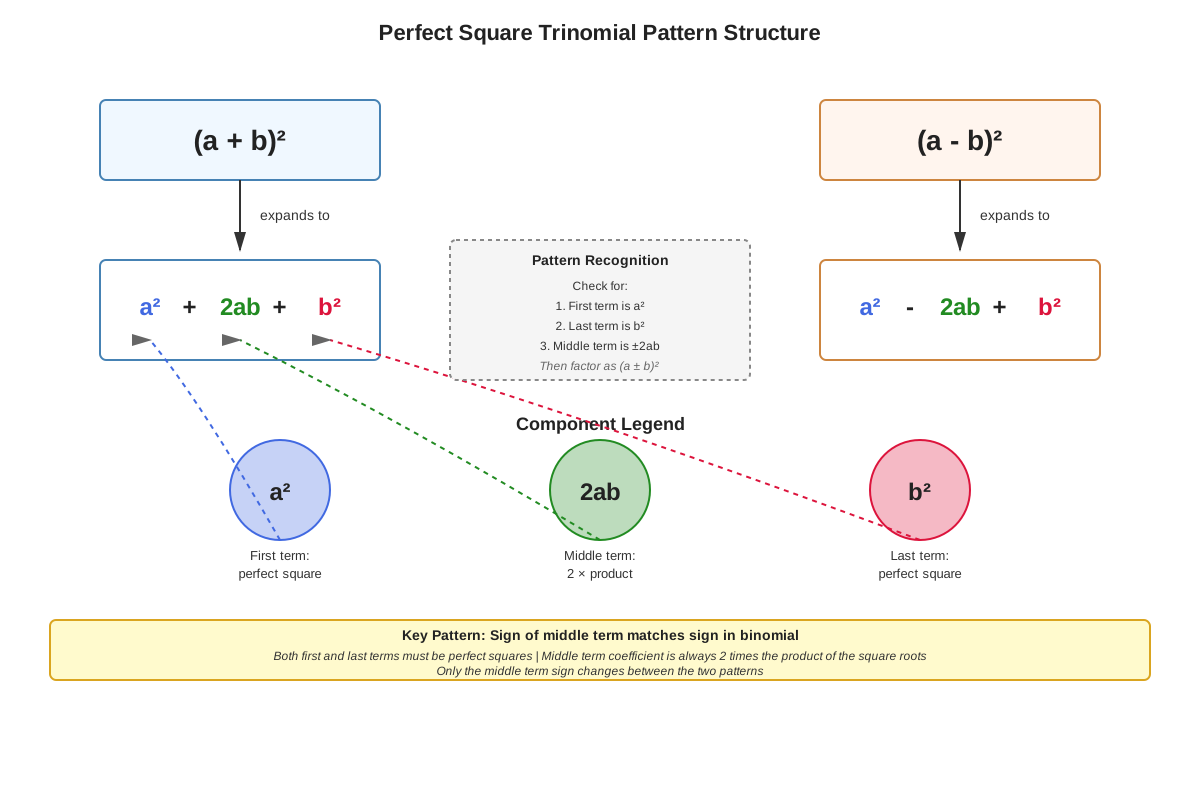
A perfect square trinomial is a quadratic expression that results from squaring a binomial. These expressions can always be factored into the form (a + b)² or (a - b)², where a and b represent any algebraic terms. The two standard patterns are:
Positive middle term: a² + 2ab + b² = (a + b)²
Negative middle term: a² - 2ab + b² = (a - b)²
The key identifying feature is that the first and last terms must be perfect squares themselves, and the middle term must equal exactly twice the product of the square roots of the first and last terms. This relationship creates a predictable structure that distinguishes perfect square trinomials from general quadratic expressions.
Identifying Perfect Square Trinomials
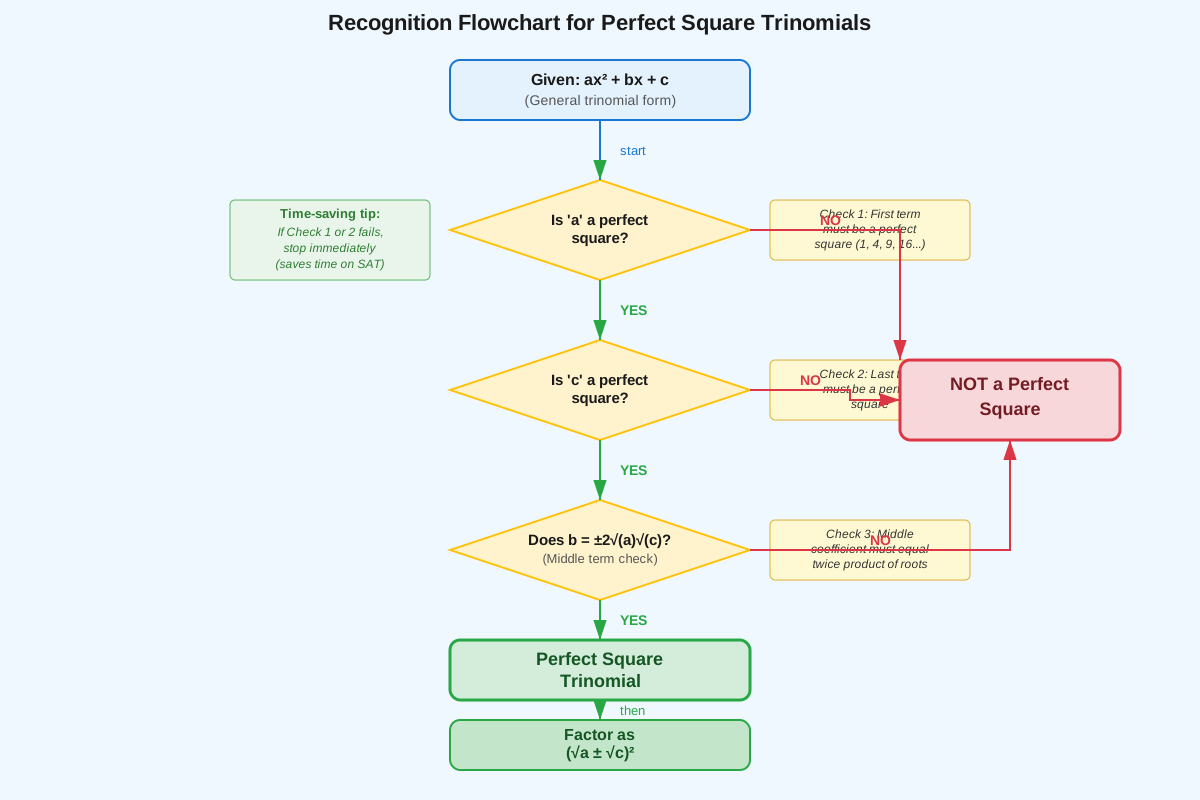
To determine whether a trinomial is a perfect square, follow this systematic verification process:
- Check the first term: Confirm it's a perfect square (can be written as something squared)
- Check the last term: Verify it's also a perfect square
- Extract square roots: Find the square root of both the first and last terms
- Calculate expected middle term: Multiply the two square roots by 2
- Compare: The actual middle term coefficient must match (positive or negative) the calculated value
For example, consider x² + 10x + 25:
- First term: x² = (x)² ✓
- Last term: 25 = (5)² ✓
- Square roots: x and 5
- Expected middle term: 2(x)(5) = 10x ✓
- Conclusion: This is a perfect square trinomial = (x + 5)²
The Geometric Interpretation
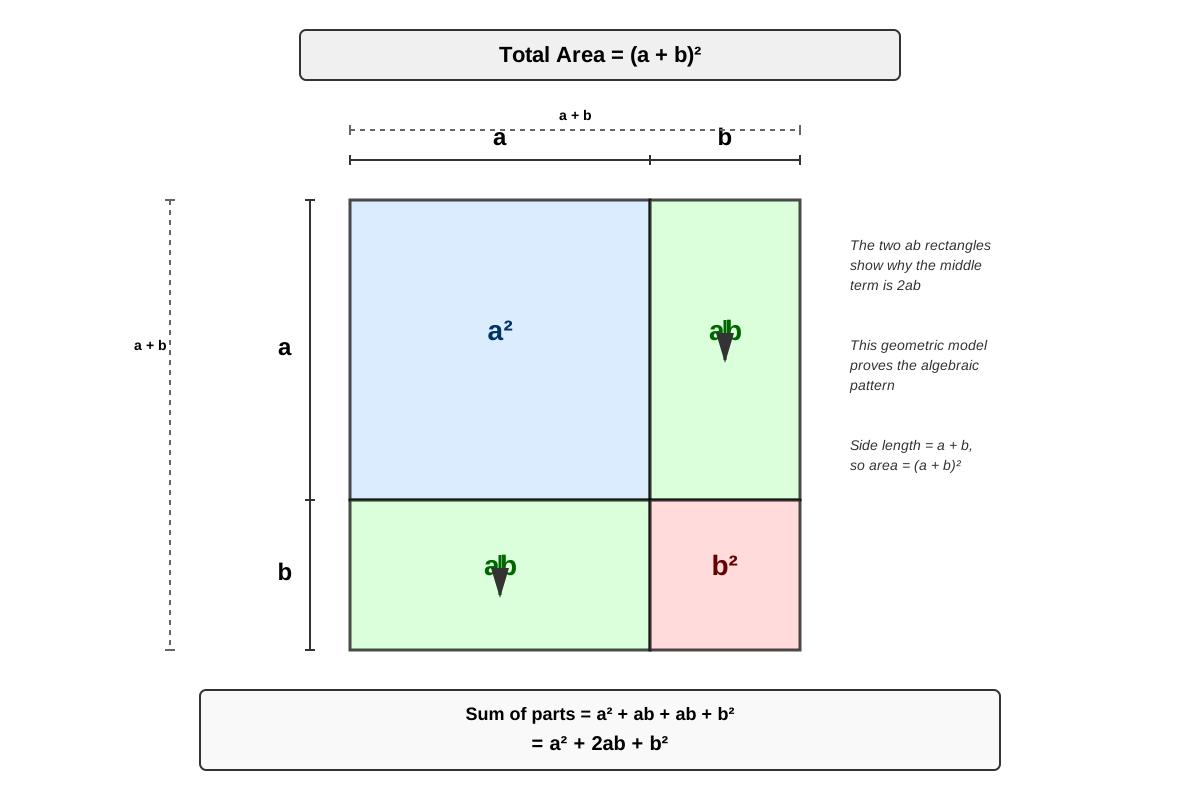
Perfect square trinomials have a visual representation that explains their algebraic structure. When squaring the binomial (a + b), imagine constructing a square with side length (a + b). The area of this square equals (a + b)², which expands to:
- One square with area a² (the a × a region)
- One square with area b² (the b × b region)
- Two rectangles each with area ab (the a × b regions)
The total area is a² + ab + ab + b² = a² + 2ab + b², demonstrating why the middle term has a coefficient of 2. This geometric model helps students understand why the pattern exists rather than simply memorizing it.
Factoring Perfect Square Trinomials
Once identified, factoring perfect square trinomials becomes straightforward:
Step 1: Identify the square root of the first term (this becomes the first term in the binomial)
Step 2: Identify the square root of the last term (this becomes the second term in the binomial)
Step 3: Determine the sign between terms in the binomial based on the middle term's sign
Step 4: Write the factored form as the binomial squared
Example: Factor 4x² - 12x + 9
- √(4x²) = 2x
- √9 = 3
- Middle term is negative, so use subtraction
- Factored form: (2x - 3)²
Non-Standard Forms and Variations
Perfect square trinomials don't always appear in standard form. The SAT frequently presents them with:
Leading coefficients other than 1: 9x² + 30x + 25 = (3x + 5)²
Variables in multiple terms: x² + 2xy + y² = (x + y)²
Negative leading coefficients: -x² + 6x - 9 = -(x² - 6x + 9) = -(x - 3)²
Embedded within larger expressions: x⁴ + 8x² + 16 = (x²)² + 2(x²)(4) + 4² = (x² + 4)²
Recognizing these variations requires flexibility in pattern matching and the ability to factor out common factors before identifying the perfect square structure.
Completing the Square
Completing the square is the process of creating a perfect square trinomial by adding a strategic constant. Given an expression x² + bx, the constant needed to complete the square is (b/2)², which creates:
x² + bx + (b/2)² = (x + b/2)²
This technique is fundamental for:
- Converting quadratic functions to vertex form
- Solving quadratic equations
- Deriving the quadratic formula
- Analyzing conic sections
Example: Complete the square for x² + 8x
- Take half the coefficient of x: 8/2 = 4
- Square this value: 4² = 16
- Add 16: x² + 8x + 16 = (x + 4)²
Relationship to Quadratic Equations
When a quadratic equation can be expressed as a perfect square trinomial equal to zero, it has exactly one solution (a repeated root). This occurs because:
(x - h)² = 0 implies x - h = 0, giving x = h
This connection explains why the discriminant (b² - 4ac) equals zero for perfect square trinomials:
- For a² + 2ab + b² = 0, the discriminant is (2ab)² - 4(a²)(b²) = 4a²b² - 4a²b² = 0
Understanding this relationship helps students predict solution behavior and choose efficient solving strategies.
Concept Relationships
Perfect square trinomials serve as a central hub connecting multiple algebraic concepts. The foundational relationship begins with binomial multiplication → which produces → perfect square trinomials → which enable → efficient factoring. This factoring capability then branches into two major pathways: solving quadratic equations and transforming function forms.
The equation-solving pathway flows: perfect square recognition → enables → taking square roots directly → avoiding → quadratic formula complexity. This creates significant time savings on the SAT when applicable.
The function transformation pathway connects: perfect square trinomials → form the basis of → completing the square → which converts → standard form to vertex form → revealing → parabola properties (vertex location, axis of symmetry, transformations).
Perfect square trinomials also relate horizontally to other special factoring patterns. They share structural similarities with difference of squares (a² - b² = (a+b)(a-b)), and both represent cases where general factoring formulas simplify dramatically. Additionally, perfect square trinomials connect to polynomial identities and serve as building blocks for factoring higher-degree polynomials like x⁴ + 8x² + 16.
The prerequisite knowledge flows upward: exponent rules → enable understanding → squared terms → which combine with → distributive property → to explain → why the 2ab pattern emerges → completing the conceptual foundation for perfect square trinomials.
Quick check — test yourself on Perfect square trinomials so far.
Try Flashcards →High-Yield Facts
⭐ The middle term coefficient of a perfect square trinomial always equals twice the product of the square roots of the first and last terms
⭐ Perfect square trinomials factor into identical binomials: (a ± b)²
⭐ To complete the square for x² + bx, add (b/2)² to create a perfect square trinomial
⭐ Quadratic equations that are perfect square trinomials have exactly one solution (discriminant = 0)
⭐ The two standard forms are a² + 2ab + b² = (a + b)² and a² - 2ab + b² = (a - b)²
- Perfect square trinomials always have positive first and last terms when written in standard form
- The sign of the middle term determines whether the factored form uses addition or subtraction
- Recognizing perfect square trinomials eliminates the need for trial-and-error factoring methods
- Perfect square trinomials can have variables in any or all terms: x² + 2xy + y² is valid
- When factoring expressions with leading coefficients, factor out common factors first before checking for perfect square patterns
Common Misconceptions
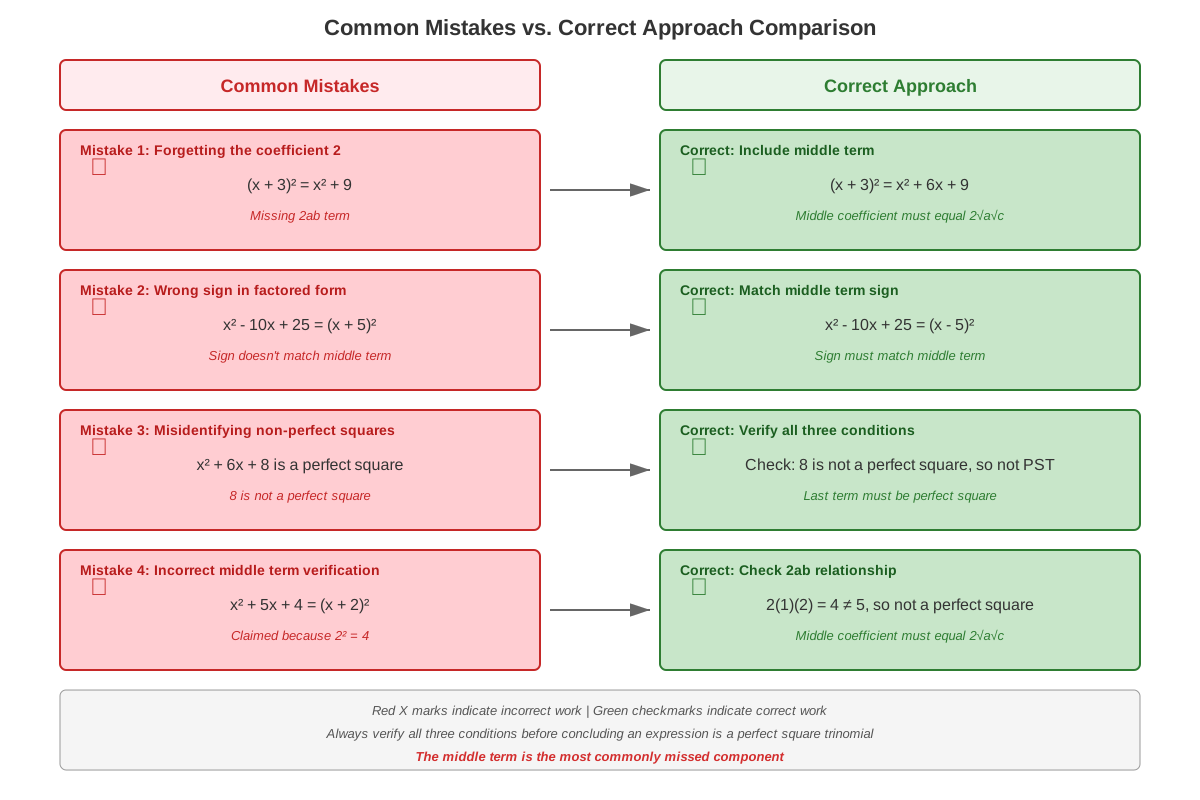
Misconception: All trinomials with three perfect square terms are perfect square trinomials → Correction: The middle term must specifically equal 2ab where a and b are the square roots of the first and last terms. For example, x² + 3x + 9 has perfect square first and last terms, but 3x ≠ 2(x)(3) = 6x, so it's not a perfect square trinomial.
Misconception: Perfect square trinomials must have a leading coefficient of 1 → Correction: Perfect square trinomials can have any perfect square as the leading coefficient. For example, 25x² + 20x + 4 = (5x + 2)² is a valid perfect square trinomial with leading coefficient 25.
Misconception: The middle term must always be positive → Correction: Perfect square trinomials can have negative middle terms, which factor to (a - b)². The expression x² - 10x + 25 = (x - 5)² is a perfect square trinomial.
Misconception: When completing the square, add (b)² instead of (b/2)² → Correction: To complete the square for x² + bx, you must add (b/2)², which is half the coefficient squared, not the coefficient squared. For x² + 6x, add (6/2)² = 9, not 36.
Misconception: Perfect square trinomials always equal zero in equations → Correction: Perfect square trinomials are expressions that can equal any value. While (x + 3)² = 0 is one equation, (x + 3)² = 16 is equally valid and requires different solving techniques (taking square roots of both sides).
Misconception: You can't have a perfect square trinomial with negative leading coefficient → Correction: While the standard form has positive leading coefficients, you can factor out -1 first: -x² + 6x - 9 = -(x² - 6x + 9) = -(x - 3)².
Worked Examples
Example 1: Identifying and Factoring a Perfect Square Trinomial
Problem: Factor completely: 16x² + 24x + 9
Solution:
Step 1: Check if the first term is a perfect square
- 16x² = (4x)² ✓
Step 2: Check if the last term is a perfect square
- 9 = (3)² ✓
Step 3: Identify the square roots
- √(16x²) = 4x
- √9 = 3
Step 4: Calculate what the middle term should be for a perfect square
- Expected middle term: 2(4x)(3) = 24x
- Actual middle term: 24x ✓
Step 5: Since all conditions are met, factor as a perfect square
- The middle term is positive, so use addition
- Answer: (4x + 3)²
Verification: Expand (4x + 3)² = (4x + 3)(4x + 3) = 16x² + 12x + 12x + 9 = 16x² + 24x + 9 ✓
This example demonstrates the systematic approach to identifying perfect square trinomials and connects to the learning objective of applying pattern recognition to SAT-style questions.
Example 2: Completing the Square and Solving
Problem: Solve for x by completing the square: x² + 14x + 33 = 0
Solution:
Step 1: Move the constant to the right side
- x² + 14x = -33
Step 2: Identify the coefficient of x and calculate (b/2)²
- Coefficient b = 14
- (14/2)² = 7² = 49
Step 3: Add 49 to both sides to create a perfect square trinomial
- x² + 14x + 49 = -33 + 49
- x² + 14x + 49 = 16
Step 4: Factor the left side as a perfect square
- (x + 7)² = 16
Step 5: Take the square root of both sides
- x + 7 = ±4
Step 6: Solve for x
- x + 7 = 4 or x + 7 = -4
- x = -3 or x = -11
Answer: x = -3 or x = -11
Verification:
- For x = -3: (-3)² + 14(-3) + 33 = 9 - 42 + 33 = 0 ✓
- For x = -11: (-11)² + 14(-11) + 33 = 121 - 154 + 33 = 0 ✓
This example illustrates how completing the square creates a perfect square trinomial, enabling efficient equation solving—a critical SAT skill that connects to multiple learning objectives.
Exam Strategy
When approaching SAT questions involving perfect square trinomials, implement this strategic framework:
Initial Assessment (5-10 seconds): Scan the expression for perfect square first and last terms. If both terms are perfect squares, immediately calculate 2ab to check the middle term. This quick verification determines whether to use perfect square factoring or general factoring methods.
Trigger Words and Phrases: Watch for these SAT question stems that signal perfect square trinomial problems:
- "Factor completely"
- "Which of the following is equivalent to..."
- "Complete the square"
- "Express in vertex form"
- "For what value of k is the expression a perfect square"
- "The equation has exactly one solution"
Process of Elimination Tips:
- If answer choices show factored forms, eliminate any that don't have identical binomials
- For completing the square problems, eliminate answers where the constant added isn't (b/2)²
- When identifying perfect squares, eliminate options where the middle term coefficient isn't even (since 2ab must be even when a and b are integers)
Time Allocation: Perfect square trinomial questions should take 30-60 seconds once the pattern is recognized. If you spend more than 90 seconds, you're likely missing the pattern—consider moving on and returning later. The time saved by recognizing these patterns creates buffer time for more complex problems.
Common SAT Variations:
- Hidden perfect squares: Factor out common factors first (2x² + 8x + 8 = 2(x² + 4x + 4) = 2(x + 2)²)
- Reverse problems: Given a factored form like (3x - 5)², expand to find coefficients
- Coefficient determination: Find the value that makes an expression a perfect square (x² + kx + 36)
Calculator vs. No-Calculator: Perfect square trinomial recognition is equally valuable in both sections. In the calculator section, resist the urge to use the quadratic formula when a perfect square pattern exists—mental factoring is faster and reduces error risk.
Memory Techniques
The "Perfect Square Checklist" Mnemonic - FIRST:
- First term is a perfect square
- Identify the square roots
- Root products doubled = middle term
- Sign matches (positive middle → addition, negative → subtraction)
- Test by expanding if uncertain
Visual Pattern Recognition: Memorize the visual structure:
(□)² + 2(□)(○) + (○)² = (□ + ○)²
(□)² - 2(□)(○) + (○)² = (□ - ○)²
The "Half and Square" Rule for Completing the Square:
"Take half the middle, square it to complete the riddle"
- For x² + bx, add (b/2)²
The "2ab Detector": When checking if a trinomial is a perfect square, remember "Two times A times B" must equal the middle term. Create a mental image of the number 2 as a bridge connecting the square roots.
Acronym for Common Errors - SNAP:
- Sign: Check if middle term sign matches your factored form
- Number: Verify the coefficient is exactly 2ab, not just close
- All terms: Ensure first AND last terms are perfect squares
- Parentheses: Remember to square the entire binomial, not individual terms
Summary
Perfect square trinomials represent a high-yield pattern in SAT Math that enables rapid factoring and efficient equation solving. These special quadratic expressions follow the forms a² + 2ab + b² = (a + b)² and a² - 2ab + b² = (a - b)², where the middle term coefficient always equals twice the product of the square roots of the first and last terms. Recognizing this pattern within seconds distinguishes efficient test-takers from those who resort to time-consuming general methods. The concept extends beyond simple factoring to completing the square, converting functions to vertex form, and solving equations with repeated roots. Mastery requires systematic verification (checking that first and last terms are perfect squares, then confirming the middle term equals 2ab), understanding geometric interpretations, and recognizing non-standard variations including expressions with leading coefficients other than one. The ability to identify and manipulate perfect square trinomials creates cascading efficiency gains throughout the SAT Math section, particularly in algebra and function questions where these patterns frequently appear.
Key Takeaways
- Perfect square trinomials follow two patterns: a² + 2ab + b² = (a + b)² and a² - 2ab + b² = (a - b)², with the middle term coefficient always equaling twice the product of the square roots of the outer terms
- Systematic identification requires verifying three conditions: first term is a perfect square, last term is a perfect square, and middle term equals 2ab where a and b are the respective square roots
- Completing the square creates perfect square trinomials by adding (b/2)² to expressions of the form x² + bx, enabling conversion to vertex form and efficient equation solving
- Perfect square trinomials in equations have exactly one solution (discriminant equals zero), signaling that taking square roots directly is more efficient than using the quadratic formula
- SAT questions test this concept through direct factoring, coefficient determination problems, completing the square applications, and embedded patterns within complex expressions
- Time efficiency comes from immediate pattern recognition—spending 5-10 seconds checking for perfect square structure saves minutes compared to general factoring methods
- Common variations include non-unit leading coefficients, negative leading coefficients requiring factoring out -1, and higher-degree expressions where substitution reveals the perfect square pattern
Related Topics
Difference of Squares: This complementary factoring pattern (a² - b² = (a + b)(a - b)) shares structural similarities with perfect square trinomials and frequently appears alongside them in SAT questions. Mastering both patterns enables comprehensive factoring proficiency.
Vertex Form of Quadratic Functions: Perfect square trinomials form the foundation of vertex form f(x) = a(x - h)² + k, where completing the square transforms standard form into this more revealing representation that directly shows parabola transformations.
The Quadratic Formula Derivation: Understanding perfect square trinomials and completing the square enables comprehension of how the quadratic formula is derived, deepening conceptual understanding of why the formula works.
Rational Expressions and Equations: Perfect square trinomials appear in denominators and numerators of rational expressions, where recognizing the pattern enables simplification and efficient equation solving.
Conic Sections: Completing the square with perfect square trinomials is essential for converting general form equations of circles, ellipses, and hyperbolas into standard form, revealing geometric properties.
Practice CTA
Now that you've mastered the core concepts of perfect square trinomials, it's time to solidify your understanding through active practice. Work through the practice questions to test your pattern recognition speed and accuracy, then use the flashcards to reinforce the key formulas and identification steps. Remember, the difference between knowing these patterns and achieving SAT success lies in the ability to recognize them instantly under test conditions. Each practice problem you complete builds the automaticity that translates to points on test day. You've invested the time to learn the concepts—now invest the time to make them second nature!
Sign up free to keep reading
Create a free AnvayaPrep account to finish this SAT guide on Perfect square trinomials — plus flashcards and practice questions.