Overview
Adding rational expressions is a fundamental algebraic skill that appears frequently on the SAT math section, particularly in the Heart of Algebra and Passport to Advanced Math domains. A rational expression is simply a fraction where both the numerator and denominator are polynomials. Just as students learned to add numerical fractions by finding common denominators, adding rational expressions requires the same conceptual approach but with algebraic expressions instead of simple numbers. This topic tests both procedural fluency with algebraic manipulation and conceptual understanding of fraction operations.
Mastering SAT adding rational expressions is essential because these problems often appear in multiple-choice and grid-in formats, typically worth 1-2 questions per test administration. The College Board uses these questions to assess whether students can work flexibly with algebraic structures and apply fraction arithmetic principles to more abstract contexts. Questions may ask students to simplify combined expressions, identify equivalent forms, or solve equations that require adding rational expressions as an intermediate step.
This topic sits at the intersection of several key mathematical concepts: polynomial operations, factoring, fraction arithmetic, and algebraic simplification. Success with adding rational expressions demonstrates readiness for more advanced algebra topics and provides the foundation for working with rational equations, which also appear on the SAT. The skills developed here—finding common denominators, factoring expressions, and simplifying complex fractions—transfer directly to calculus and other higher-level mathematics courses.
Learning Objectives
- [ ] Identify key features of adding rational expressions, including common denominators and restrictions on variable values
- [ ] Explain how adding rational expressions appears on the SAT in various question formats and difficulty levels
- [ ] Apply adding rational expressions to answer SAT-style questions efficiently and accurately
- [ ] Factor polynomial denominators to determine the least common denominator (LCD)
- [ ] Simplify complex rational expressions after addition by canceling common factors
- [ ] Recognize when rational expressions cannot be added due to incompatible forms or undefined values
Prerequisites
- Fraction arithmetic: Understanding how to add fractions with different denominators is the numerical foundation for this algebraic skill
- Polynomial operations: Multiplying and expanding polynomials is necessary when creating common denominators and combining numerators
- Factoring techniques: Recognizing factorable forms (difference of squares, trinomials, common factors) enables finding the LCD efficiently
- Simplifying algebraic expressions: Combining like terms and reducing fractions ensures final answers are in simplest form
- Domain restrictions: Understanding when expressions are undefined (division by zero) helps identify valid solutions
Why This Topic Matters
In real-world applications, rational expressions model rates, proportions, and relationships between quantities. Engineers use them to calculate combined resistances in electrical circuits, economists apply them to marginal cost analysis, and scientists employ them in chemical concentration problems. The ability to add rational expressions allows professionals to combine different rates or proportions into a single unified expression.
On the SAT, adding rational expressions appears in approximately 1-3 questions per test, representing roughly 2-5% of the math section. These questions typically fall into the medium-to-hard difficulty range (500-700 score level). The College Board tests this concept through direct simplification problems, equation-solving contexts where addition is a necessary step, and word problems involving combined rates or work scenarios. Questions may appear in both the calculator and no-calculator sections, though they're more common in the no-calculator portion where algebraic manipulation skills are emphasized.
Common question formats include: asking students to identify which expression is equivalent to a sum of rational expressions; presenting a complex fraction that requires addition as part of simplification; embedding rational expression addition within applied problems about combined work rates; and requiring students to find values that make combined expressions equal to specific targets. The SAT particularly favors questions where the denominators require factoring before finding the common denominator, as this tests multiple skills simultaneously.
Core Concepts
Understanding Rational Expressions
A rational expression is a fraction where both the numerator and denominator are polynomials. Examples include $\frac{x+2}{x-3}$, $\frac{2x^2-5}{x^2+4x+4}$, and even simple expressions like $\frac{5}{x}$. The fundamental principle governing rational expressions is that they behave exactly like numerical fractions—they follow the same arithmetic rules but require algebraic manipulation skills.
Every rational expression has a domain restriction: values that make the denominator equal to zero are excluded because division by zero is undefined. For $\frac{x+2}{x-3}$, the value $x=3$ is excluded. Identifying these restrictions is crucial for SAT questions that ask about valid solutions or equivalent expressions.
The Common Denominator Principle
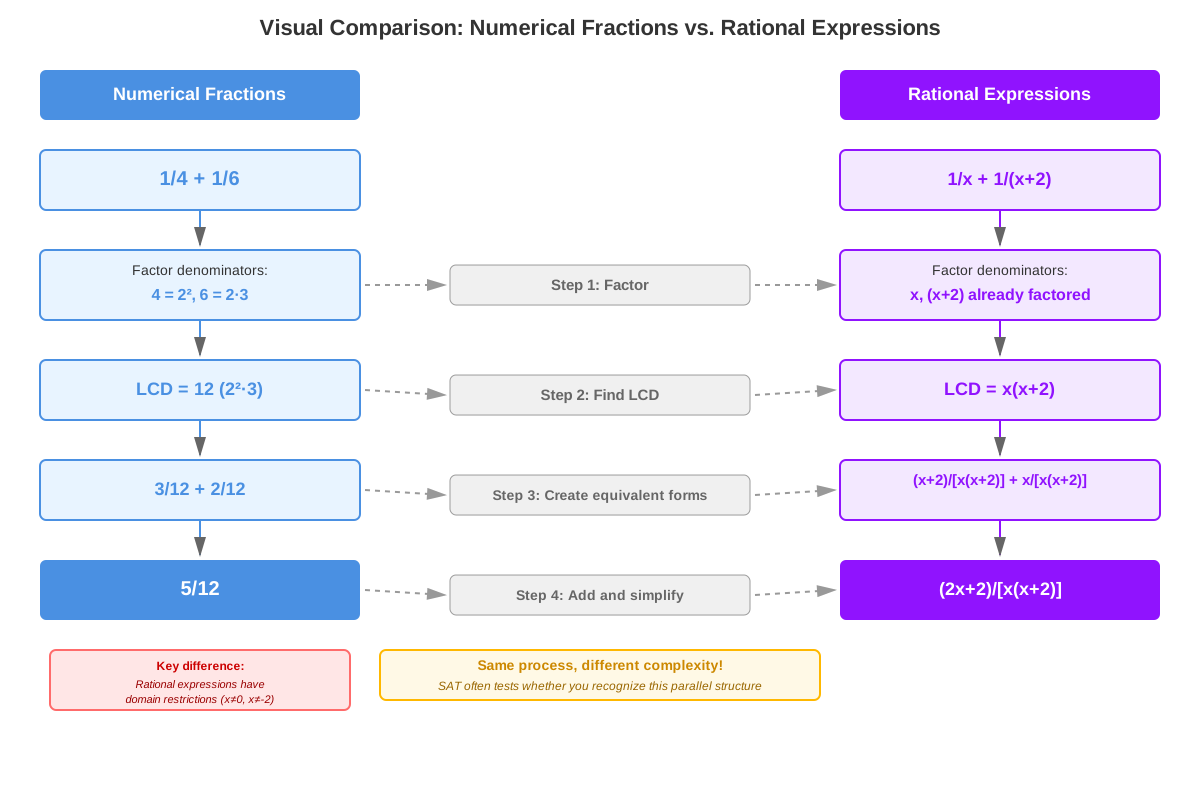
To add rational expressions, they must share a common denominator, just as $\frac{1}{4}+\frac{1}{6}$ requires converting to $\frac{3}{12}+\frac{2}{12}$. The least common denominator (LCD) is the smallest expression that contains all factors from each denominator. Finding the LCD efficiently requires factoring each denominator completely.
For numerical denominators like adding $\frac{3}{4x}+\frac{5}{6x}$, the LCD is $12x$ (the LCM of 4 and 6, multiplied by $x$). For polynomial denominators, the process requires more sophisticated factoring.
Finding the LCD with Polynomial Denominators
When denominators are polynomials, follow this systematic approach:
- Factor each denominator completely into irreducible factors
- Identify all unique factors across both denominators
- For each unique factor, use the highest power that appears in any denominator
- Multiply these factors together to create the LCD
For example, to add $\frac{2}{x^2-4}+\frac{3}{x^2-5x+6}$:
- Factor: $x^2-4=(x+2)(x-2)$ and $x^2-5x+6=(x-2)(x-3)$
- Unique factors: $(x+2)$, $(x-2)$, $(x-3)$
- LCD: $(x+2)(x-2)(x-3)$
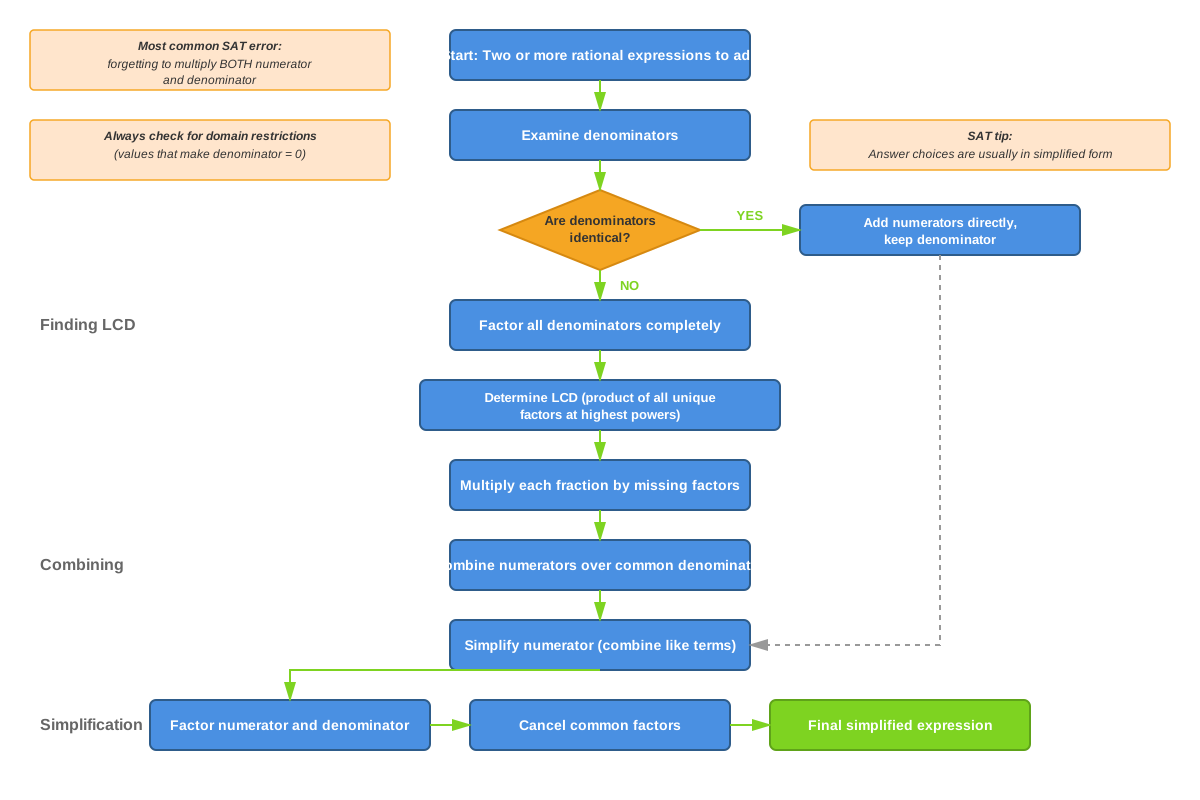
The Addition Process
Once the LCD is determined, follow these steps:
- Rewrite each fraction with the LCD as the denominator
- Multiply each numerator by the factor(s) needed to create the LCD
- Add the numerators while keeping the common denominator
- Simplify the resulting expression by combining like terms in the numerator
- Factor and reduce if possible by canceling common factors
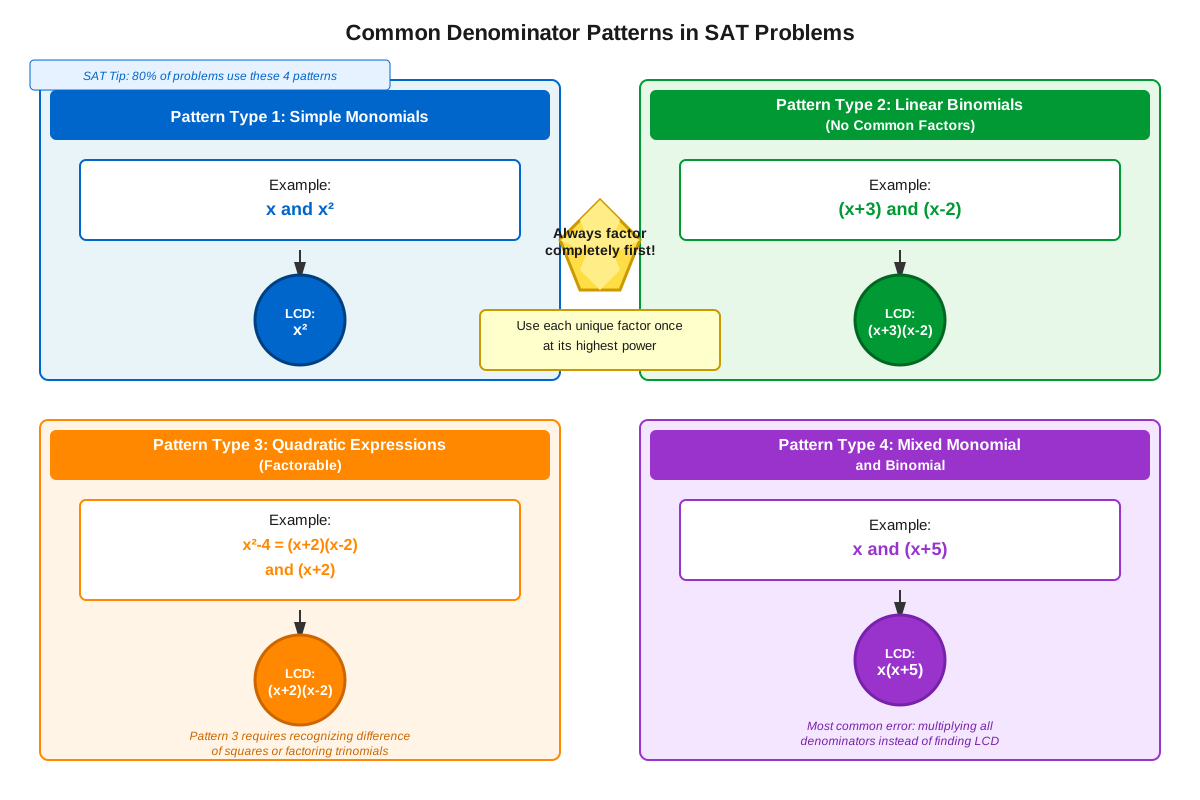
Working with Monomial Denominators
When denominators are simple monomials or contain only numerical coefficients and variables, the process is straightforward:
$$\frac{3}{2x}+\frac{5}{3x^2}$$
The LCD is $6x^2$ (LCM of 2 and 3 is 6; highest power of $x$ is $x^2$):
$$\frac{3 \cdot 3x}{2x \cdot 3x}+\frac{5 \cdot 2}{3x^2 \cdot 2}=\frac{9x}{6x^2}+\frac{10}{6x^2}=\frac{9x+10}{6x^2}$$
Working with Binomial Denominators
When denominators are binomials that don't share factors, the LCD is simply their product:
$$\frac{4}{x+3}+\frac{2}{x-1}$$
LCD: $(x+3)(x-1)$
$$\frac{4(x-1)}{(x+3)(x-1)}+\frac{2(x+3)}{(x-1)(x+3)}=\frac{4x-4+2x+6}{(x+3)(x-1)}=\frac{6x+2}{(x+3)(x-1)}$$
This can be factored further: $\frac{2(3x+1)}{(x+3)(x-1)}$
Working with Factorable Polynomial Denominators
The most challenging SAT problems involve denominators that must be factored before finding the LCD:
$$\frac{x}{x^2+5x+6}+\frac{2}{x+2}$$
Factor: $x^2+5x+6=(x+2)(x+3)$
The second denominator is already $(x+2)$
LCD: $(x+2)(x+3)$
$$\frac{x}{(x+2)(x+3)}+\frac{2(x+3)}{(x+2)(x+3)}=\frac{x+2x+6}{(x+2)(x+3)}=\frac{3x+6}{(x+2)(x+3)}$$
Factor the numerator: $\frac{3(x+2)}{(x+2)(x+3)}$
Cancel common factors: $\frac{3}{x+3}$ (with restriction $x \neq -2, -3$)
Simplification and Final Form
After adding, always check whether the numerator and denominator share common factors. Factor both completely and cancel any common factors. The SAT expects answers in simplified form. However, be cautious: only cancel factors (terms connected by multiplication), never terms connected by addition or subtraction.
Concept Relationships
The process of adding rational expressions builds directly on fraction arithmetic principles, extending them to algebraic contexts. Factoring polynomials → enables → finding the LCD → which allows → creating equivalent expressions with common denominators → leading to → combining numerators → followed by → simplification through cancellation.
This topic connects backward to prerequisite knowledge: polynomial operations provide the tools for expanding expressions when creating common denominators, while factoring skills enable efficient LCD identification. The domain restriction concept links to function notation and understanding when expressions are undefined.
Looking forward, adding rational expressions is essential for solving rational equations (where expressions are set equal to values), working with complex fractions (fractions within fractions), and understanding limits in calculus. The algebraic manipulation skills developed here—particularly recognizing equivalent forms and simplifying complex expressions—transfer to virtually all advanced mathematics.
Within the SAT Math curriculum, this topic connects to systems of equations (where rational expressions may appear), function operations (adding functions that are rational expressions), and word problems involving rates and proportions. The factoring skills required here reinforce the Passport to Advanced Math domain's emphasis on structural understanding of algebraic expressions.
Quick check — test yourself on Adding rational expressions so far.
Try Flashcards →High-Yield Facts
⭐ The LCD must contain every factor that appears in any denominator, using the highest power of each factor
⭐ Always factor denominators completely before attempting to find the LCD
⭐ When adding rational expressions, only the numerators are added—the common denominator stays the same
⭐ After adding, always check if the numerator and denominator share common factors that can be canceled
⭐ Domain restrictions come from values that make any original denominator equal to zero, even after simplification
- Rational expressions with monomial denominators require finding the LCM of coefficients and the highest power of each variable
- When denominators are already identical, simply add the numerators and keep the denominator unchanged
- The expression $(x-a)$ and $(a-x)$ are opposites: $(a-x)=-(x-a)$, which can help find common denominators
- Multiplying both numerator and denominator by the same non-zero expression creates an equivalent rational expression
- The SAT never requires finding common denominators for more than two rational expressions in a single problem
- Simplified answers may have denominators in factored or expanded form—both are typically acceptable unless specified
- When the LCD is the product of both denominators, the denominators share no common factors
- Canceling is only valid for factors (multiplication), never for terms being added or subtracted
- Complex fractions (fractions within fractions) often require adding rational expressions as an intermediate step
- The numerator of the final answer should be expanded and combined, not left as separate products
Common Misconceptions
Misconception: Adding both numerators and denominators separately (treating $\frac{a}{b}+\frac{c}{d}$ as $\frac{a+c}{b+d}$)
Correction: Only numerators are added when fractions share a common denominator. Different denominators must first be converted to a common denominator, then only the numerators are added while the denominator remains unchanged.
Misconception: Canceling terms instead of factors (canceling the $x$ in $\frac{x+3}{x+5}$ to get $\frac{3}{5}$)
Correction: Canceling is only valid for factors—expressions connected by multiplication. Terms connected by addition or subtraction cannot be canceled. The expression $\frac{x+3}{x+5}$ cannot be simplified further because $x$ is a term, not a factor.
Misconception: Forgetting to multiply the numerator when creating equivalent fractions with the LCD
Correction: When multiplying the denominator by a factor to create the LCD, the numerator must be multiplied by the same factor to maintain equivalence. If converting $\frac{3}{x+2}$ to have denominator $(x+2)(x-1)$, the numerator becomes $3(x-1)$, not just $3$.
Misconception: Assuming the LCD is always the product of both denominators
Correction: The LCD is the product of denominators only when they share no common factors. When denominators have common factors, the LCD is smaller than their product. For $\frac{1}{x-2}+\frac{1}{(x-2)(x+3)}$, the LCD is $(x-2)(x+3)$, not $(x-2)(x-2)(x+3)$.
Misconception: Believing that domain restrictions disappear after simplification
Correction: Domain restrictions from the original expression remain even after simplification. If $\frac{x+2}{(x+2)(x-3)}$ simplifies to $\frac{1}{x-3}$, the value $x=-2$ is still excluded because it made the original denominator zero, even though it doesn't appear in the simplified form.
Misconception: Thinking that $(x-3)$ and $(3-x)$ are the same expression
Correction: These expressions are opposites: $(3-x)=-(x-3)$. When finding a common denominator involving both, factor out the negative: $\frac{2}{x-3}+\frac{5}{3-x}=\frac{2}{x-3}+\frac{5}{-(x-3)}=\frac{2}{x-3}-\frac{5}{x-3}=\frac{-3}{x-3}$.
Misconception: Expanding the denominator after finding the LCD
Correction: While expanding is sometimes acceptable, keeping denominators in factored form makes it easier to identify and cancel common factors during simplification. The SAT typically accepts both forms unless the question specifies otherwise.
Worked Examples
Example 1: Adding with Factorable Polynomial Denominators
Problem: Simplify $\frac{3}{x^2-9}+\frac{2}{x+3}$
Solution:
Step 1: Factor all denominators completely.
- $x^2-9$ is a difference of squares: $(x+3)(x-3)$
- $x+3$ is already factored
Step 2: Identify the LCD.
- First denominator has factors: $(x+3)$ and $(x-3)$
- Second denominator has factor: $(x+3)$
- LCD must include both $(x+3)$ and $(x-3)$: LCD = $(x+3)(x-3)$
Step 3: Rewrite each fraction with the LCD.
- First fraction already has LCD as denominator: $\frac{3}{(x+3)(x-3)}$
- Second fraction needs $(x-3)$ factor: $\frac{2(x-3)}{(x+3)(x-3)}$
Step 4: Add the numerators.
$$\frac{3}{(x+3)(x-3)}+\frac{2(x-3)}{(x+3)(x-3)}=\frac{3+2(x-3)}{(x+3)(x-3)}$$
Step 5: Simplify the numerator.
$$\frac{3+2x-6}{(x+3)(x-3)}=\frac{2x-3}{(x+3)(x-3)}$$
Step 6: Check for common factors.
- The numerator $2x-3$ doesn't factor further
- No common factors with denominator
- This is the final simplified form
Answer: $\frac{2x-3}{(x+3)(x-3)}$ or equivalently $\frac{2x-3}{x^2-9}$
Connection to Learning Objectives: This problem demonstrates identifying key features (factoring denominators), applying the addition process systematically, and recognizing the simplified form typical of SAT questions.
Example 2: Adding with Monomial and Binomial Denominators
Problem: Which expression is equivalent to $\frac{5}{2x}+\frac{3}{x+4}$?
Solution:
Step 1: Identify the denominators.
- First denominator: $2x$
- Second denominator: $x+4$
- These share no common factors
Step 2: Determine the LCD.
- LCD = $2x(x+4)$
Step 3: Create equivalent fractions.
- First fraction needs factor $(x+4)$: $\frac{5(x+4)}{2x(x+4)}$
- Second fraction needs factor $2x$: $\frac{3(2x)}{2x(x+4)}$
Step 4: Add the numerators.
$$\frac{5(x+4)+3(2x)}{2x(x+4)}$$
Step 5: Expand and simplify the numerator.
$$\frac{5x+20+6x}{2x(x+4)}=\frac{11x+20}{2x(x+4)}$$
Step 6: Check for factoring opportunities.
- Numerator: $11x+20$ has no common factors
- Cannot be factored further
- No common factors with denominator
Answer: $\frac{11x+20}{2x(x+4)}$ or $\frac{11x+20}{2x^2+8x}$ (expanded form)
Connection to Learning Objectives: This example shows how SAT questions present addition problems in "which expression is equivalent" format, requiring students to apply the complete addition process and recognize that both factored and expanded denominator forms may appear in answer choices.
Exam Strategy
When approaching SAT questions on adding rational expressions, begin by quickly scanning the denominators to assess complexity. If denominators are simple monomials or numbers, the problem will be straightforward. If denominators are polynomials, immediately factor them before attempting anything else—this single step prevents most errors.
Trigger words and phrases to watch for include: "equivalent to," "simplified form," "which expression equals," and "for all values of $x$ except." The phrase "for all values except" signals that the question involves domain restrictions, meaning you should identify values that make denominators zero.
Process-of-elimination strategies:
- Eliminate answer choices with different denominators from what the LCD should be
- Check answer choices by substituting a simple value like $x=1$ or $x=0$ (if allowed by domain restrictions) into both the original expression and answer choices
- Eliminate choices where the degree of the numerator or denominator doesn't match what you'd expect from the addition process
- If stuck, work backward from answer choices by splitting them into separate fractions to see if they match the original
Time allocation: Budget 1.5-2 minutes for straightforward addition problems with monomial or simple binomial denominators. Allow 2.5-3 minutes for problems requiring factoring of quadratic expressions. If a problem takes longer than 3 minutes, mark it for review and move on—these questions are worth the same single point as easier questions.
Quick checks: After finding your answer, verify that the degree of your numerator makes sense (it should generally be one less than the denominator's degree or equal to it). Also verify that your answer is fully simplified—SAT answer choices are always in simplest form.
Memory Techniques
LCD Mnemonic: "Factors First, Highest Powers" (FFHP)
- Factor all denominators completely
- Find all unique factors
- Highest power of each factor goes in LCD
- Product of these creates the LCD
Addition Process Acronym: "FRANCE"
- Factor denominators
- Recognize the LCD
- Adjust each fraction to have LCD
- Numerators add (denominators stay same)
- Combine like terms
- Eliminate common factors (simplify)
Visualization Strategy: Picture rational expressions as puzzle pieces that need matching edges (common denominators) before they can connect. The LCD is the "frame" that both pieces must fit into.
Canceling Rule Reminder: "Only Factors Fly"—only factors (connected by multiplication) can be canceled and "fly away," never terms connected by addition or subtraction.
Domain Restriction Memory Aid: "Zero Zones"—any value that creates a "zero zone" in any denominator (original or intermediate) is permanently excluded from the domain.
Summary
Adding rational expressions extends fraction arithmetic to algebraic contexts, requiring students to find common denominators for expressions containing polynomials. The process involves factoring denominators completely, identifying the least common denominator by including all unique factors at their highest powers, creating equivalent expressions with the LCD, adding only the numerators while maintaining the common denominator, and simplifying by combining like terms and canceling common factors. Success requires strong factoring skills, careful algebraic manipulation, and attention to domain restrictions. The SAT tests this concept through direct simplification problems and embedded applications, typically at medium difficulty. Students must recognize that denominators determine the approach: monomial denominators require simple LCM finding, while polynomial denominators demand complete factoring before proceeding. The final answer must be fully simplified with no common factors between numerator and denominator, though both factored and expanded forms may be acceptable depending on answer choice formats.
Key Takeaways
- Always factor polynomial denominators completely before attempting to find the LCD—this is the critical first step that enables everything else
- The LCD contains every unique factor from all denominators, using the highest power of each factor that appears
- When adding rational expressions, only numerators are added; the common denominator remains unchanged throughout the process
- After combining numerators, always check for common factors between the numerator and denominator that can be canceled to simplify
- Domain restrictions come from any value that makes any original denominator zero, and these restrictions persist even after simplification
- The SAT expects answers in simplified form, so factor and cancel whenever possible before selecting an answer
- Substituting simple values (when allowed) provides a quick way to verify answers or eliminate incorrect choices
Related Topics
Subtracting Rational Expressions: Uses the same LCD process as addition but requires careful attention to distributing negative signs across entire numerators. Mastering addition makes subtraction straightforward.
Multiplying and Dividing Rational Expressions: These operations don't require common denominators but do require factoring and canceling skills developed through addition practice.
Solving Rational Equations: Equations containing rational expressions often require adding or subtracting them as an intermediate step before clearing denominators to solve.
Complex Fractions: Fractions containing fractions in numerator or denominator frequently require adding rational expressions to simplify the overall structure.
Partial Fraction Decomposition: An advanced technique (typically post-SAT) that reverses the addition process, breaking complex rational expressions into simpler components—understanding addition provides the foundation.
Practice CTA
Now that you've mastered the concepts and strategies for adding rational expressions, it's time to cement your understanding through practice. Work through the practice questions to apply these techniques to SAT-style problems, and use the flashcards to reinforce key facts and procedures. Remember, the difference between understanding a concept and mastering it for test day lies in deliberate practice. Each problem you solve strengthens your pattern recognition and speeds up your problem-solving process. You've got the tools—now build the confidence through practice!
Sign up free to keep reading
Create a free AnvayaPrep account to finish this SAT guide on Adding rational expressions — plus flashcards and practice questions.