Overview
Subtracting rational expressions is a fundamental algebraic skill that appears frequently on the SAT Math section. A rational expression is simply a fraction where the numerator and denominator are polynomials. Just as students learned to subtract numerical fractions in elementary school by finding common denominators, subtracting rational expressions requires the same conceptual approach but with algebraic expressions instead of simple numbers. This topic builds directly on fraction arithmetic while incorporating polynomial manipulation, making it a bridge between basic algebra and more advanced mathematical reasoning.
The SAT consistently tests this skill because it evaluates multiple competencies simultaneously: understanding of fractions, facility with polynomial operations, factoring ability, and algebraic simplification. Questions involving sat subtracting rational expressions often appear in both the calculator and no-calculator sections, typically as part of multi-step problems or within more complex algebraic scenarios. Students who master this topic gain confidence in handling algebraic fractions throughout the exam, from simplifying expressions to solving rational equations.
Understanding rational expression subtraction connects to broader math concepts tested on the SAT, including solving rational equations, working with function operations, and manipulating complex algebraic expressions. This skill also underpins work with proportions, rates, and combined work problems—all common SAT question types. The ability to efficiently find common denominators and simplify results separates students who merely know procedures from those who truly understand algebraic structure, a distinction the SAT is designed to reveal.
Learning Objectives
- [ ] Identify key features of subtracting rational expressions
- [ ] Explain how subtracting rational expressions appears on the SAT
- [ ] Apply subtracting rational expressions to answer SAT-style questions
- [ ] Determine the least common denominator (LCD) for rational expressions with polynomial denominators
- [ ] Factor polynomial denominators to identify common factors and simplify the subtraction process
- [ ] Simplify complex rational expressions after subtraction by canceling common factors
- [ ] Recognize and avoid common algebraic errors when distributing negative signs across numerators
Prerequisites
- Fraction arithmetic with numerical denominators: Understanding how to subtract fractions like 3/4 - 1/6 provides the conceptual foundation for all rational expression operations
- Polynomial operations (addition, subtraction, multiplication): Manipulating the numerators after finding common denominators requires fluency with combining like terms and distributing
- Factoring polynomials: Identifying common factors in denominators is essential for finding the LCD efficiently
- Simplifying algebraic fractions: Recognizing and canceling common factors between numerators and denominators ensures expressions are in simplest form
- Understanding of variables and algebraic notation: Rational expressions extend fraction concepts to include variables, requiring comfort with abstract symbolic manipulation
Why This Topic Matters
In real-world applications, rational expressions model countless scenarios involving rates, proportions, and relationships between quantities. Engineers use them to calculate combined resistances in electrical circuits, economists employ them in marginal cost analysis, and scientists apply them when working with concentration problems in chemistry. The ability to subtract rational expressions enables solving problems where two rates or proportions must be compared or combined—such as determining the difference in efficiency between two machines or calculating net flow rates in fluid dynamics.
On the SAT, rational expression subtraction appears in approximately 2-4 questions per test, making it a high-yield topic for score improvement. These questions typically appear as part of the Heart of Algebra or Passport to Advanced Math content domains. The College Board frequently embeds this skill within multi-step problems where students must first subtract rational expressions, then use the result to solve an equation or evaluate the expression for specific values. Questions may present the expressions in factored or unfactored form, testing whether students can recognize equivalent forms and choose efficient solution paths.
Common SAT question formats include: asking students to identify which expression is equivalent to a given subtraction problem; requiring simplification of a difference of rational expressions as part of solving an equation; presenting word problems where setting up the subtraction is the key step; and multiple-choice questions where recognizing the correct LCD determines the answer. The SAT also tests this concept by asking students to identify restrictions on variable values (values that make denominators zero) after performing subtraction operations.
Core Concepts
Understanding Rational Expressions
A rational expression is a fraction in which both the numerator and denominator are polynomials. Examples include 3/x, (x+2)/(x-5), and (2x²-3x+1)/(x²-4). Just as the fraction 3/4 represents "3 divided by 4," the rational expression (x+2)/(x-5) represents "(x+2) divided by (x-5)." The fundamental principle governing all operations with rational expressions mirrors the rules for numerical fractions: to subtract fractions, they must share a common denominator.
The domain of a rational expression excludes any values that make the denominator equal to zero, since division by zero is undefined. For example, the expression (x+2)/(x-5) is undefined when x = 5. Identifying these restrictions becomes particularly important after subtraction, as the simplified form may have a different denominator than the original expressions.
The Subtraction Process: Step-by-Step
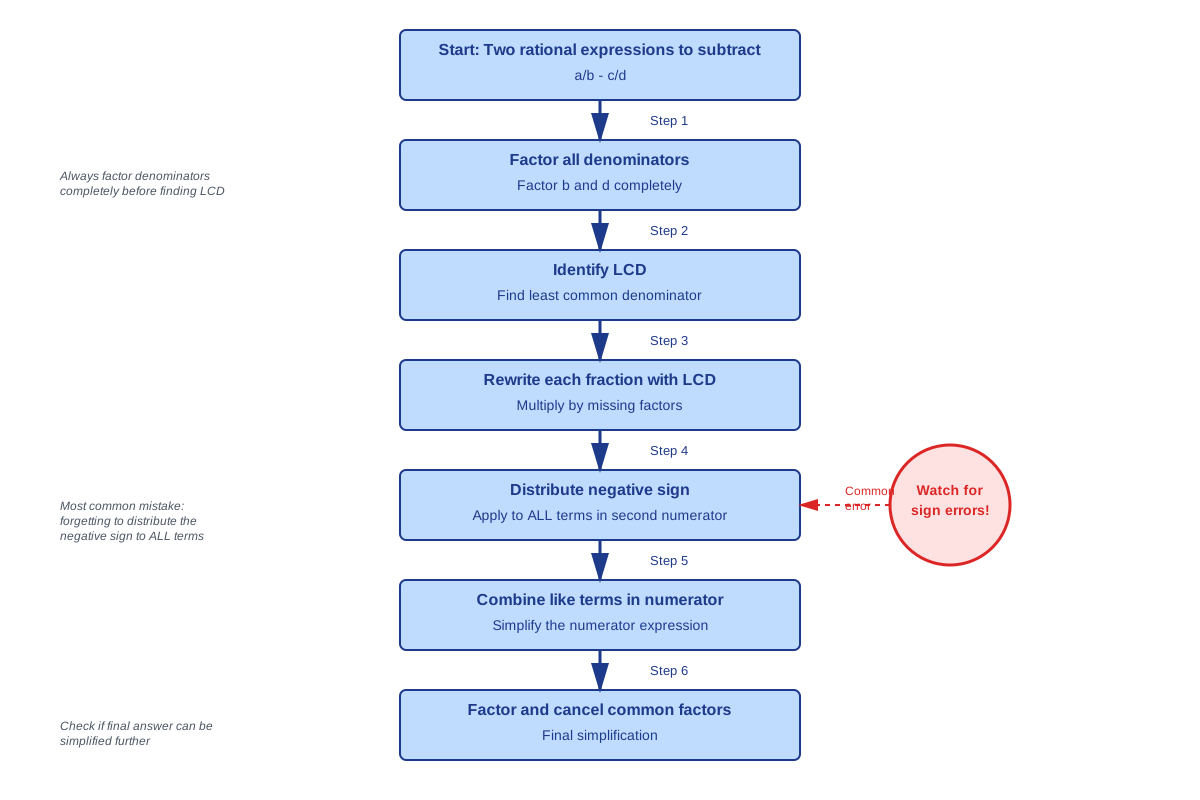
Subtracting rational expressions follows a systematic four-step process:
- Factor all denominators completely: This reveals common factors and makes finding the LCD more efficient
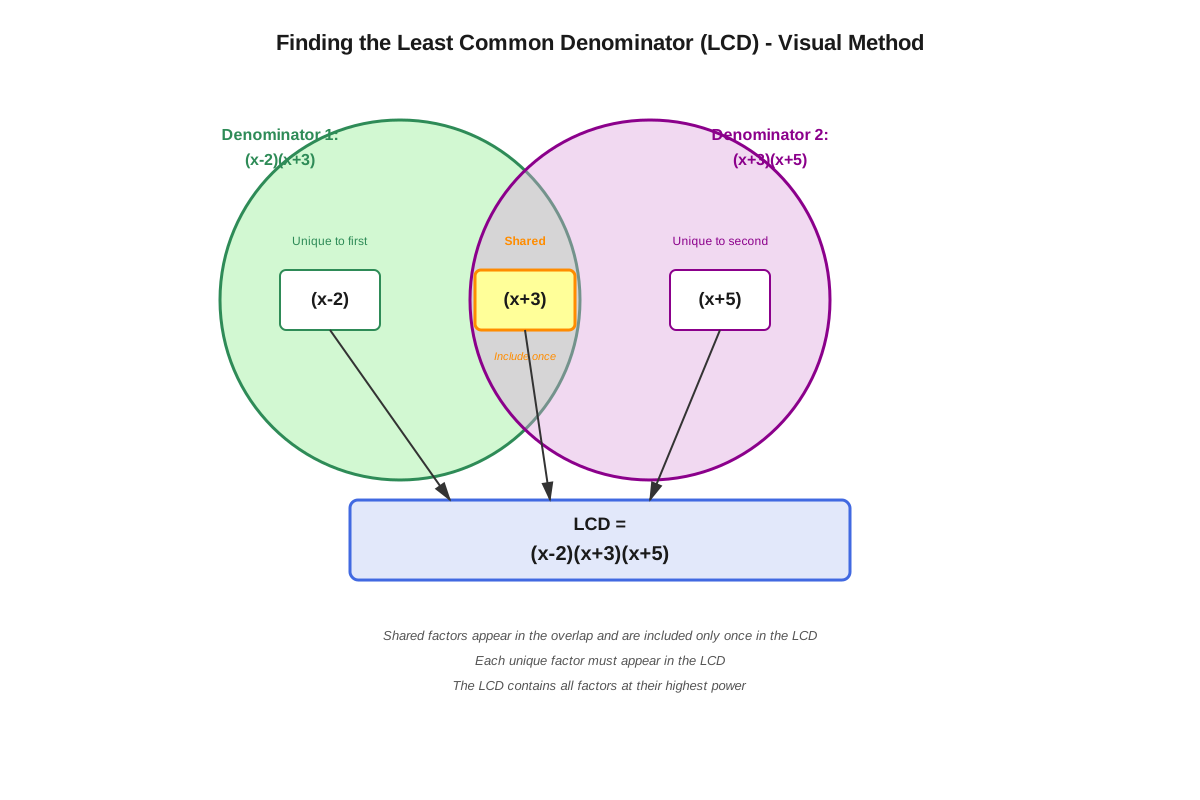
- Identify the least common denominator (LCD): The LCD contains each unique factor raised to the highest power it appears in any denominator
- Rewrite each fraction with the LCD: Multiply both numerator and denominator of each fraction by the factors needed to create the LCD
- Subtract the numerators and simplify: Combine the numerators over the common denominator, being careful with negative signs, then simplify by factoring and canceling
Finding the Least Common Denominator (LCD)
The least common denominator for rational expressions works exactly like the LCD for numerical fractions, but with polynomial factors instead of prime factors. Consider subtracting 5/(x-3) - 2/(x+1). Since the denominators (x-3) and (x+1) share no common factors, the LCD is their product: (x-3)(x+1).
For denominators with common factors, the LCD includes each factor only once at its highest power. For example, when subtracting expressions with denominators 6x² and 4x³, factor them as 2·3·x² and 2²·x³. The LCD must include 2² (the highest power of 2), 3 (appears once), and x³ (the highest power of x), giving LCD = 12x³.
| Original Denominators | Factored Form | LCD | Explanation |
|---|---|---|---|
| x, x² | x, x² | x² | Highest power of x |
| (x-2), (x-2)² | (x-2), (x-2)² | (x-2)² | Highest power of (x-2) |
| x²-4, x-2 | (x+2)(x-2), (x-2) | (x+2)(x-2) | x²-4 factors; (x-2) is common |
| x²-9, x²+6x+9 | (x+3)(x-3), (x+3)² | (x+3)²(x-3) | Both contain (x+3) |
Handling Negative Signs in Subtraction
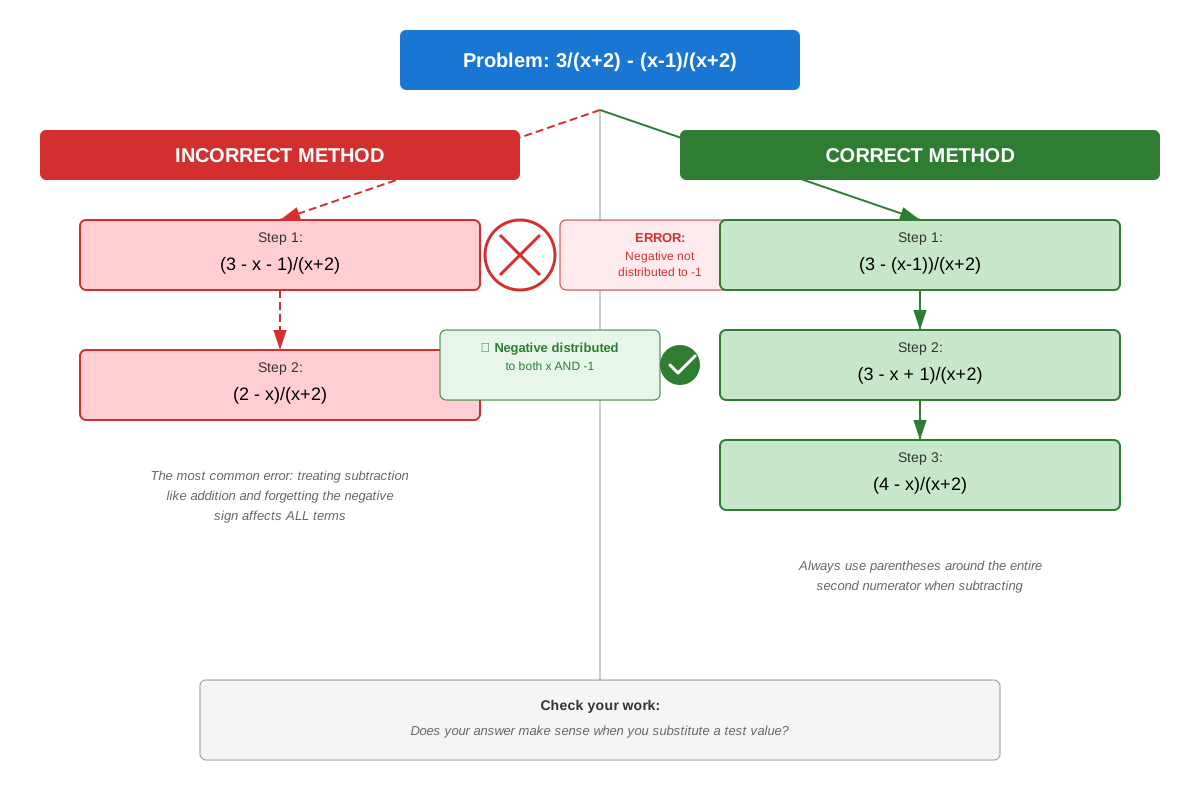
The most common error in subtracting rational expressions involves mishandling the negative sign. When subtracting, the negative sign must distribute across the entire numerator of the second fraction. Consider:
3/(x+1) - (x-2)/(x+1) = [3 - (x-2)]/(x+1) = [3 - x + 2]/(x+1) = (5-x)/(x+1)Notice that subtracting (x-2) requires distributing the negative: -(x-2) = -x+2. Students who write 3-x-2 instead of 3-x+2 make a critical sign error. When the second numerator contains multiple terms, parentheses are essential for correct distribution.
Simplifying After Subtraction
After combining numerators over the common denominator, the resulting expression often can be simplified by factoring the numerator and canceling common factors with the denominator. This step is crucial for matching answer choices on the SAT and for identifying the simplest form of the expression.
For example, after subtracting and combining, you might obtain (x²-4)/[(x-2)(x+1)]. Factoring the numerator as (x+2)(x-2) allows canceling the common factor (x-2), yielding the simplified form (x+2)/(x+1). Always check whether the numerator factors, especially when it's a quadratic expression.
Special Cases and Patterns
Certain subtraction problems involve recognizable patterns that enable faster solutions:
- Same denominator: When denominators are identical, simply subtract numerators directly: a/c - b/c = (a-b)/c
- Opposite denominators: Expressions like 1/(x-3) and 1/(3-x) have opposite denominators since 3-x = -(x-3). Factor out -1 to create a common denominator
- Monomial denominators: When denominators are simple monomials like 2x and 3x², finding the LCD involves only numerical and variable factors without polynomial factoring
Concept Relationships
The process of subtracting rational expressions integrates multiple algebraic skills in a hierarchical relationship. Factoring polynomials serves as the foundation → enabling identification of the least common denominator → which allows rewriting fractions with common denominators → leading to numerator subtraction → followed by simplification through canceling common factors.
This topic connects backward to prerequisite knowledge of numerical fraction subtraction, where students first learned that different denominators require finding a common denominator before subtracting. The algebraic version extends this concept by replacing numbers with polynomial expressions. The factoring skills developed in earlier algebra units become essential tools rather than isolated techniques.
Forward connections include solving rational equations (where subtraction creates a single rational expression that can be cleared by multiplying both sides by the LCD), working with complex fractions (where subtraction may occur in numerators or denominators), and analyzing rational functions (where understanding how to combine rational expressions helps in function composition and transformation).
Within the broader SAT Math curriculum, rational expression subtraction connects to the Heart of Algebra domain (manipulating algebraic expressions) and Passport to Advanced Math (working with polynomial and rational functions). The skill also appears in Problem Solving and Data Analysis when working with rate problems that require combining or comparing rates expressed as fractions.
Quick check — test yourself on Subtracting rational expressions so far.
Try Flashcards →High-Yield Facts
⭐ The denominators must be identical before subtracting numerators—this is the fundamental rule that governs all rational expression subtraction
⭐ The LCD is the product of all unique factors, each raised to its highest power appearing in any denominator
⭐ When subtracting, the negative sign must distribute across every term in the second numerator: a/c - (b+d)/c = (a-b-d)/c, not (a-b+d)/c
⭐ Always factor denominators completely before identifying the LCD—this prevents unnecessary work and reveals common factors
⭐ After subtraction, factor the resulting numerator to check for common factors with the denominator that can be canceled
- The domain restrictions (values that make denominators zero) must be identified from the original denominators, not just the simplified form
- When denominators are opposites like (x-3) and (3-x), factor out -1 from one to create matching denominators: 3-x = -(x-3)
- Monomial denominators (like 6x² and 9x³) have an LCD found by taking the LCM of coefficients and the highest power of each variable
- If denominators are already factored, finding the LCD is straightforward; if not, factor them first
- The subtraction a/b - c/d equals (ad-bc)/(bd) only when b and d share no common factors; otherwise, this creates an unnecessarily complex denominator
- Rational expressions with quadratic denominators often factor as difference of squares, perfect square trinomials, or standard trinomials—recognizing these patterns speeds up the process
- On the SAT, answer choices are typically in simplified form, so the final step of canceling common factors is essential for matching your result
Common Misconceptions
Misconception: When subtracting rational expressions with the same denominator, subtract both numerators and denominators.
Correction: Only the numerators are subtracted; the common denominator remains unchanged. The expression a/c - b/c equals (a-b)/c, not (a-b)/(c-c).
Misconception: The LCD is always the product of the two denominators.
Correction: The LCD is the product of denominators only when they share no common factors. When common factors exist, the LCD is smaller than the product. For example, with denominators (x-2) and (x-2)², the LCD is (x-2)², not (x-2)³.
Misconception: When subtracting (x-3)/(x+1) - (2x-5)/(x+1), the result is (x-3-2x-5)/(x+1).
Correction: The negative sign must distribute: (x-3-2x+5)/(x+1) = (-x+2)/(x+1). The term -5 becomes +5 after distributing the negative sign.
Misconception: After simplifying by canceling common factors, the domain restrictions change.
Correction: Domain restrictions are determined by the original denominators before simplification. If (x²-4)/(x-2) simplifies to (x+2), the value x=2 is still excluded from the domain because it made the original denominator zero.
Misconception: Factoring the numerator after subtraction is optional.
Correction: Factoring the numerator is essential for two reasons: it allows canceling common factors with the denominator (required for simplest form), and SAT answer choices are presented in simplified form, so matching requires complete simplification.
Misconception: When denominators are (x-5) and (5-x), they're completely different and require multiplying them together for the LCD.
Correction: These denominators are opposites: 5-x = -(x-5). Multiply the second fraction by -1/-1 to create a common denominator of (x-5), giving LCD = (x-5), not (x-5)(5-x).
Worked Examples
Example 1: Different Linear Denominators
Problem: Simplify: 3/(x-2) - 5/(x+3)
Solution:
Step 1: Factor denominators (already in factored form)
- First denominator: (x-2)
- Second denominator: (x+3)
- These share no common factors
Step 2: Identify the LCD
- LCD = (x-2)(x+3)
Step 3: Rewrite each fraction with the LCD
- First fraction needs (x+3) in denominator: [3(x+3)]/[(x-2)(x+3)]
- Second fraction needs (x-2) in denominator: [5(x-2)]/[(x-2)(x+3)]
Step 4: Subtract numerators
3(x+3)/[(x-2)(x+3)] - 5(x-2)/[(x-2)(x+3)]
= [3(x+3) - 5(x-2)]/[(x-2)(x+3)]
= [3x + 9 - 5x + 10]/[(x-2)(x+3)]
= [-2x + 19]/[(x-2)(x+3)]
Step 5: Check for simplification
- The numerator -2x+19 doesn't factor in a way that creates common factors with the denominator
- Final answer: (-2x+19)/[(x-2)(x+3)] or (-2x+19)/(x²+x-6)
This problem demonstrates the core process and emphasizes careful distribution of the negative sign when subtracting 5(x-2).
Example 2: Denominators with Common Factors
Problem: Simplify: (x+1)/(x²-9) - 2/(x-3)
Solution:
Step 1: Factor denominators completely
- First denominator: x²-9 = (x+3)(x-3) [difference of squares]
- Second denominator: (x-3) [already factored]
Step 2: Identify the LCD
- First denominator contains: (x+3)(x-3)
- Second denominator contains: (x-3)
- LCD must include both factors: (x+3)(x-3)
Step 3: Rewrite each fraction with the LCD
- First fraction already has LCD: (x+1)/[(x+3)(x-3)]
- Second fraction needs (x+3): [2(x+3)]/[(x+3)(x-3)]
Step 4: Subtract numerators
(x+1)/[(x+3)(x-3)] - 2(x+3)/[(x+3)(x-3)]
= [(x+1) - 2(x+3)]/[(x+3)(x-3)]
= [x + 1 - 2x - 6]/[(x+3)(x-3)]
= [-x - 5]/[(x+3)(x-3)]
Step 5: Check for simplification
- Factor numerator: -x-5 = -(x+5)
- No common factors with denominator (x+3)(x-3)
- Final answer: -(x+5)/[(x+3)(x-3)] or (-x-5)/(x²-9)
This example shows the importance of factoring denominators first to identify common factors, preventing unnecessary work. It also reinforces that recognizing difference of squares patterns is crucial for efficient problem-solving on the SAT.
Exam Strategy
When approaching SAT questions involving rational expression subtraction, begin by quickly scanning the answer choices. If they're in factored form, keep your work factored throughout; if they're expanded, you may need to expand your final answer. This preview saves time by showing you the expected format.
Trigger words and phrases that signal rational expression subtraction include: "simplify the difference," "subtract the expressions," "which expression is equivalent to," and "the result of subtracting." Word problems might describe scenarios involving "the difference between two rates" or "how much faster/slower," which translate to subtraction of rational expressions.
For process of elimination, immediately eliminate answer choices with incorrect denominators. After finding the LCD, you know what the denominator should be (or what it simplifies to), allowing you to eliminate half or more of the choices before completing the numerator work. Also eliminate choices that have sign errors—if your numerator subtraction yields a negative leading coefficient, eliminate positive options.
Time allocation: Straightforward subtraction problems with linear denominators should take 60-90 seconds. Problems requiring factoring quadratic denominators or additional simplification may take 2-3 minutes. If a problem is taking longer, mark it and return after completing easier questions. The SAT rewards efficient problem selection.
Strategic shortcuts: When denominators are identical, immediately subtract numerators without any LCD work. When you see opposite denominators like (x-a) and (a-x), factor out -1 from one rather than multiplying them together. If answer choices are numerical and the problem contains variables, consider substituting a simple value (like x=0 or x=1) to eliminate wrong answers quickly—but verify your answer algebraically if time permits.
Memory Techniques
LCD Mnemonic: "Factors Highest Power" reminds you that the LCD contains each Factor at its Highest Power appearing in any denominator.
Subtraction Sign Mnemonic: "Distribute Negatives Everywhere" (DNE) reminds you that when subtracting, the negative sign Distributes across every term in the Numerator, affecting Everything.
Process Acronym: "Find LCD, Rewrite, Subtract, Simplify" (FLRSS) captures the five-step process: Factor denominators, find LCD, Rewrite fractions, Subtract numerators, Simplify result.
Visualization Strategy: Picture rational expressions as physical fractions with a horizontal line. The line represents division and creates a barrier—operations above the line (numerators) are separate from operations below the line (denominators). When subtracting, imagine the negative sign as a wave that must wash over every term in the second numerator.
Pattern Recognition: Remember "DOTS" for common denominator patterns: Difference of squares (x²-a²), Opposites [like (x-3) and (3-x)], Trinomials (x²+bx+c), Same denominators (immediate subtraction).
Summary
Subtracting rational expressions extends the familiar process of subtracting numerical fractions to algebraic contexts, requiring students to find common denominators for polynomial expressions. The systematic approach involves factoring all denominators, identifying the least common denominator by taking each unique factor at its highest power, rewriting each fraction with the LCD, carefully subtracting numerators while distributing negative signs across all terms, and simplifying by factoring and canceling common factors. This skill appears frequently on the SAT because it integrates multiple algebraic competencies: polynomial factoring, fraction operations, and algebraic simplification. Success requires particular attention to sign distribution when subtracting and recognition that the LCD is not always the product of denominators when common factors exist. The ability to efficiently subtract rational expressions enables solving more complex problems involving rational equations, function operations, and real-world rate problems, making it a cornerstone skill for SAT Math success.
Key Takeaways
- Rational expression subtraction requires a common denominator, found by factoring all denominators and taking each unique factor at its highest power
- The negative sign in subtraction must distribute across every term in the second numerator—this is the most common source of errors
- Always factor denominators before finding the LCD to identify common factors and avoid unnecessary complexity
- After subtracting, factor the resulting numerator to check for common factors with the denominator that can be canceled for simplification
- Domain restrictions come from the original denominators before simplification, not the simplified form
- Recognize special patterns: same denominators allow immediate subtraction, opposite denominators require factoring out -1, and difference of squares in denominators should be factored immediately
- SAT answer choices are in simplified form, so complete simplification by canceling all common factors is essential for matching your result
Related Topics
Solving Rational Equations: After mastering subtraction of rational expressions, students can solve equations containing rational expressions by first combining terms through subtraction, then clearing denominators by multiplying both sides by the LCD.
Adding Rational Expressions: The parallel operation to subtraction, using identical LCD-finding techniques but requiring addition of numerators instead—mastering subtraction makes addition straightforward.
Multiplying and Dividing Rational Expressions: These operations don't require common denominators but do require factoring and canceling skills developed through subtraction practice.
Complex Fractions: Expressions with fractions in numerators or denominators often require subtracting rational expressions as an intermediate step before simplifying the overall complex fraction.
Rational Functions and Their Graphs: Understanding how to combine rational expressions through subtraction enables analysis of function operations like (f-g)(x) when f and g are rational functions.
Practice CTA
Now that you've mastered the concepts and strategies for subtracting rational expressions, it's time to cement your understanding through practice. Work through the practice questions to apply these techniques to SAT-style problems, and use the flashcards to reinforce key facts and procedures. Remember, the difference between knowing the process and executing it flawlessly under test conditions comes from deliberate practice. Each problem you solve builds the pattern recognition and algebraic fluency that will make these questions feel automatic on test day. You've got this—start practicing!
Sign up free to keep reading
Create a free AnvayaPrep account to finish this SAT guide on Subtracting rational expressions — plus flashcards and practice questions.