Overview
Equivalent ratios form a cornerstone of proportional reasoning tested extensively on the SAT. A ratio expresses the relationship between two or more quantities, and equivalent ratios are different expressions of the same proportional relationship—much like how 1/2, 2/4, and 3/6 are equivalent fractions. Understanding equivalent ratios enables students to solve problems involving scaling, unit conversions, mixture problems, and real-world applications that appear throughout both the calculator and no-calculator sections of the SAT math exam.
The SAT frequently tests equivalent ratios through direct proportion problems, scale factor questions, and multi-step word problems that require students to maintain consistent relationships between quantities. These questions often appear disguised as geometry problems (similar figures), rate problems (speed, density, concentration), or data interpretation scenarios. Mastery of equivalent ratios is not merely about mechanical computation—it requires recognizing when two situations share the same proportional structure and applying that insight to find unknown values.
This topic connects deeply to other essential SAT math concepts including fractions, percentages, linear equations, and functions. The proportional reasoning developed through equivalent ratios provides the foundation for understanding direct and inverse variation, slope as a rate of change, and even probability ratios. Students who develop fluency with equivalent ratios gain a powerful problem-solving tool applicable across multiple content domains, making this a high-yield topic worthy of focused study.
Learning Objectives
- [ ] Identify key features of equivalent ratios
- [ ] Explain how equivalent ratios appears on the SAT
- [ ] Apply equivalent ratios to answer SAT-style questions
- [ ] Generate multiple equivalent forms of a given ratio through multiplication and division
- [ ] Solve for unknown values in proportional relationships using cross-multiplication
- [ ] Recognize when two real-world situations represent equivalent ratios
- [ ] Convert between different ratio formats (part-to-part, part-to-whole, three-term ratios)
Prerequisites
- Basic fraction operations: Equivalent ratios rely on the same principles as equivalent fractions—multiplying or dividing numerator and denominator by the same value
- Multiplication and division fluency: Scaling ratios requires quick, accurate computation with whole numbers, decimals, and fractions
- Understanding of variables: Many ratio problems involve setting up equations with unknown quantities
- Basic algebraic manipulation: Solving proportions often requires isolating variables and performing inverse operations
Why This Topic Matters
Equivalent ratios appear in countless real-world contexts: recipe scaling in cooking, map reading with scale factors, currency conversion, mixing paint colors, calculating medication dosages, and analyzing financial ratios. Professional fields including architecture, engineering, chemistry, finance, and data science all rely heavily on proportional reasoning. The ability to recognize and work with equivalent ratios represents fundamental quantitative literacy essential for college coursework and career success.
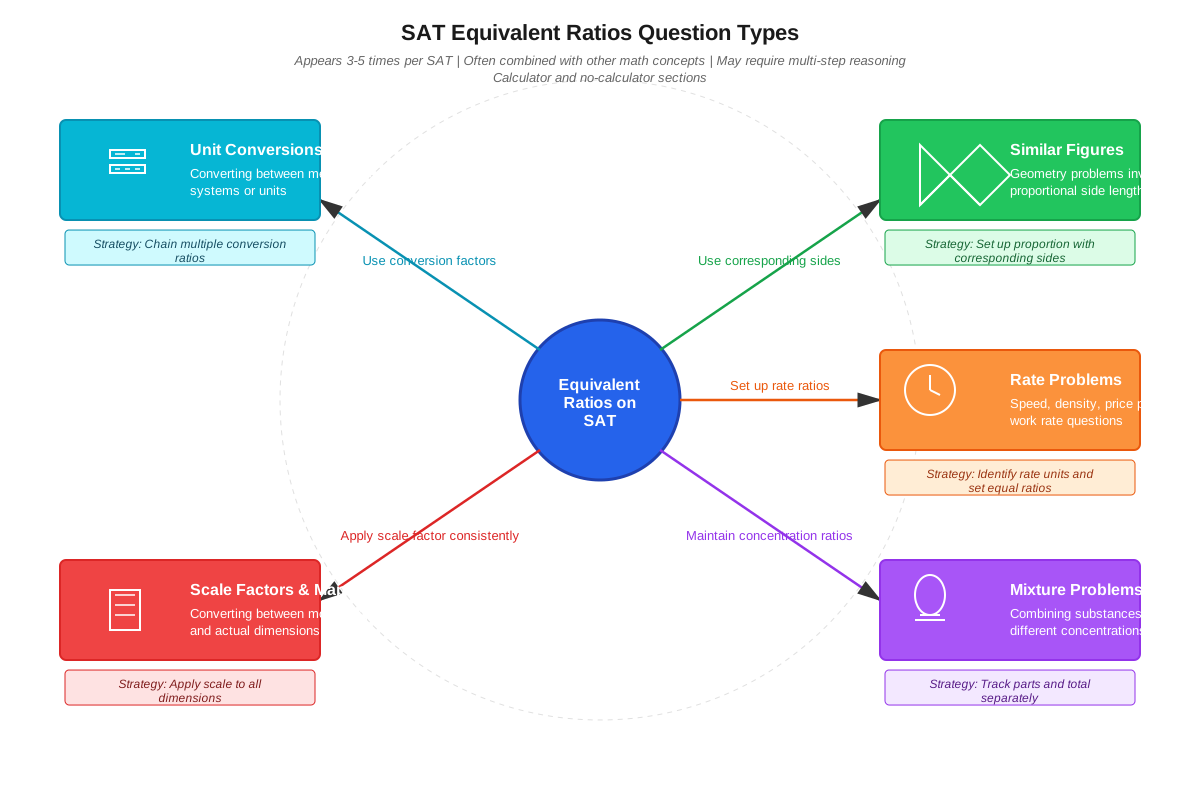
On the SAT, equivalent ratios questions appear with remarkable frequency—typically 3-5 questions per test across both math sections. These questions carry significant weight because they often appear as medium-to-hard difficulty problems worth the same points as easier questions, making them high-value targets for score improvement. The College Board tests equivalent ratios through multiple question formats: direct proportion word problems, table interpretation requiring ratio recognition, geometry problems involving similar figures, and multi-step problems combining ratios with other concepts.
Common SAT manifestations include: comparing quantities in different units (miles per hour vs. feet per second), determining unknown values in proportional relationships, scaling recipes or mixtures, interpreting scale drawings, analyzing survey data with consistent proportions, and solving problems involving similar triangles or other geometric figures. The topic frequently appears in context-rich word problems that require students to extract the relevant ratio relationship from descriptive text before performing calculations.
Core Concepts
Definition of Equivalent Ratios
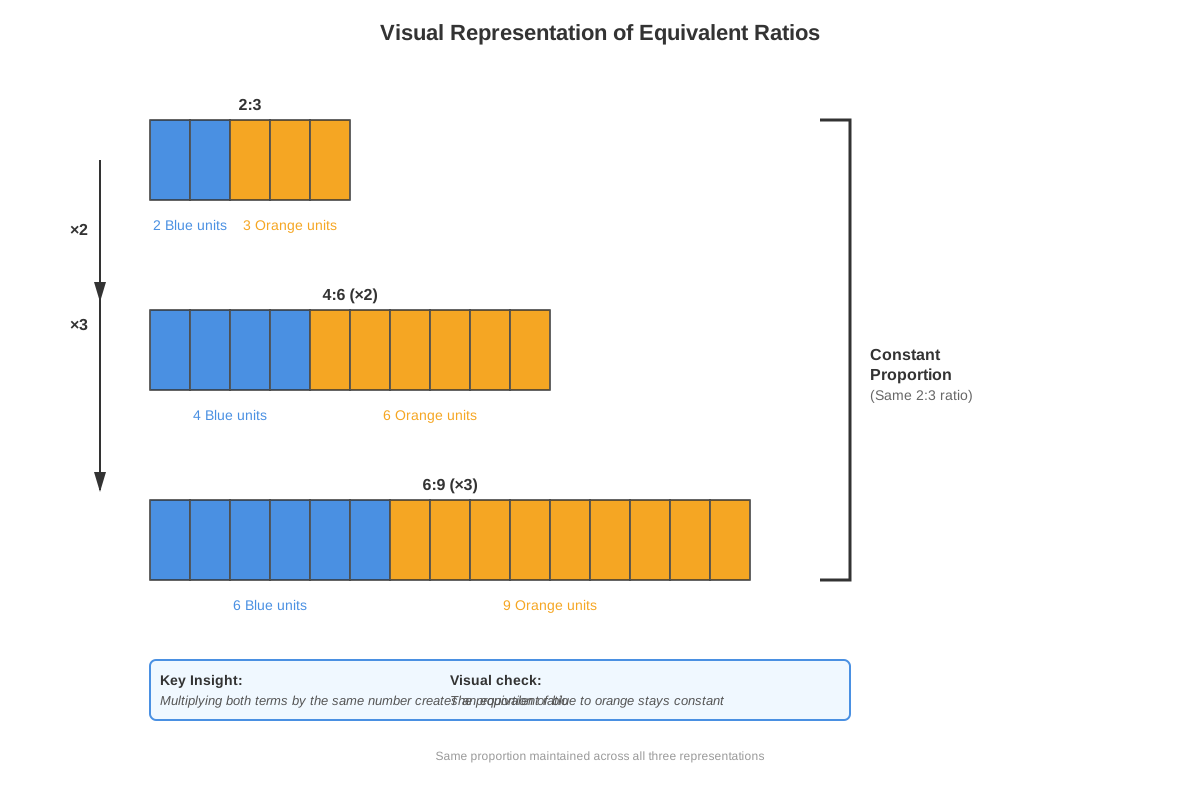
Equivalent ratios are two or more ratios that express the same relationship between quantities, even though the numbers themselves differ. Just as 1/2 = 2/4 = 3/6 represents equivalent fractions, the ratios 1:2, 2:4, and 3:6 are equivalent because they maintain the same proportional relationship. Mathematically, two ratios a:b and c:d are equivalent when a/b = c/d, or equivalently, when ad = bc (the cross-products are equal).
The fundamental principle underlying equivalent ratios is scaling: multiplying or dividing both terms of a ratio by the same non-zero number produces an equivalent ratio. For example, starting with the ratio 3:5, multiplying both terms by 2 yields 6:10, while dividing both terms by 1 maintains 3:5. This scaling property mirrors the fundamental property of fractions and forms the basis for all proportion-solving techniques.
Ratio Notation and Formats
Ratios can be expressed in multiple equivalent formats, and SAT questions may use any of these interchangeably:
| Format | Example | Interpretation |
|---|---|---|
| Colon notation | 3:4 | 3 to 4 |
| Fraction notation | 3/4 | 3 per 4 |
| Word form | "3 to 4" | 3 compared to 4 |
| Decimal | 0.75 | 3 divided by 4 |
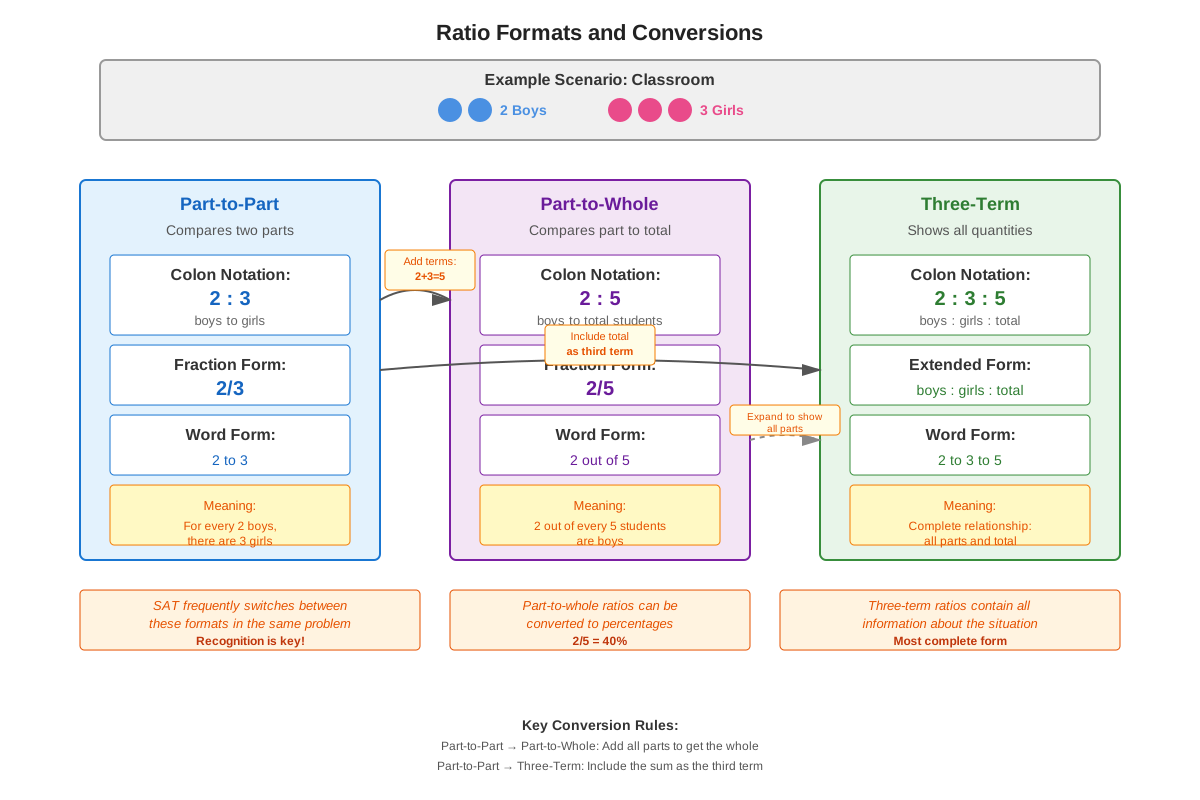
Part-to-part ratios compare one part of a whole to another part (e.g., "the ratio of boys to girls is 3:2"). Part-to-whole ratios compare one part to the entire quantity (e.g., "3 out of 5 students are boys," which is 3:5). Understanding the distinction is crucial because SAT questions often require converting between these formats.
Three-term ratios express relationships among three quantities simultaneously (e.g., 2:3:5). These can be thought of as two linked ratios: if A:B:C = 2:3:5, then A:B = 2:3 and B:C = 3:5. When working with three-term ratios, all three terms must be scaled by the same factor to maintain equivalence.
Creating Equivalent Ratios
To generate equivalent ratios, apply these systematic methods:
- Multiplication method: Multiply both terms by the same positive number
- Starting ratio: 4:7
- Multiply by 3: (4×3):(7×3) = 12:21
- Multiply by 0.5: (4×0.5):(7×0.5) = 2:3.5
- Division method: Divide both terms by the same positive number (simplifying)
- Starting ratio: 18:24
- Divide by 6: (18÷6):(24÷6) = 3:4
- This produces the simplified form or lowest terms
- Finding a common multiplier: When given one term of an equivalent ratio, determine the scale factor
- If 5:8 is equivalent to 15:x, recognize that 5×3 = 15, so x = 8×3 = 24
Solving Proportions
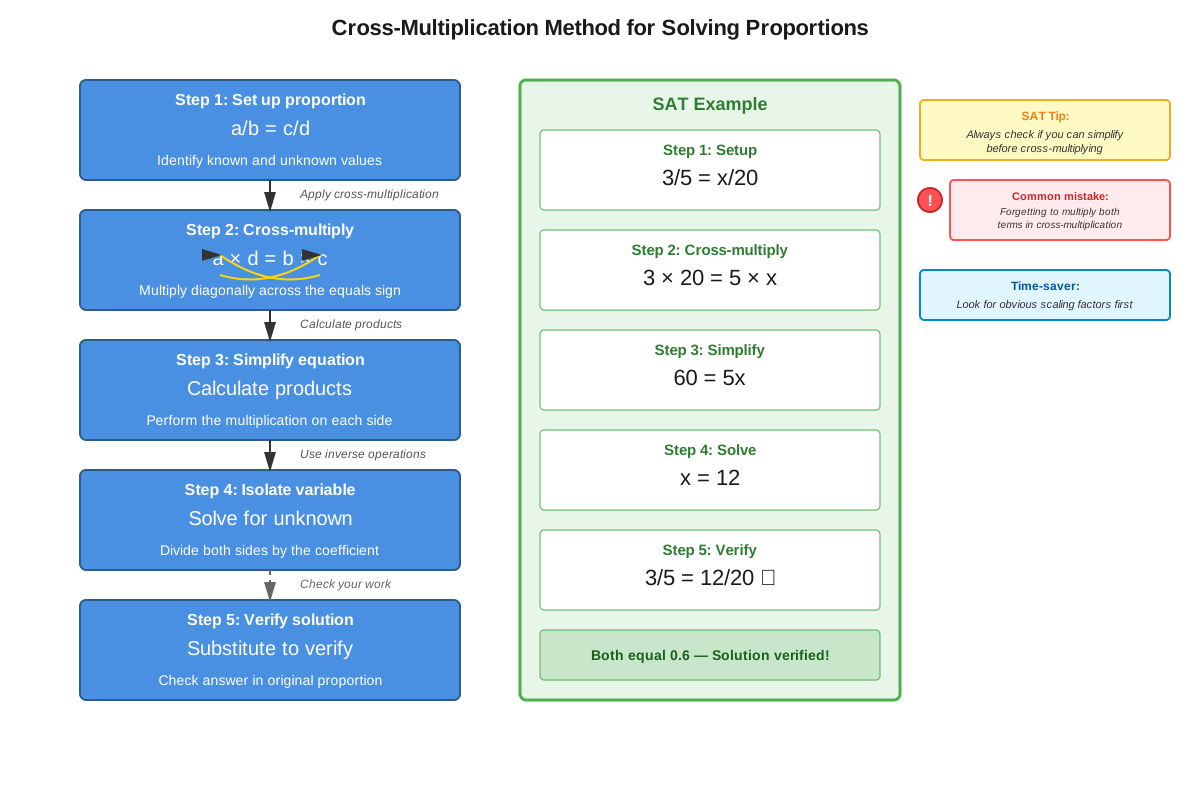
A proportion is an equation stating that two ratios are equivalent: a/b = c/d. The SAT frequently requires solving proportions to find unknown values. The most reliable method is cross-multiplication:
If a/b = c/d, then ad = bc
Step-by-step process:
- Set up the proportion with the unknown variable
- Cross-multiply to create an equation
- Solve for the variable using algebraic techniques
- Check your answer by verifying the ratios are equivalent
Example: If 3/7 = x/21, cross-multiply to get 3(21) = 7x, which gives 63 = 7x, so x = 9.
Unit Rates and Scaling
A unit rate is a ratio with a denominator of 1, expressing "per one unit" (e.g., 60 miles per 1 hour). Converting to unit rates often simplifies comparison and calculation. To find a unit rate, divide the numerator by the denominator.
Scaling problems involve using equivalent ratios to find quantities in proportional situations. If a recipe for 4 servings requires 3 cups of flour, how much flour is needed for 10 servings? Set up the proportion: 3/4 = x/10, then solve: 4x = 30, so x = 7.5 cups.
Recognizing Proportional Relationships
Two quantities are in a proportional relationship if their ratio remains constant. On the SAT, this appears in:
- Tables: Check if the ratio of corresponding values remains constant
- Graphs: Proportional relationships graph as straight lines through the origin
- Word problems: Look for phrases like "at the same rate," "proportional to," or "varies directly with"
To verify proportionality in a table, calculate the ratio for each pair of values. If all ratios simplify to the same value, the relationship is proportional.
Concept Relationships
The concepts within equivalent ratios form an interconnected web of proportional reasoning. Ratio notation serves as the foundation, providing the language for expressing relationships. This leads directly to equivalent ratios, which are created through scaling (multiplication or division). When two equivalent ratios are set equal, they form a proportion, which can be solved using cross-multiplication. Unit rates represent a special case of equivalent ratios where one term equals 1, simplifying comparison and calculation.
The connection to prerequisite knowledge is direct: equivalent ratios extend the concept of equivalent fractions from pure numbers to real-world quantities. The algebraic manipulation skills developed in basic algebra enable solving proportions for unknown values. Multiplication and division fluency makes scaling ratios efficient and accurate.
Looking forward, equivalent ratios connect to numerous advanced topics: percentages (ratios with denominator 100), probability (ratios of favorable to total outcomes), slope (ratio of vertical to horizontal change), similar figures (corresponding sides in constant ratio), trigonometric ratios (sine, cosine, tangent), and direct variation (y/x = k). Mastering equivalent ratios provides the proportional reasoning foundation essential for these higher-level concepts.
Relationship map: Ratio notation → Equivalent ratios (via scaling) → Proportions → Cross-multiplication → Solving for unknowns → Applications (unit rates, scaling, similar figures) → Advanced topics (percentages, slope, variation)
High-Yield Facts
⭐ Two ratios a:b and c:d are equivalent if and only if a/b = c/d or ad = bc (cross-products equal)
⭐ Multiplying or dividing both terms of a ratio by the same non-zero number creates an equivalent ratio
⭐ To solve a proportion a/b = c/d, cross-multiply to get ad = bc, then solve for the unknown
⭐ A unit rate has a denominator of 1 and is found by dividing the numerator by the denominator
⭐ In a proportional relationship, the ratio between corresponding values remains constant
- Part-to-part ratios compare two parts; part-to-whole ratios compare one part to the total
- Three-term ratios (a:b:c) must be scaled by multiplying all three terms by the same factor
- The simplified form of a ratio is found by dividing both terms by their greatest common factor
- Equivalent ratios can be expressed as fractions, decimals, or percentages interchangeably
- When comparing ratios, convert them to the same format (usually fractions or decimals)
- Scale factors in similar figures represent the ratio of corresponding linear measurements
- Ratios can involve more than two quantities but must maintain consistent relationships
- Zero cannot appear as the second term in a ratio (division by zero is undefined)
Quick check — test yourself on Equivalent ratios so far.
Try Flashcards →Common Misconceptions
Misconception: Adding the same number to both terms of a ratio creates an equivalent ratio → Correction: Only multiplication or division by the same non-zero number preserves equivalence. Adding 2 to both terms of 3:4 gives 5:6, which is NOT equivalent (3/4 ≠ 5/6). The proportional relationship changes when adding or subtracting.
Misconception: The ratio 3:4 means there are exactly 3 and 4 items → Correction: The ratio 3:4 means the quantities are in the proportion 3 to 4, but actual amounts could be 6 and 8, or 30 and 40, or any equivalent ratio. The ratio describes the relationship, not necessarily the exact quantities.
Misconception: Part-to-part and part-to-whole ratios are interchangeable → Correction: These represent different relationships. If boys to girls is 3:2 (part-to-part), then boys to total students is 3:5 (part-to-whole), not 3:2. Always identify which type the problem requires.
Misconception: In the proportion a/b = c/d, cross-multiplication gives ab = cd → Correction: Cross-multiplication multiplies diagonally: ad = bc, not straight across. This is one of the most common algebraic errors in proportion problems.
Misconception: Ratios must always be expressed as whole numbers → Correction: While simplified ratios often use whole numbers, ratios can involve fractions, decimals, or mixed numbers. The ratio 1.5:2 is perfectly valid and equivalent to 3:4.
Misconception: Doubling one quantity in a ratio doubles the other quantity → Correction: This is only true if you're maintaining the same ratio. If the original ratio is 3:4 and you double the first term to 6, the second term must become 8 (not 4) to maintain equivalence.
Worked Examples
Example 1: Multi-Step Scaling Problem
Problem: A recipe for 6 servings requires 2.5 cups of flour and 1.5 cups of sugar. How many cups of flour are needed to make 15 servings, and what is the ratio of flour to sugar in the scaled recipe?
Solution:
Step 1: Identify the scaling factor
- Original servings: 6
- Desired servings: 15
- Scale factor: 15 ÷ 6 = 2.5
Step 2: Scale the flour amount
- Original flour: 2.5 cups
- Scaled flour: 2.5 × 2.5 = 6.25 cups
Step 3: Find the flour-to-sugar ratio
- The ratio remains constant regardless of scaling
- Original ratio: 2.5:1.5
- Simplify by dividing both terms by 0.5: (2.5÷0.5):(1.5÷0.5) = 5:3
Step 4: Verify using the scaled amounts
- Scaled flour: 6.25 cups
- Scaled sugar: 1.5 × 2.5 = 3.75 cups
- Ratio: 6.25:3.75 = (6.25÷1.25):(3.75÷1.25) = 5:3 ✓
Answer: 6.25 cups of flour are needed, and the flour-to-sugar ratio is 5:3.
Connection to learning objectives: This problem requires applying equivalent ratios to a real-world scaling scenario, identifying that the ratio remains constant, and converting between different ratio formats.
Example 2: Proportion with Unknown in Multiple Positions
Problem: In a school, the ratio of teachers to students is 2:35. If there are 140 students, how many teachers are there? If the school wants to maintain the same ratio but increase to 18 teachers, how many students would be needed?
Solution:
Part A: Finding number of teachers
Step 1: Set up the proportion
- Let t = number of teachers
- Teachers:Students = 2:35 = t:140
- As a proportion: 2/35 = t/140
Step 2: Cross-multiply
- 2(140) = 35t
- 280 = 35t
Step 3: Solve for t
- t = 280 ÷ 35 = 8 teachers
Part B: Finding number of students for 18 teachers
Step 1: Set up the proportion
- Let s = number of students
- Teachers:Students = 2:35 = 18:s
- As a proportion: 2/35 = 18/s
Step 2: Cross-multiply
- 2s = 35(18)
- 2s = 630
Step 3: Solve for s
- s = 630 ÷ 2 = 315 students
Step 4: Verify the ratio
- 18:315 simplified: divide both by 9 to get 2:35 ✓
Answer: There are currently 8 teachers. To maintain the ratio with 18 teachers, the school would need 315 students.
Connection to learning objectives: This demonstrates solving proportions with unknowns in different positions, applying cross-multiplication systematically, and verifying that calculated values maintain the equivalent ratio.
Exam Strategy
When approaching sat equivalent ratios questions, follow this systematic process:
1. Identify the ratio type: Determine whether the problem involves part-to-part, part-to-whole, or three-term ratios. This affects how you set up your proportion.
2. Extract the given ratio: Carefully read the problem to identify the initial ratio relationship. Watch for trigger phrases like "ratio of A to B," "for every," "per," or "out of."
3. Set up the proportion correctly: Ensure corresponding quantities align vertically or horizontally. If the ratio is teachers:students = 2:35, and you're given teachers = 8, write 2/35 = 8/x, NOT 2/35 = x/8.
4. Choose your solution method: Cross-multiplication works reliably for all proportions, but sometimes scaling is faster. If 3:7 = 9:x, recognizing that 3×3 = 9 means x = 7×3 = 21 is quicker than formal cross-multiplication.
5. Check reasonableness: Before finalizing your answer, verify it makes logical sense. If you're scaling up, the answer should be larger; if simplifying, smaller.
Exam Tip: When time is limited, convert ratios to decimals for quick comparison. The ratio 7:12 ≈ 0.583, making it easy to check if 14:24 is equivalent (14÷24 ≈ 0.583 ✓).
Trigger words and phrases to watch for:
- "Proportional to" or "varies directly with" → set up equivalent ratios
- "At the same rate" → the ratio remains constant
- "For every" → indicates a ratio relationship
- "Out of" or "per" → often signals part-to-whole ratios
- "Maintain the ratio" → use equivalent ratios to scale
- "Similar figures" → corresponding sides are in equivalent ratios
Process-of-elimination tips:
- Eliminate answers that don't maintain the proportional relationship when substituted back
- If the problem involves scaling up, eliminate smaller values; if scaling down, eliminate larger values
- Check if answer choices are in simplified form when the question asks for a ratio
- For multiple-choice questions asking "which ratio is equivalent," cross-multiply each option rather than simplifying all ratios
Time allocation: Most equivalent ratio problems should take 1-2 minutes. If you're spending more than 2 minutes, you may be overcomplicating the setup. Mark it, move on, and return if time permits. The mechanical calculation should be quick—most time should go to correctly interpreting the problem and setting up the proportion.
Memory Techniques
CROSS mnemonic for proportion solving:
- Carefully identify the ratio relationship
- Rearrange into fraction form (a/b = c/d)
- Opposite corners multiply (cross-multiply: ad = bc)
- Solve the resulting equation
- Substitute back to verify
"Same Scaling" rule: Visualize a balance scale—whatever you do to one side (multiply or divide), you must do to the other to keep it balanced. This reinforces that both terms must be scaled identically.
Part-to-Part vs. Part-to-Whole visualization: Draw a simple pie chart mentally. If the ratio of shaded to unshaded is 2:3 (part-to-part), the shaded portion to the whole pie is 2:5 (part-to-whole). The parts (2+3) always sum to the whole (5).
"Diagonal Multiplication" for cross-products: When you see a/b = c/d, visualize drawing an X through the equation. The X shows you which terms to multiply: top-left with bottom-right (ad) equals top-right with bottom-left (bc).
Three-term ratio trick: For ratios like A:B:C = 2:3:5, remember "All Together" = 2+3+5 = 10 total parts. This helps convert to part-to-whole ratios quickly. A is 2/10 of the total, B is 3/10, C is 5/10.
Unit rate shortcut: "Per ONE" → divide to get the rate for a single unit. This creates a benchmark for all comparisons.
Summary
Equivalent ratios represent the same proportional relationship between quantities expressed with different numbers, created by multiplying or dividing both terms by the same non-zero value. This fundamental concept appears extensively on the SAT through proportion problems, scaling scenarios, unit rate calculations, and applications involving similar figures or real-world contexts. Students must master multiple ratio formats (colon notation, fractions, word form), distinguish between part-to-part and part-to-whole ratios, and solve proportions using cross-multiplication (if a/b = c/d, then ad = bc). The key to success lies in correctly identifying the ratio relationship from word problems, setting up proportions with corresponding quantities properly aligned, and systematically solving for unknown values. Equivalent ratios connect to broader mathematical concepts including fractions, percentages, linear relationships, and geometric similarity, making this topic a high-yield investment for SAT preparation. Mastery requires both conceptual understanding of proportional relationships and procedural fluency with scaling and proportion-solving techniques.
Key Takeaways
- Equivalent ratios maintain the same proportional relationship; create them by multiplying or dividing both terms by the same non-zero number
- Two ratios a:b and c:d are equivalent when a/b = c/d or when cross-products are equal (ad = bc)
- Cross-multiplication is the most reliable method for solving proportions: set up a/b = c/d, then solve ad = bc
- Part-to-part ratios compare two components; part-to-whole ratios compare one component to the total—these are different relationships
- Unit rates (denominator of 1) simplify comparisons and calculations in rate problems
- Always verify your answer maintains the original proportional relationship by checking that the ratios simplify to the same value
- SAT questions test equivalent ratios through scaling problems, similar figures, unit conversions, and multi-step word problems requiring proportional reasoning
Related Topics
Percentages: Percentages are ratios with a denominator of 100, making them a special case of equivalent ratios. Mastering equivalent ratios provides the foundation for percentage calculations, conversions, and percent change problems.
Direct and Inverse Variation: Direct variation (y = kx) represents a proportional relationship where the ratio y/x remains constant—a direct application of equivalent ratios. Understanding this connection enables solving variation problems efficiently.
Similar Figures and Scale Factors: In geometry, similar figures have corresponding sides in equivalent ratios. The scale factor represents this constant ratio, connecting equivalent ratios to geometric applications.
Slope and Rate of Change: Slope (rise/run) is fundamentally a ratio, and equivalent slopes represent the same rate of change. This connects algebraic and geometric representations of proportional relationships.
Probability Ratios: Probability can be expressed as the ratio of favorable outcomes to total outcomes, requiring the same proportional reasoning developed through equivalent ratios.
Practice CTA
Now that you've mastered the core concepts of equivalent ratios, it's time to solidify your understanding through active practice. Work through the practice questions to apply these techniques to SAT-style problems, and use the flashcards to reinforce key definitions and procedures. Remember, proportional reasoning is a skill that improves dramatically with deliberate practice—each problem you solve strengthens your pattern recognition and computational fluency. The investment you make now in mastering equivalent ratios will pay dividends across multiple SAT math topics. You've got this!
Sign up free to keep reading
Create a free AnvayaPrep account to finish this SAT guide on Equivalent ratios — plus flashcards and practice questions.