Overview
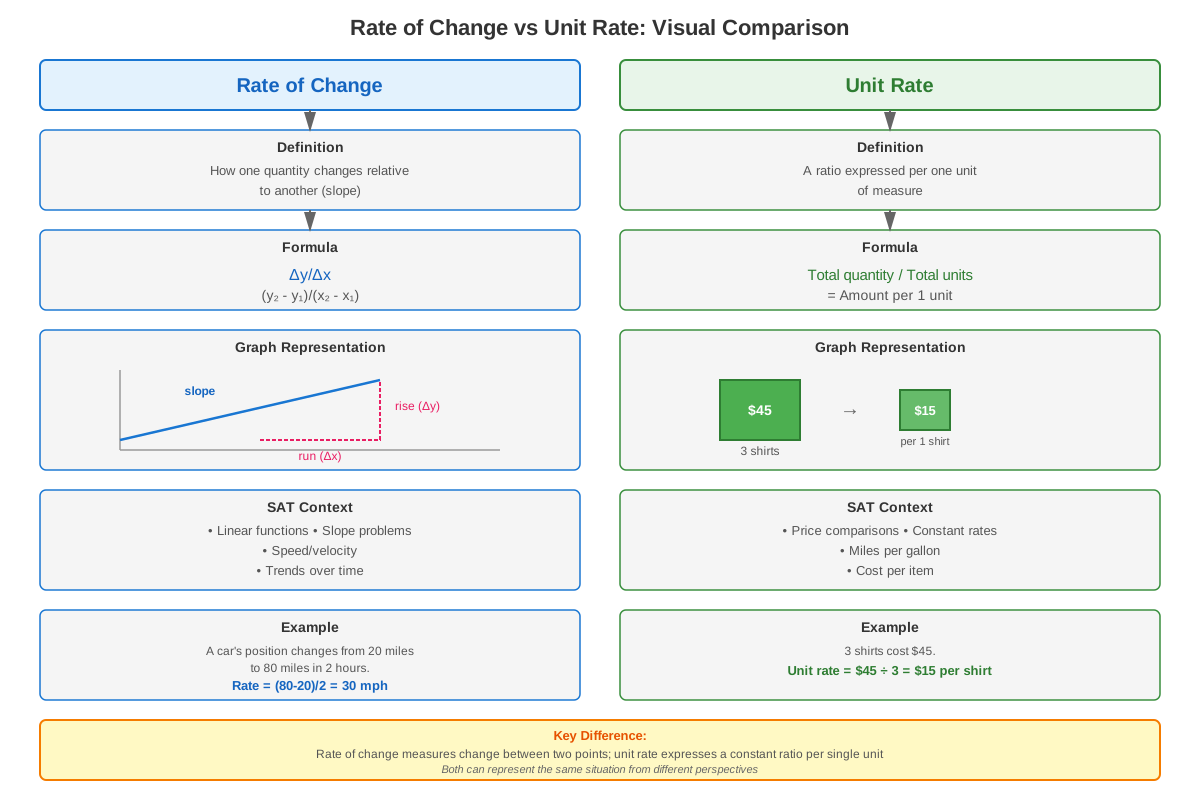
Understanding the distinction between rate of change and unit rate is fundamental to success on the SAT Math section. While these concepts may seem similar at first glance, they serve different purposes and appear in distinct question types throughout the exam. A rate of change describes how one quantity changes in relation to another quantity—often representing the slope of a line or the speed at which something increases or decreases. In contrast, a unit rate expresses a ratio as a quantity per one unit of another measure, such as miles per hour or dollars per item. Both concepts fall under the broader umbrella of ratios, rates, and proportions, making them essential tools for solving a wide variety of SAT problems.
The SAT frequently tests these concepts in multiple contexts: linear equations, word problems, data interpretation, and real-world scenarios. Questions may ask students to calculate the rate at which a car travels, determine the slope of a line representing a relationship between variables, or compare different rates to make decisions. Understanding when to apply rate of change versus unit rate—and recognizing that they can sometimes overlap—is crucial for avoiding common traps and selecting correct answers efficiently.
Mastery of sat rate of change vs unit rate concepts connects directly to other critical math topics including linear functions, proportional relationships, and algebraic problem-solving. These skills form the foundation for more advanced topics like systems of equations and function analysis, making this a high-yield area that deserves focused attention during SAT preparation.
Learning Objectives
- [ ] Identify key features of rate of change vs unit rate
- [ ] Explain how rate of change vs unit rate appears on the SAT
- [ ] Apply rate of change vs unit rate to answer SAT-style questions
- [ ] Distinguish between rate of change and unit rate in various mathematical contexts
- [ ] Calculate both rate of change and unit rate from tables, graphs, and word problems
- [ ] Convert between different representations of rates (verbal, numerical, graphical, algebraic)
Prerequisites
- Basic ratio and proportion concepts: Understanding how to set up and solve proportions is essential for working with rates
- Coordinate plane and graphing: Rate of change often appears as slope, requiring familiarity with plotting points and reading graphs
- Linear equations in slope-intercept form: The rate of change is the coefficient of x in y = mx + b
- Unit conversion: Many rate problems require converting between units (hours to minutes, feet to miles, etc.)
- Basic algebraic manipulation: Solving for variables and rearranging equations is necessary for rate calculations
Why This Topic Matters
In real-world applications, rates govern countless decisions and calculations. Unit rates help consumers compare prices (which is the better deal: 3 pounds for $6 or 5 pounds for $9?), while rates of change help analysts predict trends, engineers design systems, and scientists model phenomena. From calculating fuel efficiency to understanding population growth, these concepts appear throughout professional and personal life.
On the SAT, rate and rate of change questions appear with high frequency—typically 3-5 questions per test across both the calculator and no-calculator sections. These questions often appear as:
- Word problems requiring rate calculations
- Linear function questions asking for slope interpretation
- Data analysis problems with tables or graphs
- Multi-step problems combining rates with other algebraic concepts
- Real-world scenario questions requiring rate comparisons
The College Board consistently includes rate problems because they assess multiple skills simultaneously: reading comprehension, algebraic reasoning, unit analysis, and practical problem-solving. Questions may be straightforward calculations or complex multi-step problems that require identifying which type of rate applies to the situation.
Core Concepts
Understanding Unit Rate
A unit rate expresses a ratio as a quantity per single unit of another measure. The key characteristic is that the denominator equals 1. Common examples include:
- 60 miles per 1 hour (60 mph)
- $3.50 per 1 pound
- 25 students per 1 teacher
To calculate a unit rate, divide the first quantity by the second quantity:
Unit Rate = Total Quantity / Number of UnitsFor example, if a car travels 240 miles using 8 gallons of gas, the unit rate (fuel efficiency) is:
240 miles ÷ 8 gallons = 30 miles per gallon
Unit rates are particularly useful for comparison. When presented with multiple options, converting each to a unit rate allows for direct comparison. If Store A sells 3 apples for $2.40 and Store B sells 5 apples for $3.75, converting to unit rates reveals:
- Store A: $2.40 ÷ 3 = $0.80 per apple
- Store B: $3.75 ÷ 5 = $0.75 per apple
Store B offers the better deal.
Understanding Rate of Change
Rate of change describes how one variable changes with respect to another variable. In mathematical terms, it represents the ratio of the change in the output (dependent variable) to the change in the input (independent variable). The most common representation is slope in linear relationships:
Rate of Change = Change in y / Change in x = Δy / Δx = (y₂ - y₁) / (x₂ - x₁)Rate of change can be:
- Positive: The dependent variable increases as the independent variable increases
- Negative: The dependent variable decreases as the independent variable increases
- Zero: The dependent variable remains constant regardless of changes in the independent variable
- Undefined: Occurs with vertical lines where x doesn't change
In the equation y = mx + b, the coefficient m represents the rate of change. For example, in y = 3x + 5, the rate of change is 3, meaning y increases by 3 units for every 1-unit increase in x.
Key Differences and Similarities
| Aspect | Unit Rate | Rate of Change |
|---|---|---|
| Definition | Ratio expressed per one unit | How one quantity changes relative to another |
| Denominator | Always equals 1 | Can be any value (often simplified) |
| Context | Comparison, pricing, efficiency | Slope, trends, growth/decay |
| Representation | Usually a single number with units | Can be slope, derivative, or difference quotient |
| SAT Appearance | Word problems, real-world scenarios | Linear equations, graphs, tables |
| Example | 55 miles per hour | Temperature increases 3° per hour |
Important overlap: A unit rate CAN be a rate of change when describing how something changes per unit of time or another measure. For example, "the temperature increases at 2 degrees per hour" is both a unit rate (per 1 hour) and a rate of change (describing how temperature changes over time).
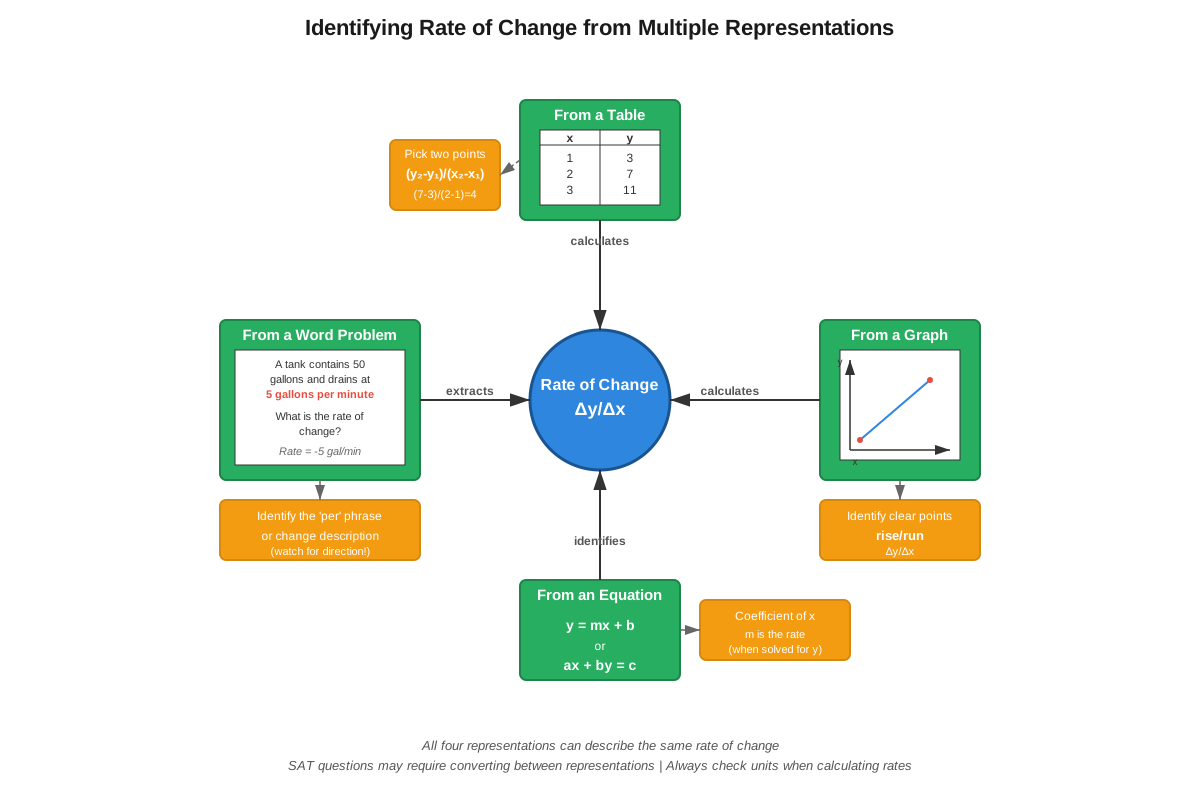
Calculating from Different Representations
From a table:
- Identify two points (x₁, y₁) and (x₂, y₂)
- Calculate the change in y: y₂ - y₁
- Calculate the change in x: x₂ - x₁
- Divide: (y₂ - y₁) / (x₂ - x₁)
From a graph:
- Select two clear points on the line
- Count the vertical change (rise)
- Count the horizontal change (run)
- Calculate rise/run
From a word problem:
- Identify the two quantities being compared
- Determine which is the independent variable (usually time or quantity purchased)
- Set up the ratio: dependent quantity / independent quantity
- Simplify to get the rate
Interpreting Rate in Context
The SAT emphasizes interpretation, not just calculation. Students must understand what a rate means in the context of a problem. If a line has a slope of -5 in a graph showing account balance over time, this means the account decreases by $5 per unit of time. If a unit rate is 0.25 pounds per dollar, this means each dollar purchases 0.25 pounds of the item.
Pay attention to units throughout calculations. The units of a rate of change are always "units of y per units of x." Maintaining proper units helps verify that calculations are correct and interpretations are meaningful.
Concept Relationships
The relationship between unit rate and rate of change forms a hierarchical structure where rate of change is the broader concept, and unit rate is a specific application. Both concepts stem from the fundamental idea of ratios—comparing two quantities.
Conceptual flow:
Ratios → Rates (ratios with different units) → Unit Rate (rate per 1 unit) and Rate of Change (how quantities vary together)
Rate of change connects directly to slope in coordinate geometry. When working with linear functions, the rate of change IS the slope. This connection extends to the slope-intercept form (y = mx + b) where m represents the constant rate of change.
Unit rate connects to proportional relationships and direct variation. When a relationship is proportional (y = kx), the constant k represents both the unit rate and the rate of change. This dual nature makes proportional relationships particularly important on the SAT.
Both concepts connect to problem-solving strategies involving:
- Setting up equations from word problems
- Analyzing data in tables and graphs
- Making predictions and comparisons
- Converting between units
The distinction becomes critical when dealing with non-linear relationships. Unit rates remain useful for specific comparisons, but rate of change becomes variable (requiring calculus concepts beyond the SAT scope, though the SAT may ask about average rate of change over an interval).
High-Yield Facts
⭐ Unit rate always has a denominator of 1 (e.g., 50 miles per 1 hour, not 100 miles per 2 hours)
⭐ Rate of change in a linear equation y = mx + b is the coefficient m (the slope)
⭐ To find rate of change from two points, use (y₂ - y₁)/(x₂ - x₁)
⭐ A positive rate of change means the dependent variable increases as the independent variable increases
⭐ Unit rates are essential for comparing different options (which deal is better, which is more efficient)
- Rate of change can be negative, positive, zero, or undefined depending on the relationship
- The units of a rate are always "units of numerator per units of denominator"
- In real-world problems, time is typically the independent variable (x-axis or denominator)
- A horizontal line has a rate of change of zero (no change in y as x changes)
- A vertical line has an undefined rate of change (x doesn't change while y does)
- Average rate of change over an interval uses the same formula as slope between two points
- Speed and velocity are unit rates (distance per unit time)
- In proportional relationships, the unit rate equals the rate of change equals the constant of proportionality
Quick check — test yourself on Rate of change vs unit rate so far.
Try Flashcards →Common Misconceptions
Misconception: Unit rate and rate of change are completely different concepts with no overlap.
Correction: While distinct, they can overlap. A unit rate describing change over time (like 60 miles per hour) is also a rate of change. The key difference is that unit rate emphasizes the "per one unit" aspect, while rate of change emphasizes how quantities vary together.
Misconception: Rate of change is always positive.
Correction: Rate of change can be positive (increasing), negative (decreasing), zero (constant), or undefined (vertical line). The sign indicates the direction of change, which is crucial for interpretation.
Misconception: To find unit rate, always divide the larger number by the smaller number.
Correction: Unit rate requires dividing the quantity you want to express by the number of units. If you want price per item, divide total price by number of items, regardless of which number is larger.
Misconception: The rate of change between any two points on a curve is the same as the slope of a line connecting those points.
Correction: For linear relationships, this is true. For non-linear relationships, the slope between two points gives the average rate of change over that interval, not the instantaneous rate of change at any specific point.
Misconception: Units don't matter when calculating rates.
Correction: Units are essential for both calculation accuracy and interpretation. The units of your answer tell you what the rate means. Forgetting to include or convert units is a common source of errors on the SAT.
Misconception: A steeper line always means a better rate.
Correction: Whether a steeper slope is "better" depends on context. A steeper positive slope in a profit graph is good, but a steeper negative slope in a cost graph is bad. Always interpret slope in the context of the problem.
Worked Examples
Example 1: Distinguishing Unit Rate from Rate of Change
Problem: A water tank contains 500 gallons of water. Water drains from the tank at a constant rate. After 4 hours, the tank contains 380 gallons.
a) What is the unit rate of water drainage?
b) What is the rate of change of the water level?
c) Write an equation representing the amount of water W in the tank after t hours.
Solution:
a) Finding the unit rate:
- Water drained = 500 - 380 = 120 gallons
- Time elapsed = 4 hours
- Unit rate = 120 gallons ÷ 4 hours = 30 gallons per hour
The tank drains at 30 gallons per hour.
b) Finding the rate of change:
- The water level is decreasing, so the rate of change is negative
- Change in water = 380 - 500 = -120 gallons
- Change in time = 4 - 0 = 4 hours
- Rate of change = -120/4 = -30 gallons per hour
The rate of change is -30 gallons per hour (negative because the amount is decreasing).
c) Writing the equation:
- Initial amount (y-intercept): 500 gallons
- Rate of change (slope): -30 gallons per hour
- Using y = mx + b format: W = -30t + 500
Connection to learning objectives: This problem demonstrates how unit rate and rate of change can represent the same physical situation but with different emphases. The unit rate (30 gallons per hour) describes the drainage speed, while the rate of change (-30 gallons per hour) describes how the water amount changes over time. The negative sign in the rate of change is crucial for correctly modeling the situation.
Example 2: Comparing Rates to Make Decisions
Problem: Sarah is comparing two job offers:
- Job A: $2,400 for 3 weeks of work
- Job B: $3,500 for 4 weeks of work
Additionally, Job A offers a $200 signing bonus, while Job B offers a $150 signing bonus.
a) Which job has the better weekly pay rate?
b) If Sarah can only work for 5 weeks total this summer, which job would earn her more money?
Solution:
a) Calculating unit rates (weekly pay):
- Job A unit rate: $2,400 ÷ 3 weeks = $800 per week
- Job B unit rate: $3,500 ÷ 4 weeks = $875 per week
Job B has the better weekly pay rate at $875 per week compared to Job A's $800 per week.
b) Calculating total earnings for 5 weeks:
- Job A: ($800 per week × 5 weeks) + $200 bonus = $4,000 + $200 = $4,200
- Job B: ($875 per week × 5 weeks) + $150 bonus = $4,375 + $150 = $4,525
Job B would earn Sarah more money: $4,525 compared to $4,200 from Job A.
Alternative approach using equations:
Let w = number of weeks worked
- Job A total: T_A = 800w + 200
- Job B total: T_B = 875w + 150
At w = 5:
- T_A = 800(5) + 200 = 4,200
- T_B = 875(5) + 150 = 4,525
Connection to learning objectives: This problem shows how unit rates enable comparison and decision-making. The rate of change (slope) in the linear equations represents the weekly pay rate, while the y-intercept represents the signing bonus. This demonstrates the practical application of these concepts in real-world scenarios typical of SAT questions.
Exam Strategy
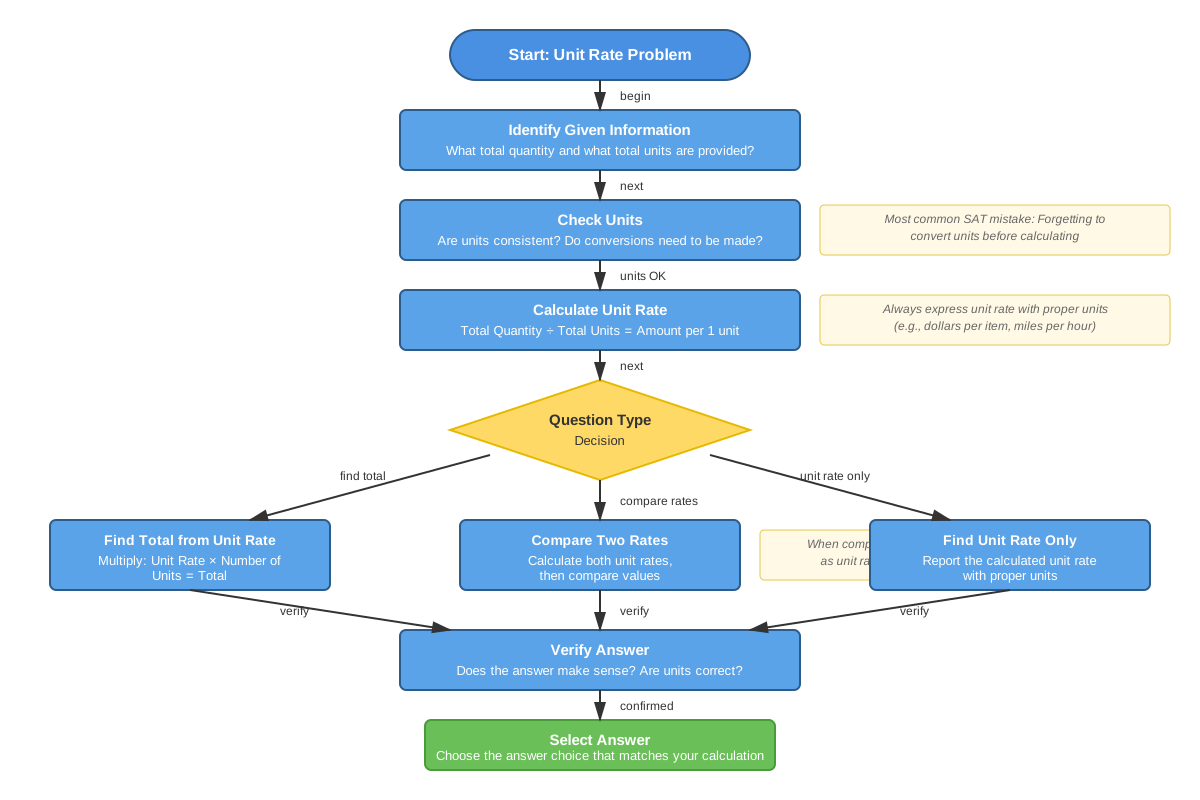
When approaching SAT questions involving rates, follow this systematic process:
Step 1: Identify what type of rate is being asked
- Look for keywords: "per," "each," "every," "rate," "slope," "speed"
- Determine if you need a unit rate (for comparison) or rate of change (for modeling/prediction)
Step 2: Extract the relevant information
- Identify the two quantities being compared
- Determine which is independent (usually time, quantity purchased) and which is dependent
- Note the units for each quantity
Step 3: Set up the calculation correctly
- For unit rate: divide total quantity by number of units
- For rate of change: use (change in y)/(change in x) or identify the slope
Step 4: Check your answer's reasonableness
- Do the units make sense?
- Is the sign (positive/negative) appropriate for the context?
- Does the magnitude seem reasonable?
Exam Tip: If a question asks "which is the better deal" or "which is more efficient," you're dealing with unit rate comparison. Convert all options to the same unit rate format before comparing.
Trigger words and phrases to watch for:
- "Per" → signals a rate (miles per hour, dollars per pound)
- "Each" or "every" → often indicates unit rate
- "Slope" or "rate of change" → explicitly asking for rate of change
- "Increases by" or "decreases by" → describes rate of change
- "At this rate" → asking you to apply a rate to a new situation
- "Which is the better value" → requires unit rate comparison
Process of elimination tips:
- Eliminate answers with incorrect units
- Eliminate answers with the wrong sign (positive when it should be negative, or vice versa)
- If the question involves a decreasing quantity, the rate of change must be negative
- For unit rate comparisons, eliminate options that aren't expressed per single unit
Time allocation:
- Simple unit rate calculations: 30-45 seconds
- Rate of change from a graph or table: 45-60 seconds
- Multi-step word problems involving rates: 90-120 seconds
- Don't spend more than 2 minutes on any single rate problem; if stuck, flag it and return later
Memory Techniques
Mnemonic for Rate of Change Formula: "You Can't Xpect Change" → Y₂ - Y₁ over X₂ - X₁
Visualization for Unit Rate: Picture a single unit (one hour, one pound, one gallon) and ask "how much per THIS ONE thing?" This reinforces that unit rate always has a denominator of 1.
Acronym for Rate Problem Steps: RICE
- Read the problem carefully
- Identify the quantities and their units
- Calculate using the appropriate formula
- Evaluate your answer for reasonableness
Memory aid for slope/rate of change: "Rise over Run" for graphs, but remember it's really "Change in y over Change in x" which works for all representations (tables, graphs, equations).
Sign memory trick: Think of a hill:
- Walking up a hill = positive rate of change
- Walking down a hill = negative rate of change
- Walking on flat ground = zero rate of change
Unit Rate comparison trick: Convert everything to "price per item" or "distance per time" format—whichever makes the numbers easier to compare. Smaller numbers are better for prices, larger numbers are better for efficiency/speed.
Summary
Understanding the distinction between rate of change and unit rate is essential for SAT Math success. A unit rate expresses a ratio per single unit (denominator equals 1), making it ideal for comparisons and real-world decision-making. Rate of change describes how one variable changes relative to another, most commonly appearing as slope in linear relationships. While these concepts are distinct, they can overlap when a unit rate describes change over time or another variable. The SAT tests these concepts through word problems, linear equations, graphs, and tables, requiring students to calculate rates, interpret their meaning in context, and apply them to solve multi-step problems. Mastery requires recognizing which type of rate applies to each situation, performing accurate calculations with proper unit analysis, and interpreting results correctly. The key to success is understanding that both concepts stem from ratios but serve different purposes: unit rates enable comparison, while rates of change enable modeling and prediction.
Key Takeaways
- Unit rate always has a denominator of 1 and is used primarily for comparing options or expressing efficiency
- Rate of change equals slope in linear relationships and can be calculated using (y₂ - y₁)/(x₂ - x₁)
- Pay attention to signs: negative rate of change indicates decreasing relationships, positive indicates increasing
- Units matter critically: always include units in your calculations and verify they make sense in context
- Both concepts appear frequently on the SAT in word problems, graphs, tables, and linear equations
- The overlap occurs when unit rates describe change: "60 miles per hour" is both a unit rate and a rate of change
- Context determines interpretation: a steep slope might be good or bad depending on what the variables represent
Related Topics
Linear Functions and Slope-Intercept Form: Deepens understanding of how rate of change appears as the coefficient m in y = mx + b, connecting algebraic and graphical representations.
Proportional Relationships: Explores situations where the rate of change equals the constant of proportionality, building on the overlap between unit rate and rate of change.
Systems of Linear Equations: Uses rate of change concepts to analyze where two linear relationships intersect, often in real-world contexts involving rates.
Direct and Inverse Variation: Extends rate concepts to relationships where quantities vary directly (y = kx) or inversely (y = k/x), requiring modified rate analysis.
Data Analysis and Scatterplots: Applies rate of change concepts to real data, including finding lines of best fit and interpreting their slopes in context.
Mastering rate of change versus unit rate provides the foundation for all these advanced topics, making it a cornerstone of SAT Math preparation.
Practice CTA
Now that you've thoroughly reviewed rate of change versus unit rate, it's time to solidify your understanding through practice. Attempt the practice questions to test your ability to distinguish between these concepts, calculate rates accurately, and apply them to SAT-style problems. Use the flashcards to reinforce key definitions and formulas until they become automatic. Remember, the SAT rewards both accuracy and speed—practice will help you develop both. Every problem you solve strengthens your pattern recognition and builds confidence for test day. You've got this!
Sign up free to keep reading
Create a free AnvayaPrep account to finish this SAT guide on Rate of change vs unit rate — plus flashcards and practice questions.