Overview
Ratio comparisons form a critical foundation for success on the SAT math section, appearing in approximately 10-15% of all math questions across both calculator and no-calculator portions. This topic extends beyond simple ratio understanding to require students to analyze, compare, and manipulate multiple ratios simultaneously—a skill that distinguishes high scorers from average performers. SAT ratio comparisons questions demand that students recognize relationships between quantities, translate word problems into mathematical expressions, and apply proportional reasoning to solve complex multi-step problems.
The ability to compare ratios effectively connects to numerous other mathematical domains tested on the SAT, including percentages, proportions, rates, algebraic reasoning, and data interpretation. When students master ratio comparisons, they develop a powerful analytical tool that applies to geometry problems involving similar figures, algebra problems involving direct and inverse variation, and data analysis questions requiring interpretation of scaled information. This topic frequently appears in real-world contexts such as recipe scaling, map distances, population density comparisons, and financial calculations—making it both practically relevant and exam-critical.
Understanding ratio comparisons requires moving beyond memorized procedures to develop genuine proportional reasoning skills. The SAT tests this topic through various question formats: multiple-choice problems requiring calculation, grid-in questions demanding precise numerical answers, and complex word problems embedded within real-world scenarios. Students who can fluently compare ratios, convert between different ratio representations, and recognize equivalent ratios gain a significant advantage on test day, as these skills enable faster problem-solving and reduce computational errors.
Learning Objectives
- [ ] Identify key features of ratio comparisons
- [ ] Explain how ratio comparisons appears on the SAT
- [ ] Apply ratio comparisons to answer SAT-style questions
- [ ] Convert ratios between different forms (part-to-part, part-to-whole, fractions, decimals)
- [ ] Determine which of multiple ratios represents the greatest or least value
- [ ] Solve multi-step problems involving ratio comparisons in real-world contexts
- [ ] Recognize and apply equivalent ratios to simplify comparison tasks
- [ ] Analyze ratio relationships within tables, graphs, and word problems
Prerequisites
- Basic ratio understanding: Students must know how to express relationships between quantities as ratios (e.g., 3:4) and understand the difference between part-to-part and part-to-whole ratios, as ratio comparisons build directly on this foundation.
- Fraction operations: Proficiency with comparing, simplifying, and converting fractions is essential because ratios are often expressed as fractions when making comparisons.
- Cross-multiplication: This technique enables efficient comparison of ratios without finding common denominators.
- Proportional reasoning: Understanding that equivalent ratios maintain the same relationship when scaled up or down is fundamental to recognizing when ratios are equal or different.
- Basic algebra: Ability to set up and solve simple equations helps when working with unknown quantities in ratio problems.
Why This Topic Matters
Ratio comparisons represent one of the most practical mathematical skills tested on the SAT, with direct applications to everyday decision-making, scientific reasoning, and professional contexts. In real life, consumers compare unit prices to determine better values, healthcare professionals calculate medication dosages based on body weight ratios, architects scale blueprints, and data analysts interpret comparative statistics. The ability to quickly and accurately compare ratios enables informed decision-making across countless scenarios, from determining which investment offers better returns to understanding population growth rates.
On the SAT, ratio comparison questions appear with remarkable frequency—typically 3-5 questions per test—making this a high-yield topic for focused study. These questions appear in various forms: straightforward computational problems worth quick points, complex word problems requiring multi-step reasoning, and data interpretation questions embedded within tables or graphs. The College Board particularly favors questions that combine ratio comparisons with other topics such as percentages, rates of change, or algebraic expressions, testing students' ability to integrate multiple mathematical concepts simultaneously.
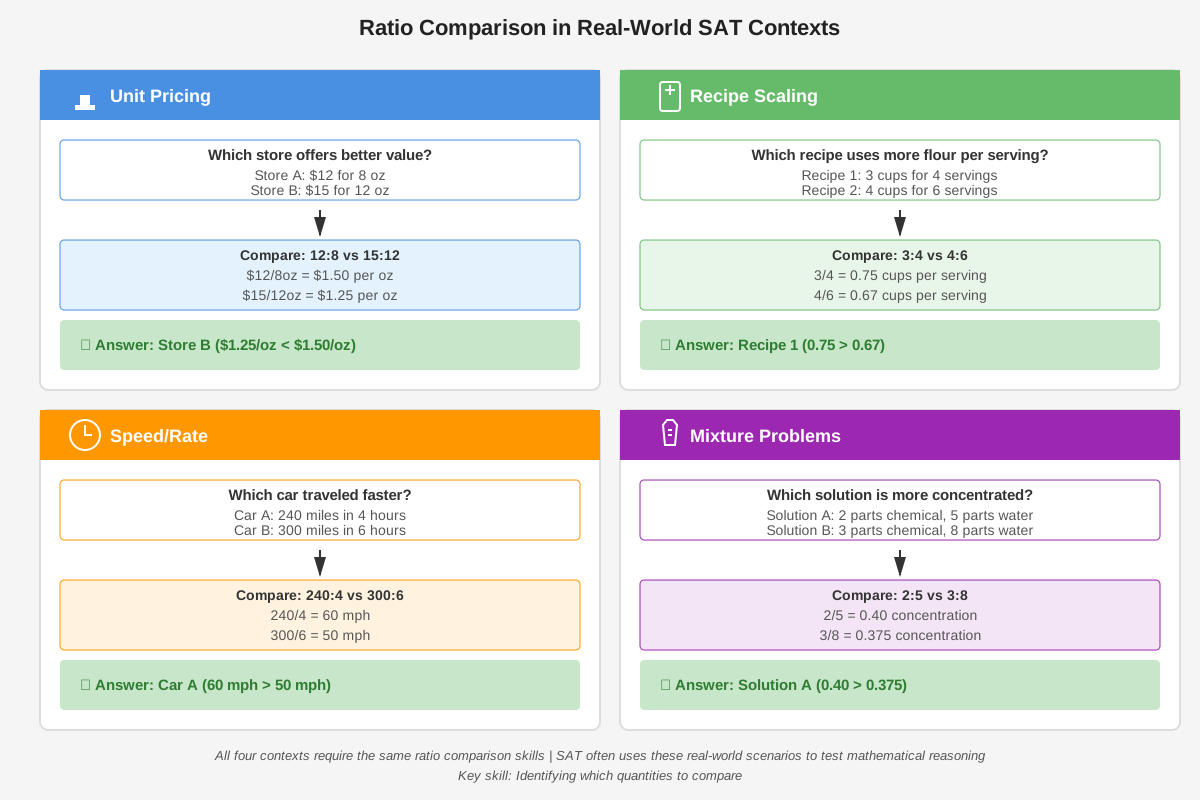
Common SAT question formats include: comparing prices per unit to determine best value, analyzing population densities across different regions, determining which mixture has a higher concentration of a particular ingredient, comparing rates of work or travel, and interpreting scaled representations such as maps or models. Questions often present information in deliberately complex formats—mixing different units, providing excess information, or requiring students to extract ratio information from tables or graphs—to test genuine understanding rather than rote memorization.
Core Concepts
Understanding Ratio Representations
A ratio expresses the relationship between two or more quantities, and effective ratio comparison requires fluency with multiple representation formats. Ratios can be written as "a to b," "a:b," or as the fraction a/b. When comparing ratios, the fractional form often proves most useful because it allows direct application of fraction comparison techniques. For example, the ratio 3:4 can be written as 3/4, which equals 0.75 when converted to decimal form.
The distinction between part-to-part ratios and part-to-whole ratios becomes crucial when making comparisons. A part-to-part ratio compares one component to another (e.g., 2 red marbles to 3 blue marbles, written 2:3), while a part-to-whole ratio compares one component to the total (e.g., 2 red marbles to 5 total marbles, written 2:5). When comparing ratios from different contexts, students must ensure they're comparing the same type of ratio—a common source of errors on the SAT.
Methods for Comparing Ratios
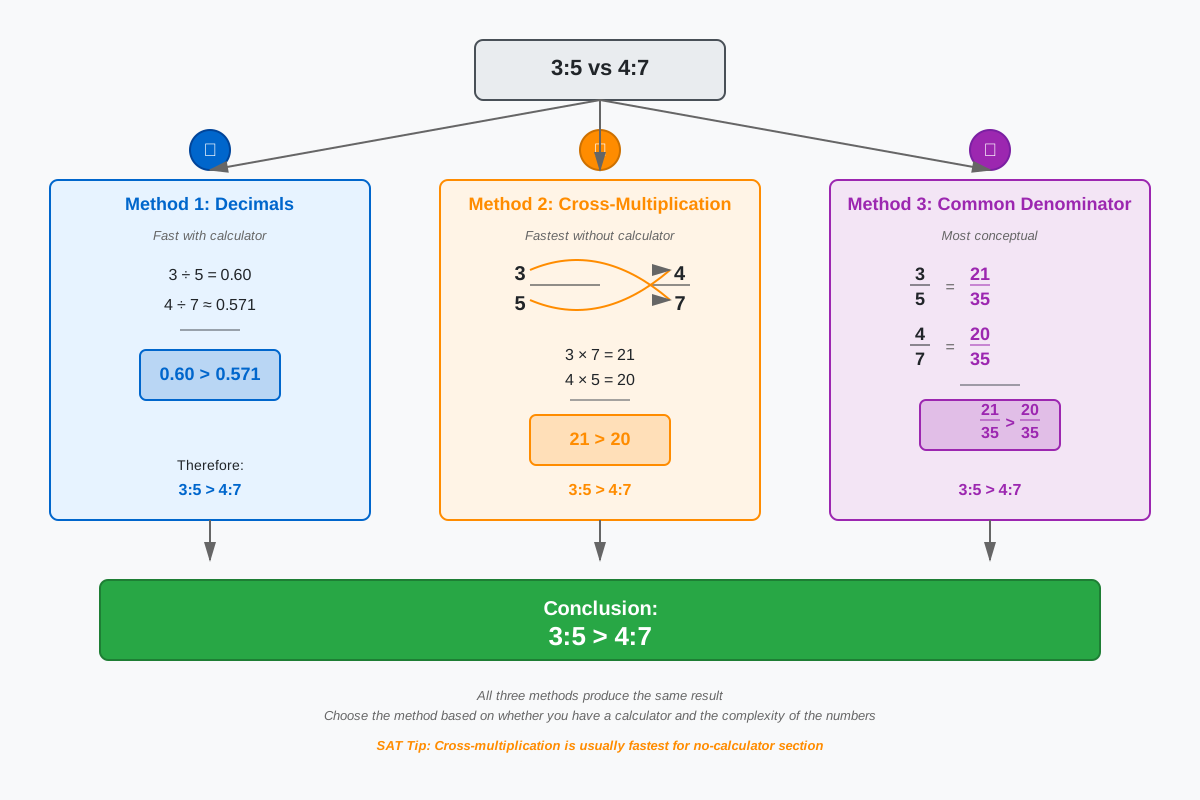
Cross-multiplication provides the most efficient method for comparing two ratios expressed as fractions. To compare a/b and c/d, multiply a × d and b × c. If a × d > b × c, then a/b > c/d. For example, to compare 3/4 and 5/7: calculate 3 × 7 = 21 and 4 × 5 = 20. Since 21 > 20, we know 3/4 > 5/7. This method eliminates the need to find common denominators and reduces calculation time significantly.
Converting to common denominators offers an alternative approach that some students find more intuitive. To compare 2/3 and 3/5, find the least common denominator (15): 2/3 = 10/15 and 3/5 = 9/15. Since 10/15 > 9/15, we conclude 2/3 > 3/5. This method works well when denominators are small or when comparing more than two ratios simultaneously.
Decimal conversion provides another powerful comparison tool, particularly when using a calculator. Converting each ratio to decimal form allows immediate visual comparison. For instance, 7/12 ≈ 0.583 and 4/7 ≈ 0.571, so 7/12 > 4/7. This method proves especially useful when dealing with complex ratios or when the SAT question asks for approximate comparisons.
Unit Rate Comparisons
A unit rate expresses a ratio as a quantity per one unit of another quantity (e.g., miles per hour, price per ounce, students per teacher). SAT questions frequently require students to calculate and compare unit rates to determine which option represents the best value or highest efficiency. To find a unit rate, divide the first quantity by the second quantity.
For example, if Store A sells 3 pounds of apples for $5.97 and Store B sells 5 pounds for $9.45, calculate the unit rates: Store A charges $5.97 ÷ 3 = $1.99 per pound, while Store B charges $9.45 ÷ 5 = $1.89 per pound. Store B offers the better value. The SAT often presents such comparisons with deliberately similar values to test careful calculation.
Scaling and Equivalent Ratios
Equivalent ratios maintain the same relationship between quantities but use different numbers. The ratios 2:3, 4:6, and 8:12 are all equivalent because each can be obtained by multiplying or dividing both terms by the same number. Recognizing equivalent ratios enables students to simplify comparisons and identify when two seemingly different ratios actually represent the same relationship.
When comparing ratios, scaling to a common term often simplifies the process. If comparing 3:5 and 4:7, scale both ratios to have the same first term (12): 3:5 becomes 12:20, and 4:7 becomes 12:21. Now the comparison is straightforward: 12:20 represents a smaller second term relative to the first than 12:21, so 3:5 > 4:7 when comparing the first quantity to the second.
Multi-Ratio Comparisons
SAT questions frequently present scenarios involving three or more ratios that must be compared simultaneously. The most efficient approach involves converting all ratios to the same format (usually decimals or fractions with common denominators) and then ordering them. For example, to order 5/8, 3/5, and 7/11 from least to greatest, convert to decimals: 5/8 = 0.625, 3/5 = 0.600, and 7/11 ≈ 0.636. The order is 3/5 < 5/8 < 7/11.
| Ratio | Decimal Form | Ordering |
|---|---|---|
| 3/5 | 0.600 | Smallest |
| 5/8 | 0.625 | Middle |
| 7/11 | 0.636 | Largest |
Ratio Comparisons in Context
Real-world SAT problems embed ratio comparisons within scenarios requiring careful interpretation. A typical question might present population data for multiple cities with different areas, requiring students to calculate and compare population densities (people per square mile). Success requires: (1) identifying the relevant quantities, (2) calculating the appropriate ratios, (3) converting to comparable forms, and (4) making the comparison.
Consider this scenario: City A has 240,000 people in 80 square miles, City B has 180,000 people in 50 square miles, and City C has 300,000 people in 120 square miles. Calculate densities: City A = 240,000/80 = 3,000 people/sq mi, City B = 180,000/50 = 3,600 people/sq mi, City C = 300,000/120 = 2,500 people/sq mi. City B has the highest population density.
Concept Relationships
Ratio comparisons build directly upon fundamental ratio concepts, extending the basic understanding of relationships between quantities to more sophisticated analytical tasks. The progression flows: basic ratio understanding → ratio representation in multiple forms → ratio comparison techniques → application to complex problems. Each level requires mastery of the previous concepts while adding new analytical dimensions.
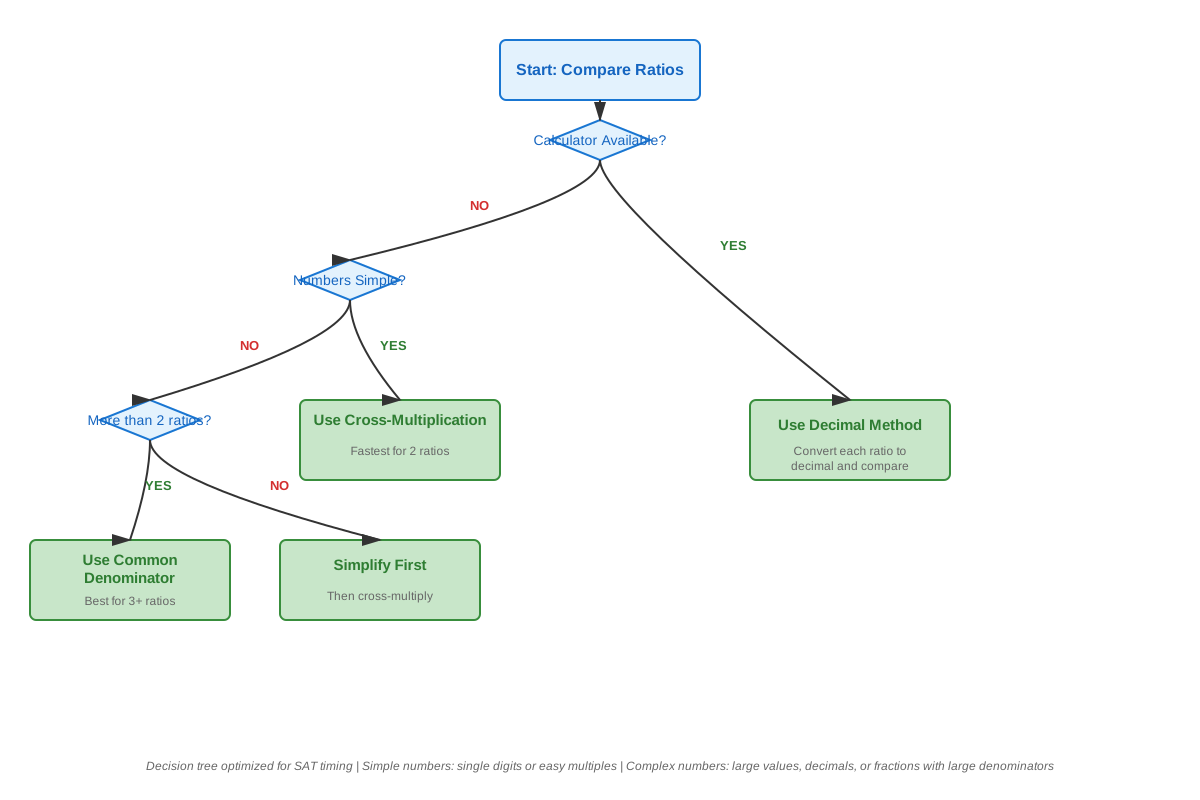
Within the topic itself, the various comparison methods interconnect strategically. Cross-multiplication and common denominator methods both accomplish the same goal through different computational paths, while decimal conversion offers a third approach that leverages calculator efficiency. Students benefit from understanding all three methods because different problem contexts favor different approaches—cross-multiplication for quick two-ratio comparisons, common denominators for multiple ratio comparisons, and decimals for approximate comparisons or calculator-permitted sections.
Ratio comparisons connect forward to more advanced topics including proportions (which involve setting ratios equal), rates (which are specialized ratios involving time), percentages (which are ratios expressed per 100), and similar figures in geometry (which involve comparing corresponding side lengths). The proportional reasoning developed through ratio comparison practice transfers directly to these related topics, making this a foundational skill with broad mathematical applications.
The relationship to algebraic reasoning proves particularly important on the SAT, as many ratio comparison problems involve unknown quantities represented by variables. Students must combine ratio comparison skills with equation-solving abilities to handle questions like: "If the ratio of x to y is 3:4 and the ratio of y to z is 5:6, what is the ratio of x to z?" This requires recognizing that y serves as a common term and scaling ratios appropriately: x:y = 15:20 and y:z = 20:24, therefore x:z = 15:24 = 5:8.
Quick check — test yourself on Ratio comparisons so far.
Try Flashcards →High-Yield Facts
⭐ Cross-multiplication provides the fastest method for comparing two ratios: If a/b and c/d are being compared, calculate a × d and b × c; the larger product indicates the larger ratio.
⭐ Unit rates enable direct comparison of quantities with different scales: Always divide the total quantity by the number of units to find the rate per single unit.
⭐ When comparing ratios, ensure both are the same type (part-to-part or part-to-whole): Mixing types leads to incorrect comparisons and is a common SAT trap.
⭐ Equivalent ratios can be created by multiplying or dividing both terms by the same non-zero number: This property enables scaling ratios to common terms for easier comparison.
⭐ Converting ratios to decimal form allows immediate visual comparison: This method works particularly well when comparing three or more ratios simultaneously.
- Part-to-whole ratios always have a denominator larger than the numerator when the part is less than the whole.
- When ratios are given in different units, conversion to common units must occur before comparison.
- The ratio a:b can be inverted to b:a, which represents the reciprocal relationship.
- Ratios can be simplified like fractions by dividing both terms by their greatest common factor.
- In word problems, the order of quantities in the ratio must match the order stated in the problem.
- Comparing ratios with negative numbers requires careful attention to sign rules.
- A ratio of 1:1 indicates equal quantities, making it a useful benchmark for comparisons.
- When three quantities are related by ratios (a:b and b:c), they can be combined by scaling to make the middle term equal.
Common Misconceptions
Misconception: All ratios can be compared by simply looking at the numbers without calculation.
Correction: Ratios must be converted to comparable forms (same denominators, decimals, or through cross-multiplication) before accurate comparison is possible. For example, 3/7 might appear smaller than 5/12 at first glance, but cross-multiplication reveals 3 × 12 = 36 > 5 × 7 = 35, so 3/7 is actually larger.
Misconception: A larger numerator always means a larger ratio.
Correction: The denominator must also be considered. The ratio 3/10 is smaller than 2/5 even though 3 > 2, because when converted to common denominators, 3/10 < 4/10.
Misconception: Ratios and fractions are completely different mathematical concepts.
Correction: Ratios can be expressed as fractions and follow the same comparison rules. The ratio 3:4 is mathematically equivalent to the fraction 3/4, and all fraction comparison techniques apply to ratios.
Misconception: When comparing unit rates, the larger number always represents the better value.
Correction: Context determines whether larger or smaller is better. For prices per unit, smaller is better (lower cost), but for miles per gallon, larger is better (greater efficiency). Always consider what the unit rate represents.
Misconception: Part-to-part and part-to-whole ratios can be directly compared without conversion.
Correction: These represent fundamentally different relationships. If a mixture has red to blue paint in a 2:3 ratio, the part-to-whole ratio of red paint is 2:5 (2 parts red to 5 total parts), not 2:3. Comparing 2:3 to 2:5 without recognizing this difference leads to errors.
Misconception: Adding the same number to both terms of a ratio creates an equivalent ratio.
Correction: Only multiplication or division by the same non-zero number creates equivalent ratios. The ratio 2:3 is not equivalent to 3:4 (adding 1 to both terms), but it is equivalent to 4:6 (multiplying both terms by 2).
Misconception: The ratio 3:4:5 means the quantities are 3, 4, and 5.
Correction: The ratio indicates the relative relationship, not the actual quantities. If the ratio of three quantities is 3:4:5 and the smallest quantity is 15, then the quantities are 15, 20, and 25 (each term multiplied by 5).
Worked Examples
Example 1: Comparing Unit Prices
Problem: A grocery store offers three sizes of olive oil. The 12-ounce bottle costs $8.40, the 20-ounce bottle costs $13.00, and the 32-ounce bottle costs $19.20. Which size offers the best value per ounce?
Solution:
Step 1: Calculate the unit price (price per ounce) for each bottle by dividing the total price by the number of ounces.
12-ounce bottle: $8.40 ÷ 12 = $0.70 per ounce
20-ounce bottle: $13.00 ÷ 20 = $0.65 per ounce
32-ounce bottle: $19.20 ÷ 32 = $0.60 per ounce
Step 2: Compare the unit prices. The smallest unit price represents the best value.
$0.60 < $0.65 < $0.70
Step 3: Identify the answer. The 32-ounce bottle at $0.60 per ounce offers the best value.
Connection to Learning Objectives: This problem demonstrates the application of ratio comparisons to real-world SAT-style questions, specifically using unit rate calculations to make value comparisons. It illustrates why ratio comparisons matter for practical decision-making and shows the standard format the SAT uses for such questions.
Example 2: Multi-Step Ratio Comparison with Scaling
Problem: In School A, the ratio of teachers to students is 1:15. In School B, the ratio of teachers to students is 2:27. Which school has a lower student-to-teacher ratio (meaning more teachers per student)?
Solution:
Step 1: Recognize that "student-to-teacher ratio" is the inverse of "teacher-to-student ratio." We need to flip the given ratios.
School A: teacher-to-student is 1:15, so student-to-teacher is 15:1
School B: teacher-to-student is 2:27, so student-to-teacher is 27:2
Step 2: Convert these ratios to unit rates (students per teacher) to enable comparison.
School A: 15 students per 1 teacher = 15 students per teacher
School B: 27 students per 2 teachers = 27 ÷ 2 = 13.5 students per teacher
Step 3: Compare the unit rates. The smaller number indicates fewer students per teacher, meaning more teachers per student.
13.5 < 15
Step 4: State the conclusion. School B has a lower student-to-teacher ratio (13.5:1 compared to 15:1), meaning School B has more teachers per student.
Alternative approach using cross-multiplication:
To compare 15/1 and 27/2 (students per teacher):
Cross-multiply: 15 × 2 = 30 and 1 × 27 = 27
Since 30 > 27, we know 15/1 > 27/2, confirming School B has the lower ratio.
Connection to Learning Objectives: This problem requires identifying key features of ratio comparisons (recognizing inverse relationships), converting between different ratio forms (teacher-to-student versus student-to-teacher), and applying multiple comparison methods. It demonstrates how SAT questions test conceptual understanding beyond simple calculation.
Exam Strategy
When approaching SAT ratio comparisons questions, begin by carefully identifying what type of comparison the question requires. Look for trigger phrases such as "best value," "greatest rate," "lowest ratio," "most efficient," or "highest concentration." These phrases signal that you need to calculate and compare ratios, not simply work with a single ratio. Underline or circle these comparison words to maintain focus on the question's actual requirement.
Process-of-elimination strategies prove particularly effective for ratio comparison questions. If a multiple-choice question asks which option represents the greatest ratio, calculate the ratio for just two answer choices first. Eliminate the smaller one, then compare the remaining choice against a third option. This approach reduces calculation time and minimizes arithmetic errors. When answer choices are given as ratios in different forms (some as fractions, others as decimals), convert all to the same form before comparing.
Time allocation for ratio comparison questions should follow this guideline: spend 30-45 seconds reading and understanding the problem, 45-60 seconds performing calculations, and 15-30 seconds checking your answer. If a problem requires comparing more than three ratios, consider using your calculator to convert all ratios to decimals, which typically saves time compared to finding common denominators manually. However, for simple two-ratio comparisons, cross-multiplication without a calculator often proves faster.
Watch for unit inconsistencies as a common SAT trap. Questions may present one ratio in dollars per pound and another in cents per ounce, requiring unit conversion before comparison. Always check that the units match before comparing ratios. Similarly, be alert for questions that mix part-to-part and part-to-whole ratios—the SAT frequently includes this trap to test careful reading and conceptual understanding.
Exam Tip: When a question asks "which is greater" or "which is the best value," you don't always need to calculate all ratios precisely. Sometimes you can eliminate obviously incorrect answers through estimation, then calculate precisely only for the remaining competitive options.
For grid-in questions involving ratio comparisons, double-check whether the question asks for the ratio itself, the difference between ratios, or some other derived value. The SAT occasionally asks for the ratio of two ratios, requiring an additional calculation step that students sometimes miss under time pressure.
Memory Techniques
"CRUD" for Comparison Methods: Cross-multiply, Reduce to common denominators, Unit rates, Decimal conversion. This acronym helps recall the four main techniques for comparing ratios, ensuring you have multiple approaches available depending on the problem context.
"Part-Part, Part-Whole, Don't Compare the Two": This rhyme reminds students that part-to-part ratios and part-to-whole ratios represent different relationships and cannot be directly compared without conversion. When you encounter a ratio comparison problem, mentally check which type each ratio represents.
Visualization strategy: Picture ratios as slopes of lines on a coordinate plane. A steeper slope (larger ratio) means the y-value increases more rapidly relative to the x-value. This visualization helps with intuitive understanding of which ratio is larger and connects ratio concepts to geometric representations that appear elsewhere on the SAT.
"Flip for Inverse": When a problem asks about the inverse of a given ratio (e.g., given teacher-to-student but asked about student-to-teacher), visualize physically flipping the fraction. This simple mental image prevents the common error of using the ratio in its original form.
The "Common Term" technique: When comparing ratios that share a common element (like comparing a:b and b:c), remember to scale both ratios so the common term (b) has the same value in both. Visualize this as building a bridge between the ratios using the common term as the connecting point.
Summary
Ratio comparisons represent a high-yield SAT math topic that requires students to analyze relationships between quantities, convert ratios into comparable forms, and apply proportional reasoning to solve multi-step problems. Success demands fluency with multiple comparison methods—cross-multiplication for quick two-ratio comparisons, common denominators for multiple simultaneous comparisons, and decimal conversion for calculator-assisted efficiency. Students must distinguish between part-to-part and part-to-whole ratios, recognize equivalent ratios, and calculate unit rates to enable direct comparisons. The SAT tests this topic through real-world contexts such as unit price comparisons, population density analysis, mixture concentrations, and rate comparisons, often embedding ratio comparison requirements within complex word problems that require careful reading and multi-step reasoning. Mastery requires not just computational skill but also conceptual understanding of what ratios represent and how different ratio forms relate to each other. The ability to quickly identify which comparison method suits a particular problem, execute calculations accurately, and interpret results in context distinguishes high-scoring students from average performers on this frequently-tested topic.
Key Takeaways
- Cross-multiplication provides the fastest method for comparing two ratios: multiply diagonally and compare products to determine which ratio is larger without finding common denominators.
- Unit rates enable direct comparison of quantities with different scales: always calculate the amount per single unit (price per ounce, miles per hour, etc.) to make meaningful comparisons.
- Part-to-part and part-to-whole ratios cannot be directly compared: verify which type each ratio represents and convert if necessary before making comparisons.
- Multiple comparison methods exist for different contexts: master cross-multiplication, common denominators, and decimal conversion to choose the most efficient approach for each problem.
- Equivalent ratios maintain the same relationship when both terms are multiplied or divided by the same number: use this property to scale ratios to common terms for easier comparison.
- SAT ratio comparison questions frequently embed comparisons within real-world scenarios: practice extracting relevant information, calculating appropriate ratios, and interpreting results in context.
- Careful attention to units and question requirements prevents common errors: always check that units match before comparing and verify whether the question asks for the largest, smallest, or some other specific comparison.
Related Topics
Proportions and Proportional Relationships: After mastering ratio comparisons, students progress to solving proportion equations where two ratios are set equal. This extends comparison skills to finding unknown values that maintain proportional relationships.
Rates and Unit Conversions: Building on unit rate comparisons, this topic explores more complex rate problems involving distance-rate-time relationships, work rates, and conversions between different measurement systems.
Percentages and Percent Change: Percentages represent ratios expressed per 100, making ratio comparison skills directly applicable to percentage problems, including percent increase/decrease and comparing percentage values.
Similar Figures in Geometry: Geometric similarity involves comparing ratios of corresponding side lengths, applying ratio comparison concepts to spatial reasoning and scale factor problems.
Direct and Inverse Variation: These algebraic concepts formalize ratio relationships, with direct variation maintaining constant ratios and inverse variation maintaining constant products.
Practice CTA
Now that you've mastered the core concepts of ratio comparisons, it's time to solidify your understanding through active practice. Attempt the practice questions to apply these strategies to SAT-style problems, and use the flashcards to reinforce key facts and formulas. Remember, ratio comparison questions appear frequently on the SAT and represent high-yield opportunities for quick points when you've developed fluency with the comparison methods. Each practice problem you solve strengthens your pattern recognition and builds the confidence you need to tackle these questions efficiently on test day. Your investment in mastering this topic will pay dividends across multiple question types throughout the math section!
Sign up free to keep reading
Create a free AnvayaPrep account to finish this SAT guide on Ratio comparisons — plus flashcards and practice questions.