Overview
Similar figures ratios represent one of the most frequently tested geometric concepts on the SAT. When two figures are similar, they have the same shape but not necessarily the same size—their corresponding angles are equal, and their corresponding sides are proportional. Understanding how to work with these proportional relationships is crucial for solving a wide range of math problems that appear in both the calculator and no-calculator sections of the exam.
The SAT tests similar figures in multiple contexts: triangles, rectangles, circles, and three-dimensional solids. Questions may ask students to find missing side lengths, calculate areas or volumes, or determine scale factors between figures. What makes this topic particularly high-yield is that it connects directly to other essential SAT concepts including ratios, proportions, the Pythagorean theorem, and area/volume formulas. Mastering similar figures ratios provides a foundation for solving complex multi-step problems that combine several mathematical principles.
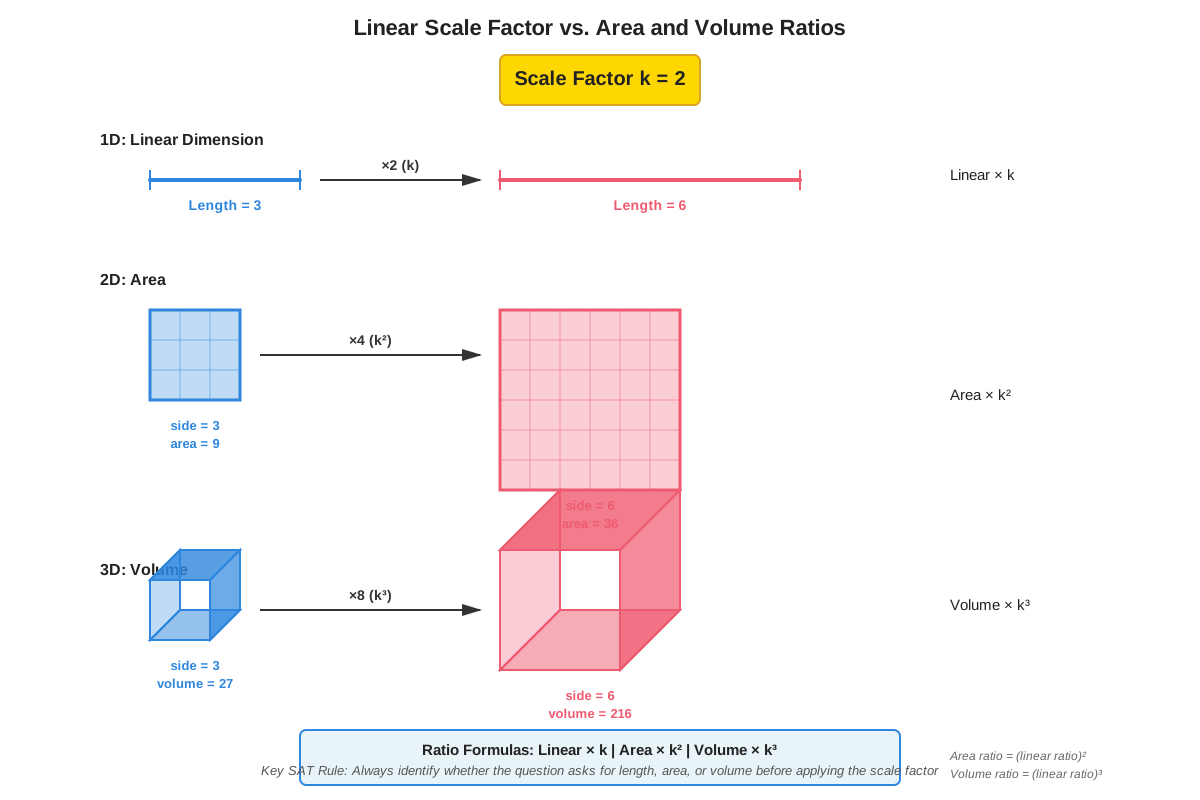
The power of similar figures lies in understanding that when the linear dimensions of a figure change by a scale factor of k, the area changes by k², and the volume changes by k³. This relationship appears repeatedly on the SAT, often in word problems involving maps, models, blueprints, or real-world scaling scenarios. Students who internalize these ratio relationships can quickly eliminate incorrect answer choices and solve problems that might otherwise require lengthy calculations.
Learning Objectives
- [ ] Identify key features of similar figures ratios
- [ ] Explain how similar figures ratios appears on the SAT
- [ ] Apply similar figures ratios to answer SAT-style questions
- [ ] Calculate scale factors between similar figures given corresponding measurements
- [ ] Determine the relationship between linear scale factors and area/volume ratios
- [ ] Solve multi-step problems involving similar triangles and proportional reasoning
- [ ] Apply similar figures concepts to real-world contexts including maps, models, and blueprints
Prerequisites
- Basic ratio and proportion concepts: Understanding equivalent ratios is essential because similar figures are defined by proportional side lengths
- Properties of triangles and polygons: Recognizing corresponding sides and angles allows identification of similar figures
- Area and perimeter formulas: Calculating how these measurements scale requires knowledge of basic geometric formulas
- Exponent rules: Understanding that area scales by k² and volume by k³ requires comfort with squared and cubed values
- Algebraic equation solving: Setting up and solving proportions involves cross-multiplication and algebraic manipulation
Why This Topic Matters
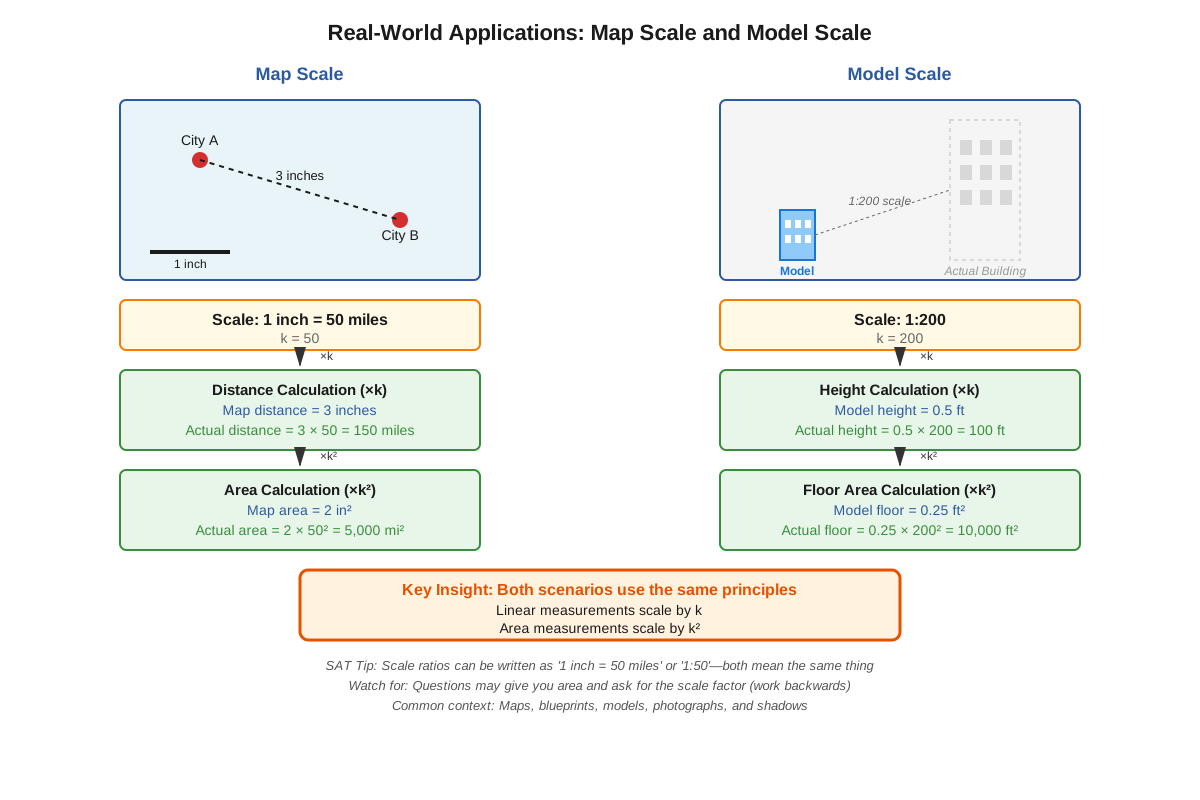
Similar figures ratios appear in countless real-world applications that make this concept both practical and testable. Architects use scale models where every dimension maintains proportional relationships to the actual building. Cartographers create maps with consistent scale factors, allowing travelers to calculate real distances from paper measurements. Medical imaging, photography, and digital design all rely on scaling principles where maintaining proportional relationships ensures accurate representations.
On the SAT, similar figures questions appear with remarkable consistency—typically 2-4 questions per test, accounting for approximately 4-7% of the total math score. These questions span difficulty levels from straightforward proportion problems to complex multi-step scenarios involving area and volume relationships. The College Board particularly favors questions that combine similar figures with other concepts, such as using similar triangles to find heights of objects, applying scale factors to calculate areas of irregular shapes, or determining volumes of scaled three-dimensional models.
Common question formats include: providing two similar triangles with some side lengths given and asking for missing measurements; presenting a scale drawing or map and requiring distance calculations; describing a scaling scenario (like enlarging a photograph) and asking how area or volume changes; and embedding similar triangles within larger geometric figures where students must identify the similar triangles before solving. The versatility of this topic makes it one of the highest-yield areas for focused study.
Core Concepts
Definition of Similar Figures
Two figures are similar if they have the same shape but not necessarily the same size. Formally, figures are similar when all corresponding angles are congruent (equal in measure) and all corresponding sides are proportional. The symbol ~ denotes similarity; if triangle ABC is similar to triangle DEF, we write △ABC ~ △DEF.
The scale factor (also called the ratio of similitude) is the constant ratio between corresponding linear measurements of similar figures. If the scale factor from figure A to figure B is k, then every linear dimension of figure B is k times the corresponding dimension of figure A. For example, if two rectangles are similar with a scale factor of 3:1, the larger rectangle's length is 3 times the smaller rectangle's length, and its width is 3 times the smaller rectangle's width.
Identifying Similar Figures
For triangles, several conditions guarantee similarity:
- AA (Angle-Angle) Similarity: If two angles of one triangle are congruent to two angles of another triangle, the triangles are similar
- SSS (Side-Side-Side) Similarity: If the three sides of one triangle are proportional to the three sides of another triangle, the triangles are similar
- SAS (Side-Angle-Side) Similarity: If two sides of one triangle are proportional to two sides of another triangle and the included angles are congruent, the triangles are similar
For other polygons, all corresponding angles must be equal AND all corresponding sides must be proportional. Note that for quadrilaterals and higher polygons, having equal angles alone does not guarantee similarity (unlike triangles where AA suffices).
Working with Proportional Sides
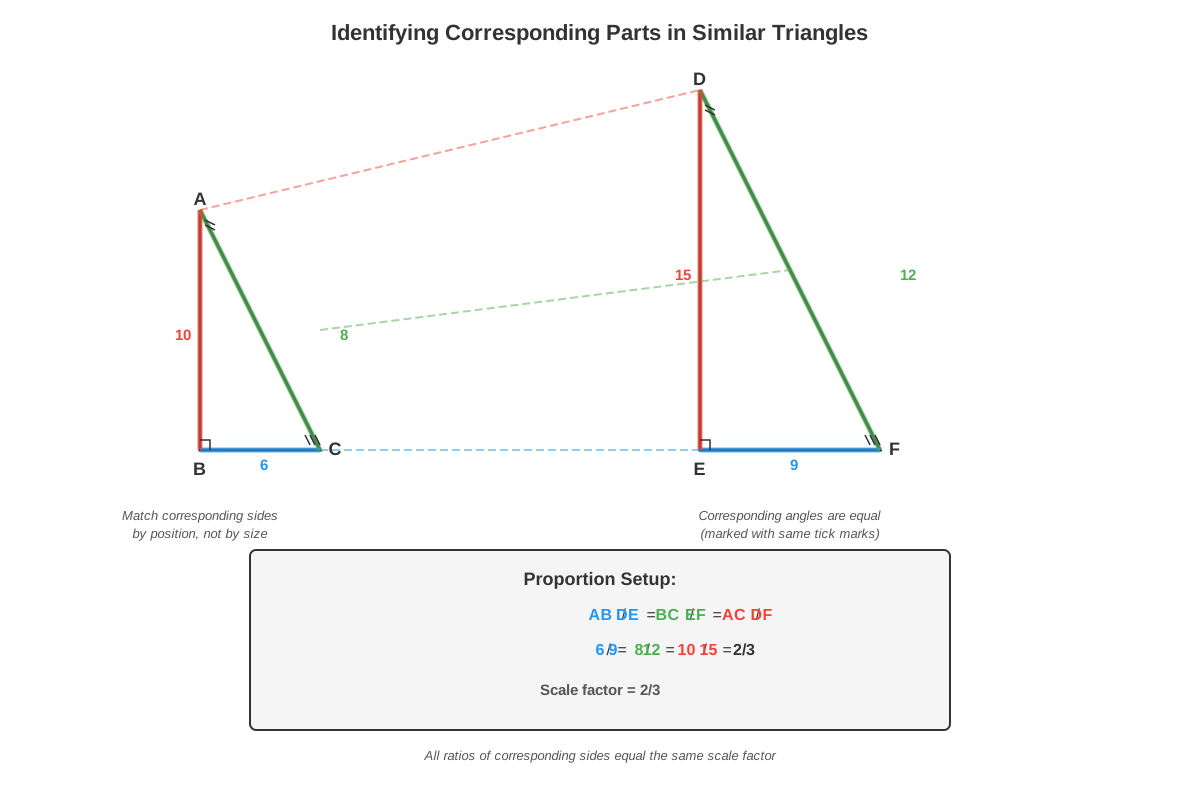
When two figures are similar with a scale factor of k, we can set up proportions to find missing measurements. If triangle ABC ~ triangle DEF with sides AB = 6, BC = 8, AC = 10, and the corresponding side DE = 9, we can find the scale factor:
k = DE/AB = 9/6 = 3/2 = 1.5This means every side of triangle DEF is 1.5 times the corresponding side of triangle ABC:
- EF = 1.5 × BC = 1.5 × 8 = 12
- DF = 1.5 × AC = 1.5 × 10 = 15
Alternatively, we can set up a proportion without explicitly finding k:
AB/DE = BC/EF
6/9 = 8/EF
6 × EF = 9 × 8
EF = 72/6 = 12
The Area Ratio Relationship
This is one of the most tested concepts on the SAT: when two similar figures have a linear scale factor of k, their areas have a ratio of k². This relationship holds for all two-dimensional figures—triangles, rectangles, circles, irregular polygons, and any other planar shapes.
| Linear Scale Factor | Area Scale Factor | Example |
|---|---|---|
| 2:1 | 4:1 | If sides double, area quadruples |
| 3:1 | 9:1 | If sides triple, area increases 9× |
| 1:2 | 1:4 | If sides halve, area becomes 1/4 |
| 5:2 | 25:4 | If sides increase by 5/2, area increases by 25/4 |
Why this works: Consider a rectangle with length L and width W. Its area is L × W. If we scale by factor k, the new dimensions are kL and kW, giving area (kL)(kW) = k²LW = k² times the original area.
The Volume Ratio Relationship
Extending to three dimensions: when two similar solids have a linear scale factor of k, their volumes have a ratio of k³. This applies to all three-dimensional figures—cubes, spheres, cylinders, pyramids, cones, and irregular solids.
| Linear Scale Factor | Volume Scale Factor | Example |
|---|---|---|
| 2:1 | 8:1 | If dimensions double, volume increases 8× |
| 3:1 | 27:1 | If dimensions triple, volume increases 27× |
| 1:2 | 1:8 | If dimensions halve, volume becomes 1/8 |
| 10:1 | 1000:1 | If dimensions increase 10×, volume increases 1000× |
Why this works: Consider a rectangular prism with length L, width W, and height H. Its volume is L × W × H. Scaling by factor k gives dimensions kL, kW, and kH, producing volume (kL)(kW)(kH) = k³LWH = k³ times the original volume.
Perimeter and Surface Area Relationships
Perimeter (for 2D figures) scales linearly with the scale factor k, just like individual side lengths. If the scale factor is 3, the perimeter is also 3 times larger.
Surface area (for 3D figures) scales with k², just like regular area. This makes sense because surface area is a two-dimensional measurement even though it describes a three-dimensional object.
Similar Triangles in Context
The SAT frequently embeds similar triangles within larger geometric configurations. Common scenarios include:
- Parallel lines creating similar triangles: When a line parallel to one side of a triangle intersects the other two sides, it creates a smaller triangle similar to the original
- Triangles sharing an angle: Two triangles that share a common angle and have another pair of equal angles are similar
- Shadow problems: An object and its shadow form a triangle similar to another object and its shadow at the same time of day
- Indirect measurement: Using similar triangles to find heights or distances that cannot be measured directly
Concept Relationships
The foundation of similar figures ratios rests on the prerequisite concept of proportional relationships. Understanding that ratios can be equivalent (3:4 = 6:8) enables recognition that corresponding sides of similar figures maintain constant ratios. This proportional thinking → leads to → the ability to set up and solve equations involving similar figures.
Within the topic itself, the concepts build hierarchically: Identifying similar figures (through AA, SSS, or SAS criteria) → must occur before → calculating scale factors → which then enables → finding missing side lengths through proportional reasoning. Once the linear scale factor is established → it directly determines → area relationships (by squaring the scale factor) → and → volume relationships (by cubing the scale factor).
The connection between linear, area, and volume scaling represents the most critical relationship within this topic. Understanding that these three types of measurements scale differently (by k, k², and k³ respectively) prevents the common error of applying the same scale factor to all measurements regardless of dimension.
Similar figures ratios connect forward to more advanced topics including trigonometry (where similar right triangles define trigonometric ratios), coordinate geometry (where dilations create similar figures), and circle geometry (where all circles are similar to each other). The proportional reasoning developed here also supports probability and statistics concepts involving scaled representations of data.
Quick check — test yourself on Similar figures ratios so far.
Try Flashcards →High-Yield Facts
⭐ Two figures are similar if all corresponding angles are equal AND all corresponding sides are proportional
⭐ When the linear scale factor between similar figures is k, the area ratio is k² and the volume ratio is k³
⭐ For triangles, AA (two pairs of equal angles) is sufficient to prove similarity
⭐ Perimeter scales linearly with the same factor as side lengths (by k), not by k²
⭐ All circles are similar to each other; all squares are similar to each other
- The scale factor can be expressed as a ratio, fraction, or decimal (e.g., 3:2, 3/2, or 1.5)
- If two similar figures have areas in ratio m:n, their linear scale factor is √m:√n
- If two similar solids have volumes in ratio m:n, their linear scale factor is ∛m:∛n
- Similar figures have the same shape but different sizes; congruent figures have the same shape AND same size (congruence is a special case of similarity where k = 1)
- When a line parallel to one side of a triangle intersects the other two sides, it divides those sides proportionally
- In similar figures, the ratio of any two linear measurements within one figure equals the ratio of the corresponding measurements in the similar figure
- Surface area of three-dimensional solids scales by k², not k³, because surface area is a two-dimensional measurement
Common Misconceptions
Misconception: If two figures have the same angles, they must be similar.
Correction: For polygons with more than three sides, equal angles alone do not guarantee similarity—the sides must also be proportional. Only for triangles does AA (angle-angle) guarantee similarity. For example, all rectangles have four 90° angles, but a 2×3 rectangle is not similar to a 2×5 rectangle.
Misconception: If the scale factor is 3, then the area is also 3 times larger.
Correction: When the linear scale factor is 3, the area is 3² = 9 times larger. Linear measurements scale by k, but area measurements scale by k². This is one of the most frequently tested distinctions on the SAT.
Misconception: The scale factor must always be greater than 1.
Correction: Scale factors can be less than 1 when the similar figure is smaller than the original. For example, a scale factor of 1/2 means the new figure has dimensions half as large as the original. The relationships k, k², and k³ still apply regardless of whether k is greater than or less than 1.
Misconception: Surface area of a three-dimensional solid scales by k³ like volume does.
Correction: Surface area is a two-dimensional measurement (measured in square units), so it scales by k², not k³. Only volume, which is three-dimensional (measured in cubic units), scales by k³.
Misconception: If two triangles have one pair of equal angles, they are similar.
Correction: Triangles need at least two pairs of equal angles (AA) to guarantee similarity. One pair of equal angles is insufficient. However, if you also know that the sides forming those equal angles are proportional (SAS similarity), then the triangles are similar.
Misconception: The scale factor from figure A to figure B is the same as the scale factor from figure B to figure A.
Correction: These scale factors are reciprocals of each other. If the scale factor from A to B is 3, then the scale factor from B to A is 1/3. Always pay attention to the direction of the scaling relationship.
Worked Examples
Example 1: Finding Missing Sides and Area Ratio
Problem: Triangle ABC has sides AB = 8 cm, BC = 12 cm, and AC = 10 cm. Triangle DEF is similar to triangle ABC, with DE = 12 cm corresponding to AB. Find the lengths of EF and DF, and determine the ratio of the area of triangle DEF to the area of triangle ABC.
Solution:
Step 1: Find the scale factor from triangle ABC to triangle DEF.
k = DE/AB = 12/8 = 3/2 = 1.5Step 2: Use the scale factor to find the other sides of triangle DEF.
EF = k × BC = 1.5 × 12 = 18 cm
DF = k × AC = 1.5 × 10 = 15 cm
Step 3: Find the area ratio using k².
Area ratio = k² = (1.5)² = 2.25 = 9/4Therefore, EF = 18 cm, DF = 15 cm, and the area of triangle DEF is 9/4 (or 2.25) times the area of triangle ABC.
Connection to learning objectives: This problem demonstrates identifying similar figures, calculating scale factors, applying proportional reasoning to find missing measurements, and using the k² relationship for areas—all core SAT skills.
Example 2: Volume Scaling with Real-World Context
Problem: A company produces a spherical water tank with a radius of 3 meters that holds 113 cubic meters of water. They want to create a similar tank that holds 904 cubic meters. What should the radius of the larger tank be?
Solution:
Step 1: Recognize this is a volume scaling problem. Set up the volume ratio.
Volume ratio = 904/113 = 8Step 2: Since volume scales by k³, find the linear scale factor.
k³ = 8
k = ∛8 = 2
Step 3: Apply the linear scale factor to the radius.
New radius = k × original radius = 2 × 3 = 6 metersStep 4: Verify using the volume formula for a sphere (V = 4/3 πr³).
Original volume = 4/3 π(3)³ = 4/3 π(27) = 36π ≈ 113 cubic meters ✓
New volume = 4/3 π(6)³ = 4/3 π(216) = 288π ≈ 904 cubic meters ✓
The larger tank should have a radius of 6 meters.
Connection to learning objectives: This problem applies similar figures ratios to a real-world context, demonstrates the k³ relationship for volumes, and shows how to work backward from a volume ratio to find a linear dimension—a sophisticated application frequently tested on the SAT.
Exam Strategy
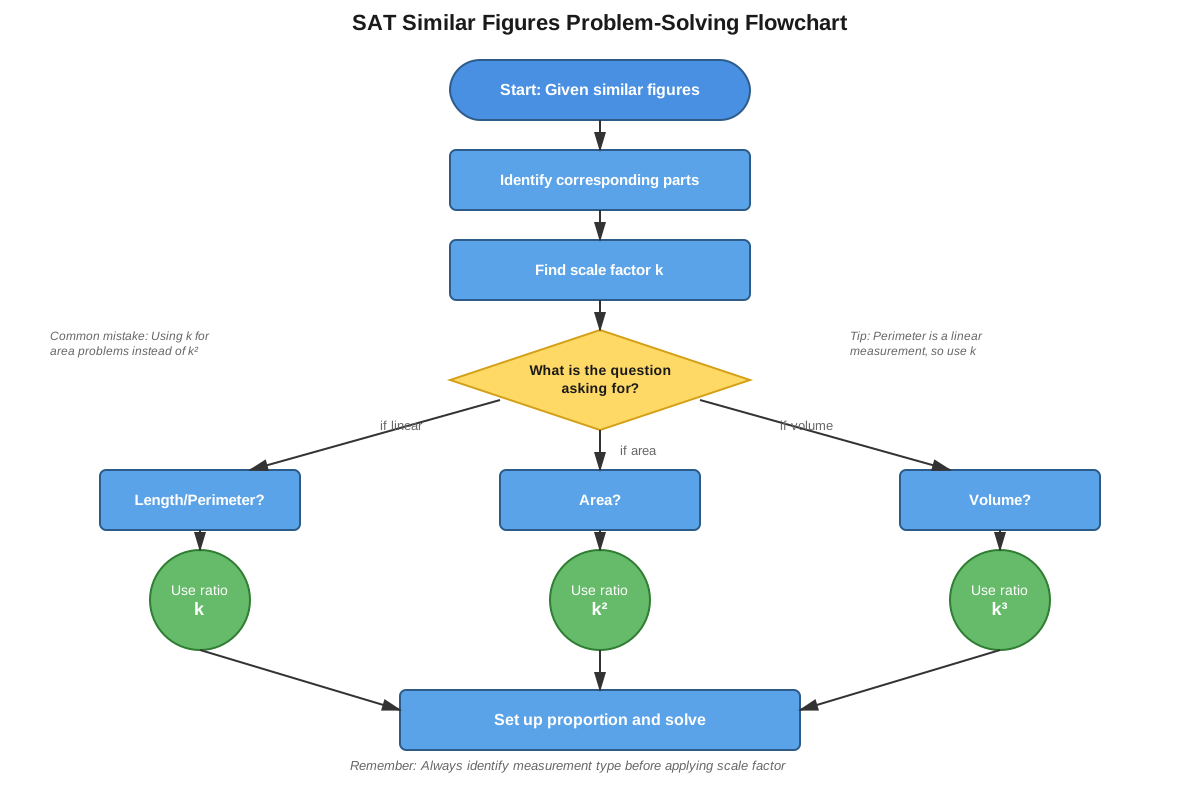
When approaching SAT similar figures ratios questions, begin by identifying what type of measurement the question asks about: linear (side length, height, radius), area (surface area, cross-sectional area), or volume. This immediately tells you whether to use k, k², or k³.
Trigger words and phrases to watch for:
- "Similar figures/triangles" or "same shape" → signals proportional relationships
- "Scale factor," "ratio," or "proportional" → indicates you'll need to set up ratios
- "Area" or "surface area" → remember to square the linear scale factor
- "Volume" → remember to cube the linear scale factor
- "Corresponding sides/angles" → identifies which parts of figures match up
- "Map scale," "blueprint," "model" → real-world similar figures contexts
Process-of-elimination strategies:
- If a question gives a linear scale factor of 2 and asks about area, immediately eliminate any answer choice that says "2 times larger"—it must be 4 times larger
- For volume problems with a scale factor of 3, eliminate answers showing 3× or 9× increase—only 27× is correct
- If you calculate a scale factor and get a decimal like 1.5, convert it to a fraction (3/2) to match answer choices more easily
- When finding a missing side length, set up your proportion carefully and eliminate answers that don't maintain the correct ratio direction
Time allocation advice: Most similar figures problems can be solved in 60-90 seconds once you identify the relationship type. If a problem seems to require more than 2 minutes, you may be overcomplicating it—look for a simpler proportional relationship. Multi-step problems involving both area and volume might legitimately take 2-3 minutes, but these are rare.
Exam Tip: Always write down the scale factor explicitly, even if it seems obvious. This prevents errors when you need to square or cube it for area or volume calculations.
Memory Techniques
The "Dimension Power Rule" mnemonic:
- 1D (linear): scale by k¹ = k
- 2D (area): scale by k²
- 3D (volume): scale by k³
The exponent matches the dimension number—this simple pattern prevents confusion about which power to use.
"AA is A-OK for triangles": Remember that Angle-Angle similarity works for triangles but not for other polygons. The rhyme helps recall this special property of triangles.
Visualization strategy for area scaling: Picture a square with side length 1. When you double the side length to 2, you can fit FOUR of the original squares inside the new square (arranged in a 2×2 grid). This visual demonstrates why doubling linear dimensions quadruples area.
Visualization strategy for volume scaling: Imagine a cube with edge length 1. When you double the edge length to 2, you can fit EIGHT of the original cubes inside the new cube (arranged in a 2×2×2 configuration). This shows why doubling linear dimensions multiplies volume by 8.
"Perimeter is a Pal": Perimeter scales the same way as sides (linearly by k), making it a "pal" to linear measurements. This distinguishes it from area, which scales differently.
The "Square Root/Cube Root Reversal": If given an area ratio and asked for a linear scale factor, take the square root. If given a volume ratio and asked for a linear scale factor, take the cube root. The operation reverses the squaring/cubing that created the area/volume ratio.
Summary
Similar figures ratios represent a foundational concept in SAT geometry that connects proportional reasoning with spatial relationships. Two figures are similar when they have identical shapes but potentially different sizes, characterized by equal corresponding angles and proportional corresponding sides. The scale factor k describes how linear measurements compare between similar figures, and this single value determines all other relationships: perimeter scales by k, area scales by k², and volume scales by k³. Mastering these relationships enables efficient problem-solving across diverse question types, from finding missing side lengths through proportional equations to calculating how area and volume change under scaling transformations. The SAT tests this concept frequently in both pure geometric contexts and real-world applications involving maps, models, and scaled representations. Success requires recognizing which type of measurement a question addresses (linear, area, or volume) and applying the appropriate power of the scale factor, while avoiding the common error of treating all measurements as if they scale linearly.
Key Takeaways
- Similar figures have equal corresponding angles and proportional corresponding sides; the constant ratio is the scale factor k
- Linear measurements (sides, perimeter, height, radius) scale by k; area measurements scale by k²; volume measurements scale by k³
- For triangles, AA (two pairs of equal angles) is sufficient to prove similarity; other polygons require both angle equality and side proportionality
- When given an area ratio, take the square root to find the linear scale factor; when given a volume ratio, take the cube root
- Surface area of three-dimensional objects scales by k² (not k³) because it's a two-dimensional measurement
- Setting up proportions correctly requires matching corresponding parts: if AB corresponds to DE, then BC corresponds to EF
- The SAT frequently embeds similar triangles within larger figures or presents them in real-world contexts like maps, shadows, and models
Related Topics
Trigonometric Ratios: Similar right triangles form the foundation of trigonometry. All right triangles with the same acute angle are similar, which is why sine, cosine, and tangent ratios remain constant for a given angle regardless of triangle size.
Coordinate Geometry and Dilations: Dilations in the coordinate plane create similar figures by multiplying all coordinates by a scale factor. Understanding similar figures ratios enables analysis of how dilations affect distance, area, and other geometric properties.
Circle Geometry: All circles are similar to each other with scale factors determined by their radii. This principle underlies relationships between arc length, sector area, and other circular measurements.
Pythagorean Theorem Applications: Similar right triangles often appear in problems combining the Pythagorean theorem with proportional reasoning, particularly in indirect measurement scenarios.
Geometric Probability: When probability depends on area or volume (like hitting a target or selecting a random point), understanding how these measurements scale with similar figures becomes essential for calculating probabilities correctly.
Practice CTA
Now that you've mastered the core concepts of similar figures ratios, it's time to solidify your understanding through active practice. Work through the practice questions to apply these principles to SAT-style problems, and use the flashcards to reinforce the key relationships between linear, area, and volume scaling. Remember: understanding the theory is just the first step—consistent practice with timed questions will build the speed and confidence you need to excel on test day. Every problem you solve strengthens your pattern recognition and deepens your mathematical intuition. You've got this!
Sign up free to keep reading
Create a free AnvayaPrep account to finish this SAT guide on Similar figures ratios — plus flashcards and practice questions.