Overview
Colons are one of the most frequently tested punctuation marks in the SAT Reading and Writing (RW) section, appearing consistently across multiple questions in every exam administration. Understanding how to use colons correctly is essential for success on the SAT because these questions test both grammatical knowledge and logical reasoning skills. A colon serves as a powerful punctuation tool that introduces, explains, or elaborates on information presented in the first part of a sentence.
On the SAT colons questions, students must determine whether a colon is the appropriate punctuation choice in a given context, distinguishing it from semicolons, commas, dashes, and periods. These questions assess whether students understand that colons require a complete independent clause before them and typically introduce lists, explanations, examples, or elaborations that follow. The College Board tests this concept because proper colon usage demonstrates sophisticated writing skills and the ability to create clear, logical connections between ideas.
Mastery of colon usage connects directly to broader concepts within the Boundaries and Sentence Structure unit, including understanding independent and dependent clauses, recognizing complete sentences, and choosing appropriate punctuation to join or separate ideas. Students who excel at colon questions typically have strong foundational knowledge of sentence structure and can quickly identify whether a clause can stand alone as a complete thought. This topic integrates seamlessly with other punctuation concepts tested on the SAT, making it a high-yield area for focused study that yields immediate score improvements.
Learning Objectives
- [ ] Identify key features of colons and their grammatical requirements
- [ ] Explain how colons appears on the SAT and the question formats used
- [ ] Apply colons to answer SAT-style questions with accuracy and confidence
- [ ] Distinguish between correct and incorrect colon usage in various sentence contexts
- [ ] Recognize the structural requirements before and after a colon
- [ ] Evaluate whether alternative punctuation marks would be more appropriate than a colon
- [ ] Analyze the logical relationship between clauses to determine colon appropriateness
Prerequisites
- Independent clauses: Understanding what constitutes a complete sentence is essential because colons require an independent clause before them
- Dependent clauses: Recognizing incomplete thoughts helps students identify when colons are incorrectly placed
- Basic punctuation marks: Familiarity with periods, commas, and semicolons provides context for when colons are the superior choice
- Sentence boundaries: Knowing where sentences begin and end prevents run-on sentences and fragments when using colons
Why This Topic Matters
Colon usage appears in real-world writing across professional, academic, and creative contexts. Business communications use colons to introduce lists of action items or key findings. Academic papers employ colons to present research findings or introduce quotations. Even casual writing benefits from proper colon usage to create emphasis and clarity. Students who master colons develop more sophisticated writing skills that serve them throughout college and their careers.
On the SAT, colon questions appear with remarkable consistency, typically showing up 2-4 times per exam in the Reading and Writing section. These questions are considered medium difficulty but are highly strategic because they follow predictable patterns that students can learn to recognize quickly. The College Board presents colon questions in multiple formats: some ask students to choose the correct punctuation from four options, while others embed the colon choice within broader sentence revision questions. Understanding colons also helps students perform better on questions about semicolons, dashes, and commas, as these punctuation marks often appear as answer choices together.
In exam passages, colons most commonly appear in informational and argumentative texts where authors need to introduce evidence, provide examples, or present lists. Scientific passages might use colons to introduce experimental results, while historical passages employ them to present specific examples of broader trends. Recognizing these patterns helps students anticipate when colons are likely to be tested and approach these questions with confidence.
Core Concepts
The Basic Rule: Complete Before, Explanation After
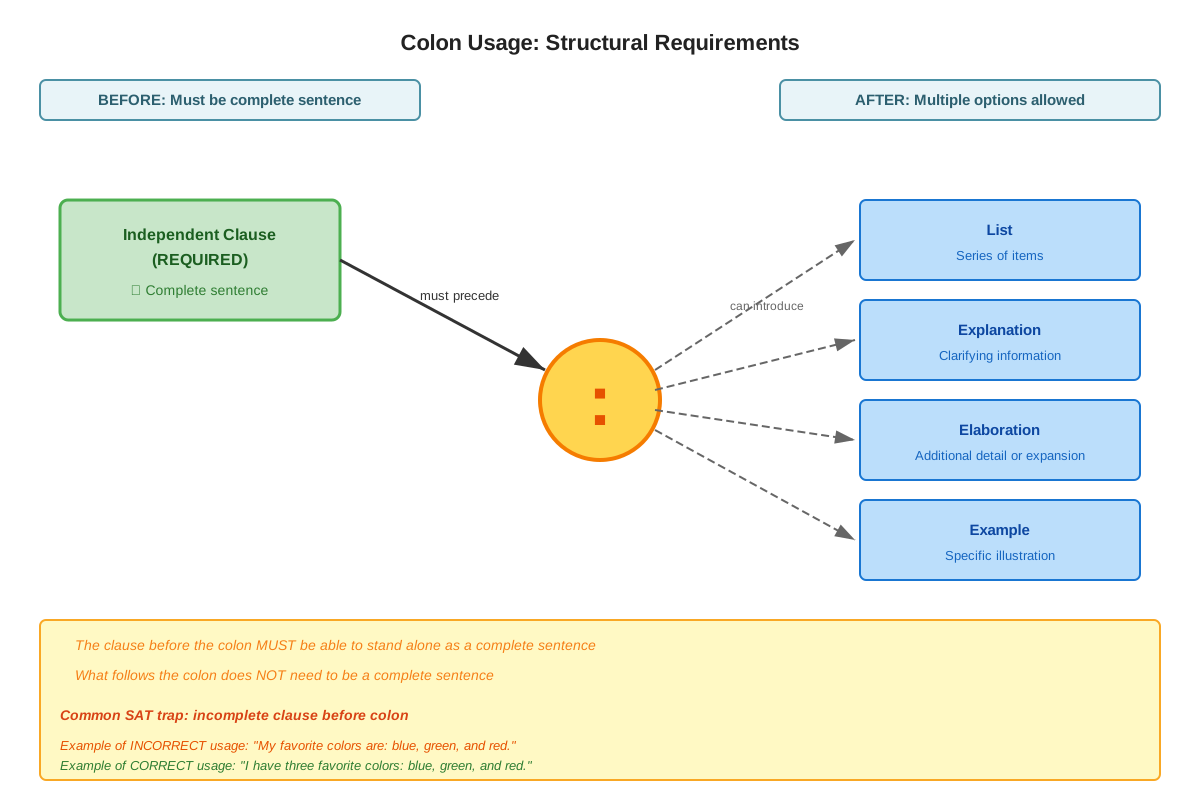
The fundamental principle of colon usage is straightforward: a colon must be preceded by an independent clause (a complete sentence that can stand alone) and typically introduces information that explains, elaborates on, or provides examples of what came before. This "complete before, explanation after" rule is the foundation of every SAT question about colons.
Consider this correct example: "The experiment yielded a surprising result: the plants grew faster in darkness than in light." The portion before the colon ("The experiment yielded a surprising result") is a complete sentence. The portion after the colon explains what that result was. This structure satisfies the basic requirement for colon usage.
What Can Follow a Colon
After a colon, several types of information can appear, and understanding these categories helps students recognize correct usage:
Lists: Colons frequently introduce lists of items, whether single words, phrases, or longer elements. Example: "The recipe requires three ingredients: flour, sugar, and eggs."
Explanations: Colons can introduce a clause or phrase that explains or elaborates on the statement before the colon. Example: "She had one goal: to finish the marathon."
Examples: When providing a specific example of a general statement, colons create a clear logical connection. Example: "The museum features one particularly valuable painting: Monet's Water Lilies."
Quotations: In formal writing, colons can introduce quotations, especially longer ones. Example: "Lincoln began his address with a powerful statement: 'Four score and seven years ago...'"
Independent clauses: Unlike semicolons, which require independent clauses on both sides, colons can be followed by either independent or dependent clauses, as long as the information after the colon relates to what came before.
The Independent Clause Requirement
The most critical rule for SAT colons questions is that an independent clause must precede the colon. This means the portion before the colon must contain a subject and verb and express a complete thought. Many incorrect answer choices on the SAT violate this rule.
| Correct Usage | Incorrect Usage |
|---|---|
| "She needed one thing: courage." | "She needed: courage." |
| "The study examined three factors: diet, exercise, and sleep." | "The study examined: diet, exercise, and sleep." |
| "He had a simple philosophy: work hard and stay humble." | "His philosophy was: work hard and stay humble." |
In the incorrect examples, the portions before the colons are not complete sentences. "She needed" leaves the reader asking "needed what?" Similarly, "The study examined" is incomplete without an object. The phrase "His philosophy was" requires a complement to be complete.
Colons vs. Other Punctuation
Understanding when to use colons instead of other punctuation marks is essential for SAT success. Here's how colons compare to their closest alternatives:
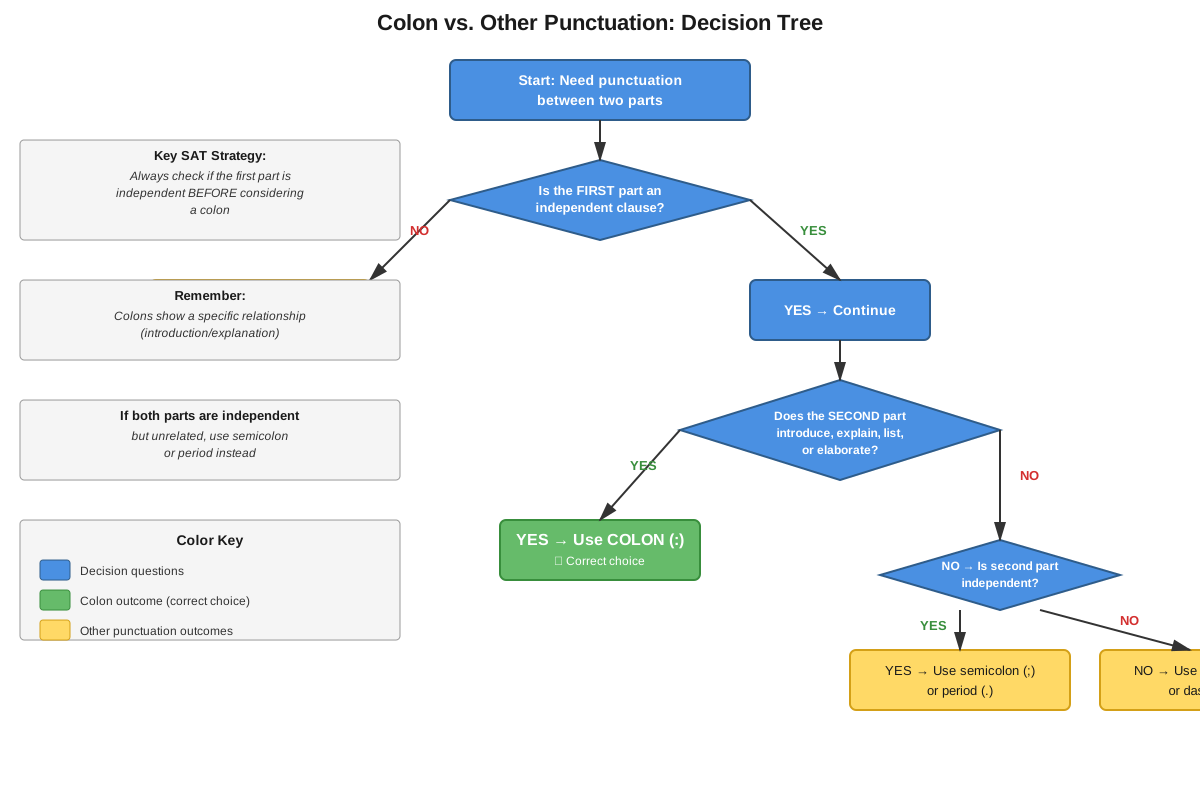
Colons vs. Semicolons: Semicolons join two independent clauses of equal weight, while colons introduce information that explains or elaborates on the first clause. Semicolons suggest balance; colons suggest hierarchy (the second part serves the first).
Colons vs. Commas: Commas are weaker separators and don't signal the same level of introduction or explanation. Use colons when you want to create anticipation or formally introduce what follows.
Colons vs. Dashes: Dashes are more informal and can be used more flexibly. While both can introduce explanations, colons are more formal and structured. Dashes can also interrupt mid-sentence, while colons cannot.
Colons vs. Periods: Periods create complete separation between sentences, while colons maintain a connection, signaling that the second part relates directly to the first.
Common SAT Colon Patterns
The SAT tests colon usage in predictable patterns. Recognizing these patterns accelerates question-solving:
- The "such as" trap: When a sentence already contains "such as" or "including," adding a colon is usually incorrect because these phrases already introduce examples.
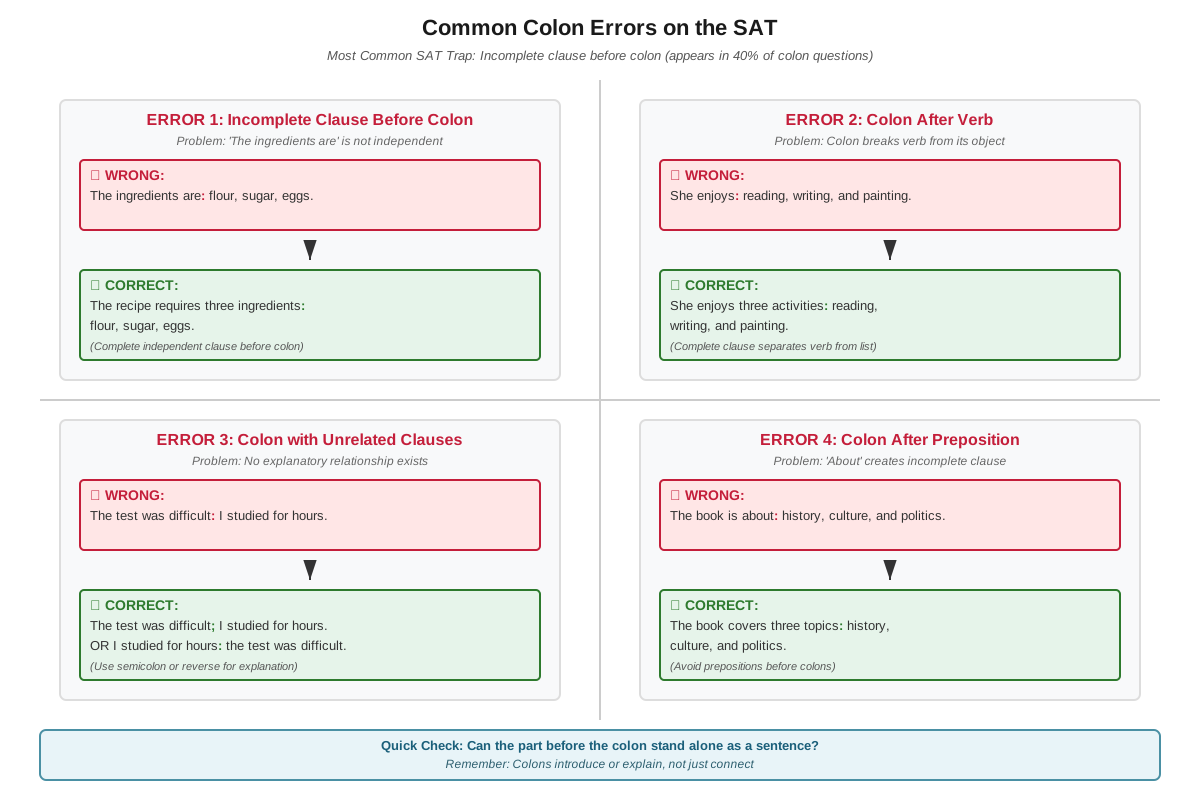
- The verb-object separation: Never place a colon between a verb and its direct object or between a preposition and its object.
- The list introduction: When introducing a list, ensure the clause before the colon is complete. "The ingredients are" is incomplete; "The recipe requires these ingredients" is complete.
- The explanation pattern: Look for sentences where the second part answers an implicit question raised by the first part.
Capitalization After Colons
While not heavily tested on the SAT, understanding capitalization rules helps with overall sentence structure questions. In American English, capitalize the first word after a colon only if it begins a complete sentence that could stand alone and the writer wants to emphasize it as a separate thought. For lists, examples, or fragments, use lowercase.
Concept Relationships
The concepts within colon usage form a hierarchical relationship: the independent clause requirement serves as the foundation, upon which all other rules build. Understanding independent clauses → enables recognition of complete thoughts before colons → which allows proper evaluation of colon placement → leading to correct identification of what can follow colons (lists, explanations, examples).
Colon usage connects directly to prerequisite knowledge of sentence boundaries because determining whether a colon is appropriate requires identifying where one complete thought ends and another begins. This relationship flows both ways: mastering colons reinforces understanding of independent clauses, which in turn improves performance on comma splice and run-on sentence questions.
The relationship between colons and other punctuation marks (semicolons, dashes, commas) is one of functional alternatives. These punctuation marks occupy overlapping but distinct territories in the grammar landscape. Understanding colons → clarifies when semicolons are appropriate → which distinguishes both from comma usage → creating a comprehensive punctuation framework.
Within the broader Boundaries and Sentence Structure unit, colon mastery → supports understanding of how ideas connect within and between sentences → which enhances overall writing clarity → leading to improved performance across all RW questions involving sentence revision and structure.
High-Yield Facts
⭐ A colon must be preceded by an independent clause (a complete sentence that can stand alone)
⭐ Colons introduce information that explains, elaborates on, or provides examples of what came before
⭐ Never place a colon directly after a verb when it separates the verb from its object
⭐ Colons can introduce lists, explanations, examples, quotations, or additional clauses
⭐ When a sentence already contains "such as" or "including," a colon is typically unnecessary and incorrect
- Colons create a hierarchical relationship between clauses, unlike semicolons which join equal clauses
- The portion after a colon does not need to be an independent clause (unlike semicolons)
- Colons are more formal than dashes but serve similar introductory functions
- Multiple items in a list after a colon should be parallel in structure
- Colons cannot appear in the middle of a clause to interrupt it (unlike dashes)
- On the SAT, incorrect colon placement often occurs between prepositions and their objects
- The "complete before, explanation after" rule applies to virtually every correct colon usage
Quick check — test yourself on Colons so far.
Try Flashcards →Common Misconceptions
Misconception: Colons and semicolons are interchangeable punctuation marks. → Correction: Colons introduce explanations or lists and require only an independent clause before them, while semicolons join two independent clauses of equal importance and require independent clauses on both sides.
Misconception: Any sentence with a list needs a colon before the list. → Correction: A colon should only precede a list when the portion before the colon is a complete independent clause. "The ingredients are: flour, sugar, and eggs" is incorrect because "The ingredients are" is not complete without its complement.
Misconception: Colons can be placed after "such as" or "including" to introduce examples. → Correction: Phrases like "such as" and "including" already serve the introductory function, making a colon redundant and incorrect. Write "The museum features many artists, including Monet" not "including: Monet."
Misconception: The portion after a colon must always be a complete sentence. → Correction: Unlike semicolons, colons can be followed by fragments, single words, phrases, or complete sentences, as long as they relate to and explain what came before.
Misconception: Colons and commas serve the same function in introducing lists. → Correction: Colons create a formal introduction and require a complete clause before them, while commas are used within lists or after introductory phrases. The strength and formality of the separation differ significantly.
Misconception: If a sentence is long, it probably needs a colon somewhere. → Correction: Sentence length doesn't determine colon usage; the logical relationship between clauses and the completeness of the clause before the colon determine correctness.
Worked Examples
Example 1: Identifying Correct Colon Usage
Question: Which choice completes the sentence with correct punctuation?
"The research team discovered something unexpected in their analysis of the ancient texts___the documents were written in a previously unknown dialect."
A) analysis of the ancient texts,
B) analysis of the ancient texts:
C) analysis of the ancient texts;
D) analysis of the ancient texts—
Solution Process:
Step 1: Identify the clause before the punctuation mark. "The research team discovered something unexpected in their analysis of the ancient texts" is a complete independent clause with a subject (team), verb (discovered), and complete thought.
Step 2: Identify the clause after the punctuation mark. "The documents were written in a previously unknown dialect" is also an independent clause.
Step 3: Determine the relationship between the clauses. The second clause explains what the "something unexpected" was—it provides specific information about the discovery mentioned in the first clause.
Step 4: Evaluate each option:
- Option A (comma): Too weak; creates a comma splice by joining two independent clauses with only a comma
- Option B (colon): Correct; introduces an explanation of what was discovered
- Option C (semicolon): Grammatically acceptable but doesn't capture the explanatory relationship as effectively
- Option D (dash): Also acceptable but less formal than a colon
Answer: B is the best choice because the colon perfectly captures the explanatory relationship: the second clause specifies what the unexpected discovery was.
Connection to Learning Objectives: This example demonstrates how to identify key features of colons (complete clause before, explanation after) and apply this knowledge to answer SAT-style questions.
Example 2: Recognizing Incorrect Colon Usage
Question: Which choice completes the sentence with correct punctuation?
"The museum's collection includes___paintings, sculptures, and photographs from the Renaissance period."
A) includes:
B) includes
C) includes,
D) includes;
Solution Process:
Step 1: Check if the portion before the punctuation is a complete independent clause. "The museum's collection includes" is NOT complete—it requires an object to complete the verb "includes."
Step 2: Recognize the verb-object relationship. "Includes" is a transitive verb that needs a direct object. The list "paintings, sculptures, and photographs" serves as that object.
Step 3: Apply the colon rule. Since we cannot place a colon between a verb and its direct object, option A is incorrect.
Step 4: Evaluate remaining options:
- Option B (no punctuation): Correct; the list flows naturally as the object of "includes"
- Option C (comma): Incorrect; creates an unnecessary pause between verb and object
- Option D (semicolon): Incorrect; semicolons join independent clauses, not verbs to objects
Answer: B is correct because no punctuation should separate a verb from its direct object.
Connection to Learning Objectives: This example illustrates a common SAT trap where students might think a list requires a colon, but the incomplete clause before the colon makes it incorrect. This reinforces the critical rule that colons require complete independent clauses before them.
Exam Strategy
When approaching SAT colons questions, follow this systematic process to maximize accuracy and efficiency:
Step 1: Identify the punctuation decision point. Locate exactly where the punctuation mark appears or would appear in the sentence. Read the sentence carefully from beginning to end.
Step 2: Apply the "cover test". Cover everything after the potential colon and read only what comes before. Ask: "Is this a complete sentence?" If no, eliminate the colon option immediately.
Step 3: Check for verb-object separation. Look specifically for patterns like "includes:", "are:", "such as:", or "like:". These almost always indicate incorrect colon usage because they separate verbs or prepositions from their objects.
Step 4: Evaluate the relationship. If the clause before the colon is complete, determine whether the information after it explains, elaborates, or provides examples. Colons work best when the second part answers an implicit question raised by the first.
Step 5: Compare alternatives. On the SAT, colon questions often include semicolons, dashes, and commas as alternatives. Use process of elimination:
- Eliminate commas if they would create comma splices
- Eliminate semicolons if the relationship is explanatory rather than balanced
- Choose between colons and dashes based on formality and context
Trigger words and phrases to watch for:
- "Such as" or "including" before the punctuation (usually means colon is wrong)
- "For example" or "namely" (these phrases often replace the need for a colon)
- Verbs like "includes," "are," "contains" directly before the punctuation (red flag for incorrect colon)
Time allocation advice: Colon questions should take 30-45 seconds maximum. If you've applied the cover test and checked for verb-object separation, you should be able to eliminate at least two options quickly. Don't overthink these questions—the rules are mechanical and consistent.
Exam Tip: If you're unsure between a colon and a dash, choose the colon in formal, academic passages and the dash in more casual or narrative passages. The SAT tends to favor colons in scientific and historical texts.
Memory Techniques
The "Complete Before" Mnemonic: Remember C.B.E. - Complete Before, Explanation after. Before using a colon, the clause must be Complete; after the colon comes the Explanation.
The Cover-Up Technique: Physically cover (or mentally block out) everything after the potential colon. If what remains isn't a complete sentence, the colon is wrong. This kinesthetic approach helps cement the independent clause requirement.
The "No Verb Separation" Rule: Visualize a colon as a wall. You cannot build a wall between a verb and what it acts upon—they must stay together. This image helps prevent the common error of placing colons after verbs.
The Question-Answer Framework: Think of colons as introducing answers to implicit questions. The first part raises a question ("What was the result?" "What are the items?" "What is the explanation?"), and the second part answers it. If you can't identify the implicit question, a colon might not be appropriate.
The Hierarchy Visual: Picture a colon as an arrow pointing downward (⬇️), indicating that what follows is subordinate to or explains what came before. A semicolon is a double-headed arrow (↔️), showing equal relationship. This visual distinction helps differentiate the two punctuation marks.
Summary
Colons are essential punctuation marks on the SAT that introduce explanations, lists, examples, or elaborations. The fundamental rule governing colon usage is that an independent clause—a complete sentence that can stand alone—must precede the colon. The information following the colon should explain, elaborate on, or provide specific examples of what was stated before it. Common errors include placing colons between verbs and their objects, using colons after phrases like "such as" or "including," and placing colons after incomplete clauses. Success on SAT colon questions requires quickly identifying whether the clause before the potential colon is complete and determining whether the relationship between the two parts is explanatory or introductory. Students should use the "cover test" to verify completeness and watch for trigger patterns that indicate incorrect usage. Mastering colons not only improves performance on direct punctuation questions but also enhances overall understanding of sentence structure and boundaries, contributing to higher scores across the Reading and Writing section.
Key Takeaways
- Colons require a complete independent clause before them—this is the most important rule and the most frequently tested concept
- Colons introduce explanations, lists, examples, or elaborations that relate directly to the preceding clause
- Never place a colon between a verb and its object or between a preposition and its object—this is a common SAT trap
- The "cover test" is your most reliable strategy: cover what comes after the colon and verify that what remains is a complete sentence
- Phrases like "such as" and "including" already introduce examples, making additional colons redundant and incorrect
- Colons differ from semicolons in that semicolons join equal independent clauses while colons create a hierarchical, explanatory relationship
- On the SAT, colon questions appear 2-4 times per exam and follow predictable patterns that can be mastered with focused practice
Related Topics
Semicolons: Understanding semicolons deepens colon mastery because these punctuation marks are often presented as alternatives in answer choices. Semicolons join two independent clauses of equal weight, while colons introduce explanatory information.
Dashes: Dashes serve similar introductory functions to colons but with different levels of formality and flexibility. Mastering colons provides a foundation for understanding when dashes are more appropriate.
Comma Usage: Many colon questions test whether students can distinguish between situations requiring colons versus commas. Understanding both punctuation marks creates a comprehensive approach to sentence boundaries.
Independent and Dependent Clauses: Since colons require independent clauses before them, deepening knowledge of clause types directly improves colon question performance and overall sentence structure understanding.
Parallel Structure: When colons introduce lists, the items in those lists should maintain parallel structure, connecting colon usage to broader grammar concepts tested on the SAT.
Practice CTA
Now that you've mastered the core concepts of colon usage, it's time to reinforce your learning through active practice. Attempt the practice questions designed specifically for this topic, focusing on applying the "cover test" and identifying the explanatory relationships that colons create. Use the flashcards to drill the high-yield facts until they become automatic—this will save you valuable time on test day. Remember, colon questions are highly predictable and follow consistent patterns, making them an excellent opportunity to secure quick, confident points on the SAT. Every practice question you complete strengthens your pattern recognition and builds the confidence you need to excel. You've got this!
Sign up free to keep reading
Create a free AnvayaPrep account to finish this SAT guide on Colons — plus flashcards and practice questions.