Overview
Dashes are one of the most versatile and frequently tested punctuation marks on the SAT Reading and Writing (RW) section. Unlike commas or parentheses, dashes create emphasis while setting off information, making them a powerful tool for writers to control pacing and highlight important details. On the SAT, understanding how to use dashes correctly is essential for success in the Standard English Conventions domain, particularly within questions about boundaries and sentence structure. Students who master dash usage gain a significant advantage, as these punctuation marks appear in multiple question types and can dramatically change a sentence's meaning when used incorrectly.
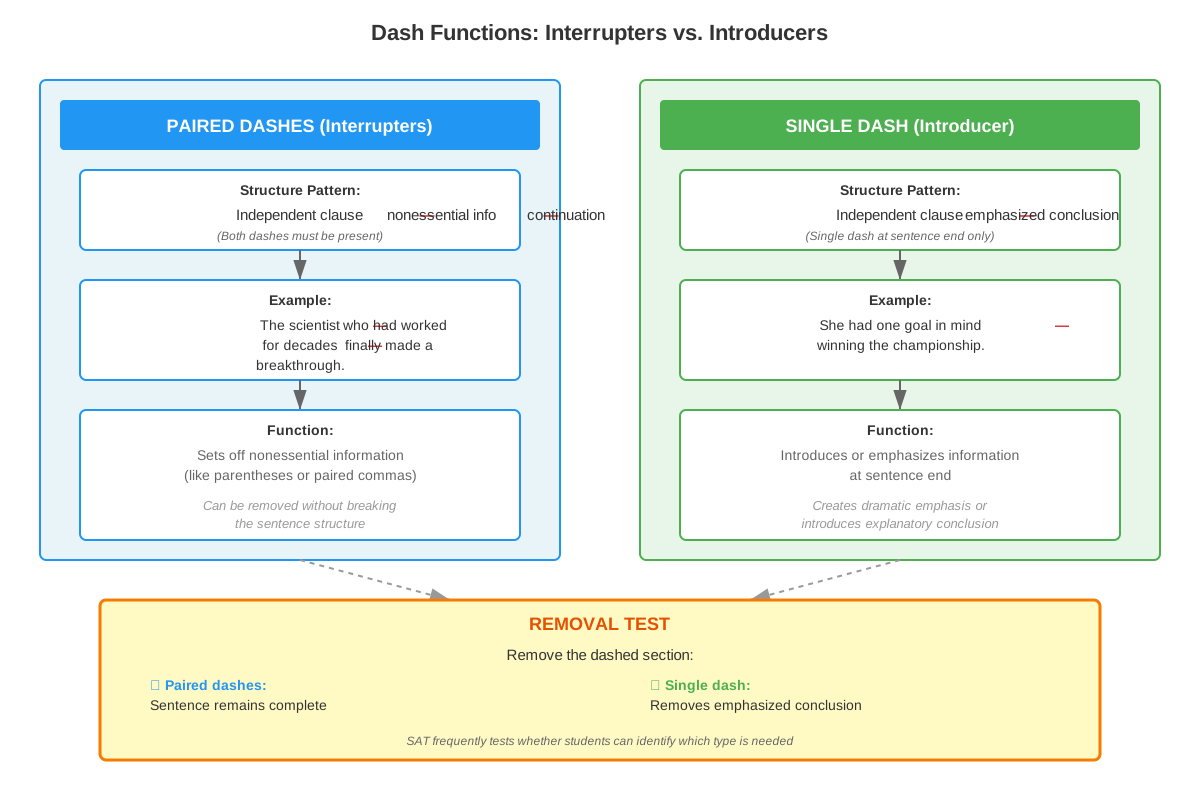
The SAT tests dashes in two primary contexts: as interrupters that set off nonessential information (similar to parentheses or paired commas) and as introducers that emphasize information at the end of a sentence. Questions may ask students to choose between dashes and other punctuation marks, requiring a nuanced understanding of when dashes are grammatically correct versus when they're merely stylistically acceptable. This distinction is crucial because the SAT prioritizes grammatical correctness over stylistic preference.
Mastering dashes connects directly to broader concepts in sentence structure, including understanding independent and dependent clauses, recognizing essential versus nonessential information, and maintaining parallel structure. Students who understand dashes will find themselves better equipped to tackle questions about commas, semicolons, and colons, as all these punctuation marks work together to create clear, effective sentences. The ability to recognize proper dash usage also enhances reading comprehension, as students learn to identify which information an author considers supplementary versus central to the main point.
Learning Objectives
- [ ] Identify key features of dashes and distinguish them from other punctuation marks
- [ ] Explain how dashes appears on the SAT in various question formats
- [ ] Apply dashes to answer SAT-style questions with accuracy and confidence
- [ ] Differentiate between situations requiring paired dashes versus single dashes
- [ ] Evaluate whether dashes, commas, or parentheses are most appropriate in a given context
- [ ] Recognize and correct common dash usage errors in SAT passages
- [ ] Analyze how dash placement affects sentence meaning and emphasis
Prerequisites
- Independent and dependent clauses: Understanding clause types is essential because dashes often separate or connect these structures, and students must recognize whether a dash creates a fragment or a complete sentence.
- Essential versus nonessential information: Dashes primarily set off nonessential information, so students must distinguish between details that can be removed without changing core meaning and those that cannot.
- Basic comma rules: Since dashes often function as alternatives to commas, students need baseline comma knowledge to understand when dashes are preferable or required.
- Sentence boundaries: Recognizing where sentences begin and end helps students avoid using dashes to create run-ons or fragments.
Why This Topic Matters
In real-world writing, dashes serve critical functions in professional communication, academic writing, and creative expression. They allow writers to insert clarifying information, create dramatic pauses, or emphasize conclusions without disrupting sentence flow. Journalists use dashes to add context efficiently, while academic writers employ them to incorporate definitions or examples seamlessly. Understanding dashes enhances both writing clarity and reading comprehension across all disciplines.
On the SAT, dash questions appear with notable frequency—typically 1-3 questions per test in the Standard English Conventions category. These questions often appear as "boundary" questions where students must choose the correct punctuation to separate or connect sentence elements. The College Board particularly favors questions that test whether students can recognize when paired dashes are necessary versus when a single dash suffices. Additionally, dash questions frequently appear alongside answer choices featuring commas, semicolons, or colons, requiring students to understand the subtle differences between these punctuation marks.
Common SAT passage contexts include scientific explanations with technical definitions, historical narratives with dates or clarifying details, and argumentative texts with examples or counterpoints. The test makers deliberately place dashes in positions where multiple punctuation marks might seem plausible, testing whether students truly understand grammatical rules versus relying on what "sounds right." This makes dash mastery particularly high-yield, as these questions often separate students who have studied systematically from those relying on intuition alone.
Core Concepts
The Two Types of Dashes
The SAT primarily tests the em dash (—), which is the longer dash used to set off information or create emphasis. The en dash (–), which is shorter and used primarily for ranges (like "pages 10–15"), rarely appears in SAT questions. When discussing "dashes" on the SAT, students should think exclusively of em dashes. These punctuation marks serve two distinct grammatical functions that students must master separately.
Paired Dashes as Interrupters
Paired dashes function like parentheses or paired commas to set off nonessential information within a sentence. This is the most frequently tested dash usage on the SAT. The key principle is that the information between the dashes can be removed, and the remaining sentence must still be grammatically complete and logical.
Example: The new policy—which was implemented last year—has reduced costs significantly.
If we remove the dashed section: "The new policy has reduced costs significantly." This sentence remains complete and meaningful, confirming the dashes are used correctly.
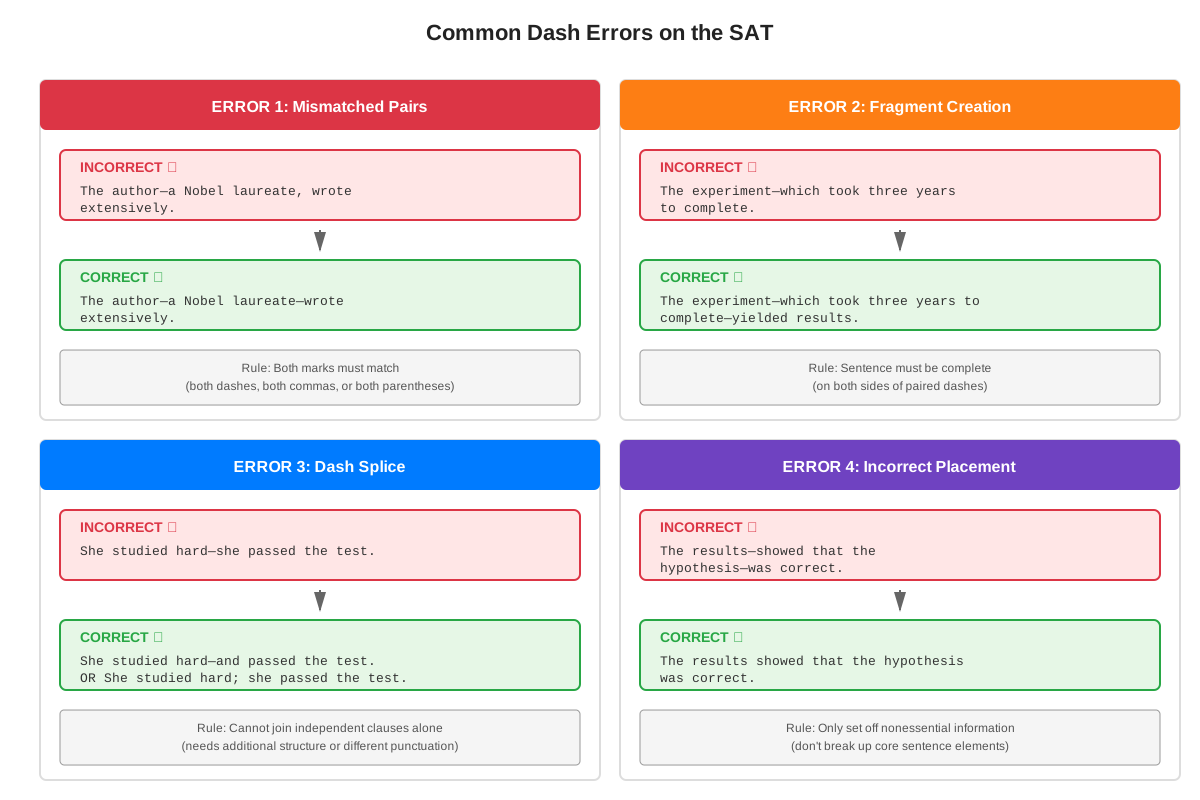
Critical Rule: When using paired dashes, both dashes are mandatory. Students cannot mix punctuation marks by using a dash on one side and a comma on the other. This is a common trap on the SAT.
Incorrect: The new policy—which was implemented last year, has reduced costs significantly.
Correct: The new policy—which was implemented last year—has reduced costs significantly.
Single Dash for Emphasis
A single dash appears at the end of a sentence to introduce or emphasize information, often creating a dramatic pause or highlighting a conclusion. This usage differs fundamentally from paired dashes because the information after the dash is typically essential to the sentence's meaning.
Example: The experiment revealed an unexpected result—the compound was completely stable at room temperature.
The information after the dash provides the crucial detail about what the unexpected result was, making it essential rather than supplementary. Single dashes create stronger emphasis than commas or colons, though colons can sometimes serve similar functions.
Dashes Versus Other Punctuation
Understanding when to use dashes instead of alternative punctuation marks is crucial for SAT success. The following table clarifies these distinctions:
| Punctuation | Function | Emphasis Level | SAT Context |
|---|---|---|---|
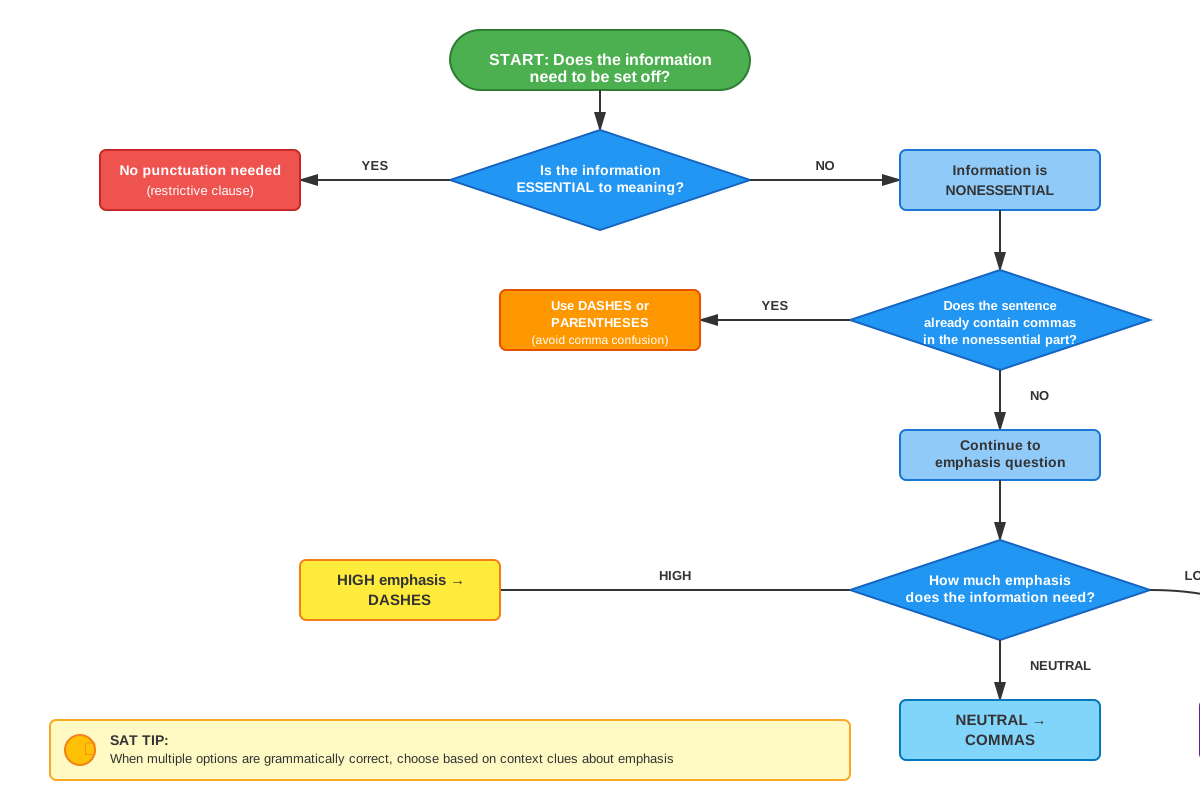
| Paired Dashes | Set off nonessential information | High emphasis | Use when highlighting interrupting information |
| Paired Commas | Set off nonessential information | Neutral | Use for standard interruptions without special emphasis |
| Parentheses | Set off nonessential information | Low emphasis (de-emphasis) | Use for truly supplementary details |
| Single Dash | Introduce/emphasize conclusion | High emphasis | Use for dramatic or important final information |
| Colon | Introduce list or explanation | Moderate emphasis | Use after independent clause to introduce formal explanation |
| Semicolon | Connect related independent clauses | Neutral | Use to join complete sentences without conjunction |
The Completeness Test
The most reliable strategy for evaluating paired dashes is the completeness test. Students should mentally remove everything between the dashes and verify that what remains forms a complete, logical sentence. This test works because nonessential information, by definition, can be eliminated without destroying sentence structure.
Step-by-step process:
- Identify the dashes in the sentence
- Remove all text between the dashes
- Read the remaining sentence
- Verify it's grammatically complete with a subject and verb
- Confirm it makes logical sense
Example for practice: The researchers—despite facing numerous setbacks and funding challenges—completed the study ahead of schedule.
Applying the test: "The researchers completed the study ahead of schedule." ✓ Complete and logical.
Common Dash Patterns on the SAT
The SAT frequently tests specific dash patterns that students should recognize immediately:
Pattern 1: Appositive Interruption
The CEO—Maria Rodriguez—announced the merger yesterday.
(The name renames/identifies the CEO)
Pattern 2: Clarifying Detail
The solution—a mixture of salt and water—proved effective.
(Explains what the solution consists of)
Pattern 3: Relative Clause Interruption
The building—which was constructed in 1887—still stands today.
(Provides additional information about the building)
Pattern 4: Emphatic Conclusion
The team discovered the answer—collaboration.
(Emphasizes the final, important information)
Dash Errors to Recognize
The SAT includes several predictable dash errors in incorrect answer choices:
Error Type 1: Mismatched Punctuation
Incorrect: The study—conducted over five years, revealed surprising results.
(Dash on one side, comma on the other)
Error Type 2: Creating Fragments
Incorrect: The researchers made a discovery. —A new species of beetle.
(The dashed portion is a fragment, not a complete sentence)
Error Type 3: Unnecessary Dashes
Incorrect: The team—completed—the project.
(Dashes separate essential sentence elements)
Error Type 4: Dash Before Coordinating Conjunction
Incorrect: The experiment failed—but the team learned valuable lessons.
(Dash incorrectly used before "but"; comma is correct)
Concept Relationships
The concept of dashes connects intimately with other punctuation and sentence structure principles. Paired dashes relate directly to paired commas and parentheses, forming a trio of punctuation marks that set off nonessential information with varying emphasis levels. Students must understand this relationship to choose correctly among these options on the SAT.
Relationship map:
Understanding sentence completeness → enables recognition of → independent clauses → which determines whether → dashes create proper boundaries → leading to → correct punctuation choices → resulting in → higher SAT scores
Single dashes connect to colons and semicolons in the broader category of punctuation that appears at sentence boundaries or before major sentence divisions. However, while semicolons require independent clauses on both sides and colons require an independent clause before them, single dashes have more flexible requirements, making them distinct yet related.
The concept of essential versus nonessential information serves as the foundation for all dash usage. This principle extends beyond dashes to affect comma placement, relative pronoun choice (that versus which), and overall sentence structure. Students who master this distinction find that dash questions become significantly easier because they can quickly identify whether information can be removed.
Dashes also relate to the broader concept of sentence boundaries, as incorrect dash usage often creates fragments or run-ons. Understanding where sentences properly begin and end helps students recognize when dashes are being used to incorrectly join independent clauses (which requires semicolons or periods instead) versus when they're correctly setting off interrupting information.
High-Yield Facts
⭐ Paired dashes must both be present—students cannot use a dash on one side and a comma on the other; this is the most common trap answer on the SAT.
⭐ The completeness test is foolproof: Remove everything between paired dashes, and the remaining sentence must be grammatically complete and logical.
⭐ Dashes create more emphasis than commas or parentheses when setting off nonessential information, making them the correct choice when the passage emphasizes the interrupting detail.
⭐ Single dashes at sentence end emphasize conclusions or introduce important information, often appearing in answer choices alongside colons.
⭐ Dashes cannot appear before coordinating conjunctions (for, and, nor, but, or, yet, so) in standard usage; commas are correct in these positions.
- Dashes are more informal than colons but more formal than parentheses in academic writing contexts.
- The information between paired dashes is nonessential, meaning the sentence's core meaning remains unchanged if that information is removed.
- A dash cannot separate a subject from its verb or a verb from its essential object or complement.
- When dashes appear in answer choices alongside commas, the question is testing emphasis level or whether the punctuation is paired correctly.
- Em dashes (—) are distinct from hyphens (-), which join compound words; the SAT tests only em dashes in punctuation questions.
Quick check — test yourself on Dashes so far.
Try Flashcards →Common Misconceptions
Misconception: Dashes and hyphens are interchangeable.
Correction: Hyphens (-) join compound words like "well-known" or "twenty-five," while em dashes (—) set off information or create emphasis. The SAT tests only em dashes in punctuation questions, and using a hyphen where a dash is needed is always incorrect.
Misconception: A dash can replace any comma in a sentence.
Correction: Dashes can only replace commas when those commas set off nonessential information. Dashes cannot replace commas that separate items in a list, come before coordinating conjunctions, or follow introductory elements. The function must match, not just the position.
Misconception: It's acceptable to use a dash on one side of an interruption and a comma on the other.
Correction: Paired punctuation must match. If a dash begins an interruption, another dash must end it. Mixing dash and comma is grammatically incorrect and appears frequently as a trap answer on the SAT.
Misconception: Dashes are too informal for the SAT.
Correction: Dashes are perfectly acceptable in formal writing when used correctly. The SAT includes dashes in correct answer choices regularly. The key is proper usage, not avoiding dashes entirely.
Misconception: Any information can go between dashes as long as the sentence is complete afterward.
Correction: While the sentence must be complete after removing dashed information, the information between dashes must also be grammatically appropriate—typically a phrase or clause that relates to the surrounding sentence. Random or unrelated information between dashes creates logical errors even if the technical punctuation is correct.
Misconception: A single dash and a colon are always interchangeable.
Correction: While both can introduce information at sentence end, colons require an independent clause before them and typically introduce lists or formal explanations. Single dashes are more flexible and create stronger emphasis, making them appropriate in different contexts.
Worked Examples
Example 1: Paired Dashes Question
Passage: The archaeological discovery—a collection of ancient pottery fragments—has provided new insights into early civilization.
Question: Which choice best maintains the sentence pattern and punctuation?
A) NO CHANGE
B) discovery—a collection of ancient pottery fragments, has
C) discovery, a collection of ancient pottery fragments—has
D) discovery, a collection of ancient pottery fragments, has
Solution Process:
Step 1: Identify the interrupting information.
"a collection of ancient pottery fragments" provides additional detail about the discovery but isn't essential to the sentence's core meaning.
Step 2: Apply the completeness test.
Remove the interruption: "The archaeological discovery has provided new insights into early civilization."
This sentence is complete and logical. ✓
Step 3: Evaluate punctuation pairing.
The interruption needs paired punctuation. Let's examine each choice:
- Choice A: Uses paired dashes (—...—) ✓
- Choice B: Uses dash then comma (—...,) ✗ Mismatched
- Choice C: Uses comma then dash (,...—) ✗ Mismatched
- Choice D: Uses paired commas (,...,) ✓ Grammatically correct but changes emphasis
Step 4: Consider context and emphasis.
Both A and D are grammatically correct, but the original uses dashes, suggesting the author wants to emphasize this discovery. The question asks to "maintain the sentence pattern," which includes the emphasis level.
Answer: A (NO CHANGE)
Key Takeaway: When paired dashes appear in the original passage and the question asks to maintain the pattern, check whether the dashes are used correctly. If they are, "NO CHANGE" is likely correct unless there's a compelling grammatical reason to change them.
Example 2: Single Dash Versus Other Punctuation
Passage: After months of research, the team finally understood the problem—inadequate funding had limited their progress from the beginning.
Question: Which punctuation mark should appear in place of the dash?
A) NO CHANGE (dash)
B) semicolon
C) comma
D) colon
Solution Process:
Step 1: Identify what comes before and after the punctuation.
Before: "After months of research, the team finally understood the problem"
After: "inadequate funding had limited their progress from the beginning"
Step 2: Check if both sides are independent clauses.
Before: Has subject ("team") and verb ("understood") = independent clause ✓
After: Has subject ("funding") and verb ("had limited") = independent clause ✓
Step 3: Evaluate each punctuation option.
Choice A (dash): Creates emphasis on the conclusion. The dash highlights what the problem was, creating dramatic effect. Grammatically correct. ✓
Choice B (semicolon): Correctly joins two independent clauses. However, semicolons suggest equal weight between clauses, not emphasis on the second. Grammatically correct but changes meaning. ✓ (grammatically) ✗ (rhetorically)
Choice C (comma): Creates a comma splice (joining two independent clauses with only a comma). Grammatically incorrect. ✗
Choice D (colon): Could work because the second clause explains "the problem." However, colons create more formal explanation rather than dramatic emphasis. Grammatically correct but changes tone. ✓ (grammatically) ✗ (rhetorically)
Step 4: Consider the passage's intent.
The phrase "finally understood" suggests a breakthrough moment. The dash creates appropriate emphasis for this dramatic realization.
Answer: A (NO CHANGE)
Key Takeaway: When a single dash appears before an independent clause that explains or emphasizes the previous clause, it's often correct because it creates stronger emphasis than semicolons or colons. Check whether the passage context calls for this emphasis.
Exam Strategy
Approaching Dash Questions
When encountering a dash question on the SAT, follow this systematic approach:
1. Identify the dash type: Determine whether the question involves paired dashes (setting off information) or a single dash (emphasizing conclusion). This immediately narrows your strategic approach.
2. Apply the completeness test for paired dashes: Remove everything between the dashes and verify the remaining sentence is complete. If it's not complete, the dashes are incorrect.
3. Check for mismatched punctuation: Scan answer choices for the common trap of mixing dashes with commas (e.g., dash on one side, comma on the other). Eliminate these immediately.
4. Consider emphasis level: If multiple answer choices are grammatically correct (dashes, commas, or parentheses), choose based on the passage's tone and the importance of the interrupting information.
Trigger Words and Phrases
Watch for these indicators that dashes might be tested:
- "Which choice best maintains...": Suggests the original punctuation might be correct; verify before changing
- Paired punctuation in answer choices: When you see dashes, commas, and parentheses as options, the question tests emphasis level
- Interrupting phrases: Words like "however," "for example," "in fact," or "of course" often signal nonessential information that might need dashes
- Appositives: When a noun is immediately followed by another noun or phrase that renames it, dashes might set off this appositive
Process of Elimination Tips
Eliminate first: Any answer choice that uses mismatched punctuation (dash with comma, or vice versa)
Eliminate second: Any choice that creates a fragment when you apply the completeness test
Eliminate third: Any choice that uses a dash before a coordinating conjunction (FANBOYS)
Choose between remaining options: Based on emphasis level and passage context
Time Allocation
Dash questions should take 30-45 seconds on average. If you find yourself spending more than one minute, you're likely overthinking. Apply the completeness test, check for mismatched punctuation, and move forward. These questions test mechanical rules more than subtle interpretation, so trust your systematic approach rather than deliberating endlessly about what "sounds better."
Exam Tip: If you're stuck between paired dashes and paired commas, and both pass the completeness test, choose dashes when the passage emphasizes the interrupting information or when the interruption is longer or more complex. Choose commas for shorter, less emphasized interruptions.
Memory Techniques
The DASH Acronym
Determine if paired or single
Apply completeness test
Scan for mismatched punctuation
Highlight emphasis level
This four-step process covers every dash question systematically.
The "Removal Rule"
Visualize dashes as removable brackets. If you can lift out everything between the dashes and the sentence still stands on its own, the dashes are correct. Think of dashes as handles on a drawer—you can pull out the drawer (the interrupting information), and the cabinet (the main sentence) remains intact.
The "Emphasis Ladder"
Remember punctuation emphasis from lowest to highest:
- Parentheses = whisper (de-emphasize)
- Commas = normal voice (neutral)
- Dashes = louder voice (emphasize)
When choosing between these three for nonessential information, climb the ladder based on how much the author wants to emphasize the interruption.
The "Match Game"
For paired punctuation, remember: Dashes date dashes, commas date commas, parentheses date parentheses. They must match—no mixing allowed. This silly visualization helps students remember that paired punctuation cannot be mismatched.
The "Complete Sentence Sandwich"
For paired dashes, visualize the sentence as a sandwich:
- Top bread = text before first dash
- Filling = text between dashes
- Bottom bread = text after second dash
The two pieces of bread (top + bottom) must form a complete sandwich (sentence) even without the filling (interrupting information).
Summary
Dashes are high-yield punctuation marks on the SAT that serve two primary functions: paired dashes set off nonessential information with emphasis, while single dashes introduce or emphasize conclusions at sentence end. The most critical skill for SAT success is applying the completeness test—removing everything between paired dashes and verifying that the remaining sentence is grammatically complete and logical. Students must recognize that paired dashes require matching punctuation on both sides; mixing dashes with commas is the most common trap answer. When choosing between dashes, commas, and parentheses for nonessential information, dashes create the strongest emphasis, commas provide neutral emphasis, and parentheses de-emphasize. Single dashes differ from colons in that they create more dramatic emphasis and have more flexible grammatical requirements. Understanding these principles allows students to approach dash questions systematically, eliminating incorrect answers quickly and choosing the correct option with confidence. Mastering dashes connects directly to broader sentence structure concepts and significantly improves performance on Standard English Conventions questions.
Key Takeaways
- Paired dashes must match—never mix a dash with a comma when setting off interrupting information; this is the #1 trap answer on the SAT
- Apply the completeness test: Remove text between paired dashes, and the remaining sentence must be grammatically complete and make logical sense
- Dashes create emphasis: Choose dashes over commas when the passage emphasizes the interrupting information; choose dashes over parentheses when information shouldn't be de-emphasized
- Single dashes emphasize conclusions: Use them at sentence end to highlight important final information with dramatic effect
- Dashes cannot precede coordinating conjunctions: When "but," "and," or other FANBOYS words appear, commas are correct, not dashes
- Nonessential information only: Dashes can only set off information that could be removed without destroying the sentence's core meaning
- Systematic approach wins: Follow DASH (Determine, Apply, Scan, Highlight) rather than relying on what "sounds right" to maximize accuracy
Related Topics
Commas and Comma Rules: Understanding comprehensive comma usage helps students distinguish when commas versus dashes are appropriate for setting off nonessential information, and mastering both punctuation marks together provides complete coverage of interrupting elements.
Semicolons and Colons: These punctuation marks often appear in answer choices alongside dashes, particularly for single-dash questions. Understanding how semicolons join independent clauses and how colons introduce explanations clarifies when dashes are preferable.
Parentheses: As the third option for setting off nonessential information, parentheses complete the emphasis spectrum with dashes and commas. Mastering all three allows students to choose correctly based on passage context.
Essential vs. Nonessential Clauses: This fundamental concept underlies all dash usage. Deepening understanding of what makes information essential versus supplementary improves accuracy on dash questions and related punctuation questions.
Sentence Fragments and Run-ons: Since incorrect dash usage often creates these errors, studying fragments and run-ons reinforces proper dash application and helps students recognize when dashes create boundary problems.
Practice CTA
Now that you've mastered the core concepts of dash usage on the SAT, it's time to put your knowledge into action! Complete the practice questions to reinforce these principles and build the pattern recognition that leads to automatic, confident answers on test day. Use the flashcards to memorize high-yield facts and common patterns until they become second nature. Remember: dash questions are highly predictable once you understand the rules, making them an excellent opportunity to secure quick, reliable points on the Reading and Writing section. Every practice question you complete strengthens your ability to spot trap answers and choose correctly under time pressure. You've got this!
Sign up free to keep reading
Create a free AnvayaPrep account to finish this SAT guide on Dashes — plus flashcards and practice questions.