Overview
The problem and solution structure is one of the most frequently tested organizational patterns on the ACT Reading section. This structure appears when an author presents a challenge, issue, or difficulty and then discusses one or more ways to address, resolve, or respond to that challenge. Understanding this pattern is crucial because it helps students predict where key information will appear in a passage, identify the author's purpose, and quickly locate answers to specific questions.
On the ACT, passages organized with problem and solution structure appear across all four passage types: Literary Narrative/Prose Fiction, Social Science, Humanities, and Natural Science. Recognizing this structure allows students to create a mental roadmap of the passage, anticipating that the author will first establish what's wrong or what needs improvement, then pivot to discussing potential remedies or responses. This organizational awareness dramatically improves reading efficiency and comprehension under timed conditions.
The ACT problem and solution structure connects directly to other critical reading skills, including identifying main ideas, understanding author's purpose, recognizing cause-and-effect relationships, and analyzing argumentative structure. When students master this organizational pattern, they gain a powerful tool for navigating complex passages and answering questions about passage structure, author's intent, and the relationship between different parts of a text. This skill is particularly valuable because approximately 15-20% of ACT Reading questions directly or indirectly test understanding of text structure.
Learning Objectives
- [ ] Identify when Problem and solution structure is being tested
- [ ] Explain the core rule or strategy behind Problem and solution structure
- [ ] Apply Problem and solution structure to ACT-style questions accurately
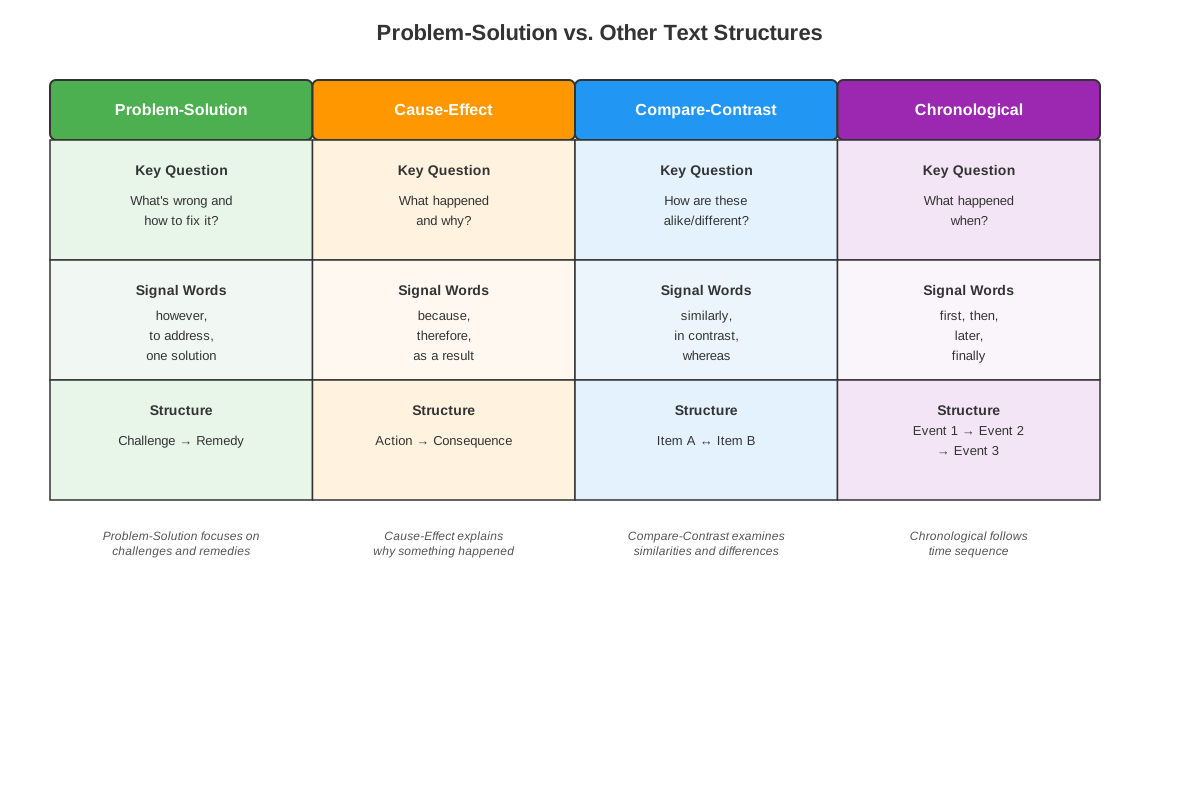
- [ ] Distinguish problem and solution structure from other organizational patterns (cause-effect, compare-contrast, chronological)
- [ ] Locate transition words and phrases that signal shifts between problem and solution sections
- [ ] Predict where specific information will appear based on problem-solution organization
- [ ] Analyze how authors use problem and solution structure to advance their purpose
Prerequisites
- Basic passage comprehension skills: Students must be able to read and understand main ideas in ACT-level passages, as identifying structure requires first understanding content
- Familiarity with paragraph function: Understanding that different paragraphs serve different purposes helps students recognize when an author shifts from describing problems to proposing solutions
- Knowledge of transition words: Recognizing signal words like "however," "therefore," and "consequently" helps identify structural shifts within passages
- Understanding of author's purpose: Recognizing why an author writes (to inform, persuade, explain) helps predict when problem-solution structure will be used
Why This Topic Matters
Problem and solution structure appears in real-world writing constantly—from scientific research papers discussing challenges and experimental approaches, to newspaper editorials identifying social issues and proposing policy changes, to business reports analyzing obstacles and recommending strategies. This organizational pattern reflects how humans naturally think about challenges: identify what's wrong, then consider how to fix it.
On the ACT Reading section, problem and solution structure appears in approximately 40-50% of passages, making it one of the most common organizational patterns tested. Questions specifically targeting this structure typically appear 2-3 times per test, but understanding the structure helps answer many additional questions about main ideas, purpose, and passage organization. Common question stems include: "The main problem discussed in the passage is...", "According to the passage, one solution to [problem] is...", "The author's primary purpose in the third paragraph is to...", and "The passage is best described as..."
This structure appears most frequently in Natural Science passages (discussing scientific problems and research solutions), Social Science passages (presenting social issues and policy responses), and Humanities passages (examining cultural or artistic challenges and responses). Even Prose Fiction passages occasionally use this structure when characters face obstacles and work toward resolutions. Recognizing the structure immediately helps students navigate these passages more efficiently, often reducing reading time by 30-60 seconds per passage—a significant advantage on a timed test.
Core Concepts
Defining Problem and Solution Structure
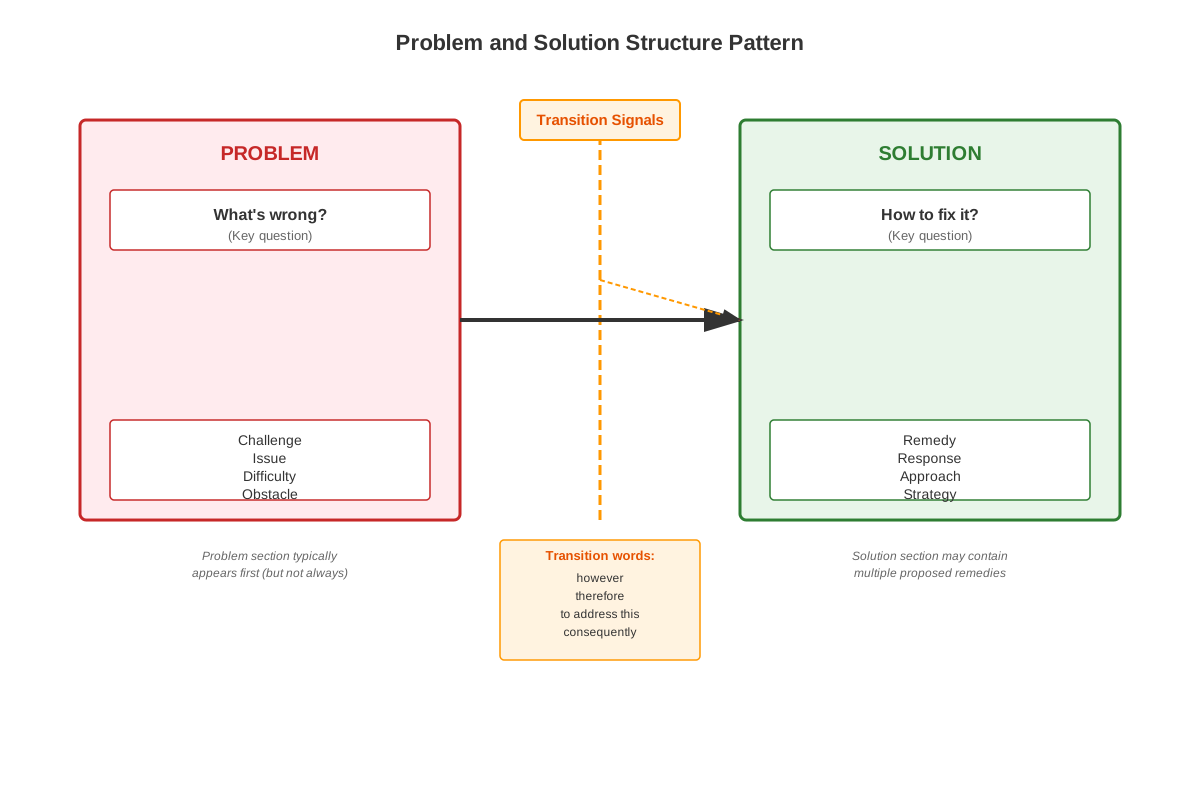
Problem and solution structure is an organizational pattern in which an author presents a difficulty, challenge, issue, or question, then discusses one or more approaches to addressing, resolving, or responding to that problem. This structure has two essential components: the problem (what's wrong, what needs improvement, what challenge exists) and the solution (how to fix it, what approaches might work, what responses are being tried).
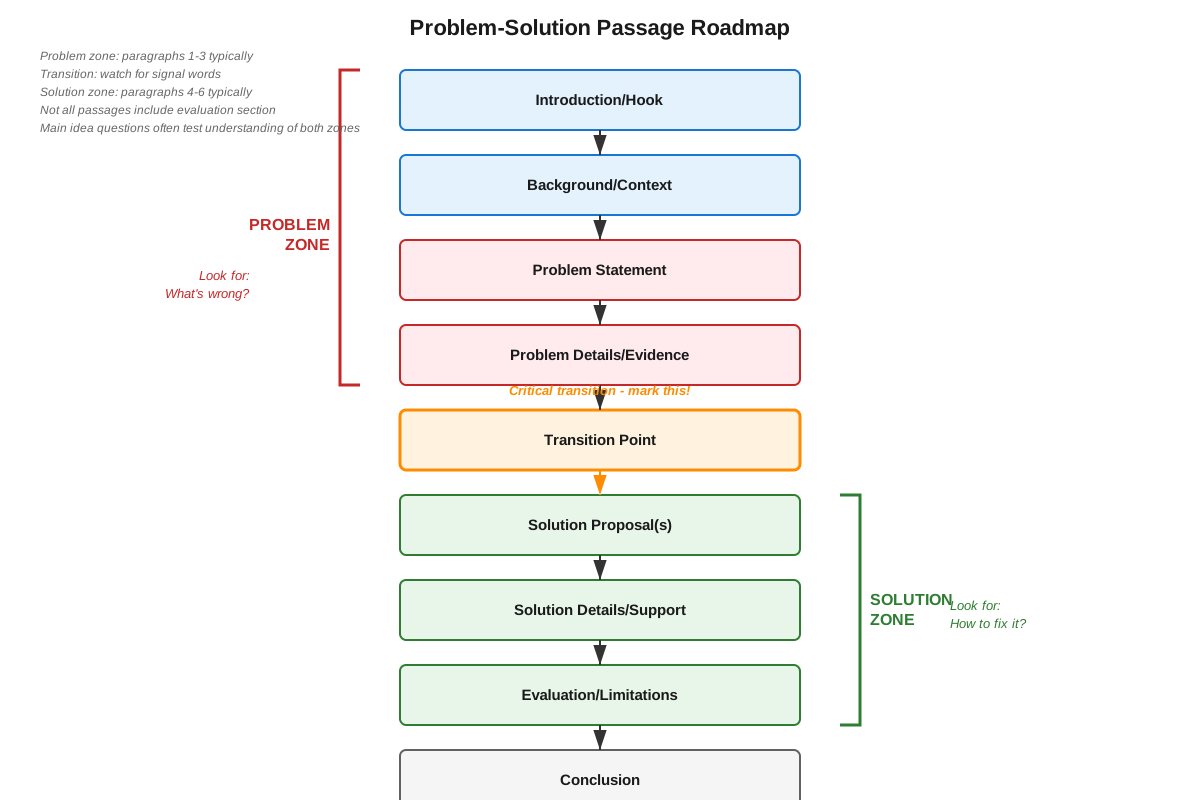
The problem component typically includes:
- Description of the issue or challenge
- Explanation of why it matters or who it affects
- Background information establishing the problem's significance
- Evidence demonstrating the problem's existence or severity
The solution component typically includes:
- One or multiple proposed approaches to addressing the problem
- Explanation of how each solution works or would work
- Evidence supporting the solution's effectiveness or feasibility
- Discussion of advantages, disadvantages, or limitations of solutions
Recognizing Problem and Solution Structure
Several textual clues signal that a passage uses problem and solution structure:
Problem indicators include words and phrases such as:
- "The challenge is..."
- "A major difficulty..."
- "The problem with..."
- "One obstacle to..."
- "Unfortunately..."
- "The issue of..."
- "Researchers struggled with..."
- "A significant concern..."
Solution indicators include words and phrases such as:
- "To address this..."
- "One approach is..."
- "Scientists developed..."
- "A possible solution..."
- "To solve this problem..."
- "Researchers found that..."
- "This can be remedied by..."
- "An effective strategy..."
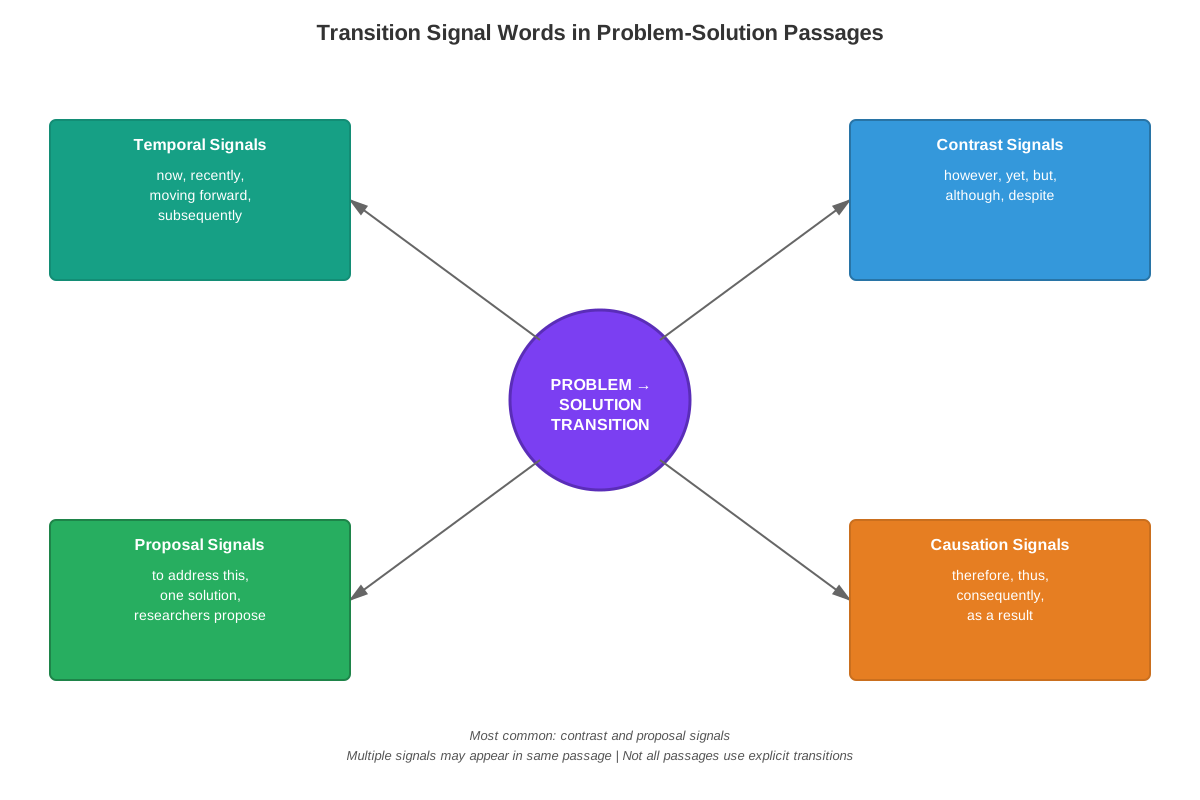
Transition signals between problem and solution sections include:
- "However..."
- "Fortunately..."
- "To overcome this..."
- "In response..."
- "As a result..."
- "Therefore..."
Variations of Problem and Solution Structure
Problem and solution structure appears in several common variations on the ACT:
| Variation | Description | Example Context |
|---|---|---|
| Single Problem, Single Solution | Author presents one problem and one primary solution | A passage about how scientists solved a specific research challenge |
| Single Problem, Multiple Solutions | Author presents one problem and several possible or attempted solutions | A passage discussing various approaches to addressing climate change |
| Multiple Problems, Corresponding Solutions | Author presents several related problems, each with its own solution | A passage about different challenges in urban planning and specific responses to each |
| Problem-Solution-Evaluation | Author presents problem, solution, then evaluates solution's effectiveness | A passage discussing a social program, its implementation, and its results |
| Implicit Problem-Solution | Problem or solution is implied rather than explicitly stated | A literary passage where a character's actions reveal solutions to unstated problems |
The Problem-Solution Relationship
Understanding how problems and solutions relate within a passage is crucial for ACT success. The solution must logically address the specific problem presented. When reading, students should ask:
- What exactly is the problem? Be specific about what needs to be fixed or addressed
- Who is affected by this problem? Understanding stakeholders helps comprehend the solution's importance
- What causes this problem? Knowing causes helps evaluate whether solutions address root issues
- What solution(s) are proposed? Identify all solutions discussed, not just the first one mentioned
- How does each solution address the problem? Trace the logical connection between problem and solution
- What evidence supports the solution's effectiveness? Look for data, examples, or reasoning
Problem and Solution in Different Passage Types
The way problem and solution structure manifests varies by passage type:
Natural Science passages typically present scientific problems (research questions, experimental challenges, natural phenomena requiring explanation) and solutions (research methods, discoveries, theories, technological innovations). Example: A passage might discuss the problem of measuring distant galaxies' speeds, then explain how astronomers developed spectroscopy as a solution.
Social Science passages often present social, economic, or political problems and discuss policy solutions, social movements, or institutional responses. Example: A passage might examine the problem of food deserts in urban areas, then discuss community garden initiatives and mobile grocery programs as solutions.
Humanities passages frequently present cultural, artistic, or philosophical problems and discuss creative, intellectual, or cultural solutions. Example: A passage might describe challenges facing traditional art forms in modern society, then discuss how artists have adapted their practices to remain relevant.
Prose Fiction passages use problem and solution structure through character challenges and their attempts to overcome obstacles. Example: A character faces a moral dilemma (problem) and must decide how to act (solution), with the narrative exploring this decision-making process.
Concept Relationships
Problem and solution structure connects intimately with several other reading comprehension concepts. The structure builds upon cause-and-effect relationships because problems often have causes that must be understood before solutions make sense. For example, if pollution (effect) is caused by industrial emissions (cause), then solutions must address those emissions.
The structure also relates to author's purpose. When an author uses problem and solution structure, their purpose is typically to inform readers about an issue and potential responses, or to persuade readers that certain solutions are preferable. Recognizing the structure helps students answer purpose questions more accurately.
Additionally, problem and solution structure connects to main idea identification. The main idea of a problem-solution passage typically encompasses both components: "The passage discusses [problem] and explains how [solution] addresses it." Students who recognize the structure can more quickly formulate accurate main idea statements.
The relationship map flows as follows:
Identifying problem indicators → Recognizing the problem section → Anticipating a solution section → Locating solution indicators → Understanding problem-solution relationship → Answering structure, purpose, and main idea questions
Understanding this structure also enables students to better comprehend passage organization questions that ask about the function of specific paragraphs or sections. In problem-solution passages, early paragraphs typically establish the problem while later paragraphs present solutions, making paragraph function more predictable.
High-Yield Facts
⭐ Problem and solution structure appears in 40-50% of ACT Reading passages across all four passage types
⭐ The problem section typically appears before the solution section, usually in the first 1-3 paragraphs
⭐ Transition words like "however," "fortunately," and "to address this" signal the shift from problem to solution
⭐ ACT questions often ask about the "main problem" or "primary solution," requiring students to distinguish main points from supporting details
⭐ Multiple solutions may be presented, and questions may ask students to identify all solutions or compare their effectiveness
- Problem and solution structure can be combined with other organizational patterns like chronological order or compare-contrast
- The solution section may include limitations, drawbacks, or challenges to implementing the solution
- Some passages present problems without fully resolved solutions, ending with ongoing challenges or future directions
- Authors may use problem and solution structure to build an argument, with the solution representing their thesis
- Questions about "author's purpose" in problem-solution passages typically have answers related to explaining, informing, or advocating for solutions
Quick check — test yourself on Problem and solution structure so far.
Try Flashcards →Common Misconceptions
Misconception: Every passage has a clear problem and solution structure → Correction: Only some passages use this structure. Others may use chronological order, compare-contrast, cause-effect, or descriptive organization. Students must identify which structure applies to each specific passage.
Misconception: The problem is always explicitly stated in the first paragraph → Correction: While problems often appear early, they may be introduced gradually across multiple paragraphs, or even implied rather than directly stated. Students should read the entire passage before concluding where the problem is presented.
Misconception: There is always one correct solution presented as superior to others → Correction: Many passages present multiple solutions without declaring one definitively better, or discuss solutions that are partial or imperfect. The ACT tests comprehension of what the passage actually says, not assumptions about ideal solutions.
Misconception: Problem and solution structure only appears in science passages → Correction: This structure appears across all four passage types, including literary narratives where characters face problems and work toward solutions, and humanities passages discussing cultural or artistic challenges.
Misconception: If a passage mentions a problem, it must use problem and solution structure → Correction: A passage might mention a problem as part of a cause-effect discussion, historical narrative, or descriptive explanation without organizing the entire passage around problem-solution structure. The structure requires substantial focus on both problem and solution components.
Misconception: The solution section always comes immediately after the problem section → Correction: Authors may return to discussing the problem after introducing solutions, or alternate between problem aspects and solution aspects. The structure is not always strictly linear.
Worked Examples
Example 1: Natural Science Passage
Passage excerpt: "For decades, astronomers struggled to measure the precise distances to far-away galaxies. Traditional methods like parallax, which works well for nearby stars, becomes useless for objects millions of light-years away. The angles involved are simply too small to measure accurately, even with powerful telescopes. This limitation prevented scientists from understanding the true scale of the universe and the rate at which it expands.
However, in the early 20th century, astronomer Henrietta Leavitt discovered a breakthrough solution. She found that certain variable stars, called Cepheid variables, have a predictable relationship between their brightness and the period of their brightness cycle. By observing how long it takes a Cepheid to complete one cycle of brightening and dimming, astronomers could calculate its true brightness. Comparing this true brightness to how bright it appears from Earth reveals its distance. This method, called the 'cosmic distance ladder,' revolutionized astronomy and enabled Edwin Hubble to demonstrate that the universe is expanding."
Question: The passage is primarily concerned with:
A) Explaining why parallax is an effective measurement technique
B) Describing a problem in astronomy and how it was solved
C) Comparing different types of variable stars
D) Arguing that the universe is expanding
Analysis:
- Step 1: Identify the structure. The first paragraph presents a problem (difficulty measuring galactic distances) with problem indicators like "struggled," "becomes useless," and "limitation prevented."
- Step 2: The second paragraph introduces a solution with the transition word "However" and solution indicators like "breakthrough solution" and "revolutionized."
- Step 3: Evaluate answer choices based on problem-solution structure:
- Choice A focuses only on parallax, missing the solution component
- Choice B accurately captures both problem (measuring distances) and solution (Leavitt's discovery)
- Choice C mentions variable stars but misses the problem-solution framework
- Choice D focuses on the universe expanding, which is a result mentioned but not the passage's primary concern
- Step 4: Select B as it best describes the problem-solution structure
Connection to learning objectives: This example demonstrates how to identify problem and solution structure (Objective 1), apply the structure to answer a main purpose question (Objective 3), and recognize transition words signaling structural shifts (Objective 5).
Example 2: Social Science Passage
Passage excerpt: "Urban food deserts—neighborhoods where residents lack access to affordable, nutritious food—pose a significant public health challenge. In many low-income areas, residents must travel several miles to reach a full-service grocery store, while fast-food restaurants and convenience stores selling processed foods dominate the local landscape. This limited access contributes to higher rates of obesity, diabetes, and heart disease in affected communities. Transportation barriers compound the problem, as many residents lack personal vehicles and public transit options may be limited.
Community organizations have developed several innovative approaches to address food deserts. Mobile grocery stores bring fresh produce directly to underserved neighborhoods, operating on regular schedules so residents can plan their shopping. Community gardens transform vacant lots into productive spaces where residents grow their own vegetables, simultaneously providing food and building community connections. Some cities have also incentivized grocery stores to open in food deserts through tax breaks and grants, though this approach has shown mixed results depending on local economic conditions."
Question: According to the passage, which of the following is NOT mentioned as a solution to food deserts?
A) Mobile grocery stores
B) Community gardens
C) Government subsidies for grocery stores
D) Mandatory nutrition education programs
Analysis:
- Step 1: Recognize this is a problem-solution passage with multiple solutions presented
- Step 2: Identify the problem section (first paragraph) and solution section (second paragraph)
- Step 3: List all solutions explicitly mentioned: mobile grocery stores (mentioned), community gardens (mentioned), tax breaks and grants for grocery stores (mentioned—this matches choice C's "government subsidies")
- Step 4: Identify which choice is NOT mentioned: nutrition education programs are never discussed
- Step 5: Select D as the correct answer
Connection to learning objectives: This example shows how to apply problem and solution structure to detail questions (Objective 3), distinguish between multiple solutions (Objective 4), and locate specific information based on structural understanding (Objective 6).
Exam Strategy
When approaching ACT Reading questions involving problem and solution structure, follow this strategic process:
During initial reading (3-4 minutes per passage):
- Watch for problem indicators in the first 2-3 paragraphs
- Mark or mentally note where the problem section ends and solution section begins
- Identify whether the passage presents one solution or multiple solutions
- Note any transition words signaling structural shifts
Trigger words to watch for in questions:
- "The main problem discussed..."
- "According to the passage, one solution..."
- "The author's primary purpose..."
- "The passage is best described as..."
- "The function of paragraph X is to..."
- "Which of the following is NOT mentioned as a way to address..."
Process-of-elimination strategy:
- For main idea/purpose questions, eliminate choices that mention only the problem or only the solution without acknowledging both components
- For detail questions about solutions, eliminate choices that describe the problem instead
- For structure questions, eliminate choices that misidentify the organizational pattern (e.g., calling it "chronological" when it's problem-solution)
- Watch for choices that are too narrow (mentioning only one solution when multiple exist) or too broad (claiming the passage discusses topics it doesn't)
Time allocation advice:
- Spend 15-20 seconds after reading to mentally summarize: "This passage discusses [problem] and explains [solution(s)]"
- For questions about passage structure or main purpose, refer back to your mental map of where problem and solution sections appear rather than re-reading the entire passage
- Budget 30-40 seconds per question, but structure questions should take less time (20-30 seconds) if you've identified the pattern correctly
Exam Tip: If a question asks about "the main problem" or "primary solution," the correct answer will typically be stated or implied in multiple places throughout the passage, not mentioned only once in passing.
Memory Techniques
PS-TIPS Mnemonic for identifying problem and solution structure:
- Problem indicators (challenge, difficulty, issue, obstacle)
- Solution indicators (approach, method, strategy, remedy)
- Transition words (however, fortunately, therefore)
- Initial paragraphs (problems usually appear early)
- Purpose connection (author wants to inform about or advocate for solutions)
- Structural questions (watch for questions asking about passage organization)
Visualization Strategy: Picture a bridge spanning a river. The problem is one riverbank (where you start), the solution is the opposite riverbank (where you want to go), and the bridge represents the author's explanation of how to get from problem to solution. This mental image helps remember that problem and solution are connected but distinct components.
The "Two-Box Method": As you read, mentally place information into two boxes:
- Box 1: Everything about the PROBLEM (what's wrong, why it matters, who's affected)
- Box 2: Everything about the SOLUTION (what's being tried, how it works, how effective it is)
This mental organization makes it easier to locate information when answering questions.
Acronym for Solution Types: Remember MITE for common solution categories:
- Methods (new techniques or approaches)
- Innovations (technological or creative solutions)
- Theories (new ways of understanding the problem)
- Efforts (actions taken by individuals or organizations)
Summary
Problem and solution structure is a fundamental organizational pattern on the ACT Reading section, appearing in approximately half of all passages across all four passage types. This structure presents a challenge, issue, or difficulty, then discusses one or more approaches to addressing that challenge. Recognizing this pattern enables students to predict where information will appear, understand the author's purpose, and efficiently answer questions about passage organization, main ideas, and specific details. The problem section typically appears in early paragraphs and uses indicators like "challenge," "difficulty," and "obstacle," while the solution section follows with indicators like "approach," "method," and "strategy." Transition words such as "however," "fortunately," and "to address this" signal shifts between sections. Students must distinguish this structure from other patterns, identify whether single or multiple solutions are presented, and understand the logical relationship between problems and their proposed solutions. Mastering this structure improves both reading efficiency and accuracy on structure-related questions, which appear 2-3 times per test and influence answers to many additional questions about purpose and main ideas.
Key Takeaways
- Problem and solution structure appears in 40-50% of ACT Reading passages and directly influences 2-3 questions per test while indirectly affecting many more
- The structure has two essential components: the problem (what's wrong) and the solution (how to address it), typically presented in that order
- Specific indicator words and transition phrases signal problem sections, solution sections, and shifts between them
- Multiple variations exist, including single problem with multiple solutions, and passages may evaluate solution effectiveness
- Recognizing this structure improves reading efficiency, helps predict where information appears, and enables faster, more accurate answering of questions about purpose, main ideas, and passage organization
- Problem and solution structure connects to other key skills including identifying cause-effect relationships, determining author's purpose, and understanding paragraph function
- Strategic reading involves marking structural transitions, mentally summarizing the problem-solution relationship, and using this framework to eliminate incorrect answer choices
Related Topics
Cause and Effect Structure: Understanding how causes lead to effects helps students distinguish between cause-effect passages and problem-solution passages, as problems often have causes that must be addressed. Mastering problem-solution structure provides a foundation for recognizing when authors focus on causal relationships versus solutions.
Compare and Contrast Structure: This organizational pattern presents similarities and differences between two or more subjects. Distinguishing compare-contrast from problem-solution structure is essential, as some passages compare different solutions to the same problem.
Author's Purpose and Tone: Recognizing problem and solution structure directly supports identifying author's purpose, as authors using this structure typically aim to inform readers about issues and responses or persuade them toward particular solutions.
Main Idea and Supporting Details: Problem-solution passages have main ideas that encompass both components. Mastering this structure enables students to formulate more accurate main idea statements and distinguish main solutions from supporting details.
Paragraph Function and Passage Organization: Understanding how individual paragraphs contribute to overall passage structure builds on problem-solution recognition, as students learn to identify whether specific paragraphs establish problems, propose solutions, or evaluate effectiveness.
Practice CTA
Now that you understand problem and solution structure, it's time to apply this knowledge! Work through the practice questions to test your ability to identify this structure in ACT-style passages and answer related questions accurately. The flashcards will help reinforce key indicators, transition words, and strategic approaches. Remember, recognizing organizational patterns is a skill that improves with practice—each passage you analyze strengthens your ability to quickly identify structure and use it to your advantage. You've built a solid foundation; now transform that knowledge into test-day success through focused practice!
Sign up free to keep reading
Create a free AnvayaPrep account to finish this ACT guide on Problem and solution structure — plus flashcards and practice questions.