Overview
In scientific research and experimental design, the control group serves as the baseline standard against which all experimental results are measured. This fundamental concept appears frequently on the ACT Science test, particularly in Research Summaries passages where students must analyze experimental procedures and interpret data. Understanding control groups is not merely about identifying which group received no treatment—it requires recognizing how scientists isolate variables, establish causation, and ensure that observed effects result from the experimental manipulation rather than confounding factors.
The ACT control group questions test whether students can distinguish between experimental and control conditions, understand why controls are necessary, and interpret data by comparing treatment groups to their appropriate baseline. These questions often appear in passages describing experiments with multiple trials, biological studies, chemistry investigations, or physics demonstrations. Students who master this concept gain a significant advantage because control group questions appear in approximately 15-20% of Research Summaries passages, making this a high-yield topic that directly impacts overall Science scores.
Control groups connect to broader scientific principles including experimental design, variable manipulation, data interpretation, and the scientific method itself. This topic serves as a foundation for understanding how scientists establish validity in their research and how students should approach any passage describing an experiment. Mastery of control groups enables students to quickly identify the purpose of different experimental conditions, predict which comparisons will be meaningful, and eliminate incorrect answer choices that misinterpret the role of baseline measurements.
Learning Objectives
- [ ] Identify when a control group is being tested in ACT Science passages
- [ ] Explain the core rule or strategy behind control group design and implementation
- [ ] Apply control group concepts to ACT-style questions accurately
- [ ] Distinguish between different types of control groups (negative, positive, and placebo controls)
- [ ] Analyze experimental designs to determine whether an appropriate control group exists
- [ ] Evaluate the validity of conclusions based on proper control group comparisons
- [ ] Predict which data comparisons will be most meaningful based on control group identification
Prerequisites
- Basic understanding of variables: Students must distinguish between independent variables (what experimenters change) and dependent variables (what experimenters measure) because control groups involve holding certain variables constant.
- Scientific method fundamentals: Knowledge of hypothesis testing and experimental procedures provides context for why control groups are necessary in research design.
- Data interpretation skills: The ability to read tables, graphs, and charts is essential because control group questions require comparing data across different experimental conditions.
- Cause and effect reasoning: Understanding how to establish causal relationships helps students recognize that control groups eliminate alternative explanations for observed results.
Why This Topic Matters
Control groups represent one of the most fundamental concepts in scientific research, appearing across all scientific disciplines from medicine to physics. In real-world applications, control groups enable researchers to determine whether new medications work better than placebos, whether teaching methods improve student outcomes, whether agricultural treatments increase crop yields, and whether engineering modifications enhance performance. Without proper controls, scientists cannot distinguish between effects caused by their experimental manipulation and effects caused by natural variation, time, or observer bias.
On the ACT Science test, control group questions appear in approximately 2-3 questions per exam, typically within Research Summaries passages. These questions may ask students to identify which experimental group serves as the control, explain why a particular control was chosen, predict what would happen without a control group, or determine which data comparison is most appropriate. The ACT frequently tests this concept because it assesses scientific reasoning rather than content memorization—students must think like scientists rather than simply recall facts.
Common question formats include: "Which of the following groups served as the control?" "The purpose of Group 1 was most likely to..." "To determine the effect of [variable], the scientists should compare..." and "Which group provides the baseline for comparison?" These questions often appear early in a passage set, making them high-value targets for students who can quickly identify control conditions and move efficiently through the remaining questions.
Core Concepts
Definition and Purpose of Control Groups
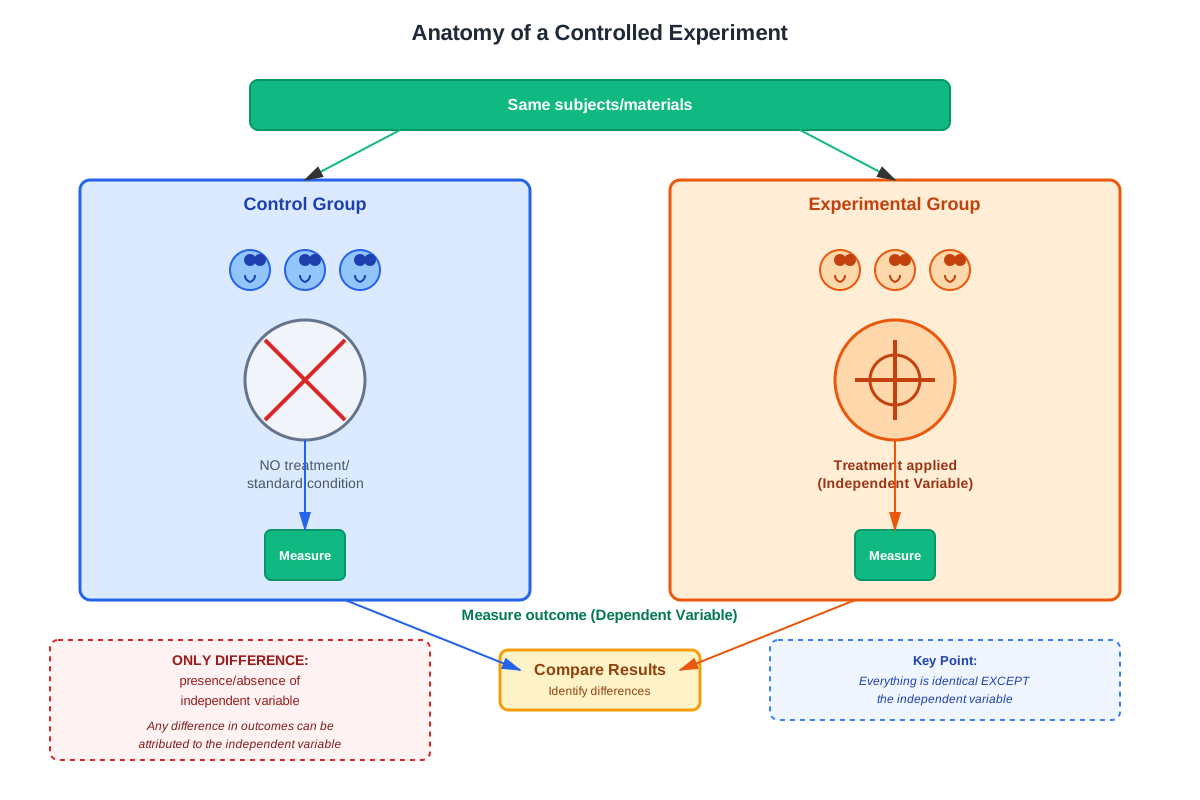
A control group is the experimental group that does not receive the treatment or manipulation being tested, serving as a baseline for comparison with experimental groups. The primary purpose of a control group is to isolate the effect of the independent variable by providing a reference point that shows what happens when the experimental treatment is absent. Without a control group, researchers cannot determine whether observed changes result from their manipulation or from other factors such as time passage, environmental conditions, or measurement procedures.
Control groups must be identical to experimental groups in every way except for the single variable being tested. This principle, called "holding variables constant," ensures that any differences in outcomes can be attributed to the experimental treatment rather than confounding variables. For example, if researchers test whether a new fertilizer increases plant growth, the control group receives no fertilizer but must have identical soil, water, light, and temperature conditions as the experimental group.
Types of Control Groups
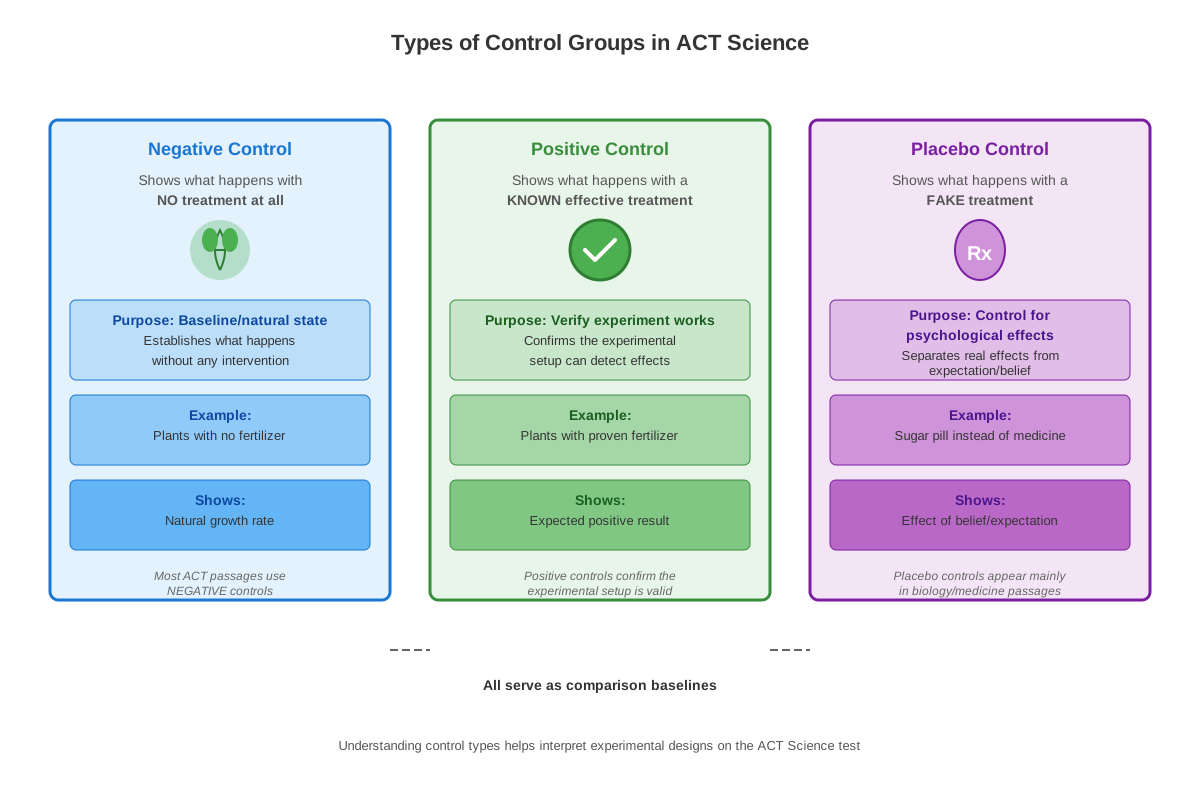
| Control Type | Description | Example | ACT Relevance |
|---|---|---|---|
| Negative Control | Receives no treatment; shows natural baseline | Plants with no fertilizer | Most common on ACT |
| Positive Control | Receives a treatment known to produce an effect; validates experimental setup | Plants with proven fertilizer | Appears in validation studies |
| Placebo Control | Receives an inactive treatment that appears identical to the real treatment | Sugar pill in drug trials | Common in biological passages |
| Vehicle Control | Receives the delivery mechanism without the active ingredient | Saline injection without drug | Appears in chemistry/biology |
Identifying Control Groups in ACT Passages
The ACT Science test presents control groups in various ways, and students must recognize them regardless of labeling. Sometimes passages explicitly state "Group 1 served as the control," but more often, students must infer the control group from the experimental description. Key indicators include:
- Groups receiving "no treatment," "0 amount," or "standard conditions": When one group receives zero units of the independent variable, that group typically serves as the control.
- Groups described as "baseline," "reference," or "comparison": These terms signal that the group provides the standard against which other groups are measured.
- Groups with natural or unchanged conditions: If one group continues normal procedures while others receive modifications, the unchanged group is usually the control.
- The group that isolates the variable: When analyzing which group serves as the control, ask "Which group allows me to see the effect of the independent variable by showing what happens without it?"
Control Groups Versus Experimental Groups
Understanding the distinction between control and experimental groups is essential for ACT success. Experimental groups (also called treatment groups) receive the manipulation being tested—they experience different levels or types of the independent variable. In contrast, the control group experiences either no manipulation or a standard/baseline manipulation.
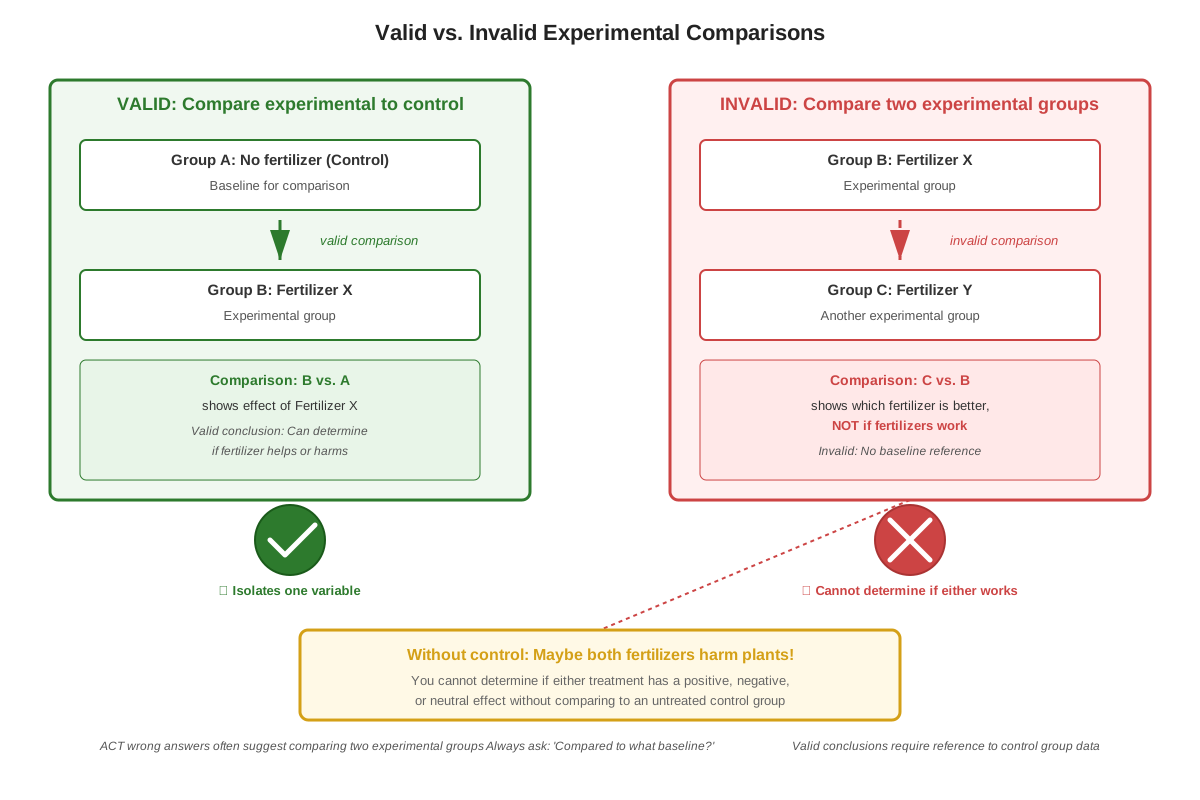
Consider an experiment testing three concentrations of a growth hormone on bacterial reproduction. If Group A receives 0 mg/L, Group B receives 5 mg/L, and Group C receives 10 mg/L, then Group A serves as the control because it shows bacterial growth without the hormone. Groups B and C are experimental groups that allow comparison of different hormone concentrations. To determine the hormone's effect, scientists compare Groups B and C to Group A, not to each other.
The Role of Control Groups in Establishing Causation
Control groups enable scientists to establish causal relationships rather than mere correlations. When an experimental group shows different results than the control group, and all other variables were held constant, scientists can conclude that the independent variable caused the observed difference. This logical structure appears frequently in ACT questions that ask about the purpose of experimental design or the validity of conclusions.
For example, if plants receiving fertilizer grow taller than control plants, and both groups had identical conditions otherwise, the fertilizer likely caused the increased growth. Without the control group, researchers couldn't determine whether the plants grew taller due to the fertilizer, the passage of time, seasonal changes, or the act of being measured. The control group shows what would have happened naturally, allowing isolation of the fertilizer's specific effect.
Multiple Control Groups and Complex Designs
Advanced ACT passages sometimes feature multiple control groups or complex experimental designs. A study might include both a negative control (no treatment) and a positive control (known effective treatment) to validate both the experimental procedure and the measurement techniques. Students must recognize that different control groups serve different purposes and that comparisons should be made to the appropriate control.
In factorial designs testing multiple variables simultaneously, each variable requires its own control condition. For instance, an experiment testing both temperature and pH might include a group at standard temperature and standard pH, serving as the control for both variables. ACT questions on such passages test whether students can identify which comparisons isolate which variables.
Concept Relationships
The control group concept connects directly to the broader framework of experimental design and the scientific method. The relationship flows as follows:
Research Question → Hypothesis → Experimental Design → Variable Identification → Control Group Selection → Data Collection → Comparison to Control → Conclusion
Control groups depend on proper variable identification—students must first recognize the independent variable (what's being manipulated) before identifying which group lacks that manipulation. This connection to variables makes control groups a bridge concept between basic scientific terminology and advanced data interpretation.
The relationship between control groups and data analysis is bidirectional: control groups inform which data comparisons are meaningful, while data patterns help confirm which group actually served as the control. When analyzing graphs or tables, students should identify the control group first, then examine how experimental groups differ from that baseline.
Control groups also connect to the concept of validity in research. Internal validity (whether the experiment actually tests what it claims to test) depends on having an appropriate control group. External validity (whether results generalize to other situations) relates to whether the control group represents realistic baseline conditions. ACT passages occasionally test these connections by asking about experimental limitations or improvements.
High-Yield Facts
⭐ The control group receives no treatment or a baseline/standard treatment, allowing comparison with experimental groups that receive the manipulation being tested.
⭐ To identify the control group, look for the group with zero amount of the independent variable, no treatment, or standard/natural conditions.
⭐ The purpose of a control group is to isolate the effect of the independent variable by showing what happens without the experimental manipulation.
⭐ All groups in an experiment (control and experimental) must be identical except for the independent variable being tested.
⭐ Meaningful comparisons involve comparing experimental groups to the control group, not necessarily to each other.
- Control groups can be negative (no treatment), positive (known effective treatment), or placebo (inactive treatment that appears real).
- Multiple experimental groups can share a single control group if they're testing different levels of the same variable.
- The absence of an appropriate control group is a major flaw in experimental design that limits the validity of conclusions.
- Control groups must be measured at the same times and in the same ways as experimental groups to ensure valid comparisons.
- In time-series experiments, the control group shows how the dependent variable changes naturally over time without intervention.
- When passages describe "baseline measurements" taken before treatment begins, these serve as temporal controls showing initial conditions.
- The control group should be large enough to provide reliable baseline data—sample size matters for both control and experimental groups.
Quick check — test yourself on Control group so far.
Try Flashcards →Common Misconceptions
Misconception: The control group is always labeled "Group 1" or "Control Group" in ACT passages.
Correction: Control groups may be labeled with any designation (Group A, Trial 3, Sample 2, etc.). Students must identify the control based on experimental conditions, not labels. Look for which group receives no treatment or baseline conditions.
Misconception: The control group doesn't receive anything or isn't measured.
Correction: The control group is fully measured and often receives standard treatment, normal conditions, or a placebo. It's an active part of the experiment that provides essential comparison data. The control group differs from experimental groups only in not receiving the specific manipulation being tested.
Misconception: Every experiment has exactly one control group.
Correction: Experiments may have multiple control groups (negative and positive controls), no clearly defined control group (in some observational studies), or shared controls across multiple experimental conditions. Students must analyze the specific experimental design presented.
Misconception: You should always compare experimental groups to each other rather than to the control.
Correction: The primary comparison in most experiments is between each experimental group and the control group. This comparison isolates the effect of different treatment levels. Comparing experimental groups to each other shows relative differences but doesn't establish the baseline effect.
Misconception: If a group receives the smallest amount of a substance, it's automatically the control group.
Correction: The control group typically receives zero amount of the independent variable, not just the smallest amount. A group receiving a small dose is still an experimental group. However, in some designs testing whether "any amount" has an effect, the zero-amount group is the control while all other amounts (including small ones) are experimental groups.
Misconception: Control groups are only necessary in biology or medicine experiments.
Correction: Control groups appear across all scientific disciplines on the ACT, including physics (testing equipment modifications), chemistry (testing reaction conditions), and earth science (testing environmental factors). Any experiment manipulating a variable benefits from a control group.
Worked Examples
Example 1: Plant Growth Experiment
Passage Summary: Scientists investigated whether different concentrations of nitrogen fertilizer affect tomato plant height. They divided 40 genetically identical tomato seedlings into four groups of 10 plants each. All plants received identical amounts of water, sunlight, and were grown in the same greenhouse. The groups received the following treatments:
- Group 1: 0 mg/L nitrogen
- Group 2: 50 mg/L nitrogen
- Group 3: 100 mg/L nitrogen
- Group 4: 150 mg/L nitrogen
After 30 days, scientists measured plant height in centimeters.
Question: Which group served as the control group in this experiment?
Step 1 - Identify the independent variable: The independent variable is nitrogen fertilizer concentration (what the scientists manipulated).
Step 2 - Identify which group lacks the manipulation: Group 1 received 0 mg/L nitrogen—no fertilizer at all.
Step 3 - Verify other conditions are constant: The passage states all plants received identical water, sunlight, and greenhouse conditions. Only nitrogen concentration varied.
Step 4 - Confirm the control group's purpose: Group 1 shows how tomato plants grow naturally without added nitrogen, providing the baseline for comparison.
Answer: Group 1 served as the control group because it received no nitrogen fertilizer (0 mg/L), allowing scientists to compare the effect of different nitrogen concentrations against natural growth without fertilizer.
Connection to Learning Objectives: This example demonstrates identifying when a control group is being tested (Learning Objective 1) and explaining the core strategy behind control group design (Learning Objective 2). The control group isolates the variable by showing what happens without the experimental manipulation.
Example 2: Enzyme Activity Study
Passage Summary: Researchers studied how temperature affects the enzyme catalase's ability to break down hydrogen peroxide. They prepared five test tubes, each containing 5 mL of hydrogen peroxide solution and 1 mL of catalase enzyme. The test tubes were maintained at different temperatures:
- Tube A: 0°C
- Tube B: 20°C
- Tube C: 37°C
- Tube D: 60°C
- Tube E: 80°C
A sixth tube (Tube F) contained 5 mL of hydrogen peroxide and 1 mL of water (no enzyme) at 37°C. Researchers measured oxygen gas production in each tube over 5 minutes.
Question: Based on the experimental design, which comparison would best show the effect of temperature on enzyme activity?
Step 1 - Identify all control elements: Tube F serves as a negative control (no enzyme) showing whether hydrogen peroxide breaks down spontaneously. However, the question asks about temperature effects, not enzyme presence.
Step 2 - Determine the appropriate baseline for temperature comparison: Since all tubes A-E contain enzyme but differ in temperature, there's no single "control temperature." However, 37°C (Tube C) represents normal human body temperature and typical laboratory conditions, making it the standard reference point.
Step 3 - Identify the meaningful comparison: To show temperature effects, compare each temperature's oxygen production to the baseline temperature (37°C) or examine the pattern across all temperatures.
Step 4 - Consider what Tube F reveals: Tube F (no enzyme at 37°C) shows background oxygen production without enzyme activity. To isolate enzyme activity at any temperature, subtract Tube F's oxygen production from that temperature's tube.
Answer: The best comparison would be between Tubes A-E (different temperatures with enzyme) and Tube F (no enzyme control), with Tube C (37°C) serving as the standard reference temperature. This shows both that the enzyme causes oxygen production (by comparing to Tube F) and how temperature affects that enzyme activity (by comparing different temperatures to the 37°C baseline).
Connection to Learning Objectives: This example demonstrates applying control group concepts to complex ACT-style questions (Learning Objective 3) and distinguishing between different types of controls (Learning Objective 4). It shows that experiments may have multiple control elements serving different purposes.
Exam Strategy
When approaching ACT Science questions about control groups, follow this systematic process:
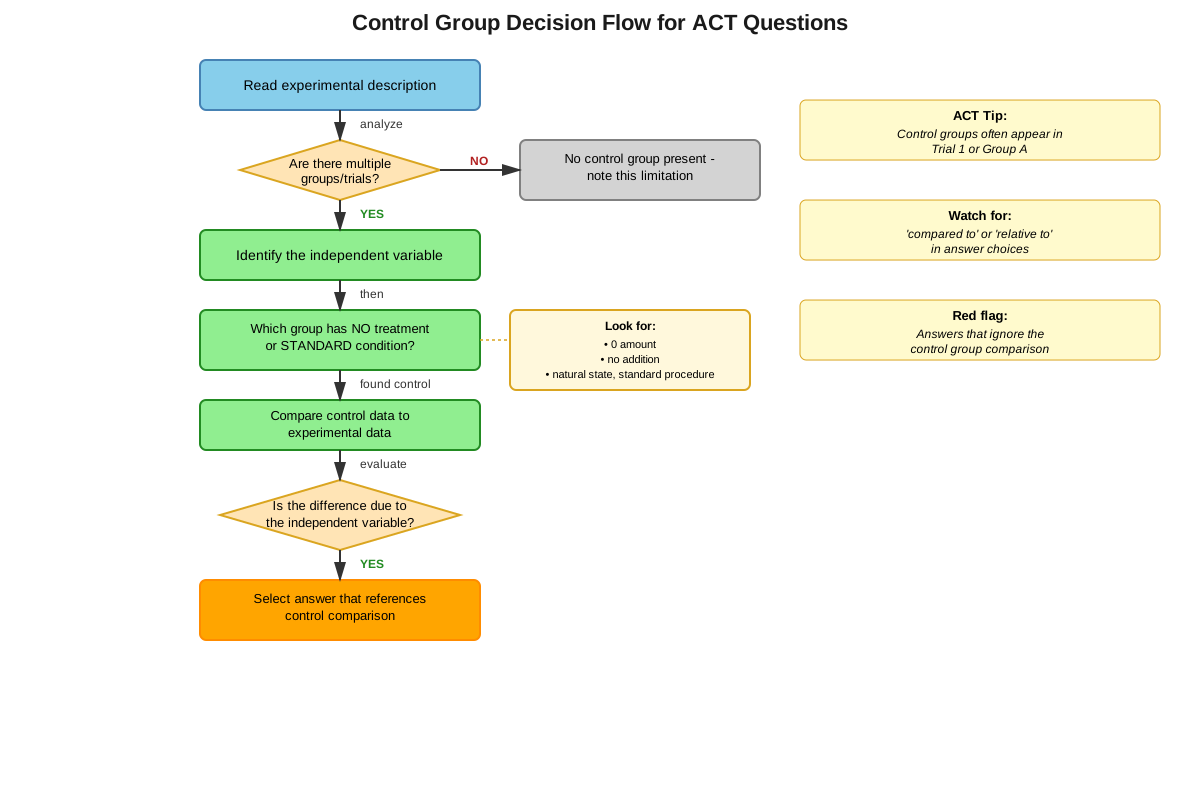
Step 1 - Quickly scan for explicit control group mentions: Some passages directly state which group is the control. If you see phrases like "served as the control," "control group," or "baseline group," note that information immediately.
Step 2 - If not explicit, identify the independent variable: Ask yourself "What is the scientist changing or manipulating?" This variable is key to finding the control.
Step 3 - Look for the zero-level or no-treatment group: The control group typically receives zero amount of the independent variable or continues under standard/natural conditions.
Step 4 - Verify constant conditions: Confirm that all other variables (dependent variables, environmental conditions, measurement procedures) remain the same across all groups.
Exam Tip: Watch for trigger words that signal control groups: "baseline," "standard conditions," "no treatment," "0 mg," "natural," "unchanged," "reference," and "comparison group."
Time-saving strategy: Control group questions often appear early in a passage set and are typically straightforward once you identify the control. Spend 15-20 seconds identifying the control group when you first read the passage, then use that information to answer multiple questions quickly.
Process of elimination tips specific to control groups:
- Eliminate answer choices describing groups that receive treatment or non-zero amounts of the independent variable
- Eliminate choices that describe groups with different conditions than the experimental groups (these aren't valid controls)
- Eliminate choices that confuse the independent and dependent variables
- When asked about the "purpose" of a group, eliminate dramatic or overly specific purposes—control groups have the simple purpose of providing baseline comparison
Common trap answers: The ACT often includes answer choices describing experimental groups with the lowest (but non-zero) treatment level. Remember that "lowest" doesn't mean "control"—the control typically has zero treatment.
Memory Techniques
Mnemonic for Control Group Purpose - "BASELINE":
- Baseline for comparison
- All other variables constant
- Shows natural conditions
- Enables isolation of variable
- Lacks the experimental treatment
- Identifies cause and effect
- Necessary for valid conclusions
- Experimental groups compared to it
Visualization Strategy: Picture a scientific experiment as a race where the control group stands at the starting line (baseline) while experimental groups run forward (receive treatment). To know how far the runners traveled, you must know where they started—that's the control group's role.
The "Zero Hero" Acronym: The control group is the ZERO HERO:
- Zero treatment or baseline conditions
- Everything else held constant
- Reference point for comparison
- Observed to show natural state
Comparison Memory Aid: Remember "C to C"—Compare experimental groups to the Control. This reminds you that meaningful comparisons involve the control group as the reference point.
Summary
Control groups form the foundation of valid experimental design by providing a baseline for comparison that isolates the effect of the independent variable. On the ACT Science test, students must quickly identify which experimental group serves as the control by recognizing groups that receive no treatment, zero amount of the manipulated variable, or standard baseline conditions. The control group must be identical to experimental groups in all ways except for the specific variable being tested, ensuring that observed differences result from the experimental manipulation rather than confounding factors. Understanding control groups enables students to interpret experimental data correctly, determine which comparisons are meaningful, and evaluate the validity of scientific conclusions. This high-yield concept appears in approximately 15-20% of Research Summaries passages and connects to broader principles of experimental design, variable manipulation, and causal reasoning that underpin scientific thinking across all disciplines.
Key Takeaways
- The control group receives no treatment or baseline conditions, serving as the reference point for measuring experimental effects
- Identify control groups by looking for zero amounts of the independent variable, no treatment, or standard/natural conditions
- All experimental groups should be compared to the control group to determine the effect of the independent variable
- Control groups must be identical to experimental groups except for the single variable being tested
- The purpose of a control group is to isolate the variable's effect by showing what happens without experimental manipulation
- Multiple types of controls exist (negative, positive, placebo), each serving specific purposes in experimental validation
- Control group questions are high-yield on the ACT, appearing in multiple questions per exam and testing scientific reasoning skills
Related Topics
Experimental Design and Variables: Understanding independent, dependent, and controlled variables provides the foundation for recognizing why control groups are necessary and how they function within the broader experimental framework. Mastering control groups enables deeper analysis of complete experimental designs.
Data Interpretation and Graph Analysis: Once students identify the control group, they must compare control and experimental data across tables and graphs. This skill builds on control group knowledge to extract meaningful conclusions from scientific data.
Scientific Method and Hypothesis Testing: Control groups represent one component of the scientific method's systematic approach to testing hypotheses. Understanding how control groups fit into the larger process of scientific inquiry strengthens overall scientific reasoning.
Validity and Reliability in Research: The presence and quality of control groups directly affect experimental validity. Advanced students can explore how control group design influences whether experiments truly test their intended hypotheses and whether results can be trusted.
Statistical Significance and Sample Size: While the ACT doesn't require statistical calculations, understanding that control groups must be large enough to provide reliable baseline data connects to broader concepts of scientific rigor and data quality.
Practice CTA
Now that you've mastered the concept of control groups, it's time to apply this knowledge to ACT-style questions. The practice questions and flashcards will challenge you to identify control groups in various experimental contexts, explain their purposes, and use them to interpret data correctly. Remember that control group questions are high-yield—investing time in practice now will pay dividends on test day. Each practice question you complete strengthens your ability to think like a scientist and approach Research Summaries passages with confidence. You've built a strong foundation; now reinforce it through deliberate practice!
Sign up free to keep reading
Create a free AnvayaPrep account to finish this ACT guide on Control group — plus flashcards and practice questions.