Overview
Equality is a foundational mathematical concept that appears frequently throughout the GMAT Data Insights section, particularly in Data Sufficiency questions. At its core, equality represents a relationship between two mathematical expressions that have the same value. While this may seem straightforward, the GMAT tests equality in sophisticated ways that require students to recognize when information is sufficient to determine whether two quantities are equal, to manipulate equations while preserving equality, and to understand the logical implications of equal relationships. Mastering equality concepts is not merely about solving equations—it's about understanding what information is necessary and sufficient to establish or disprove equal relationships between variables and expressions.
The importance of equality in GMAT Data Insights cannot be overstated. Data Sufficiency questions frequently hinge on whether the given statements provide enough information to determine if two expressions are equal, or to solve for a specific variable value. These questions test logical reasoning as much as mathematical manipulation, requiring students to recognize when equality can be established, when it remains indeterminate, and when apparent equality might be conditional on certain constraints. Understanding equality also underpins work with systems of equations, algebraic manipulation, and quantitative comparison—all high-frequency question types on the exam.
Within the broader Data Insights framework, equality serves as a bridge between pure algebraic manipulation and logical sufficiency analysis. It connects to topics like inequalities (by understanding what equality is not), systems of equations (where multiple equality relationships interact), and absolute values (where equality conditions become more complex). A strong grasp of equality principles enables students to quickly assess whether data statements provide sufficient information to answer questions definitively, which is the core skill tested in Data Sufficiency problems.
Learning Objectives
- [ ] Identify Equality in mathematical expressions and GMAT questions
- [ ] Explain Equality relationships and their properties
- [ ] Apply Equality to GMAT questions, particularly Data Sufficiency problems
- [ ] Determine when given information is sufficient to establish equality between expressions
- [ ] Manipulate equations while preserving equality relationships
- [ ] Recognize conditional versus unconditional equality statements
- [ ] Distinguish between necessary and sufficient conditions for equality
Prerequisites
- Basic algebraic manipulation: Essential for transforming equations while maintaining equality relationships
- Variable substitution: Required to test whether specific values satisfy equality conditions
- Order of operations: Necessary to correctly evaluate whether two expressions are equal
- Properties of real numbers: Understanding commutative, associative, and distributive properties that preserve equality
- Equation solving fundamentals: Needed to isolate variables and determine values that satisfy equality conditions
Why This Topic Matters
In real-world applications, equality relationships form the basis of financial modeling, engineering calculations, scientific formulas, and business analytics. When a company sets revenue equal to costs to find the break-even point, or when scientists balance chemical equations, they're applying equality principles. In data analysis—the core focus of GMAT Data Insights—determining whether two datasets, metrics, or outcomes are equal often drives critical business decisions.
On the GMAT specifically, equality concepts appear in approximately 30-40% of Data Sufficiency questions and feature prominently in Problem Solving questions as well. The exam tests equality in multiple contexts: determining if two algebraic expressions are equivalent, establishing whether sufficient information exists to solve for a variable (which requires establishing equality), evaluating whether two quantities must be equal given certain conditions, and recognizing when equality is conditional versus absolute. Data Sufficiency questions particularly favor equality because they can elegantly test whether students understand what information is truly necessary to establish equal relationships.
Common GMAT question patterns involving equality include: "Is x = y?" questions where statements provide different pieces of information about the relationship between variables; questions asking whether an expression equals a specific value; problems involving systems of equations where equality relationships must be combined; and questions where equality must be inferred from proportional relationships, ratios, or other mathematical structures. The exam also frequently tests whether students can recognize that two different-looking expressions are actually equal through algebraic manipulation.
Core Concepts
Definition and Fundamental Properties of Equality
Equality is a mathematical relationship indicating that two expressions represent the same value. When we write a = b, we assert that a and b are different representations of identical quantities. This seemingly simple concept has profound implications for mathematical reasoning and problem-solving. GMAT equality questions test not just whether students can solve equations, but whether they understand the logical structure of equal relationships and can determine what information suffices to establish them.
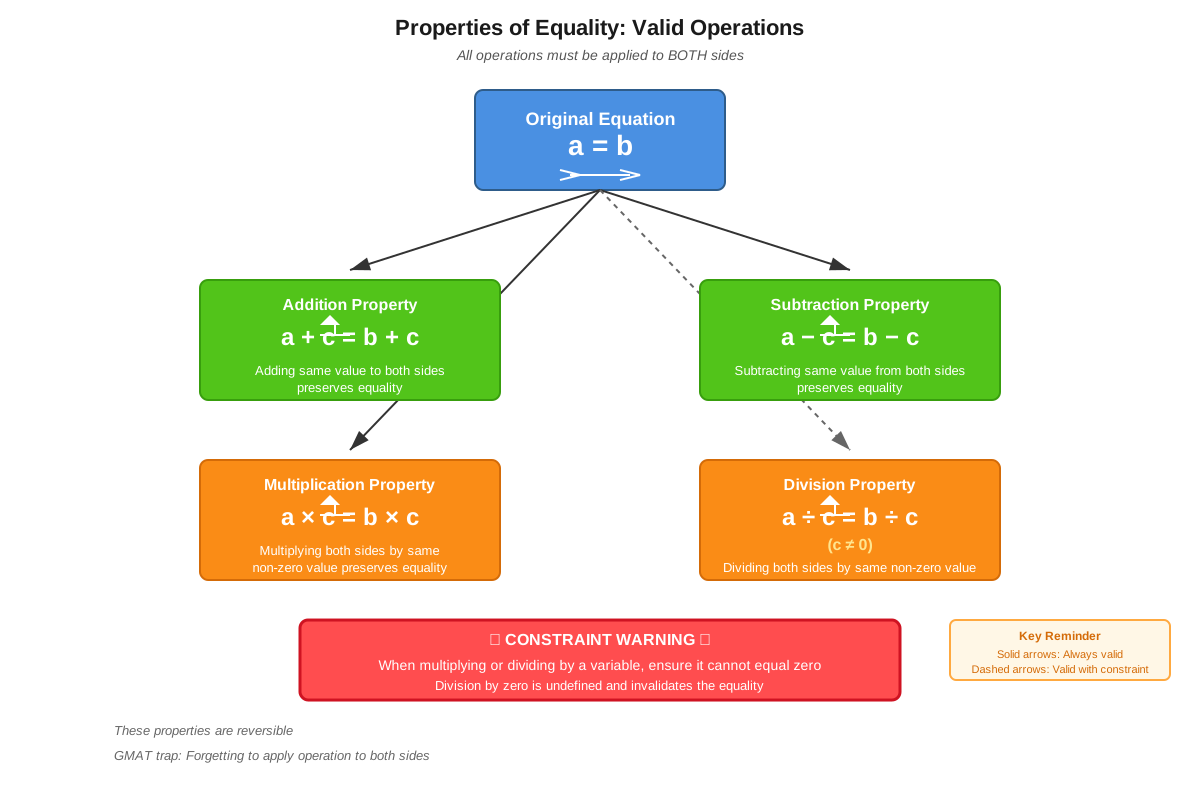
The fundamental properties of equality that preserve equal relationships include:
- Reflexive Property: Any quantity equals itself (a = a)
- Symmetric Property: If a = b, then b = a
- Transitive Property: If a = b and b = c, then a = c
- Addition Property: If a = b, then a + c = b + c
- Subtraction Property: If a = b, then a - c = b - c
- Multiplication Property: If a = b, then ac = bc
- Division Property: If a = b and c ≠ 0, then a/c = b/c
- Substitution Property: If a = b, then a can replace b in any expression
These properties are not merely theoretical—they form the logical foundation for determining sufficiency in Data Sufficiency questions. When evaluating whether a statement provides sufficient information, students must trace through these properties to determine whether equality can be definitively established.
Equality in Data Sufficiency Context
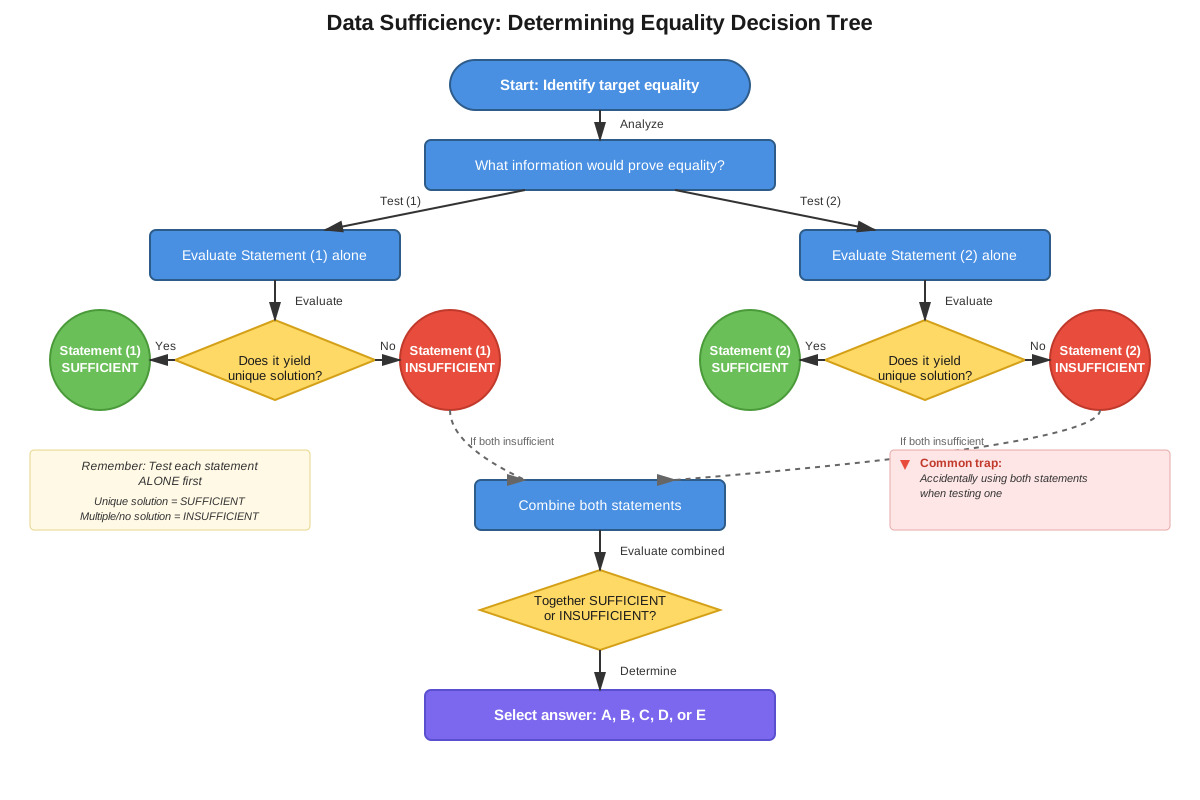
Data Sufficiency questions transform equality from a computational exercise into a logical reasoning challenge. Rather than solving for a specific value, students must determine whether the given information is sufficient to establish equality or solve for a variable. This requires understanding three distinct scenarios:
- Sufficient to determine equality: The statements provide enough information to definitively answer whether two expressions are equal
- Insufficient to determine equality: The statements leave multiple possibilities, some where expressions are equal and some where they are not
- Sufficient to determine inequality: The statements definitively prove expressions are NOT equal
Consider the question structure: "Is x = 5?" This asks whether sufficient information exists to establish equality between x and the value 5. Statement (1) might provide "x² = 25" which is insufficient alone because x could be 5 or -5. Statement (2) might provide "x > 0" which is insufficient alone. Together, they are sufficient because they narrow x to exactly 5. This exemplifies how equality in Data Sufficiency requires combining logical constraints.
Conditional Versus Unconditional Equality
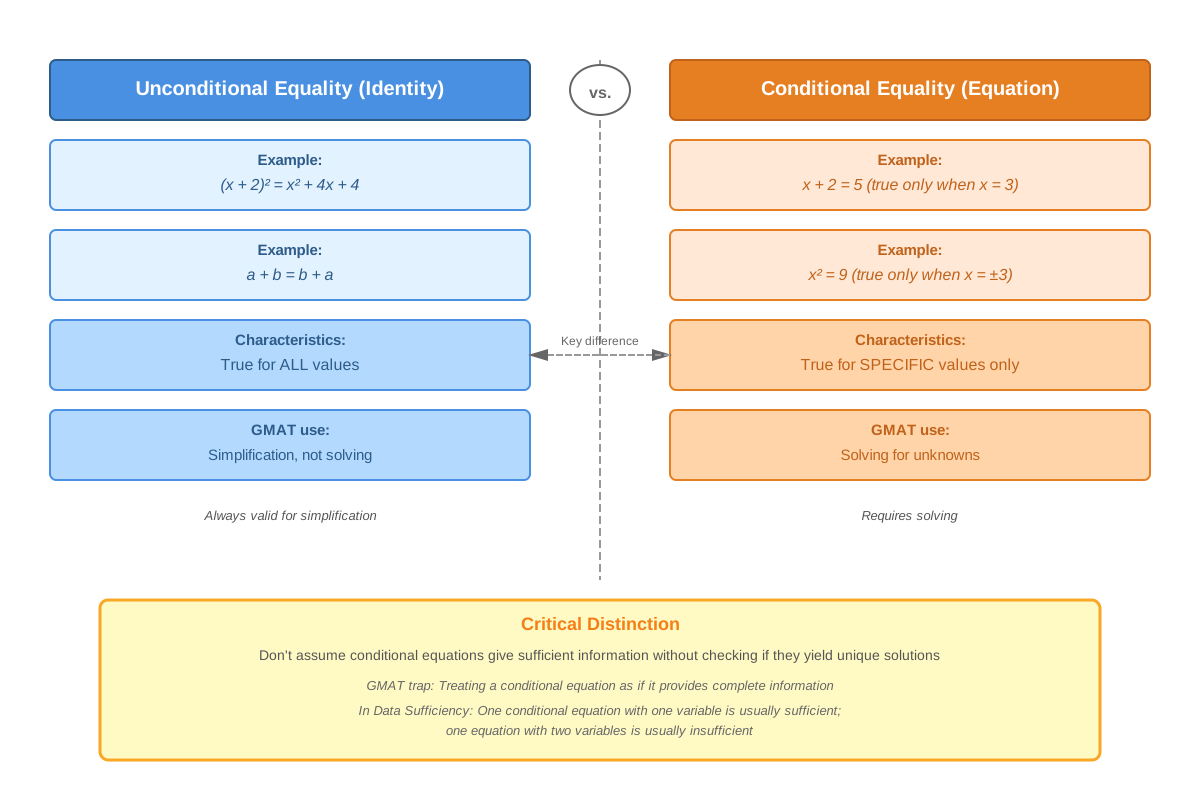
A critical distinction that GMAT questions exploit is between conditional and unconditional equality. Unconditional equality holds for all values of variables involved, such as the identity (x + 2)² = x² + 4x + 4, which is true regardless of x's value. Conditional equality holds only when specific conditions are met, such as x² = 9 being true only when x = 3 or x = -3.
| Type of Equality | Characteristics | GMAT Application |
|---|---|---|
| Unconditional | True for all variable values | Algebraic identities, equivalent expressions |
| Conditional | True only for specific values | Solving equations, determining sufficiency |
| Contradictory | Never true | Recognizing impossible conditions |
Data Sufficiency questions frequently test whether students recognize that establishing conditional equality requires determining the specific conditions, not just manipulating the equation. For instance, if asked "Is xy = 0?", knowing that x² + y² = 0 is sufficient because this condition forces both x = 0 AND y = 0 (since squares of real numbers are non-negative), making xy = 0 unconditionally true given this constraint.
Systems of Equations and Equality
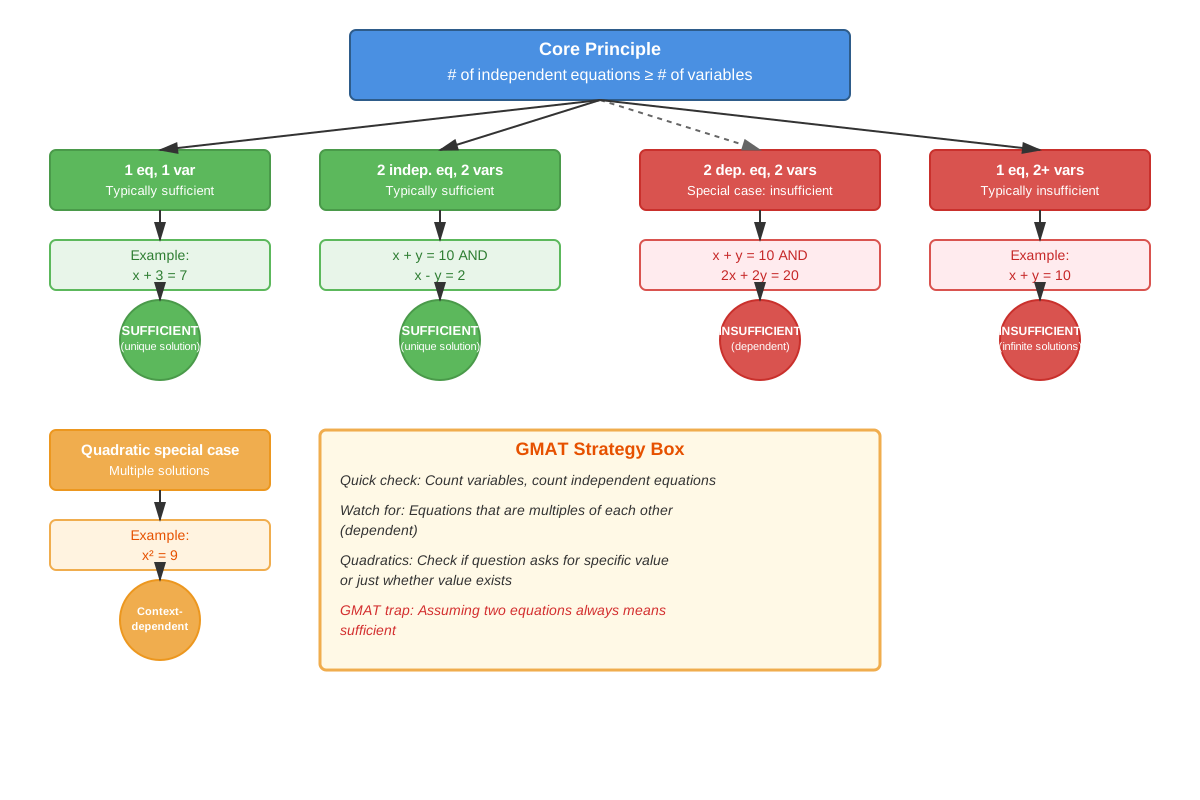
When multiple equality relationships exist simultaneously, they form systems of equations. The GMAT tests whether students understand when systems provide sufficient information to determine variable values. A fundamental principle: to solve for n variables uniquely, you generally need n independent equations (equality statements).
For a system to be sufficient for determining all variable values:
- The number of independent equations must equal or exceed the number of variables
- The equations must be truly independent (not multiples or combinations of each other)
- The equations must be consistent (not contradictory)
In Data Sufficiency, students must quickly assess whether combining statements creates a sufficient system. If asked "What is the value of x?" and given:
- Statement (1): 2x + y = 10
- Statement (2): 4x + 2y = 20
These statements are NOT independent—Statement (2) is simply Statement (1) multiplied by 2. They represent the same equality relationship, so together they remain insufficient. This tests whether students understand that apparent additional information may not actually provide new constraints.
Equality with Absolute Values and Quadratics
Equality becomes more complex when involving absolute values or quadratic expressions, both frequent GMAT topics. When solving |x| = 5, equality holds for two values: x = 5 or x = -5. This creates a branching logical structure where equality is satisfied by multiple solutions.
Similarly, quadratic equations like x² - 5x + 6 = 0 factor into (x - 2)(x - 3) = 0, yielding two equality solutions: x = 2 or x = 3. Data Sufficiency questions exploit this by asking whether sufficient information exists to determine which solution applies, or whether a unique solution exists at all.
The key insight: when equality involves even powers or absolute values, additional constraints are typically needed to establish a unique solution. A statement providing x² = 16 is insufficient to determine x's value without additional information about x's sign.
Equality Preservation Under Operations
Understanding which operations preserve equality and which require caution is essential for both solving equations and evaluating sufficiency. While addition, subtraction, and multiplication by non-zero constants preserve equality straightforwardly, other operations require careful consideration:
Squaring both sides: This can introduce extraneous solutions. If x = 3, then x² = 9, but the reverse isn't necessarily true (x² = 9 doesn't guarantee x = 3). When evaluating sufficiency, students must recognize that squaring an equality statement may create additional solutions that don't satisfy the original condition.
Taking square roots: This introduces a ± ambiguity. If x² = 25, then x = ±5. The equality relationship branches into two possibilities.
Multiplying by variables: If multiplying both sides by a variable that could be zero, the equality might become trivial (0 = 0) without preserving the original relationship's information content.
Dividing by expressions: Only valid when the divisor is guaranteed non-zero. In Data Sufficiency, students must verify this condition before concluding that division preserves the equality relationship's implications.
Concept Relationships
The concepts within equality form a hierarchical logical structure. At the foundation lie the fundamental properties of equality (reflexive, symmetric, transitive, and operational properties), which establish the rules for manipulating equal relationships. These properties enable algebraic manipulation while preserving equality, which in turn allows solving equations and simplifying expressions.
Building on this foundation, conditional versus unconditional equality introduces the concept that equality relationships may depend on specific constraints. This connects directly to Data Sufficiency applications, where the central question is whether given information provides sufficient constraints to establish equality definitively. The relationship flows: Properties → Manipulation → Conditional Analysis → Sufficiency Determination.
Systems of equations represent multiple equality relationships operating simultaneously, connecting back to the fundamental properties through the substitution property (using one equality to replace variables in another). Systems also connect forward to sufficiency analysis, as determining whether a system is solvable requires counting independent equality constraints.
Equality with absolute values and quadratics introduces branching logic, where a single equality statement may have multiple solutions. This connects to conditional equality (each solution represents a different condition under which equality holds) and to sufficiency analysis (additional information may be needed to determine which solution applies).
The relationship map: Fundamental Properties → Algebraic Manipulation → {Conditional Equality, Systems of Equations, Complex Expressions} → Data Sufficiency Analysis. Each concept builds on previous ones while contributing to the ultimate goal: determining what information suffices to establish or solve equality relationships.
Quick check — test yourself on Equality so far.
Try Flashcards →High-Yield Facts
⭐ An equation with n variables typically requires n independent equations to solve uniquely - this is the most fundamental principle for Data Sufficiency questions involving equality
⭐ Squaring both sides of an equation can introduce extraneous solutions - always verify solutions in the original equation
⭐ If x² = k where k > 0, then x = ±√k - equality with even powers creates two solutions unless additional constraints exist
⭐ Two equations are independent only if one cannot be derived from the other through multiplication or addition - apparent additional information may not actually constrain the system further
⭐ For Data Sufficiency, sufficient information must allow you to answer the question definitively, not just narrow the possibilities - "maybe yes, maybe no" means insufficient
- The transitive property of equality allows chaining relationships: if a = b and b = c, then a = c, which frequently appears in multi-step Data Sufficiency problems
- Multiplying or dividing both sides of an equation by zero is undefined or creates trivial equality (0 = 0), losing information about the original relationship
- Absolute value equations |x| = a (where a > 0) always have exactly two solutions: x = a and x = -a
- When combining statements in Data Sufficiency, the statements must be consistent (not contradictory) to provide any useful information
- Equality is preserved under function application only for one-to-one functions; for many-to-one functions like squaring, equality may not be reversible
Common Misconceptions
Misconception: If two statements each provide insufficient information individually, they must be sufficient when combined.
Correction: Statements can both be insufficient individually and remain insufficient combined if they don't provide independent constraints. For example, x + y = 5 and 2x + 2y = 10 are not independent—the second is just the first multiplied by 2.
Misconception: Solving an equation always yields a unique answer.
Correction: Equations may have no solutions (contradictory), exactly one solution (unique), or multiple solutions (underdetermined or involving absolute values/even powers). Data Sufficiency specifically tests whether information narrows to a unique solution.
Misconception: If x² = y², then x = y.
Correction: If x² = y², then x = ±y. The equality of squares doesn't guarantee equality of the original values—they could be opposites. Additional information about signs is needed to establish x = y definitively.
Misconception: More information is always better in Data Sufficiency.
Correction: Additional information is only helpful if it's independent and consistent. Redundant information (that can be derived from existing statements) doesn't increase sufficiency. Contradictory information makes the problem unsolvable.
Misconception: Algebraic manipulation always preserves the solution set.
Correction: Some operations can expand the solution set (squaring both sides) or restrict it (dividing by an expression that could be zero). When evaluating sufficiency, students must consider whether manipulations preserve, expand, or restrict the set of values satisfying the equality.
Misconception: If a statement provides an equation with two variables, it's automatically insufficient.
Correction: While generally true that one equation with two unknowns is insufficient to solve for specific values, the question might ask about a relationship or expression involving both variables that can be determined. For example, if asked "What is x + y?" and given "2x + 2y = 10," this is sufficient (x + y = 5) even though individual values remain unknown.
Worked Examples
Example 1: Data Sufficiency with Systems of Equations
Question: What is the value of x?
Statement (1): 3x + 2y = 18
Statement (2): 6x + 4y = 36
Solution Process:
First, analyze Statement (1) alone: 3x + 2y = 18. This is one equation with two variables. Without knowing y's value or having another independent equation, we cannot solve for x uniquely. For instance, if y = 0, then x = 6; if y = 3, then x = 4. Multiple values of x are possible. Statement (1) is INSUFFICIENT.
Next, analyze Statement (2) alone: 6x + 4y = 36. This also is one equation with two variables, so by the same reasoning, we cannot determine x uniquely. Statement (2) is INSUFFICIENT.
Now combine both statements: Notice that Statement (2) can be rewritten by dividing both sides by 2: (6x + 4y)/2 = 36/2, which gives 3x + 2y = 18. This is identical to Statement (1)! The statements are not independent—they represent the same equality relationship. Having the same equation twice doesn't provide additional constraints.
Think of it geometrically: each equation represents a line in the xy-plane. Statement (1) and Statement (2) represent the same line, so they intersect at infinitely many points, not a unique point. We cannot determine a unique value for x.
Answer: Both statements together are INSUFFICIENT. The correct Data Sufficiency answer is (E).
Key Takeaway: This example demonstrates that apparent additional information may not actually be independent. Always check whether equations are multiples or combinations of each other before concluding that combining statements provides sufficiency.
Example 2: Conditional Equality with Absolute Values
Question: Is x = 3?
Statement (1): |x| = 3
Statement (2): x² - 9 = 0
Solution Process:
Analyze Statement (1): |x| = 3. The absolute value equation has two solutions: x = 3 or x = -3. Since x could be either value, we cannot definitively answer whether x = 3. Statement (1) is INSUFFICIENT.
Analyze Statement (2): x² - 9 = 0. Adding 9 to both sides: x² = 9. Taking the square root of both sides: x = ±3. Again, x could be 3 or -3. Statement (2) is INSUFFICIENT.
Combine both statements: Notice that both statements provide exactly the same constraint—they both restrict x to the set {3, -3}. Statement (1) says |x| = 3, which means x = 3 or x = -3. Statement (2) says x² = 9, which also means x = 3 or x = -3. These are equivalent conditions, not independent constraints.
Since both statements together still leave two possibilities for x, we cannot definitively answer whether x = 3. Both statements together are INSUFFICIENT.
Answer: The correct Data Sufficiency answer is (E).
Alternative Scenario: If Statement (2) had instead been "x > 0," then combining the statements would be sufficient. Statement (1) gives x = ±3, and Statement (2) eliminates the negative option, leaving only x = 3. This illustrates how an additional constraint that's truly independent can establish sufficiency.
Key Takeaway: Equality involving absolute values or even powers creates multiple solutions. Establishing a unique solution requires additional constraints that eliminate all but one possibility. Recognize when statements provide equivalent versus independent information.
Exam Strategy
When approaching GMAT questions involving equality, particularly in Data Sufficiency, employ this systematic process:
Step 1: Identify what equality relationship the question asks about. Is it asking whether two expressions are equal? Whether a variable equals a specific value? Whether sufficient information exists to solve for a variable? Understanding the precise question determines what constitutes sufficiency.
Step 2: Count variables and independent equations. For questions asking for specific values, quickly count unknowns versus constraints. If there are more unknowns than independent equations, sufficiency is unlikely unless the question asks about a specific combination of variables that can be determined.
Step 3: Check for independence when combining statements. Before concluding that two statements together are sufficient, verify they're not multiples or algebraic combinations of each other. A quick test: try to derive one statement from the other through multiplication, division, addition, or subtraction.
Step 4: Watch for operations that create multiple solutions. Trigger phrases include "x²," "absolute value," "even power," or any situation where taking roots is involved. These signal that additional constraints may be needed to establish unique equality.
Step 5: Test boundary cases and special values. When evaluating sufficiency, test whether x = 0, x = 1, x = -1, or other special values satisfy the given conditions but yield different answers to the question. If different valid values give different answers, the information is insufficient.
Trigger words and phrases to watch for:
- "Is x = y?" or "Does x = y?" → Asking about equality relationship
- "What is the value of..." → Requires unique solution, not just narrowing possibilities
- "How many solutions..." → May involve multiple values satisfying equality
- "Must be equal" versus "could be equal" → Distinguishes necessary from possible equality
Time allocation advice: Data Sufficiency questions involving equality should take 2-2.5 minutes on average. Spend 30 seconds understanding what the question asks, 30-45 seconds on each statement individually, and 30-45 seconds evaluating the combination. If you find yourself doing extensive algebraic manipulation, pause and reconsider—often the insight is logical rather than computational.
Process of elimination tips:
- If Statement (1) alone is sufficient, eliminate choices B, C, and E immediately
- If Statement (1) alone is insufficient, eliminate choices A and D immediately
- If both statements individually are insufficient, the answer must be C or E—focus on whether they're independent and consistent
- If you can find even one counterexample where the statements are satisfied but the answer differs, the information is insufficient
Memory Techniques
Mnemonic for equality properties: "RSTAM-DS"
- Reflexive (a = a)
- Symmetric (if a = b, then b = a)
- Transitive (if a = b and b = c, then a = c)
- Addition/subtraction (if a = b, then a ± c = b ± c)
- Multiplication/division (if a = b, then ac = bc, a/c = b/c when c ≠ 0)
- Distributive (preserved through distribution)
- Substitution (if a = b, can substitute in any expression)
Visualization for systems of equations: Picture each equation as a line (in 2D) or plane (in 3D). Sufficient information means the lines/planes intersect at exactly one point. Parallel lines (inconsistent equations) never intersect. Coincident lines (dependent equations) intersect at infinitely many points. This mental image helps quickly assess whether systems provide unique solutions.
Acronym for Data Sufficiency evaluation: "NICE"
- Number of equations vs. variables
- Independence of statements (not multiples/combinations)
- Consistency (not contradictory)
- Exhaustiveness (covers all cases, no multiple solutions remaining)
Memory aid for operations that create multiple solutions: "SARE" - operations that Square, take Absolute values, Raise to even powers, or involve Even roots create multiple solutions requiring additional constraints.
Rhyme for checking sufficiency: "One equation, one unknown, makes the value clearly known. Two unknowns need two that's true, or else the answer's not for you." This reminds students that matching equations to unknowns is the baseline sufficiency check.
Summary
Equality represents a fundamental mathematical relationship asserting that two expressions have identical values, and mastering equality concepts is essential for GMAT Data Insights success. The exam tests equality not primarily through computational equation-solving, but through logical analysis of what information suffices to establish equal relationships. Students must understand the properties that preserve equality under various operations, recognize when equations are independent versus redundant, and distinguish between conditional equality (holding only for specific values) and unconditional equality (holding universally). Data Sufficiency questions specifically exploit equality by asking whether given statements provide enough constraints to determine if two expressions are equal or to solve for specific variable values. Critical skills include counting variables versus independent equations, recognizing that operations like squaring or taking absolute values create multiple solutions requiring additional constraints, and identifying when apparent additional information is actually redundant. Success requires moving beyond mechanical equation-solving to strategic logical analysis: determining what information is truly necessary and sufficient to establish equality relationships definitively.
Key Takeaways
- Equality in Data Sufficiency is about logical sufficiency, not just solving equations - the question is whether given information definitively establishes equal relationships, not merely whether you can manipulate the algebra
- To solve for n variables uniquely, you generally need n independent equations - this is the fundamental principle for assessing sufficiency in systems of equations
- Operations involving even powers or absolute values create multiple solutions - additional constraints are typically needed to establish unique equality when these operations are involved
- Two statements are independent only if neither can be derived from the other - redundant information doesn't increase sufficiency, no matter how different it appears superficially
- Sufficiency requires definitive answers, not narrowed possibilities - if the given information allows multiple answers to the question, it's insufficient regardless of how much it constrains the variables
- Preserve equality carefully through operations - some manipulations (like squaring) can introduce extraneous solutions, while others (like dividing by variables) require verification that divisors are non-zero
- Test special values and boundary cases - when evaluating sufficiency, checking whether x = 0, x = 1, or x = -1 (when valid) yield different answers quickly reveals insufficiency
Related Topics
Inequalities: Building on equality concepts, inequalities explore relationships where expressions are not equal but have defined ordering. Understanding equality provides the foundation for recognizing when relationships are strictly greater than, less than, or potentially equal.
Systems of Linear Equations: Extends equality to multiple simultaneous relationships, requiring analysis of independence, consistency, and solvability—all concepts rooted in understanding individual equality statements.
Absolute Value: Introduces conditional equality where |x| = a creates two equality conditions (x = a or x = -a), requiring synthesis of equality concepts with case analysis.
Quadratic Equations: Applies equality to polynomial expressions where factoring and the zero product property create multiple conditional equality solutions, building on fundamental equality manipulation skills.
Ratios and Proportions: Represents equality between ratios, connecting equality concepts to multiplicative relationships and cross-multiplication techniques.
Mastering equality enables progression to all these topics, as each builds on the logical and algebraic foundations of equal relationships while adding layers of complexity.
Practice CTA
Now that you've mastered the core concepts of equality and its application to GMAT Data Insights questions, it's time to cement your understanding through practice. Attempt the practice questions designed specifically for this topic, focusing on applying the systematic evaluation process outlined in the exam strategy section. Use the flashcards to reinforce high-yield facts and properties until they become automatic. Remember: understanding equality conceptually is the first step, but GMAT success requires translating that understanding into rapid, accurate question analysis under time pressure. Each practice question you work through builds the pattern recognition and logical reasoning skills that distinguish top scorers. You've invested the time to learn the concepts—now invest the practice time to make them instinctive. Your target score is within reach!
Sign up free to keep reading
Create a free AnvayaPrep account to finish this GMAT guide on Equality — plus flashcards and practice questions.