Overview
Algebraic modeling is one of the most critical and frequently tested skills in GMAT Quantitative Reasoning. It represents the bridge between real-world problem scenarios and mathematical solutions, requiring test-takers to translate verbal descriptions, relationships, and constraints into algebraic expressions and equations. This skill goes beyond simple equation-solving; it demands analytical thinking, pattern recognition, and the ability to represent complex relationships using variables, constants, and operations.
On the GMAT, GMAT algebraic modeling questions appear across multiple question types, including Problem Solving and Data Sufficiency. These questions often disguise themselves as word problems involving rates, work, mixtures, age relationships, profit and loss, or geometric relationships. The ability to construct accurate algebraic models separates high scorers from average performers because it enables systematic problem-solving rather than reliance on trial-and-error or intuition. Approximately 25-30% of GMAT Quantitative questions require some form of algebraic modeling, making it one of the highest-yield topics for score improvement.
Within the broader Quantitative Reasoning framework, algebraic modeling serves as a foundational skill that connects arithmetic reasoning, equation manipulation, inequality analysis, and function interpretation. It provides the structural framework for solving optimization problems, understanding constraints in Data Sufficiency questions, and analyzing multi-variable relationships. Mastery of algebraic modeling enhances performance not only in pure algebra questions but also in geometry, statistics, and applied arithmetic problems where mathematical relationships must be formalized before solutions can be computed.
Learning Objectives
- [ ] Identify algebraic modeling opportunities in GMAT word problems and data sufficiency questions
- [ ] Explain the process of translating verbal statements into algebraic expressions and equations
- [ ] Apply algebraic modeling techniques to solve complex GMAT questions efficiently
- [ ] Construct systems of equations from multi-constraint scenarios
- [ ] Recognize common algebraic modeling patterns in rate, work, mixture, and age problems
- [ ] Evaluate the sufficiency of given information using algebraic models in Data Sufficiency questions
Prerequisites
- Basic algebraic manipulation: Essential for simplifying and solving the equations created through modeling; includes combining like terms, distributing, and isolating variables
- Linear equations and inequalities: Necessary foundation since most GMAT algebraic models result in linear or simple quadratic relationships
- Ratio and proportion concepts: Many modeling scenarios involve proportional relationships that must be expressed algebraically
- Arithmetic operations with variables: Required to construct expressions representing sums, differences, products, and quotients of unknown quantities
- Word problem comprehension: Fundamental for extracting mathematical relationships from verbal descriptions
Why This Topic Matters
Algebraic modeling represents a universal problem-solving methodology applicable far beyond standardized testing. In business contexts, professionals use algebraic modeling to optimize resource allocation, forecast revenue under various scenarios, analyze break-even points, and model supply chain relationships. Engineers employ these techniques to represent physical constraints and design parameters. Financial analysts construct models to evaluate investment scenarios and risk profiles. The GMAT tests this skill precisely because it reflects the analytical reasoning required in graduate business education and professional practice.
From an exam perspective, algebraic modeling questions appear in approximately 8-12 questions per GMAT Quantitative section, representing roughly 25-35% of the total quantitative score. These questions span difficulty levels from 500 to 750+ on the GMAT scale, with harder questions typically involving multiple constraints, indirect relationships, or requiring test-takers to recognize non-obvious variable assignments. Problem Solving questions often present scenarios requiring equation construction and solution, while Data Sufficiency questions test whether given information provides sufficient constraints to determine unique solutions.
Common question formats include: consecutive integer problems requiring representation of sequences; age problems involving relationships at different time points; rate-time-distance scenarios with multiple travelers or stages; work problems with combined or sequential efforts; mixture problems involving concentrations or weighted averages; profit/cost/revenue relationships; and geometric problems requiring algebraic representation of measurement relationships. Recognition of these patterns accelerates problem-solving and reduces cognitive load during the exam.
Core Concepts
The Algebraic Modeling Process
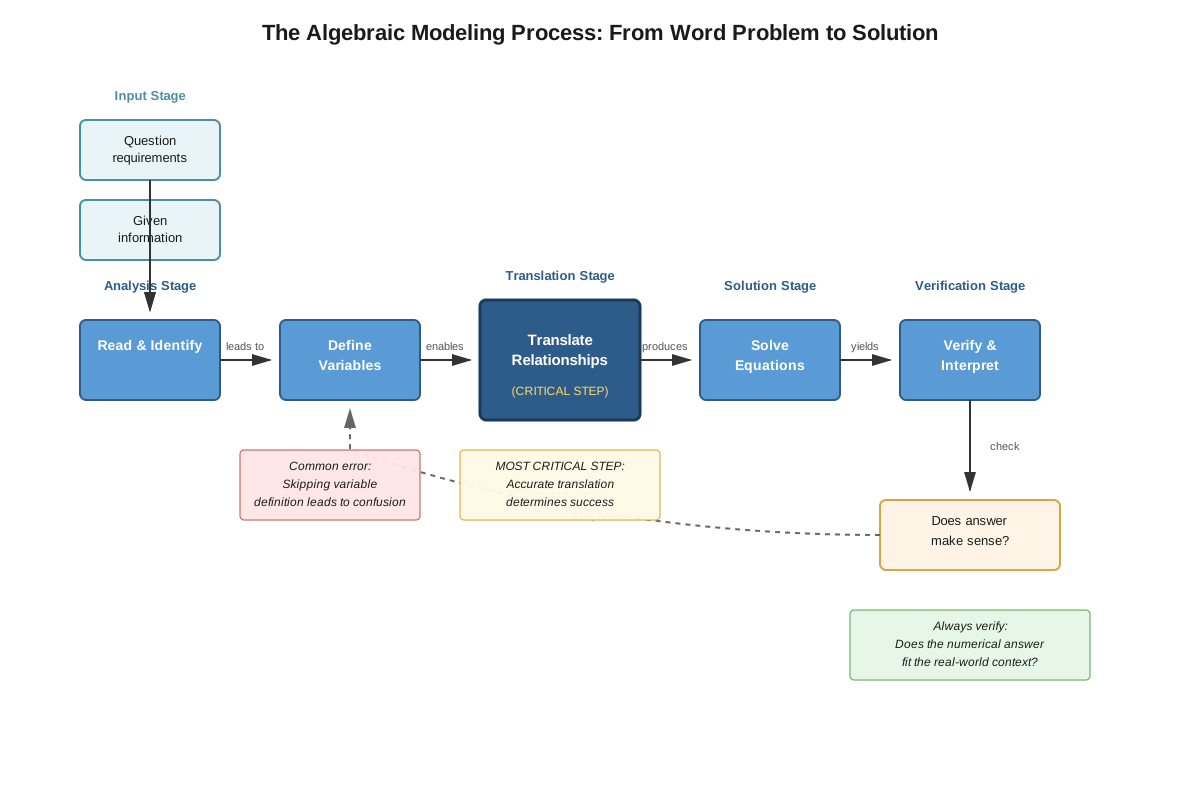
The systematic approach to algebraic modeling involves four distinct phases that transform verbal information into mathematical solutions. First, variable definition requires identifying unknown quantities and assigning appropriate variables with clear definitions. Second, relationship identification involves extracting mathematical relationships from verbal descriptions, including equations, inequalities, and constraints. Third, equation construction translates these relationships into formal algebraic expressions. Fourth, solution and verification involves solving the system and checking whether the solution satisfies all original constraints.
Effective variable definition follows specific principles: choose variables representing the most fundamental unknowns rather than derived quantities; use meaningful variable names when possible (though single letters suffice on the GMAT); clearly distinguish between variables representing different entities or time periods; and consider whether choosing different variables might simplify the resulting equations. For example, in an age problem, defining variables for current ages typically produces simpler equations than defining variables for past or future ages.
Translation Patterns
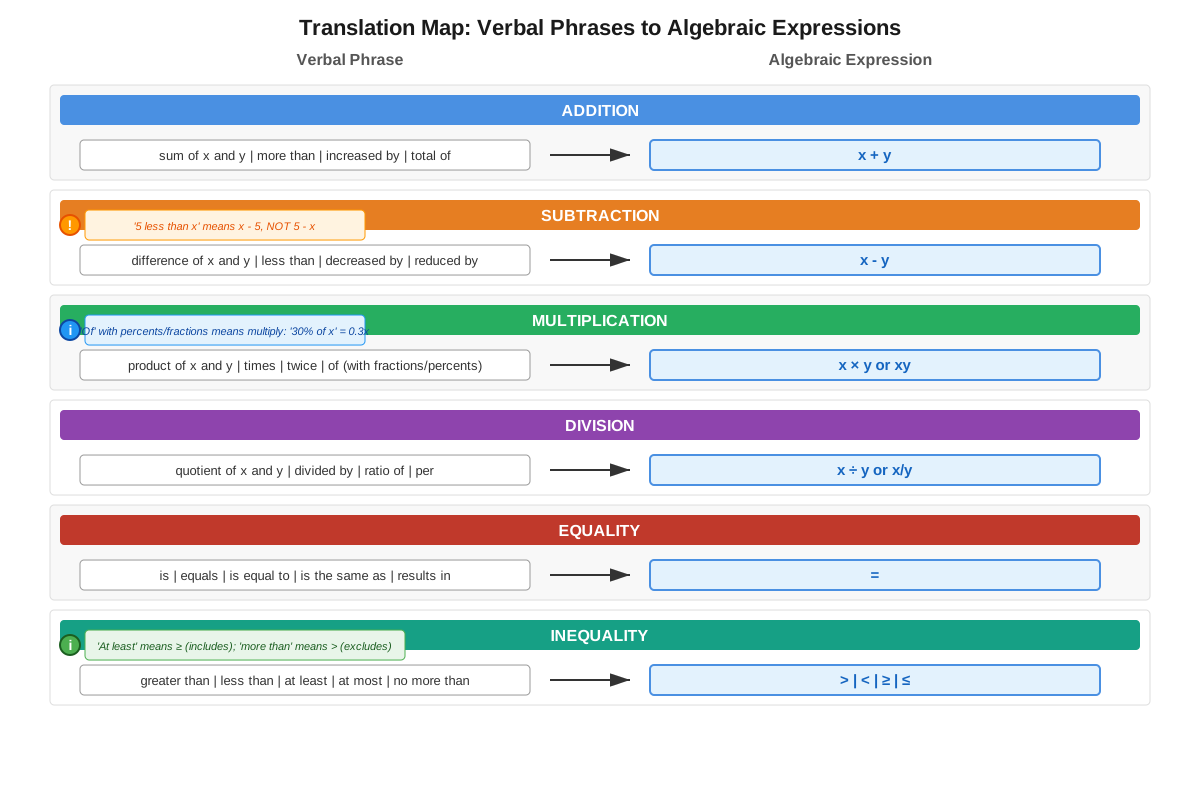
Certain verbal phrases consistently translate into specific algebraic operations, and recognizing these patterns accelerates modeling:
| Verbal Phrase | Algebraic Translation | Example |
|---|---|---|
| "sum of," "total," "combined" | Addition (+) | "The sum of two numbers" → x + y |
| "difference," "more than," "less than" | Subtraction (−) | "5 more than twice a number" → 2x + 5 |
| "product," "times," "of" (with fractions/percents) | Multiplication (×) | "30% of the price" → 0.30p |
| "quotient," "ratio," "per" | Division (÷) | "miles per hour" → m/h |
| "is," "equals," "results in" | Equals (=) | "The total is 50" → ... = 50 |
| "at least," "minimum," "no less than" | Greater than or equal (≥) | "At least 10 items" → x ≥ 10 |
| "at most," "maximum," "no more than" | Less than or equal (≤) | "At most $100" → c ≤ 100 |
Consecutive Integer Modeling
Consecutive integer problems require representing sequences algebraically. For consecutive integers, use n, n+1, n+2, etc. For consecutive even or odd integers, use n, n+2, n+4, etc. (where n is even or odd respectively). The key insight is that consecutive even integers and consecutive odd integers follow identical algebraic patterns—only the parity of the starting value differs.
Example structure: "Three consecutive integers have a sum of 72" translates to:
- Variables: n, n+1, n+2
- Equation: n + (n+1) + (n+2) = 72
- Simplified: 3n + 3 = 72
Rate-Time-Distance Modeling
The fundamental relationship Distance = Rate × Time (D = RT) generates numerous GMAT questions. Complex scenarios involve multiple travelers, round trips, or changing rates. The modeling strategy depends on what remains constant:
- Same distance, different rates/times: Set distance expressions equal (R₁T₁ = R₂T₂)
- Meeting/catching up: Sum or difference of distances equals total separation
- Round trips: Often use the relationship that total time = time going + time returning
For problems involving relative motion, travelers moving toward each other have a combined rate equal to the sum of individual rates, while travelers moving in the same direction have a relative rate equal to the difference of individual rates.
Work Rate Modeling
Work problems use the principle that Rate × Time = Work Completed. Individual work rates are typically expressed as reciprocals of time to complete the job alone. If person A completes a job in a hours and person B completes it in b hours, their combined rate is 1/a + 1/b jobs per hour.
The standard modeling approach:
- Define the complete job as 1 unit
- Express individual rates as 1/(time to complete alone)
- Set up equation: (combined rate) × (time working together) = work completed
Mixture and Weighted Average Modeling
Mixture problems involve combining substances with different properties (concentration, price, quality) to achieve a target property. The fundamental principle is that the total amount of the pure substance equals the sum of pure substances from each component.
Standard mixture equation structure:
(Amount₁)(Concentration₁) + (Amount₂)(Concentration₂) = (Total Amount)(Final Concentration)For weighted averages, the same principle applies with weights replacing amounts and values replacing concentrations.
Age Problem Modeling
Age problems involve relationships between people's ages at different time points. The critical insight is that everyone ages at the same rate—if x years pass, every person's age increases by x years. This constraint simplifies equation construction.
Standard approach:
- Define variables for current ages
- Express past ages as (current age − years ago)
- Express future ages as (current age + years from now)
- Construct equations from stated relationships
Constraint-Based Modeling for Data Sufficiency
In Data Sufficiency questions, algebraic modeling determines whether given information provides sufficient constraints to uniquely determine unknown values. A system with n variables requires n independent equations for unique solution. The modeling process focuses on:
- Identifying how many unknowns exist
- Determining how many independent constraints each statement provides
- Evaluating whether constraints are independent or redundant
- Checking whether constraints allow unique solutions or multiple possibilities
Concept Relationships
Algebraic modeling serves as the central hub connecting multiple algebraic and arithmetic concepts. The process begins with word problem comprehension → leads to → variable definition → enables → equation construction → requires → algebraic manipulation → produces → solutions → demands → verification against constraints.
Within the modeling process itself, variable selection influences equation complexity, which affects solution efficiency. Choosing variables representing fundamental unknowns rather than derived quantities typically produces simpler systems. For example, in a mixture problem, defining variables for the amounts of each component usually creates more straightforward equations than defining variables for concentrations.
The relationship between algebraic modeling and prerequisite topics flows bidirectionally. Ratio and proportion concepts inform mixture and rate problems, while algebraic modeling provides formal frameworks for solving complex ratio problems. Linear equations provide the solution mechanisms for most models, while modeling practice reinforces equation-solving skills. Inequality reasoning extends modeling to optimization and constraint problems.
Connections to advanced topics include: systems of equations (many models produce multiple equations with multiple unknowns); quadratic equations (some rate and geometry problems produce quadratic models); function notation (modeling relationships as functions); and optimization (finding maximum or minimum values subject to constraints).
High-Yield Facts
⭐ The fundamental modeling process: Define variables → Identify relationships → Construct equations → Solve → Verify
⭐ Distance = Rate × Time is the foundation for all motion problems; variations include D = RT, R = D/T, and T = D/R
⭐ Work rate principle: If A completes a job in a hours and B in b hours, their combined rate is 1/a + 1/b jobs per unit time
⭐ Consecutive integer representation: Use n, n+1, n+2 for consecutive integers; use n, n+2, n+4 for consecutive even or odd integers
⭐ Mixture equation structure: (Amount₁)(Property₁) + (Amount₂)(Property₂) = (Total Amount)(Final Property)
- Age problem constraint: Everyone ages at the same rate, so if x years pass, add x to all current ages
- Percent problems translate to decimals: "30% of x" becomes 0.30x in algebraic expressions
- "More than" and "less than" require careful attention to order: "5 more than x" is x + 5, but "5 less than x" is x − 5
- In Data Sufficiency, n variables typically require n independent equations for unique determination
- Relative rate for objects moving toward each other: sum of individual rates; moving in same direction: difference of rates
- The sum of n consecutive integers equals n times the middle value (for odd n) or n times the average of two middle values (for even n)
- Weighted average always falls between the minimum and maximum values being averaged
- When modeling with percentages, the whole is typically represented as 100% or 1.0
- Profit = Revenue − Cost is the fundamental business relationship underlying many word problems
- In mixture problems, the amount of pure substance remains constant even as concentrations change through dilution or evaporation
Quick check — test yourself on Algebraic modeling so far.
Try Flashcards →Common Misconceptions
Misconception: Variables can only be represented by x, y, and z.
Correction: Any letter can represent a variable, and choosing meaningful letters (like r for rate or t for time) can reduce errors. However, on the GMAT, single letters are sufficient and often clearer than trying to use mnemonic variable names.
Misconception: "5 less than x" translates to 5 − x.
Correction: "5 less than x" means x − 5, not 5 − x. The phrase structure "A less than B" always means B − A. The number being subtracted comes first in the English phrase but second in the algebraic expression.
Misconception: In work problems, if A takes 3 hours and B takes 4 hours, working together takes 7 hours.
Correction: Working together, they complete the job faster, not slower. The combined rate is 1/3 + 1/4 = 7/12 jobs per hour, so together they complete the job in 12/7 hours (approximately 1.7 hours). Rates add, not times.
Misconception: Every word problem requires only one variable.
Correction: Many GMAT problems involve multiple unknowns requiring multiple variables. While sometimes one variable suffices by expressing other quantities in terms of it, complex scenarios often require systems of equations with multiple variables for clarity and efficiency.
Misconception: The algebraic model must match the exact order of information presented in the problem.
Correction: Effective modeling often requires reorganizing information, identifying the fundamental relationships, and constructing equations that may combine information from different parts of the problem statement. The problem narrative order rarely matches the optimal equation construction order.
Misconception: In mixture problems, you can add concentrations directly.
Correction: Concentrations cannot be added directly; you must multiply each concentration by its amount to find the pure substance quantity, then add those quantities. The final concentration equals total pure substance divided by total amount.
Misconception: Data Sufficiency questions always require actually solving for the variable values.
Correction: Data Sufficiency tests whether you can determine values, not whether you actually compute them. Often, recognizing that you have enough independent equations to match the number of unknowns suffices without performing the actual calculations, saving valuable time.
Worked Examples
Example 1: Multi-Stage Work Problem
Problem: Machine A can complete a job in 6 hours. Machine B can complete the same job in 4 hours. If Machine A works alone for 2 hours, then both machines work together, how long will it take to complete the entire job?
Solution Process:
Step 1 - Define variables and rates:
- Let the complete job = 1 unit
- Machine A's rate = 1/6 job per hour
- Machine B's rate = 1/4 job per hour
- Let t = time both machines work together (in hours)
Step 2 - Identify work completed in each phase:
- Work completed by A alone in 2 hours = (1/6)(2) = 2/6 = 1/3 of the job
- Work remaining after A works alone = 1 − 1/3 = 2/3 of the job
Step 3 - Construct equation for combined work phase:
- Combined rate = 1/6 + 1/4 = 2/12 + 3/12 = 5/12 jobs per hour
- Work completed together = (combined rate)(time) = (5/12)(t)
- This must equal the remaining work: (5/12)(t) = 2/3
Step 4 - Solve for t:
- (5/12)(t) = 2/3
- t = (2/3) ÷ (5/12)
- t = (2/3) × (12/5)
- t = 24/15 = 8/5 = 1.6 hours
Step 5 - Calculate total time:
- Total time = time A works alone + time both work together
- Total time = 2 + 1.6 = 3.6 hours
Verification: A completes (1/6)(3.6) = 0.6 of the job; B completes (1/4)(1.6) = 0.4 of the job; Total = 0.6 + 0.4 = 1.0 ✓
This example demonstrates the learning objective of applying algebraic modeling to multi-stage scenarios, requiring careful tracking of different work phases and proper rate addition.
Example 2: Data Sufficiency with Algebraic Modeling
Problem: A store sells notebooks and pens. What is the price of one notebook?
(1) The total cost of 3 notebooks and 5 pens is $23.
(2) The total cost of 2 notebooks and 3 pens is $14.
Solution Process:
Step 1 - Define variables:
- Let n = price of one notebook (in dollars)
- Let p = price of one pen (in dollars)
- We need to determine the value of n
Step 2 - Analyze Statement (1):
- Equation: 3n + 5p = 23
- This is one equation with two unknowns
- Cannot solve uniquely for n without knowing p
- Statement (1) alone is INSUFFICIENT
Step 3 - Analyze Statement (2):
- Equation: 2n + 3p = 14
- This is one equation with two unknowns
- Cannot solve uniquely for n without knowing p
- Statement (2) alone is INSUFFICIENT
Step 4 - Analyze both statements together:
- System of equations:
- 3n + 5p = 23 ... (equation 1)
- 2n + 3p = 14 ... (equation 2)
- We have 2 equations and 2 unknowns
- The equations are independent (not multiples of each other)
- This system can be solved uniquely for both n and p
Step 5 - Verify sufficiency without solving completely:
- To confirm, we could solve: Multiply equation 2 by 1.5: 3n + 4.5p = 21
- Subtract from equation 1: 0.5p = 2, so p = 4
- Substitute back: 2n + 3(4) = 14, so 2n = 2, thus n = 1
- Both statements together are SUFFICIENT
Answer: C (Both statements together are sufficient, but neither alone is sufficient)
This example illustrates how algebraic modeling enables systematic evaluation of Data Sufficiency questions by determining whether constraints provide enough independent equations to solve for unknowns.
Exam Strategy
When approaching GMAT algebraic modeling questions, begin by reading the entire problem carefully to identify what is being asked. Circle or mentally note the specific question—this prevents solving for the wrong variable. Before defining variables, scan for the fundamental unknowns versus derived quantities. Choosing variables wisely can dramatically simplify equations.
Trigger words and phrases signal specific modeling patterns:
- "Combined," "together," "total" → addition or rate combination
- "Difference," "more than," "less than" → subtraction with careful attention to order
- "Ratio," "per," "for every" → proportional relationships or rates
- "Consecutive" → sequential variable representation (n, n+1, n+2)
- "Working together" → combined rates in work problems
- "Mixture," "solution," "concentration" → weighted average or mixture equations
- "Years ago," "years from now" → age problem with time shifts
For Problem Solving questions, after constructing your model, check whether the problem requires the variable value itself or some derived quantity. Many GMAT problems ask for expressions like "2x + 5" rather than just "x," and recognizing this can sometimes allow you to avoid fully solving the system.
For Data Sufficiency questions, focus on counting unknowns versus independent constraints rather than actually solving. If you have n unknowns and n independent equations, the answer is typically determinable (sufficient). Watch for disguised redundancy—two statements that provide the same constraint in different forms are not independent. Also recognize that some questions require only determining whether a unique solution exists, not computing it.
Process of elimination strategies specific to algebraic modeling:
- Eliminate answer choices that violate basic constraints (negative values where only positive make sense, non-integer answers for counting problems)
- Check extreme cases or simple values to eliminate impossible answers
- Use dimensional analysis—if the question asks for time, eliminate answers with distance or rate units
- For Data Sufficiency, eliminate C and E first if one statement alone is clearly sufficient
Time allocation: Spend 30-45 seconds on initial problem comprehension and variable definition. This upfront investment prevents errors and often reveals shortcuts. Allocate 60-90 seconds for equation construction and solving. Reserve 15-30 seconds for verification, especially checking that your answer addresses the actual question asked and satisfies all stated constraints.
Memory Techniques
DRIVE mnemonic for the modeling process:
- Define variables clearly
- Read and identify all relationships
- Identify the question being asked
- Verify equations match the scenario
- Execute solution and check
"Rate × Time = Work" can be remembered as "RTW" (Ready To Work), applicable to both distance problems (where work = distance) and job completion problems.
For consecutive integer problems, visualize a number line with evenly spaced points. This mental image reinforces that consecutive integers differ by 1, while consecutive even/odd integers differ by 2.
Mixture problems: Remember "CAMP" (Concentration × Amount = Pure substance). The pure substance is what you're tracking through the mixture process.
Age problems: Use the phrase "Everyone ages together" to remember that time passes equally for all people in the problem. If you go back 5 years, subtract 5 from everyone's current age.
For translation patterns, remember "English order ≠ Math order" for subtraction phrases. "A less than B" means B − A, not A − B. The subject of "less than" comes second in the algebraic expression.
Data Sufficiency: Remember "E.I.N." (Equations = Independent × Number of variables). You need as many independent equations as variables for sufficiency.
Summary
Algebraic modeling transforms verbal problem descriptions into mathematical equations that can be systematically solved, representing one of the most critical and frequently tested skills on the GMAT Quantitative section. The core process involves defining variables for unknown quantities, identifying mathematical relationships from verbal statements, constructing equations or inequalities that capture these relationships, solving the resulting system, and verifying solutions against original constraints. Success requires mastering translation patterns that convert common phrases into algebraic operations, recognizing standard problem types (consecutive integers, rate-time-distance, work rates, mixtures, ages), and developing systematic approaches for both Problem Solving and Data Sufficiency questions. The skill extends beyond mechanical equation construction to strategic thinking about variable selection, constraint identification, and solution verification. For Data Sufficiency specifically, algebraic modeling enables evaluation of whether given information provides sufficient independent constraints to determine unique solutions without necessarily computing those solutions. Mastery of algebraic modeling not only improves performance on direct algebra questions but enhances problem-solving ability across all quantitative topics where relationships must be formalized mathematically.
Key Takeaways
- Algebraic modeling is the systematic process of translating verbal descriptions into mathematical equations, essential for 25-35% of GMAT Quantitative questions
- The five-step modeling process (Define → Identify → Construct → Solve → Verify) provides a reliable framework for approaching any word problem
- Standard problem patterns (consecutive integers, rate-time-distance, work rates, mixtures, ages) each have characteristic modeling structures that can be learned and applied efficiently
- Careful attention to translation patterns prevents common errors, especially with subtraction phrases where English order differs from mathematical order
- In Data Sufficiency questions, focus on counting unknowns versus independent constraints rather than actually solving, recognizing that n variables typically require n independent equations
- Strategic variable selection—choosing fundamental unknowns rather than derived quantities—often dramatically simplifies the resulting equations
- Verification is essential: always check that solutions satisfy all original constraints and answer the specific question asked, not just any related quantity
Related Topics
Systems of Linear Equations: Builds directly on algebraic modeling by providing solution techniques for models with multiple variables and constraints. Mastering modeling makes systems more intuitive since you understand where the equations originate.
Quadratic Equations: Some algebraic models, particularly in geometry and optimization problems, produce quadratic rather than linear equations. Understanding modeling helps recognize when quadratic solutions are needed.
Inequalities and Optimization: Extends modeling to problems involving constraints and finding maximum or minimum values, common in business scenario questions on the GMAT.
Functions and Function Notation: Represents a formal framework for expressing relationships between variables, building on the relationship identification skills developed through algebraic modeling.
Coordinate Geometry: Requires algebraic modeling to represent geometric relationships, distances, slopes, and areas using variables and equations.
Practice CTA
Now that you've mastered the fundamentals of algebraic modeling, it's time to solidify your understanding through deliberate practice. Attempt the practice questions associated with this topic, focusing on applying the systematic five-step modeling process to each problem. Pay special attention to variable definition and equation construction—these foundational steps determine success in the solution phase. Use the flashcards to reinforce translation patterns and standard problem structures until recognition becomes automatic. Remember, algebraic modeling is a skill that improves dramatically with practice, and each problem you work through builds pattern recognition that accelerates your performance on test day. Your investment in mastering this high-yield topic will pay dividends across the entire Quantitative section!
Sign up free to keep reading
Create a free AnvayaPrep account to finish this GMAT guide on Algebraic modeling — plus flashcards and practice questions.