Overview
Polynomials are algebraic expressions that form the foundation of numerous quantitative problems on the GMAT. A polynomial consists of variables and coefficients combined using addition, subtraction, and multiplication operations, with variables raised to non-negative integer exponents. Understanding polynomials is crucial because they appear directly in algebra questions and indirectly in word problems, data sufficiency questions, and problem-solving scenarios. Mastery of polynomial manipulation, factoring, and evaluation enables test-takers to solve complex equations efficiently and recognize patterns that lead to faster solutions.
The GMAT frequently tests polynomial concepts through factoring questions, simplification problems, and equation-solving scenarios. Questions may ask test-takers to factor quadratic expressions, expand polynomial products, or identify equivalent expressions. Additionally, GMAT polynomials often appear in disguised forms within word problems involving area, revenue, or optimization scenarios where relationships between variables follow polynomial patterns. The ability to recognize polynomial structures and apply appropriate manipulation techniques separates high scorers from average performers.
Within the broader Quantitative Reasoning framework, polynomials serve as a bridge between basic algebraic operations and more advanced topics like functions, inequalities, and coordinate geometry. They connect directly to equation-solving strategies, factoring techniques, and the fundamental theorem of algebra. A solid grasp of polynomial concepts enables efficient problem-solving across multiple question types and provides the algebraic fluency necessary for tackling the most challenging GMAT quantitative questions within the time constraints of the exam.
Learning Objectives
- [ ] Identify polynomials and distinguish them from non-polynomial expressions
- [ ] Explain the structure, terminology, and classification of polynomials
- [ ] Apply polynomial operations (addition, subtraction, multiplication) to GMAT questions
- [ ] Factor polynomial expressions using multiple techniques
- [ ] Evaluate polynomials for given variable values efficiently
- [ ] Recognize special polynomial products and apply them to simplify expressions
- [ ] Solve polynomial equations that appear in GMAT problem-solving and data sufficiency questions
Prerequisites
- Basic algebraic operations: Essential for manipulating polynomial terms and combining like terms
- Exponent rules: Required for understanding how variables with powers behave during multiplication and division
- Order of operations (PEMDAS): Necessary for correctly evaluating and simplifying polynomial expressions
- Equation-solving fundamentals: Provides the foundation for solving polynomial equations
- Factoring basics: Understanding common factors and distributive property enables polynomial factoring
Why This Topic Matters
Polynomials represent one of the most frequently tested algebraic concepts on the GMAT, appearing in approximately 15-20% of quantitative questions. Their practical applications extend beyond pure mathematics into business scenarios involving revenue modeling (where revenue = price × quantity often creates quadratic relationships), cost analysis, and optimization problems. Understanding polynomial behavior helps business professionals model relationships between variables and make data-driven decisions.
On the GMAT specifically, polynomial questions appear in multiple formats: direct simplification problems, factoring challenges, equation-solving scenarios, and embedded within word problems. Data sufficiency questions frequently test whether students can recognize when polynomial information is sufficient to determine a unique solution. Problem-solving questions may require factoring to simplify complex expressions or recognizing special products to avoid time-consuming calculations.
The strategic importance of polynomials extends beyond individual questions. Students who master polynomial manipulation can solve problems 30-50% faster than those who rely on algebraic expansion alone. This time savings becomes critical in the computer-adaptive format where spending extra time on easier questions reduces available time for more challenging problems. Additionally, polynomial fluency enables pattern recognition—a key skill for identifying the most efficient solution path among multiple valid approaches.
Core Concepts
Definition and Structure of Polynomials
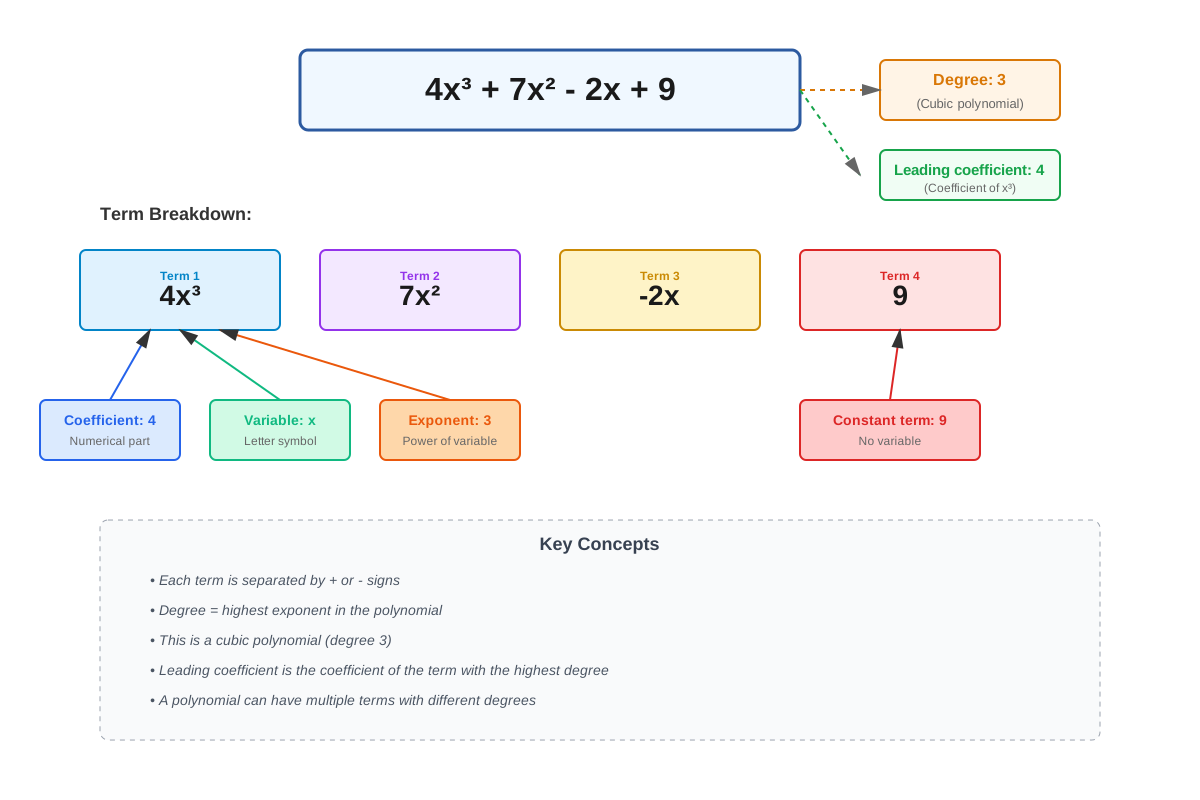
A polynomial is an algebraic expression consisting of one or more terms, where each term is the product of a coefficient (a constant number) and one or more variables raised to non-negative integer exponents. The general form of a polynomial in one variable x is:
a_n·x^n + a_(n-1)·x^(n-1) + ... + a_2·x^2 + a_1·x + a_0where the coefficients a_n, a_(n-1), ..., a_0 are real numbers and n is a non-negative integer. The degree of a polynomial is the highest exponent of the variable when the polynomial is written in standard form. For example, 3x^4 + 2x^2 - 5x + 7 is a polynomial of degree 4.
Key terminology includes:
- Term: A single part of the polynomial (e.g., 3x^2 is one term)
- Coefficient: The numerical factor in a term (in 3x^2, the coefficient is 3)
- Constant term: The term without a variable (a_0 in the general form)
- Leading coefficient: The coefficient of the term with the highest degree
- Standard form: Terms arranged in descending order of degree
Classification of Polynomials
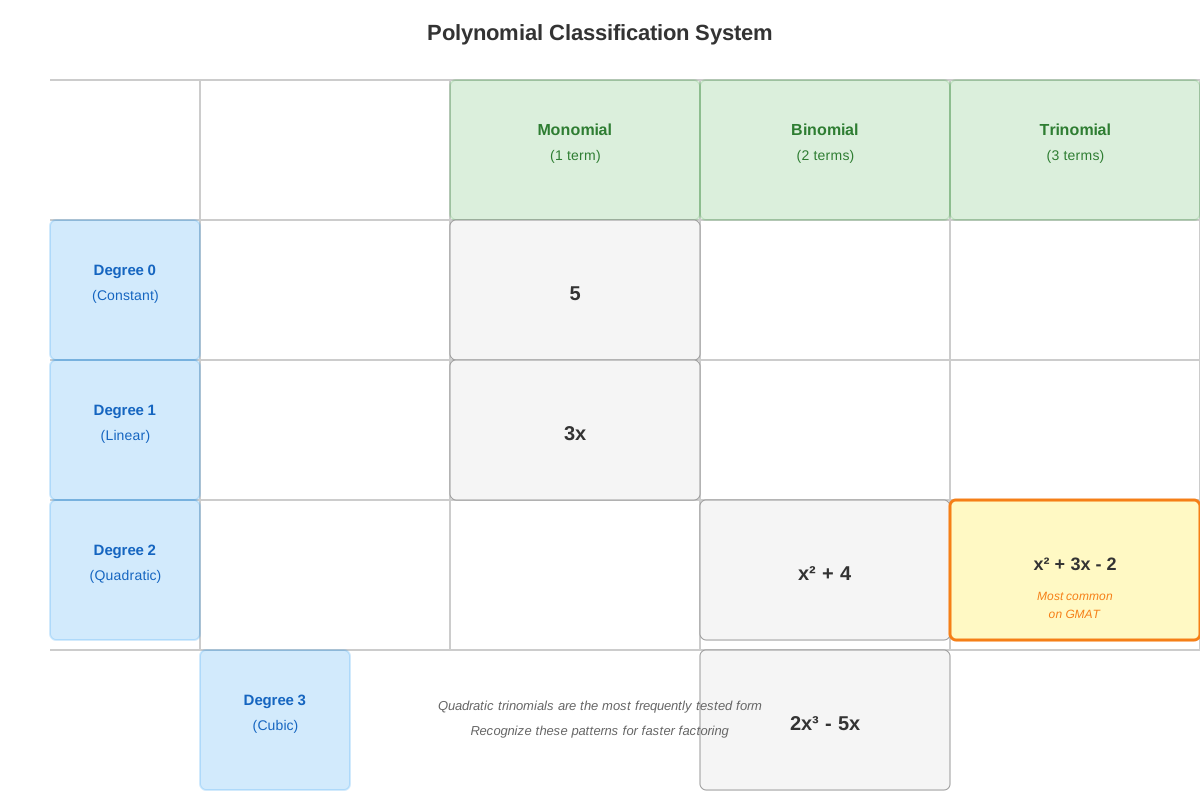
Polynomials are classified by both their degree and the number of terms they contain:
| Classification by Degree | Name | Example |
|---|---|---|
| Degree 0 | Constant | 5 |
| Degree 1 | Linear | 2x + 3 |
| Degree 2 | Quadratic | x^2 - 4x + 4 |
| Degree 3 | Cubic | 2x^3 + x^2 - 5 |
| Degree 4 | Quartic | x^4 - 16 |
| Classification by Terms | Name | Example |
|---|---|---|
| One term | Monomial | 5x^3 |
| Two terms | Binomial | x^2 - 9 |
| Three terms | Trinomial | x^2 + 5x + 6 |
Understanding these classifications helps identify which techniques apply to specific problems. Quadratic polynomials (degree 2) are the most frequently tested on the GMAT, followed by cubic expressions.
Polynomial Operations
Addition and Subtraction: Combine like terms (terms with identical variable parts). Only coefficients of like terms can be added or subtracted.
Example: (3x^2 + 2x - 5) + (x^2 - 4x + 7) = 4x^2 - 2x + 2
Multiplication: Apply the distributive property systematically. Each term in the first polynomial multiplies every term in the second polynomial.
For binomials, use the FOIL method (First, Outer, Inner, Last):
(a + b)(c + d) = ac + ad + bc + bd
Example: (x + 3)(x + 5) = x^2 + 5x + 3x + 15 = x^2 + 8x + 15
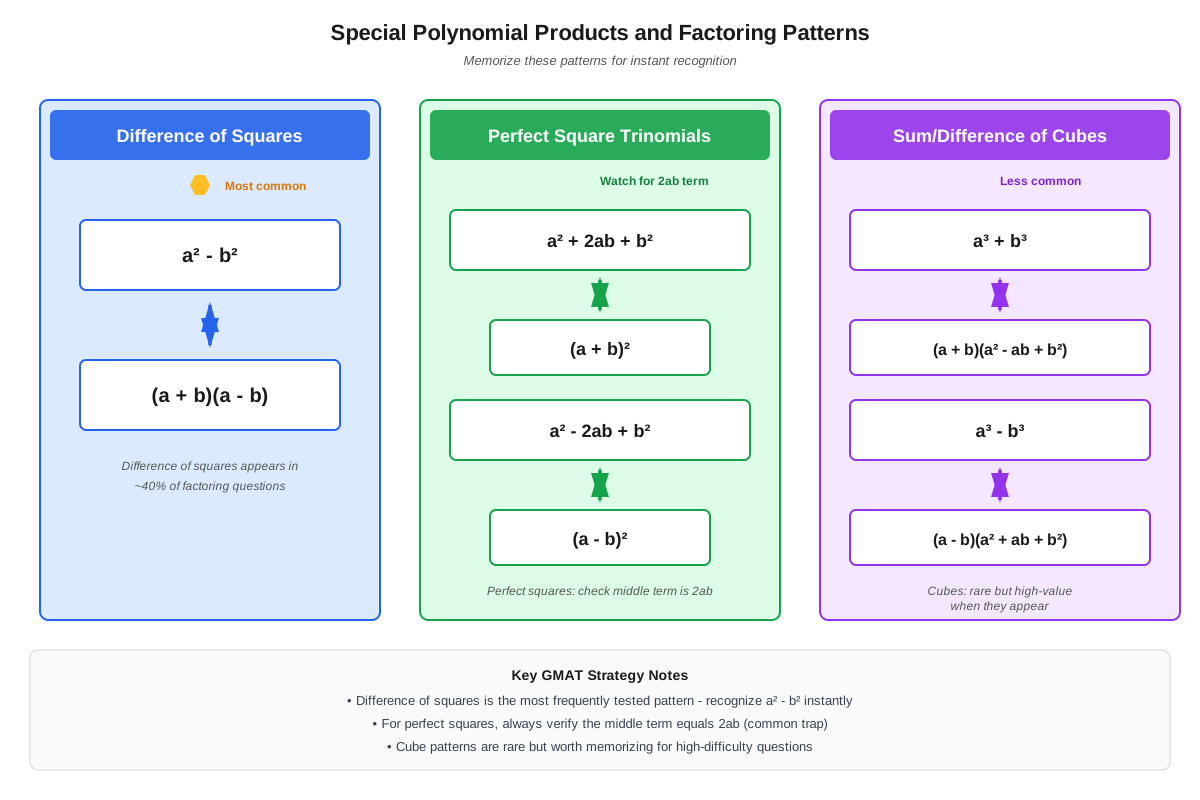
Special Polynomial Products
Recognizing these patterns saves significant time on the GMAT:
- Difference of Squares: a^2 - b^2 = (a + b)(a - b)
- Perfect Square Trinomials:
- a^2 + 2ab + b^2 = (a + b)^2
- a^2 - 2ab + b^2 = (a - b)^2
- Sum and Difference of Cubes:
- a^3 + b^3 = (a + b)(a^2 - ab + b^2)
- a^3 - b^3 = (a - b)(a^2 + ab + b^2)
These patterns appear frequently in GMAT questions, often as shortcuts to avoid lengthy calculations.
Factoring Polynomials
Factoring is the process of expressing a polynomial as a product of simpler polynomials. The GMAT tests several factoring techniques:
1. Greatest Common Factor (GCF): Extract the largest factor common to all terms.
- Example: 6x^3 + 9x^2 = 3x^2(2x + 3)
2. Factoring Trinomials: For ax^2 + bx + c, find two numbers that multiply to ac and add to b.
- Example: x^2 + 7x + 12 = (x + 3)(x + 4)
3. Grouping: For four-term polynomials, group terms in pairs and factor each pair.
- Example: x^3 + 3x^2 + 2x + 6 = x^2(x + 3) + 2(x + 3) = (x^2 + 2)(x + 3)
4. Special Products: Recognize and apply the patterns listed above.
Evaluating Polynomials
Evaluation means finding the value of a polynomial when the variable(s) take specific values. The most efficient method is substitution followed by order of operations:
Example: Evaluate 2x^2 - 3x + 5 when x = -2
- Substitute: 2(-2)^2 - 3(-2) + 5
- Calculate: 2(4) + 6 + 5 = 8 + 6 + 5 = 19
For complex evaluations, the Remainder Theorem states that when polynomial P(x) is divided by (x - a), the remainder is P(a). This concept occasionally appears in advanced GMAT questions.
Polynomial Equations
A polynomial equation sets a polynomial equal to a value (usually zero). Solving requires:
- Setting the equation equal to zero
- Factoring the polynomial completely
- Applying the Zero Product Property: if ab = 0, then a = 0 or b = 0
- Solving each resulting linear equation
Example: Solve x^2 + 5x + 6 = 0
- Factor: (x + 2)(x + 3) = 0
- Apply zero product property: x + 2 = 0 or x + 3 = 0
- Solutions: x = -2 or x = -3
Concept Relationships
The concepts within polynomial study form a hierarchical structure. Polynomial identification serves as the foundation, enabling students to recognize when polynomial techniques apply. This leads directly to polynomial classification, which determines which specific operations and factoring methods are most efficient.
Polynomial operations (addition, subtraction, multiplication) build upon basic algebraic manipulation and connect forward to special products, which are simply memorized patterns of common polynomial multiplications. Recognizing special products enables reverse engineering through factoring, the inverse operation of multiplication.
Factoring represents the central skill connecting multiple concepts: it requires understanding polynomial structure, recognizing patterns from special products, and applying systematic techniques. Factoring enables solving polynomial equations through the zero product property, which connects polynomials to the broader topic of equation-solving.
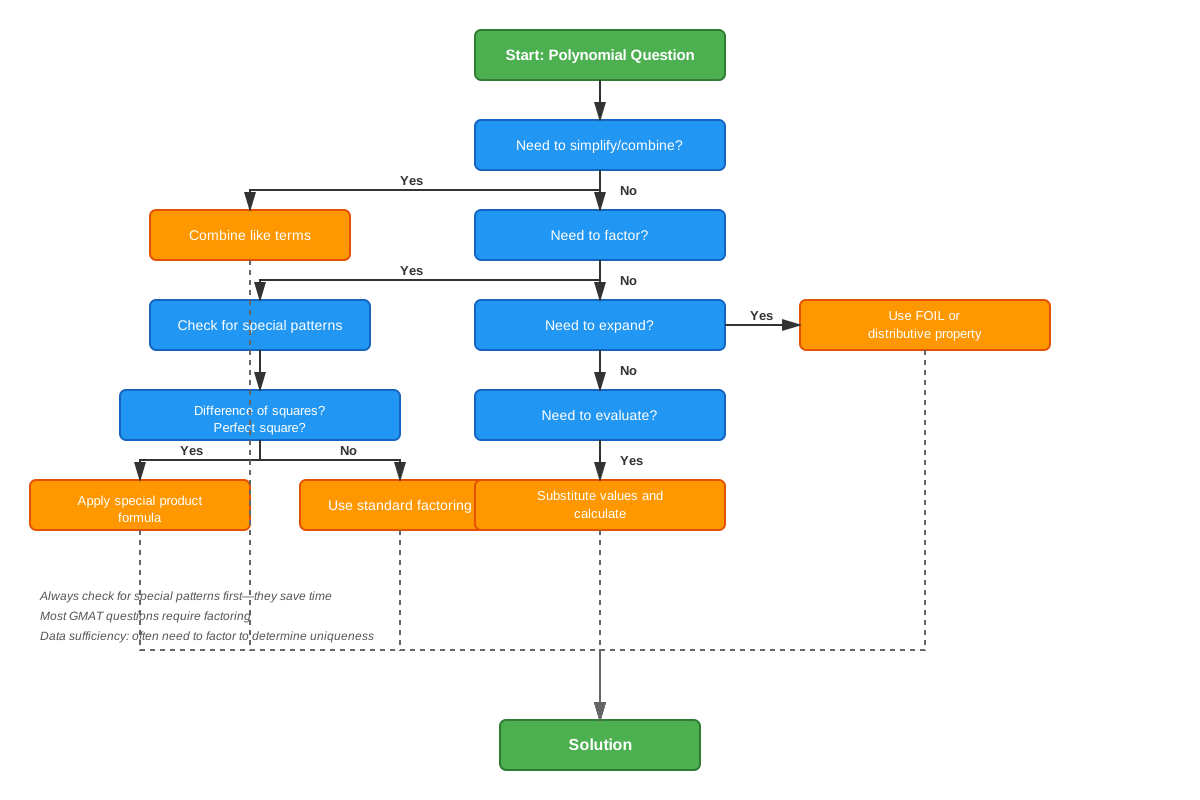
The relationship map flows as follows:
Polynomial Identification → Classification → Operations → Special Products ↔ Factoring → Polynomial Equations → Evaluation
This structure also connects to prerequisite topics: exponent rules enable polynomial multiplication, while basic equation-solving provides the framework for polynomial equations. Looking forward, polynomial mastery enables study of functions, inequalities, and coordinate geometry where polynomial relationships model curves and regions.
Quick check — test yourself on Polynomials so far.
Try Flashcards →High-Yield Facts
⭐ A polynomial contains only non-negative integer exponents; expressions with negative exponents, fractional exponents, or variables in denominators are NOT polynomials
⭐ The degree of a polynomial is the highest exponent when written in standard form; it determines the maximum number of solutions to polynomial equations
⭐ The difference of squares formula a^2 - b^2 = (a + b)(a - b) is the most frequently tested special product on the GMAT
⭐ When factoring trinomials of the form x^2 + bx + c, find two numbers that multiply to c and add to b
⭐ The zero product property (if ab = 0, then a = 0 or b = 0) is essential for solving factored polynomial equations
- A quadratic polynomial (degree 2) can have at most two distinct real solutions
- Perfect square trinomials follow the patterns (a ± b)^2 = a^2 ± 2ab + b^2
- When multiplying polynomials, the degree of the product equals the sum of the degrees of the factors
- Like terms must have identical variable parts (same variables with same exponents) to be combined
- The constant term in a factored polynomial equals the product of the constant terms in each factor
- Factoring by grouping works best for four-term polynomials with no common factor across all terms
- The leading coefficient is the coefficient of the term with the highest degree
- Sum of cubes and difference of cubes formulas are less common but appear in challenging GMAT questions
- Polynomial division (not covered in depth here) follows similar logic to long division with numbers
- The Fundamental Theorem of Algebra states that a polynomial of degree n has exactly n roots (counting multiplicities and complex roots)
Common Misconceptions
Misconception: All algebraic expressions are polynomials.
Correction: Polynomials must have only non-negative integer exponents. Expressions like 3x^(-2) + 5 or √x + 2 are NOT polynomials because they contain negative exponents or fractional exponents (√x = x^(1/2)).
Misconception: When factoring x^2 + 9, the result is (x + 3)(x + 3).
Correction: x^2 + 9 cannot be factored using real numbers. The sum of squares (a^2 + b^2) has no real factorization, unlike the difference of squares (a^2 - b^2). Only x^2 - 9 factors to (x + 3)(x - 3).
Misconception: The degree of (x^2 + 3)(x^3 - 2) is 6 because 2 × 3 = 6.
Correction: While this conclusion is correct, the reasoning is incomplete. The degree equals the sum of the degrees (2 + 3 = 5), but the highest degree term comes from multiplying the highest degree terms: x^2 · x^3 = x^5, giving degree 5, not 6.
Misconception: To solve x^2 + 5x + 6 = 0, divide both sides by x to get x + 5 + 6/x = 0.
Correction: Never divide by a variable that could equal zero, as this eliminates potential solutions. Instead, factor the polynomial: (x + 2)(x + 3) = 0, yielding solutions x = -2 or x = -3.
Misconception: (a + b)^2 = a^2 + b^2
Correction: This is one of the most common algebraic errors. The correct expansion is (a + b)^2 = a^2 + 2ab + b^2. The middle term 2ab is essential and frequently tested on the GMAT.
Misconception: When adding polynomials, all terms can be combined.
Correction: Only like terms (terms with identical variable parts) can be combined. In 3x^2 + 2x + x^2 - 5x, only 3x^2 and x^2 are like terms (giving 4x^2), and 2x and -5x are like terms (giving -3x). The result is 4x^2 - 3x.
Misconception: The polynomial 5 has no degree.
Correction: A non-zero constant is a polynomial of degree 0 (since 5 = 5x^0). The only polynomial without a defined degree is the zero polynomial (0).
Worked Examples
Example 1: Factoring and Solving a Quadratic Equation
Problem: If x^2 - 7x + 12 = 0, what are the possible values of x?
Solution:
Step 1: Recognize this as a quadratic polynomial equation that needs factoring.
Step 2: Factor the trinomial x^2 - 7x + 12. We need two numbers that:
- Multiply to +12 (the constant term)
- Add to -7 (the coefficient of x)
The numbers are -3 and -4 because (-3)(-4) = 12 and (-3) + (-4) = -7.
Step 3: Write the factored form:
x^2 - 7x + 12 = (x - 3)(x - 4) = 0
Step 4: Apply the zero product property. If (x - 3)(x - 4) = 0, then either:
- x - 3 = 0, which gives x = 3, OR
- x - 4 = 0, which gives x = 4
Answer: x = 3 or x = 4
Connection to Learning Objectives: This example demonstrates identifying a polynomial (quadratic trinomial), explaining its structure (degree 2 with three terms), and applying factoring techniques to solve a GMAT-style equation.
Example 2: Simplifying Using Special Products
Problem: Simplify (2x + 5)^2 - (2x - 5)^2 without expanding fully.
Solution:
Step 1: Recognize this as a difference of squares pattern: A^2 - B^2 = (A + B)(A - B), where A = (2x + 5) and B = (2x - 5).
Step 2: Apply the difference of squares formula:
(2x + 5)^2 - (2x - 5)^2 = [(2x + 5) + (2x - 5)][(2x + 5) - (2x - 5)]
Step 3: Simplify each bracket:
- First bracket: (2x + 5) + (2x - 5) = 2x + 5 + 2x - 5 = 4x
- Second bracket: (2x + 5) - (2x - 5) = 2x + 5 - 2x + 5 = 10
Step 4: Multiply the results:
(4x)(10) = 40x
Answer: 40x
Alternative (inefficient) approach: Expanding each square separately would require:
- (2x + 5)^2 = 4x^2 + 20x + 25
- (2x - 5)^2 = 4x^2 - 20x + 25
- Subtracting: (4x^2 + 20x + 25) - (4x^2 - 20x + 25) = 40x
The special product approach saves significant time and reduces calculation errors.
Connection to Learning Objectives: This example shows how recognizing special polynomial products enables efficient problem-solving on time-constrained GMAT questions, demonstrating both identification and application of polynomial concepts.
Exam Strategy
When approaching GMAT polynomials questions, begin by identifying the polynomial type and degree, as this determines which techniques apply. For quadratic expressions, immediately check whether special products (difference of squares, perfect square trinomials) apply before attempting general factoring methods. These patterns appear in approximately 60% of polynomial questions and provide significant time savings.
Trigger words and phrases to watch for include:
- "Factor the expression" → Apply systematic factoring techniques
- "Simplify" → Look for like terms to combine or special products to recognize
- "Solve for x" → Set equal to zero and factor
- "What is the value when x = ..." → Direct substitution and evaluation
- "Which of the following is equivalent to" → Test answer choices or manipulate algebraically
For data sufficiency questions involving polynomials, remember that:
- Knowing a polynomial equals zero and being able to factor it may still be insufficient if multiple solutions exist
- Information about the degree of a polynomial limits the maximum number of solutions
- Statements providing values for polynomial expressions at specific points may enable solving for coefficients
Process-of-elimination strategies:
- Eliminate answer choices with incorrect degrees (the degree must match the original expression)
- Test answer choices by substituting simple values (x = 0, x = 1, x = -1) to eliminate incorrect options quickly
- Check the constant term in factored forms—it must equal the constant term in the original expression
- Verify the leading coefficient matches between original and factored forms
Time allocation: Spend no more than 2 minutes on polynomial questions. If factoring doesn't emerge within 30 seconds, consider:
- Testing answer choices by expanding them
- Substituting strategic values to eliminate options
- Using special product patterns as shortcuts
For complex polynomial multiplication, avoid full expansion when possible. Instead, identify which terms contribute to the answer being sought (often only the constant term or leading coefficient matters for the question).
Memory Techniques
FOIL Mnemonic for binomial multiplication: First, Outer, Inner, Last
- Visualize the multiplication pattern as connecting terms in order
Special Products Mnemonic - "DIPS":
- Difference of squares: a^2 - b^2 = (a+b)(a-b)
- Identical binomials (perfect squares): (a±b)^2 = a^2 ± 2ab + b^2
- Plus/minus cubes: a^3 ± b^3 has specific factorizations
- Sum of squares: CANNOT be factored (remember the exception!)
Factoring Trinomials Memory Aid: "Product-Sum Method"
- For x^2 + bx + c, find numbers that are the PRODUCT of c and the SUM of b
- Visualize a simple table: one column for factor pairs of c, one column for their sums
Degree Addition Rule: "Degrees Add When Multiplying"
- When multiplying polynomials, degrees add: (degree 2) × (degree 3) = degree 5
- Visualize exponent rules: x^2 · x^3 = x^(2+3) = x^5
Zero Product Property Visualization: "Zero Breaks the Chain"
- If a chain of multiplied factors equals zero, at least one link must be zero
- Visualize: (factor₁)(factor₂)(factor₃) = 0 means at least one factor = 0
Perfect Square Recognition: "Square-Double-Square" (SDS)
- a^2 ± 2ab + b^2 follows the pattern: Square, Double product, Square
- Check if first and last terms are perfect squares, then verify middle term is double their product
Summary
Polynomials form a cornerstone of GMAT quantitative reasoning, appearing in 15-20% of algebra questions across multiple formats. A polynomial is an algebraic expression with non-negative integer exponents, classified by degree (linear, quadratic, cubic) and number of terms (monomial, binomial, trinomial). Mastery requires fluency in three core skills: operations (adding, subtracting, multiplying polynomials using the distributive property), factoring (extracting common factors, factoring trinomials, recognizing special products), and solving polynomial equations (factoring then applying the zero product property). The most high-yield concepts for the GMAT are the difference of squares formula, perfect square trinomials, and systematic trinomial factoring. Success on polynomial questions depends on pattern recognition—identifying when special products apply saves significant time compared to full algebraic expansion. Students must distinguish polynomials from non-polynomial expressions, understand that only like terms combine, and remember that the sum of squares cannot be factored using real numbers. Efficient problem-solving requires testing answer choices strategically, substituting simple values to eliminate options, and allocating no more than two minutes per question while leveraging shortcuts whenever possible.
Key Takeaways
- Polynomials contain only non-negative integer exponents; expressions with negative or fractional exponents are not polynomials
- The difference of squares (a^2 - b^2 = (a+b)(a-b)) is the most frequently tested special product and provides the fastest solution path when recognized
- Factoring trinomials requires finding two numbers that multiply to the constant term and add to the middle coefficient, a systematic process that appears in numerous GMAT questions
- The zero product property enables solving polynomial equations: if a factored expression equals zero, at least one factor must equal zero
- Perfect square trinomials follow the pattern a^2 ± 2ab + b^2 = (a±b)^2, and recognizing this pattern eliminates time-consuming factoring attempts
- Only like terms (identical variable parts with same exponents) can be combined when adding or subtracting polynomials
- Time efficiency on the GMAT requires recognizing special products before attempting general factoring methods, as pattern recognition saves 30-50% of solution time
Related Topics
Quadratic Equations and the Quadratic Formula: Extends polynomial concepts to solving quadratics that don't factor easily, providing an alternative method when factoring fails. Mastering basic polynomial factoring makes the quadratic formula more intuitive.
Functions and Function Notation: Polynomial functions represent a major category of functions tested on the GMAT. Understanding polynomial structure enables analysis of function behavior, domain, and range.
Inequalities: Polynomial inequalities require factoring skills combined with number line analysis. The zero product property extends to determining where polynomial expressions are positive or negative.
Coordinate Geometry: Polynomial equations describe curves (parabolas, cubics) in the coordinate plane. Factoring reveals x-intercepts, while polynomial structure determines curve shape.
Systems of Equations: Many GMAT systems involve polynomial equations. Factoring skills enable efficient solution of non-linear systems that appear in advanced problem-solving questions.
Practice CTA
Now that you've mastered the core concepts of polynomials, it's time to solidify your understanding through active practice. Attempt the practice questions associated with this topic, focusing on recognizing patterns quickly and applying factoring techniques efficiently. Use the flashcards to reinforce special product formulas and factoring methods until they become automatic. Remember, the difference between good and great GMAT scores often comes down to pattern recognition speed—the more you practice identifying polynomial structures, the faster and more accurate you'll become on test day. Challenge yourself to solve each practice problem using the most efficient method, not just any method that works. Your investment in deliberate practice now will pay dividends in both speed and confidence when you face these questions under timed conditions!
Sign up free to keep reading
Create a free AnvayaPrep account to finish this GMAT guide on Polynomials — plus flashcards and practice questions.