Overview
Decimals are a fundamental component of the GMAT Quantitative Reasoning section, appearing in approximately 15-20% of all quantitative questions either directly or as part of more complex problem-solving scenarios. Understanding decimals is essential not only for arithmetic questions but also for algebra, word problems, data sufficiency questions, and data interpretation tasks. The GMAT tests decimal proficiency through operations, conversions, comparisons, and applications in real-world contexts such as finance, percentages, and ratios.
Mastery of GMAT decimals requires more than basic computational ability—it demands conceptual understanding of place value, the relationship between decimals and fractions, and the ability to estimate and manipulate decimal values efficiently under time pressure. The GMAT frequently tests whether students can recognize equivalent forms of numbers, perform operations without calculators, and identify when decimal precision matters versus when estimation suffices. Questions often combine decimals with other arithmetic concepts like percentages, ratios, and scientific notation, making this topic a critical foundation for success across multiple question types.
Within the broader Quantitative Reasoning framework, decimals serve as a bridge between whole numbers and fractions, enabling precise representation of non-integer values. They connect directly to percentages (which are decimals multiplied by 100), ratios (which can be expressed as decimals), and scientific notation (which uses decimals with powers of ten). Strong decimal skills also support algebraic manipulation, as many equations involve decimal coefficients or solutions. Understanding decimals thoroughly allows test-takers to move fluidly between different numerical representations, a skill the GMAT rewards consistently.
Learning Objectives
- [ ] Identify decimals in various contexts and formats
- [ ] Explain the structure and place value system of decimals
- [ ] Apply decimals to GMAT questions involving operations and problem-solving
- [ ] Convert between decimals, fractions, and percentages with accuracy
- [ ] Compare and order decimal values efficiently
- [ ] Perform arithmetic operations with decimals without a calculator
- [ ] Recognize when to use exact decimal calculations versus estimation strategies
Prerequisites
- Whole number operations: Understanding addition, subtraction, multiplication, and division forms the foundation for decimal operations, which follow identical rules with attention to place value
- Place value system: Knowledge of the base-10 system (ones, tens, hundreds) extends naturally to decimal places (tenths, hundredths, thousandths)
- Basic fractions: Decimals are alternative representations of fractions with denominators that are powers of 10, making fraction fluency essential for conversions
- Powers of ten: Recognizing how multiplying or dividing by 10, 100, 1000, etc., shifts decimal points is crucial for efficient calculation
Why This Topic Matters
Decimals appear throughout professional and academic contexts, from financial calculations and statistical analysis to scientific measurements and data interpretation. In business settings, decimals represent currency amounts, interest rates, growth percentages, and financial ratios. Scientists use decimals to express measurements with precision, while data analysts work with decimal representations of proportions and probabilities. This real-world ubiquity makes decimals an essential skill for the graduate-level business programs the GMAT serves as a gateway to.
On the GMAT specifically, decimals appear in approximately 15-20% of Quantitative Reasoning questions, distributed across problem-solving and data sufficiency formats. Questions may directly test decimal operations (addition, subtraction, multiplication, division), require conversions between decimals and other forms (fractions, percentages, scientific notation), or embed decimals within word problems involving money, measurements, or rates. Data Interpretation questions frequently present decimal values in tables and graphs that must be compared, combined, or analyzed. The GMAT also tests conceptual understanding through questions about decimal place value, rounding, and the effects of operations on decimal magnitude.
Common question patterns include: comparing decimal values to determine order; performing multi-step calculations involving decimals and other operations; converting between fractions, decimals, and percentages; determining the result of multiplying or dividing by powers of ten; and estimating decimal calculations to eliminate answer choices efficiently. Data sufficiency questions often test whether students understand what information is needed to determine a decimal value or relationship. The ability to work confidently with decimals under time pressure, without a calculator, directly impacts GMAT performance across multiple content areas.
Core Concepts
Understanding Decimal Structure and Place Value
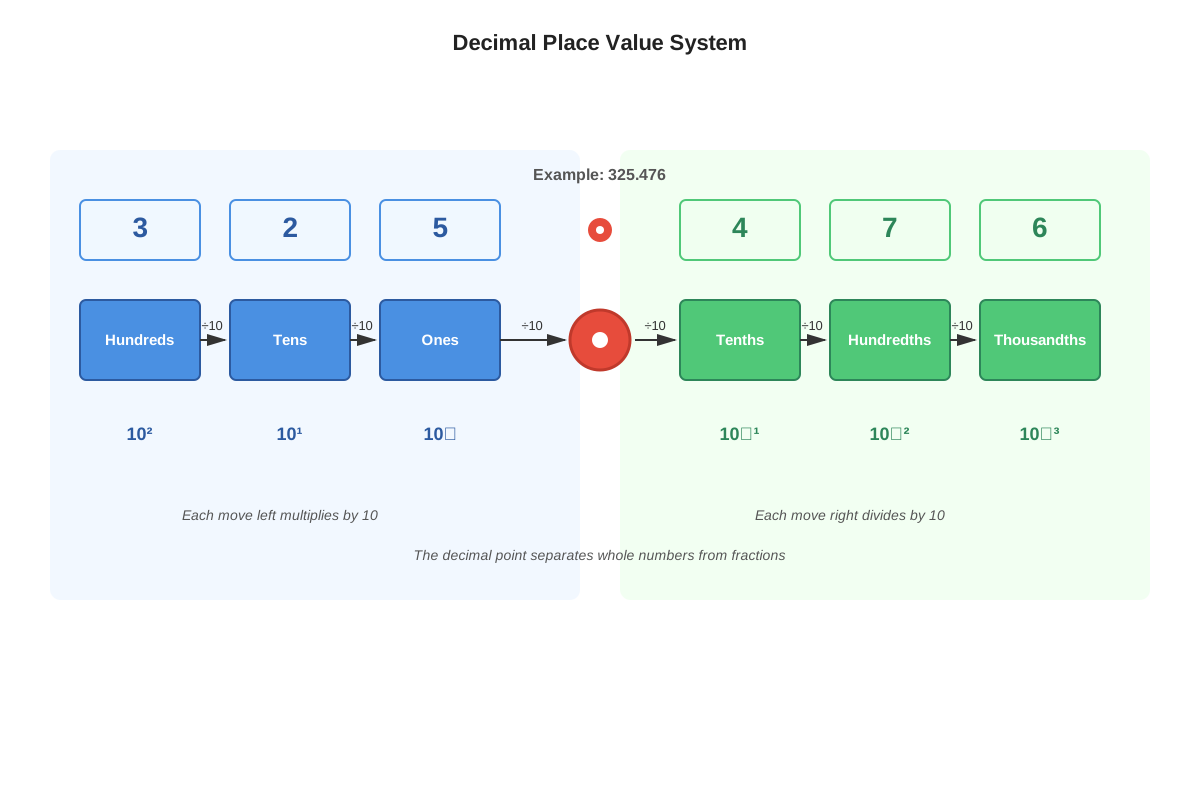
A decimal is a number that uses a decimal point to separate the whole number portion from the fractional portion. The decimal point serves as the reference marker for the place value system, with positions to the left representing whole numbers (ones, tens, hundreds) and positions to the right representing fractional parts (tenths, hundredths, thousandths). Each position represents a power of ten: moving one place to the right divides by 10, while moving one place to the left multiplies by 10.
For example, in the decimal 347.682:
- 3 is in the hundreds place (3 × 100 = 300)
- 4 is in the tens place (4 × 10 = 40)
- 7 is in the ones place (7 × 1 = 7)
- 6 is in the tenths place (6 × 0.1 = 0.6)
- 8 is in the hundredths place (8 × 0.01 = 0.08)
- 2 is in the thousandths place (2 × 0.001 = 0.002)
Understanding this structure is fundamental because the GMAT tests whether students can identify the value of specific digits, compare decimals of different lengths, and recognize equivalent representations. A common GMAT trap involves comparing decimals like 0.5 and 0.500—these are identical in value despite different appearances, as trailing zeros after the decimal point do not change magnitude.
Comparing and Ordering Decimals
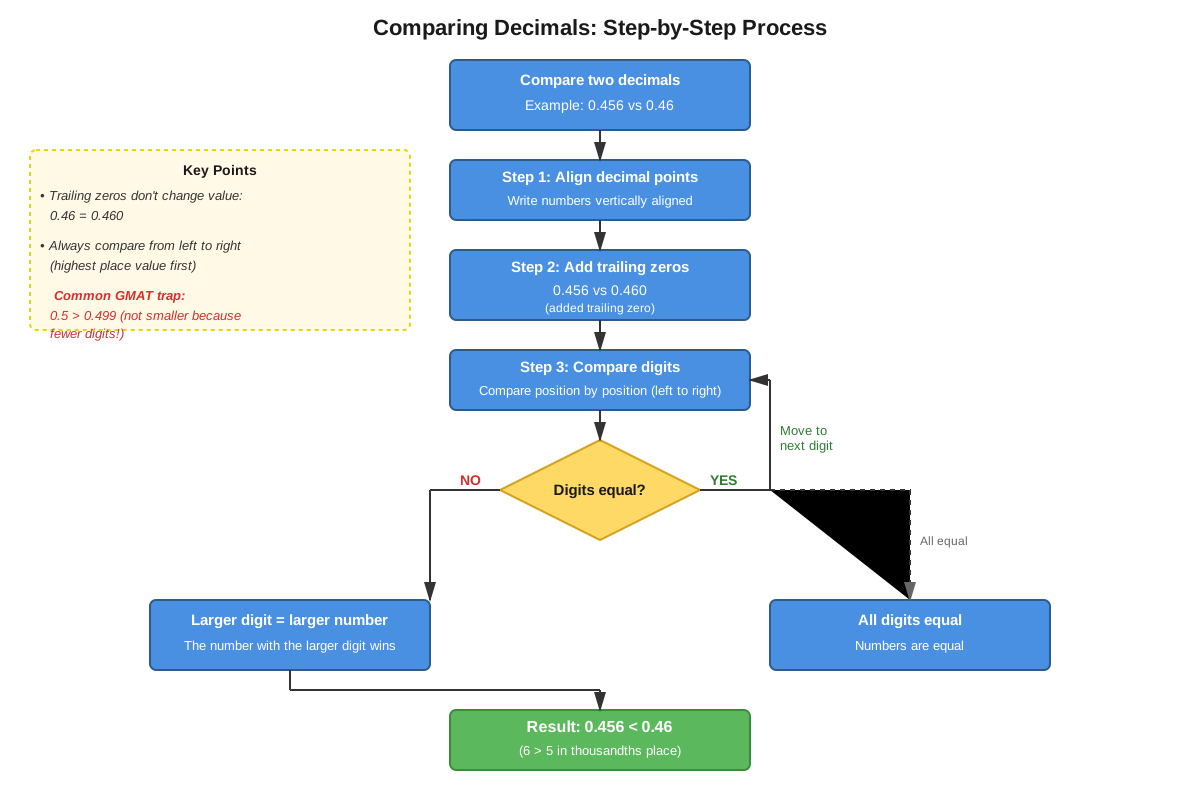
Comparing decimals requires systematic attention to place value, starting from the leftmost position and moving right. To compare two decimals, align them by their decimal points and compare digit by digit from left to right. The first position where digits differ determines which decimal is larger.
Process for comparing decimals:
- Align decimal points vertically
- Add trailing zeros if needed to make lengths equal (optional but helpful)
- Compare digits from left to right
- The first unequal digit determines the larger number
Example: Compare 0.456 and 0.46
- Align: 0.456 vs 0.460
- Compare tenths: 4 = 4 (equal)
- Compare hundredths: 5 < 6
- Therefore: 0.456 < 0.46
The GMAT frequently tests this skill by presenting answer choices in decimal form or asking students to order values from least to greatest. A critical insight is that more decimal places does not mean a larger number—0.9 is greater than 0.875, even though 0.875 has more digits.
Converting Between Decimals, Fractions, and Percentages
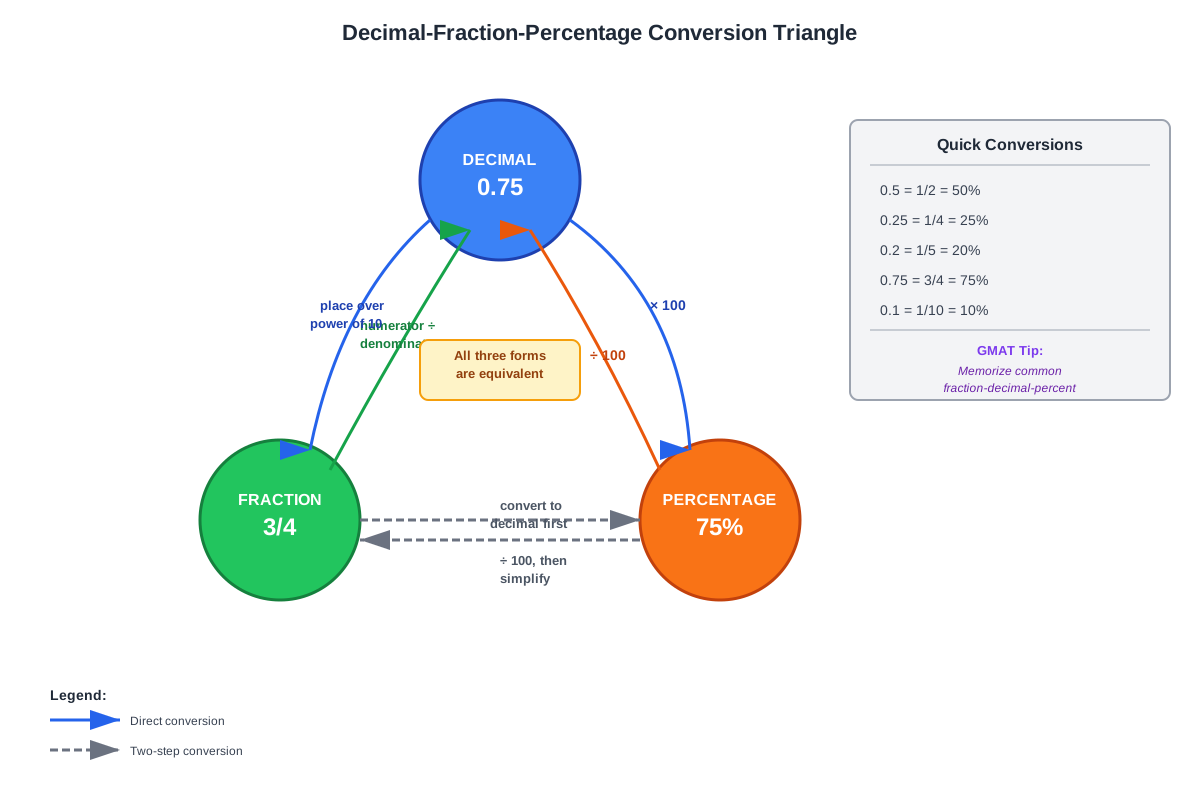
The ability to convert fluently between decimals, fractions, and percentages is essential for GMAT success, as questions often present information in one form and require answers in another.
Decimal to Fraction:
- Write the decimal as a fraction with the decimal digits as the numerator
- Use a denominator that is a power of 10 based on the number of decimal places
- Simplify the fraction if possible
Example: 0.625 = 625/1000 = 5/8 (after dividing both by 125)
Fraction to Decimal:
Divide the numerator by the denominator using long division or recognize common fraction-decimal equivalents.
Decimal to Percentage:
Multiply the decimal by 100 and add the percent symbol (or move the decimal point two places right).
Example: 0.375 = 37.5%
Percentage to Decimal:
Divide by 100 (or move the decimal point two places left).
Example: 45% = 0.45
| Fraction | Decimal | Percentage |
|---|---|---|
| 1/2 | 0.5 | 50% |
| 1/4 | 0.25 | 25% |
| 3/4 | 0.75 | 75% |
| 1/5 | 0.2 | 20% |
| 1/8 | 0.125 | 12.5% |
| 2/3 | 0.666... | 66.67% |
Memorizing these common conversions saves valuable time on the GMAT and enables quick estimation.
Arithmetic Operations with Decimals
Addition and Subtraction:
Align decimal points vertically and perform the operation as with whole numbers, keeping the decimal point in the same position in the answer.
Example: 45.67 + 3.8
  45.67
+  3.80
-------
  49.47
Multiplication:
Multiply as with whole numbers, ignoring decimal points initially. Then count the total number of decimal places in both factors and place the decimal point in the product so it has that many decimal places.
Example: 2.5 × 3.4
- Multiply: 25 × 34 = 850
- Count decimal places: 1 + 1 = 2
- Place decimal: 8.50 = 8.5
Division:
When dividing by a decimal, multiply both dividend and divisor by the same power of 10 to make the divisor a whole number, then divide normally.
Example: 7.5 ÷ 0.25
- Multiply both by 100: 750 ÷ 25
- Divide: 750 ÷ 25 = 30
Multiplying and Dividing by Powers of Ten
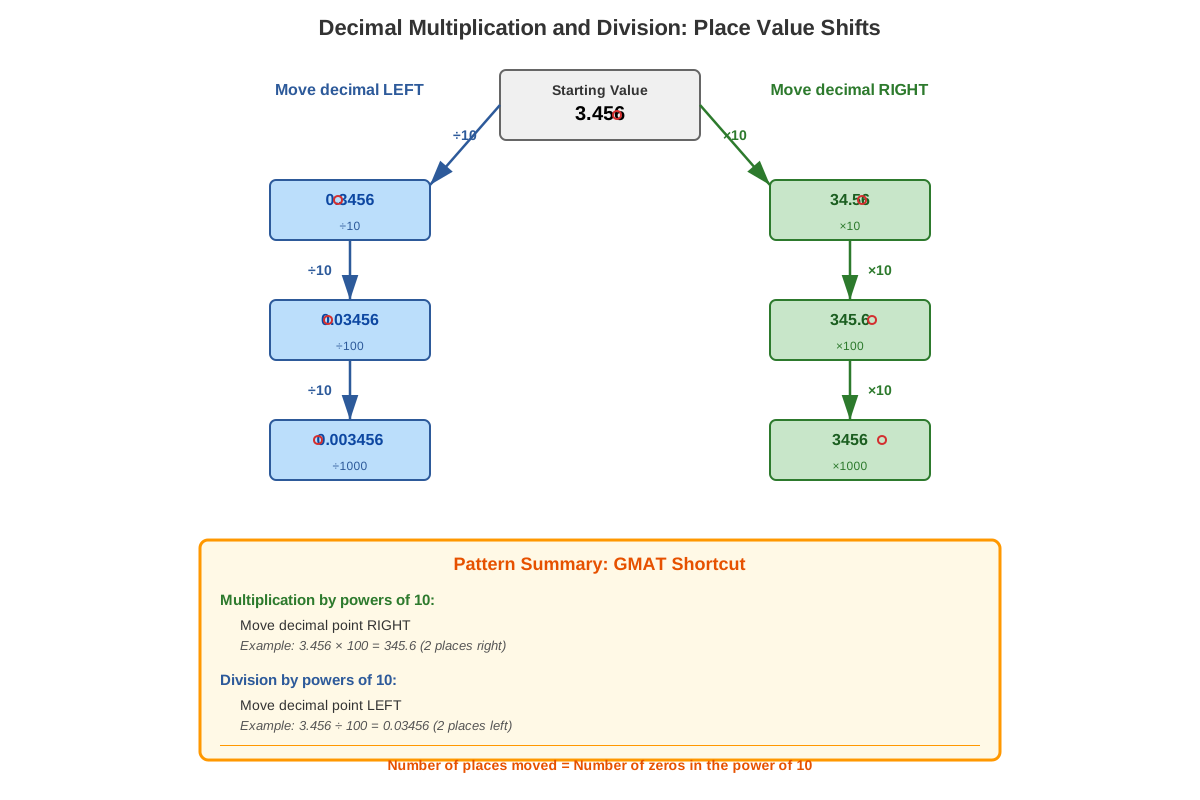
Understanding how decimals interact with powers of ten is crucial for GMAT efficiency. Multiplying by 10, 100, 1000, etc., moves the decimal point to the right; dividing moves it to the left.
Rules:
- Multiply by 10^n: Move decimal point n places right
- Divide by 10^n: Move decimal point n places left
- Add zeros as placeholders when necessary
Examples:
- 4.56 × 100 = 456 (moved 2 places right)
- 4.56 ÷ 10 = 0.456 (moved 1 place left)
- 0.003 × 1000 = 3 (moved 3 places right)
This concept connects directly to scientific notation and percentage calculations, both common on the GMAT.
Rounding and Estimation
The GMAT rewards students who can estimate efficiently to eliminate incorrect answer choices without performing exact calculations. Rounding decimals follows standard rules:
Rounding rules:
- Identify the place value to round to
- Look at the digit immediately to the right
- If that digit is 5 or greater, round up; if less than 5, round down
- Replace all digits to the right with zeros (or drop them after the decimal point)
Example: Round 3.7849 to the nearest hundredth
- Look at the thousandths place: 4
- Since 4 < 5, round down
- Result: 3.78
For GMAT estimation, round numbers to make calculations simpler, then determine which answer choice is closest. This strategy is particularly effective when answer choices are spread apart.
Repeating and Terminating Decimals
Terminating decimals have a finite number of digits after the decimal point (e.g., 0.25, 0.875). These occur when the fraction's denominator (in lowest terms) has only factors of 2 and/or 5.
Repeating decimals have one or more digits that repeat infinitely (e.g., 0.333..., 0.142857142857...). These occur when the denominator has prime factors other than 2 or 5. Repeating decimals are often written with a bar over the repeating portion: 0.3̄ or 0.1̄4̄2̄8̄5̄7̄.
The GMAT may test recognition of whether a fraction will produce a terminating or repeating decimal, or require converting repeating decimals to fractions. Understanding this distinction helps with estimation and answer choice elimination.
Concept Relationships
The concepts within decimals form an interconnected system where place value understanding serves as the foundation for all other skills. Place value knowledge → enables → accurate comparison and ordering → which supports → estimation strategies. Similarly, place value mastery → enables → arithmetic operations → which combine with → powers of ten manipulation → to facilitate → efficient calculation.
The conversion skills form another relationship chain: fraction understanding ↔ decimal representation ↔ percentage expression, where fluency in moving between these forms enables flexible problem-solving. This bidirectional relationship means that strengthening any one representation improves facility with all three.
Decimals connect to prerequisite topics through direct extension: whole number operations extend to decimal operations by incorporating place value rules; basic fractions translate to decimals through division; powers of ten govern decimal point movement. These connections mean that students with strong foundational skills can rapidly develop decimal proficiency.
Looking forward, decimal mastery enables progression to more advanced topics: decimals → support → percentage calculations (used in interest, growth, and proportion problems); decimals → enable → ratio and proportion work (often expressed in decimal form); decimals → facilitate → scientific notation (which combines decimals with exponents); decimals → underpin → data interpretation (where decimal values appear in tables and graphs).
Quick check — test yourself on Decimals so far.
Try Flashcards →High-Yield Facts
⭐ The decimal point position determines value: Moving the decimal point one place right multiplies by 10; moving it one place left divides by 10.
⭐ Trailing zeros after the decimal point do not change value: 0.5 = 0.50 = 0.500, but leading zeros before the first non-zero digit are essential (0.05 ≠ 0.5).
⭐ When multiplying decimals, add the number of decimal places: If one factor has 2 decimal places and another has 1, the product has 3 decimal places.
⭐ To divide by a decimal, convert the divisor to a whole number: Multiply both dividend and divisor by the same power of 10.
⭐ Common fraction-decimal equivalents save time: Memorize 1/2 = 0.5, 1/4 = 0.25, 1/5 = 0.2, 1/8 = 0.125, 1/3 = 0.333..., 2/3 = 0.666...
- Comparing decimals requires left-to-right digit comparison: Align decimal points and compare position by position starting from the left.
- A fraction produces a terminating decimal only if its denominator (in lowest terms) has only factors of 2 and/or 5: Otherwise, it produces a repeating decimal.
- Rounding to a specific place value requires examining the digit immediately to the right: 5 or greater rounds up; less than 5 rounds down.
- Multiplying by 0.1 is the same as dividing by 10: Similarly, dividing by 0.1 is the same as multiplying by 10.
- The number of decimal places indicates precision: More decimal places mean more precise measurements, but not necessarily larger values.
- Converting a percentage to a decimal requires dividing by 100: This moves the decimal point two places left (45% = 0.45).
- Adding or subtracting decimals requires aligning decimal points: This ensures that place values correspond correctly.
Common Misconceptions
Misconception: More decimal places always means a larger number.
Correction: The number of decimal places indicates precision, not magnitude. 0.9 is greater than 0.875, even though 0.875 has more digits. Always compare place values from left to right, starting with the tenths place.
Misconception: When multiplying decimals, place the decimal point in the product by counting from the left.
Correction: Count the total decimal places in both factors, then place the decimal point in the product by counting from the right. For 2.5 × 3.4, there are 2 total decimal places, so 850 becomes 8.50.
Misconception: To divide by a decimal, move the decimal point in the dividend only.
Correction: Move the decimal point in both the dividend and divisor by the same number of places to make the divisor a whole number. This maintains the quotient's value while simplifying the division.
Misconception: 0.5 and 0.05 are similar values that can be approximated as the same.
Correction: These values differ by a factor of 10. The position of the decimal point is critical—0.5 is ten times larger than 0.05. Always pay careful attention to decimal point placement.
Misconception: Trailing zeros before the decimal point don't matter (e.g., 50 vs 50.0).
Correction: While mathematically equivalent, trailing zeros after a decimal point can indicate precision in measurement contexts. However, for GMAT purposes, 50 = 50.0 = 50.00 in value.
Misconception: All fractions can be expressed as terminating decimals.
Correction: Only fractions whose denominators (in lowest terms) contain only factors of 2 and/or 5 produce terminating decimals. Fractions like 1/3, 1/7, and 1/9 produce repeating decimals.
Misconception: When comparing 0.8 and 0.75, the one with more digits is larger.
Correction: Compare by place value: 0.8 = 0.80, and in the hundredths place, 80 > 75, so 0.8 > 0.75. The number of digits after the decimal point doesn't determine magnitude.
Worked Examples
Example 1: Multi-Step Decimal Operations
Question: A store offers a 15% discount on an item originally priced at $48.50. After applying the discount, a 6% sales tax is added. What is the final price?
Solution:
Step 1: Calculate the discount amount
- 15% = 0.15
- Discount = 48.50 × 0.15
- Multiply: 4850 × 15 = 72,750
- Count decimal places: 2 + 2 = 4
- Discount = 7.2750 = $7.28 (rounded)
Step 2: Calculate the price after discount
- Price after discount = 48.50 - 7.28 = $41.22
- Alternatively: Price after discount = 48.50 × 0.85 = $41.23 (slight rounding difference)
Step 3: Calculate the sales tax
- 6% = 0.06
- Tax = 41.23 × 0.06
- Multiply: 4123 × 6 = 24,738
- Count decimal places: 2 + 2 = 4
- Tax = 2.4738 ≈ $2.47
Step 4: Calculate final price
- Final price = 41.23 + 2.47 = $43.70
- Alternatively: Final price = 41.23 × 1.06 = $43.70
Connection to learning objectives: This problem requires applying decimals to a real-world GMAT scenario, performing multiple operations (multiplication, subtraction, addition), and converting between percentages and decimals.
Example 2: Comparing and Ordering Decimals
Question: Arrange the following values in ascending order: 0.625, 5/8, 62%, 0.6
Solution:
Step 1: Convert all values to decimals for easy comparison
- 0.625 is already a decimal
- 5/8: Divide 5 by 8 = 0.625
- 62% = 62/100 = 0.62
- 0.6 is already a decimal
Step 2: Align and compare
- 0.625
- 0.625
- 0.620
- 0.600
Step 3: Order from smallest to largest
- 0.600 (which is 0.6)
- 0.620 (which is 62%)
- 0.625 (which is both 0.625 and 5/8)
Answer: 0.6, 62%, 0.625 = 5/8
Connection to learning objectives: This problem demonstrates identifying decimals in various forms, explaining their relationships through conversion, and applying comparison skills. It also shows that different representations (fraction, decimal, percentage) can have identical values.
Example 3: Division by Decimals with Estimation
Question: What is 15.75 ÷ 0.25?
Solution:
Method 1: Exact Calculation
Step 1: Convert divisor to whole number
- Multiply both dividend and divisor by 100
- 15.75 × 100 = 1575
- 0.25 × 100 = 25
Step 2: Divide
- 1575 ÷ 25 = 63
Method 2: Estimation (GMAT Strategy)
Step 1: Recognize that 0.25 = 1/4
- Dividing by 1/4 is the same as multiplying by 4
Step 2: Calculate
- 15.75 × 4 ≈ 16 × 4 = 64
- More precisely: 15.75 × 4 = 63
Answer: 63
Connection to learning objectives: This demonstrates applying decimal division techniques and shows how recognizing fraction-decimal equivalents enables faster calculation—a crucial GMAT skill.
Exam Strategy
When approaching GMAT questions involving decimals, begin by identifying whether the question requires exact calculation or whether estimation will suffice. If answer choices are widely spaced (e.g., 25, 50, 75, 100), estimation often eliminates all but one option, saving valuable time. If choices are close together (e.g., 45.2, 45.5, 45.8, 46.1), precise calculation becomes necessary.
Trigger words and phrases to watch for:
- "Approximately" or "closest to" signals that estimation is acceptable
- "Exactly" or "precise" requires careful calculation
- "Decimal form" or "to the nearest hundredth" specifies the required answer format
- "Percent," "fraction," or "ratio" may require conversion from decimal form
- "Increase by" or "decrease by" often involves decimal multiplication
Process-of-elimination strategies:
- Decimal point placement: Quickly eliminate answers with decimal points in obviously wrong positions by estimating magnitude
- Trailing digit analysis: If you can determine the last digit of an answer through units digit multiplication, eliminate choices that don't match
- Benchmark comparison: Compare the expected result to familiar benchmarks (0.5, 1, 10, etc.) to eliminate unreasonable answers
- Conversion checking: If converting between forms, eliminate answers that represent impossible conversions (e.g., a percentage over 100% when the decimal is less than 1)
Time allocation advice:
- Spend no more than 2 minutes on any single quantitative question
- If a decimal calculation appears complex, look for shortcuts: common fraction equivalents, powers of ten, or cancellation opportunities
- For data sufficiency questions involving decimals, often you can determine sufficiency without calculating exact values
- Practice mental math with common decimal operations to reduce reliance on scratch work
Specific approaches for decimal questions:
- When multiplying or dividing by powers of ten, visualize the decimal point moving rather than performing full calculations
- For comparison questions, align decimal points mentally and compare left to right
- When converting between forms, memorize common equivalents to avoid repeated calculations
- If a problem involves multiple decimal operations, consider whether working with fractions might be simpler
Memory Techniques
Mnemonic for decimal place values (right of decimal point): "The Happy Turtle" represents Tenths, Hundredths, Thousandths in order from the decimal point.
Visualization for decimal point movement: Imagine the decimal point as a stationary marker and the digits as moving. When multiplying by 10, the digits shift left (making the number larger); when dividing by 10, digits shift right (making the number smaller). This mental model prevents confusion about which direction to move the decimal point.
Acronym for conversion sequence: "First Divide, Please" reminds you that Fraction → Decimal → Percentage is the natural conversion flow (divide numerator by denominator to get decimal, then multiply by 100 for percentage).
Memory palace for common conversions: Visualize a house with rooms:
- Kitchen (1/2 = 0.5 = 50%): Half a pie
- Bedroom (1/4 = 0.25 = 25%): Quarter of the bed
- Bathroom (1/5 = 0.2 = 20%): One of five tiles
- Living room (1/8 = 0.125 = 12.5%): One-eighth of an octagonal rug
Rhyme for rounding: "Five or more, raise the score; four or less, let it rest" helps remember that 5 rounds up while 4 rounds down.
Finger technique for powers of ten: Hold up fingers to represent the exponent. Moving right (multiplying) means the number gets bigger (fingers point up); moving left (dividing) means the number gets smaller (fingers point down). The number of fingers shows how many places to move the decimal point.
Summary
Decimals represent fractional values using a base-10 place value system, with positions to the right of the decimal point indicating tenths, hundredths, thousandths, and so on. Mastery of decimals for the GMAT requires understanding place value structure, performing arithmetic operations accurately, converting fluently between decimals, fractions, and percentages, and comparing decimal values efficiently. The key to success lies in recognizing that decimal operations follow the same rules as whole number operations, with careful attention to decimal point placement. Multiplying and dividing by powers of ten simply shifts the decimal point right or left, respectively. When comparing decimals, align decimal points and compare digit by digit from left to right. For GMAT efficiency, memorize common fraction-decimal-percentage equivalents and develop strong estimation skills to eliminate incorrect answer choices quickly. Understanding whether a calculation requires precision or allows estimation, recognizing when to convert between forms, and applying systematic approaches to decimal operations will enable confident, accurate performance on the 15-20% of GMAT questions that involve decimals directly or indirectly.
Key Takeaways
- Decimals use place value to represent fractional parts, with each position to the right of the decimal point representing a power of ten (tenths, hundredths, thousandths)
- Arithmetic operations with decimals follow whole number rules with attention to decimal point placement: align points for addition/subtraction, count total decimal places for multiplication, convert divisors to whole numbers for division
- Converting between decimals, fractions, and percentages is essential: memorize common equivalents (1/2 = 0.5 = 50%, 1/4 = 0.25 = 25%, etc.) for GMAT efficiency
- Multiplying by powers of ten moves the decimal point right; dividing moves it left: this principle enables quick mental calculations and connects to scientific notation
- Comparing decimals requires left-to-right digit comparison after aligning decimal points: more decimal places doesn't mean larger value
- Estimation strategies save time on the GMAT: when answer choices are spread apart, round decimals to simplify calculations and eliminate incorrect options
- Recognize terminating versus repeating decimals: fractions with denominators containing only factors of 2 and/or 5 (in lowest terms) produce terminating decimals
Related Topics
Fractions: Decimals are alternative representations of fractions, and strong fraction skills enable quick conversion and recognition of equivalent forms. Mastering decimals provides a foundation for more complex fraction operations and simplification.
Percentages: Every percentage is a decimal multiplied by 100, making decimal proficiency essential for percentage calculations involving discounts, interest rates, growth, and proportions—all common GMAT topics.
Ratios and Proportions: Ratios are often expressed in decimal form for comparison purposes, and solving proportion problems frequently requires decimal calculations or conversions.
Scientific Notation: This advanced topic combines decimals with exponents, expressing very large or very small numbers as a decimal between 1 and 10 multiplied by a power of ten.
Data Interpretation: Tables, graphs, and charts frequently present data in decimal form, requiring comparison, calculation, and analysis skills built on decimal mastery.
Exponents and Roots: Understanding how decimals interact with exponents (including negative exponents) and how to express roots in decimal form extends decimal knowledge to more advanced topics.
Practice CTA
Now that you've built a comprehensive understanding of decimals, it's time to reinforce your knowledge through active practice. Attempt the practice questions to apply these concepts in GMAT-style scenarios, testing your ability to perform operations, make conversions, and solve problems under time pressure. Use the flashcards to drill common fraction-decimal-percentage equivalents until they become automatic, freeing your mental energy for more complex problem-solving during the actual exam. Remember: decimal mastery isn't just about knowing the rules—it's about applying them quickly and accurately when it counts. Your investment in practice now will pay dividends in confidence and performance on test day!
Sign up free to keep reading
Create a free AnvayaPrep account to finish this GMAT guide on Decimals — plus flashcards and practice questions.