Overview
Integers form the foundation of arithmetic reasoning on the GMAT and appear in approximately 30-40% of all Quantitative Reasoning questions, either as the primary focus or as an underlying component of more complex problems. Understanding integers goes far beyond simply recognizing whole numbers—it requires mastery of their properties, behaviors under various operations, and the patterns they create. The GMAT tests integer concepts through direct questions about divisibility, remainders, and number properties, as well as through integrated problems involving algebra, word problems, and data sufficiency questions.
The importance of GMAT integers cannot be overstated. Integer properties underpin critical topics including prime factorization, greatest common divisors, least common multiples, exponents, and even certain aspects of probability and combinatorics. Questions involving integers often appear deceptively simple but contain subtle traps that distinguish high scorers from average performers. The test makers deliberately craft questions that reward deep conceptual understanding over mechanical calculation, making it essential to grasp not just what integers are, but how they behave in different mathematical contexts.
Within the broader Quantitative Reasoning framework, integers serve as building blocks for nearly every arithmetic and number theory concept tested on the GMAT. They connect directly to topics like fractions (where integers form numerators and denominators), ratios (which compare integer quantities), and algebraic expressions (where integer coefficients and solutions carry special significance). Mastering integers provides the conceptual foundation necessary for tackling advanced problem-solving questions and enables efficient pattern recognition that saves valuable time during the exam.
Learning Objectives
- [ ] Identify integers and distinguish them from other number types
- [ ] Explain the properties and characteristics that define integers
- [ ] Apply integer concepts to solve GMAT questions efficiently
- [ ] Determine whether expressions or operations will yield integer results
- [ ] Analyze divisibility patterns and factor relationships among integers
- [ ] Evaluate the behavior of integers under arithmetic operations
- [ ] Solve data sufficiency questions involving integer constraints
Prerequisites
- Basic arithmetic operations: Addition, subtraction, multiplication, and division form the foundation for understanding how integers interact and combine.
- Number line concept: Visualizing integers on a number line helps establish their ordering and relative positions.
- Positive and negative number operations: Understanding sign rules is essential since integers include both positive and negative values.
- Basic algebraic notation: Recognizing variables and expressions allows application of integer properties to abstract problems.
Why This Topic Matters
Integer concepts appear throughout real-world applications in finance, computer science, engineering, and business analytics—fields that MBA candidates frequently encounter. Inventory management, financial modeling, scheduling problems, and resource allocation all rely on integer constraints since many real-world quantities cannot be fractional (you cannot have 2.5 employees or ship 3.7 packages). Understanding integer properties enables professionals to model problems accurately and recognize when solutions must be constrained to whole number values.
On the GMAT specifically, integer questions appear in multiple formats: approximately 15-20% of Problem Solving questions directly test integer properties, while another 15-20% of Data Sufficiency questions use integer constraints as the key to determining sufficiency. Integer concepts also appear embedded within word problems, inequality questions, and algebraic manipulation problems. The test frequently uses integer properties to create elegant solutions that bypass lengthy calculations—recognizing these patterns can save 30-60 seconds per question, a critical advantage given the exam's time constraints.
Common question types include: determining whether a number is an integer; finding the number of integers in a range; analyzing divisibility and remainders; working with consecutive integers; identifying even/odd patterns; and using integer constraints in data sufficiency to determine whether information is sufficient. The GMAT particularly favors questions where integer properties create unexpected constraints or enable clever shortcuts, rewarding students who have internalized these concepts rather than merely memorized procedures.
Core Concepts
Definition and Classification of Integers
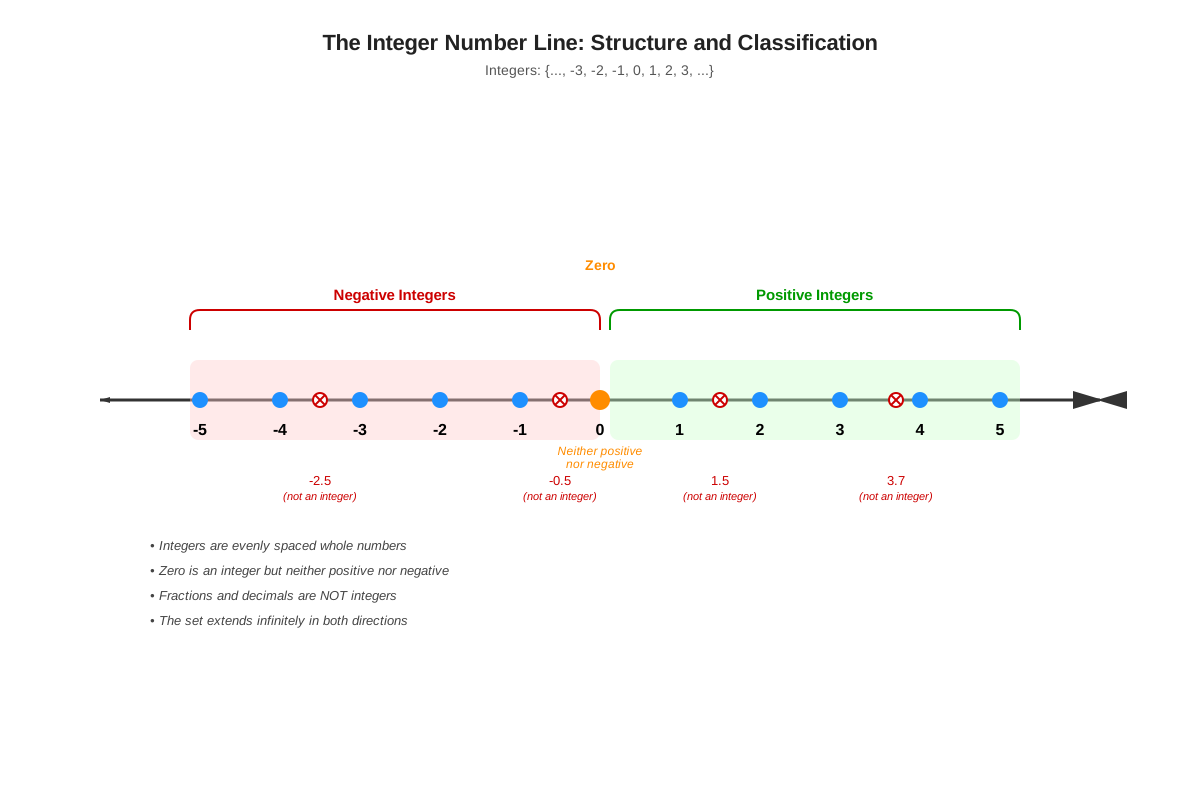
Integers are the set of whole numbers and their negatives, including zero. Formally, the set of integers is represented as {..., -3, -2, -1, 0, 1, 2, 3, ...} and extends infinitely in both positive and negative directions. Integers do NOT include fractions, decimals, or irrational numbers. The number 5 is an integer; 5.5 is not. The number -12 is an integer; -12.001 is not.
Integers can be classified into several important categories:
| Category | Definition | Examples |
|---|---|---|
| Positive integers | Integers greater than zero | 1, 2, 3, 47, 1000 |
| Negative integers | Integers less than zero | -1, -2, -15, -999 |
| Zero | Neither positive nor negative | 0 |
| Even integers | Divisible by 2 | -4, -2, 0, 2, 4, 6 |
| Odd integers | Not divisible by 2 | -5, -3, -1, 1, 3, 5 |
| Consecutive integers | Integers that follow in sequence | 7, 8, 9 or -3, -2, -1 |
Properties of Integer Operations
Understanding how integers behave under arithmetic operations is crucial for GMAT success:
Addition and Subtraction:
- The sum of two integers is always an integer (closure property)
- Adding two positive integers yields a positive integer
- Adding two negative integers yields a negative integer
- Subtracting integers follows the same closure property
- The sum of an even number of consecutive integers may or may not be an integer multiple of that count
Multiplication:
- The product of two integers is always an integer
- Positive × Positive = Positive
- Negative × Negative = Positive
- Positive × Negative = Negative
- The product of any integer and zero equals zero
- Even × Any Integer = Even
- Odd × Odd = Odd
Division:
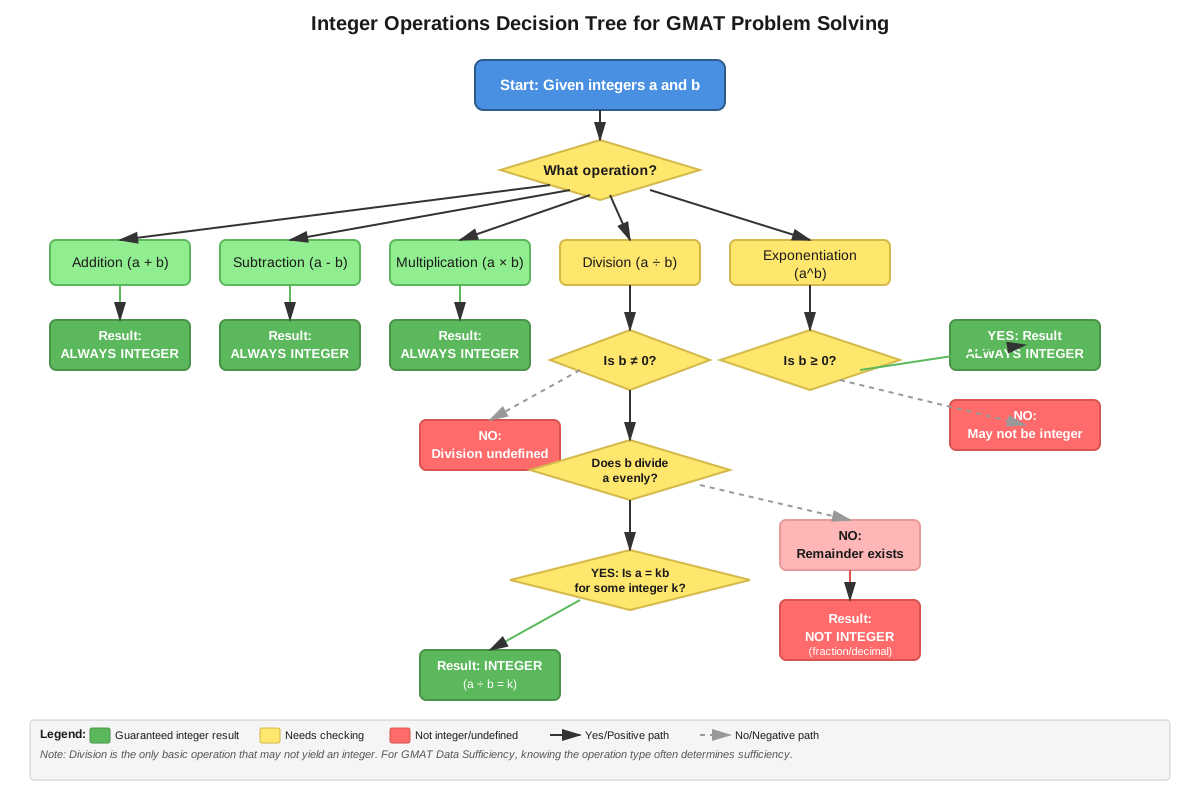
- Division of integers does NOT always yield an integer (this is a critical distinction)
- 10 ÷ 2 = 5 (integer result)
- 10 ÷ 3 = 3.333... (not an integer)
- When division of integers yields an integer, we say the dividend is "divisible by" the divisor
Even and Odd Integer Patterns
The GMAT frequently tests understanding of even and odd integer behavior:
Addition patterns:
- Even + Even = Even (e.g., 4 + 6 = 10)
- Odd + Odd = Even (e.g., 3 + 5 = 8)
- Even + Odd = Odd (e.g., 4 + 5 = 9)
Multiplication patterns:
- Even × Even = Even (e.g., 4 × 6 = 24)
- Odd × Odd = Odd (e.g., 3 × 5 = 15)
- Even × Odd = Even (e.g., 4 × 5 = 20)
Power patterns:
- Even^n = Even for any positive integer n
- Odd^n = Odd for any positive integer n
These patterns enable rapid elimination of answer choices and quick verification of solutions without complete calculation.
Consecutive Integers
Consecutive integers are integers that follow one another in order without gaps: n, n+1, n+2, etc. The GMAT tests several important properties:
- The sum of any set of consecutive integers equals (average) × (count)
- For an odd number of consecutive integers, the sum is always divisible by the count
- For an even number of consecutive integers, the sum is never divisible by the count (unless the sequence includes specific patterns)
- The average of consecutive integers equals the median, which is the middle value (or average of two middle values)
Consecutive even integers follow the pattern n, n+2, n+4 (e.g., 2, 4, 6, 8).
Consecutive odd integers follow the pattern n, n+2, n+4 (e.g., 1, 3, 5, 7).
Divisibility and Factors
An integer a is divisible by an integer b if a ÷ b yields an integer result with no remainder. Equivalently, b is a factor of a, and a is a multiple of b.
Key divisibility rules tested on the GMAT:
- Divisibility by 2: Last digit is even (0, 2, 4, 6, 8)
- Divisibility by 3: Sum of digits is divisible by 3
- Divisibility by 4: Last two digits form a number divisible by 4
- Divisibility by 5: Last digit is 0 or 5
- Divisibility by 6: Number is divisible by both 2 and 3
- Divisibility by 9: Sum of digits is divisible by 9
- Divisibility by 10: Last digit is 0
Understanding factors enables quick analysis of whether expressions will yield integer results and helps identify constraints in data sufficiency questions.
Integer Constraints in Algebra
When variables represent integers, additional constraints apply that don't exist for general real numbers. If x is an integer and 3 < x < 7, then x can only be 4, 5, or 6—exactly three values. This discrete nature creates powerful constraints that the GMAT exploits in data sufficiency questions.
Integer constraints often determine sufficiency: knowing that x is an integer might make a statement sufficient that would be insufficient if x could be any real number. This principle appears in approximately 20% of data sufficiency questions involving inequalities or ranges.
Concept Relationships
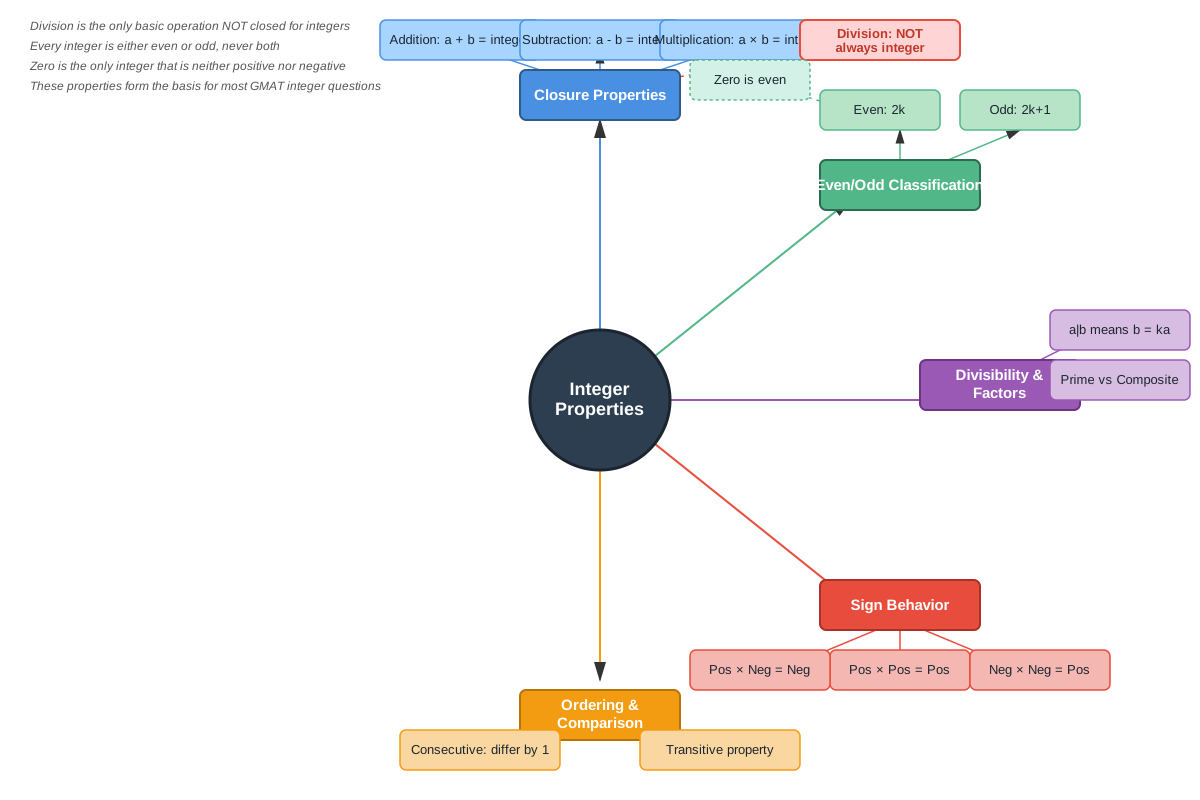
The concepts within integer theory form an interconnected web. Integer classification (even/odd, positive/negative) → determines → operational behavior (how integers combine under arithmetic operations) → which enables → pattern recognition (predicting results without calculation). Understanding divisibility connects directly to factors and multiples, which in turn relates to prime factorization (a related topic).
Consecutive integer properties build upon basic integer operations and connect to arithmetic sequences (a broader topic). The concept of integer constraints bridges integers to algebra and inequalities, showing how discrete values create different solution sets than continuous variables.
Within the prerequisite knowledge, number line concepts provide the visual foundation for understanding integer ordering and comparison, while basic arithmetic operations enable exploration of integer operational properties. These foundational concepts support the more advanced applications of integers in data sufficiency reasoning and problem-solving optimization.
The relationship extends beyond integers to other Quantitative Reasoning topics: integers form the basis for rational numbers (fractions with integer numerators and denominators), appear as exponents in power expressions, define counting problems in combinatorics, and establish constraints in optimization problems. Mastering integers thus opens pathways to understanding these more complex topics.
High-Yield Facts
⭐ Integers include zero, positive whole numbers, and negative whole numbers, but never fractions or decimals.
⭐ The product of an even integer and any integer is always even; the product of two odd integers is always odd.
⭐ Division of two integers does not always produce an integer result—this is the key distinction from other operations.
⭐ For consecutive integers, if the count is odd, the sum is divisible by the count; if the count is even, it is not.
⭐ Zero is an even integer (divisible by 2: 0 ÷ 2 = 0) and is neither positive nor negative.
- The sum or difference of two integers is always an integer (closure under addition and subtraction).
- An integer is divisible by 3 if and only if the sum of its digits is divisible by 3.
- The sum of an even integer and an odd integer is always odd.
- Any integer multiplied by zero equals zero, regardless of the integer's value.
- Consecutive even integers or consecutive odd integers differ by 2 (not 1).
- If n is an integer, then n(n+1) is always even because one of the factors must be even.
- The square of any integer is either even (if the integer is even) or odd (if the integer is odd).
- Between any two distinct integers, there are a finite, countable number of integers.
- An integer raised to a positive integer power maintains its even/odd classification.
- The average of an even number of consecutive integers is never an integer (it falls between two integers).
Quick check — test yourself on Integers so far.
Try Flashcards →Common Misconceptions
Misconception: Zero is not an integer or is a positive integer.
Correction: Zero is definitively an integer and is classified as even. It is neither positive nor negative, occupying a unique position as the only integer that is its own additive inverse.
Misconception: All numbers are integers.
Correction: Integers are a specific subset of real numbers. Fractions (1/2), decimals (3.7), and irrational numbers (√2, π) are NOT integers. Only whole numbers and their negatives qualify as integers.
Misconception: The result of dividing two integers is always an integer.
Correction: Division is the only basic arithmetic operation that does not guarantee an integer result when performed on integers. While 8 ÷ 2 = 4 (integer), 8 ÷ 3 = 2.666... (not an integer). This property is frequently tested on the GMAT.
Misconception: Consecutive integers always differ by 1.
Correction: While standard consecutive integers differ by 1 (e.g., 5, 6, 7), the GMAT also tests "consecutive even integers" (2, 4, 6) and "consecutive odd integers" (1, 3, 5), which differ by 2. Always read the question carefully to identify which type is specified.
Misconception: Even + Odd = Even.
Correction: The sum of an even integer and an odd integer is always odd, not even. For example, 4 (even) + 3 (odd) = 7 (odd). This pattern is crucial for quickly eliminating wrong answers.
Misconception: Negative integers are not "real" integers or follow different rules.
Correction: Negative integers are full members of the integer set and follow the same operational rules as positive integers, with appropriate attention to sign rules. The integer -5 is just as much an integer as 5.
Misconception: If x² = 16 and x is an integer, then x = 4.
Correction: Both x = 4 and x = -4 satisfy this equation. When working with integers and even powers, always consider both positive and negative solutions unless the problem explicitly restricts the domain.
Worked Examples
Example 1: Even/Odd Pattern Recognition
Question: If n is an odd integer, which of the following must be even?
(A) n² + n
(B) n³ - n
(C) n² - 1
(D) 2n + 1
(E) n(n - 2)
Solution:
Step 1: Recognize that we need to determine which expression MUST be even for ANY odd integer n.
Step 2: Test the pattern rather than specific numbers initially. For odd n:
- n² is odd (odd × odd = odd)
- n + 1 is even (odd + 1 = even)
- n - 1 is even (odd - 1 = even)
- n - 2 is odd (odd - even = odd)
Step 3: Evaluate each choice:
(A) n² + n = odd + odd = even ✓
(B) n³ - n = odd - odd = even ✓
(C) n² - 1 = odd - odd = even ✓
Step 4: Multiple answers appear even, so verify with a specific value. Let n = 3:
(A) 3² + 3 = 9 + 3 = 12 (even) ✓
(B) 3³ - 3 = 27 - 3 = 24 (even) ✓
(C) 3² - 1 = 9 - 1 = 8 (even) ✓
(D) 2(3) + 1 = 7 (odd) ✗
(E) 3(3 - 2) = 3(1) = 3 (odd) ✗
Step 5: Eliminate D and E. For remaining choices, use algebraic insight:
(A) n² + n = n(n + 1) = product of consecutive integers, which is always even
(B) n³ - n = n(n² - 1) = n(n-1)(n+1) = product of three consecutive integers, always even
(C) n² - 1 = (n-1)(n+1) = product of two consecutive even integers (since n is odd), always even
All of A, B, and C must be even. However, if the question asks "which of the following" (singular), the most direct answer is (A) as it represents the simplest factorization showing the even property.
Connection to Learning Objectives: This example demonstrates applying integer properties (even/odd patterns) to algebraic expressions, a high-yield GMAT skill.
Example 2: Data Sufficiency with Integer Constraints
Question: Is x an integer?
(1) 3x is an integer
(2) x/3 is an integer
Solution:
Step 1: Analyze Statement (1): 3x is an integer
If 3x is an integer, does x have to be an integer?
- If x = 2, then 3x = 6 (integer), and x is an integer ✓
- If x = 1/3, then 3x = 1 (integer), but x is NOT an integer ✗
Statement (1) is INSUFFICIENT because x could be an integer or a fraction like 1/3, 2/3, 4/3, etc.
Step 2: Analyze Statement (2): x/3 is an integer
If x/3 is an integer, then x/3 = k for some integer k.
Therefore, x = 3k.
Since k is an integer and 3 is an integer, x must be an integer (the product of integers is always an integer).
Statement (2) is SUFFICIENT to determine that x is an integer.
Answer: B (Statement 2 alone is sufficient, but Statement 1 alone is not sufficient)
Key Insight: This problem illustrates how integer constraints work differently depending on whether the variable is multiplied or divided by an integer. Division by an integer forces the original variable to be a multiple of that integer (hence an integer), while multiplication by an integer allows fractional values that "cancel out" the multiplier.
Connection to Learning Objectives: This example demonstrates identifying when expressions must be integers and applying integer concepts to data sufficiency questions, both critical GMAT skills.
Exam Strategy
When approaching GMAT integers questions, implement this systematic process:
Step 1: Identify integer constraints
Look for explicit statements like "x is an integer" or "how many integers" in the question stem. These constraints fundamentally change the problem's nature and often provide the key to efficient solutions.
Step 2: Recognize trigger words
- "Must be" → test extreme cases and patterns
- "Could be" → find one valid example
- "How many integers" → count discrete values, don't solve algebraically
- "Consecutive" → use sum formulas and average properties
- "Even/odd" → apply operational patterns rather than calculating
Step 3: Use pattern recognition over calculation
Rather than computing 47 × 53, recognize that odd × odd = odd. Rather than dividing 1,234 by 3, check if digit sum (1+2+3+4=10) is divisible by 3 (it's not, so 1,234 isn't divisible by 3).
Step 4: Test strategic values
When variables represent integers, test:
- Zero (often overlooked, has unique properties)
- Positive and negative values (signs matter)
- Even and odd values (different behaviors)
- Small values (1, 2, 3) for quick verification
Step 5: Eliminate using integer properties
In Problem Solving, eliminate answers that violate integer properties:
- If the question asks for an even result, eliminate odd answer choices
- If consecutive integers are involved, eliminate answers that don't match count/sum relationships
- If divisibility is required, eliminate answers that don't satisfy divisibility rules
Time-Saving Tip: On Data Sufficiency questions, integer constraints often make statements sufficient that would be insufficient for general real numbers. Always consider whether restricting to integers creates a finite, determinable set of values.
Process of Elimination Strategy:
For "must be true" questions, eliminate any choice that fails for even one valid integer value. For "could be true" questions, eliminate only choices that fail for ALL integer values. This distinction is crucial and frequently tested.
Memory Techniques
MNEMONIC for Even/Odd Addition: "Same Sum Even" (Same parities sum to Even)
- Even + Even = Even (same → even)
- Odd + Odd = Even (same → even)
- Even + Odd = Odd (different → odd)
MNEMONIC for Even/Odd Multiplication: "Even Eats Everything"
- Any multiplication involving an even integer produces an even result
- Only Odd × Odd = Odd
VISUALIZATION for Consecutive Integers:
Picture consecutive integers as a balanced beam. For an odd count (3, 5, 7 integers), there's a center point (the median) that balances perfectly—the sum is divisible by count. For an even count (2, 4, 6 integers), the balance point falls between two integers—the sum is not divisible by count.
ACRONYM for Divisibility Rules: "Two Three Four Five Six Nine Ten"
- Two: last digit even
- Three: digit sum divisible by 3
- Four: last two digits divisible by 4
- Five: last digit 0 or 5
- Six: divisible by both 2 and 3
- Nine: digit sum divisible by 9
- Ten: last digit 0
MEMORY ANCHOR for Zero:
"Zero is the Even Neutral Integer" (ENI)
- Even: 0 ÷ 2 = 0 (integer result)
- Neutral: neither positive nor negative
- Integer: definitely part of the integer set
Summary
Integers represent the set of whole numbers including zero and all negative whole numbers, forming a discrete subset of real numbers that excludes fractions, decimals, and irrational values. Mastery of integer concepts requires understanding their classification (even/odd, positive/negative/zero), their behavior under arithmetic operations (particularly that division may not yield integer results), and the patterns they create (especially even/odd operational rules and consecutive integer properties). The GMAT tests integers both directly through number property questions and indirectly through algebraic constraints, data sufficiency scenarios, and word problems. Success requires recognizing that integer constraints create discrete solution sets, applying divisibility rules for efficient problem-solving, and using pattern recognition to avoid lengthy calculations. The most critical insights include: zero is an even integer; division of integers doesn't guarantee integer results; even/odd patterns enable rapid answer elimination; and integer constraints in data sufficiency often determine whether statements are sufficient. These concepts appear in 30-40% of Quantitative Reasoning questions, making integers one of the highest-yield topics for GMAT preparation.
Key Takeaways
- Integers are whole numbers (positive, negative, and zero) but never include fractions or decimals—this distinction is fundamental to recognizing when operations will yield integer results.
- Zero is an even integer and is neither positive nor negative—it has unique properties that the GMAT frequently tests in edge cases.
- Even/odd patterns for operations enable rapid problem-solving: same parities add to even, any multiplication with even yields even, and only odd × odd = odd.
- Division is the only basic arithmetic operation that doesn't guarantee an integer result when performed on integers—this property appears in approximately 15% of integer questions.
- Integer constraints in data sufficiency questions often determine sufficiency by creating finite, countable solution sets rather than continuous ranges.
- Consecutive integer properties (especially sum divisibility rules) provide shortcuts that save significant time on test day.
- Divisibility rules (especially for 2, 3, 4, 5, 6, 9, and 10) enable quick verification without performing actual division, a critical time-saving technique.
Related Topics
Prime Numbers and Prime Factorization: Building on integer concepts, prime numbers are integers greater than 1 with exactly two factors. Mastering integers enables understanding of prime factorization, which is essential for GCD and LCM problems.
Factors, Multiples, and Divisibility: These topics extend integer concepts by exploring relationships between integers, including how to count factors, find common multiples, and apply advanced divisibility techniques.
Number Properties and Remainders: Understanding what happens when integers don't divide evenly leads to remainder theory, modular arithmetic, and cyclicity patterns—all high-yield GMAT topics.
Absolute Value and Inequalities: Integer constraints combined with absolute value create unique solution sets that appear frequently in both Problem Solving and Data Sufficiency questions.
Sequences and Series: Consecutive integers form the foundation for arithmetic sequences, and understanding integer patterns enables quick sum calculations for series problems.
Practice CTA
Now that you've mastered the core concepts of integers, it's time to reinforce your understanding through active practice. Attempt the practice questions associated with this topic, focusing on applying the even/odd patterns, divisibility rules, and integer constraint strategies you've learned. Use the flashcards to drill high-yield facts until they become automatic—this automaticity will save you precious seconds on test day. Remember, integer concepts appear in nearly 40% of GMAT Quantitative questions, making this practice time one of your highest-yield investments. Approach each practice problem as an opportunity to strengthen your pattern recognition and strategic thinking. You've built the foundation—now build the speed and confidence that lead to a top score!
Sign up free to keep reading
Create a free AnvayaPrep account to finish this GMAT guide on Integers — plus flashcards and practice questions.