Overview
Lines and angles form the foundational building blocks of geometry on the GMAT Quantitative Reasoning section. These concepts appear not only in dedicated geometry problems but also integrate into coordinate geometry, data sufficiency questions, and complex multi-step problem-solving scenarios. Understanding the properties of parallel lines, perpendicular lines, angle relationships, and the behavior of intersecting lines is essential for tackling approximately 15-20% of GMAT quant questions. Mastery of this topic enables test-takers to quickly identify angle relationships, apply geometric theorems, and eliminate incorrect answer choices with confidence.
The GMAT tests GMAT lines and angles concepts through both problem-solving and data sufficiency formats, requiring students to not only calculate specific angle measures but also determine whether given information is sufficient to solve a problem. Questions often combine lines and angles with other geometric concepts such as triangles, polygons, and coordinate geometry, making this topic a critical gateway to more advanced geometric reasoning. The exam frequently presents diagrams that are intentionally not drawn to scale, testing whether students can apply theoretical knowledge rather than rely on visual estimation.
Beyond isolated geometry questions, lines and angles concepts underpin coordinate geometry problems involving slopes, distance formulas, and the equations of lines. Understanding angle relationships also proves essential when working with polygons, as interior and exterior angles depend on these fundamental principles. The interconnected nature of these concepts means that weakness in lines and angles will cascade into difficulties across multiple areas of GMAT Quantitative Reasoning, making this a high-priority topic for thorough mastery.
Learning Objectives
- [ ] Identify lines and angles in various geometric configurations and GMAT problem formats
- [ ] Explain the properties and relationships of different types of angles (complementary, supplementary, vertical, corresponding, alternate interior, alternate exterior)
- [ ] Apply lines and angles concepts to solve GMAT problem-solving and data sufficiency questions
- [ ] Calculate unknown angle measures using angle relationship theorems and properties
- [ ] Recognize and utilize the properties of parallel lines cut by a transversal
- [ ] Determine angle measures in complex multi-line configurations without relying on visual estimation
- [ ] Evaluate data sufficiency for angle-related problems by identifying necessary and sufficient conditions
Prerequisites
- Basic arithmetic operations: Essential for calculating angle measures and solving equations involving angles
- Algebraic equation solving: Required to set up and solve for unknown angle variables when given relationships
- Understanding of geometric notation: Necessary to interpret angle symbols, degree measures, and line notation in diagrams
- Number properties: Helpful for recognizing patterns in angle relationships and working with ratios of angles
Why This Topic Matters
In real-world applications, lines and angles concepts appear in architecture, engineering, navigation, computer graphics, and design. Architects use angle relationships to ensure structural integrity, while engineers apply these principles in mechanical systems and construction. Navigation systems rely on angular measurements for determining direction and position, and computer graphics depend on geometric transformations involving angles and lines.
On the GMAT specifically, lines and angles questions appear in approximately 3-5 questions per exam, representing a significant portion of the geometry subsection. These questions typically appear as medium to medium-hard difficulty problems, with data sufficiency questions being particularly common. The GMAT tests this topic through several question types: direct angle calculation problems, parallel line configurations with transversals, angle relationships in polygons, and integrated problems combining angles with coordinate geometry or algebraic expressions.
The exam frequently presents this material in ways that test conceptual understanding rather than rote memorization. Questions may provide diagrams marked "not drawn to scale," require students to recognize that multiple configurations are possible, or ask whether given information uniquely determines an angle measure. Understanding lines and angles also serves as prerequisite knowledge for more complex geometry topics, making it a foundational skill that impacts performance across the entire Quantitative Reasoning section.
Core Concepts
Types of Lines
Lines are straight one-dimensional figures that extend infinitely in both directions, having no endpoints. A line segment is a portion of a line with two endpoints, while a ray has one endpoint and extends infinitely in one direction. On the GMAT, understanding these distinctions helps interpret diagrams and problem statements accurately.
Parallel lines are lines in the same plane that never intersect, no matter how far they extend. They maintain a constant distance from each other and are denoted by the symbol ∥. For example, if line l is parallel to line m, we write l ∥ m. Parallel lines have identical slopes when expressed in coordinate geometry.
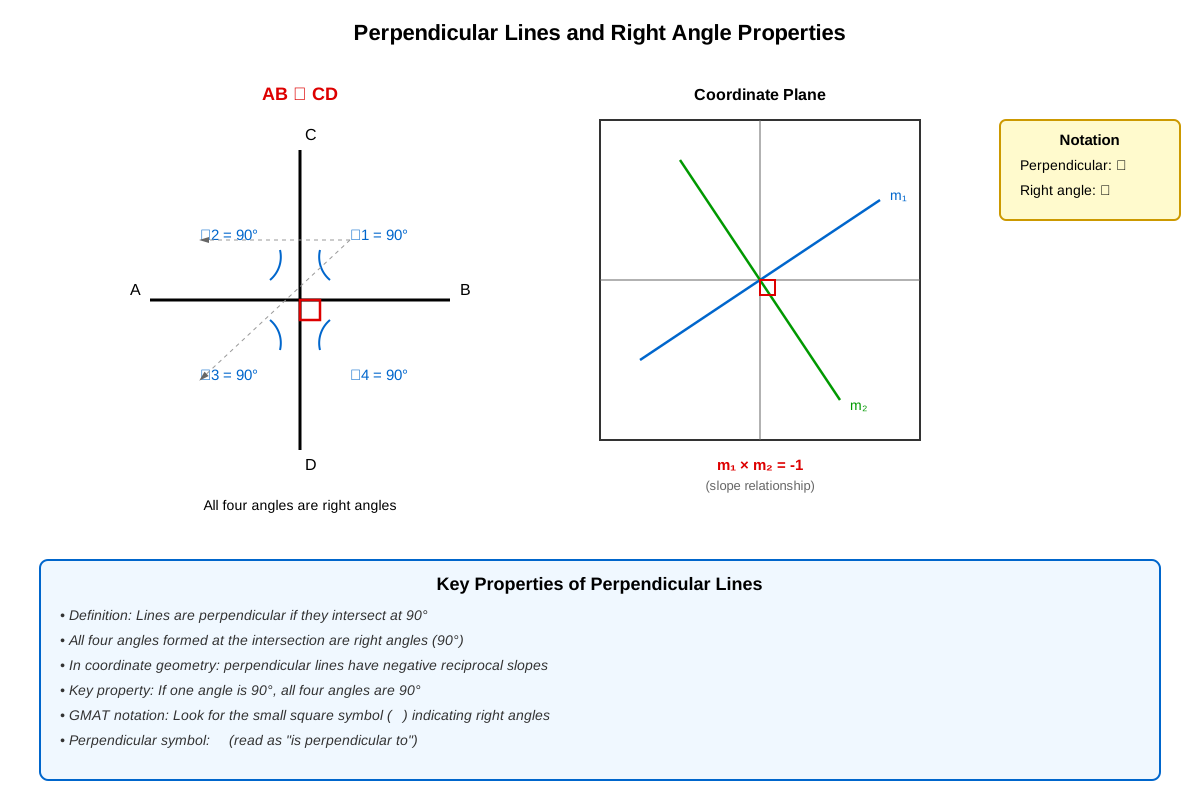
Perpendicular lines intersect at a 90-degree angle (right angle) and are denoted by the symbol ⊥. When two lines are perpendicular, they form four right angles at their intersection point. In coordinate geometry, perpendicular lines have slopes that are negative reciprocals of each other (if one line has slope m, the perpendicular line has slope -1/m, provided m ≠ 0).
Intersecting lines are lines that cross at exactly one point. The point where they meet is called the point of intersection. When two lines intersect, they form four angles around the intersection point, creating important angle relationships that the GMAT frequently tests.
Types of Angles
An angle is formed by two rays sharing a common endpoint called the vertex. Angles are measured in degrees, with a complete rotation around a point measuring 360°.
Acute angles measure greater than 0° but less than 90°. These are "sharp" angles that appear smaller than a right angle.
Right angles measure exactly 90° and are typically marked with a small square symbol at the vertex. Right angles represent perpendicularity and are fundamental to many geometric constructions.
Obtuse angles measure greater than 90° but less than 180°. These angles appear "wide" or "open" compared to right angles.
Straight angles measure exactly 180° and form a straight line. When an angle measures 180°, its two sides point in opposite directions along the same line.
Reflex angles measure greater than 180° but less than 360°. While less commonly tested on the GMAT, understanding that angles can exceed 180° is important for complete geometric reasoning.
Angle Relationships
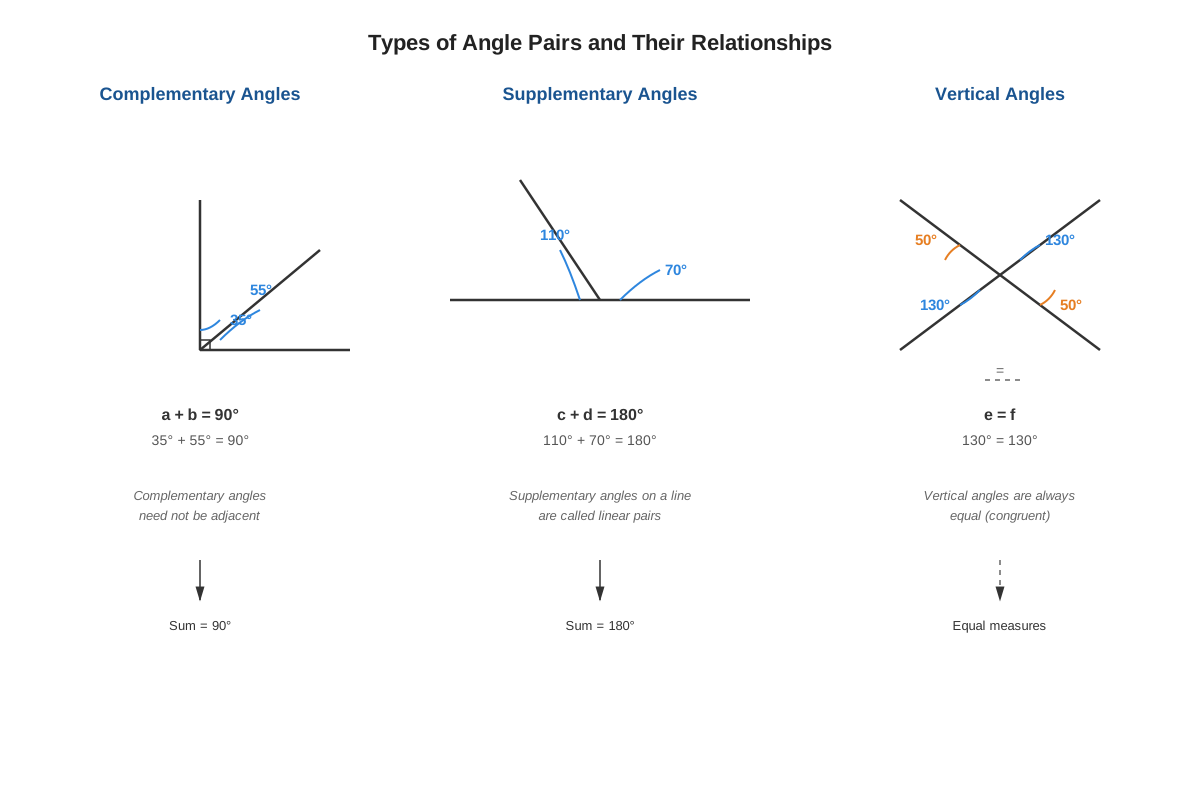
Complementary angles are two angles whose measures sum to 90°. If angle A and angle B are complementary, then A + B = 90°. For example, a 30° angle and a 60° angle are complementary. Complementary angles need not be adjacent (next to each other).
Supplementary angles are two angles whose measures sum to 180°. If angle A and angle B are supplementary, then A + B = 180°. For instance, a 120° angle and a 60° angle are supplementary. Like complementary angles, supplementary angles need not be adjacent.
Vertical angles (also called vertically opposite angles) are formed when two lines intersect. They are the angles opposite each other at the intersection point. A critical property: vertical angles are always equal. If two lines intersect forming angles a, b, c, and d (going around the intersection point), then a = c and b = d. This property is one of the most frequently tested concepts on the GMAT.
Adjacent angles share a common vertex and a common side but do not overlap. When two adjacent angles form a straight line, they are supplementary (their measures sum to 180°). This is called a linear pair.
Parallel Lines and Transversals
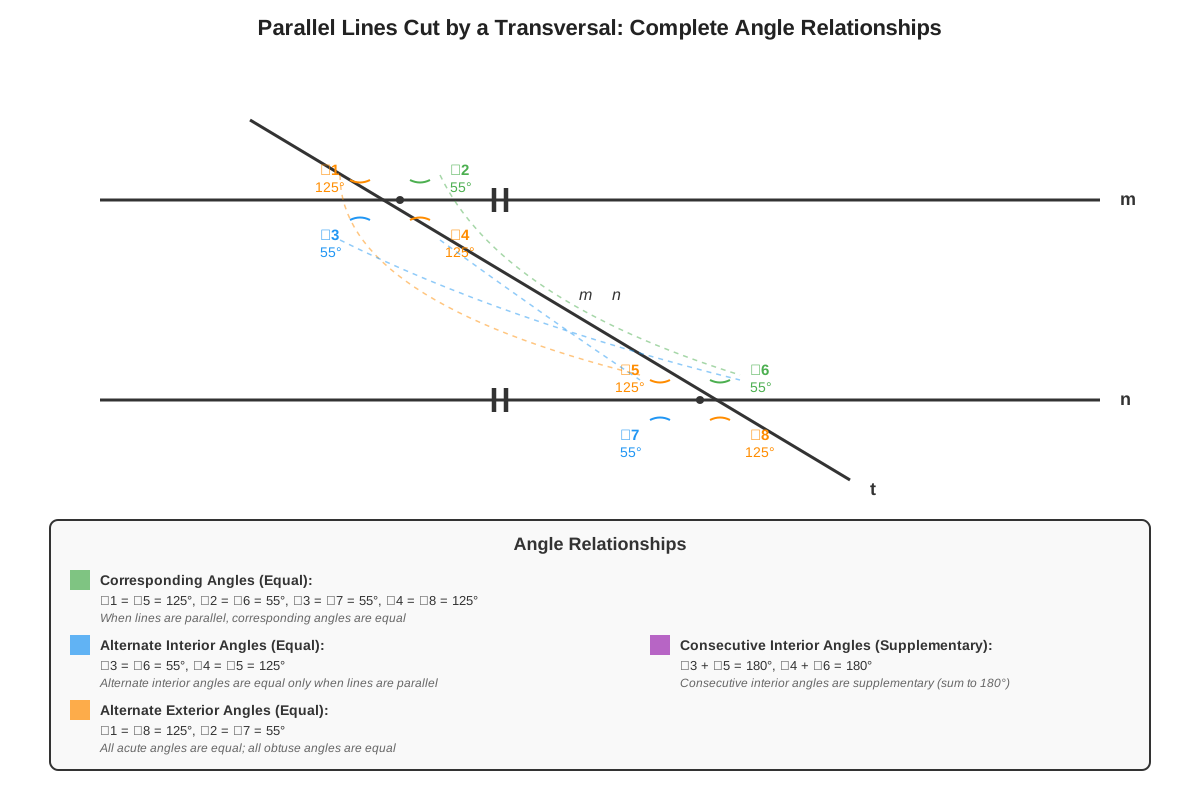
A transversal is a line that intersects two or more other lines at distinct points. When a transversal crosses two parallel lines, it creates eight angles with special relationships that the GMAT tests extensively.
When a transversal intersects two parallel lines, the following angle relationships hold:
Corresponding angles are angles in the same relative position at each intersection point. Corresponding angles are equal when the lines are parallel. For example, if a transversal crosses two parallel lines, the upper-left angle at the first intersection equals the upper-left angle at the second intersection.
Alternate interior angles are angles on opposite sides of the transversal and between (interior to) the parallel lines. Alternate interior angles are equal when the lines are parallel. These angles form a "Z" pattern (or reverse "Z") in the diagram.
Alternate exterior angles are angles on opposite sides of the transversal and outside (exterior to) the parallel lines. Alternate exterior angles are equal when the lines are parallel.
Consecutive interior angles (also called co-interior angles or same-side interior angles) are angles on the same side of the transversal and between the parallel lines. Consecutive interior angles are supplementary (sum to 180°) when the lines are parallel.
| Angle Relationship | Location | Property (when lines are parallel) |
|---|---|---|
| Corresponding | Same relative position | Equal |
| Alternate Interior | Opposite sides, between lines | Equal |
| Alternate Exterior | Opposite sides, outside lines | Equal |
| Consecutive Interior | Same side, between lines | Supplementary (sum to 180°) |
| Vertical | Opposite at intersection | Equal (always, regardless of parallel) |
Angle Measurement Properties
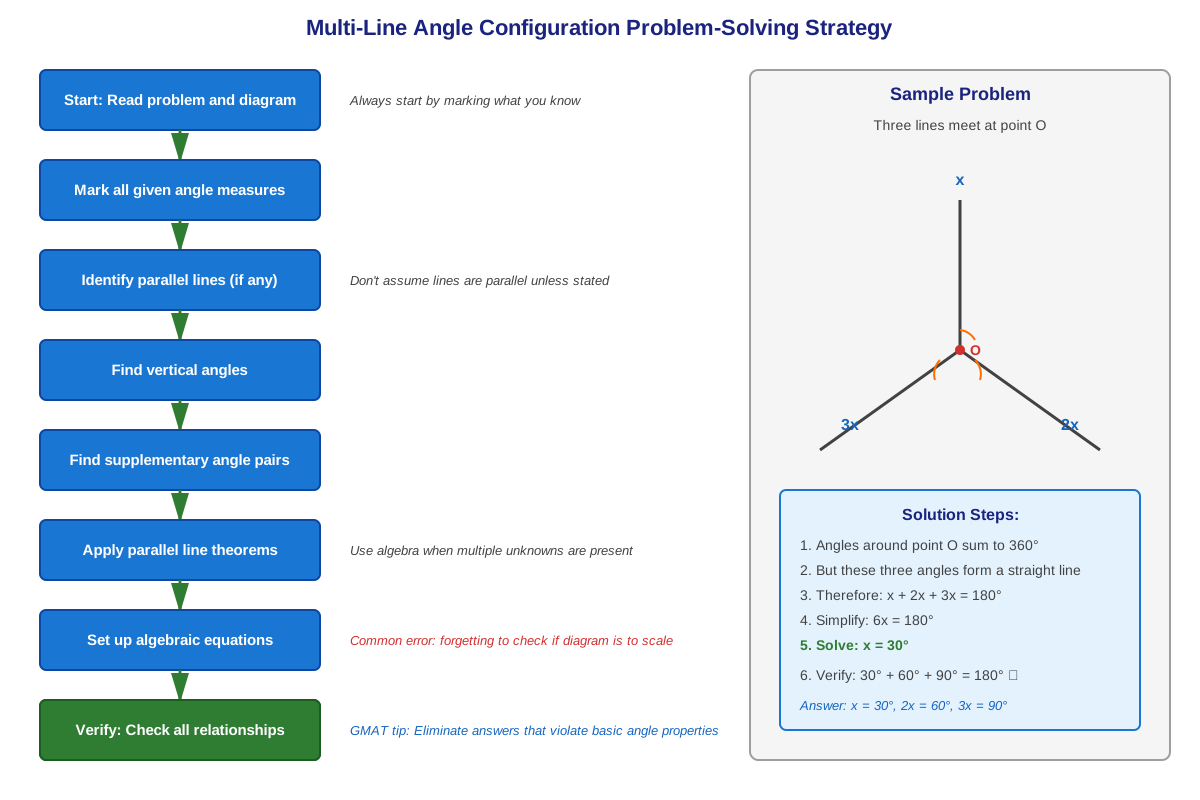
The sum of all angles around a point equals 360°. This property applies when multiple rays emanate from a single point or when multiple lines intersect at one point.
The sum of all angles on one side of a straight line equals 180°. This is the basis for linear pairs and supplementary angles.
When multiple lines intersect at a single point, the angles can be calculated using these fundamental properties combined with given information about specific angle measures or relationships.
Problem-Solving Strategies
- Mark known information: When given a diagram, immediately mark all known angle measures and relationships (parallel lines, perpendicular lines, equal angles).
- Identify angle relationships: Look for vertical angles, linear pairs, and parallel line configurations that create corresponding or alternate angles.
- Set up equations: Use angle relationships to create algebraic equations when angles are expressed as variables or expressions.
- Work systematically: Calculate angles step-by-step, using each newly found angle to determine others.
- Verify reasonableness: Check that acute angles are less than 90°, obtuse angles are between 90° and 180°, and all calculations respect the fundamental properties (angles around a point sum to 360°, etc.).
Concept Relationships
The concepts within lines and angles form a hierarchical structure where basic definitions support more complex relationships. Lines (the fundamental geometric objects) → combine to form angles (measured regions between rays) → which exhibit angle relationships (complementary, supplementary, vertical) → that become more complex when parallel lines and transversals are introduced → creating multiple simultaneous angle relationships that require systematic problem-solving strategies.
Vertical angles and linear pairs represent the simplest angle relationships, arising from just two intersecting lines. These concepts extend to parallel lines cut by a transversal, where the same intersection principles apply at two locations simultaneously, creating corresponding, alternate interior, and alternate exterior angle relationships. Understanding that vertical angles are equal and linear pairs are supplementary provides the foundation for recognizing why corresponding angles are equal when lines are parallel.
Lines and angles connect to prerequisite topics through algebraic equation-solving (setting up and solving for unknown angle measures) and arithmetic operations (adding angles to find sums, calculating differences). These concepts also connect forward to more advanced geometry topics: triangles (where angle sum equals 180°), polygons (where interior and exterior angles depend on angle relationships), and coordinate geometry (where slope represents the angle a line makes with the horizontal axis).
The relationship between perpendicular lines and right angles bridges to the Pythagorean theorem and distance calculations. Parallel lines connect to the concept of slope in coordinate geometry, where parallel lines have equal slopes. Understanding angle bisectors (lines that divide angles into two equal parts) extends these concepts and appears in more complex GMAT problems involving triangles and circles.
High-Yield Facts
⭐ Vertical angles are always equal, regardless of whether the intersecting lines are parallel, perpendicular, or neither.
⭐ When two parallel lines are cut by a transversal, corresponding angles are equal, alternate interior angles are equal, and consecutive interior angles are supplementary.
⭐ Angles in a linear pair (adjacent angles forming a straight line) are supplementary, meaning they sum to 180°.
⭐ The sum of all angles around a point equals 360°, which is essential for problems involving multiple lines intersecting at one point.
⭐ Complementary angles sum to 90°, while supplementary angles sum to 180°—these definitions are frequently tested in word problems.
- When a transversal intersects two lines and corresponding angles are equal, the two lines must be parallel (the converse is also true).
- Perpendicular lines form four right angles (each measuring 90°) at their intersection point.
- If two angles are both supplementary to the same angle (or to equal angles), then those two angles are equal to each other.
- The measure of an exterior angle of a triangle equals the sum of the two non-adjacent interior angles (this extends lines and angles concepts to triangles).
- In coordinate geometry, perpendicular lines have slopes that are negative reciprocals: if one line has slope m, a perpendicular line has slope -1/m.
- Alternate interior angles form a "Z" pattern (or reverse "Z"), which helps quickly identify them in complex diagrams.
- When three or more parallel lines are cut by two transversals, the segments cut off on one transversal are proportional to the segments cut off on the other transversal.
Quick check — test yourself on Lines and angles so far.
Try Flashcards →Common Misconceptions
Misconception: Vertical angles are angles that appear "vertical" or "upright" in a diagram.
Correction: Vertical angles are opposite angles formed when two lines intersect, regardless of their orientation. The term "vertical" refers to them being opposite at the vertex (intersection point), not to their visual orientation.
Misconception: Adjacent angles are always complementary or supplementary.
Correction: Adjacent angles simply share a vertex and a side. They are only supplementary if they form a linear pair (their non-common sides form a straight line). Adjacent angles can have any sum depending on their configuration.
Misconception: If two lines are cut by a transversal and some angles are equal, the lines must be parallel.
Correction: The lines are parallel only if specific angle pairs are equal (corresponding angles, alternate interior angles, or alternate exterior angles). Random angle equality does not guarantee parallel lines.
Misconception: Diagrams on the GMAT are drawn to scale, so angles can be estimated visually.
Correction: GMAT diagrams are explicitly marked "not drawn to scale" in many cases. Students must rely on given information and geometric properties, not visual estimation. Even when not marked, assuming scale can lead to errors.
Misconception: Complementary angles must be adjacent to each other.
Correction: Complementary angles are any two angles that sum to 90°, regardless of their position. They can be in completely different parts of a diagram or even in separate diagrams entirely.
Misconception: When two lines intersect, all four angles formed are different.
Correction: When two lines intersect, they form two pairs of vertical angles. Each pair consists of equal angles, so there are actually only two different angle measures (which are supplementary to each other).
Misconception: Alternate interior angles are always equal.
Correction: Alternate interior angles are equal only when the two lines cut by the transversal are parallel. If the lines are not parallel, alternate interior angles will have different measures.
Worked Examples
Example 1: Parallel Lines with Transversal
Problem: Two parallel lines l and m are cut by a transversal t. The angle formed on the upper-left side of the intersection with line l measures 65°. What is the measure of the angle on the lower-right side of the intersection with line m?
Solution:
Step 1: Visualize or sketch the configuration. We have two parallel lines (l and m) cut by a transversal (t), creating two intersection points.
Step 2: Identify the given angle. The upper-left angle at line l is 65°.
Step 3: Identify the target angle. We need the lower-right angle at line m.
Step 4: Recognize the angle relationship. The upper-left angle at line l and the lower-right angle at line m are corresponding angles (they're in the same relative position at each intersection).
Step 5: Apply the corresponding angles theorem. Since lines l and m are parallel, corresponding angles are equal.
Step 6: Conclude. The lower-right angle at line m measures 65°.
Alternative approach: We could also solve this by recognizing that the upper-left angle at line l (65°) and the upper-right angle at line l are supplementary (they form a linear pair), so the upper-right angle at line l is 180° - 65° = 115°. This upper-right angle at line l and the lower-right angle at line m are alternate interior angles, which are equal when lines are parallel. Wait—this would give us 115°, which contradicts our first answer. Let me reconsider.
Actually, the upper-right angle at line l and the lower-right angle at line m are NOT alternate interior angles. Let me reconsider the configuration more carefully. The upper-left angle at line l (65°) and the lower-right angle at line m are actually alternate exterior angles if we consider them on opposite sides of the transversal and outside the parallel lines. Alternate exterior angles are equal when lines are parallel, confirming our answer of 65°.
Answer: 65°
Connection to learning objectives: This problem requires identifying angle types (corresponding or alternate exterior), explaining their properties (equal when lines are parallel), and applying these concepts to calculate an unknown angle measure.
Example 2: Data Sufficiency with Intersecting Lines
Problem: Three lines intersect at point P, forming six angles around the point. What is the measure of the smallest angle?
Statement (1): Two of the angles measure 90° each.
Statement (2): Four of the angles are equal to each other.
Solution:
Step 1: Understand what we're looking for. We need to determine the measure of the smallest angle formed when three lines intersect at a point.
Step 2: Recall relevant properties. The sum of all angles around a point is 360°. When three lines intersect at one point, they form six angles.
Step 3: Evaluate Statement (1): Two of the angles measure 90° each.
If two angles are 90° each, they account for 180° of the total 360°. The remaining four angles must sum to 360° - 180° = 180°. However, we don't know how these remaining 180° are distributed among the four angles. They could be four 45° angles (making 45° the smallest), or they could be distributed unevenly (like 10°, 20°, 60°, 90°, making 10° the smallest). Statement (1) alone is INSUFFICIENT.
Step 4: Evaluate Statement (2): Four of the angles are equal to each other.
Let's call the measure of each of these four equal angles x. The remaining two angles sum to 360° - 4x. We don't know the individual measures of these two remaining angles or how they compare to x. For instance, if x = 60°, the four equal angles total 240°, leaving 120° for the other two angles. These could be 60° each (making all six angles equal at 60°), or 30° and 90° (making 30° the smallest), or 10° and 110° (making 10° the smallest). Statement (2) alone is INSUFFICIENT.
Step 5: Evaluate both statements together.
From Statement (1): Two angles are 90° each, and the other four sum to 180°.
From Statement (2): Four angles are equal.
The two 90° angles from Statement (1) could be two of the four equal angles from Statement (2). If so, then four angles are each 90°, totaling 360°. But this leaves 0° for the remaining two angles, which is impossible (angles must have positive measure in this context).
Therefore, the two 90° angles must be among the two angles that are NOT part of the group of four equal angles. So we have:
- Two angles of 90° each (the non-equal pair)
- Four angles that are equal to each other, summing to 180°
If the four equal angles sum to 180°, each measures 180° ÷ 4 = 45°.
So the six angles are: 90°, 90°, 45°, 45°, 45°, 45°.
The smallest angle measures 45°.
Both statements together are SUFFICIENT.
Answer: C (Both statements together are sufficient, but neither alone is sufficient)
Connection to learning objectives: This problem tests the ability to identify angle relationships around a point, explain the property that angles around a point sum to 360°, and apply logical reasoning to determine sufficiency in a data sufficiency context.
Exam Strategy
When approaching GMAT lines and angles questions, begin by carefully reading the problem and identifying what information is given and what is being asked. For problem-solving questions, immediately mark all known information on the diagram: angle measures, parallel line indicators, perpendicular line indicators, and any equal angles. For data sufficiency questions, resist the urge to combine statements initially—evaluate each statement independently first.
Trigger words and phrases to watch for include:
- "Parallel lines" or the symbol ∥ → Look for corresponding, alternate interior, or alternate exterior angles
- "Perpendicular" or the symbol ⊥ → Expect 90° angles
- "Straight line" or "straight angle" → Angles sum to 180°
- "Intersect at a point" → Look for vertical angles (which are equal) and consider that angles around the point sum to 360°
- "Not drawn to scale" → Do not rely on visual estimation; use only given information and geometric properties
- "Complementary" → Angles sum to 90°
- "Supplementary" → Angles sum to 180°
Process-of-elimination strategies specific to lines and angles:
- Eliminate answer choices that violate basic angle properties (e.g., an acute angle cannot be greater than 90°)
- If parallel lines are mentioned, eliminate choices that don't respect corresponding or alternate angle relationships
- For data sufficiency, eliminate Statement (1) or (2) if it allows multiple possible values for the target angle
- Check whether answer choices respect the constraint that angles around a point sum to 360° or angles on a line sum to 180°
Time allocation: Most lines and angles problems should take 1.5-2 minutes. If a problem involves multiple steps (finding several angles sequentially), allocate up to 2.5 minutes. If you cannot identify the relevant angle relationship within 30 seconds, mark the question and return to it later. Data sufficiency questions may require slightly more time (2-2.5 minutes) because you must evaluate two statements and their combination.
Strategic approach for complex diagrams:
- Identify all pairs of vertical angles and mark them as equal
- Identify all linear pairs and note that they sum to 180°
- If parallel lines are present, mark all corresponding angles as equal
- Work systematically from known angles to unknown angles, using one relationship at a time
- Set up algebraic equations when angles are expressed as variables
Exam Tip: When a diagram shows multiple intersecting lines, start by finding vertical angles (the easiest relationship) before attempting more complex angle calculations. This often provides a quick entry point into the problem.
Memory Techniques
Mnemonic for parallel line angle relationships: "CAT" helps remember the three types of equal angles when parallel lines are cut by a transversal:
- Corresponding angles are equal
- Alternate interior angles are equal
- Transversal creates these relationships (and alternate exterior angles are also equal)
Visualization for alternate interior angles: Picture a "Z" or reverse "Z" pattern. Alternate interior angles form the angles at the ends of the Z, helping you quickly identify them in complex diagrams.
Complementary vs. Supplementary:
- Complementary = Corner (right angle = 90°)
- Supplementary = Straight line (180°)
- Or remember: "Complementary is the Cuter (smaller) sum"
Vertical angles acronym: "Vertical angles are Very Equal" (VVE)
Angles around a point: Visualize a complete circle = 360°. When multiple angles meet at a point, they complete the circle, so they must sum to 360°.
Linear pair: Think "Linear = Line = 180°" to remember that angles forming a straight line sum to 180°.
Perpendicular lines: The symbol ⊥ looks like a corner, reminding you of the 90° right angle formed.
Summary
Lines and angles constitute essential foundational knowledge for GMAT Quantitative Reasoning, appearing in approximately 15-20% of geometry questions and integrating into more complex problems involving triangles, polygons, and coordinate geometry. Mastery requires understanding the definitions and properties of different line types (parallel, perpendicular, intersecting) and angle types (acute, right, obtuse, straight), along with critical angle relationships including vertical angles (always equal), linear pairs (supplementary, summing to 180°), complementary angles (summing to 90°), and supplementary angles (summing to 180°). When parallel lines are cut by a transversal, corresponding angles are equal, alternate interior angles are equal, alternate exterior angles are equal, and consecutive interior angles are supplementary. Success on GMAT lines and angles questions demands systematic problem-solving: marking known information, identifying angle relationships, setting up equations when necessary, and verifying that solutions respect fundamental properties such as angles around a point summing to 360°. Students must avoid relying on visual estimation from diagrams and instead apply geometric theorems and properties to determine angle measures with certainty.
Key Takeaways
- Vertical angles formed by intersecting lines are always equal, making them the quickest angle relationship to identify and apply in complex problems
- When parallel lines are cut by a transversal, multiple angle relationships emerge: corresponding angles are equal, alternate interior angles are equal, and consecutive interior angles are supplementary (sum to 180°)
- Angles around a point sum to 360°, while angles forming a straight line (linear pair) sum to 180°—these are the two most fundamental angle sum properties
- Complementary angles sum to 90°, supplementary angles sum to 180°—these definitions appear frequently in word problems and algebraic setups
- GMAT diagrams are often not drawn to scale, requiring reliance on given information and geometric properties rather than visual estimation
- Data sufficiency questions test whether given information uniquely determines an angle measure, requiring systematic evaluation of each statement independently before considering them together
- Systematic problem-solving is essential: mark known information, identify angle relationships, work step-by-step from known to unknown angles, and verify reasonableness of results
Related Topics
Triangles and Triangle Properties: Understanding lines and angles provides the foundation for triangle angle sum (180°), exterior angles, and angle-side relationships. Mastering lines and angles enables quick recognition of angle relationships within triangles.
Polygons and Their Properties: Interior and exterior angles of polygons depend on angle sum properties and linear pairs. Lines and angles concepts extend directly to calculating polygon angle measures.
Coordinate Geometry: The slope of a line represents its angle relative to the horizontal axis. Parallel lines have equal slopes, while perpendicular lines have slopes that are negative reciprocals—direct applications of lines and angles concepts.
Circles and Arc Measures: Angles formed by chords, secants, and tangents to circles build upon basic angle relationships. Central angles and inscribed angles extend the angle measurement concepts learned here.
Geometric Transformations: Rotations, reflections, and translations involve angle measures and line relationships, making lines and angles prerequisite knowledge for understanding transformations.
Practice CTA
Now that you've mastered the core concepts of lines and angles, it's time to solidify your understanding through active practice. Attempt the practice questions associated with this topic, focusing on applying the angle relationships and problem-solving strategies you've learned. Work through each problem systematically, marking diagrams and identifying angle relationships before calculating. Use the flashcards to reinforce high-yield facts and angle properties until they become automatic. Remember: consistent practice with these foundational concepts will not only improve your performance on direct geometry questions but will also enhance your ability to tackle complex multi-step problems throughout the GMAT Quantitative Reasoning section. You've built a strong foundation—now strengthen it through deliberate practice!
Sign up free to keep reading
Create a free AnvayaPrep account to finish this GMAT guide on Lines and angles — plus flashcards and practice questions.