Overview
Social science passages represent one of the three major passage types students encounter in the GRE Verbal Reasoning section, alongside humanities and natural science passages. These passages draw from disciplines such as psychology, sociology, anthropology, economics, political science, and history. Unlike natural science passages that focus on empirical phenomena and experimental methods, GRE social science passages typically explore human behavior, social structures, cultural phenomena, historical developments, and theoretical frameworks that explain societal patterns.
Understanding how to approach social science passages is essential for GRE success because they constitute approximately 30-40% of all reading comprehension passages on the exam. These passages present unique challenges: they often discuss abstract concepts, present competing theoretical perspectives, trace historical developments of ideas, or analyze complex social phenomena through multiple lenses. The vocabulary tends to be sophisticated but less technical than natural science passages, and the arguments frequently involve nuanced interpretations rather than straightforward cause-and-effect relationships.
Social science passages connect directly to other Verbal Reasoning skills tested on the GRE. They require strong vocabulary knowledge to understand discipline-specific terminology, critical reasoning skills to evaluate arguments and evidence, and the ability to identify main ideas, supporting details, and authorial purpose. Mastering these passages builds transferable skills applicable to all reading comprehension question types, including inference questions, function questions, and select-in-passage questions. The analytical thinking required for social science passages also supports performance on Text Completion and Sentence Equivalence questions that feature social science contexts.
Learning Objectives
- [ ] Identify when Social science passages is being tested
- [ ] Explain the core rule or strategy behind Social science passages
- [ ] Apply Social science passages to GRE-style questions accurately
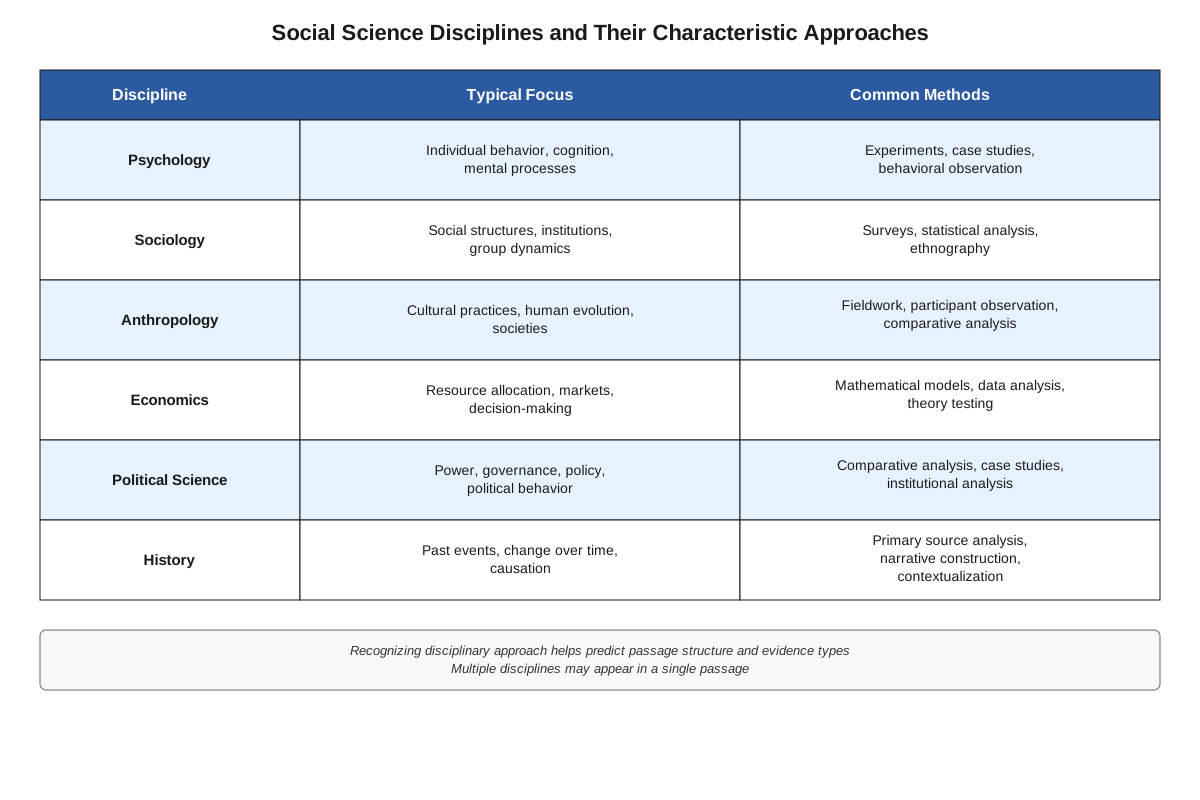
- [ ] Distinguish between different social science disciplines and their characteristic approaches
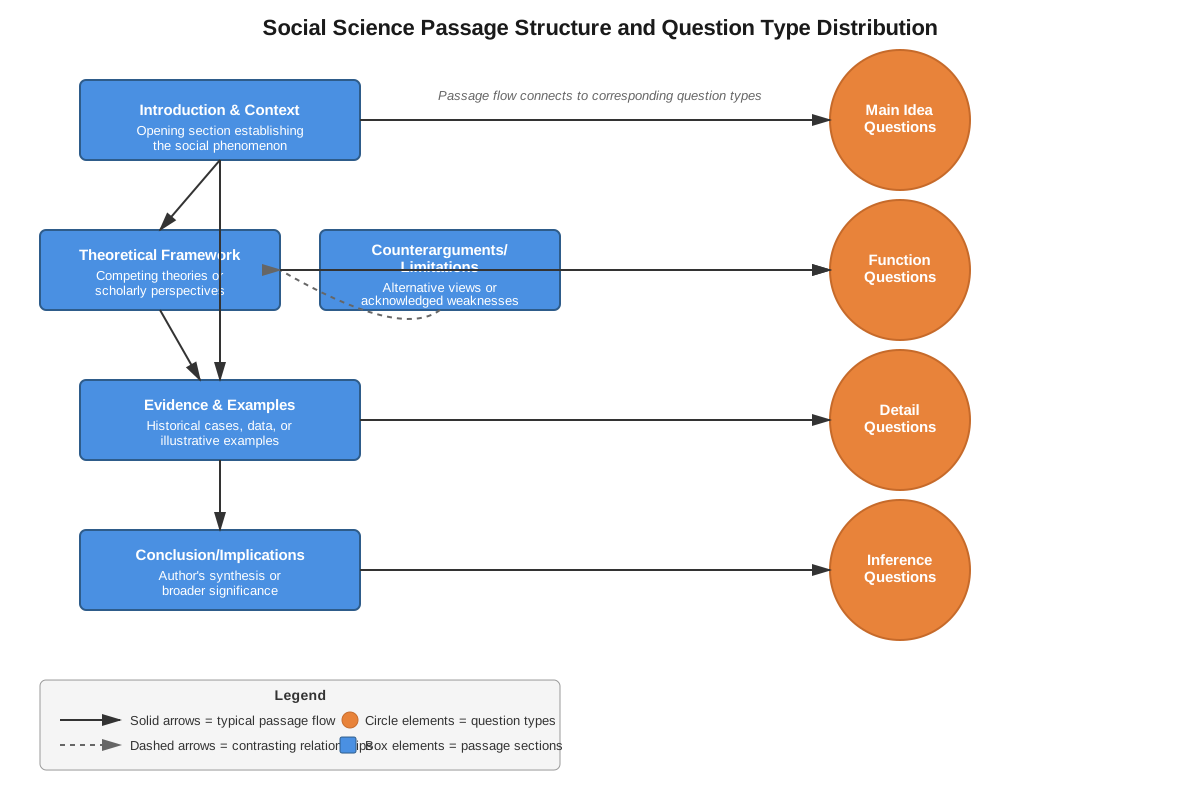
- [ ] Recognize common organizational patterns in social science passages
- [ ] Evaluate the strength of evidence and reasoning in social science arguments
- [ ] Synthesize information from multiple perspectives presented within a single passage
Prerequisites
- Basic reading comprehension skills: The ability to identify main ideas, supporting details, and passage structure forms the foundation for tackling any GRE reading passage.
- Familiarity with argument structure: Understanding how claims, evidence, and conclusions relate helps students analyze the logical flow of social science arguments.
- General academic vocabulary: A baseline vocabulary level enables students to focus on passage-specific terminology rather than struggling with common academic words.
- Time management fundamentals: Knowing how to allocate time across Verbal Reasoning sections ensures students can complete social science passages without rushing.
Why This Topic Matters
Social science passages appear in virtually every GRE Verbal Reasoning section, making them unavoidable for test-takers. Educational Testing Service (ETS) includes these passages because graduate programs across disciplines require students to read, analyze, and synthesize research from social sciences. Whether pursuing business, law, public policy, education, or even STEM fields, graduate students encounter social science research that informs their work.
On the exam, social science passages typically generate 2-4 questions per passage for short passages (approximately 150-200 words) and 4-6 questions for long passages (approximately 400-500 words). Question types include:
- Main idea/primary purpose questions that test overall comprehension
- Detail questions requiring location of specific information
- Inference questions demanding logical conclusions from stated information
- Function questions asking why the author includes particular information
- Vocabulary-in-context questions testing word meaning within the passage
- Select-in-passage questions requiring identification of specific sentences
Common manifestations include passages discussing psychological theories (cognitive biases, developmental stages), sociological phenomena (social movements, demographic trends), economic concepts (market behaviors, policy impacts), anthropological findings (cultural practices, evolutionary adaptations), political science topics (governance structures, voting patterns), and historical analyses (periodization, causation of events). The passages may present a single perspective in depth, contrast multiple viewpoints, trace the evolution of a concept, or apply a theoretical framework to specific cases.
Core Concepts
Characteristics of Social Science Passages
Social science passages on the GRE share several defining features that distinguish them from other passage types. First, they focus on human behavior, social phenomena, or cultural patterns rather than natural phenomena or artistic works. The subject matter involves people—individually or collectively—and the systems, structures, and patterns that emerge from human activity.
Second, these passages frequently present theoretical frameworks or conceptual models. Unlike natural science passages that emphasize empirical data and experimental results, social science passages often discuss how scholars interpret phenomena through different theoretical lenses. A passage might explain how rational choice theory explains voting behavior, or how symbolic interactionism interprets social rituals.
Third, social science passages commonly address causation and correlation in complex systems where multiple variables interact. Authors may discuss factors contributing to social change, consequences of policy decisions, or relationships between demographic variables and outcomes. The reasoning tends to be probabilistic rather than deterministic—acknowledging that social phenomena involve tendencies and patterns rather than universal laws.
Common Organizational Patterns
Understanding how social science passages are structured helps students navigate them efficiently and anticipate where key information appears.
| Pattern | Description | Typical Structure | Key Signals |
|---|---|---|---|
| Theory Presentation | Introduces and explains a theoretical framework | Definition → Components → Applications → Implications | "proposes," "framework," "model," "theory suggests" |
| Comparative Analysis | Contrasts two or more perspectives or approaches | Perspective A → Perspective B → Comparison/Evaluation | "in contrast," "alternatively," "whereas," "however" |
| Historical Development | Traces how ideas or phenomena evolved over time | Earlier view → Transition → Current understanding | "traditionally," "initially," "subsequently," "now" |
| Problem-Solution | Identifies an issue and discusses responses | Problem description → Proposed solutions → Evaluation | "challenge," "addresses," "solution," "approach" |
| Cause-Effect Analysis | Examines factors leading to outcomes | Causes/factors → Mechanisms → Effects/consequences | "results in," "leads to," "contributes to," "because" |
Discipline-Specific Approaches
Different social science disciplines employ characteristic methods and perspectives that appear in GRE passages:
Psychology passages typically discuss mental processes, behavior patterns, cognitive mechanisms, or developmental stages. They may present experimental findings, discuss therapeutic approaches, or explain psychological theories. Key concepts include cognitive biases, memory processes, motivation, personality traits, and social influence.
Sociology passages examine social structures, institutions, group dynamics, and societal patterns. They often discuss social stratification, cultural norms, social movements, demographic trends, or organizational behavior. These passages may analyze how social forces shape individual behavior or how collective action produces social change.
Economics passages explore production, distribution, and consumption of goods and services, market behaviors, policy impacts, or economic theories. They discuss concepts like supply and demand, incentive structures, market failures, economic growth, or behavioral economics findings that challenge traditional assumptions.
Anthropology passages investigate cultural practices, human evolution, cross-cultural comparisons, or ethnographic findings. They may discuss cultural relativism, adaptation strategies, symbolic systems, or archaeological evidence. These passages often emphasize diversity in human experience and challenge ethnocentric assumptions.
Political science passages analyze governance structures, political behavior, policy processes, international relations, or power dynamics. They examine voting patterns, institutional design, political ideologies, or factors influencing policy outcomes.
History passages (when focused on social history) trace developments over time, analyze causation of historical events, discuss historiographical debates, or examine how scholars interpret evidence. They emphasize change over time and the complex interplay of factors producing historical outcomes.
Evidence and Reasoning in Social Science
Social science passages employ various types of evidence and reasoning that students must recognize and evaluate:
Empirical evidence includes statistical data, survey results, experimental findings, or observational studies. Authors cite this evidence to support claims about patterns, relationships, or effects. Students should note what the evidence actually demonstrates versus what the author claims it demonstrates.
Theoretical reasoning applies conceptual frameworks to explain phenomena. Authors use deductive logic to derive predictions from theories or show how theories account for observed patterns. Understanding the theory's core assumptions helps students follow the reasoning.
Historical evidence draws on documents, records, or accounts from the past to support interpretations. Authors may discuss how historians debate the significance or meaning of historical evidence.
Comparative analysis examines similarities and differences across cases, cultures, or time periods to identify patterns or test hypotheses. Authors may argue that similarities suggest common causes or that differences reveal the importance of specific factors.
Case studies provide detailed examination of specific instances to illustrate broader patterns or test theoretical predictions. While case studies offer rich detail, students should recognize their limitations for generalization.
Author's Purpose and Tone
Identifying the author's purpose helps students answer primary purpose questions and understand the passage's overall thrust. Common purposes in social science passages include:
- Explaining a theory or concept: The author aims to help readers understand a theoretical framework, its components, and applications
- Presenting research findings: The author reports empirical results and their implications
- Comparing perspectives: The author contrasts different theoretical approaches or interpretations
- Challenging conventional wisdom: The author argues against a widely held view using evidence or reasoning
- Tracing historical development: The author shows how ideas or phenomena evolved over time
- Analyzing causes or effects: The author examines factors producing outcomes or consequences of events
The tone in social science passages typically remains objective and analytical rather than emotional or polemical. Even when authors critique perspectives, they usually maintain scholarly detachment. However, subtle indicators reveal the author's stance: qualifying language ("may," "suggests," "appears to"), evaluative terms ("surprisingly," "unfortunately," "importantly"), or emphasis on particular evidence.
Concept Relationships
The concepts within social science passages form an interconnected system. Discipline-specific approaches determine what types of evidence authors present and how they reason from that evidence. For example, psychology passages emphasize experimental evidence and cognitive mechanisms, while anthropology passages rely more on ethnographic observation and cultural interpretation.
Organizational patterns reflect the author's purpose: comparative analysis patterns serve passages contrasting perspectives, while historical development patterns suit passages tracing conceptual evolution. Recognizing the pattern helps students anticipate where key information appears and how ideas connect.
Evidence and reasoning support the passage's main argument or thesis. Understanding what counts as strong evidence in social science contexts—and recognizing limitations of different evidence types—enables students to evaluate arguments critically and answer inference questions accurately.
The relationship flows: Discipline → Approach → Evidence type → Reasoning pattern → Organizational structure → Author's purpose. Mastering social science passages requires understanding this entire chain, not just isolated elements.
These concepts connect to prerequisite knowledge of argument structure (claims, evidence, conclusions) and reading comprehension fundamentals (main idea, supporting details, inference). They also relate to other Verbal Reasoning topics: vocabulary knowledge helps with discipline-specific terminology, while critical reasoning skills transfer to argument analysis questions in other sections.
High-Yield Facts
⭐ Social science passages constitute 30-40% of all GRE reading comprehension passages, making them one of the three major passage types alongside humanities and natural sciences.
⭐ The most common organizational patterns are comparative analysis, historical development, and theory presentation, which together account for the majority of social science passages.
⭐ Authors typically maintain an objective, analytical tone even when critiquing perspectives, using subtle indicators like qualifying language to reveal their stance.
⭐ Social science passages emphasize theoretical frameworks and conceptual models more than natural science passages, which focus on empirical findings and experimental methods.
⭐ Evidence in social science passages includes statistical data, survey results, case studies, historical documents, and comparative analysis across cultures or time periods.
- Social science disciplines on the GRE include psychology, sociology, economics, anthropology, political science, and history with social focus.
- Causation in social science passages is typically presented as probabilistic and multifactorial rather than deterministic and singular.
- Main idea questions for social science passages often focus on the author's primary purpose: explaining, comparing, challenging, or tracing development.
- Vocabulary in social science passages tends to be sophisticated but less technical than natural science passages, with more abstract concepts.
- Detail questions require careful location of specific information, often involving paraphrasing rather than exact word matches.
- Inference questions demand logical conclusions based on stated information without requiring outside knowledge of the discipline.
- Function questions ask why the author includes particular information, requiring understanding of how details support the overall argument.
- Select-in-passage questions typically ask students to identify where the author makes a specific claim or provides particular evidence.
Quick check — test yourself on Social science passages so far.
Try Flashcards →Common Misconceptions
Misconception: Social science passages require extensive background knowledge in psychology, sociology, or economics to answer questions correctly.
Correction: The GRE is designed to test reading comprehension and reasoning skills, not subject matter expertise. All information needed to answer questions appears in or can be inferred from the passage itself. While familiarity with social science concepts may speed comprehension, it's not required for success.
Misconception: The author's opinion doesn't matter in objective, academic passages.
Correction: Even in scholarly passages, authors have perspectives, preferences, and purposes. Identifying subtle indicators of the author's stance—through word choice, emphasis, and structure—is crucial for answering primary purpose and tone questions. The author may favor one theory over another or challenge conventional wisdom.
Misconception: All evidence presented in a passage is equally strong and reliable.
Correction: Social science passages often present evidence of varying quality and scope. A single case study provides less generalizable support than a large-scale statistical study. Authors may mention evidence to critique it or show its limitations. Students must evaluate evidence critically rather than accepting all claims equally.
Misconception: Historical development passages simply list events chronologically without making an argument.
Correction: Even passages tracing development over time make arguments about why changes occurred, which factors mattered most, or how current understanding differs from earlier views. The chronological structure serves a rhetorical purpose, and students must identify the author's thesis about the development described.
Misconception: Comparative passages always favor one perspective over others.
Correction: While some comparative passages do advocate for a particular approach, others present multiple perspectives without clearly endorsing one. The author may argue that different perspectives suit different contexts or that synthesis of multiple approaches offers the best understanding. Students should avoid assuming the author must prefer one option.
Misconception: Technical vocabulary in social science passages always signals important content.
Correction: While discipline-specific terms often mark key concepts, not every technical term is crucial for answering questions. Some terminology appears in supporting details or examples. Students should focus on how terms function in the passage's argument rather than memorizing every definition.
Worked Examples
Example 1: Psychology Passage with Comparative Structure
Passage:
"Traditional theories of decision-making assumed that individuals act as rational agents, carefully weighing costs and benefits to maximize utility. However, research in behavioral economics has revealed systematic deviations from this rational model. Kahneman and Tversky's prospect theory demonstrates that people evaluate potential losses and gains asymmetrically: the pain of losing $100 exceeds the pleasure of gaining $100. This loss aversion leads to risk-averse behavior in contexts involving potential gains but risk-seeking behavior when facing certain losses. Moreover, individuals rely on mental shortcuts, or heuristics, that produce predictable biases. The availability heuristic, for instance, causes people to overestimate the probability of events that readily come to mind, such as dramatic accidents frequently covered in media. While these heuristics often serve us well in everyday situations, they can lead to systematic errors in judgment when applied inappropriately."
Question: The primary purpose of the passage is to:
(A) Explain why traditional decision-making theories remain valid despite recent challenges
(B) Describe how behavioral economics findings reveal departures from rational choice assumptions
(C) Argue that heuristics always produce errors in human judgment
(D) Compare the relative merits of prospect theory and traditional utility theory
(E) Demonstrate that loss aversion is the most important factor in decision-making
Solution:
Step 1: Identify the organizational pattern. The passage follows a comparative structure: traditional view → contrasting research findings → specific examples of deviations.
Step 2: Determine the author's purpose. The author introduces traditional rational choice theory, then uses "However" to signal a shift to behavioral economics research that challenges this model. The remainder of the passage provides specific examples (loss aversion, availability heuristic) of how people deviate from rational assumptions.
Step 3: Evaluate each answer choice:
- (A) is incorrect because the passage challenges rather than defends traditional theories
- (B) correctly captures the passage's purpose: describing behavioral economics findings that show departures from rational choice
- (C) is too extreme; the passage states heuristics "often serve us well" and only "can lead" to errors
- (D) is incorrect because the passage doesn't compare the merits of theories but rather shows how one challenges the other
- (E) is too narrow; loss aversion is one example among several, not presented as most important
Answer: (B)
Connection to learning objectives: This example demonstrates how to identify the organizational pattern (comparative), recognize the author's purpose (presenting research that challenges a traditional view), and apply understanding of social science passage structure to answer a primary purpose question accurately.
Example 2: Sociology Passage with Inference Question
Passage:
"Social capital—the networks, norms, and trust that facilitate cooperation—varies significantly across communities. Putnam's research on Italian regional governments found that areas with strong civic traditions, characterized by high levels of associational membership and interpersonal trust, exhibited more effective governance than regions lacking such traditions. These differences persisted despite similar formal institutional structures, suggesting that informal social networks matter as much as formal institutions. However, critics note that Putnam's analysis may confuse cause and effect: perhaps effective governance builds social capital rather than vice versa. Furthermore, the specific forms of social capital that prove beneficial may vary by context. Bonding social capital—strong ties within homogeneous groups—can provide support and solidarity but may also reinforce insularity and limit access to diverse resources. Bridging social capital—connections across different social groups—facilitates information flow and opportunity but may involve weaker ties that provide less intensive support."
Question: The passage suggests which of the following about the relationship between social capital and governance?
(A) Formal institutional structures determine governance effectiveness regardless of social capital levels
(B) The causal relationship between social capital and effective governance remains debated
(C) Bonding social capital consistently produces better governance outcomes than bridging social capital
(D) Putnam's research definitively established that social capital causes effective governance
(E) Social capital has no measurable impact on governance in modern societies
Solution:
Step 1: Identify what the passage states about the relationship. The passage presents Putnam's finding that social capital correlates with effective governance, then introduces critics who question the causal direction.
Step 2: Look for qualifying language. The passage uses "suggesting" (not proving), mentions critics who note Putnam "may confuse cause and effect," and discusses how the relationship might work differently in different contexts.
Step 3: Evaluate answer choices:
- (A) contradicts the passage, which states social networks matter "as much as" formal institutions
- (B) correctly captures the passage's presentation: Putnam found a relationship, but critics debate causation
- (C) is not supported; the passage discusses trade-offs between bonding and bridging capital without declaring one superior
- (D) is too strong; the passage presents Putnam's work as suggestive, not definitive, and mentions critics
- (E) contradicts the passage, which discusses various ways social capital relates to governance
Answer: (B)
Connection to learning objectives: This example shows how to make valid inferences from social science passages by attending to qualifying language, recognizing when authors present debates rather than settled conclusions, and avoiding answer choices that overstate the passage's claims.
Exam Strategy
Approaching Social Science Passages
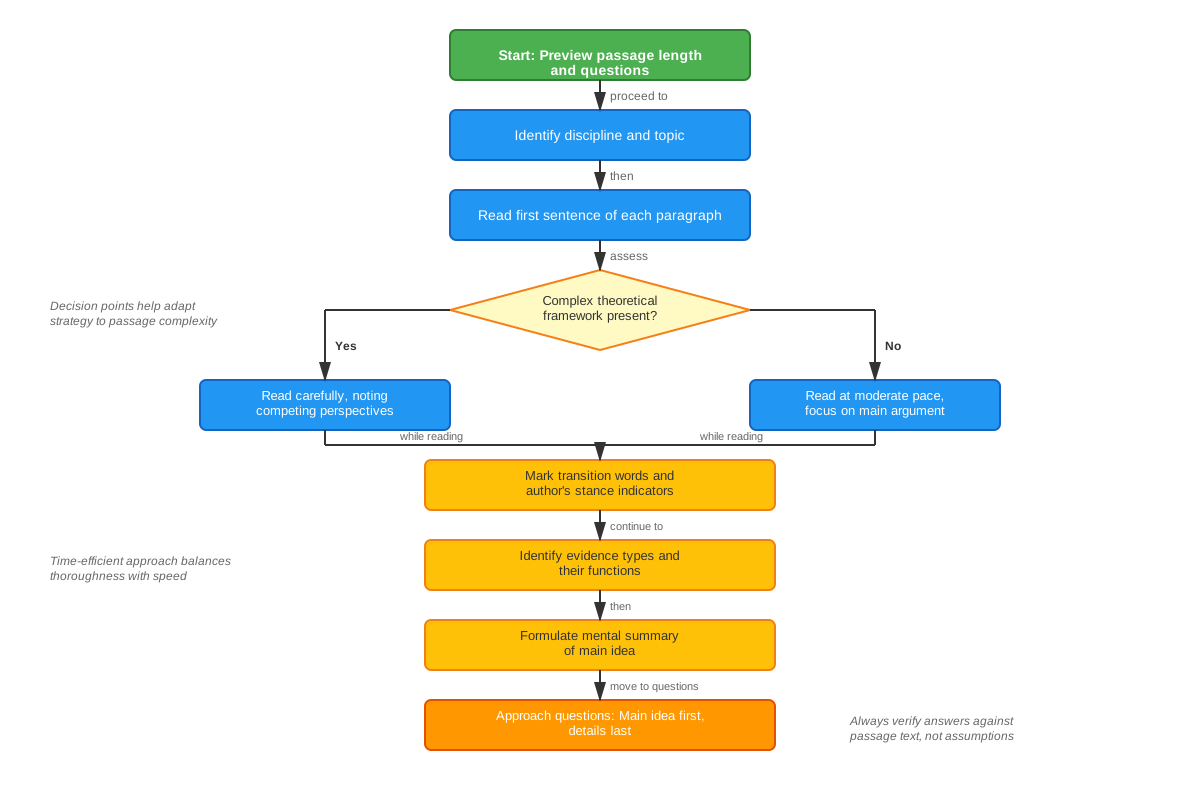
First reading strategy: Read actively for structure and purpose rather than trying to memorize details. Identify the organizational pattern within the first few sentences, note the author's main argument or thesis, and track how each paragraph functions in the overall structure. Mark transitions that signal shifts in perspective or introduce contrasting views.
Annotation technique: Use minimal, strategic annotations. Mark the main claim, note where different perspectives appear, and flag specific examples or evidence. Avoid over-highlighting, which can obscure rather than clarify structure. Focus on functional annotations: "author's view," "traditional approach," "criticism," "example."
Trigger Words and Phrases
Watch for these signals in social science passages:
Contrast indicators: "however," "in contrast," "alternatively," "whereas," "on the other hand," "nevertheless" → Signal shifts between perspectives or challenges to previous claims
Theory/framework markers: "proposes," "framework," "model," "theory," "approach," "perspective," "paradigm" → Indicate introduction of conceptual systems
Evidence signals: "research shows," "studies indicate," "data reveal," "findings suggest," "evidence demonstrates" → Mark empirical support for claims
Qualification language: "may," "might," "suggests," "appears to," "tends to," "often" → Indicate probabilistic rather than absolute claims
Temporal markers: "traditionally," "historically," "initially," "subsequently," "currently," "now" → Signal historical development patterns
Causation language: "leads to," "results in," "contributes to," "produces," "causes," "influences" → Indicate causal relationships
Process of Elimination Tips
For main idea/primary purpose questions: Eliminate choices that are too narrow (focusing on a single detail or example), too broad (going beyond the passage's scope), or that contradict the passage's overall thrust. The correct answer should encompass the entire passage without overgeneralizing.
For detail questions: Eliminate choices that use passage vocabulary but distort relationships or introduce information not stated. The correct answer may paraphrase rather than quote directly, so focus on meaning rather than exact wording.
For inference questions: Eliminate choices that require outside knowledge, go beyond what the passage supports, or contradict stated information. The correct inference must be logically derivable from passage content without speculation.
For function questions: Eliminate choices that describe what the information says rather than why the author includes it. Focus on how the detail supports the overall argument or relates to surrounding content.
Time Allocation
For short passages (150-200 words with 2-3 questions): Spend approximately 2-3 minutes reading and 1 minute per question, totaling 4-6 minutes.
For long passages (400-500 words with 4-6 questions): Spend approximately 3-4 minutes reading and 1 minute per question, totaling 7-10 minutes.
Exam Tip: Don't get bogged down in complex theoretical details during the first reading. You can return to specific sections when questions direct you there. Focus on understanding the passage's structure and main argument, which enables you to answer most questions efficiently.
Memory Techniques
PEST mnemonic for common social science disciplines: Psychology, Economics, Sociology, Theory (includes political science, anthropology, and history). When you see a passage, quickly categorize it using PEST to activate relevant expectations about evidence types and reasoning patterns.
TEACH framework for organizational patterns:
- Theory presentation
- Evolution/historical development
- Analysis (cause-effect)
- Comparison
- Hypothesis/problem-solution
Visualization strategy: Picture social science passages as conversations between scholars. When the passage presents multiple perspectives, visualize different people speaking. This helps track whose view is whose and prevents confusion between the author's position and views the author describes.
The "So what?" technique: After reading each paragraph, mentally ask "So what?" or "Why does this matter?" This forces identification of how each section functions in the overall argument, improving comprehension of structure and purpose.
Evidence evaluation checklist (acronym: SCALE):
- Scope: Does the evidence cover a broad range or limited cases?
- Causation: Does it show correlation or causation?
- Authority: Who conducted the research?
- Limitations: What are the boundaries of the claim?
- Examples: Is this a specific instance or general pattern?
Summary
Social science passages represent a major category of GRE reading comprehension content, drawing from psychology, sociology, economics, anthropology, political science, and history. These passages typically present theoretical frameworks, compare competing perspectives, trace historical developments, or analyze complex social phenomena through evidence including statistical data, case studies, and comparative analysis. Success requires recognizing common organizational patterns (comparative analysis, historical development, theory presentation, cause-effect analysis, problem-solution), identifying the author's purpose and subtle indicators of stance, and evaluating different types of evidence appropriately. Unlike natural science passages that emphasize empirical findings, social science passages focus more on theoretical interpretation and often present probabilistic, multifactorial causation. Students must read actively for structure rather than memorizing details, use trigger words to track shifts in perspective, and apply process-of-elimination strategies tailored to different question types. The key to mastering social science passages lies in understanding how discipline-specific approaches shape evidence and reasoning, recognizing that all information needed appears in the passage itself, and maintaining focus on the author's overall purpose rather than getting lost in complex details.
Key Takeaways
- Social science passages constitute 30-40% of GRE reading comprehension and draw from psychology, sociology, economics, anthropology, political science, and history
- Common organizational patterns include comparative analysis, historical development, theory presentation, cause-effect analysis, and problem-solution structures
- These passages emphasize theoretical frameworks and conceptual models more than empirical data, with causation presented as probabilistic and multifactorial
- Success requires identifying the author's purpose (explaining, comparing, challenging, or tracing development) and recognizing subtle indicators of the author's stance through qualifying language and emphasis
- All information needed to answer questions appears in or can be inferred from the passage—no outside subject matter expertise is required
- Read actively for structure and purpose rather than memorizing details, using trigger words to track perspective shifts and evidence types
- Apply question-specific elimination strategies: for main idea questions, eliminate choices that are too narrow or broad; for inference questions, eliminate choices requiring outside knowledge or unsupported speculation
Related Topics
Natural Science Passages: Understanding the differences between social science and natural science passages helps students adjust their reading strategies based on passage type. Natural science passages emphasize empirical methods and experimental findings, while social science passages focus more on theoretical interpretation.
Humanities Passages: These passages share with social science passages an emphasis on interpretation and multiple perspectives, but focus on literature, art, philosophy, and cultural criticism rather than social phenomena. Mastering social science passages builds skills transferable to humanities content.
Argument Analysis: The critical reasoning skills developed through social science passages—evaluating evidence, identifying assumptions, recognizing logical relationships—directly support performance on argument-based questions throughout the Verbal Reasoning section.
Vocabulary in Context: Social science passages frequently test sophisticated but non-technical vocabulary. Building vocabulary knowledge through social science reading enhances both passage comprehension and performance on sentence-level questions.
Inference Questions Across Passage Types: The inference skills practiced with social science passages apply to all reading comprehension content. Understanding how to draw valid conclusions without overstepping textual support is fundamental to GRE success.
Practice CTA
Now that you've mastered the core concepts and strategies for social science passages, it's time to apply your knowledge! Attempt the practice questions to test your ability to identify organizational patterns, recognize author's purpose, evaluate evidence, and answer GRE-style questions accurately. Use the flashcards to reinforce key concepts and trigger words. Remember: consistent practice with active reading and strategic question analysis transforms understanding into high performance. Each passage you tackle builds the pattern recognition and analytical skills that lead to GRE success. You've got this!
Sign up free to keep reading
Create a free AnvayaPrep account to finish this GRE guide on Social science passages — plus flashcards and practice questions.