Overview
Understanding author's purpose is one of the most critical skills tested in GRE Verbal Reasoning's Reading Comprehension section. Every passage on the GRE is written with specific intentions—whether to argue a position, explain a phenomenon, compare competing theories, or critique an existing viewpoint. Recognizing these intentions allows test-takers to navigate passages more efficiently, predict question types, and eliminate incorrect answer choices with confidence. The GRE author's purpose questions don't simply ask what the passage says; they probe why the author wrote it and how the author structured their argument to achieve specific rhetorical goals.
Mastering author's purpose transforms passive reading into active analysis. Rather than absorbing information linearly, skilled test-takers constantly ask: "Why is the author telling me this? What point are they building toward? How does this paragraph serve the overall argument?" This metacognitive approach dramatically improves both speed and accuracy across all Reading Comprehension question types, not just those explicitly labeled as purpose questions. When students understand the author's overarching goal, they can better evaluate specific claims, identify the passage's structure, and anticipate where supporting evidence or counterarguments will appear.
Within the broader Verbal Reasoning framework, author's purpose serves as a foundational skill that connects to nearly every other reading comprehension competency. It underpins the ability to identify main ideas (which represent the author's central purpose), distinguish primary from secondary purposes, evaluate tone and attitude, and understand how individual paragraphs function within the passage's architecture. Questions about passage structure, function of specific details, and the author's attitude all require accurate identification of purpose. Consequently, this topic represents high-leverage preparation time—improvements here cascade across multiple question types.
Learning Objectives
- [ ] Identify when Author's purpose is being tested in GRE questions
- [ ] Explain the core rule or strategy behind determining Author's purpose
- [ ] Apply Author's purpose analysis to GRE-style questions accurately
- [ ] Distinguish between primary and secondary purposes within a single passage
- [ ] Recognize the relationship between author's purpose and passage structure
- [ ] Evaluate how specific paragraphs or sentences serve the author's overall purpose
- [ ] Differentiate between descriptive and prescriptive purposes in academic writing
Prerequisites
- Basic reading comprehension skills: Ability to understand literal meaning of complex sentences is necessary before analyzing authorial intent
- Familiarity with passage structure: Understanding how passages organize information (introduction, body, conclusion) helps identify where purpose statements typically appear
- Vocabulary at intermediate level: Recognizing common academic and rhetorical terms enables faster identification of purpose indicators
- Ability to identify main ideas: The main idea often directly reflects or closely relates to the author's primary purpose
Why This Topic Matters
In real-world academic and professional contexts, identifying author's purpose is essential for critical reading. Scholars must evaluate whether research papers aim to establish new findings, challenge existing paradigms, or synthesize current knowledge. Professionals need to discern whether reports recommend action, present neutral analysis, or advocate for specific policies. This skill prevents misinterpretation and enables readers to engage appropriately with texts—knowing when to scrutinize claims versus when to absorb information.
On the GRE specifically, author's purpose appears with remarkable frequency. Approximately 15-20% of Reading Comprehension questions directly test this skill through questions like "The primary purpose of the passage is to..." or "The author mentions X primarily in order to..." Additionally, another 20-30% of questions indirectly require purpose analysis to answer correctly. These include questions about passage structure, tone, and the function of specific details. Given that Reading Comprehension constitutes roughly half of the Verbal Reasoning score, mastering author's purpose can directly impact 3-5 points on the 130-170 scale.
Common manifestations in GRE passages include: authors presenting and evaluating competing theories in science passages; authors challenging conventional wisdom in humanities passages; authors explaining complex phenomena while highlighting remaining mysteries; authors tracing historical developments to argue for reinterpretation; and authors describing problems while implicitly or explicitly advocating solutions. Recognizing these patterns allows test-takers to anticipate question types and locate relevant information efficiently.
Core Concepts
Defining Author's Purpose
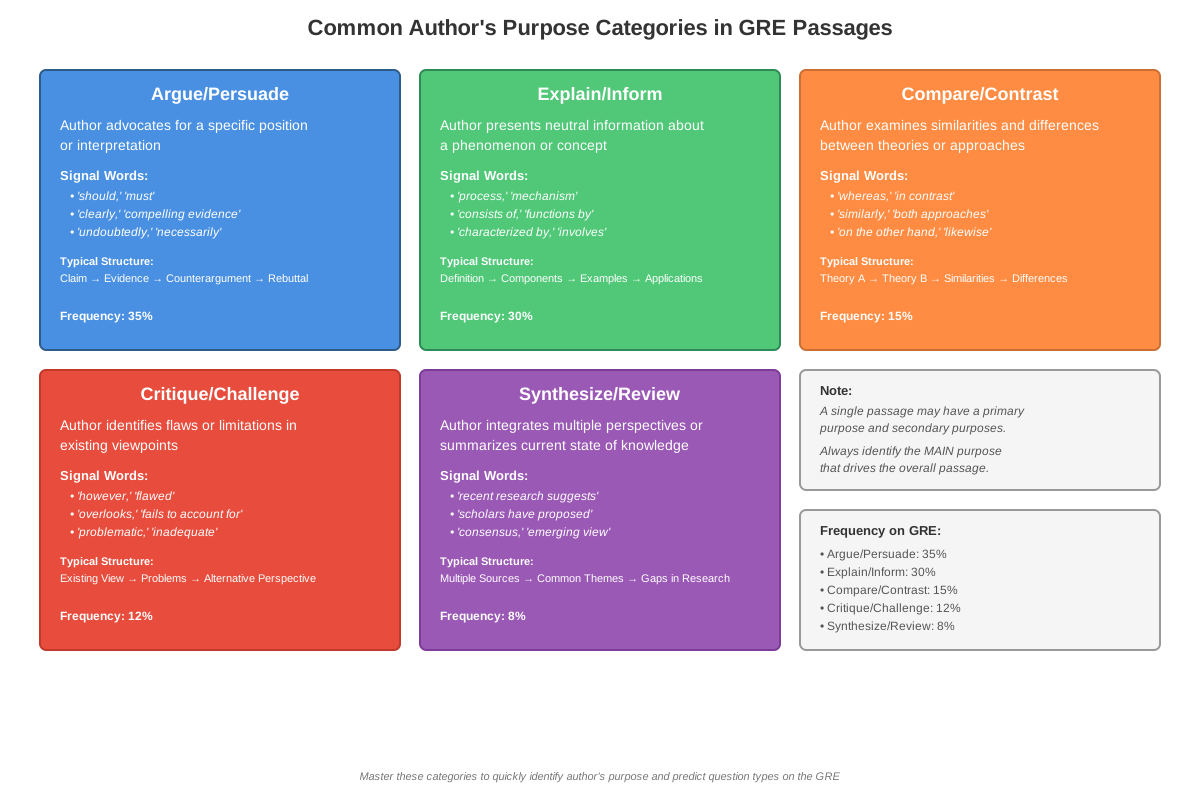
Author's purpose refers to the reason an author composed a text—the goal they aimed to achieve through their writing. On the GRE, this typically falls into several broad categories: to argue or persuade, to explain or inform, to describe or analyze, to compare or contrast, to critique or challenge, or to synthesize or reconcile. Unlike simpler reading tasks that focus on "what" the passage says, purpose questions target "why" the author wrote it and "how" they structured their argument.
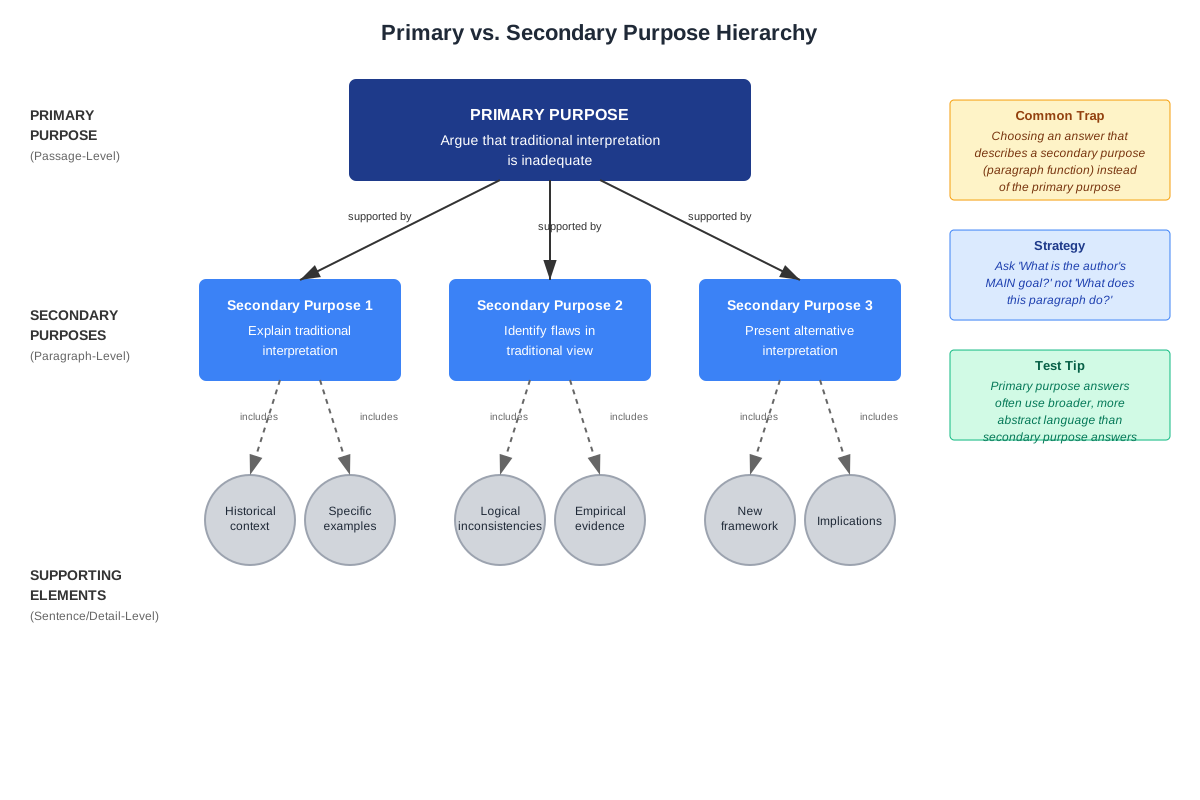
The GRE tests purpose at multiple levels. The primary purpose encompasses the passage's overarching goal—what the author fundamentally set out to accomplish. Secondary purposes include subsidiary goals that support the primary purpose, such as providing background information, addressing counterarguments, or offering examples. Additionally, local purposes refer to why specific paragraphs, sentences, or details appear—how they function within the larger argumentative structure.
Categories of Author's Purpose
| Purpose Type | Characteristics | Common Indicators | Example Question Stems |
|---|---|---|---|
| Argumentative/Persuasive | Author takes a position and defends it | "should," "must," "argue," "contend" | "The author's primary purpose is to advocate..." |
| Explanatory/Informative | Author clarifies how something works | "process," "mechanism," "explains," "demonstrates" | "The passage primarily serves to explain..." |
| Analytical/Evaluative | Author examines components or assesses merit | "analysis," "evaluation," "assessment," "examination" | "The author's main goal is to analyze..." |
| Comparative | Author highlights similarities/differences | "whereas," "in contrast," "similarly," "both" | "The passage primarily compares..." |
| Critical/Challenging | Author questions or refutes existing views | "however," "misconception," "contrary to," "challenges" | "The primary purpose is to critique..." |
| Synthetic/Reconciliatory | Author integrates multiple perspectives | "reconcile," "synthesis," "integrate," "both...and" | "The author attempts to reconcile..." |
Identifying Purpose Through Structural Markers
GRE passages reveal purpose through predictable structural elements. The opening paragraph frequently contains purpose statements, either explicit ("This paper argues that...") or implicit (through the introduction of a problem or question). The concluding paragraph often reinforces or restates the primary purpose, sometimes with implications or recommendations that clarify the author's goals.
Transition words and phrases serve as critical purpose indicators. Words like "however," "nevertheless," and "yet" signal that the author is challenging or complicating a previously stated view—suggesting a critical or analytical purpose. Phrases like "in order to," "so that," and "with the goal of" explicitly state intentions. Terms like "surprisingly," "remarkably," or "contrary to expectations" indicate the author aims to highlight something unexpected or challenge conventional thinking.
The tone and attitude of the passage provide essential clues about purpose. An author using measured, neutral language likely aims to inform or explain. One employing evaluative language ("inadequate," "compelling," "flawed") probably intends to critique or argue. Enthusiastic or promotional language suggests advocacy, while tentative language ("may," "might," "possibly") indicates exploratory or analytical purposes.
The Relationship Between Purpose and Structure
Understanding that structure follows purpose is crucial for GRE success. An author whose purpose is to challenge an existing theory will typically structure the passage as: (1) present the existing theory, (2) introduce problems or limitations, (3) offer an alternative or call for revision. An author aiming to explain a complex phenomenon might structure the passage as: (1) introduce the phenomenon, (2) describe its mechanisms or components, (3) discuss implications or applications.
This structure-purpose relationship enables prediction. After reading the first paragraph, skilled test-takers hypothesize the author's purpose and predict how subsequent paragraphs will develop. If the opening introduces two competing theories, the passage likely aims to compare them, evaluate their relative merits, or propose a synthesis. If the opening describes a puzzling observation, the passage probably aims to explain it or present competing explanations.
Primary vs. Secondary Purposes
GRE passages rarely have a single, simple purpose. An author might primarily aim to argue for a new interpretation of historical events (primary purpose) while secondarily providing background on those events (secondary purpose) and addressing potential objections (another secondary purpose). Distinguishing primary from secondary purposes is essential because wrong answer choices often describe secondary purposes or the purpose of individual paragraphs rather than the passage as a whole.
The primary purpose must account for the entire passage. If an answer choice accurately describes only the first two paragraphs but ignores the final paragraph's shift to implications, it's incorrect. The primary purpose represents the author's overarching goal—the reason the passage exists. Secondary purposes are subordinate goals that support or enable the primary purpose.
Local Purpose: Function of Details
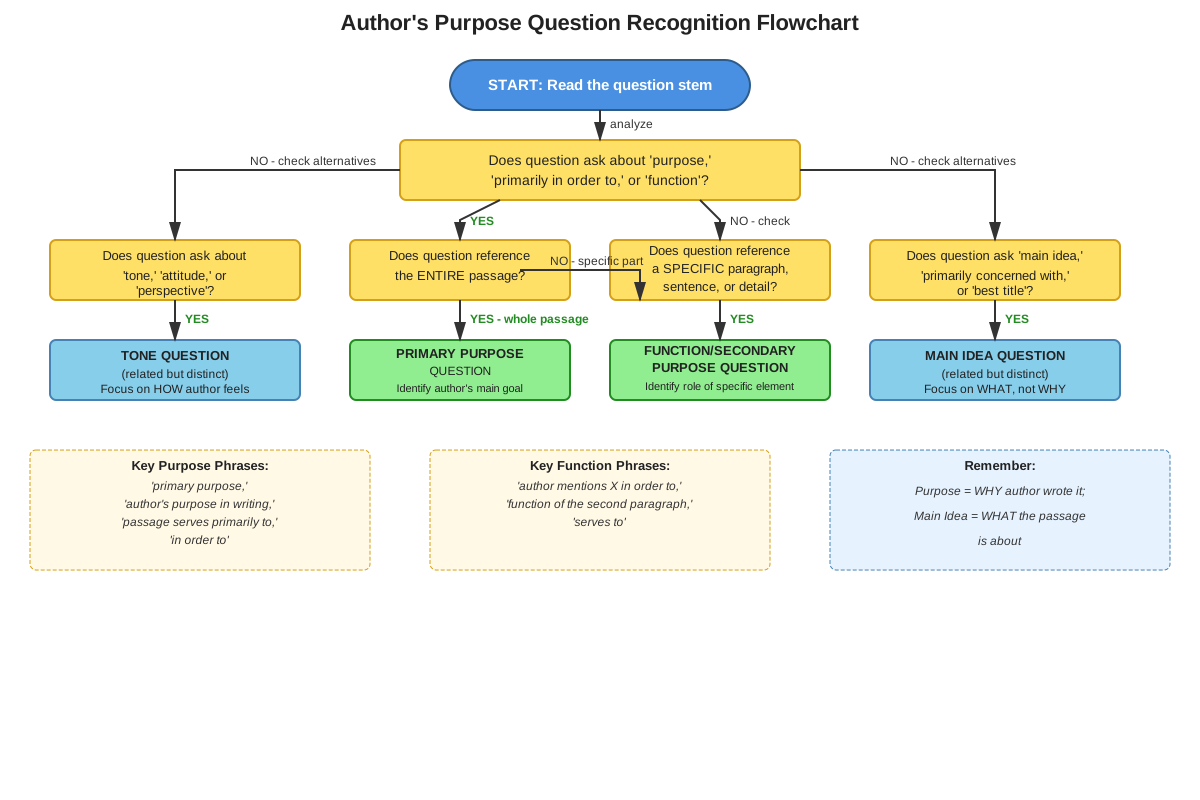
Beyond overall passage purpose, the GRE frequently asks about the purpose of specific elements: "The author mentions X in order to..." or "The function of the second paragraph is to..." These local purpose questions require understanding how individual components serve the larger argument.
Common functions include: providing evidence for a claim, illustrating an abstract concept with a concrete example, introducing a counterargument to be refuted, offering background necessary for understanding the main argument, qualifying or limiting a previous statement, and transitioning between major sections of the argument. Recognizing these functions requires constant awareness of how each sentence relates to the author's overarching purpose.
Concept Relationships
The concepts within author's purpose form a hierarchical relationship: Primary Purpose sits at the top, representing the passage's overarching goal. This breaks down into Secondary Purposes that support the primary purpose through various means. At the most granular level, Local Purposes explain why specific paragraphs, sentences, or details appear.
Structural Markers (transitions, tone, paragraph organization) serve as the evidence base for inferring all levels of purpose. These markers → reveal → Local Purposes → which aggregate into → Secondary Purposes → which collectively achieve → Primary Purpose.
Author's purpose connects bidirectionally with other Reading Comprehension skills. Main Idea and Primary Purpose are closely related—the main idea often states what the author concluded, while the primary purpose explains why they wrote the passage. Passage Structure is determined by purpose—authors organize passages to achieve their goals. Tone and Attitude both reveal and result from purpose—an author's purpose shapes their tone, and their tone provides clues about their purpose.
Understanding author's purpose enables more sophisticated analysis of Inference Questions (by clarifying what the author would likely agree with based on their goals), Strengthen/Weaken Questions (by identifying what would support or undermine the author's purpose), and Application Questions (by predicting how the author would approach related scenarios based on their demonstrated purposes).
High-Yield Facts
⭐ The primary purpose must account for the entire passage, not just the opening or majority of paragraphs—wrong answers often describe purposes of individual sections.
⭐ Purpose questions can be answered by reading the first and last paragraphs carefully—these typically contain the clearest purpose indicators.
⭐ When an author presents a view only to challenge it, the challenge is the purpose, not the presentation—"describe theory X" is wrong if the author's goal is "critique theory X."
⭐ Verbs in answer choices are more important than nouns—"argue that X is true" differs fundamentally from "describe arguments for X."
⭐ The most common primary purposes on the GRE are: challenge/critique, explain/analyze, and compare/evaluate—these account for approximately 70% of passages.
- Answer choices using extreme language ("prove," "definitively establish," "completely refute") are usually incorrect—GRE passages typically present more measured purposes.
- If the passage discusses multiple theories or perspectives, the purpose likely involves comparing, evaluating, or synthesizing them rather than simply describing them.
- Background information and context-setting are almost never the primary purpose—they're secondary purposes supporting a larger goal.
- When the author asks questions (especially in the opening), the passage's purpose typically involves answering those questions or explaining why they're difficult to answer.
- The purpose of mentioning specific examples or studies is usually to illustrate, support, or provide evidence for a broader claim—not to describe those examples for their own sake.
Quick check — test yourself on Author's purpose so far.
Try Flashcards →Common Misconceptions
Misconception: The primary purpose is whatever the passage spends the most words discussing.
Correction: The primary purpose is the author's overarching goal, which may be achieved through extensive discussion of background or opposing views. A passage might spend 60% of its length describing a theory only to spend the final 40% critiquing it—the critique is the purpose.
Misconception: If the author describes something, their purpose is "to describe."
Correction: Description is usually a means to an end. Authors describe phenomena to explain them, describe theories to evaluate them, or describe problems to argue for solutions. The purpose is the ultimate goal, not the immediate method.
Misconception: Author's purpose and main idea are the same thing.
Correction: Main idea states the author's central point or conclusion (what they want you to know), while purpose explains why they wrote the passage (what they're trying to accomplish). A passage might have the main idea "Theory X has significant limitations" with the purpose "to challenge the prevailing acceptance of Theory X."
Misconception: The purpose is always stated explicitly in the passage.
Correction: While some passages include explicit purpose statements ("This paper argues..."), many require inference from structural markers, tone, and content organization. GRE passages often have implicit purposes that must be deduced.
Misconception: Every paragraph has a different purpose that should be treated equally.
Correction: Paragraphs serve functions within the larger purpose hierarchy. Some provide background (secondary purpose), others present the main argument (primary purpose), and others address objections (secondary purpose). These aren't equivalent—they're organized around achieving the primary purpose.
Misconception: If the author presents both sides of an issue, their purpose must be "to present both sides."
Correction: Presenting multiple perspectives is usually a means to compare them, evaluate their relative merits, synthesize them, or argue for one over the others. The purpose is what the author does with those perspectives, not merely that they present them.
Worked Examples
Example 1: Science Passage
Passage Excerpt:
"For decades, researchers attributed the extinction of North American megafauna at the end of the Pleistocene epoch primarily to human overhunting, citing the temporal correlation between human arrival and species disappearance. However, recent paleoclimatic data reveal that this period also witnessed dramatic climate shifts, including rapid temperature fluctuations and changing precipitation patterns. While human hunting undoubtedly played a role, the exclusive focus on anthropogenic causes has obscured the likely reality: megafaunal extinction resulted from the interaction of human predation and environmental stress. Species already weakened by habitat changes proved especially vulnerable to even moderate hunting pressure. This synergistic model better explains regional variation in extinction timing and the differential survival of certain species."
Question: The primary purpose of the passage is to:
(A) describe the methods researchers use to study Pleistocene extinctions
(B) argue that climate change, not human hunting, caused megafaunal extinction
(C) present evidence that human arrival coincided with megafaunal extinction
(D) challenge an oversimplified explanation by proposing a more nuanced model
(E) explain why certain megafaunal species survived while others disappeared
Analysis:
Step 1: Identify structural markers
- "However" signals a shift from presenting an existing view to challenging it
- "has obscured" indicates criticism of the existing view
- "better explains" suggests the author is advocating for an alternative
Step 2: Trace the argument's progression
- Paragraph presents existing theory (human overhunting)
- Introduces complicating evidence (climate data)
- Critiques the existing theory ("exclusive focus...has obscured")
- Proposes alternative (synergistic model)
- Claims superiority of alternative ("better explains")
Step 3: Determine the overarching goal
The author isn't merely describing research methods (A), presenting evidence for correlation (C), or explaining survival patterns (E)—these are secondary purposes or means to the larger end. The author also isn't arguing that climate alone caused extinction (B)—they explicitly state "human hunting undoubtedly played a role."
The primary purpose is to challenge the oversimplified single-cause explanation and argue for a more complex, interactive model. This matches (D).
Answer: (D)
This question demonstrates how the primary purpose often involves challenging or refining existing views rather than simply presenting information. The verbs "challenge" and "proposing" in choice (D) accurately capture the author's argumentative stance, while other choices use verbs like "describe," "present," and "explain" that suggest more neutral, informative purposes.
Example 2: Humanities Passage
Passage Excerpt:
"Art historians have long debated whether Renaissance patronage systems constrained or enabled artistic innovation. The traditional view holds that wealthy patrons' demands for religious themes and conventional compositions limited artists' creative freedom. Yet examination of correspondence between artists and patrons reveals a more complex dynamic. Patrons frequently deferred to artists' expertise on technical matters and compositional choices. Moreover, the financial security patronage provided allowed artists to experiment with expensive materials and time-intensive techniques that would have been impossible for independent artists operating in uncertain markets. Rather than viewing patronage as purely restrictive, we should recognize it as a system that simultaneously imposed certain thematic constraints while creating conditions favorable to technical and stylistic innovation."
Question: The author mentions "correspondence between artists and patrons" primarily in order to:
(A) provide evidence that challenges the traditional view of patronage
(B) illustrate the types of themes patrons typically requested
(C) demonstrate that patrons had extensive knowledge of artistic techniques
(D) explain how Renaissance artists communicated with their sponsors
(E) show that financial arrangements were documented in writing
Analysis:
Step 1: Identify the local context
The correspondence is mentioned in the sentence beginning "Yet examination of correspondence..." The word "Yet" signals that this evidence will complicate or challenge what came before.
Step 2: Determine what came before
The previous sentence presented "the traditional view" that patronage "limited artists' creative freedom."
Step 3: Determine what the correspondence shows
The correspondence reveals that "patrons frequently deferred to artists' expertise"—contradicting the traditional view that patrons constrained artists.
Step 4: Identify the function
The correspondence serves as evidence to challenge the traditional view. This is a classic pattern: present existing view → introduce evidence → use evidence to complicate or refute existing view.
Answer: (A)
Choices (B), (C), (D), and (E) all describe things the correspondence might incidentally reveal, but they don't capture its function within the author's argument. The author doesn't mention correspondence to explain communication methods (D) or document financial arrangements (E)—these might be true but aren't the purpose. The correspondence is mentioned specifically to provide evidence against the traditional view, making (A) correct.
This example illustrates how local purpose questions require understanding not just what information appears, but why the author included it—how it serves the larger argumentative purpose.
Exam Strategy
Approaching Purpose Questions
Step 1: Identify the question scope
Determine whether the question asks about primary purpose (whole passage), paragraph function (one paragraph), or local purpose (specific detail or sentence). This determines how much of the passage your answer must account for.
Step 2: Read strategically
For primary purpose questions, focus intensively on the first and last paragraphs, which typically contain the clearest purpose indicators. For local purpose questions, read the sentence before and after the referenced detail to understand its context.
Step 3: Look for structural markers
Identify transition words, especially those signaling contrast ("however," "yet," "nevertheless") or causation ("therefore," "thus," "consequently"). These reveal the author's argumentative moves and intentions.
Step 4: Analyze verbs in answer choices
The verb is usually more important than the noun. "Argue that X is flawed" differs fundamentally from "describe flaws in X." The first indicates the author takes a position; the second suggests neutral presentation.
Trigger Words and Phrases
In questions:
- "primary purpose" → must account for entire passage
- "main goal" → synonymous with primary purpose
- "in order to" → asking about function/purpose
- "primarily serves to" → asking why something appears
- "function of [paragraph/detail]" → asking about local purpose
In passages:
- "However," "Nevertheless," "Yet" → author is challenging or complicating
- "In fact," "Indeed," "Actually" → author is emphasizing or correcting
- "Should," "Must," "Ought to" → author is arguing/prescribing
- "Surprisingly," "Unexpectedly," "Contrary to" → author is highlighting something unexpected
- "Both...and," "Not only...but also" → author may be synthesizing or adding complexity
Process of Elimination Tips
Eliminate answers that:
- Describe only part of the passage (especially just the opening)
- Use verbs that are too neutral when the author takes a clear position ("describe" when the author argues)
- Use verbs that are too strong when the author is measured ("prove" or "definitively establish")
- Focus on secondary purposes or background information
- Describe the opposite of what the author does (e.g., "support theory X" when the author critiques it)
Favor answers that:
- Account for the entire passage, especially any shifts or turns in the argument
- Use verbs matching the author's tone and stance
- Capture the author's ultimate goal, not just their methods
- Align with the passage's concluding paragraph
Time Allocation
Purpose questions, especially primary purpose questions, should be answered relatively quickly—typically 45-60 seconds. These questions reward strategic reading of the passage's beginning and end rather than detailed analysis of every paragraph. If you've read the passage actively, asking "why is the author telling me this?" throughout, you should have a clear sense of purpose before encountering the question.
For local purpose questions, budget 60-90 seconds to locate the relevant detail, read its context, and evaluate answer choices. Don't get drawn into re-reading large portions of the passage—focus on the immediate context of the referenced element.
Memory Techniques
The PURPOSE Acronym
Position: Does the author take a stance or remain neutral?
Ultimate goal: What does the author want to accomplish by the end?
Relationship to existing views: Is the author supporting, challenging, or synthesizing?
Paragraph functions: How does each section serve the whole?
Opening and closing: What do the first and last paragraphs emphasize?
Structural markers: What transitions and tone words reveal intent?
Entire passage: Does my answer account for everything, not just part?
Visualization Strategy
Imagine the author as a lawyer making a case. Ask: What verdict are they arguing for? What evidence are they presenting? How are they addressing opposing arguments? This legal framework helps clarify that most GRE passages have argumentative purposes—authors are "making a case" for a particular interpretation, explanation, or evaluation.
Common Purpose Patterns
Memorize these frequent GRE passage structures and their associated purposes:
- Present theory → Introduce problems → Propose alternative = Purpose: Challenge existing theory
- Describe phenomenon → Explain mechanisms → Discuss implications = Purpose: Explain phenomenon
- Introduce debate → Present both sides → Argue for synthesis = Purpose: Reconcile competing views
- State conventional wisdom → Provide counterevidence → Argue for revision = Purpose: Challenge conventional view
- Describe problem → Analyze causes → Suggest solution = Purpose: Advocate for solution
Summary
Author's purpose represents one of the highest-yield skills for GRE Reading Comprehension, directly tested in 15-20% of questions and indirectly relevant to many others. The primary purpose encompasses the author's overarching goal for writing the passage—why it exists—while secondary and local purposes explain how specific elements support that goal. GRE passages typically aim to argue or challenge, explain or analyze, compare or evaluate, rather than simply describe or present information. Identifying purpose requires attention to structural markers (especially transition words signaling contrast or emphasis), analysis of opening and closing paragraphs where purpose is most clearly stated, and recognition of common passage patterns. The key distinction is between what the passage says (main idea) and why the author wrote it (purpose). Successful test-takers read actively, constantly asking "why is the author telling me this?" and "how does this serve the larger argument?" This metacognitive approach enables faster, more accurate answering across all Reading Comprehension question types, as understanding purpose provides a framework for evaluating all other aspects of the passage.
Key Takeaways
- Author's purpose explains why the passage exists, not just what it says—focus on the author's goals and intentions, not merely the content
- Primary purpose must account for the entire passage—wrong answers often describe only the opening or individual paragraphs
- Verbs in answer choices matter more than nouns—"argue," "challenge," and "critique" indicate very different purposes than "describe" or "present"
- The first and last paragraphs contain the clearest purpose indicators—read these most carefully for primary purpose questions
- Most GRE passages have argumentative purposes—authors typically challenge, evaluate, or advocate rather than neutrally describe
- Structure follows purpose—recognizing common passage patterns helps predict purpose and locate information efficiently
- Local purpose questions require understanding how details serve the larger argument—ask "why did the author include this?" not just "what does this say?"
Related Topics
Main Idea Identification: Understanding author's purpose directly supports identifying main ideas, as the main idea often represents the conclusion the author reached in service of their purpose. Mastering purpose enables more accurate main idea identification.
Passage Structure and Organization: Authors organize passages to achieve their purposes. Understanding purpose allows prediction of how passages will develop and where specific information will appear.
Tone and Attitude: An author's purpose shapes their tone, and their tone provides evidence for their purpose. These skills reinforce each other bidirectionally.
Function Questions: These ask about the role of specific paragraphs or details—essentially local purpose questions. Mastering overall purpose analysis makes function questions more manageable.
Inference Questions: Understanding what the author aimed to accomplish helps predict what they would likely agree with or how they would approach related scenarios.
Practice CTA
Now that you've mastered the core concepts of author's purpose, it's time to apply this knowledge to authentic GRE-style questions. The practice questions and flashcards will reinforce your ability to quickly identify purpose indicators, distinguish primary from secondary purposes, and eliminate wrong answers efficiently. Remember: every passage you encounter is an opportunity to ask "why did the author write this?" Active practice with this question will transform your reading comprehension performance. You've built the foundation—now strengthen it through deliberate practice!
Sign up free to keep reading
Create a free AnvayaPrep account to finish this GRE guide on Author's purpose — plus flashcards and practice questions.