Overview
Understanding the author's attitude is a critical skill for success on the GRE Verbal Reasoning section. This concept requires test-takers to move beyond literal comprehension of a passage and identify the author's tone, perspective, and emotional stance toward the subject matter. The GRE author's attitude questions assess whether students can detect subtle cues in word choice, sentence structure, and rhetorical devices that reveal how an author feels about their topic—whether they're skeptical, enthusiastic, ambivalent, critical, or neutral.
Mastering author's attitude questions directly impacts performance on approximately 15-20% of Reading Comprehension questions on the GRE. These questions often appear deceptively simple but require sophisticated analytical skills. Students must distinguish between what an author explicitly states and what they implicitly suggest through tone markers, qualifiers, and evaluative language. The ability to accurately identify attitude separates high scorers from average performers because it demonstrates advanced reading comprehension that goes beyond surface-level understanding.
Within the broader context of GRE Verbal Reasoning, author's attitude connects intimately with other Reading Comprehension skills including identifying main ideas, understanding purpose, and recognizing logical structure. While main idea questions ask "what" the author discusses and purpose questions ask "why" they wrote the passage, attitude questions probe "how" the author feels about their subject. This emotional and evaluative dimension adds depth to passage analysis and frequently appears in questions about specific details, overall tone, and the author's relationship to competing viewpoints presented in the text.
Learning Objectives
- [ ] Identify when Author's attitude is being tested in GRE Reading Comprehension questions
- [ ] Explain the core rule or strategy behind determining Author's attitude accurately
- [ ] Apply Author's attitude analysis to GRE-style questions with consistent accuracy
- [ ] Distinguish between author's attitude and the attitudes of other parties mentioned in passages
- [ ] Recognize tone markers and evaluative language that signal specific attitudes
- [ ] Differentiate between degrees of attitude intensity (mild vs. strong positions)
- [ ] Eliminate incorrect answer choices by identifying attitude mismatches
Prerequisites
- Basic reading comprehension skills: Understanding literal meaning is foundational before analyzing implicit tone and attitude
- Vocabulary knowledge: Recognizing connotations of descriptive words (laudatory, dismissive, ambivalent) is essential for identifying attitude
- Ability to identify main ideas: Attitude often relates to the central argument, so recognizing what the passage is primarily about helps determine how the author feels about it
- Understanding of passage structure: Recognizing transitions, contrasts, and emphasis helps locate attitude indicators throughout a text
Why This Topic Matters
In academic and professional contexts, the ability to detect an author's attitude enables critical evaluation of sources, identification of bias, and assessment of argument credibility. Scholars must distinguish between objective reporting and subjective commentary, while professionals need to understand stakeholder positions in reports, proposals, and analyses. This skill translates directly to graduate-level reading where students encounter complex arguments with nuanced perspectives.
On the GRE specifically, author's attitude questions appear in approximately 2-3 questions per Verbal Reasoning section, making them high-yield content for score improvement. These questions typically take one of several forms: direct attitude questions ("The author's attitude toward X can best be described as..."), tone questions ("The tone of the passage is primarily..."), or inference questions that require understanding attitude to answer correctly ("The author would most likely agree with which of the following..."). The GRE frequently tests attitude in passages about scientific debates, historical interpretations, literary criticism, and social science controversies where authors take positions on contested issues.
Common manifestations include passages where authors critique prevailing theories, advocate for alternative interpretations, express skepticism about conventional wisdom, or demonstrate enthusiasm for emerging research. The test-makers deliberately craft passages with subtle attitude markers rather than obvious emotional language, requiring careful attention to word choice, qualifiers, and rhetorical patterns. Questions about attitude toward specific details within passages are particularly common, testing whether students can track how the author's overall perspective applies to individual elements discussed.
Core Concepts
Defining Author's Attitude
Author's attitude refers to the emotional stance, evaluative perspective, or subjective position an author takes toward their subject matter, specific ideas within a passage, or viewpoints presented by others. Unlike objective reporting that presents information neutrally, attitude involves judgment, evaluation, or emotional coloring. On the GRE, identifying attitude requires analyzing not just what information the author presents, but how they present it—the connotations of their word choices, the presence or absence of qualifiers, and the rhetorical strategies they employ.
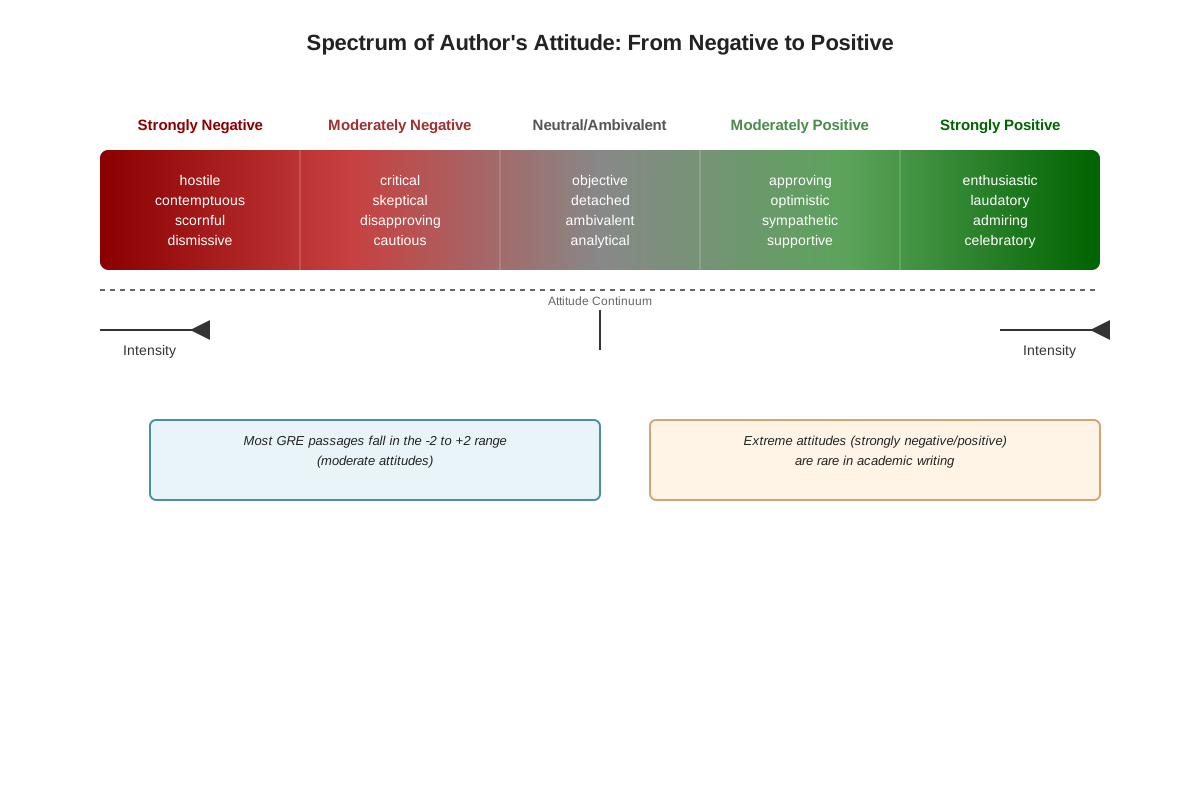
Attitude exists on multiple dimensions simultaneously. The valence dimension ranges from positive (approving, enthusiastic, admiring) through neutral (objective, detached, impartial) to negative (critical, dismissive, contemptuous). The intensity dimension measures strength of feeling, from mild (somewhat skeptical, cautiously optimistic) to strong (vehemently opposed, deeply enthusiastic). The certainty dimension reflects confidence level, from tentative (possibly, might suggest) to definitive (clearly demonstrates, undoubtedly proves). GRE passages often feature moderate attitudes rather than extreme positions, requiring careful discrimination between similar answer choices.
Tone Markers and Evaluative Language
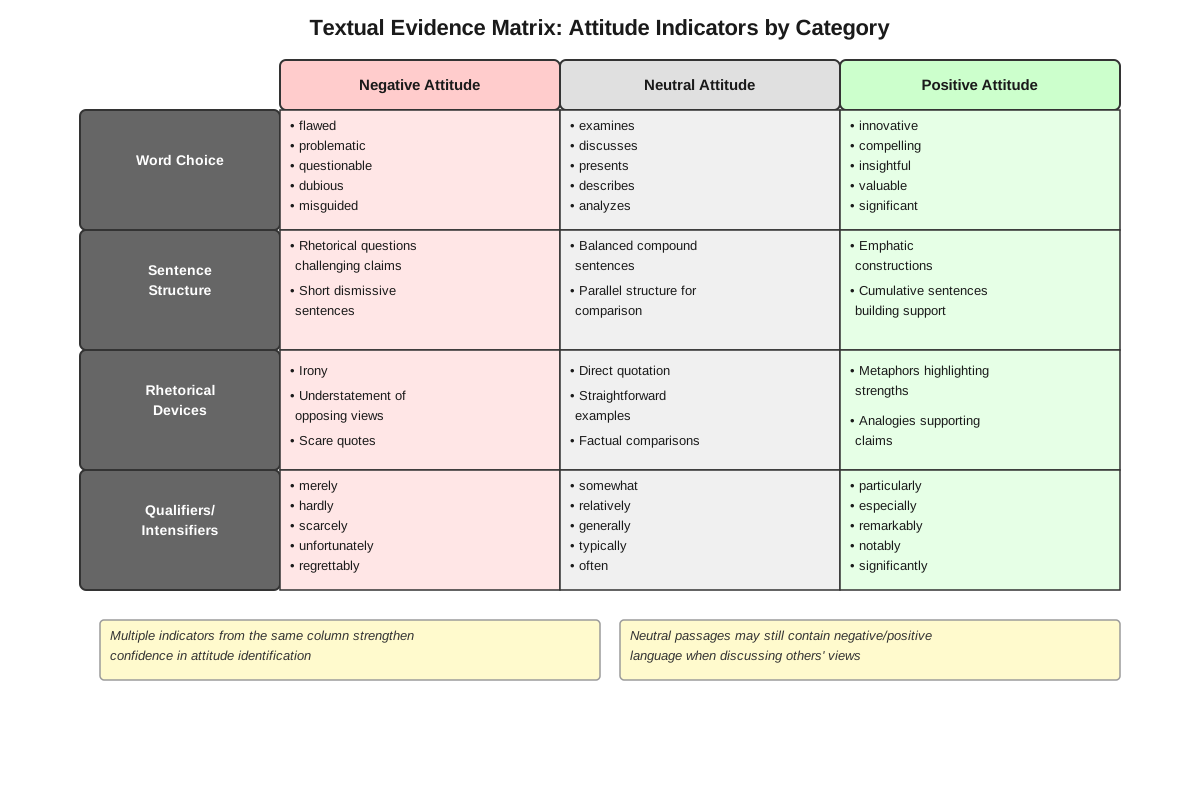
Identifying attitude depends on recognizing tone markers—linguistic signals that reveal the author's perspective. These include:
Adjectives and adverbs with connotative meaning: Words like "merely," "unfortunately," "remarkably," "supposedly," and "admittedly" carry evaluative weight beyond their literal definitions. An author describing a theory as "simplistic" reveals negative attitude, while "elegant" suggests approval.
Verbs of attribution: How authors introduce others' ideas signals their stance. Compare "Smith claims" (neutral or skeptical) versus "Smith demonstrates" (accepting) versus "Smith argues persuasively" (approving). The verb choice indicates whether the author endorses, questions, or rejects the attributed position.
Qualifiers and hedging language: Phrases like "somewhat," "appears to," "may suggest," and "to some extent" indicate tentative or measured attitudes. Conversely, absolute language like "clearly," "undoubtedly," and "definitively" signals strong conviction.
Contrast markers: Words like "however," "unfortunately," "surprisingly," and "despite" often introduce the author's true position, especially when contrasting with conventional views or others' opinions.
Distinguishing Author's Attitude from Others' Attitudes
GRE passages frequently present multiple perspectives—the author's view, conventional wisdom, other scholars' positions, or historical attitudes. A critical skill involves distinguishing whose attitude is being expressed at any given moment. Authors may describe others' positions objectively while holding different views themselves, or they may explicitly critique perspectives they present.
Signal phrases help identify attribution:
- "Critics argue..." (others' view, not necessarily author's)
- "It has been suggested..." (distancing language, often preceding author's disagreement)
- "Indeed," "In fact," "Clearly" (author's own position)
- "While some scholars believe X, [new sentence with author's view]" (contrast structure)
When a question asks about the author's attitude toward a specific element, verify whether the author is describing that element directly or reporting someone else's view of it. The author might neutrally describe a theory they personally find problematic, or enthusiastically explain a position they ultimately reject.
The Attitude Spectrum
GRE answer choices for attitude questions typically draw from a recognizable spectrum of descriptive terms. Understanding these terms and their relative positions helps eliminate incorrect answers:
| Positive Attitudes | Neutral Attitudes | Negative Attitudes |
|---|---|---|
| Enthusiastic | Objective | Skeptical |
| Admiring | Analytical | Critical |
| Approving | Detached | Dismissive |
| Optimistic | Ambivalent | Pessimistic |
| Laudatory | Impartial | Contemptuous |
| Supportive | Descriptive | Disapproving |
Ambivalent deserves special attention as it indicates mixed feelings or recognition of both positive and negative aspects—common in sophisticated academic writing. Authors may acknowledge a theory's explanatory power while questioning its empirical support, or praise a methodology while critiquing its application.
Context Clues for Attitude
Beyond individual words, broader contextual patterns reveal attitude:
Rhetorical questions: Questions the author poses but doesn't answer often signal skepticism toward implied answers. "But does this explanation account for the contradictory evidence?" suggests the author believes it doesn't.
Concession and refutation patterns: Structures like "While X may be true, Y is more significant" reveal the author's priorities and judgments about relative importance.
Emphasis through structure: Ideas placed in prominent positions (opening or closing sentences, main clauses rather than subordinate clauses) typically reflect the author's priorities and receive implicit endorsement.
Evidence selection and presentation: Which evidence authors choose to highlight, how much space they devote to different viewpoints, and whether they present counterarguments all signal attitude indirectly.
Concept Relationships
The concepts within author's attitude analysis form an interconnected system. Tone markers serve as the textual evidence that reveals evaluative language, which in turn indicates position on the attitude spectrum. The ability to distinguish the author's attitude from others' attitudes depends on recognizing signal phrases and attribution verbs that function as specific types of tone markers. All these elements work together within the broader context clues that include rhetorical structure and emphasis patterns.
Author's attitude connects to prerequisite knowledge in several ways: vocabulary knowledge enables recognition of connotative meanings in tone markers; main idea identification provides the framework for understanding what the author has an attitude about; and structural analysis reveals where and how attitude is expressed through rhetorical patterns.
The relationship map flows as follows:
Passage structure → reveals → Emphasis and priority → signals → Author's position → expressed through → Tone markers and evaluative language → classified along → Attitude spectrum dimensions (valence, intensity, certainty) → distinguished from → Others' attitudes → leading to → Accurate answer selection
This topic also connects forward to inference questions, where understanding attitude helps predict what the author would likely agree or disagree with, and to application questions, where attitude toward existing theories suggests how the author might evaluate new evidence or scenarios.
High-Yield Facts
⭐ Author's attitude questions appear in 15-20% of GRE Reading Comprehension questions, making them high-yield content for score improvement
⭐ Tone markers include evaluative adjectives, attribution verbs, qualifiers, and contrast words that reveal the author's perspective beyond literal content
⭐ The most common GRE attitudes are moderate rather than extreme: skeptical rather than contemptuous, approving rather than enthusiastic, analytical rather than passionate
⭐ "However," "unfortunately," and "surprisingly" often introduce the author's true position, especially when contrasting with conventional views
⭐ Authors may objectively describe positions they personally disagree with—always verify whose attitude is being expressed
- Attitude exists on three dimensions: valence (positive/neutral/negative), intensity (mild/strong), and certainty (tentative/definitive)
- Ambivalent means mixed feelings or recognition of both strengths and weaknesses, not lack of opinion
- Verbs of attribution reveal stance: "claims" suggests skepticism, "demonstrates" suggests acceptance, "argues persuasibly" suggests approval
- Rhetorical questions typically signal skepticism toward the implied answer
- Evidence selection and emphasis patterns indirectly reveal attitude through what authors choose to highlight or minimize
- Extreme answer choices (contemptuous, effusive, vehement) are rarely correct for GRE passages, which feature academic, measured tones
- The author's attitude toward the main idea usually aligns with their overall purpose for writing the passage
- Concession-refutation patterns ("While X, Y") emphasize the second element as the author's priority
- Qualifiers like "somewhat," "appears to," and "may suggest" indicate tentative or measured attitudes
- Answer choices that contradict the passage's purpose or main idea cannot correctly describe the author's attitude
Quick check — test yourself on Author's attitude so far.
Try Flashcards →Common Misconceptions
Misconception: The author's attitude is always explicitly stated in the passage.
Correction: Attitude is typically conveyed implicitly through tone markers, word choice, and rhetorical structure rather than direct statements like "I believe" or "I disapprove." GRE passages require inference from subtle linguistic cues.
Misconception: If an author presents a viewpoint, they must agree with it.
Correction: Authors frequently present others' positions objectively or even sympathetically before critiquing them. Always check attribution signals to determine whose perspective is being expressed. The phrase "Critics argue..." introduces others' views, not necessarily the author's.
Misconception: Neutral or objective tone means the author has no attitude.
Correction: Objectivity is itself an attitude choice—a deliberate stance of impartiality. However, even in seemingly objective passages, authors often reveal subtle preferences through emphasis, evidence selection, and structural choices. True neutrality is rare on the GRE.
Misconception: Strong language always indicates strong attitude.
Correction: Authors may use strong language when describing others' positions or conventional views they actually oppose. Context determines whether emphatic language reflects the author's own conviction or represents a view they're presenting for analysis or critique.
Misconception: The author's attitude must be consistent throughout the entire passage.
Correction: Authors can hold different attitudes toward different elements within a passage—approving of a methodology while questioning its conclusions, or supporting a theory's goals while criticizing its implementation. Questions about attitude toward specific details require locating relevant sections rather than assuming uniform attitude.
Misconception: Ambivalent means indifferent or uninterested.
Correction: Ambivalent indicates mixed feelings or recognition of both positive and negative aspects—a sophisticated, engaged response rather than apathy. An author might be ambivalent about a theory's value, acknowledging both its insights and limitations.
Misconception: Academic passages are always objective and neutral.
Correction: Even scholarly writing involves evaluation, argument, and perspective-taking. GRE passages often present authors advocating for interpretations, critiquing prevailing theories, or expressing measured skepticism—all forms of attitude within academic discourse conventions.
Worked Examples
Example 1: Scientific Debate Passage
Passage excerpt: "While the conventional model of planetary formation has dominated astronomical thinking for decades, recent observations from deep-space telescopes have revealed anomalies that proponents of the theory have struggled to explain adequately. The discovery of gas giants orbiting remarkably close to their parent stars, for instance, directly contradicts predictions derived from the standard model. Some astronomers have attempted to reconcile these findings with existing theory through ad hoc modifications, but such adjustments appear increasingly strained. Alternative frameworks, though still preliminary, offer more elegant explanations for these unexpected configurations."
Question: The author's attitude toward the conventional model of planetary formation can best be described as:
(A) Enthusiastically supportive
(B) Cautiously skeptical
(C) Completely dismissive
(D) Objectively neutral
(E) Deeply ambivalent
Analysis:
Step 1: Identify tone markers related to the conventional model:
- "struggled to explain adequately" (negative evaluation)
- "ad hoc modifications" (suggests makeshift, unsatisfactory solutions)
- "appear increasingly strained" (critical assessment)
- Contrast with alternative frameworks described as offering "more elegant explanations" (implicit criticism of conventional model's inelegance)
Step 2: Determine valence and intensity:
- Valence: Negative (critical of the model's explanatory power)
- Intensity: Moderate (uses "struggled" and "appear" rather than "fails completely" or "utterly inadequate")
Step 3: Eliminate answer choices:
- (A) Eliminated: No supportive language; author highlights problems
- (C) Eliminated: Too extreme; author acknowledges the model "dominated" thinking (suggesting it had merit), and uses measured language rather than complete rejection
- (D) Eliminated: Evaluative language like "struggled," "strained," and "elegant" reveals judgment, not pure objectivity
- (E) Eliminated: No evidence of mixed feelings; author consistently questions the model without acknowledging significant strengths
Step 4: Confirm correct answer:
(B) Cautiously skeptical matches both the negative valence (skeptical) and moderate intensity (cautiously). The author questions the model's adequacy while maintaining academic restraint.
Connection to learning objectives: This example demonstrates identifying attitude through tone markers (struggled, strained, elegant), distinguishing intensity levels (cautious vs. complete dismissal), and eliminating answers that mismatch the textual evidence.
Example 2: Literary Criticism Passage
Passage excerpt: "Morrison's narrative technique in Beloved has been hailed by some critics as a groundbreaking achievement in American literature. Indeed, her use of fragmented chronology and multiple perspectives does create a reading experience that mirrors the psychological fragmentation of trauma. However, one might question whether this formal innovation always serves the novel's thematic purposes. In several chapters, the temporal shifts seem to obscure rather than illuminate character motivation, leaving readers disoriented without corresponding interpretive rewards. While Morrison's ambition is admirable, the execution occasionally falters."
Question: Which of the following best characterizes the author's attitude toward Morrison's narrative technique?
(A) Unqualified admiration
(B) Measured appreciation with reservations
(C) Scholarly detachment
(D) Fundamental disagreement
(E) Dismissive rejection
Analysis:
Step 1: Map the attitude progression through the passage:
- Opens with others' view: "hailed by some critics" (attribution to others)
- Partial agreement: "Indeed" signals author's acceptance of one positive aspect
- Pivot: "However, one might question" introduces author's reservations
- Specific criticism: "obscure rather than illuminate," "disoriented without corresponding interpretive rewards"
- Concluding evaluation: "ambition is admirable" (positive) "but execution occasionally falters" (negative)
Step 2: Identify the attitude structure:
This is a classic concession-and-qualification pattern: acknowledging strengths while raising concerns. The author recognizes genuine achievement ("does create," "admirable ambition") but identifies limitations ("occasionally falters," "seem to obscure").
Step 3: Determine the overall attitude:
- Valence: Mixed (both positive and negative elements)
- Intensity: Moderate (uses "occasionally," "might question," "seem to" rather than absolute criticism)
- This is neither pure praise nor rejection, but qualified approval
Step 4: Eliminate and confirm:
- (A) Eliminated: "However" and subsequent criticism rule out unqualified admiration
- (C) Eliminated: Evaluative language ("admirable," "falters") shows engagement beyond detachment
- (D) Eliminated: Author agrees with positive aspects ("Indeed," "admirable")
- (E) Eliminated: Too negative; author acknowledges genuine achievements
(B) Measured appreciation with reservations accurately captures the balanced evaluation with both positive recognition and specific concerns.
Connection to learning objectives: This example shows distinguishing the author's attitude from others' attitudes (critics' views vs. author's qualified position), recognizing concession-refutation patterns, and identifying mixed attitudes that acknowledge both strengths and weaknesses.
Exam Strategy
Question Recognition
Attitude questions appear in several formats. Watch for these trigger phrases:
- "The author's attitude toward X can best be described as..."
- "The tone of the passage is primarily..."
- "The author regards X with..."
- "Which of the following best characterizes the author's view of..."
- "The author mentions X with..."
Even questions not explicitly about attitude may require attitude analysis: "The author would most likely agree with..." or "The author's primary purpose is to..." often depend on understanding the author's perspective.
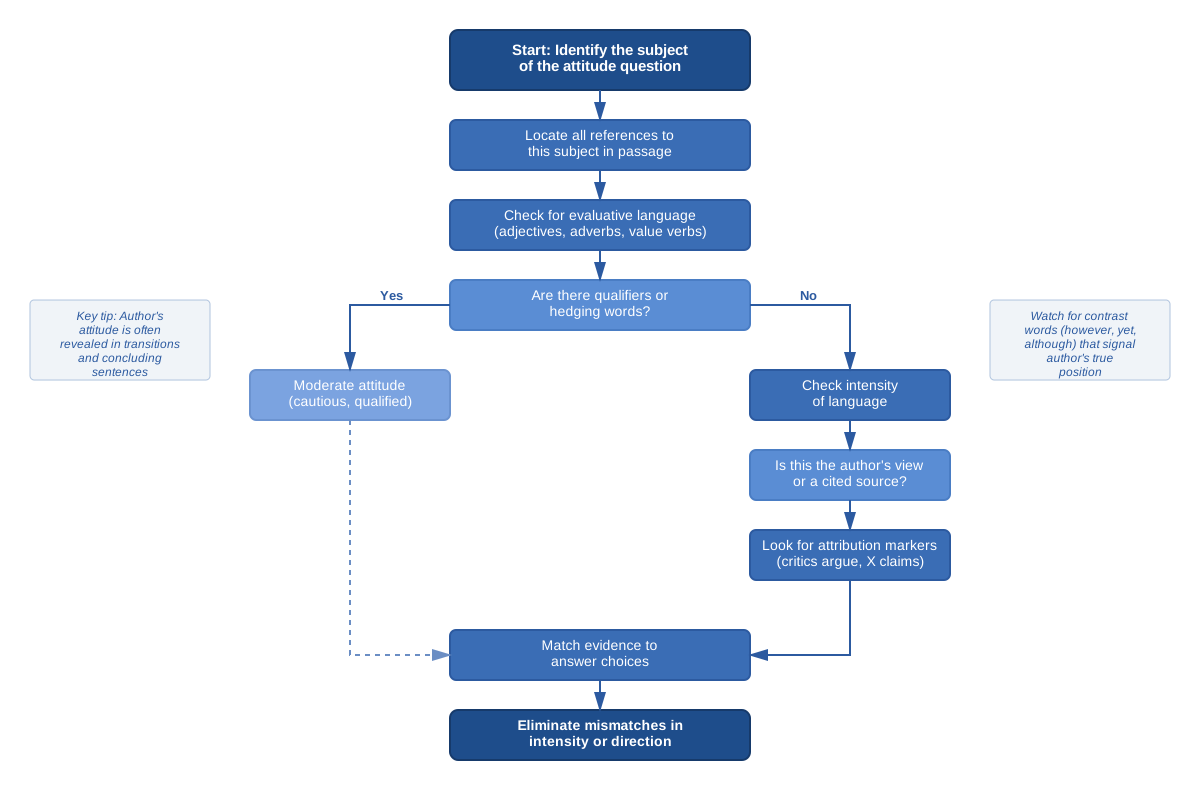
Systematic Approach
Step 1: Locate relevant text - For questions about attitude toward specific details, find where the author discusses that element. Don't rely on memory; verify with the passage.
Step 2: Identify tone markers - Underline or note evaluative adjectives, attribution verbs, qualifiers, and contrast words in the relevant section.
Step 3: Check attribution - Verify whether the language expresses the author's view or reports someone else's position. Look for signal phrases like "critics argue," "conventional wisdom holds," or "some scholars believe."
Step 4: Assess dimensions - Determine valence (positive/neutral/negative), intensity (mild/moderate/strong), and certainty (tentative/definite).
Step 5: Predict before looking at choices - Formulate your own description of the attitude before reading answer options to avoid being swayed by plausible-sounding wrong answers.
Step 6: Eliminate systematically - Remove choices that mismatch valence, are too extreme or too mild, or contradict the passage's purpose.
Process of Elimination Tips
Eliminate extreme answer choices first: GRE passages rarely feature contemptuous, effusive, vehement, or dogmatic attitudes. Academic writing tends toward measured positions.
Check consistency with purpose: If the author's purpose is to critique a theory, their attitude cannot be "enthusiastically supportive." Attitude must align with overall intent.
Verify with specific evidence: The correct answer must be supportable with specific tone markers from the passage. If you cannot point to textual evidence, reconsider.
Watch for degree mismatches: "Skeptical" and "dismissive" both indicate negative attitudes, but differ in intensity. Choose the degree that matches the passage's language.
Time Management
Attitude questions typically require 60-90 seconds. They demand careful reading but don't usually require complex logical reasoning. If you're spending more than 90 seconds, you may be overthinking. Trust clear tone markers over subtle interpretations.
For passages with multiple attitude questions, note tone markers during your initial reading. This investment saves time when questions ask about attitude toward different elements.
Common Traps
Trap 1: Confusing description with endorsement - Authors may thoroughly explain positions they ultimately reject. Detailed description ≠ agreement.
Trap 2: Selecting based on passage content rather than attitude - If a passage discusses problems, the answer isn't necessarily "pessimistic." The author might be objectively analytical about problems or even optimistic about solutions.
Trap 3: Choosing answers that sound sophisticated - "Ambivalent" and "paradoxical" sound academic but are only correct when the passage genuinely shows mixed feelings or contradictory elements.
Trap 4: Ignoring qualifiers - "Somewhat skeptical" differs significantly from "deeply skeptical." Qualifiers in answer choices must match the passage's intensity level.
Memory Techniques
The CAVE Mnemonic for Tone Markers
Contrast words (however, unfortunately, surprisingly)
Attribution verbs (claims, demonstrates, argues)
Value adjectives (elegant, simplistic, remarkable)
Emphasis qualifiers (merely, clearly, supposedly)
When analyzing attitude, systematically check for CAVE elements in the relevant passage section.
The Attitude Spectrum Visualization
Picture a thermometer with three zones:
- Top (red zone): Positive attitudes (enthusiastic, approving, optimistic)
- Middle (yellow zone): Neutral/mixed attitudes (objective, ambivalent, analytical)
- Bottom (blue zone): Negative attitudes (skeptical, critical, dismissive)
Within each zone, intensity increases toward the extreme. This visual helps eliminate answers in the wrong zone or wrong intensity level.
The "However" Rule
"However" introduces the author's true position. When passages present conventional views followed by "however," "unfortunately," or "surprisingly," the author's actual attitude typically appears after the contrast marker. This simple rule helps locate attitude quickly in complex passages.
Attribution Signal Phrases
Remember these common patterns:
- Distancing: "supposedly," "allegedly," "it has been claimed" → author likely disagrees
- Neutral reporting: "according to," "scholars note," "research indicates" → author presenting others' views without clear endorsement
- Endorsement: "indeed," "in fact," "clearly," "X demonstrates" → author agrees
The Goldilocks Principle
For GRE attitude questions, the correct answer is usually "just right"—not too extreme, not too mild. When choosing between similar options, select the moderate one unless strong textual evidence supports an extreme position.
Summary
Mastering author's attitude questions requires moving beyond literal comprehension to analyze how authors convey perspective through linguistic choices. Success depends on recognizing tone markers—evaluative adjectives, attribution verbs, qualifiers, and contrast words—that reveal attitude implicitly. The GRE tests this skill through questions about overall tone and attitude toward specific elements, requiring students to distinguish the author's views from others' positions presented in the passage. Attitudes exist along dimensions of valence (positive/neutral/negative), intensity (mild/strong), and certainty (tentative/definite), with GRE passages typically featuring moderate, academic tones rather than extreme positions. Systematic analysis involves locating relevant text, identifying tone markers, checking attribution, assessing attitude dimensions, and eliminating answer choices that mismatch the textual evidence. Common pitfalls include confusing description with endorsement, selecting extreme answers, and ignoring the qualifying language that signals intensity. By applying structured strategies and recognizing high-yield patterns like concession-refutation structures and the significance of contrast markers, students can consistently identify author's attitude and improve performance on this high-frequency question type.
Key Takeaways
- Author's attitude is revealed through tone markers (evaluative language, attribution verbs, qualifiers, contrast words) rather than explicit statements, requiring inference from subtle linguistic cues
- Distinguish the author's attitude from others' attitudes by checking attribution signals and verifying whose perspective is being expressed at any given moment
- GRE attitudes are typically moderate and academic rather than extreme—skeptical rather than contemptuous, approving rather than enthusiastic—making extreme answer choices usually incorrect
- Contrast markers like "however," "unfortunately," and "surprisingly" often introduce the author's true position, especially when following presentation of conventional views
- Attitude must align with the author's overall purpose—if the purpose is to critique, the attitude cannot be supportive; consistency between purpose and attitude eliminates wrong answers
- Ambivalent means mixed feelings with recognition of both strengths and weaknesses, not indifference or lack of opinion—a sophisticated, engaged response common in academic writing
- Systematic analysis using the CAVE framework (Contrast words, Attribution verbs, Value adjectives, Emphasis qualifiers) ensures comprehensive identification of attitude indicators
Related Topics
Main Idea and Primary Purpose: Understanding what the author discusses and why they wrote the passage provides essential context for determining their attitude toward the subject matter. Attitude questions often connect to purpose—an author writing to critique will have negative attitudes toward their target.
Inference Questions: Author's attitude enables prediction of what the author would likely agree or disagree with in hypothetical scenarios. Mastering attitude analysis strengthens inference skills by revealing the author's underlying perspective.
Logical Structure and Argumentation: Recognizing how authors build arguments—through concession-refutation, evidence selection, and emphasis patterns—reveals attitude indirectly. Understanding structure helps locate where attitude is most clearly expressed.
Vocabulary in Context: The connotative meanings of words serve as primary tone markers. Advanced vocabulary knowledge enables recognition of subtle attitude indicators that distinguish between similar answer choices.
Specific Detail Questions: Questions about why the author mentions specific information often require understanding the author's attitude toward that detail—whether they present it as supporting evidence, problematic data, or illustrative example.
Practice CTA
Now that you've mastered the core concepts and strategies for identifying author's attitude, it's time to apply this knowledge to authentic GRE-style questions. The practice questions and flashcards will reinforce your ability to recognize tone markers, distinguish attitude dimensions, and eliminate incorrect answer choices systematically. Remember: consistent practice with immediate feedback transforms understanding into automatic skill. Each practice question you complete strengthens your pattern recognition and builds the confidence needed for test-day success. Approach the practice materials strategically, reviewing not just which answers are correct but why wrong answers fail to match the textual evidence. Your investment in deliberate practice now will pay dividends in improved accuracy and speed on the actual exam.
Sign up free to keep reading
Create a free AnvayaPrep account to finish this GRE guide on Author's attitude — plus flashcards and practice questions.