Overview
Detail questions are one of the most frequently tested question types in the GRE Reading Comprehension section, accounting for approximately 30-40% of all reading questions. These questions assess a test-taker's ability to locate, understand, and accurately interpret specific information explicitly stated in a passage. Unlike inference questions that require reading between the lines, GRE detail questions focus on what the author directly states, making them among the most straightforward—yet still challenging—question types when approached without proper strategy.
The fundamental challenge of detail questions lies not in complex reasoning but in precision and accuracy. Test-takers must navigate dense academic passages, often containing multiple similar-sounding details, and identify the exact information requested without falling prey to trap answers that distort, exaggerate, or subtly misrepresent the passage content. Success requires careful reading, strong passage mapping skills, and the discipline to return to the text rather than relying on memory.
Within the broader Verbal Reasoning framework, detail questions serve as the foundation for more complex question types. Mastering the ability to extract explicit information accurately prepares students for inference questions, function questions, and structure questions—all of which build upon the skill of precise textual comprehension. Detail questions also reinforce critical reading habits such as identifying topic sentences, tracking supporting evidence, and distinguishing between main ideas and supporting details, skills that enhance performance across all GRE Verbal question types.
Learning Objectives
- [ ] Identify when Detail questions is being tested
- [ ] Explain the core rule or strategy behind Detail questions
- [ ] Apply Detail questions to GRE-style questions accurately
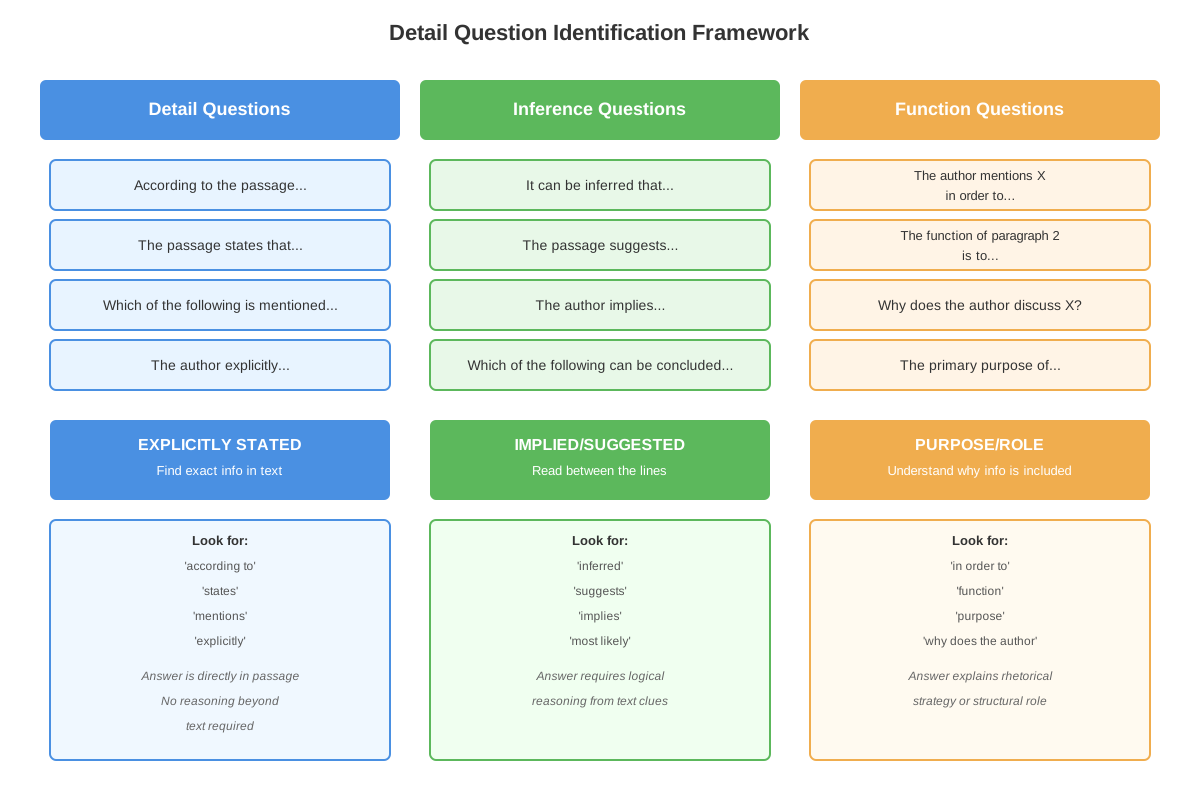
- [ ] Distinguish detail questions from inference and function questions based on question stems
- [ ] Develop a systematic approach to locating relevant information in passages efficiently
- [ ] Recognize and avoid common trap answer patterns in detail questions
- [ ] Evaluate answer choices by comparing them directly against passage text
Prerequisites
- Basic reading comprehension skills: The ability to understand college-level academic prose is essential, as GRE passages cover complex topics across sciences, humanities, and social sciences
- Familiarity with GRE passage structure: Understanding how GRE passages are organized (introduction, development, conclusion) helps locate details more efficiently
- Knowledge of GRE question format: Recognizing the multiple-choice format and understanding how to navigate computer-based testing improves time management
- Vocabulary at intermediate level: While detail questions don't primarily test vocabulary, understanding passage content requires solid word knowledge
Why This Topic Matters
Detail questions represent the most direct assessment of reading accuracy on the GRE. In real-world academic and professional contexts, the ability to extract precise information from complex texts is fundamental to research, legal analysis, medical diagnosis, policy evaluation, and countless other high-level cognitive tasks. Graduate programs value this skill because it underlies effective literature reviews, accurate data interpretation, and rigorous scholarly work.
On the GRE specifically, detail questions appear in approximately 3-4 questions per Verbal section, making them the most common or second-most common question type alongside inference questions. Each Verbal section contains 5-6 reading comprehension questions out of 20 total questions, and detail questions consistently comprise 30-40% of these. Given that Verbal Reasoning accounts for half of the total GRE score, mastering detail questions can directly impact percentile rankings and admission outcomes.
Detail questions appear in passages of all lengths—short passages (1 paragraph, approximately 100 words), medium passages (2-3 paragraphs, approximately 200-300 words), and long passages (4-5 paragraphs, approximately 450-500 words). They can address any aspect of passage content: specific examples, data points, dates, names, definitions, explanations, causes, effects, comparisons, or supporting evidence. The questions often target information that appears in the middle of dense paragraphs, testing whether students skim carelessly or read with precision.
Core Concepts
Definition and Characteristics of Detail Questions
Detail questions, also called "explicit information questions" or "stated fact questions," ask test-takers to identify information that is directly stated in the passage. The correct answer will be a paraphrase or direct quotation of passage content, not an interpretation, extension, or inference. These questions test reading accuracy rather than analytical reasoning.
The defining characteristic of detail questions is that they can be answered by pointing to a specific sentence or set of sentences in the passage. The information requested is explicit—meaning clearly and directly expressed—rather than implicit. While the correct answer may use synonyms or restructure the sentence, it will not add new information or require logical leaps beyond what the author stated.
Recognizing Detail Question Stems
Detail questions can be identified by their question stems, which typically include phrases such as:
- "According to the passage..."
- "The passage states that..."
- "The author mentions which of the following..."
- "The passage indicates that..."
- "Which of the following does the passage cite as..."
- "The passage provides information about..."
- "According to the passage, [specific topic] is characterized by..."
These stems signal that the answer exists explicitly in the text. The word "according" is particularly diagnostic—it almost always indicates a detail question rather than an inference question. Similarly, verbs like "states," "mentions," "indicates," "cites," and "provides" point to explicit information retrieval.
The Core Strategy: Return to the Passage
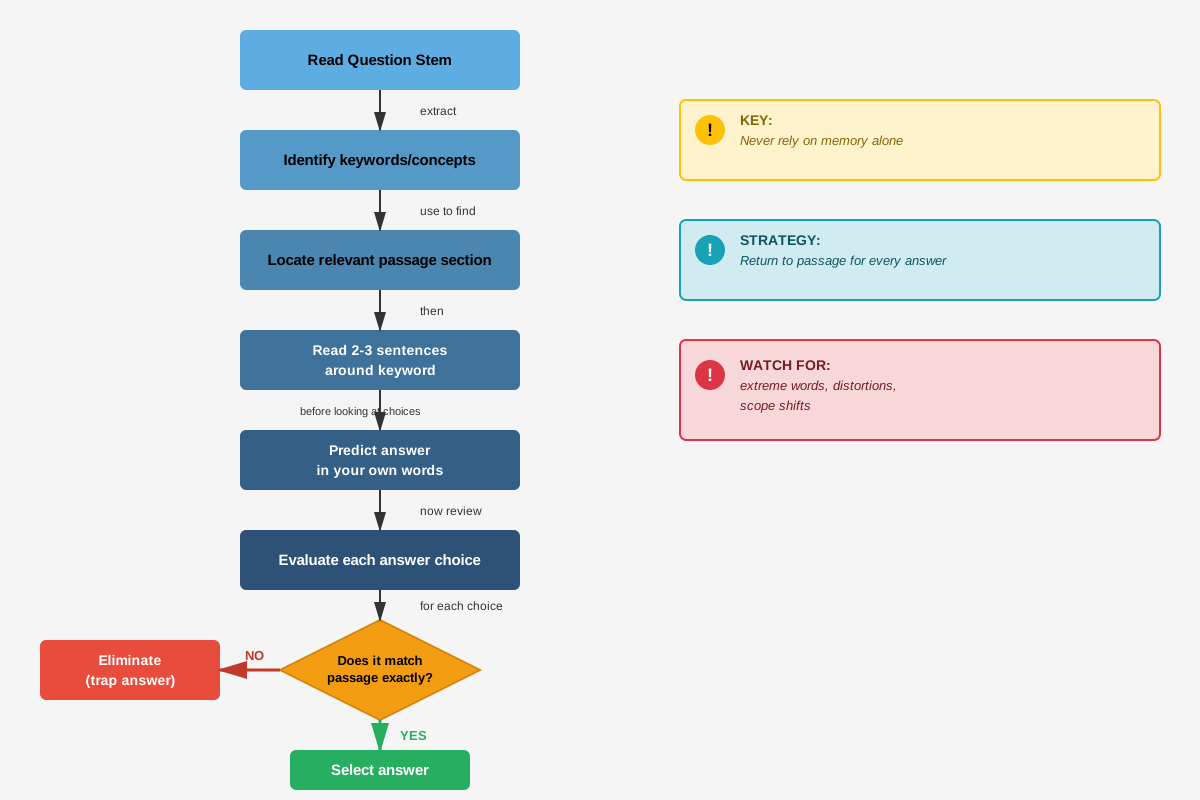
The fundamental rule for detail questions is deceptively simple: always return to the passage before selecting an answer. This strategy counters the natural tendency to rely on memory, which is unreliable for dense academic passages containing multiple similar details.
The systematic approach involves four steps:
- Identify the question type by analyzing the question stem
- Locate keywords in the question that will help find the relevant passage section
- Return to the passage and find the specific sentence(s) containing the answer
- Match the passage content to the answer choices, eliminating options that distort, add to, or contradict the text
This process ensures accuracy and prevents falling for trap answers designed to exploit faulty memory or careless reading.
Passage Mapping for Efficient Detail Location
Effective detail question answering begins during the initial passage reading. Passage mapping—creating a mental or brief written outline of each paragraph's main point—enables rapid location of details when questions arise.
A simple passage map notes:
- Paragraph 1: Main topic introduction
- Paragraph 2: First supporting point or example
- Paragraph 3: Contrasting view or additional evidence
- Paragraph 4: Author's conclusion or synthesis
When a detail question asks about a specific concept, the passage map directs the test-taker to the relevant paragraph, saving precious time. For computer-based testing, where scrolling is required, knowing which paragraph contains the information is especially valuable.
Types of Details Tested
GRE detail questions target various information types:
| Detail Type | Example Question Focus | Passage Location |
|---|---|---|
| Specific examples | "The passage mentions which example of X?" | Supporting evidence within body paragraphs |
| Definitions | "According to the passage, Y is defined as..." | First mention of technical terms |
| Causes and effects | "The passage states that Z resulted from..." | Explanatory sections |
| Comparisons | "The passage indicates that A differs from B in..." | Comparative analysis paragraphs |
| Dates and names | "According to the passage, the study was conducted in..." | Historical or research contexts |
| Characteristics | "The passage describes X as having which feature?" | Descriptive passages |
Understanding these categories helps anticipate where in a passage certain details are likely to appear, improving search efficiency.
Paraphrasing and Synonyms
Correct answers to detail questions rarely quote the passage verbatim. Instead, they paraphrase the original text using synonyms and restructured syntax. This tests whether students understand the meaning rather than just memorizing words.
For example, if a passage states: "The enzyme catalyzes the reaction by lowering the activation energy required," a correct answer might read: "The enzyme facilitates the chemical process by reducing the energy threshold needed."
Recognizing paraphrases requires:
- Understanding synonyms (catalyzes = facilitates; reaction = chemical process; lowering = reducing; activation energy = energy threshold)
- Identifying equivalent sentence structures
- Focusing on meaning rather than exact wording
Trap Answer Patterns
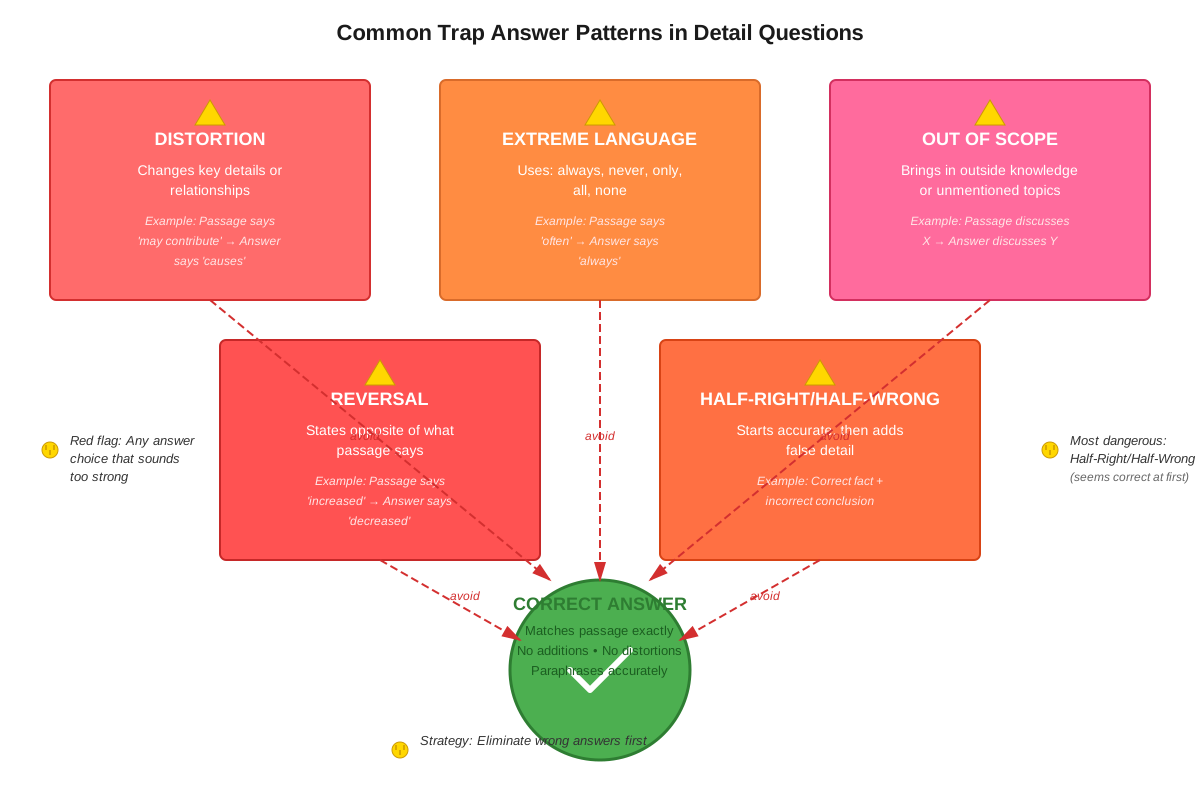
Detail questions employ predictable wrong answer types:
Distortions: These answers take passage information and subtly change it—using "all" instead of "some," "never" instead of "rarely," or reversing cause and effect.
Out-of-scope: These answers introduce information not mentioned in the passage, even if it seems plausible or true in the real world.
Opposite answers: These directly contradict passage statements, often appearing attractive to test-takers who misread or misremember.
Extreme language: Answers using absolute terms (always, never, only, all, none) are often incorrect unless the passage uses equally strong language.
Half-right answers: These combine accurate passage information with added or distorted elements, making them partially correct but ultimately wrong.
Concept Relationships
Detail questions form the foundation of the Reading Comprehension hierarchy. The skill of accurately extracting explicit information directly enables success with inference questions, which require combining stated details to reach unstated conclusions. Without mastering detail location and interpretation, students cannot reliably make valid inferences.
Detail questions also connect to function questions (which ask why an author includes certain information) because identifying what information is present precedes analyzing its purpose. Similarly, structure questions (which ask about passage organization) build on the ability to track details across paragraphs.
The relationship flows: Detail Mastery → Inference Ability → Function Analysis → Structure Understanding
Within detail questions themselves, the concepts interconnect: Question Stem Recognition → Keyword Identification → Passage Mapping → Text Location → Paraphrase Matching → Trap Avoidance → Answer Selection. Each step depends on the previous one, creating a systematic approach that reduces errors and improves efficiency.
High-Yield Facts
⭐ Detail questions account for 30-40% of all GRE Reading Comprehension questions, making them the most or second-most common question type
⭐ The correct answer to a detail question is always explicitly stated in the passage, though usually paraphrased
⭐ Question stems containing "according to the passage" or "the passage states" almost always indicate detail questions
⭐ Always return to the passage before selecting an answer—memory is unreliable for dense academic texts
⭐ Trap answers often use extreme language (always, never, only) unless the passage uses equally strong terms
- Detail questions can appear for passages of any length: short (1 paragraph), medium (2-3 paragraphs), or long (4-5 paragraphs)
- Correct answers use synonyms and paraphrasing rather than direct quotations from the passage
- Wrong answers frequently distort passage information by changing quantifiers (some → all) or reversing relationships
- Passage mapping during initial reading significantly improves detail location speed
- Detail questions test reading accuracy, not analytical reasoning or inference skills
- Keywords in the question stem guide efficient location of relevant passage sections
- Half-right answers that combine accurate and inaccurate information are common traps
- Detail questions may ask about examples, definitions, causes, effects, comparisons, dates, names, or characteristics
- The ability to recognize paraphrases is essential for matching passage content to answer choices
- Detail questions appear in both single-question passages and multiple-question passage sets
Quick check — test yourself on Detail questions so far.
Try Flashcards →Common Misconceptions
Misconception: Detail questions are easy because they only require finding information in the passage → Correction: While detail questions test explicit information, they are challenging because trap answers subtly distort passage content, and dense academic passages contain multiple similar details that can be confused. Success requires precision and systematic strategy, not just basic reading ability.
Misconception: If an answer choice sounds familiar from the passage, it must be correct → Correction: Trap answers often use words and phrases from the passage but combine them incorrectly or place them in wrong contexts. Familiarity is not sufficient—the answer must accurately match the specific information requested by the question.
Misconception: You can answer detail questions from memory without returning to the passage → Correction: Relying on memory leads to errors because GRE passages are dense and contain multiple similar details. The correct strategy always involves locating the specific passage section and comparing it directly to answer choices.
Misconception: The correct answer will use the same words as the passage → Correction: Correct answers typically paraphrase passage content using synonyms and restructured sentences. Test-takers must focus on meaning rather than exact wording to identify correct answers.
Misconception: If something is true in the real world, it's a good answer even if not stated in the passage → Correction: Detail questions test only what the passage explicitly states. Outside knowledge, even if accurate, is irrelevant. The correct answer must be supported by passage text, regardless of real-world truth.
Misconception: Longer, more detailed answer choices are more likely to be correct → Correction: Answer length has no correlation with correctness. Both correct and incorrect answers can be brief or detailed. Evaluate answers based on accuracy relative to passage content, not length or complexity.
Worked Examples
Example 1: Science Passage Detail Question
Passage Excerpt:
"Photosynthesis in C4 plants differs from that in C3 plants through a specialized carbon fixation pathway. C4 plants initially fix carbon dioxide into a four-carbon compound in mesophyll cells before transferring it to bundle sheath cells, where the Calvin cycle occurs. This spatial separation of carbon fixation steps allows C4 plants to minimize photorespiration, a wasteful process that reduces photosynthetic efficiency in C3 plants, particularly under high temperature and light intensity conditions."
Question: According to the passage, C4 plants minimize photorespiration by:
(A) Eliminating the Calvin cycle from their photosynthetic process
(B) Conducting photosynthesis only under low temperature conditions
(C) Separating carbon fixation steps between different cell types
(D) Converting three-carbon compounds into four-carbon compounds
(E) Reducing light intensity exposure in bundle sheath cells
Solution Process:
Step 1: Identify question type. The stem "According to the passage" signals a detail question requiring explicit information.
Step 2: Identify keywords. "C4 plants," "minimize photorespiration," and "by" (indicating mechanism) are key terms.
Step 3: Return to passage. The relevant sentence states: "This spatial separation of carbon fixation steps allows C4 plants to minimize photorespiration..."
Step 4: Match to answer choices.
- (A) is incorrect—the passage states the Calvin cycle occurs in bundle sheath cells, not that it's eliminated
- (B) is incorrect—the passage mentions C4 plants minimize photorespiration "under high temperature," not that they only photosynthesize under low temperature
- (C) is correct—this accurately paraphrases "spatial separation of carbon fixation steps" as "separating carbon fixation steps between different cell types" (mesophyll and bundle sheath cells)
- (D) is incorrect—this reverses the process; the passage describes fixing CO2 into four-carbon compounds, not converting three-carbon to four-carbon
- (E) is incorrect—nothing in the passage mentions reducing light intensity
Answer: (C)
Connection to Learning Objectives: This example demonstrates identifying a detail question (Objective 1), applying the return-to-passage strategy (Objective 2), and accurately matching paraphrased content (Objective 3).
Example 2: Humanities Passage Detail Question
Passage Excerpt:
"The Harlem Renaissance of the 1920s represented not merely an artistic movement but a fundamental reimagining of African American cultural identity. Writers like Langston Hughes and Zora Neale Hurston rejected the accommodationist stance of earlier generations, instead celebrating vernacular language, folk traditions, and the authentic experiences of Black life. This cultural assertiveness coincided with the Great Migration, as hundreds of thousands of African Americans relocated from the rural South to northern urban centers, creating concentrated communities that fostered artistic collaboration and intellectual exchange."
Question: The passage indicates that the Harlem Renaissance writers differed from earlier generations by:
(A) Relocating from southern to northern regions of the United States
(B) Focusing exclusively on folk traditions rather than contemporary experiences
(C) Embracing rather than downplaying distinctive aspects of Black culture
(D) Establishing the first concentrated African American urban communities
(E) Collaborating with artists from diverse ethnic backgrounds
Solution Process:
Step 1: Question stem "The passage indicates" confirms this is a detail question.
Step 2: Keywords: "Harlem Renaissance writers," "differed from earlier generations," "by" (mechanism of difference).
Step 3: Return to passage. The relevant sentence: "Writers like Langston Hughes and Zora Neale Hurston rejected the accommodationist stance of earlier generations, instead celebrating vernacular language, folk traditions, and the authentic experiences of Black life."
Step 4: Evaluate answers.
- (A) is incorrect—the passage states the Great Migration occurred, but doesn't say writers themselves migrated or that this distinguished them from earlier generations
- (B) is incorrect—uses extreme language "exclusively" and contradicts "authentic experiences of Black life," which includes contemporary life
- (C) is correct—accurately paraphrases "rejected the accommodationist stance" (which means downplaying cultural distinctiveness) and "celebrating vernacular language, folk traditions" (embracing distinctive aspects)
- (D) is incorrect—the passage says the Great Migration "created concentrated communities," not that Harlem Renaissance writers established them
- (E) is incorrect—the passage mentions "artistic collaboration" but specifies it occurred within African American communities, not across ethnic backgrounds
Answer: (C)
Connection to Learning Objectives: This demonstrates recognizing paraphrasing (accommodationist stance = downplaying; celebrating = embracing), avoiding trap answers with extreme language (B), and distinguishing between what the passage states versus what it implies.
Exam Strategy
Systematic Approach to Detail Questions
When encountering a detail question on the GRE, follow this time-efficient process:
- Read the question stem carefully (5-10 seconds): Identify it as a detail question and note exactly what information is requested
- Identify 2-3 keywords (5 seconds): Choose specific terms that will help locate the relevant passage section
- Scan the passage for keywords (10-20 seconds): Use your passage map to narrow the search, then scan for the specific terms
- Read the relevant sentence(s) carefully (15-20 seconds): Read the sentence containing the answer plus surrounding context
- Predict the answer (5-10 seconds): Before looking at choices, formulate what the answer should say based on passage content
- Evaluate each answer choice (20-30 seconds): Compare each option to the passage text, eliminating clear mismatches
- Select the best match (5 seconds): Choose the answer that most accurately reflects passage content
Total time allocation: 60-90 seconds per detail question
Trigger Words and Phrases
Recognize these question stem indicators of detail questions:
- "According to the passage"
- "The passage states/indicates/mentions/suggests"
- "The author describes X as"
- "Which of the following does the passage cite"
- "The passage provides information about"
- "As stated in the passage"
Contrast these with inference question stems:
- "The passage implies/suggests"
- "It can be inferred"
- "The author would most likely agree"
- "Which of the following can be concluded"
Process of Elimination Tips
Eliminate first: Answers with extreme language (always, never, only, all, none) unless the passage uses equally strong terms
Eliminate second: Answers introducing information not mentioned in the passage, even if plausible
Eliminate third: Answers that reverse or distort passage relationships (cause/effect, comparison, sequence)
Choose from remaining: The answer that most closely paraphrases passage content using synonyms
Time Management
For passages with multiple questions, answer detail questions first. They require less cognitive processing than inference or function questions and build confidence. If a detail question requires extensive searching, mark it and return after completing other questions—sometimes later questions provide clues about passage organization.
On computer-based testing, use the "Mark" feature for questions requiring passage review, but don't mark more than 2-3 questions per section or you'll run out of time for review.
Memory Techniques
DETAIL Acronym for the systematic approach:
- Determine question type (detail vs. inference)
- Extract keywords from question
- Track keywords in passage
- Analyze relevant sentence(s)
- Identify paraphrases in answers
- Locate best match
"Return Before You Choose" mantra: Repeat this phrase mentally when tempted to answer from memory. The extra second of reminder prevents careless errors.
The Paraphrase Principle: Visualize correct answers as "same meaning, different words." This mental model helps recognize synonyms and restructured sentences.
Extreme Language Red Flag: Picture a red flag appearing whenever you see "always," "never," "only," "all," or "none" in an answer choice. This visual cue triggers careful verification against passage text.
Keyword Highlighting: When reading passages, mentally highlight (or physically mark on scratch paper) proper nouns, dates, technical terms, and transition words. These serve as landmarks for rapid detail location.
Summary
Detail questions represent the most direct test of reading accuracy on the GRE, requiring test-takers to locate and correctly interpret explicit information from academic passages. Success depends not on complex reasoning but on systematic strategy: identifying detail questions through their characteristic stems ("according to the passage," "the passage states"), returning to the text rather than relying on memory, locating relevant information efficiently through keyword scanning and passage mapping, and matching passage content to paraphrased answer choices. The primary challenges involve avoiding trap answers that subtly distort information, recognizing synonyms and restructured sentences, and maintaining precision when passages contain multiple similar details. By following the systematic approach—identify question type, extract keywords, locate passage section, analyze text, evaluate answers, select best match—test-takers can consistently answer detail questions accurately within 60-90 seconds each, building a strong foundation for the 30-40% of Reading Comprehension questions that test explicit information retrieval.
Key Takeaways
- Detail questions test explicit information directly stated in passages, accounting for 30-40% of GRE Reading Comprehension questions
- Always return to the passage before selecting an answer—memory is unreliable for dense academic texts
- Question stems with "according to the passage" or "the passage states" reliably indicate detail questions
- Correct answers paraphrase passage content using synonyms and restructured sentences rather than direct quotations
- Trap answers commonly distort information through extreme language, reversed relationships, or added details not in the passage
- Passage mapping during initial reading enables rapid location of details when questions arise
- The systematic approach (identify type → extract keywords → locate text → analyze → evaluate → select) ensures accuracy and efficiency
Related Topics
Inference Questions: Building on detail question mastery, inference questions require combining explicitly stated information to reach logical conclusions not directly stated. Understanding how to extract accurate details is prerequisite to making valid inferences.
Function Questions: These questions ask why authors include specific details or examples. Mastering detail location and interpretation enables analysis of authorial purpose and rhetorical strategy.
Vocabulary in Context: Detail questions sometimes require understanding how specific words are used in passage context. Strong vocabulary skills enhance detail question performance.
Passage Structure and Organization: Understanding how GRE passages are organized (introduction, development, conclusion, transitions) improves efficiency in locating details and creates mental passage maps.
Main Idea Questions: While main idea questions focus on overall passage purpose, they require synthesizing details. Detail mastery provides the foundation for identifying central themes.
Practice CTA
Now that you understand the systematic approach to detail questions, it's time to apply these strategies to authentic GRE-style passages. Complete the practice questions associated with this topic, focusing on implementing the return-to-passage strategy and recognizing paraphrases. Use the flashcards to reinforce question stem recognition and trap answer patterns. Remember: detail questions are highly learnable through deliberate practice. Each question you work through strengthens your ability to read with precision and select answers with confidence. Your investment in mastering this high-frequency question type will directly impact your Verbal Reasoning score and bring you closer to your target GRE performance.
Sign up free to keep reading
Create a free AnvayaPrep account to finish this GRE guide on Detail questions — plus flashcards and practice questions.