Overview
Passage structure refers to the organizational framework and logical architecture that authors use to present ideas, arguments, and information in written texts. On the GRE Verbal Reasoning section, understanding GRE passage structure is not merely about identifying what a passage says, but recognizing how it says it—the blueprint that governs the arrangement of paragraphs, the progression of arguments, the placement of evidence, and the relationship between different textual elements. This skill is fundamental because approximately 50% of Reading Comprehension questions either directly or indirectly test your ability to understand how passages are constructed, including questions about the author's purpose, the function of specific paragraphs, and the overall organizational pattern.
Mastering passage structure transforms reading from a passive activity into an active analytical process. Rather than getting lost in details or struggling to remember specific facts, students who understand structural patterns can predict where arguments are heading, identify the most important information quickly, and navigate complex academic prose with confidence. This skill is particularly crucial for the GRE because passages are deliberately designed to be dense, unfamiliar, and time-consuming—understanding structure allows test-takers to work efficiently under pressure.
Within the broader context of Verbal Reasoning, passage structure serves as the foundation for virtually all other Reading Comprehension skills. It connects directly to identifying main ideas (which typically appear at structurally significant locations), understanding author's tone and purpose (which are revealed through structural choices), and answering inference questions (which often require understanding how ideas relate across different parts of a passage). Without a solid grasp of passage structure, students must rely on memory and luck; with it, they gain a systematic approach to tackling even the most challenging passages.
Learning Objectives
- [ ] Identify when Passage structure is being tested
- [ ] Explain the core rule or strategy behind Passage structure
- [ ] Apply Passage structure to GRE-style questions accurately
- [ ] Recognize and categorize the five most common GRE passage structures within 30 seconds of reading
- [ ] Determine the function of individual paragraphs within the overall passage architecture
- [ ] Predict likely question types based on structural patterns observed in a passage
Prerequisites
- Basic reading comprehension skills: The ability to understand literal meaning in academic prose is necessary before analyzing organizational patterns
- Familiarity with paragraph structure: Understanding topic sentences, supporting details, and transitions helps recognize how paragraphs function within larger passages
- Vocabulary at intermediate level: Sufficient vocabulary prevents structural analysis from being derailed by unknown words
- Awareness of argument components: Recognizing claims, evidence, and conclusions enables identification of how these elements are arranged
Why This Topic Matters
Understanding passage structure has profound practical applications beyond standardized testing. In academic settings, recognizing organizational patterns helps students efficiently extract information from textbooks, research articles, and scholarly papers. In professional contexts, this skill enables quick comprehension of reports, proposals, and technical documentation. The ability to identify how information is organized is fundamental to critical thinking and effective communication across all disciplines.
On the GRE specifically, passage structure appears with remarkable frequency and in multiple question formats. Approximately 10-15% of Reading Comprehension questions explicitly ask about structure through prompts like "Which of the following best describes the organization of the passage?" or "The author mentions X primarily in order to..." However, the true importance extends far beyond these direct questions. Understanding structure helps answer main idea questions (20-25% of questions), function questions (15-20%), and even detail questions (30-35%), since knowing where information typically appears allows for efficient scanning. In a section where time pressure is intense—roughly 1.5 minutes per question including reading time—structural awareness can save 30-60 seconds per passage.
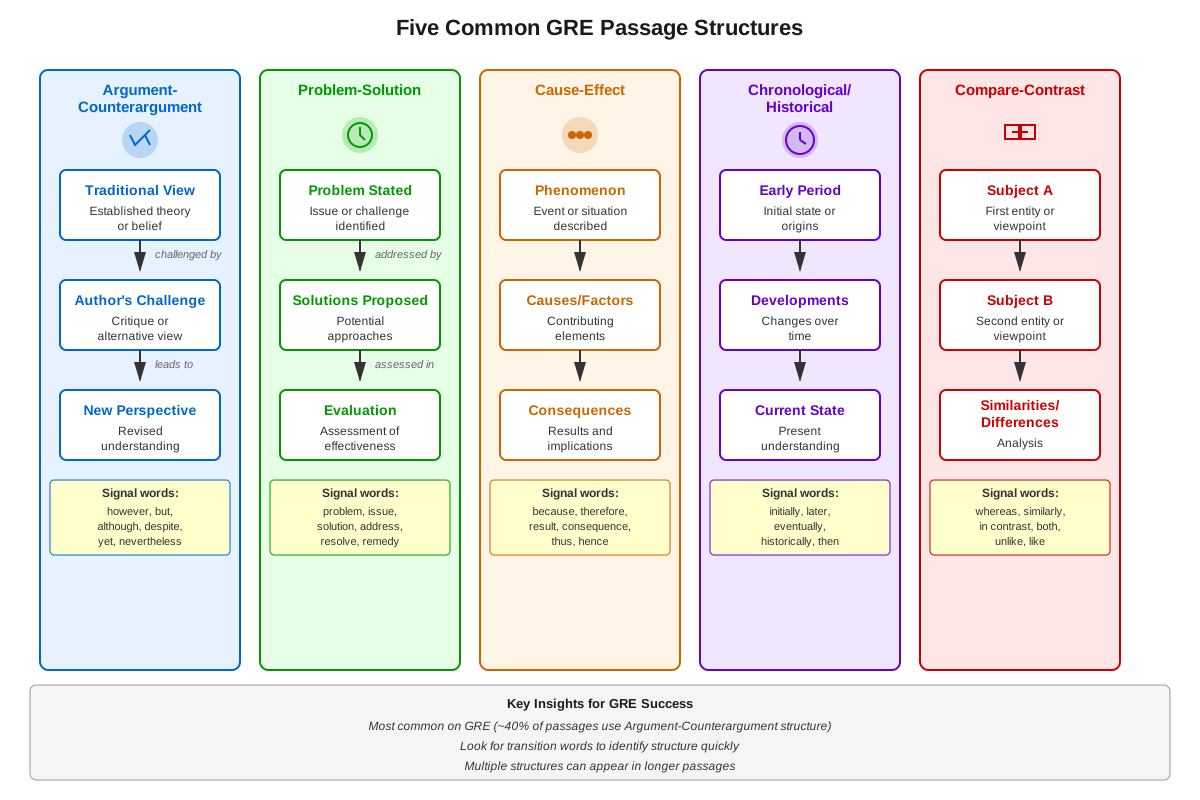
Common structural patterns on the GRE include: presenting a phenomenon and explaining it, introducing a theory and critiquing it, comparing and contrasting two viewpoints, describing a problem and proposing solutions, and tracing historical development of an idea. These patterns appear across all three passage lengths (short, medium, and long) and across all content areas (humanities, social sciences, and natural sciences). Recognizing these patterns early in a passage provides a mental framework that makes subsequent information easier to process and remember.
Core Concepts
The Five Primary GRE Passage Structures
The GRE consistently employs five fundamental organizational patterns. Recognizing these patterns within the first paragraph dramatically improves comprehension efficiency.
1. Theory/Explanation Structure: The passage introduces a phenomenon, concept, or observation, then explains its causes, mechanisms, or implications. This structure typically begins with a surprising fact or interesting observation, followed by paragraphs that elaborate on why or how this occurs. The main idea usually appears early, with subsequent paragraphs providing supporting details.
2. Argument/Critique Structure: The passage presents a theory, hypothesis, or conventional wisdom, then challenges, qualifies, or refutes it. This is one of the most common GRE structures. The first paragraph typically introduces the prevailing view (often with phrases like "traditionally," "it has long been believed," or "conventional wisdom holds"), while subsequent paragraphs present evidence or reasoning that undermines this view. The author's main point is usually the critique, not the original theory.
3. Compare/Contrast Structure: The passage examines two or more theories, approaches, phenomena, or viewpoints, highlighting similarities and differences. This structure may alternate between subjects (discussing all aspects of A, then all aspects of B) or may organize by criteria (comparing A and B on point 1, then on point 2, etc.). Signal words include "whereas," "in contrast," "similarly," "unlike," and "on the other hand."
4. Problem/Solution Structure: The passage identifies a problem, puzzle, or question, then presents one or more proposed solutions or answers. This structure often appears in science passages where researchers are trying to explain puzzling observations. The passage may present multiple competing solutions or may advocate for one particular approach.
5. Historical Development Structure: The passage traces how an idea, theory, artistic movement, or scientific understanding evolved over time. This chronological structure typically moves from earlier to later developments, often showing how each stage built upon or reacted against previous stages. Temporal markers like dates, "initially," "subsequently," and "eventually" are common.
Paragraph Functions Within Passages
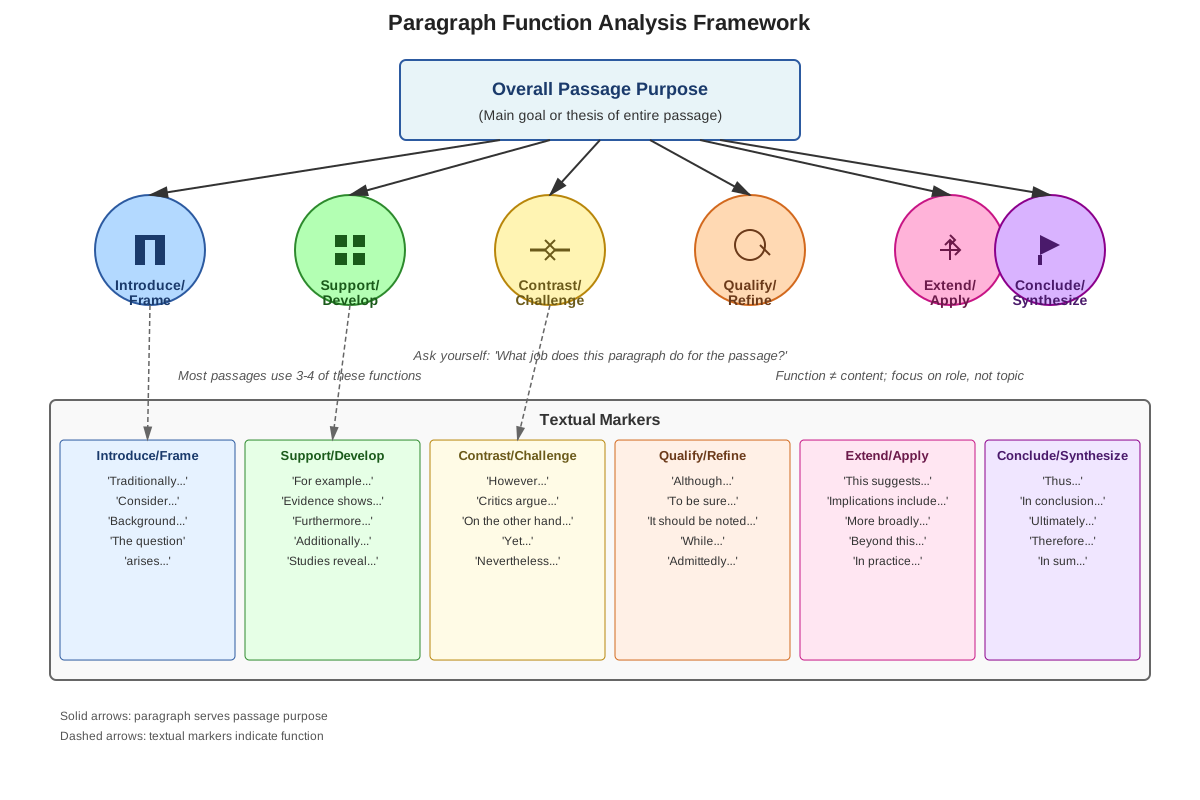
Each paragraph in a GRE passage serves a specific structural function. Identifying these functions helps predict content and locate information quickly.
| Paragraph Function | Typical Content | Common Location |
|---|---|---|
| Introduction/Context | Background information, historical context, or general statements that set up the main discussion | First paragraph |
| Thesis/Main Claim | The author's primary argument or the passage's central idea | Often first paragraph, sometimes second |
| Evidence/Support | Data, examples, studies, or reasoning that supports the main claim | Middle paragraphs |
| Counterargument | Alternative viewpoints or objections to the main claim | Middle paragraphs |
| Rebuttal | Responses to counterarguments, showing why they fail | Following counterargument |
| Qualification/Nuance | Limitations, exceptions, or refinements to the main claim | Later paragraphs |
| Conclusion/Implications | Summary, broader significance, or future directions | Final paragraph (though GRE passages often lack formal conclusions) |
Structural Signals and Transition Words
Authors use specific linguistic markers to signal structural relationships. These transition words and phrases are high-yield indicators of passage structure:
Continuation signals (same direction): furthermore, moreover, additionally, in addition, similarly, likewise
- Indicate the author is building on or reinforcing the previous point
Contrast signals (opposite direction): however, nevertheless, yet, although, despite, in contrast, on the other hand, whereas
- Indicate a shift in direction, often marking the most important structural pivot in a passage
Cause-effect signals: because, since, therefore, thus, consequently, as a result, leads to
- Indicate explanatory relationships between ideas
Evidence signals: for example, for instance, specifically, in particular, such as
- Indicate supporting details or illustrations
Emphasis signals: indeed, in fact, notably, especially, most importantly
- Highlight particularly significant information
The Structural Pivot Point
Most GRE passages contain a pivot point—a moment where the passage shifts direction, introduces a complication, or presents the author's true position. This pivot is typically marked by a contrast transition word (however, but, yet, nevertheless) and often appears at the beginning of the second or third paragraph. The information after the pivot is usually more important than what came before, as it represents the author's actual contribution rather than mere background. Questions about the author's primary purpose or main idea typically focus on content after the pivot point.
Mapping Passage Structure in Real Time
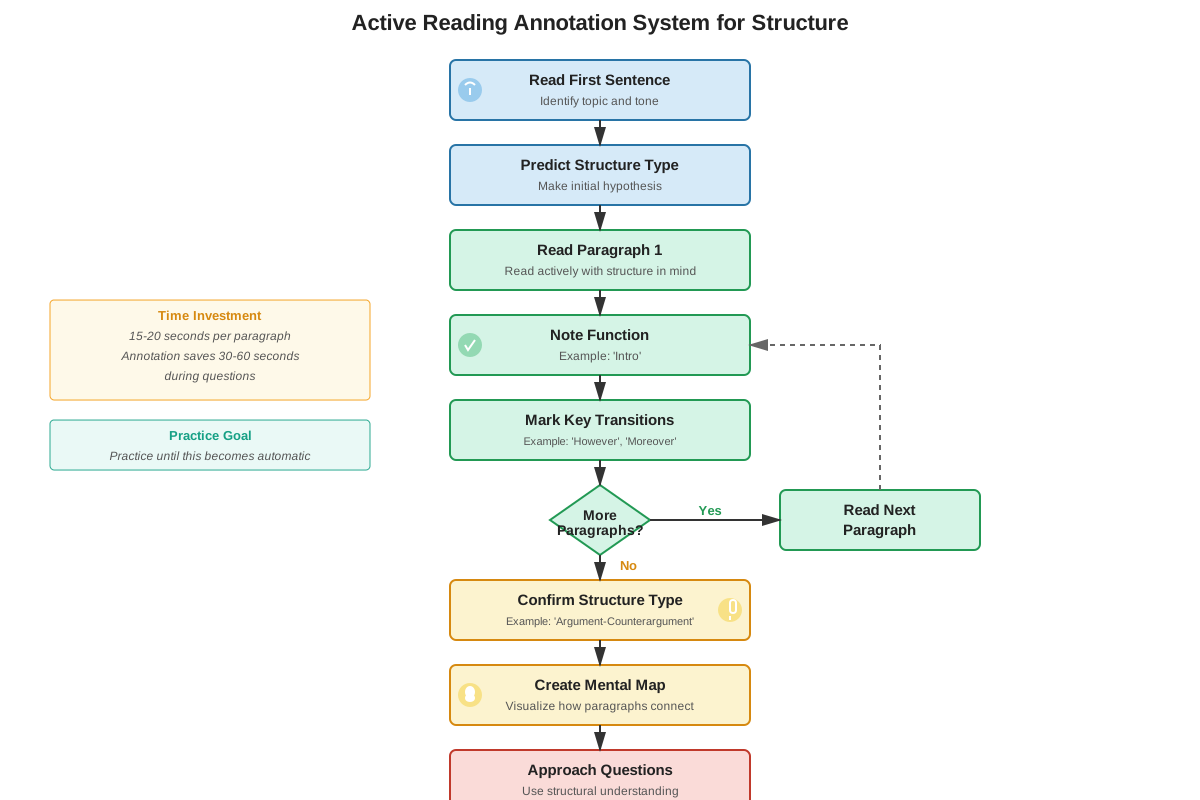
Effective GRE test-takers create mental or physical passage maps—brief notes that capture the function of each paragraph. A passage map is not a summary of content but rather a structural outline. For example:
¶1: Traditional view - X causes Y
¶2: BUT new evidence suggests Z causes Y
¶3: Implications of new view
This map takes 10-15 seconds to create but saves significant time when answering questions, as it allows immediate location of relevant information without re-reading.
Author's Purpose and Structural Choices
An author's purpose is revealed through structural decisions. A passage that spends three paragraphs critiquing a theory and only one paragraph introducing it clearly has the purpose of critique, not explanation. A passage that presents two viewpoints with equal detail and neutral language likely aims to compare, not advocate. Understanding this relationship between structure and purpose is essential for answering "primary purpose" questions, which appear in nearly every GRE Reading Comprehension set.
Concept Relationships
The concepts within passage structure form an interconnected system. Recognizing passage structure types (the five primary patterns) enables identifying paragraph functions, since each structure type employs paragraphs in predictable ways. For example, an Argument/Critique structure typically uses the first paragraph for introduction of the conventional view, the second for presenting the critique, and the third for evidence supporting the critique.
Structural signals and transition words serve as the linguistic markers that make both passage structure and paragraph functions visible to readers. These signals are the surface features that reveal the underlying architecture. When a reader sees "however" at the beginning of a paragraph, this signals both a contrast function for that paragraph and often marks the pivot point of the entire passage.
The pivot point concept connects directly to author's purpose, as the content after the pivot typically reveals what the author actually wants to communicate, as opposed to background or setup. This relationship explains why GRE questions about main idea or primary purpose are best answered by focusing on post-pivot content.
Passage mapping integrates all other concepts—it requires recognizing the overall structure type, identifying individual paragraph functions, noting transition signals, and marking the pivot point. The map becomes a tool that makes all other structural knowledge actionable during question-answering.
These structural concepts also connect to prerequisite knowledge: understanding paragraph structure at the micro level (topic sentences, supporting details) scales up to understanding passage structure at the macro level. Similarly, recognizing argument components (claims, evidence, counterarguments) enables identification of paragraph functions within argumentative passages.
The progression flows: Transition signals → Paragraph functions → Overall structure type → Pivot point identification → Author's purpose → Effective passage mapping → Efficient question answering.
High-Yield Facts
⭐ Approximately 50% of GRE Reading Comprehension questions test structural understanding either directly or indirectly
⭐ The most common GRE passage structure is Argument/Critique, where a conventional view is introduced then challenged
⭐ Contrast transition words (however, but, yet, nevertheless) typically mark the most important structural pivot in a passage
⭐ The author's main point usually appears after the pivot point, not in the first paragraph
⭐ Paragraph functions are more important than paragraph content for answering structural questions
- Passages with multiple viewpoints typically present the author's preferred view last or with more supporting detail
- "Primary purpose" questions are best answered by identifying what happens after the passage's pivot point
- The first paragraph of GRE passages often contains background or conventional wisdom rather than the author's main claim
- Temporal markers (dates, "initially," "later") signal Historical Development structure
- Questions asking "in order to" or "serves primarily to" are testing paragraph function within overall structure
- Compare/Contrast structures on the GRE rarely give equal weight to both sides—one is usually favored
- Problem/Solution passages often present multiple solutions, with the author favoring the most recently discussed
- Structural questions can often be answered without understanding every detail in the passage
- The conclusion paragraph in GRE passages (when present) often introduces qualifications or broader implications rather than simply summarizing
- Recognizing structure in the first 30 seconds of reading can save 60+ seconds during question-answering
Quick check — test yourself on Passage structure so far.
Try Flashcards →Common Misconceptions
Misconception: The main idea always appears in the first paragraph.
Correction: On the GRE, the first paragraph often provides background, context, or a conventional view that will be challenged. The author's actual main point frequently appears in the second or third paragraph, after a structural pivot marked by "however" or similar contrast words.
Misconception: All information in a passage is equally important.
Correction: Passage structure creates a hierarchy of importance. Information after pivot points, in paragraphs that present the author's own view (rather than others' views), and in positions of emphasis (beginnings and ends of paragraphs) is more likely to be tested than background details or examples.
Misconception: Structural questions require understanding every word in the passage.
Correction: Structural questions test the organizational framework and paragraph functions, which can often be determined from topic sentences, transition words, and the general flow of ideas, even if some technical details or vocabulary remain unclear.
Misconception: A passage map should summarize the content of each paragraph.
Correction: An effective passage map notes the function of each paragraph (e.g., "introduces theory," "presents critique," "provides evidence"), not detailed content. Function-based maps are faster to create and more useful for answering questions.
Misconception: Compare/Contrast passages present both sides neutrally.
Correction: Even in Compare/Contrast structures, GRE passages typically favor one viewpoint through subtle cues like spending more time on it, presenting it second (recency effect), providing more evidence for it, or using more positive language when discussing it.
Misconception: Historical Development passages are purely chronological with no argument.
Correction: Even when tracing historical development, GRE passages typically make an argument about that development—perhaps that it represents progress, that it involved a crucial turning point, or that it reveals an important pattern. The chronological structure serves the argumentative purpose.
Misconception: The author's purpose is always explicitly stated.
Correction: Authors rarely state their purpose directly. Instead, purpose must be inferred from structural choices: how much space is devoted to different ideas, where emphasis is placed, what comes after pivot points, and what tone is used when discussing different viewpoints.
Worked Examples
Example 1: Identifying Structure and Answering a Function Question
Passage:
For decades, economists attributed the rapid industrialization of South Korea primarily to government intervention in the form of strategic subsidies and protective tariffs. This explanation emphasized the role of state planning in directing resources toward key industries and shielding domestic companies from foreign competition. However, recent research by Park and colleagues challenges this conventional account. By analyzing firm-level data from 1960-1990, Park demonstrates that the most successful Korean companies were actually those that received the least government support and faced the most international competition. These firms, forced to innovate to survive, developed technological capabilities and management practices that proved more sustainable than those of their heavily subsidized counterparts. This finding suggests that South Korea's economic success may have occurred not because of government intervention, but despite it.
Question: The author mentions "strategic subsidies and protective tariffs" primarily in order to:
(A) Advocate for similar policies in other developing nations
(B) Explain the mechanism by which South Korea achieved industrialization
(C) Present a view that will be challenged later in the passage
(D) Provide evidence supporting Park's research findings
(E) Illustrate the complexity of economic development
Worked Solution:
Step 1: Identify the overall passage structure
This passage follows the classic Argument/Critique structure. The first two sentences present a conventional view ("economists attributed... to government intervention"), and then "However" in the third sentence signals the pivot point where this view is challenged.
Step 2: Locate the mentioned phrase and determine its paragraph function
"Strategic subsidies and protective tariffs" appears in the first sentence, which is part of the conventional view being introduced. This is the setup that will be challenged, not the author's own position.
Step 3: Analyze the question type
The phrase "primarily in order to" indicates this is a function question—it's asking about the structural role of this information, not its content.
Step 4: Apply structural understanding
In an Argument/Critique structure, information before the pivot point serves to introduce the view that will be challenged. The author mentions these policies not because they support them or believe they explain South Korea's success, but because they represent the conventional wisdom that Park's research contradicts.
Step 5: Eliminate answers using structural logic
- (A) Incorrect: The author is introducing a view to challenge it, not advocating for it
- (B) Incorrect: This might seem tempting, but it's the conventional explanation, not the author's accepted explanation
- (C) Correct: This perfectly captures the structural function—presenting the conventional view that the "However" paragraph will challenge
- (D) Incorrect: These policies are actually contradicted by Park's findings
- (E) Incorrect: Too vague and doesn't capture the specific structural function
Answer: (C)
Key Takeaway: In Argument/Critique structures, information before the pivot serves to set up the view that will be challenged. Recognizing this structure immediately clarifies the function of early-passage information.
Example 2: Using Structure to Answer a Primary Purpose Question
Passage:
The discovery of fossilized feathers in non-avian dinosaurs initially seemed to support the theory that birds evolved directly from small theropod dinosaurs. However, the distribution of these feathered fossils across the dinosaur family tree presents a puzzle. Feather-like structures have been found in dinosaur species that are only distantly related to birds, suggesting that feathers may have evolved multiple times independently. Moreover, some dinosaur lineages closely related to birds lack any evidence of feathers in the fossil record. Chen's recent analysis proposes a solution to this puzzle: rather than evolving multiple times, feathers may have evolved once in a common ancestor of all these dinosaur groups but were subsequently lost in some lineages. This hypothesis, while speculative, better accounts for the patchy distribution of feathers across the dinosaur family tree and suggests that feathers were far more ancient and widespread than previously believed.
Question: The primary purpose of the passage is to:
(A) Argue that birds did not evolve from dinosaurs
(B) Describe the discovery of fossilized feathers in dinosaurs
(C) Present and evaluate a hypothesis that explains puzzling fossil evidence
(D) Prove that feathers evolved only once in dinosaur history
(E) Compare different theories about dinosaur evolution
Worked Solution:
Step 1: Identify the passage structure
This passage follows a Problem/Solution structure. The first sentence provides background, the second and third sentences present a puzzle ("However, the distribution... presents a puzzle"), and the fourth and fifth sentences present Chen's proposed solution.
Step 2: Locate the pivot point
The pivot occurs at "However" in the second sentence, where the passage shifts from background to problem. A second structural shift occurs at "Chen's recent analysis proposes a solution," where the passage moves from problem to solution.
Step 3: Determine what receives the most emphasis
The passage spends roughly equal space on the problem (sentences 2-3) and the solution (sentences 4-5), but the solution represents the author's main contribution—the reason for writing the passage. The author is not merely describing a problem but presenting a proposed resolution.
Step 4: Apply the principle that primary purpose focuses on the author's main contribution
The author's purpose is not just to describe discoveries (that's background) or to state a problem (that's setup), but to present Chen's hypothesis as a potential solution and evaluate it ("while speculative, better accounts for...").
Step 5: Evaluate answer choices
- (A) Incorrect: The passage accepts bird-dinosaur evolution; the puzzle is about feather distribution
- (B) Incorrect: Too narrow; this is only background information
- (C) Correct: Captures both the problem (puzzling evidence) and solution (Chen's hypothesis) and the evaluative element ("while speculative, better accounts")
- (D) Incorrect: Too strong ("prove"); the passage presents this as a hypothesis, not proven fact
- (E) Incorrect: Only one hypothesis is discussed in detail; this isn't a comparison passage
Answer: (C)
Key Takeaway: In Problem/Solution structures, the primary purpose typically involves both presenting the problem and discussing the proposed solution. The author's main point is usually the solution, not the problem itself.
Exam Strategy
Approaching Structural Questions
When you encounter a question asking about passage organization, paragraph function, or author's purpose, follow this systematic approach:
1. Identify the question type immediately (2-3 seconds)
Look for trigger phrases:
- "The organization of the passage can best be described as..."
- "The author mentions X primarily in order to..."
- "Which of the following best describes the structure..."
- "The primary purpose of the passage is to..."
2. Refer to your passage map (5-10 seconds)
If you created a brief structural map while reading, consult it rather than re-reading the entire passage. Your map should show paragraph functions and the pivot point.
3. For function questions, determine location relative to pivot (5 seconds)
- Information before the pivot: Usually background, conventional view, or setup
- Information at the pivot: The turn, the "but," the complication
- Information after the pivot: The author's actual point, the new view, the solution
4. Eliminate answers that confuse content with function (10-15 seconds)
Wrong answers often describe what the passage says rather than why it says it. For example, if a passage mentions a study to provide evidence for a claim, the function is "provide evidence," not "describe a study."
Time Allocation Strategy
- Initial reading with structural awareness: 2-3 minutes for a long passage
- Focus on first and last sentences of paragraphs
- Note transition words, especially contrast markers
- Create a brief passage map (10-15 seconds)
- Answering structural questions: 30-45 seconds
- These should be faster than detail questions since you don't need to locate specific information
- Use your passage map rather than re-reading
- When stuck: Identify the pivot point and focus on post-pivot content for primary purpose questions
Trigger Words to Watch For
In question stems:
- "primarily in order to" → function question
- "organization" or "structure" → structural pattern question
- "primary purpose" or "main purpose" → overall structure and author's intent
- "serves to" or "functions to" → paragraph function question
In passages (marking structure):
- "However," "But," "Yet," "Nevertheless" → pivot point (mark this!)
- "Traditionally," "Conventional wisdom," "It has long been believed" → view that will likely be challenged
- "Recent research," "New evidence," "X argues" → the author's actual focus
- "For example," "For instance" → supporting detail (less likely to be the main point)
Process of Elimination for Structural Questions
Eliminate answers that:
- Focus on minor details or examples rather than main structural elements
- Describe only part of the passage (e.g., only the first paragraph) when the question asks about overall structure
- Attribute to the author views that are actually being critiqued or presented as others' opinions
- Use extreme language ("prove," "definitively establish") when the passage is more tentative
- Confuse the conventional view (before pivot) with the author's view (after pivot)
Favor answers that:
- Acknowledge structural pivots ("present a view and then challenge it")
- Match the emphasis pattern of the passage (what gets the most space)
- Capture the function rather than just the content
- Align with what comes after the pivot point for primary purpose questions
Memory Techniques
The PIVOT Acronym for Structural Analysis
Point of contrast - Look for "however," "but," "yet"
Identify what comes before (usually conventional view or background)
Verify what comes after (usually author's main point)
Organize your passage map around this pivot
Test questions focus on post-pivot content for main idea
The Five Structures Mnemonic: "TEACH"
Theory/Explanation - Introduces phenomenon, explains it
Examine/Critique - Presents view, challenges it
Analyze/Compare - Examines multiple viewpoints
Challenge/Solution - Identifies problem, proposes solution
Historical Development - Traces evolution over time
Visualization Strategy: The Passage as a Building
Visualize each paragraph as a floor in a building:
- Ground floor: Foundation/background (often less important)
- Middle floors: The main action happens here; look for the pivot
- Top floor: Conclusion or implications (when present)
- The elevator: Transition words that move you between floors
The most important floor is usually where the pivot occurs—where the passage changes direction.
Function Words Quick Reference
Create a mental category system for paragraph functions:
Setup functions: introduce, provide background, present conventional view
Action functions: argue, challenge, critique, propose, demonstrate
Support functions: provide evidence, illustrate, exemplify
Refinement functions: qualify, acknowledge limitations, add nuance
When reading, mentally tag each paragraph with one of these function categories.
Summary
Passage structure represents the organizational blueprint that governs how GRE passages present information and arguments. Mastering this topic requires recognizing five primary structural patterns (Theory/Explanation, Argument/Critique, Compare/Contrast, Problem/Solution, and Historical Development), identifying the specific function each paragraph serves within the overall architecture, and locating the pivot point where passages typically shift direction. The pivot point, usually marked by contrast transition words like "however" or "but," is particularly crucial because content after the pivot typically reveals the author's main point and primary purpose. Effective structural analysis involves creating brief passage maps that note paragraph functions rather than detailed content, allowing for efficient navigation when answering questions. Approximately 50% of Reading Comprehension questions test structural understanding either directly (through questions about organization, function, or purpose) or indirectly (by requiring knowledge of where different types of information typically appear). Students who master passage structure transform reading from a memory-intensive task into a strategic analysis, enabling them to work faster, answer more accurately, and handle even unfamiliar or complex passages with confidence.
Key Takeaways
- The five primary GRE passage structures (TEACH: Theory/Explanation, Examine/Critique, Analyze/Compare, Challenge/Solution, Historical Development) appear repeatedly across all passage types and content areas
- The pivot point, typically marked by "however," "but," or "yet," is the most important structural element—content after the pivot usually contains the author's main point
- Paragraph functions matter more than paragraph content for structural questions; focus on what each paragraph does (introduce, challenge, support, qualify) rather than what it says
- Create passage maps that capture structure in 10-15 seconds: brief notes on each paragraph's function that enable quick navigation during question-answering
- Primary purpose questions are best answered by identifying what happens after the passage's pivot point, not by focusing on introductory or background material
- Structural questions can be answered faster than detail questions because they don't require locating specific information—use this to your time-management advantage
- Transition words are high-yield structural signals: contrast words mark pivots, continuation words indicate same-direction movement, and evidence words introduce supporting details
Related Topics
Main Idea and Primary Purpose Questions: Understanding passage structure is essential for identifying main ideas, which typically appear at structurally significant locations (after pivot points, in thesis paragraphs). Mastering structure makes these question types significantly easier.
Inference Questions: Many inference questions require understanding how ideas relate across different parts of a passage—a skill that depends on recognizing structural relationships between paragraphs.
Author's Tone and Attitude: An author's attitude is revealed through structural choices, such as how much space is devoted to different viewpoints and what language is used before versus after pivot points.
Detail and Evidence Questions: While these questions test specific information, understanding structure helps locate relevant details quickly by knowing which paragraph functions typically contain which types of information.
Argument Analysis: The structure of argumentative passages (claim, evidence, counterargument, rebuttal) directly connects to passage structure concepts, particularly in Argument/Critique patterns.
Practice CTA
Now that you understand the fundamental principles of passage structure, it's time to apply this knowledge to actual GRE-style passages. The practice questions and flashcards will help you recognize structural patterns quickly, identify pivot points automatically, and answer function questions with confidence. Remember: structural analysis is a skill that improves rapidly with deliberate practice. Each passage you analyze strengthens your ability to see organizational patterns, making you faster and more accurate on test day. Approach the practice materials with the goal of identifying structure within the first 30 seconds of reading—this single skill can transform your Reading Comprehension performance.
Sign up free to keep reading
Create a free AnvayaPrep account to finish this GRE guide on Passage structure — plus flashcards and practice questions.