Overview
Understanding author's tone is a critical skill for success on the GRE Verbal Reasoning section. Tone refers to the author's attitude toward the subject matter or audience, conveyed through word choice, sentence structure, and rhetorical devices. On the GRE, identifying tone requires students to move beyond literal comprehension and analyze the subtle emotional and attitudinal layers embedded in academic prose. Questions about tone appear frequently in Reading Comprehension passages, often asking test-takers to characterize the author's stance as skeptical, enthusiastic, ambivalent, or any number of nuanced descriptors.
Mastering GRE author's tone questions provides a significant competitive advantage because these questions test sophisticated reading skills that distinguish high scorers from average performers. Unlike straightforward factual questions, tone questions require synthesizing evidence from throughout a passage, recognizing connotative meanings, and distinguishing between similar but distinct attitudes. The ability to accurately identify tone also enhances performance on other question types, including primary purpose questions, inference questions, and questions about the author's perspective on competing viewpoints.
Author's tone connects intimately with other Reading Comprehension skills, particularly understanding argument structure, identifying rhetorical strategies, and recognizing the author's purpose. Tone serves as a lens through which all other passage elements should be interpreted—the same factual claim can support different arguments depending on whether it's presented enthusiastically, cautiously, or critically. This topic sits at the intersection of vocabulary knowledge, contextual analysis, and critical reasoning, making it essential for achieving a comprehensive mastery of GRE Verbal Reasoning.
Learning Objectives
- [ ] Identify when Author's tone is being tested in GRE Reading Comprehension questions
- [ ] Explain the core rule or strategy behind determining Author's tone accurately
- [ ] Apply Author's tone analysis to GRE-style questions with consistent accuracy
- [ ] Distinguish between similar tone descriptors (e.g., skeptical vs. dismissive, enthusiastic vs. measured approval)
- [ ] Recognize tone indicators in passage language, including word choice, qualifiers, and rhetorical questions
- [ ] Eliminate incorrect tone answer choices by identifying extreme, contradictory, or unsupported characterizations
- [ ] Synthesize tone evidence from multiple parts of a passage to form a complete assessment
Prerequisites
- Basic vocabulary knowledge: Understanding connotative meanings of words is essential for detecting subtle attitudinal differences in passage language
- Reading comprehension fundamentals: Students must be able to identify main ideas and supporting details before analyzing how those ideas are presented
- Understanding of argument structure: Recognizing claims, evidence, and counterarguments helps identify where authors reveal their attitudes most clearly
- Familiarity with academic prose: GRE passages use formal, scholarly language where tone is often understated rather than obvious
Why This Topic Matters
In academic and professional contexts, accurately assessing an author's tone enables readers to evaluate credibility, detect bias, and understand the full implications of written arguments. Scholars must distinguish between tentative hypotheses and confident assertions, while professionals need to recognize when colleagues express genuine enthusiasm versus polite reservation. These real-world skills translate directly to GRE success.
On the GRE, tone questions appear in approximately 15-25% of Reading Comprehension question sets, making them one of the most frequent question types. They typically appear as direct questions ("The author's tone can best be described as...") or as components of other questions ("The author mentions X in order to express..."). Tone analysis also indirectly supports answering primary purpose questions, attitude questions, and questions about the author's view of theories or evidence presented in the passage.
Common manifestations include passages where authors critique existing theories (requiring recognition of measured criticism versus harsh dismissal), present new research findings (distinguishing cautious optimism from unqualified enthusiasm), or discuss historical developments (identifying whether the author views changes as progress, decline, or neutral evolution). Science passages often feature authors evaluating competing hypotheses, humanities passages frequently involve authors assessing interpretations or artistic movements, and social science passages may present authors analyzing policy implications with varying degrees of advocacy or neutrality.
Core Concepts
Defining Author's Tone
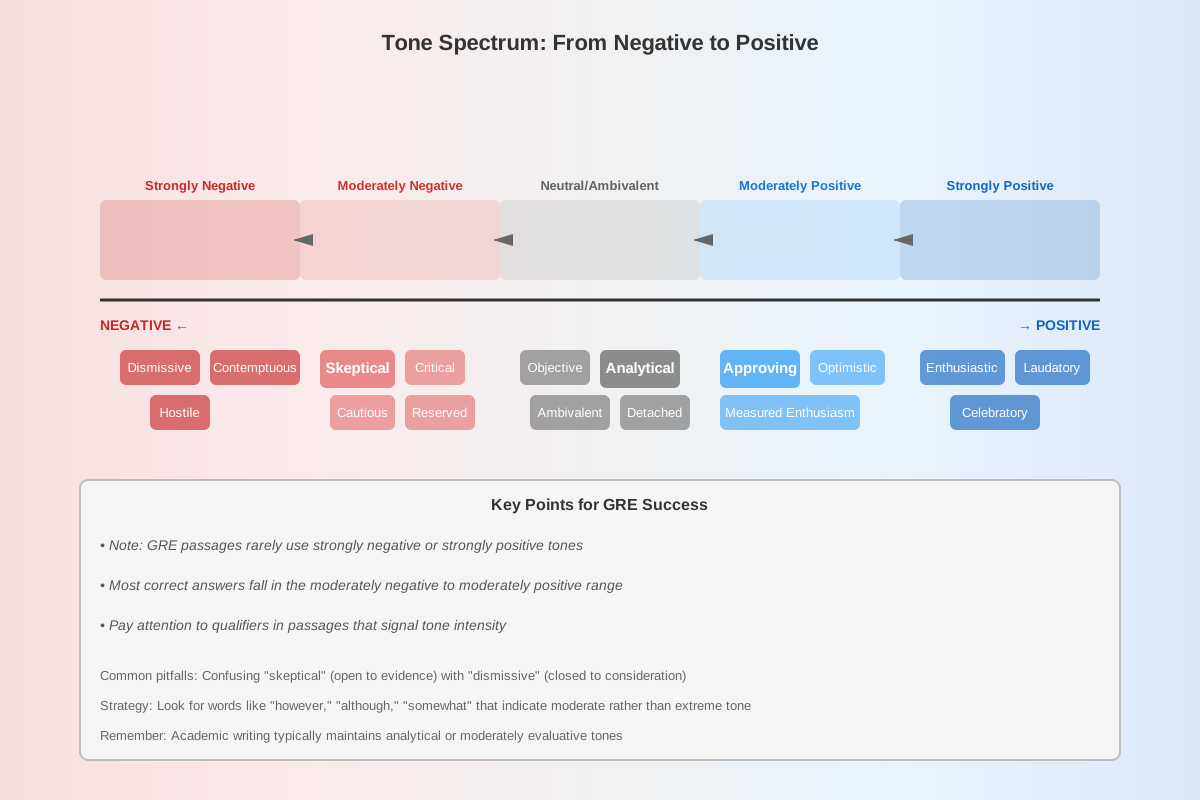
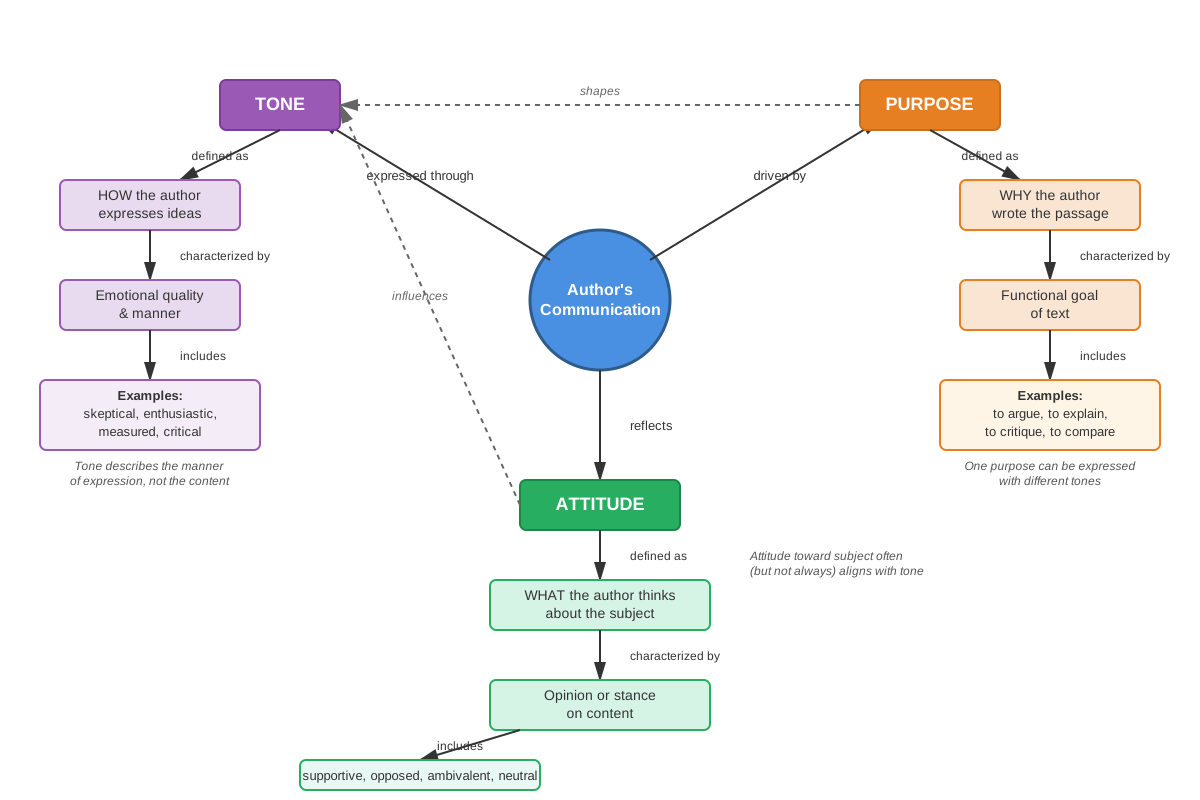
Author's tone represents the writer's attitude, mood, or emotional stance toward the subject matter being discussed. Unlike the content itself (what is said), tone concerns how that content is presented—the emotional coloring and attitudinal positioning that shapes reader interpretation. On the GRE, tone exists on multiple spectrums: positive to negative, certain to uncertain, engaged to detached, and serious to humorous (though humor rarely appears in GRE passages).
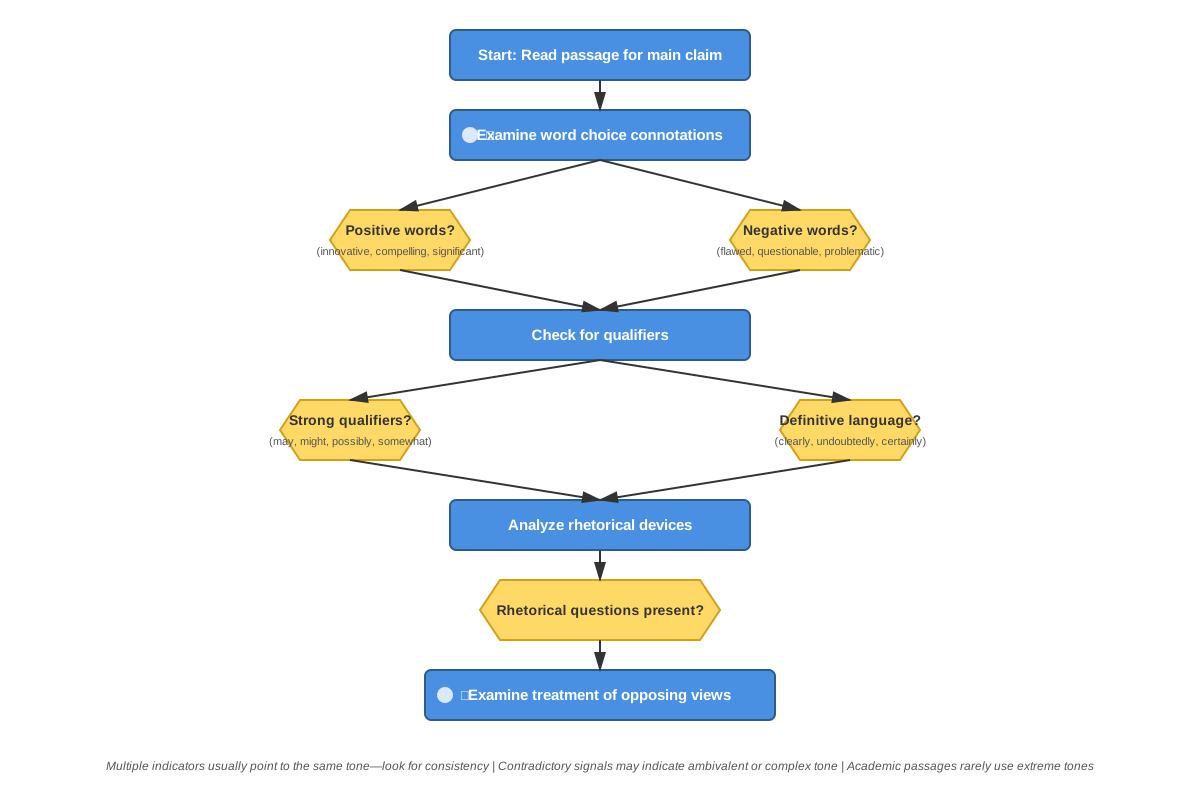
Tone emerges from cumulative linguistic choices rather than single words. An author creates a skeptical tone not merely by using the word "doubtful" but through patterns of hedging language ("may," "might," "possibly"), presentation of counterevidence, rhetorical questions that challenge claims, and qualifiers that limit the scope of assertions. Conversely, an enthusiastic tone manifests through superlatives, unqualified assertions, emphasis on positive implications, and language that highlights significance or breakthrough nature of findings.
Tone Indicators in Passage Language
Several linguistic features serve as reliable tone indicators that reveal authorial attitude:
Word choice (diction): The connotative meanings of words provide crucial tone signals. Compare "persistent" (neutral to positive) versus "stubborn" (negative), or "traditional" (neutral) versus "hidebound" (negative). Authors select words that carry attitudinal weight beyond their denotative meanings.
Qualifiers and hedging language: Words like "somewhat," "relatively," "appears to," "suggests," and "may indicate" signal caution, uncertainty, or measured assessment. Their presence typically indicates a reserved, tentative, or qualified tone rather than confident assertion.
Intensifiers and emphatic language: Conversely, words like "clearly," "undoubtedly," "certainly," "remarkable," and "significant" signal confidence and emphasis, contributing to tones of conviction or enthusiasm.
Rhetorical questions: Questions posed without expectation of answer often signal skepticism or criticism, particularly when they highlight problems with a theory or approach: "But can this explanation account for the contradictory evidence?"
Contrast and concession markers: Words like "however," "although," "despite," and "nevertheless" often introduce the author's true position after presenting opposing views, making these transition points crucial for tone assessment.
The Tone Spectrum
GRE tone descriptors typically fall along several key dimensions:
| Positive Tones | Neutral Tones | Negative Tones |
|---|---|---|
| Enthusiastic | Objective | Skeptical |
| Approving | Analytical | Critical |
| Optimistic | Detached | Dismissive |
| Admiring | Descriptive | Disapproving |
| Supportive | Balanced | Pessimistic |
| Certain Tones | Uncertain Tones |
|---|---|
| Confident | Tentative |
| Assertive | Cautious |
| Definitive | Ambivalent |
| Convinced | Questioning |
Understanding these spectrums helps eliminate answer choices. If a passage presents balanced analysis of competing theories without favoring either, "dismissive" and "enthusiastic" can both be eliminated as too extreme, while "ambivalent" or "objective" become strong candidates.
Distinguishing Similar Tones
The GRE frequently tests the ability to distinguish between closely related tone descriptors. Key distinctions include:
Skeptical vs. Dismissive: Skeptical authors question claims and require more evidence but remain open to persuasion; dismissive authors reject ideas as unworthy of serious consideration. Skepticism involves critical engagement; dismissiveness involves rejection.
Enthusiastic vs. Measured approval: Enthusiastic authors express unqualified excitement and emphasize transformative potential; measured approval acknowledges value while noting limitations or maintaining scholarly reserve.
Critical vs. Objective: Critical authors identify flaws and express disapproval; objective authors present information without revealing personal judgment, even when discussing problems or limitations.
Ambivalent vs. Balanced: Ambivalent authors experience conflicting feelings and uncertainty about how to evaluate something; balanced authors present multiple perspectives fairly without necessarily being uncertain about their own position.
Tone Consistency Throughout Passages
Authors typically maintain consistent tone throughout a passage, though tone may shift when discussing different subjects. A science passage might present an author who is skeptical of Theory A but approving of Theory B. The key is recognizing that tone questions usually ask about the author's overall tone or tone toward a specific element mentioned in the question stem.
When passages discuss multiple viewpoints, distinguish between the author's tone and the tone of sources the author cites. A passage might describe how "critics harshly condemned the policy," but the author's own tone toward the policy might be neutral or even supportive. Always identify whose attitude is being assessed.
Common Tone Patterns by Passage Type
Science passages frequently feature authors who are:
- Cautiously optimistic about new research findings
- Skeptical of inadequately supported theories
- Objective when describing experimental procedures
- Analytical when comparing competing explanations
Humanities passages often present authors who are:
- Appreciative of artistic or literary achievements
- Critical of reductive interpretations
- Engaged with nuanced analysis of cultural phenomena
- Measured in evaluating historical significance
Social science passages commonly show authors who are:
- Concerned about social problems
- Analytical regarding policy implications
- Balanced when presenting multiple perspectives
- Cautiously supportive or critical of interventions
Concept Relationships
Author's tone serves as an integrative concept that connects multiple Reading Comprehension skills. Understanding argument structure provides the foundation for tone analysis—recognizing where authors present their own views versus others' views is essential for accurate tone assessment. The relationship flows: Argument Structure → Identifies whose perspective is being expressed → Enables accurate Tone Analysis.
Tone analysis directly supports answering primary purpose questions because an author's purpose (to critique, to advocate, to explain objectively) inherently involves tone. The connection operates bidirectionally: Primary Purpose ↔ Author's Tone. A passage whose primary purpose is "to challenge a prevailing theory" will feature a critical or skeptical tone, while one aiming "to describe a phenomenon" will likely maintain an objective or analytical tone.
Vocabulary knowledge enables tone recognition by revealing connotative meanings. This relationship is foundational: Vocabulary Mastery → Enables recognition of Tone Indicators → Supports accurate Tone Assessment. Without understanding that "pedestrian" means unimaginative rather than merely relating to walking, students cannot recognize an author's dismissive tone toward conventional approaches.
Tone analysis also enhances inference skills. An author's tone toward evidence or theories helps readers infer what the author would likely think about related claims. The relationship: Tone Assessment → Provides framework for → Making valid Inferences about author's broader perspective.
Within tone analysis itself, concepts build sequentially: Identifying Tone Indicators → Accumulating Evidence → Placing tone on relevant spectrum → Distinguishing between similar descriptors → Selecting most accurate characterization. Each step depends on the previous one, making this a hierarchical skill progression.
High-Yield Facts
⭐ Tone questions typically ask about the author's attitude, not the attitude of sources or subjects the author discusses—always distinguish whose perspective is being assessed
⭐ Extreme tone descriptors (scathing, effusive, contemptuous, rapturous) are rarely correct for GRE passages, which feature measured academic prose
⭐ The presence of qualifiers and hedging language ("may," "might," "appears to," "suggests") signals a cautious, tentative, or measured tone rather than confident assertion
⭐ Rhetorical questions in passages typically signal skepticism or criticism, especially when they highlight problems with theories or approaches
⭐ When authors present counterarguments before refuting them, the tone toward those counterarguments differs from the tone toward their own position
- Tone must be supported by specific language throughout the passage, not inferred from a single word or phrase
- Objective or analytical tones are common in passages that primarily describe or explain without advocating for particular positions
- Transition words like "however" and "nevertheless" often introduce the author's true position and reveal tone most clearly
- An author can be critical of a theory's limitations while still acknowledging its contributions—this represents measured criticism, not dismissiveness
- Tone toward different elements within a passage may vary (skeptical of old theory, approving of new approach), so question stems must be read carefully
Quick check — test yourself on Author's tone so far.
Try Flashcards →Common Misconceptions
Misconception: The author's tone is always consistent throughout the entire passage.
Correction: While overall tone is usually consistent, authors may express different attitudes toward different theories, approaches, or time periods discussed within a single passage. Always check what specific element the question asks about.
Misconception: If a passage discusses negative outcomes or problems, the author's tone must be negative.
Correction: Authors can objectively describe problems without expressing personal disapproval. Tone concerns the author's attitude toward the subject, not the positive or negative nature of the subject itself. A passage about disease can maintain an objective, analytical tone.
Misconception: Strong, confident language always indicates enthusiasm or approval.
Correction: Authors can be confidently critical or assertively skeptical. Confidence concerns certainty level, while positive/negative valence is a separate dimension. An author might definitively reject a theory (confident + negative) or tentatively support an approach (uncertain + positive).
Misconception: Mentioning limitations or problems with a theory means the author is dismissive of it.
Correction: Scholarly writing routinely acknowledges limitations while still finding value in theories or approaches. Measured criticism or balanced assessment differs from dismissiveness, which involves rejection as unworthy of serious consideration.
Misconception: The correct tone answer will match a specific word used in the passage.
Correction: Tone emerges from cumulative evidence across the passage, not single words. An author might never use the word "skeptical" yet create a skeptical tone through questioning, presentation of counterevidence, and hedging language. Conversely, a passage might quote someone else's "enthusiastic" response while the author maintains an objective tone.
Misconception: Neutral or objective tones indicate the author has no expertise or opinion on the subject.
Correction: Objective tone is a rhetorical choice common in expository writing that aims to inform rather than persuade. Authors can be deeply knowledgeable and have informed opinions while choosing to present information objectively without explicit advocacy.
Worked Examples
Example 1: Science Passage
Passage excerpt: "The recent findings regarding neural plasticity in adult brains have challenged long-held assumptions about cognitive development. While these results are certainly intriguing, researchers caution that the sample sizes remain relatively small, and the long-term implications are not yet fully understood. Nevertheless, the study represents a promising avenue for future investigation, potentially opening new approaches to treating cognitive decline."
Question: The author's tone toward the neural plasticity findings can best be described as:
(A) Unqualified enthusiasm
(B) Cautious optimism
(C) Profound skepticism
(D) Dismissive criticism
(E) Complete objectivity
Solution Process:
Step 1: Identify tone indicators throughout the excerpt.
- "certainly intriguing" = positive language showing interest
- "researchers caution" = hedging, introducing limitations
- "relatively small" = qualifier limiting the strength of findings
- "not yet fully understood" = acknowledgment of uncertainty
- "Nevertheless" = transition suggesting author moves past limitations
- "promising avenue" = positive assessment of future potential
- "potentially opening" = qualified positive projection
Step 2: Assess the overall pattern.
The author acknowledges value ("intriguing," "promising") but consistently qualifies enthusiasm with limitations and uncertainties. This is neither unqualified enthusiasm nor skepticism, but rather positive assessment tempered by scholarly caution.
Step 3: Eliminate incorrect choices.
- (A) Unqualified enthusiasm: Eliminated—too strong given all the qualifiers and limitations mentioned
- (C) Profound skepticism: Eliminated—author uses positive language and sees promise
- (D) Dismissive criticism: Eliminated—author finds the research intriguing and promising
- (E) Complete objectivity: Eliminated—author expresses positive assessment ("promising," "intriguing") rather than pure neutrality
Step 4: Select the best answer.
(B) Cautious optimism perfectly captures the combination of positive assessment ("intriguing," "promising") with careful qualification of claims (small samples, uncertain implications, "potentially").
Connection to learning objectives: This example demonstrates identifying tone indicators (qualifiers, positive language, hedging), distinguishing between similar tones (enthusiasm vs. cautious optimism), and eliminating extreme characterizations.
Example 2: Humanities Passage
Passage excerpt: "Critics have long praised Morrison's narrative technique as groundbreaking, but such assessments overlook the substantial debt her work owes to earlier African American literary traditions. While Morrison's achievements are undeniable, positioning her as a singular innovator without precedent does a disservice both to her predecessors and to our understanding of literary evolution. A more nuanced view recognizes her work as a brilliant synthesis and extension of existing traditions rather than a complete departure from them."
Question: The author's attitude toward Morrison's work can best be described as:
(A) Dismissive of her literary contributions
(B) Uncritical in praising her innovations
(C) Appreciative but concerned about overstated claims
(D) Ambivalent about her artistic merit
(E) Objective and emotionally detached
Solution Process:
Step 1: Identify what the author says about Morrison directly versus what the author says about critics' views.
- About critics: "overlook," "does a disservice" = critical of critics' approach
- About Morrison: "achievements are undeniable," "brilliant synthesis and extension" = clearly positive
Step 2: Identify the author's concern.
The author objects not to Morrison's work but to how it's characterized—as completely unprecedented rather than building on traditions. The phrase "more nuanced view" signals the author wants a more accurate, balanced assessment.
Step 3: Assess tone toward Morrison.
The author uses unqualified positive language ("undeniable achievements," "brilliant") while arguing for proper contextualization. This is appreciation combined with concern about how her work is framed.
Step 4: Eliminate incorrect choices.
- (A) Dismissive: Eliminated—author calls achievements "undeniable" and work "brilliant"
- (B) Uncritical: Eliminated—author is actually criticizing overly simple praise
- (D) Ambivalent: Eliminated—author clearly values Morrison's work, no conflicting feelings about merit
- (E) Objective: Eliminated—author makes evaluative judgments ("brilliant," "does a disservice")
Step 5: Confirm the best answer.
(C) Appreciative but concerned about overstated claims accurately captures the author's positive view of Morrison combined with concern about critics' positioning her without acknowledging literary precedents.
Connection to learning objectives: This example demonstrates distinguishing between the author's tone and others' views, recognizing that criticism of how something is discussed differs from criticism of the thing itself, and identifying measured, nuanced tones.
Exam Strategy
Approaching Tone Questions Systematically
When encountering a tone question, follow this strategic process:
- Read the question stem carefully to identify whose tone is being assessed (the author's overall tone, tone toward a specific theory, tone toward a person or group mentioned)
- Scan the passage for tone indicators rather than rereading every word—focus on adjectives, qualifiers, transition words, and rhetorical questions
- Note the author's word choices when discussing the relevant subject, paying attention to connotative meanings
- Identify any contrast structures (however, although, despite) that reveal the author's true position versus positions being discussed or rejected
- Eliminate extreme answer choices first unless the passage contains unusually strong language
- Distinguish between similar remaining choices by checking whether passage evidence supports the more specific characterization
Trigger Words and Phrases
Watch for these high-yield tone indicators:
Skepticism/Criticism signals: "questionable," "fails to account for," "overlooks," "problematic," "dubious," rhetorical questions, "however" followed by limitations
Approval/Support signals: "significant," "important contribution," "successfully demonstrates," "compelling evidence," "valuable insight"
Caution/Qualification signals: "may," "might," "appears to," "suggests," "relatively," "somewhat," "not yet," "remains to be seen"
Enthusiasm signals: "remarkable," "groundbreaking," "revolutionary," "clearly demonstrates," "undoubtedly," superlatives
Objectivity signals: Absence of evaluative language, focus on description rather than assessment, balanced presentation without revealed preference
Process of Elimination Strategies
Exam Tip: Eliminate answer choices that are contradicted by even a single piece of strong evidence in the passage. Tone must be consistent with all relevant passage content.
Eliminate extremes: Unless the passage contains unusually strong language, eliminate "scathing," "effusive," "contemptuous," "rapturous," and similar extreme descriptors. GRE passages favor measured academic tones.
Check for evidence: If an answer choice suggests the author is critical, there must be explicit negative language in the passage. If no such language exists, eliminate the choice.
Verify consistency: The correct tone must be supported throughout the relevant portion of the passage, not contradicted by any significant statement.
Match intensity: If the passage shows mild approval, "enthusiastic" is too strong; if it shows serious concerns, "mildly questioning" is too weak.
Time Allocation
Tone questions should take 45-60 seconds once the passage has been read. If struggling between two choices, quickly locate 2-3 specific phrases that support one characterization over the other rather than rereading extensively. The evidence for tone is usually distributed throughout the passage, so checking multiple locations provides confirmation.
Memory Techniques
The TONE Acronym
Transitions reveal true position (however, nevertheless, although)
Overstatements are rarely correct (extreme descriptors)
Note qualifiers and hedging (may, might, appears to)
Evaluate word connotations (persistent vs. stubborn)
Visualization Strategy: The Tone Thermometer
Visualize a thermometer with three parallel columns:
Column 1 (Certainty): Confident at top, Tentative at bottom
Column 2 (Valence): Positive at top, Negative at bottom
Column 3 (Engagement): Passionate at top, Detached at bottom
As you read, mentally place the author's position on each thermometer. This creates a three-dimensional tone profile that helps distinguish similar options.
The "But Test"
When the author presents others' views before stating their own position, the word after "but," "however," or "nevertheless" typically reveals the author's true tone. Mentally highlight these transition points as tone indicators.
Spectrum Positioning
Remember the mnemonic "ENDO" for the neutral-to-negative spectrum:
- Enthusiastic (most positive)
- Neutral/Objective (middle)
- Doubtful/Skeptical (negative but open)
- Opposed/Dismissive (most negative)
This helps quickly eliminate choices that fall on the wrong part of the spectrum.
Summary
Mastering author's tone requires synthesizing evidence from word choice, qualifiers, rhetorical devices, and structural elements throughout GRE Reading Comprehension passages. Tone represents the author's attitude toward subject matter, distinct from the content itself, and emerges from cumulative linguistic patterns rather than isolated words. Success depends on distinguishing between similar tone descriptors (skeptical vs. dismissive, enthusiastic vs. measured approval), recognizing that extreme characterizations rarely apply to academic prose, and carefully identifying whose perspective is being assessed. Key strategies include focusing on transition words that reveal the author's true position, noting qualifiers and hedging language that signal caution, and eliminating answer choices contradicted by passage evidence. Tone questions appear frequently on the GRE and test sophisticated reading skills that distinguish high scorers, making this topic essential for Verbal Reasoning success. The ability to accurately assess tone also enhances performance on related question types including primary purpose, inference, and author's perspective questions.
Key Takeaways
- Author's tone emerges from cumulative evidence including word choice, qualifiers, transitions, and rhetorical devices, not from single words or phrases
- Extreme tone descriptors (scathing, effusive, contemptuous) are rarely correct for GRE passages, which feature measured academic prose
- Always distinguish between the author's tone and the attitudes of sources, critics, or subjects the author discusses
- Qualifiers and hedging language ("may," "appears to," "suggests") signal cautious or tentative tones, while unqualified assertions indicate confidence
- Transition words like "however" and "nevertheless" often introduce the author's true position and most clearly reveal tone
- Tone can vary within a passage depending on what element is being discussed, so read question stems carefully to identify what the tone question targets
- Successful tone analysis requires placing the author's attitude on multiple spectrums (positive/negative, certain/uncertain, engaged/detached) to distinguish between similar answer choices
Related Topics
Primary Purpose Questions: Understanding author's tone directly supports identifying whether a passage aims to critique, advocate, explain objectively, or propose solutions. Mastering tone enables more accurate primary purpose analysis.
Inference Questions: An author's tone toward evidence or theories provides a framework for inferring what the author would likely think about related claims or scenarios not explicitly discussed.
Argument Structure Analysis: Recognizing where authors present their own views versus others' perspectives is foundational for accurate tone assessment and enables deeper understanding of how arguments are constructed.
Vocabulary in Context: Understanding connotative meanings and subtle distinctions between similar words enhances the ability to detect tone indicators and recognize attitudinal nuances in passage language.
Rhetorical Strategy Questions: Analyzing why authors choose particular rhetorical devices (rhetorical questions, concessions, emphasis) connects directly to understanding the tone those devices create.
Practice CTA
Now that you understand the core concepts and strategies for identifying author's tone, it's time to apply these skills to authentic GRE-style questions. The practice questions will challenge you to distinguish between subtle tone variations, identify tone indicators in complex passages, and eliminate incorrect characterizations systematically. Flashcards will reinforce your recognition of tone descriptors and their precise meanings. Consistent practice with these materials will transform tone analysis from an uncertain skill into a reliable strength that boosts your Verbal Reasoning score. Approach each practice question methodically, using the strategies outlined in this guide, and review your reasoning process regardless of whether you answer correctly—understanding why wrong answers are wrong is just as valuable as identifying right answers.
Sign up free to keep reading
Create a free AnvayaPrep account to finish this GRE guide on Author's tone — plus flashcards and practice questions.